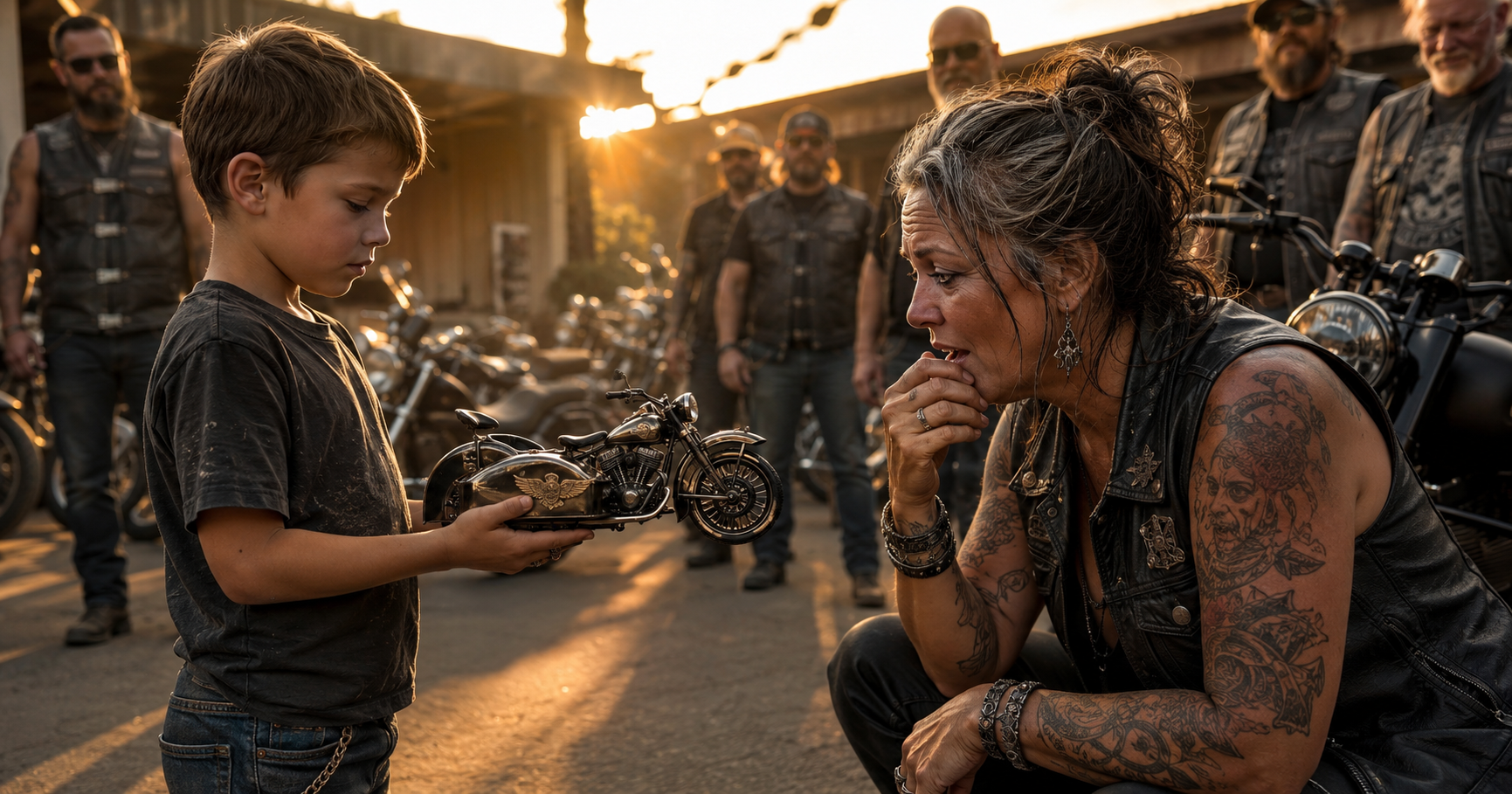
The Boy Who Brought a Tiny Motorcycle Into a Biker Club — And Uncovered a Secret Buried for Eighteen Years

The engines could be heard three streets away.

By late Saturday afternoon, the parking lot behind the Black Harbor Riders clubhouse had become a sea of chrome, leather, dust, and exhaust.

Nearly forty motorcycles stood beneath the fading summer sun. Men and women in worn leather vests leaned against picnic tables, traded stories, argued about carburetors, and laughed loudly enough to compete with the music coming from inside the old brick building.

At the center of it all stood Mara Vale.

At forty-eight, Mara had spent more than half her life on motorcycles.

She wasn’t the loudest person in the yard.

She didn’t need to be.

When Mara spoke, people listened.

Her dark hair was threaded with silver, and a thin scar crossed the left side of her chin, a souvenir from a highway crash she rarely discussed. On the back of her leather vest was the black lighthouse emblem of the club she had helped rebuild after its darkest years.

She was listening to two riders argue over tomorrow’s charity route when she noticed something strange near the gate.

A child was standing there.

Alone.

He looked about eight years old.

His hair was messy, his sneakers were dusty, and the sleeves of his oversized green sweatshirt almost covered his hands.

He wasn’t crying.

Not yet.

But he looked like someone using every bit of strength he had to prevent himself from doing so.

One of the younger riders noticed him.

“Hey, little man. You lost?”

The boy shook his head.

“No.”

His voice was barely audible above the music.

Another rider lowered the bottle in his hand.

“Your parents know you’re here?”

The boy hesitated.

“My mom thinks I’m at Mr. Bennett’s house.”

A few people exchanged concerned looks.

Mara stepped away from the picnic table.

“What are you carrying?”

The boy looked down.

Only then did everyone notice the object wrapped in an old kitchen towel beneath his arm.

He carefully unfolded the cloth.

Conversation around him slowly disappeared.

Inside the towel was a miniature motorcycle.

But calling it a toy felt wrong.

It was perhaps twelve inches long, constructed almost completely from metal.

The frame was made from thin steel tubing.

The wheels had real spokes.

The handlebars turned.

Tiny springs formed the rear suspension.

Someone had even created miniature brake cables no thicker than thread.

The fuel tank had been polished until it reflected the sunlight.

A small metal sidecar was attached to the motorcycle.

On its side was a faded blue stripe.

The craftsmanship was extraordinary.

The boy held it with both hands.

“I want to sell it.”

Someone near the picnic table laughed, thinking he was joking.

Mara didn’t.

“Why?”

The boy looked at the ground.

“Because we need money.”

The laughter vanished.

Mara walked closer.

“What’s your name?”

“Eli.”

“Eli what?”

“Eli Carter.”

Mara crouched so they were almost eye level.

“How much are you trying to get for it, Eli Carter?”

The boy clearly hadn’t expected the question.

He looked around at the motorcycles surrounding him.

Then he swallowed.

“Two hundred dollars?”

A few riders shifted uncomfortably.

Mara studied his face.

“Who made it?”

“My grandmother.”

That answer made Mara look back at the miniature motorcycle.

“Your grandmother built motorcycles?”

“Not real ones.”

Eli carefully ran a finger across the tiny fuel tank.

“She made things out of metal. Birds. Cars. Boats. Sometimes motorcycles.”

“Where is she?”

The boy’s expression changed.

“She died last winter.”

Mara’s voice softened.

“I’m sorry.”

Eli nodded quickly as if sympathy might make him cry.

“My mom says we’re not supposed to sell Grandma’s things.”

“Then why are you selling this?”

For several seconds he said nothing.

Finally, he whispered:

“Our landlord came yesterday.”

Mara waited.

“He said if Mom doesn’t pay everything by Monday, we have to leave.”

A woman standing behind Mara muttered something under her breath.

Eli continued.

“My mom works at the bakery in the morning and cleans offices at night.”

He stared at the tiny motorcycle.

“She thinks I don’t hear her crying in the bathroom.”

Nobody in the yard moved.

“So you brought this here?” Mara asked.

Eli nodded.

“My grandmother said motorcycle people understand handmade things.”

Something tightened in Mara’s expression.

“What was your grandmother’s name?”

“Claire.”

Mara stopped breathing for half a second.

There were thousands of women named Claire.

It meant nothing.

It should have meant nothing.

“What was her last name?”

“Carter.”

Mara relaxed slightly.

Then Eli rotated the miniature motorcycle to show her its other side.

And Mara saw the symbol.

A tiny brass moth had been soldered beneath the sidecar.

Its wings were no bigger than a thumbnail.

Mara’s face went completely still.

She reached toward it.

Then stopped before touching it.

“Where did she get that?”

Eli looked confused.

“Get what?”

“The moth.”

“She made it.”

The yard seemed suddenly very far away.

Mara stared at that tiny brass insect as a memory nearly two decades old opened inside her.

A cramped garage.

Two young women working beneath a hanging fluorescent lamp.

Metal filings covering the floor.

The smell of oil.

A nineteen-year-old girl laughing while soldering a brass moth onto a homemade keychain.

Mara heard her voice as clearly as if she were standing nearby.

Everybody uses skulls and flames. Moths are better. They survive in the dark.

Mara had not heard that voice in eighteen years.

She looked at Eli.

“Did your grandmother ever use another name?”

He shrugged.

“I don’t know.”

“Did she have a middle name?”

“Evelyn, I think.”

Mara stood so suddenly that Eli stepped backward.

One of the senior riders, Curtis Hale, noticed the change in her face.

“Mara?”

She ignored him.

“Where does your mother live?”

Eli became nervous.

“Why?”

Mara pointed toward the miniature motorcycle.

“Because I think your grandmother was my sister.”

No one said anything.

Eli stared at her.

“Your sister?”

Mara nodded slowly.

“Her name was Claire Evelyn Vale.”

Eli looked at the model.

Then back at Mara.

“Grandma never said she had a sister.”

“I know.”

There was pain in Mara’s voice now.

“That’s the part I don’t understand.”


Twenty minutes later, six motorcycles and Mara’s old pickup truck turned onto a narrow residential street on the north side of town.

Eli sat in the passenger seat clutching the miniature motorcycle.

“You don’t have to be scared,” Mara told him.

“I’m not.”

“You’ve checked the mirror twelve times.”

Eli stopped looking behind them.

“I’m a little scared.”

“That’s more believable.”

He glanced at her.

“Are those people following us?”

Mara looked in the mirror at the motorcycles behind them.

“They’re my family.”

Eli frowned.

“But they’re not related to you.”

Mara smiled sadly.

“Family gets complicated.”

The house was easy to find.

It was a narrow two-story rental with cracked steps and a porch railing that had been repaired with mismatched wood.

A woman was standing outside before Mara had completely stopped the truck.

She looked terrified.

“Eli!”

The boy jumped out.

“Mom—”

“What were you thinking?”

She rushed down the steps and grabbed him by both shoulders.

“I’ve been looking everywhere!”

“I’m sorry.”

“You cannot disappear like that!”

“I was trying to help.”

His mother finally noticed the motorcycles.

Her anger disappeared.

She pulled Eli behind her.

Mara climbed out slowly, keeping her hands visible.

“You must be Leah.”

The woman’s face changed.

“How do you know my name?”

“My name is Mara Vale.”

Leah went pale.

For a moment, Mara knew.

There was no doubt anymore.

Claire had told her daughter about the family she’d left behind.

Leah looked toward the tiny motorcycle.

“You took that?”

Eli’s head dropped.

“I was going to sell it.”

“You what?”

“We need money.”

Leah closed her eyes.

“Eli…”

“I’m sorry, Mom.”

She pulled him into her arms.

“I don’t care about the rent more than I care about you.”

Then she looked at Mara.

“What happened at the clubhouse?”

“He showed us the motorcycle.”

Leah’s jaw tightened.

“And you recognized it.”

“The moth.”

Leah nodded.

Mara took a slow breath.

“Why didn’t Claire ever contact me?”

Leah looked toward the house.

“Come inside.”


The living room was small and almost painfully neat.

A box labeled KITCHEN stood beside the sofa.

Another labeled ELI’S BOOKS sat near the stairs.

They were already packing.

Mara noticed.

She didn’t mention it.

Eli placed the miniature motorcycle on the coffee table.

Leah sat opposite Mara.

For several seconds neither woman spoke.

Then Leah said:

“My mother wanted to call you hundreds of times.”

“She had eighteen years.”

“I know.”

“What happened?”

Leah rubbed her hands together.

“She told me pieces of the story when I was older. Never everything.”

Mara waited.

Leah continued.

“She said something happened at your old clubhouse.”

Mara’s expression hardened.

“There was a fire.”

“I know.”

“Three motorcycles were destroyed. One rider nearly died. Twenty thousand dollars disappeared from the club safe that same night.”

Leah nodded.

“And everyone blamed my mother.”

“Because the police found her fingerprints on the safe.”

“She worked on the safe two days earlier.”

Mara frowned.

“What?”

“The lock was broken. She repaired it.”

Mara leaned forward.

“Nobody told us that.”

“Maybe someone didn’t want you to know.”

Silence filled the room.

Mara remembered that night.

The smoke.

The sirens.

The accusations.

Claire disappearing before sunrise.

Mara searching every place they had ever gone together.

Then, months later, giving up.

Not because she’d stopped caring.

Because eventually anger was easier than grief.

“Who?” Mara asked.

Leah shook her head.

“I don’t know.”

Then Eli spoke from beside the coffee table.

“Grandma knew.”

Both women looked at him.

“What do you mean?” Leah asked.

Eli pointed toward the miniature motorcycle.

“She talked to it.”

Leah blinked.

“She did what?”

“Before she got really sick.”

He lifted the model carefully.

“She used to hold it and say, ‘One day it’ll go home.'”

Mara felt the hair rise along her arms.

“Home?”

Eli nodded.

“She said the lighthouse would know where to look.”

Mara stared at him.

Behind her, Curtis shifted.

The Black Harbor Riders emblem was a lighthouse.

Mara reached for the model.

“Eli, may I?”

He handed it to her.

She examined the miniature motorcycle more carefully.

The fuel tank opened, but there was nothing inside.

The seat lifted.

Empty.

The wheels turned normally.

Then Mara noticed something strange about the tiny sidecar.

It was too heavy.

“Do you have a screwdriver?” she asked.

Leah brought a small toolbox from the kitchen.

Mara removed two screws from the underside of the sidecar.

A thin metal panel came loose.

Something fell onto the table.

Not money.

Not jewelry.

A small brass key.

Eli’s eyes widened.

“That was inside?”

Mara picked it up.

A stamped number was visible on the head.

Curtis leaned closer.

“Locker key.”

“Looks like it.”

Leah shook her head.

“Locker where?”

Mara turned the key in her fingers.

Then she noticed a second object inside the compartment.

A folded piece of paper.

Time had yellowed it around the edges.

She opened it carefully.

There were only six words.

Where our first road ended. 317.

Mara read them twice.

Then she stood.

“I know where this is.”


Black Harbor Station had closed fifteen years earlier.

The old bus terminal was now mostly used by storage companies and delivery services, but one corridor of coin-operated lockers had survived near the rear entrance.

Mara had not entered the building since she was twenty-two.

Claire and Mara had once taken a bus from that station after their father’s funeral.

They had no plan.

No money.

No destination worth mentioning.

They bought tickets as far as their cash would take them.

Black Harbor.

Their first road had ended there.

And their new life had begun.

Locker 317 was covered in scratches.

Mara inserted the brass key.

It turned.

Inside was a steel box.

Leah stood beside her.

Eli held his mother’s hand.

Mara opened the box.

There was no fortune inside.

There were photographs.

Letters.

An old leather notebook.

A cassette recorder wrapped in cloth.

And a thick envelope marked with Mara’s name.

Mara’s hands began trembling.

She opened the envelope.

Claire’s handwriting covered eight pages.

Mara read the first paragraph.

Then had to stop.

Leah touched her shoulder.

“What does it say?”

Mara swallowed.

“She didn’t run because of the money.”

She continued reading.

Claire had discovered that a man named Warren Pike, one of the club’s founding members, had been stealing from the club’s charity fund.

Small amounts at first.

Then larger ones.

Claire confronted him.

Pike threatened her.

She refused to remain silent.

So he created a different plan.

He emptied the safe.

Started the fire.

Then made sure Claire’s fingerprints became the only evidence anyone cared about.

But Claire had secretly photographed pages from his accounting book.

She had also recorded one of their arguments.

The cassette was still inside the box.

Curtis stared at the old recorder.

“Warren Pike.”

Mara looked at him.

“You knew him.”

“Everybody knew him.”

Curtis’s face was gray.

“He was treated like a hero after Claire disappeared.”

Mara’s voice became cold.

“He let us hate her.”

“He’s been dead seven years.”

“Then he died with everyone still believing his lie.”

Mara turned another page.

The anger vanished as quickly as it had appeared.

Claire explained why she never returned.

She had been pregnant.

Not with some hidden lover’s child.

Not as part of another scandal.

She had simply been terrified.

She had already watched Pike destroy her reputation and nearly kill someone in a fire.

She believed returning would put her unborn daughter in danger.

That daughter was Leah.

Claire moved from town to town for years.

She used different surnames.

She worked wherever she could.

She raised Leah alone.

And every year she wrote Mara another letter.

But she never mailed one.

Mara looked into the steel box.

There were dozens.

Birthdays.

Christmases.

Apologies.

Stories.

Memories.

Eighteen years of conversations that had never happened.

Mara covered her mouth.

Eli stood beside her.

“Was Grandma bad?”

Mara immediately knelt.

“No.”

Her eyes were wet.

“Your grandmother was one of the bravest people I’ve ever known.”

“Then why did everybody think she was bad?”

“Because sometimes a lie gets heard first.”

Eli considered that.

“Can you fix it?”

Mara looked at the letters.

Then at Leah.

Then at the little metal motorcycle that had carried a key through eighteen years of silence.

“Yes.”

She nodded.

“We can.”


The Black Harbor Riders held a meeting that night.

Every member came.

Old photographs were pulled from storage.

Records were compared.

The cassette was played.

Pike’s voice was damaged by age and static, but it was understandable.

So was Claire’s.

Mara stood in the middle of the clubhouse hearing her sister speak for the first time in eighteen years.

She did not cry until the recording ended.

Then nobody pretended not to notice.

The next morning, the club removed Warren Pike’s photograph from the founders’ wall.

In its place they hung Claire’s.

Beneath it Mara placed the brass moth.

But she wasn’t finished.

At nine o’clock Monday morning, Leah walked toward her landlord’s office carrying an envelope.

Inside was every dollar she owed.

And three months of rent in advance.

She stopped halfway through the parking lot and turned toward Mara.

“I can’t take this.”

Mara leaned against her truck.

“You already did.”

“This is too much.”

“It’s not charity.”

“What is it, then?”

Mara looked toward Eli, who was sitting inside the pickup making motorcycle noises.

“Family gets complicated.”

Leah laughed despite herself.

Then her eyes filled with tears.

“My mother would’ve liked you.”

Mara looked away.

“She did once.”

“No.”

Leah stepped closer.

“She always did.”

That hurt more.

And somehow healed more.


The story should have ended there.

But it didn’t.

Three months later, an unused garage behind the Black Harbor Riders clubhouse was renovated.

The club removed the broken shelves.

Installed workbenches.

Bought welding equipment.

Added ventilation.

Filled cabinets with tools.

Above the entrance they mounted a small metal sign.

Not a corporate logo.

Not a slogan.

Just a brass moth.

The workshop became a place where local teenagers could learn machining, welding, motorcycle repair, and metal art for free.

They called it Claire’s Garage.

Leah volunteered there on Saturdays.

Eventually, she left one of her cleaning jobs and became the program coordinator.

Eli practically lived in the workshop.

He learned how to use a file before he was allowed anywhere near a welder.

He learned the difference between steel and aluminum.

He learned why you never touch freshly cut metal.

He learned that Mara kept candy hidden in the top drawer of her desk.

And he learned that motorcycle clubs were not nearly as frightening as they looked from the sidewalk.

One evening, Mara found him alone at a workbench.

The miniature motorcycle sat in front of him.

Beside it was a small piece of brass.

“What are you making?” she asked.

Eli covered it with his hand.

“Nothing.”

“That looks suspiciously like something.”

He sighed.

Then showed her.

It was a terrible little lighthouse.

Crooked.

Uneven.

One side was much larger than the other.

Mara smiled.

“It’s perfect.”

“No, it’s not.”

“That’s how handmade things work.”

“They’re supposed to look bad?”

“They’re supposed to look like somebody cared enough to make them.”

Eli thought about that.

Then he pointed toward the miniature motorcycle.

“Are you still mad at Grandma?”

Mara sat beside him.

“No.”

“Were you?”

“For a long time.”

“Because you thought she left you?”

Mara nodded.

Eli continued filing the brass lighthouse.

“Maybe she was scared.”

“She was.”

“Mom gets scared.”

“So do I.”

He looked surprised.

“You?”

“Especially me.”

Eli smiled.

Then he pushed the tiny lighthouse toward her.

“You can have this.”

Mara picked it up.

“For free?”

“For free.”

“That’s a terrible business strategy.”

“I’m eight.”

“Fair point.”

He looked toward the old miniature motorcycle.

“I almost sold Grandma’s motorcycle for two hundred dollars.”

Mara smiled.

“And instead?”

Eli looked around the workshop.

Around the new tools.

Around the photographs on the wall.

Around the people Claire’s story had brought together.

“I think it was worth more.”

Mara closed her hand around the crooked brass lighthouse.

“Much more.”


Years later, visitors to Black Harbor sometimes noticed a miniature motorcycle inside a glass cabinet near the clubhouse entrance.

They usually stopped to admire it.

They noticed the tiny spokes.

The working handlebars.

The delicate suspension.

The blue stripe painted along the sidecar.

Most people assumed it was simply an impressive model made by a talented craftsperson.

They were wrong.

It had once belonged to a woman everyone believed had betrayed her friends.

It had survived eighteen years of silence.

It had carried a key nobody knew existed.

That key had opened a locker.

The locker had opened the past.

And the past had returned a sister to Mara, even though Claire herself could never walk through the clubhouse doors again.

But perhaps the strangest part of the story was that none of it would have happened if an eight-year-old boy hadn’t decided that he needed to save his mother.

He had walked toward a yard full of intimidating strangers carrying the most valuable object he owned.

He believed he was there to sell a motorcycle.

Instead, he brought something home.

A name.

A reputation.

A history.

A family.

And a truth that had waited nearly two decades for someone small enough, stubborn enough, and brave enough to carry it through the gate.

The Boy Who Brought a Tiny Motorcycle Into a Biker Club — And Uncovered a Secret Buried for Eighteen Years
‘Prince William is losing his composure because Kate Middleton is considering taking a tragic decision with far-reaching consequences.’