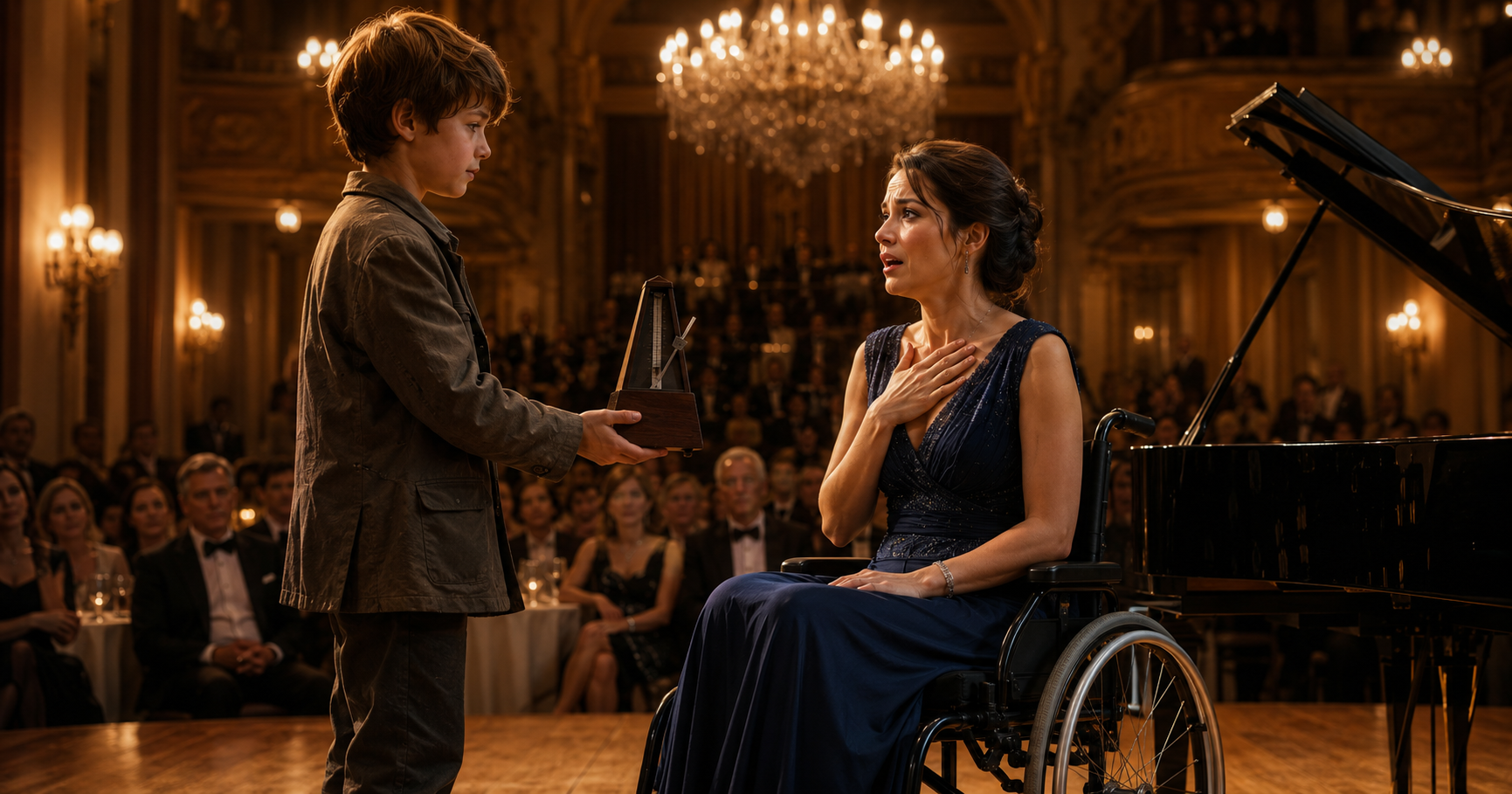
The applause inside the Bellamy Theater sounded like thunder.
Hundreds of guests filled the restored concert hall beneath a ceiling painted with silver stars. Crystal lamps glowed along the balconies. Champagne moved from hand to hand. Cameras flashed whenever someone important turned toward the stage.
It was supposed to be the happiest night of Avery Sloane’s life.
At thirty-six, Avery had become one of the most recognizable pianists in the country. Her recordings had sold millions. Her face had appeared on concert posters from London to Tokyo. Before the accident, critics had written that she could make a piano sound as if it were breathing.
Now she sat beneath the stage lights in a black wheelchair.
An elegant midnight-blue dress covered her legs.
Her hands rested quietly in her lap.
Those hands were still famous.
Her legs were not.
Fourteen months earlier, Avery had fallen from an upper rehearsal balcony inside another theater. She survived a fractured spine, severe nerve damage, and a head injury that erased pieces of the months before the fall.
Doctors had warned her that walking again was unlikely.
Playing the piano had returned slowly.
Her memory had not.
There were entire weeks she could no longer remember.
People she recognized only from photographs.
Conversations everyone else insisted had happened.
Promises she apparently had made.
And one strange thing that bothered her more than anything else.
Whenever someone mentioned the night of the accident, Marcus Vale answered for her.
Marcus stood beside her now.
He was tall, immaculate, and perfectly comfortable beneath the attention of the room.
For twelve years, he had managed Avery’s career. During the last three, he had also become her business partner. After the accident, he had taken responsibility for almost everything—contracts, appointments, finances, interviews, even which visitors were allowed into her rehabilitation center.
Tonight’s gala had been his idea.
The Avery Sloane Foundation would announce a new scholarship program for disadvantaged young musicians.
Marcus leaned toward the microphone.
“Fourteen months ago,” he told the audience, “we nearly lost one of the greatest musical voices of our generation.”
The audience became silent.
Marcus placed a hand gently on Avery’s shoulder.
“But Avery taught all of us something. Music doesn’t disappear when life changes. It simply learns to speak differently.”
Applause filled the hall.
Avery smiled because hundreds of people were watching.
Marcus lowered his voice.
“Smile a little more.”
She turned her head.
“What?”
“For the photographers.”
His smile never changed.
Avery looked toward the cameras and widened her own smile.
Another burst of applause rolled through the theater.
Then someone shouted from the back.
“Miss Sloane!”
The applause weakened.
Marcus stopped speaking.
Avery looked beyond the lights.
At first, she couldn’t see whoever had called her name.
Then a boy stepped into the center aisle.
He couldn’t have been older than twelve.
His jacket was too large for him. One sleeve had been repaired with dark thread, and his sneakers were wet from the rain outside.
An old wooden metronome was pressed against his chest.
A security guard hurried after him.
“Stop!”
The boy began running toward the stage.
Guests turned in their seats.
Several people lifted their phones.
Marcus’s expression changed immediately.
“Security.”
The boy reached the front row.
“Miss Sloane, please!”
A guard caught his shoulder.
The wooden metronome nearly slipped from his hands.
Avery raised one hand.
“Wait.”
The guard froze.
Marcus bent toward her.
“Avery, we don’t know who he is.”
“He’s a child.”
“That’s irrelevant.”
The boy struggled to catch his breath.
His eyes stayed on Avery.
“You don’t remember me, do you?”
Something about the question made the room seem colder.
Avery studied his face.
Brown hair.
Gray eyes.
A tiny scar beside his chin.
Nothing.
“I’m sorry,” she said gently. “I don’t think we’ve met.”
The boy’s expression collapsed.
Marcus stepped between them.
“There. You’ve heard her. Please escort him outside.”
“No!”
The boy lifted the wooden metronome.
“You gave me this.”
Avery’s fingers tightened around the wheelchair armrest.
Marcus stared at the object.
For the first time that evening, his confidence disappeared.
It lasted less than a second.
But Avery noticed.
The boy noticed too.
“What’s your name?” Avery asked.
“Theo Finch.”
Marcus interrupted.
“Avery—”
She ignored him.
“Theo, when did I give you that?”
“Two years ago.”
A murmur moved through the audience.
Theo opened the metronome’s wooden cover.
Inside, someone had written four words in black ink.
Avery couldn’t read them from the stage.
Theo turned it toward her.
PLAY WHEN YOU’RE AFRAID.
Her breath stopped.
She knew the handwriting.
Her handwriting.
Avery looked at Marcus.
“You said I never taught children privately.”
“I said you occasionally met scholarship students. You’ve met hundreds.”
Theo shook his head.
“It wasn’t occasional.”
Marcus’s jaw tightened.
The boy took another step toward the stage.
“You came every Thursday.”
Avery felt pressure behind her eyes.
“Where?”
“The old rehearsal room under Saint Catherine Station.”
She heard herself whisper the name.
“Saint Catherine…”
A flash appeared in her mind.
Not a memory.
A fragment.
A yellow door.
A piano missing two ivory keys.
Children laughing somewhere behind her.
Then it vanished.
Avery pressed her fingers against her temple.
Marcus noticed.
“This is enough.”
He signaled to security.
Theo shouted before the guards could reach him.
“Four notes!”
Avery looked up.
“What?”
“You told me if you ever forgot everything, I should play four notes.”
The theater went completely silent.
Marcus stepped toward him.
“Remove him.”
“Don’t touch him,” Avery said.
Her voice was different now.
Marcus turned.
“Avery.”
“I said don’t touch him.”
The guards stopped.
Theo climbed the three small steps leading onto the stage.
The old metronome trembled in his hands.
When he reached Avery, he placed it carefully on her lap.
“Do you remember what you taught me?”
She looked at him.
“No.”
His eyes filled with tears.
“You said hands remember things the brain is scared to remember.”
Avery felt something tighten inside her chest.
Theo moved toward the grand piano waiting behind them.
Marcus stepped in his way.
“The performance is over.”
Theo stared at him.
“You’re afraid she’ll remember.”
Several guests reacted.
Marcus gave a short laugh.
“This is absurd.”
Avery watched him carefully.
“What does he mean?”
Marcus turned toward her.
“He’s a confused child who has somehow managed to get into a private event.”
Theo reached inside his jacket.
Marcus’s face changed again.
This time Avery didn’t miss it.
The boy removed a small brass key.
“Your piano bench,” he said.
Avery stared at it.
“I don’t understand.”
“You told my mother to keep it.”
Marcus moved quickly.
“Give me that.”
Theo pulled his hand back.
Avery’s voice cut through the theater.
“Marcus.”
He stopped.
She had known Marcus for twelve years.
She knew the relaxed version of him.
The charming version.
The angry version.
The exhausted version.
The protective version.
But she had never seen the look in his eyes now.
Fear.
“Why do you want that key?”
“I don’t.”
“You just tried to take it.”
“Because this spectacle has gone far enough.”
Avery turned to Theo.
“What does it open?”
“The bench in rehearsal room seven.”
Another flash.
A basement corridor.
A red EXIT sign.
Her own hands closing the lid of an old piano bench.
Marcus arguing behind her.
Avery sucked in a breath.
The audience blurred.
“Avery?”
Marcus reached toward her.
She pulled away.
“Don’t.”
Theo stood beside the concert grand.
“Can I play the notes?”
Avery nodded.
The boy sat at the piano.
His feet didn’t quite reach the pedals.
He placed two fingers on the keys.
One note.
Pause.
A second.
Then a third.
Then the fourth.
The melody was painfully simple.
Only four notes.
But something inside Avery broke open.
A small rehearsal room appeared in her mind.
Theo was sitting at a battered upright piano.
He was younger.
His hands were shaking.
“I can’t play in front of people,” he had whispered.
Avery was beside him.
“Then don’t play for people.”
“Who do I play for?”
“For the person you were yesterday.”
She remembered placing his hand against the piano.
“Four notes, Theo. That’s all courage is sometimes. Four notes before you decide whether you can play the fifth.”
The memory disappeared.
Avery gasped.
Theo looked over his shoulder.
“You remember.”
“I remember the room.”
Marcus stepped forward.
“Traumatic memory can be unreliable.”
Avery ignored him.
“The yellow door.”
Theo nodded.
“Yes.”
“The broken radiator.”
“Yes.”
“The piano had…”
She closed her eyes.
“Two missing keys.”
Theo began crying.
“Yes.”
The audience erupted in whispers.
Avery’s heart hammered.
More images came.
Children sitting on the floor.
Cheap music stands.
A woman serving soup from paper cups.
Avery arriving through the back entrance so reporters wouldn’t discover she had been anonymously funding the program.
Then Marcus.
Standing inside rehearsal room seven.
Angry.
A stack of documents on the piano.
Avery remembered her own voice.
“Where did the scholarship money go?”
The memory struck so hard that she nearly cried out.
Marcus leaned down beside her.
“Stop this.”
She turned slowly.
“You were there.”
“Avery, listen to me.”
“You were in that room.”
His voice became softer.
“You’re overwhelmed.”
“I asked you about money.”
Marcus looked toward the audience.
“This isn’t the place.”
Avery suddenly remembered another sentence.
One she had said.
Not tonight.
Not here.
Months ago.
“If you moved money from the foundation, I’ll find it.”
Marcus had answered.
“You have no idea what you’re accusing me of.”
The room inside her memory changed.
Rain against windows.
Avery leaving the rehearsal building.
Marcus following.
An argument inside the theater the next evening.
The balcony.
His hand around her wrist.
Avery opened her eyes.
Her breathing became shallow.
Theo stood from the piano.
“Miss Sloane?”
Marcus crouched beside her.
“You’re having a panic attack.”
“No.”
“You need to leave.”
“No.”
“I’ll take you backstage.”
He reached for the wheelchair handles.
Avery locked the wheels.
“No.”
Marcus lowered his voice.
“You don’t know what you’re remembering.”
She looked directly into his eyes.
“I remember you grabbing my arm.”
His face went still.
“You were upset.”
“Where?”
Marcus didn’t answer.
“Where were we?”
“Avery—”
“Where?”
His silence gave her the answer.
The balcony.
Avery looked toward Theo.
“Why did your mother keep the key?”
“Because you gave it to her the morning before you fell.”
Theo swallowed.
“You said if something happened, she should never give it to Mr. Vale.”
Avery felt the entire hall disappear around her.
Marcus stood.
“This is ridiculous.”
Theo continued.
“My mom was scared. After your accident, a man came to our apartment asking about the key. She sent me to live with my aunt.”
Marcus pointed toward security.
“Get him out now.”
Nobody moved.
Avery looked toward the foundation’s attorney sitting in the front row.
“Elena.”
The woman slowly stood.
“Yes?”
“Tomorrow morning, I want every foundation account frozen pending an independent audit.”
Marcus laughed nervously.
“You can’t freeze accounts because of a child’s story.”
Avery looked at him.
“I’m not.”
She lifted the metronome from her lap.
“I’m doing it because I remember signing the original scholarship ledgers myself.”
Marcus’s face lost its color.
“And because I remember finding transfers I never authorized.”
Cameras flashed.
Marcus looked toward the exits.
Then Avery felt something.
So small she thought she had imagined it.
A pressure beneath her right foot.
She stopped speaking.
Theo noticed.
“What is it?”
Avery looked down.
Her feet were hidden beneath the long fabric of her dress.
For fourteen months she had stared at those legs and demanded they move.
Nothing.
Every morning.
Every rehabilitation session.
Every sleepless night.
Move.
Nothing.
But now she had felt something.
Not movement exactly.
Pressure.
Theo came closer.
“Are you okay?”
Avery whispered.
“I don’t know.”
Marcus took another step backward.
No one watched him anymore.
Everyone watched Avery.
Theo looked at the grand piano.
Then at her.
“Four notes.”
She frowned.
“What?”
He smiled through his tears.
“You told me not to think about the fifth one.”
Avery almost laughed.
“That was advice for piano.”
“Maybe it works for other things.”
She looked at her right leg.
Move.
Nothing.
Her heart sank.
Theo crouched beside the wheelchair.
“Don’t try to stand.”
“I’m not.”
“Just one thing.”
“What?”
“Tap the beat.”
Avery stared at him.
Theo lifted his hand and quietly counted.
“One.”
Avery imagined the first piano note.
“Two.”
The second.
“Three.”
The third.
“Four.”
The fourth.
Something moved beneath the fabric.
Several people gasped.
Avery froze.
Theo’s eyes widened.
“Again.”
Marcus shook his head.
“Avery, don’t.”
She didn’t even look at him.
Theo counted.
“One.”
Avery concentrated.
“Two.”
Heat rushed down her leg.
“Three.”
Her ankle trembled.
“Four.”
Her right foot moved.
Less than an inch.
But it moved.
A sound escaped Avery’s throat that was somewhere between laughter and a sob.
The entire audience rose.
Applause exploded through the theater.
Avery didn’t hear it.
She only saw Theo.
The boy was crying openly now.
“You did it.”
“No,” she whispered.
She looked toward the piano.
“We played the fifth note.”
Theo smiled.
Behind them, two security officers approached Marcus.
This time they weren’t responding to his instructions.
Elena, the attorney, stood beside them.
“Mr. Vale,” she said, “I think you should remain here until we clarify a few things.”
Marcus stared at Avery.
“You believe him?”
Avery looked at the man who had controlled every missing piece of her life for more than a year.
“No.”
Marcus seemed almost relieved.
Then she continued.
“I believe myself.”
His expression changed.
Avery turned toward Theo.
“Your mother. Is she safe?”
He nodded.
“She’s outside.”
“Outside?”
Theo gave a nervous smile.
“She didn’t think they’d let us both in.”
For the first time that night, Avery laughed.
Not the careful laugh she used for interviews.
Not the polite laugh photographers expected.
A real one.
“Bring her in.”
Theo started toward the stairs.
Then he stopped.
“Miss Sloane?”
“Yes?”
“Do you remember me now?”
Avery looked at the small boy who had walked into a room full of powerful strangers carrying nothing but an old metronome and a promise.
She remembered the yellow rehearsal room.
The broken piano.
The paper cups of soup.
A frightened child staring at four keys.
And herself sitting beside him.
She smiled.
“Yes, Theo.”
His face brightened.
Avery touched the wooden metronome.
“And I remember what comes after four.”
Theo smiled back.
“The fifth note.”
Avery shook her head.
“No.”
She looked down at her foot.
Then toward the piano.
“Whatever comes next.”

