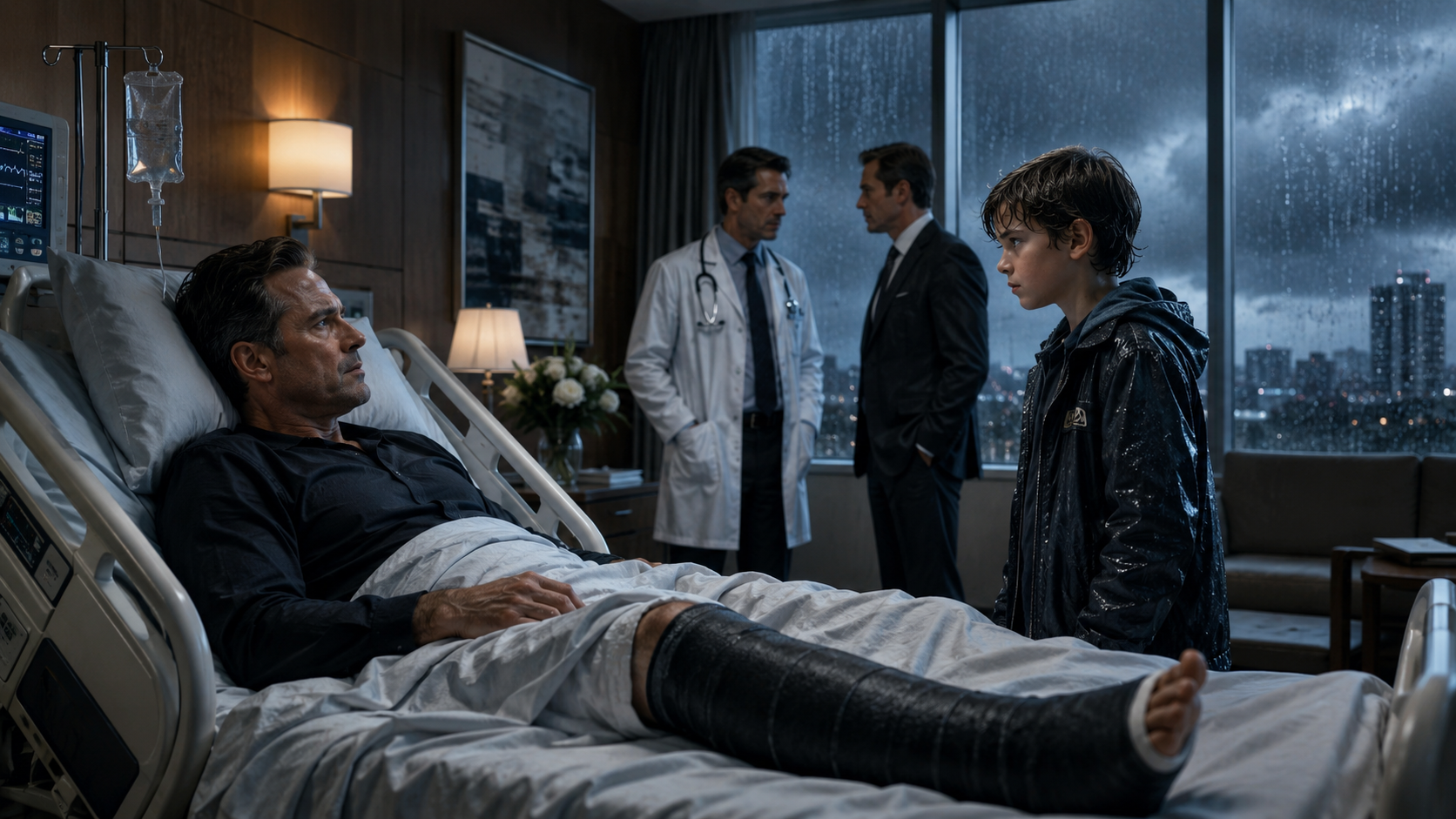
At 11:43 on a rain-soaked Tuesday morning, Adrian Vale was preparing to sign a document worth two hundred and eighty million dollars when a barefoot boy walked into his hospital room and told him he was going to die.
Adrian looked up from the contract.
For several seconds, nobody spoke.
The private room on the ninth floor of Bellmont Memorial was larger than most apartments. Floor-to-ceiling windows overlooked the gray city. A leather sofa stood against one wall. Fresh white lilies filled a crystal vase beside the television. Two security guards waited outside the door, and three members of Adrian’s legal team occupied the small conference area near the window.
The boy could not have looked more out of place.
He was perhaps eleven years old.
His rain-soaked jacket was three sizes too large. One sleeve was ripped at the elbow. His jeans were stained with mud, and water dripped from his tangled brown hair onto the polished floor.
But he wasn’t looking at the lawyers.
He wasn’t looking at the security guards rushing toward him.
He was staring at Adrian’s left leg.
More specifically, at the thick black orthopedic cast that covered it from ankle to thigh.
“Don’t sign that,” the boy said.
Adrian slowly lowered his pen.
His attorney, Graham Pike, shot to his feet.
“Who let him in?”
The boy took another step toward the bed.
Adrian noticed something strange.
The child wasn’t frightened.
Out of breath, yes.
Exhausted, certainly.
But not frightened.
One of the guards entered the room and reached for him.
The boy twisted away.
“Don’t touch me!”
“Easy,” Adrian said.
The guard stopped.
Everyone in the room looked at him.
Adrian Vale was fifty-nine, the founder of Vale Meridian Industries, and a man whose decisions routinely moved markets. He had spent thirty years building shipping terminals, energy companies, logistics networks, and telecommunications infrastructure across four continents.
He was accustomed to being obeyed.
But during the previous eighteen days, he had controlled almost nothing.
Eighteen days earlier, his armored sedan had gone through a highway barrier during a storm.
His driver had died.
Adrian had survived with what his doctors described as a complicated fracture of the left tibia.
At least that was what they had told him.
Since the accident, something about his recovery had bothered him.
The pain was inconsistent.
Some mornings his leg barely hurt at all.
Other mornings it burned strangely beneath the cast, although the sensation felt closer to the skin than the bone.
Twice he had asked for new X-rays.
Twice Dr. Simon Kessler, Bellmont’s celebrated chief orthopedic surgeon, had assured him they were unnecessary.
“You were extremely fortunate,” Kessler had said. “Don’t turn good luck into impatience.”
Adrian had accepted the explanation.
Until now.
The boy pointed at the cast.
“Ask them why they won’t remove it.”
Graham laughed nervously.
“This is ridiculous.”
The boy turned toward him.
“You know too.”
That stopped the lawyer’s smile.
Adrian noticed.
So did everyone else.
“What exactly do you think he knows?” Adrian asked.
Graham recovered quickly.
“Nothing. He’s a child who somehow bypassed hospital security.”
The boy shook his head.
“My name is Leo Mercer.”
Adrian frowned.
The name meant nothing to him.
Leo reached inside his jacket.
Both guards immediately moved.
“Hands where I can see them!” one shouted.
Leo froze.
Then, very slowly, he pulled out a small plastic identification badge.
He tossed it onto Adrian’s blanket.
The photograph showed a woman in blue hospital scrubs.
ELENA MERCER.
RADIOLOGY TECHNICIAN.
Adrian picked it up.
“Your mother?”
Leo nodded.
“She worked here.”
“Worked?”
Leo swallowed.
“She disappeared six days ago.”
The room changed.
Adrian could feel it.
Not because of what the boy had said.
Because of how the adults reacted.
One attorney suddenly found the floor fascinating.
Graham’s jaw tightened.
And the nurse standing beside Adrian’s IV monitor stopped moving entirely.
Adrian looked at her.
“Nurse?”
Her name was Claire Dawson. She had cared for him almost every day since the accident.
She stared at the monitor.
“Claire.”
Her eyes lifted reluctantly.
“Do you know this woman?”
A long silence followed.
“I’ve seen her.”
“That’s not what I asked.”
Claire looked toward Graham.
That was her mistake.
Adrian saw it.
The boy saw it too.
Leo moved closer to the bed.
“My mom took your first X-rays.”
Adrian stared at him.
“After the crash?”
“Yes.”
“How would you know that?”
“She told me.”
“When?”
“The night before she disappeared.”
Rain tapped against the glass.
Nobody else seemed to breathe.
Leo continued.
“She came home late. She was scared. I’ve never seen her scared before. She locked the door, closed all the curtains, and made me promise that if anything happened to her, I would come here.”
“To me?”
“To your cast.”
Adrian’s fingers tightened around the identification badge.
“What did she see?”
Leo glanced toward the doctors’ empty workstation.
“Not what she saw.”
He pointed again.
“What she put inside.”
Graham stepped forward.
“That’s enough.”
Adrian’s voice became cold.
“Sit down, Graham.”
“Adrian—”
“Sit.”
The attorney slowly returned to his chair.
Adrian looked at Leo.
“What did your mother put inside my cast?”
“I don’t know exactly.”
“Then why are you here?”
“Because she left me a message.”
Leo reached into his pocket and produced an old phone with a cracked screen.
“My mother said there was evidence hidden where they couldn’t search without making you ask questions.”
Adrian looked down at his leg.
The cast suddenly felt heavier.
“What evidence?”
Leo shook his head.
“She didn’t say.”
The door opened.
Dr. Simon Kessler entered.
He was tall, silver-haired, immaculate even in surgical scrubs.
He stopped the instant he saw Leo.
For perhaps half a second, the distinguished surgeon looked terrified.
Then the expression disappeared.
“Security,” he said calmly, “remove the child.”
“No,” Adrian replied.
Kessler turned.
“Mr. Vale, this boy should not be here.”
“Apparently he disagrees.”
“I don’t care.”
“I do.”
Kessler approached the bed.
“Your condition requires a stable environment.”
“My condition?”
“Your fracture.”
Adrian studied him.
“Show me today’s X-ray.”
Kessler hesitated.
“There’s no clinical reason for—”
“Show me.”
“We haven’t taken one today.”
“Then take one.”
Kessler’s face hardened.
“Unnecessary imaging exposes you to radiation without benefit.”
Adrian smiled faintly.
“I’ve invested four hundred million dollars into medical technology companies, Simon. Don’t talk to me as though one diagnostic X-ray is going to turn me into a lighthouse.”
Nobody laughed.
Kessler looked at Leo.
“What has he told you?”
“Enough to make me curious.”
“Children invent stories.”
Leo suddenly shouted, “Where is my mother?”
His voice cracked.
For the first time, the courage vanished from his face.
Underneath it was exactly what he had been all along.
An eleven-year-old child terrified that the person he loved most might never come home.
“Where is she?” he shouted again.
Kessler gave no answer.
Leo’s eyes filled with tears.
“You took her.”
“Leo,” Adrian said quietly.
But the boy backed toward the wall.
“You took her because she found out.”
“Found out what?” Adrian asked.
Leo stared at the cast.
Then he saw something near the fireplace.
A brass decorative sculpture sat on a stone pedestal—a heavy abstract figure shaped like a twisted circle.
Before anyone understood what he intended to do, Leo grabbed it.
“Stop!”
He ran toward the bed.
The guards lunged.
Adrian threw up a hand.
“Nobody touch him!”
Leo lifted the brass sculpture.
Kessler’s composure shattered.
“GET THAT AWAY FROM HIM!”
Too late.
Leo brought it down against the side of the cast.
CRACK.
A fracture appeared across the hardened shell.
Claire screamed.
Graham leapt backward.
The guards froze.
Adrian felt almost nothing.
That surprised him more than the blow.
Leo raised the sculpture again.
Kessler grabbed his arm.
“Stop!”
The boy fought desperately.
“Let me go!”
Adrian stared at the doctor.
“Simon.”
Kessler didn’t respond.
“Let go of him.”
“He’s endangering you.”
Adrian’s voice dropped.
“Then explain why you look more frightened than I am.”
Kessler slowly released Leo.
Nobody moved.
Adrian looked at the damaged cast.
“Break it.”
Claire whispered, “Mr. Vale…”
Adrian never looked away from Kessler.
“I said break it.”
Leo struck again.
CRACK.
A larger section split.
This time several pieces fell onto the blanket.
Underneath was white padding.
And beneath the padding—
black plastic.
Adrian stopped breathing.
It wasn’t medical equipment.
It was a narrow rectangular packet taped against the inside of the cast.
Leo dropped the sculpture.
“I told you.”
Kessler stepped backward.
Adrian pulled at the broken plaster himself.
“Don’t,” Kessler said.
Adrian ignored him.
He tore away another piece.
More black material became visible.
There were several packets.
One contained what appeared to be a flash-memory drive.
Another contained a tiny digital recorder.
The third held folded sheets of waterproof paper.
Adrian stared at them.
“Claire.”
The nurse began crying.
“Tell me.”
“I’m sorry.”
“Tell me what this is.”
“I wasn’t part of it at the beginning.”
Graham stood.
“Nobody should say another word until—”
Adrian turned on him.
“You speak again without being asked, and security will remove you instead of the child.”
Graham sat.
Claire wiped her face.
“The accident wasn’t an accident.”
Adrian felt the room tilt beneath him.
Kessler closed his eyes.
Claire continued.
“Your driver discovered something about the company pension fund.”
Adrian stared at her.
“What?”
“Someone had been moving money through shell companies. Hundreds of millions over several years.”
“Who?”
Claire looked toward Graham.
The lawyer went pale.
Adrian followed her gaze.
For twenty-two years, Graham Pike had sat beside him in negotiations, funerals, acquisitions, lawsuits, and family crises.
Adrian had trusted him with almost everything.
“Graham?”
His oldest adviser stood slowly.
“Adrian, this is far more complicated than—”
“Did you steal from my employees?”
“No.”
“Did you?”
“I protected the company.”
“That isn’t an answer.”
Graham’s voice sharpened.
“You built an empire without understanding what keeping one alive actually costs.”
Adrian stared at him.
The lawyer continued.
“There were obligations. Political relationships. Overseas payments. Agreements that couldn’t appear on official accounts.”
“You stole their retirement money.”
“I moved capital.”
“From people who worked for me for thirty years.”
“To protect everything you built!”
“And my driver?”
Silence.
Graham’s eyes changed.
That was enough.
Adrian felt something inside himself collapse.
“Daniel knew,” he whispered.
Graham said nothing.
Daniel Cho had driven Adrian for fourteen years.
He had two daughters.
He brought homemade dumplings to the office every Lunar New Year.
And Adrian had attended his funeral from a wheelchair three days earlier.
“You killed him.”
“No one was supposed to die.”
Leo looked between them.
“What about my mom?”
Graham didn’t answer.
The boy stepped forward.
“WHERE IS SHE?”
Kessler suddenly spoke.
“She’s alive.”
Leo froze.
Adrian turned.
“Where?”
Kessler rubbed both hands across his face.
“For God’s sake, Simon,” Adrian said.
“A private clinic outside the city.”
Leo’s voice became tiny.
“Why?”
Kessler looked at him.
“Because your mother wouldn’t give them the original files.”
“What files?”
“The images from Mr. Vale’s emergency examination.”
Adrian frowned.
“My X-rays?”
Kessler nodded.
“The fracture was minor.”
Adrian looked down at the ruined cast.
“How minor?”
“You could have walked within days.”
The anger came slowly.
Cold.
Controlled.
Much more dangerous than shouting.
“So you immobilized me.”
Kessler looked away.
“Graham needed time.”
“Time for what?”
Graham suddenly ran.
He reached the door before the first guard caught him.
The room exploded into movement.
Graham struck the guard with his shoulder, but the second security officer slammed him against the wall.
“Let me go!”
“Hold him,” Adrian said.
“You don’t understand!” Graham shouted. “That drive will destroy the company!”
Adrian looked at the black packet.
“Then perhaps it deserves to be destroyed.”
“You’ll lose everything!”
“No.”
Adrian carefully pulled the flash drive free.
“I’ll lose what you built out of stolen money.”
Leo approached the bed.
“Can we find my mom now?”
Adrian looked at him.
All the billions.
All the buildings.
All the newspapers with his photograph on the front page.
All the politicians who returned his calls.
None of it mattered in that moment.
There was only a wet, frightened child standing beside his hospital bed.
“Yes,” Adrian said. “We’re going to find her.”
Forty-two minutes later, police vehicles surrounded a small rehabilitation clinic twenty miles outside the city.
Elena Mercer was found alive in a locked recovery room.
She had not been physically harmed, but her phone had been taken and she had been prevented from leaving.
When police opened the door, she ran into the hallway.
Leo was waiting there.
For the first time that day, he didn’t look brave.
He looked eleven.
“Mom!”
Elena fell to her knees.
He crashed into her arms.
She held him so tightly that neither seemed capable of breathing.
Adrian watched from a wheelchair several feet away.
His broken cast had been removed completely.
A temporary brace now covered his leg.
A new medical team had examined him.
There was no serious fracture.
There never had been.
Elena looked over Leo’s shoulder and saw Adrian.
She stood slowly.
“I hoped he wouldn’t have to do it.”
Adrian almost laughed.
“He hit me with a brass sculpture.”
Leo looked embarrassed.
“You told me to break the cast.”
“I meant get someone to remove it.”
“You said they wouldn’t.”
Elena sighed.
“Technically, he’s right.”
Adrian smiled for the first time in weeks.
Then his expression became serious.
“Why did you hide the evidence on me?”
Elena looked down the corridor before answering.
“Because they were searching everywhere.”
She explained.
On the night of Adrian’s crash, Daniel Cho had survived for nearly twenty minutes after the vehicle struck the barrier.
Emergency workers believed he had been unconscious.
He hadn’t been.
Before dying, Daniel had given Elena a small encrypted drive.
He had recognized her from previous hospital visits with Adrian.
Daniel knew Graham’s people would search his belongings.
He told Elena the drive contained records proving that a secret group of Vale Meridian executives had been diverting employee pension money.
But there was more.
Much more.
The recorder contained a conversation Daniel had captured two days before the crash.
Graham Pike discussing how to make sure Adrian remained “unavailable” while several emergency transactions were approved.
Elena had panicked.
She knew the hospital’s administration had close relationships with Vale Meridian executives.
She trusted only herself.
While assisting with Adrian’s temporary immobilization, she hid the evidence beneath layers of padding, believing no one would dare remove the cast without a medical reason.
The plan worked.
Almost too well.
When Graham discovered Elena had handled Daniel’s belongings, he had her detained.
But he never discovered where she had hidden the evidence.
“Why didn’t you put it somewhere else?” Adrian asked.
Elena gave him a tired smile.
“I needed a safe place guarded twenty-four hours a day.”
Adrian looked at himself.
“You turned me into a safe.”
“The most expensive safe in the city.”
Leo laughed.
Adrian did too.
Three months later, the story appeared everywhere.
Graham Pike and six senior executives were indicted on charges related to financial fraud, unlawful detention, conspiracy, and the manipulation of evidence surrounding the highway crash.
Dr. Simon Kessler lost his medical license and later agreed to cooperate with prosecutors.
Several hospital administrators resigned.
More than six hundred million dollars in diverted assets were eventually traced and frozen.
But Adrian made a decision investigators hadn’t expected.
He personally guaranteed every missing dollar in the employee retirement fund before the first trial even began.
His board protested.
His accountants warned him.
Business journalists called it reckless.
Adrian didn’t care.
The money had been taken under his name.
It would be returned under his name.
Six months after the day the cast shattered, Adrian walked without a cane into the lobby of a newly opened diagnostic center.
A crowd of reporters waited outside.
Inside stood Elena Mercer in a white coat.
She had become director of patient imaging and ethics compliance.
Leo stood beside her wearing a suit that was slightly too big for him.
Adrian stopped in front of the boy.
“You look suspiciously respectable.”
Leo tugged at his tie.
“I hate this thing.”
“Good. You’re learning.”
Elena smiled.
A photographer asked them to stand together.
Adrian shook his head.
“No photographs yet.”
He reached into his jacket and removed a small wooden box.
Leo stared at it.
“What’s that?”
“A present.”
“I don’t want money.”
“I know.”
Leo opened the box.
Inside was a small piece of black orthopedic cast mounted on a silver plate.
An engraved sentence appeared beneath it:
WHEN EVERYONE ELSE STAYED QUIET, ONE CHILD MADE ENOUGH NOISE TO REVEAL THE TRUTH.
Leo read it twice.
Then looked up.
“You kept part of it?”
“Of course.”
“Why?”
Adrian glanced at Elena.
Then at the employees walking through the new medical center.
Then back at the boy who had entered his hospital room looking like a homeless runaway and dismantled a conspiracy with two swings of a brass sculpture.
“Because powerful people have a terrible habit of believing they can’t be touched.”
Leo grinned.
“And?”
Adrian smiled.
“Sometimes they need an eleven-year-old with a very heavy object to remind them otherwise.”
Elena covered her face.
“Please do not encourage him.”
“I’m not.”
“You absolutely are.”
Leo laughed.
Outside, cameras flashed through the glass.
Adrian looked toward them.
For decades, he had believed power came from money, control, reputation, and the ability to make important people listen.
He understood something different now.
Sometimes power belonged to the person nobody noticed.
The nurse who refused to delete an image.
The driver who recorded a conversation.
The mother who hid the truth.
The child who refused to leave.
And sometimes the most important sound in a room full of powerful people…
was the crack of something they believed would never break.

