HE NIGHT THE MOUNTAIN WENT DARK

At eighty-two, Clara Bell had learned that silence could have weight.

Some nights it was light and harmless, like fresh snow resting on the branches outside her kitchen window.

Other nights it pressed against the walls.

That January evening, it felt heavier than usual.

Clara lived alone at the northern edge of Bracken Hollow, a mountain town so small that the grocery store shared a wall with the post office and everyone knew who had bought cough medicine before breakfast.

Her house stood farther uphill than the others, beyond the last streetlight, where the paved road narrowed into a single lane between dark spruce trees.

Once, Clara had loved the isolation.

Her husband, Walter, had called it their private corner of the world.

He had built the house nearly forty years earlier, when his back was strong and Clara still believed growing old together meant neither of them would ever have to be lonely.

But Walter had been gone nine winters now.

Their only daughter lived six states away.

The grandchildren called when they remembered.

And most evenings Clara ate alone beneath the yellow kitchen lamp while an old battery radio murmured weather reports beside the breadbox.

That afternoon, the reports had been unusually serious.

A powerful winter front was crossing the mountains.

Roads were expected to close.

Temperatures would fall far below freezing.

Residents were warned to remain indoors.

By sunset, the entire valley had disappeared beneath moving walls of snow.

Clara checked the locks twice.

She added another log to the wood stove.

Then she filled a kettle and told herself she was perfectly safe.

At 7:43 p.m., the electricity failed.

The refrigerator stopped humming.

The kitchen light vanished.

The house became black except for the orange glow of the stove.

Clara sighed.

“Of course.”

She reached for a lantern.

She had survived power outages before.

She had candles, canned food, firewood, blankets and enough stubbornness to last until spring.

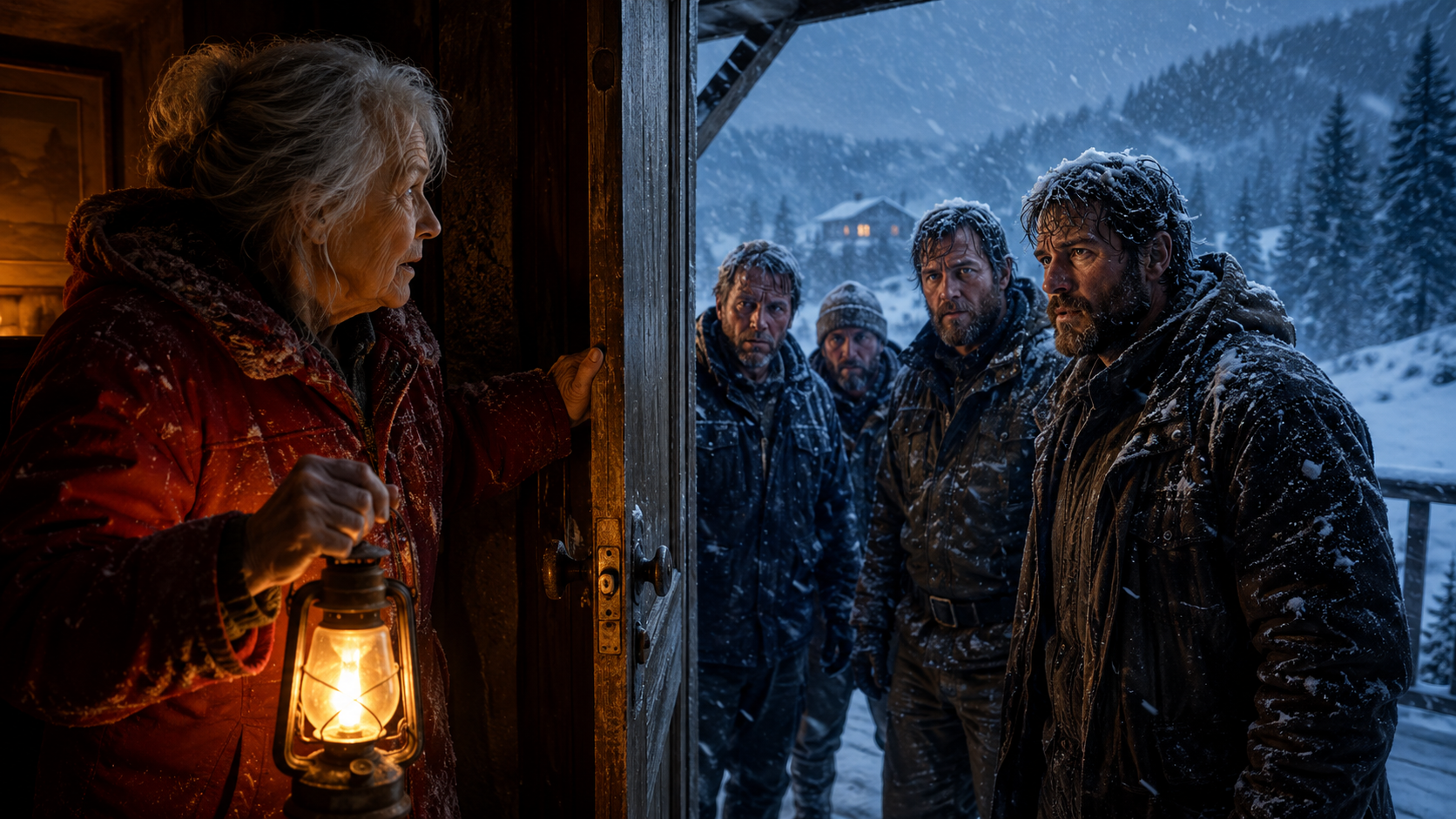
Then someone knocked on her front door.

Not gently.

Three hard blows.

Clara stopped moving.

Nobody should have been outside.

The road had become impossible nearly an hour earlier.

She waited.

Another knock came.

“Mrs. Bell?”

A man’s voice.

Clara slowly reached toward the drawer beside the stove.

Inside was Walter’s old revolver.

She had not fired it in twenty years.

That did not mean she had forgotten where it was.

“Who is it?”

“My name’s Adrian. Our truck went off the road.”

Another man’s voice called from farther back.

“We’re freezing out here, ma’am.”

Clara lifted the lantern and approached the door.

“Where’s your truck?”

“Half a mile downhill.”

“How many of you?”

A pause.

“Four.”

Clara’s fingers tightened around the lantern.

Four strange men.

At night.

During a blizzard.

Perfect.

She opened only the small interior viewing panel Walter had installed years ago.

Snow immediately blew through it.

Four figures stood on the porch.

All were large men wearing heavy work jackets.

One had a shaved head.

Another had a scar running from his eyebrow toward his ear.

The youngest looked barely thirty.

The oldest was perhaps fifty.

Their clothes were soaked with melting snow.

The man closest to the door raised both hands.

“I’m Adrian Knox.”

He slowly turned sideways.

A patch was sewn onto his jacket.

NORTH COUNTY RESTORATION PROGRAM.

Clara knew the name.

Everyone in Bracken Hollow did.

The county used prison labor and recently released inmates for road maintenance, construction and disaster cleanup.

Clara looked again at the four men.

Former prisoners.

Her stomach tightened.

The youngest man was trembling badly.

His lips had begun turning pale.

“Please,” Adrian said. “We don’t want trouble. Just somewhere warm until the wind settles down.”

Clara should have closed the panel.

She should have called someone.

But the telephone was dead.

The power was gone.

And there was something unmistakable about the young man’s shaking hands.

He was not pretending to be cold.

He was in danger.

Clara unlatched the door.

“You leave your boots outside.”

The men stared at her.

“Excuse me?”

“I just cleaned this floor.”

For the first time, the man with the scar smiled.

“Yes, ma’am.”

Clara opened the door.

“Come in before I change my mind.”

They entered one by one.

Adrian Knox.

Miles Carter.

Ruben Shaw.

And Theo Banks, the youngest.

All four placed their boots neatly beside the door.

They stood awkwardly near the stove while snow melted from their jackets.

Clara looked at them.

“You eaten?”

Adrian shook his head.

“Not since noon.”

“I’ve got stew.”

“We don’t want to take your food.”

“Then don’t.”

He blinked.

Clara pointed toward the table.

“Sit.”

Within twenty minutes, four former prisoners were eating beef stew in Clara Bell’s kitchen.

The situation was so absurd she almost laughed.

Instead, she studied them.

Miles ate slowly and politely.

Ruben kept looking toward the dark windows.

Theo held his bowl with both hands as though trying to absorb the heat through his fingers.

Adrian barely ate at all.

“You’re worried about something,” Clara said.

He looked up.

“Our truck.”

“You said it went off the road.”

“It did.”

“Then forget about it until morning.”

Adrian exchanged a glance with Ruben.

Clara noticed.

“What?”

“Nothing.”

“I’m eighty-two, not stupid.”

Adrian rubbed his jaw.

“We were carrying equipment.”

“What kind?”

“Emergency communications gear.”

Clara’s expression changed.

Before retirement, she had spent twenty-seven years working as a dispatcher for the county fire service.

“What equipment?”

“A portable repeater. Batteries. Signal amplifier. A few radios.”

“Where were you taking them?”

“Red Pine Nursing Center.”

Clara placed her spoon down.

Red Pine stood ten miles beyond the mountain pass.

More than sixty elderly residents lived there.

“They lost their backup communications system yesterday,” Adrian explained. “County maintenance couldn’t get anybody else through. Our crew volunteered.”

Clara looked at the patch on his coat again.

“Volunteered?”

Miles laughed quietly.

“We do occasionally volunteer for things.”

Clara ignored the remark.

“Where’s your supervisor?”

“Broken wrist.”

“The crash?”

Adrian nodded.

“Ambulance took him out before the road closed completely. We were told to turn back. Then the truck slid into the ditch.”

Ruben leaned toward the stove.

“We figured we’d spend the night inside the truck until Theo started losing feeling in his hands.”

Theo gave him an irritated look.

“I was fine.”

“You were turning blue.”

“I wasn’t blue.”

“You were blueberry blue.”

For the first time that evening, Clara smiled.

Then the radio on the counter crackled.

Everyone turned.

Clara crossed the room and adjusted the dial.

Static filled the kitchen.

Then a broken voice emerged.

“…any station… emergency traffic…”

Clara immediately became still.

Her years behind a dispatch desk returned as though she had retired yesterday.

She adjusted the antenna.

“Quiet.”

The men stopped talking.

The voice came again.

“…school transport seventeen… Glass Creek service road… eleven children aboard… driver injured…”

Theo slowly stood.

Clara turned the volume higher.

Static swallowed several words.

Then:

“…water rising… unable to move vehicle…”

Clara’s face drained of color.

Adrian saw it.

“What?”

“Glass Creek.”

“What about it?”

“The road follows the river.”

Nobody spoke.

Clara looked through the dark window.

“If the temperature dropped this fast, ice could have formed upstream.”

Ruben frowned.

“That sounds good.”

“No.”

Clara shook her head.

“Not if it formed a dam.”

A distant sound rolled across the mountains.

Not thunder.

Something deeper.

Something heavy.

Clara knew that sound.

She had heard it once when she was thirty-six.

A mass of river ice breaking loose.

Adrian moved toward the radio.

“How far is that bus?”

“Road distance? Maybe eight miles.”

“On foot?”

Clara looked at him as though he were insane.

“You wouldn’t make two.”

Miles stood.

“Our truck has chains.”

“You said it’s in a ditch.”

“We can dig it out.”

“In this?”

“We’ve dug out worse.”

Clara stared at the four men.

Theo was already putting on his jacket.

“Sit down,” she said.

None of them moved.

Adrian looked toward the radio.

“There are children on that bus.”

“The sheriff knows.”

“If anybody could reach them, they wouldn’t still be calling.”

Clara wanted to argue.

But she knew he was right.

Most county vehicles were trapped on the southern side of the pass.

The main bridge was probably closed.

And if an ice dam broke upstream, Glass Creek could rise several feet in minutes.

Then Clara remembered something.

“My snowcat.”

Adrian turned.

“Your what?”

“My husband bought an old tracked utility vehicle from the power company.”

Miles stared at her.

“You own a snowcat?”

“It hasn’t moved in four years.”

“Where?”

“Barn.”

The four men looked at each other.

Adrian pointed toward the back door.

“Show us.”

Ten minutes later, the barn was full of flashlight beams, frozen breath and shouted instructions.

The old snowcat sat beneath a gray canvas tarp.

Rust covered its tracks.

The windshield was clouded.

A mouse had built a nest inside one seat.

Miles opened the engine compartment.

“Oh, this thing is ancient.”

Clara crossed her arms.

“So are you, and nobody’s thrown you away.”

Ruben laughed.

“I like her.”

Miles looked into the engine.

“Battery’s dead.”

“I know.”

“Fuel?”

“Half a tank.”

“Diesel?”

“Yes.”

Adrian found a set of jumper cables.

“We have a battery pack in the truck.”

Clara shook her head.

“You aren’t walking back there.”

“We need it.”

“You won’t find the truck in this snow.”

“We know exactly where it is.”

“You think you do.”

Adrian looked at her.

For several seconds neither spoke.

Then Clara grabbed Walter’s old red winter coat from a hook.

“Fine.”

“What are you doing?”

“Showing you the shortcut.”

“You’re staying here.”

Clara zipped the coat.

“You came to my house, ate my stew, and now you’re giving orders?”

“This isn’t safe.”

“Neither is arguing with me.”

Twenty-five minutes later, they returned carrying the battery pack, two heavy tool cases, rope and a large weatherproof crate.

By then Clara’s hands were numb.

Miles connected the battery pack.

The engine coughed.

Stopped.

He tried again.

Nothing.

Theo slapped the dashboard.

“Come on.”

Miles tried a third time.

The engine turned.

Coughed.

Then roared to life.

Everyone shouted.

Clara heard herself laughing.

She had not laughed like that in years.

Adrian climbed into the driver’s position.

Clara climbed beside him.

He stared at her.

“No.”

“Yes.”

“No.”

“You don’t know the old logging road.”

“We have maps.”

“The road isn’t on your maps.”

Adrian rubbed both hands over his face.

“You are incredibly difficult.”

“Walter said the same thing for forty-three years.”

Adrian sighed.

“Seat belt.”

The snowcat entered the storm.

Visibility was almost nothing.

Its headlights illuminated swirling snow that seemed to race directly toward the windshield.

Clara guided Adrian along a narrow trail behind her property.

“Left at the fallen cedar.”

“What fallen cedar?”

“That one.”

“I can’t see anything.”

“Then trust me.”

He turned left.

The snowcat tilted dangerously.

Theo shouted from behind them.

“Are we supposed to be sideways?”

“Temporarily!” Clara yelled.

They continued.

The radio crackled.

“School transport seventeen… water entering rear compartment…”

Adrian pressed the accelerator.

The snowcat pushed harder through the drifts.

Twenty minutes later they reached the ridge overlooking Glass Creek.

Clara’s breath caught.

Headlights glowed below.

A yellow school bus sat at an angle against several trees.

Dark water surrounded it.

Sheets of broken ice slammed against its wheels.

“Oh God,” Theo whispered.

Adrian stopped the vehicle.

“The road’s gone.”

A section of the embankment had disappeared beneath the river.

They could not drive closer.

Ruben opened the crate.

Inside were climbing ropes, harnesses and heavy rescue straps.

Clara stared at him.

“You happened to bring climbing equipment?”

“Bridge repair crew.”

Adrian looked toward the bus.

“We anchor here.”

Miles shook his head.

“Current’s too strong.”

“Got another idea?”

Nobody did.

Adrian tied the first rope around his waist.

Theo grabbed his arm.

“You’re not doing that alone.”

“I’m heavier.”

“That isn’t an argument.”

“It is when the water wants to steal you.”

They moved downhill.

Clara stayed near the snowcat with the radio.

She watched Adrian fight through waist-deep snow toward the flooded roadway.

Halfway down, he slipped.

Ruben and Miles caught the rope.

Adrian disappeared beneath the edge of the floodwater.

Clara screamed.

Seconds later his head emerged.

He pulled himself onto a buried section of road.

“I’m good!”

“You don’t look good!” Miles shouted.

Adrian continued.

He reached the bus.

Children appeared behind the windows.

Their faces were pale.

Their hands pressed against the glass.

The driver was conscious but bleeding from the forehead.

The bus door would not open.

Adrian smashed a side emergency window with a tool.

One by one, the children climbed through.

Ruben and Theo formed a human relay along the rope.

Miles pulled them uphill.

Clara wrapped each arriving child in blankets from the snowcat.

A little girl of perhaps seven grabbed Clara’s sleeve.

“Is my brother coming?”

“What’s his name?”

“Eli.”

“How old?”

“Ten.”

Clara looked downhill.

“Adrian!”

He turned.

“There’s a boy named Eli!”

Adrian looked inside the bus.

A moment later he shouted back.

“He’s here!”

The little girl began crying with relief.

Then the mountain made another sound.

A violent cracking echoed upstream.

Clara felt every instinct from her dispatch years ignite at once.

“MOVE!”

Adrian looked toward the river.

A dark wall was coming around the bend.

Water.

Ice.

Branches.

Entire sections of frozen river.

“The dam broke!” Clara screamed.

Everything happened at once.

Adrian pushed the last child through the window.

Ruben carried him toward Theo.

Miles pulled the line.

The driver tried to climb out.

The surge hit the bus.

The yellow vehicle shifted sideways.

Metal screamed against rock.

Adrian grabbed the driver.

The bus moved again.

“ADRIAN!”

Clara watched the rope snap tight.

The bus rolled halfway onto its side.

Water exploded through the broken windows.

For several terrible seconds, Adrian disappeared.

Then Ruben shouted.

“There!”

Adrian surfaced twenty feet downstream, still holding the driver’s jacket.

Miles and Theo pulled.

Ruben crawled toward them.

The rope stretched.

The current dragged both men across the submerged road.

“Pull!” Clara shouted.

Everyone pulled.

Even the older children grabbed the rope.

Inch by inch, Adrian moved closer.

The driver reached solid snow first.

Then Adrian.

Ruben seized his coat.

Together they dragged him from the water.

Adrian lay on his back, coughing.

Clara knelt beside him.

“You idiot.”

He opened his eyes.

“Nice to see you too.”

“You could’ve died.”

He looked toward the children.

“So could they.”

Clara had no answer.

The bus vanished into the darkness moments later.

They crowded seventeen people into and onto the old snowcat.

Eleven children.

The injured driver.

Clara.

And the four men everyone in Bracken Hollow had learned to distrust before ever learning their names.

The return journey was slow.

Near dawn, the storm finally weakened.

When the snowcat emerged from the forest above Bracken Hollow, Clara saw lights.

Dozens of them.

Flashlights.

Lanterns.

Truck headlights.

People were standing in the road.

Parents ran forward.

The first mother reached the snowcat before it fully stopped.

Then everything became crying, shouting, hugging and disbelief.

Children were lifted down.

The injured driver was placed on a stretcher.

The county sheriff arrived.

He looked at Adrian.

Then at Miles.

Then Ruben.

Then Theo.

“You four were ordered to return to the maintenance depot.”

Adrian nodded.

“Yes, sir.”

“You left your assigned route.”

“Yes, sir.”

“You operated a vehicle without authorization.”

Adrian glanced at Clara.

“Technically, she authorized it.”

The sheriff stared at Clara.

She raised one eyebrow.

“It’s my snowcat.”

Someone nearby laughed.

Then the sheriff’s expression changed.

He looked at the rescued children.

Finally he looked back at the four men.

“I suppose I’ll have to write one hell of a report.”

Theo swallowed.

“Are we in trouble?”

The sheriff glanced at him.

“Son, if I arrest the four men who just pulled eleven children out of a flood, my wife won’t let me back into my own house.”

People began laughing.

Even Adrian smiled.

Then Clara noticed something uncomfortable.

Some of the townspeople were watching the men differently now.

These were the same people who had complained when the county restoration crew arrived months earlier.

The same people who had crossed streets to avoid them.

The same people who had whispered about criminal records and prison sentences.

Now they wanted to shake their hands.

Adrian noticed too.

He did not seem angry.

Only tired.

A man approached him.

“My daughter was on that bus.”

Adrian nodded.

“Glad she’s safe.”

The man held out his hand.

Adrian hesitated before taking it.

“Thank you.”

Another parent came forward.

Then another.

Theo received a hug from a boy’s father so powerful it nearly lifted him from the ground.

Ruben pretended not to be crying.

Miles did not pretend.

Clara stood a few feet away and watched.

For decades she had believed she understood people.

She had heard thousands of frightened voices during her years as a dispatcher.

She had talked strangers through fires, accidents, heart attacks and disasters.

She had learned something important from all those calls.

On the worst day of someone’s life, titles mattered very little.

Money mattered very little.

Reputation mattered very little.

What mattered was who answered.

That morning, four men with criminal records had answered.

Three days later, someone knocked on Clara’s door again.

She opened it.

Adrian, Miles, Ruben and Theo stood outside.

Clara stared at them.

“What did you break now?”

Theo laughed.

“Nothing.”

Miles pointed toward her roof.

“We noticed two missing shingles.”

“And your porch railing is loose,” Ruben added.

“And the barn door barely closes,” Adrian said.

Clara folded her arms.

“Are you insulting my house?”

“We’re offering to fix it.”

“I can’t pay you.”

Adrian smiled.

“You already did.”

“With what?”

“Stew.”

Clara looked at them for a long moment.

Then she stepped aside.

“You’re taking your boots off.”

“Yes, ma’am.”

“And if you’re staying through lunch, somebody’s chopping onions.”

Theo groaned.

“Why me?”

“Because you’re youngest.”

“That isn’t fair.”

“Life rarely is.”

By spring, Clara’s house had a repaired roof, reinforced porch, new storm windows and a barn door that finally closed without being kicked.

But those were not the biggest changes.

On Thursday evenings, Miles brought groceries.

Ruben repaired whatever Clara claimed did not need repairing.

Theo taught her how to use video calls properly, though she continued pointing the phone mostly at her forehead.

And Adrian sometimes sat quietly on the porch with her without speaking at all.

One evening Clara finally asked the question she had avoided.

“What did you do?”

Adrian stared across the valley.

“To go to prison?”

“Yes.”

He was silent for a while.

“I was twenty-three. Angry at everything. Thought fear was the same thing as respect.”

He looked at his hands.

“I robbed a store with two other men. The clerk fought back. Nobody died, but he was hurt badly.”

Clara said nothing.

“I deserved the sentence.”

“You think that?”

“Yes.”

“And now?”

“Now I think deserving punishment and deserving nothing else for the rest of your life aren’t the same thing.”

Clara slowly nodded.

“No,” she said. “They aren’t.”

Adrian looked at her.

“You weren’t afraid of us that first night?”

“I was terrified.”

He laughed.

“Really?”

“I had a revolver in the kitchen drawer.”

Adrian stopped laughing.

“You had a gun?”

“Yes.”

“All night?”

“Yes.”

“And you let four convicted felons into your house anyway?”

Clara shrugged.

“Theo was turning blue.”

From inside the house came Theo’s outraged voice.

“I WAS NOT BLUE!”

Clara and Adrian burst out laughing.

The sound carried over the porch and across the valley.

A year later, when another winter storm arrived, Bracken Hollow prepared differently.

The county had installed new emergency repeaters.

The school buses carried additional radio equipment.

Glass Creek had flood sensors.

And the restoration program had expanded.

Several businesses in town had started hiring former inmates after their county placements ended.

Miles found permanent work with a construction company.

Ruben joined a bridge maintenance crew.

Theo began training as an emergency medical technician.

Adrian became a supervisor for the restoration program.

Clara remained exactly where she had always been.

At the edge of town.

Beside the forest.

In the house Walter had built.

Except it no longer felt lonely.

On the first truly cold night of the new winter, someone knocked on her door.

Clara opened it.

Four men stood outside carrying grocery bags.

Snow covered their shoulders.

Adrian raised a container.

“Stew ingredients.”

Miles held up fresh bread.

Ruben carried firewood.

Theo had brought a cake.

Clara stared at the cake.

“Whose birthday is it?”

“Nobody’s.”

“Then why do we have cake?”

Theo looked offended.

“You need a reason?”

Clara stepped aside.

“Boots.”

Four pairs of boots immediately came off.

They entered the warm kitchen.

Outside, snow covered Bracken Hollow until roads, fences and old footprints disappeared.

Inside, five people crowded around a table that had once seemed far too large for one woman.

Years earlier, Clara had believed loneliness meant having nobody left.

She eventually discovered that was not exactly true.

Sometimes loneliness was simply an empty place in your life waiting for someone unexpected to enter it.

Sometimes the person standing outside your door carried a past you did not understand.

Sometimes that past was ugly.

Sometimes it deserved judgment.

But a person’s worst decision was not always the final chapter of their life.

A locked door could keep danger outside.

It could also keep kindness there.

And on one terrible winter night, when an old mountain went dark and eleven frightened children needed someone to come through the storm, the people with the worst reputations in Bracken Hollow became the ones willing to go.