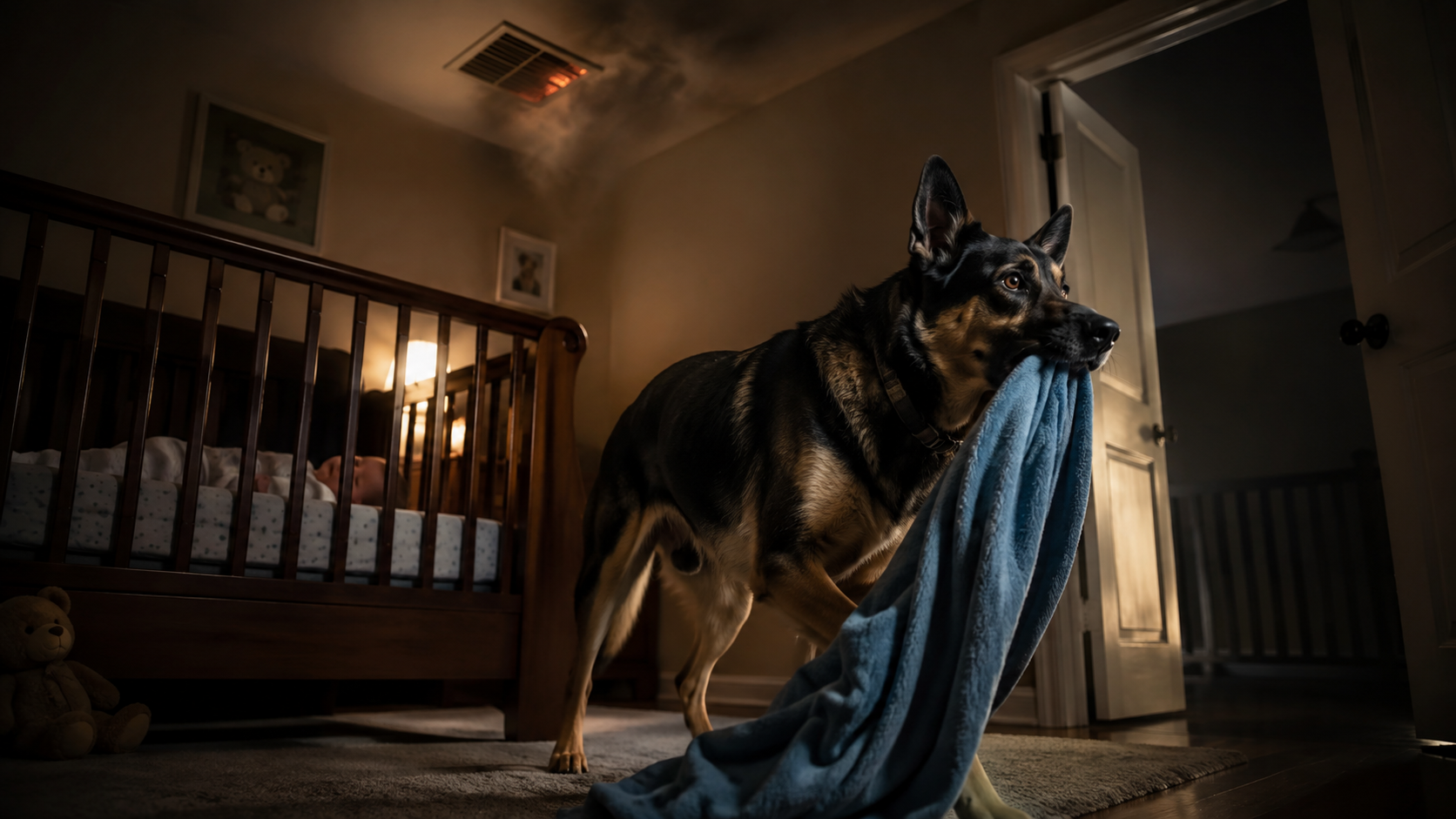
Every Night, the Dog Dragged the Baby’s Blanket Into the Hall. Then the Power Went Out.

The first time Rook stole my son’s blanket, I thought he was jealous.

It was nearly midnight, and I had just managed to get four-month-old Caleb to sleep.

Any parent who has lived through those first months knows the strange kind of victory that comes when a baby finally closes his eyes. You stop moving. You stop breathing. You become afraid that even thinking too loudly might wake him.

I stood beside the crib for another minute, watching Caleb’s tiny chest rise and fall.

Then I quietly turned off the lamp and slipped into the hallway.

Ten minutes later, I heard something dragging across the floor.

Scrape.

Pause.

Scrape.

I opened the bedroom door.

Rook was standing in the hallway with Caleb’s blue blanket hanging from his mouth.

“Seriously?”

His ears lowered.

Rook was a large black-and-tan shepherd mix with a white patch under his chin and the permanently serious expression of a police officer who had just caught someone parking illegally.

We had adopted him three years earlier.

He was gentle, quiet, and almost strangely disciplined.

He never stole food.

He never climbed onto furniture.

He never destroyed anything.

And until Caleb was born, he had never taken something that did not belong to him.

I walked toward him and reached for the blanket.

“Give it back.”

Rook stepped backward.

“Rook.”

Another step.

I almost laughed.

“You are not negotiating with me.”

He finally dropped the blanket.

I picked it up, returned to the nursery, and laid it across the rocking chair.

Caleb was still sleeping peacefully.

Nothing seemed wrong.

But as I turned toward the door, I noticed Rook standing just outside the nursery.

He would not come inside.

That was unusual.

Before Caleb was born, the nursery had been my small office. Rook used to sleep under the desk while I worked.

Now he stood at the threshold as though there were an invisible fence across the doorway.

“Come on,” I whispered.

He stared past me.

Not at Caleb.

Not at the crib.

At the ceiling.

Then he gave a soft whine.

I looked up.

There was nothing there.

“Good night, weirdo.”

I closed the door.

The following evening, he did it again.

This time he dragged one of Caleb’s stuffed animals into the hallway.

The night after that, it was the blanket again.

Then a small pillow from the rocking chair.

Anything he could reach near the crib, he carried out of the room.

My husband, Daniel, found it amusing.

“I told you,” he said over breakfast. “He’s protesting.”

“Protesting what?”

“The new management.”

I looked beneath the table.

Rook was lying near my feet.

“He loves Caleb.”

“I know.”

Daniel smiled.

“But he was the baby for three years.”

Rook raised his head when he heard his name.

“You hear that?” Daniel asked him. “You’ve been demoted.”

Rook did not look amused.

Neither was I.

Because there was something about his behavior that bothered me.

It did not look playful.

It looked urgent.

Over the next week, it became worse.

Whenever I carried Caleb toward the nursery in the evening, Rook followed closely behind us.

But the moment I crossed the doorway, he stopped.

Sometimes he barked.

Not his normal bark.

One sharp, explosive warning.

Then he would pace through the hallway.

If I closed the nursery door, he sat outside it.

For hours.

One night, I woke at three in the morning and found him still there.

His nose was pressed against the narrow space beneath the door.

“Rook?”

He immediately stood.

His eyes moved toward the handle.

I opened the door.

He rushed past me.

For the first time in days, he entered the room.

But he did not approach the crib.

Instead, he walked directly to the far wall and lifted his nose toward an air vent near the ceiling.

He sniffed.

Then backed away.

A low growl vibrated inside his chest.

My skin prickled.

“What is it?”

Rook stared upward.

I followed his gaze.

Nothing.

I smelled the air.

Baby powder.

Laundry detergent.

The faint sweetness of the lavender lotion we used after Caleb’s bath.

Nothing else.

Rook suddenly turned toward the crib.

He walked to Caleb, gently pushed his nose beneath the edge of the blanket, and pulled.

“Hey.”

I caught it before it fell.

Rook pulled harder.

“Stop.”

He released it, but immediately nudged my arm.

Then he walked toward the door.

He looked back at me.

For several seconds, neither of us moved.

“You want us to leave?”

His ears rose.

I almost felt ridiculous saying it.

But something in his expression made the question feel less ridiculous than it should have.

Caleb stirred.

I picked him up.

The moment I carried him into the hallway, Rook relaxed.

His tail moved once.

Then he lay down.

That was the first night Caleb slept in our bedroom.

The next morning, I told Daniel everything.

He listened while pouring coffee.

“So Rook thinks the nursery is haunted?”

“I’m serious.”

“So am I. Should I call an electrician or an exorcist?”

“Daniel.”

He saw my face and stopped smiling.

“Okay.”

“I think something is wrong in there.”

“With what?”

“I don’t know.”

We inspected the room together.

We checked the windows.

The heating vent.

The outlets.

The ceiling.

Daniel climbed into the attic and looked around with a flashlight.

He found nothing unusual.

No leaking pipes.

No animals.

No damaged insulation.

No strange smell.

Nothing.

“It’s an old house,” he said when he came down. “Maybe he hears mice.”

“Then why does he want Caleb out?”

“You don’t know that he does.”

I looked toward Rook.

He was standing at the bottom of the attic stairs.

Watching us.

Daniel sighed.

“I’ll call someone.”

An electrician arrived two days later.

His name was Luis, and he spent nearly an hour checking the outlets, switches, breaker panel, and nursery wiring.

Everything worked.

He tested the circuits.

Normal.

He checked the temperature around the sockets.

Normal.

He inspected the attic.

Nothing obvious.

“You’ve got an older electrical system,” he told us, “but I’m not seeing anything dangerous.”

I pointed toward the air vent.

“What about that?”

“HVAC.”

“Could something be inside?”

“Possible, but I don’t see evidence of it.”

Rook watched the entire inspection from the hallway.

Luis noticed him.

“Dog doesn’t like the room?”

“You could say that.”

Luis crouched.

“Smart-looking dog.”

Rook ignored him.

His eyes remained fixed on the vent.

Luis followed his stare.

“You smell something, buddy?”

Rook whined.

Luis stood and looked at me.

“I can pull the vent cover if it makes you feel better.”

“Please.”

He removed it.

Nothing.

Just a dark metal duct disappearing into the wall.

Luis shined a flashlight inside.

“Clean.”

I felt foolish.

Daniel paid him.

That evening, we decided to move Caleb back into the nursery.

For two nights, nothing happened.

Rook still refused to sleep.

He sat outside the door like a guard.

On the third night, our hallway lights flickered.

Just once.

I noticed it because I was carrying laundry.

The lights dimmed, returned, and stayed normal.

“Daniel?”

He was downstairs.

“What?”

“Did the lights just flicker?”

“Probably the storm.”

Thunder rolled somewhere in the distance.

A summer storm was moving toward us.

I looked at Rook.

He was already standing.

His ears were forward.

Then the lights flickered again.

Rook ran toward the nursery.

He barked.

Once.

Twice.

Three times.

Caleb started crying.

“All right!”

I hurried into the room.

Rook followed me this time.

He ran beneath the vent and began jumping toward it.

“Rook! Stop!”

Caleb screamed louder.

Thunder shook the windows.

Daniel came running upstairs.

“What’s happening?”

“I don’t know!”

Then I smelled it.

Faint.

Sharp.

Wrong.

It reminded me of the smell a hair dryer makes when it gets too hot.

Daniel smelled it too.

His expression changed immediately.

“Do you smell that?”

“Yes.”

Rook barked again.

Daniel reached for the light switch.

Nothing happened.

The nursery had gone dark.

The hallway lights were still on.

“Breaker,” Daniel said.

Then we heard a sound above us.

A tiny crack.

Like someone snapping a dry twig.

Then another.

Crack.

Rook went wild.

He jumped against me so hard I nearly lost my balance.

“Take Caleb!” Daniel shouted.

I grabbed my son from the crib.

Rook ran toward the door, turned around, barked, then ran toward the stairs.

“Go!” Daniel yelled.

I carried Caleb downstairs.

Rook stayed beside me.

Daniel went toward the breaker panel.

Then the smoke detector upstairs screamed.

Everything happened at once.

A piercing alarm filled the house.

Caleb began crying.

Rook barked.

Daniel shouted my name.

A thin ribbon of gray smoke rolled across the upstairs ceiling.

“We’re leaving!” Daniel yelled.

We ran outside barefoot.

Rain had begun falling.

I stood on the front lawn in my pajamas, holding Caleb against my chest while Daniel called emergency services.

Rook stood beside us, staring at the upstairs windows.

Thirty seconds later, one of the windows flashed orange.

My stomach dropped.

“Daniel.”

“I see it.”

There was fire inside our son’s room.

Not a huge fire.

Not yet.

But flames were moving behind the ceiling near the vent.

The room where Caleb had been sleeping less than two minutes earlier.

Firefighters arrived quickly.

We watched from across the street as they entered the house.

Rain soaked my hair.

Caleb cried against my shoulder.

Daniel wrapped his arms around both of us.

Rook would not stop staring at the nursery.

Eventually, the fire was extinguished.

A firefighter came outside.

“Everyone okay?”

“Yes.”

“Anyone else inside?”

“No.”

“Good.”

He looked at Rook.

“That your dog?”

“Yes.”

“He alert you?”

I stared at him.

“For almost two weeks.”

The firefighter raised his eyebrows.

“Well, tonight he probably saved you a very different conversation.”

The fire had started inside a section of ceiling that was almost impossible to inspect from either the room or the attic.

An electrical cable had been squeezed between a metal ventilation duct and a wooden support.

Over time, vibration from the heating and cooling system had damaged the cable’s protective coating.

Bare wiring had begun heating nearby material.

But that was not the worst part.

When investigators opened the ceiling the next morning, they discovered a dense nest packed around the damaged area.

A family of squirrels had entered through a tiny opening near the roof months earlier.

They had dragged dry leaves, shredded insulation, paper, and other material into the narrow space surrounding the duct.

The damaged wire was sitting beside something that was practically ready-made kindling.

“It had probably been heating on and off for a while,” the investigator explained.

“How long?”

“Days. Maybe weeks.”

I looked at Rook.

He was sitting near Daniel.

“And he could smell it?”

“Possibly. Dogs detect odors we miss all the time. He might also have heard activity inside the wall.”

My mind returned to those nights.

Rook at the doorway.

Rook staring at the vent.

Rook stealing Caleb’s blanket.

Rook trying to lead me into the hallway.

He had not been jealous.

He had not been misbehaving.

He had been trying to move our baby away from the danger.

The realization made my knees weak.

I sat down on the porch.

Rook came to me.

I wrapped both arms around his neck.

“You knew.”

He leaned against me.

“You knew, didn’t you?”

His tail struck the porch once.

Daniel turned away, pretending to examine the damage.

I knew he was crying.

We stayed with my sister while the repairs were completed.

The nursery was destroyed.

Part of the ceiling had burned.

Smoke had blackened one wall.

The crib had been damaged by falling debris and water.

For days, I could barely look at the photographs.

Every picture gave me the same thought.

Caleb had been there.

His crib had been directly underneath it.

I stopped myself from imagining the rest.

A week later, something unexpected happened.

I received a call from the animal rescue organization where we had adopted Rook.

The woman introduced herself as Miriam.

“I hope I’m not bothering you,” she said.

“No, not at all.”

“We saw the post your husband made about the fire.”

Daniel had shared a picture of Rook sitting outside the damaged house.

He had written only one sentence:

This dog saved our son.

Miriam continued.

“There’s something about Rook’s history I think you should know.”

I sat down.

“What?”

“When you adopted him, we didn’t have much background information.”

“That’s what you told us.”

“We didn’t then. We do now.”

My heart began beating faster.

“His original owner contacted us.”

I looked across the temporary bedroom.

Rook was asleep beside Caleb’s portable crib.

“Original owner?”

“Not exactly. His owner passed away several years ago. The man’s daughter recognized Rook from the photograph.”

I waited.

“His name wasn’t Rook back then.”

“What was it?”

“Radar.”

Despite everything, I smiled.

“That actually suits him.”

“There’s more.”

Miriam paused.

“His owner was a retired firefighter.”

I stopped smiling.

“What?”

“He volunteered with a small fire department after retirement. According to his daughter, he used to bring the dog to the station.”

I looked at Rook again.

He opened one eye.

“She said Radar was never an official detection dog. Nothing like that. But her father trained him constantly. Smoke drills. Alarm drills. Finding family members. Going to doors. Alerting when he smelled burning material.”

For several seconds, I could not speak.

All those strange things suddenly fit together.

The discipline.

The way he watched doorways.

The way he reacted to smoke alarms.

The way he never panicked.

The way he had tried to move Caleb.

“What happened to him?” I finally asked.

“To the owner?”

“Yes.”

“He died suddenly. Afterward, the family couldn’t keep the dog. Rook passed through two different homes before ending up with us. Somewhere along the way, most of his history was lost.”

I looked down.

“So he remembered.”

“It sounds like he did.”

That night, Daniel and I sat on my sister’s porch after Caleb fell asleep.

Rook lay between us.

Daniel scratched behind his ears.

“I owe you an apology,” he told him.

Rook looked up.

“I called you jealous.”

Rook yawned.

“And dramatic.”

Another yawn.

“And I made the exorcist joke.”

I laughed.

Daniel pointed at him.

“That was funny, though.”

For the first time since the fire, the laughter felt normal.

Three weeks later, we returned home.

We did not rebuild the nursery exactly as it had been.

I could not.

We changed everything.

Different walls.

Different lighting.

Different crib.

Different furniture.

The damaged duct was replaced, the wiring was updated, and every part of the attic was professionally inspected and sealed.

Finally, the room was ready.

I carried Caleb upstairs.

Rook followed me.

When we reached the nursery, I stopped.

For weeks, Rook had refused to cross that doorway.

Now he stood beside me.

He sniffed.

Once.

Twice.

Then he walked inside.

He slowly crossed the room.

He smelled the floor.

The wall.

The new vent.

Daniel and I watched silently.

Rook returned to the crib.

He looked at Caleb.

Then, without hesitation, he lay down beside it.

Daniel put his hand on my shoulder.

“I think we passed inspection.”

I smiled.

“Apparently.”

That evening, Caleb slept in his room for the first time since the fire.

I checked the baby monitor constantly.

11:00 p.m.

Midnight.

1:15.

2:40.

Every time I looked, Caleb was asleep.

And beside the crib was the dark outline of Rook.

At three in the morning, I woke suddenly.

For no reason.

I checked the monitor.

Rook was gone.

My heart jumped.

I hurried into the hallway.

He was standing near the stairs.

“What is it?”

He looked at me.

Then walked toward the kitchen.

I followed.

He stopped beside his empty water bowl.

I stared at him.

Then I started laughing so hard I had to cover my mouth.

“You scared me half to death.”

His tail wagged.

I filled the bowl.

As he drank, I crouched beside him and rubbed his neck.

“You know the problem now?”

He looked at me.

“I’m going to believe everything you say.”

He finished drinking and walked back upstairs.

Straight into Caleb’s room.

Straight to the crib.

Then he lowered himself onto the rug and closed his eyes.

Months passed.

Caleb learned to sit.

Then crawl.

Rook followed him everywhere.

When Caleb began pulling himself upright, Rook would quietly position his body behind him as though expecting him to fall.

Usually, he was right.

Caleb’s first word was “Mama.”

Daniel insists the second was “Dada.”

It wasn’t.

It was something that sounded remarkably like “Roo.”

I never corrected him.

Sometimes people ask whether I really believe Rook understood what was happening before we did.

I don’t know exactly what he understood.

Maybe he smelled overheated wiring.

Maybe he heard squirrels behind the ceiling.

Maybe some old lesson from another house, another family, and another lifetime returned to him the moment he sensed danger.

Or maybe he understood only one thing:

The smallest member of his family was sleeping in a place that did not feel safe.

And that was enough.

I used to think protecting someone required understanding the danger.

Rook taught me otherwise.

Sometimes protection is simpler than that.

You notice.

You refuse to ignore what feels wrong.

And when nobody listens, you keep trying.

You steal the blanket.

You guard the doorway.

You bark until someone gets angry.

You keep doing it anyway.

Because the person you are protecting does not need to understand your warning.

They only need you not to give up.

Years from now, Caleb probably won’t remember the night his bedroom caught fire.

He won’t remember the rain.

The smoke alarms.

The firefighters.

Or his mother standing barefoot in the street holding him against her chest.

But I will remember.

And whenever I think about how close we came to leaving him in that crib for another five minutes, I look at the big black-and-tan dog sleeping beside him.

We thought Rook was trying to steal our baby’s blanket.

He was trying to steal our baby away from the fire.

And thank God we finally listened.