BEFORE THE EARTH CLOSED

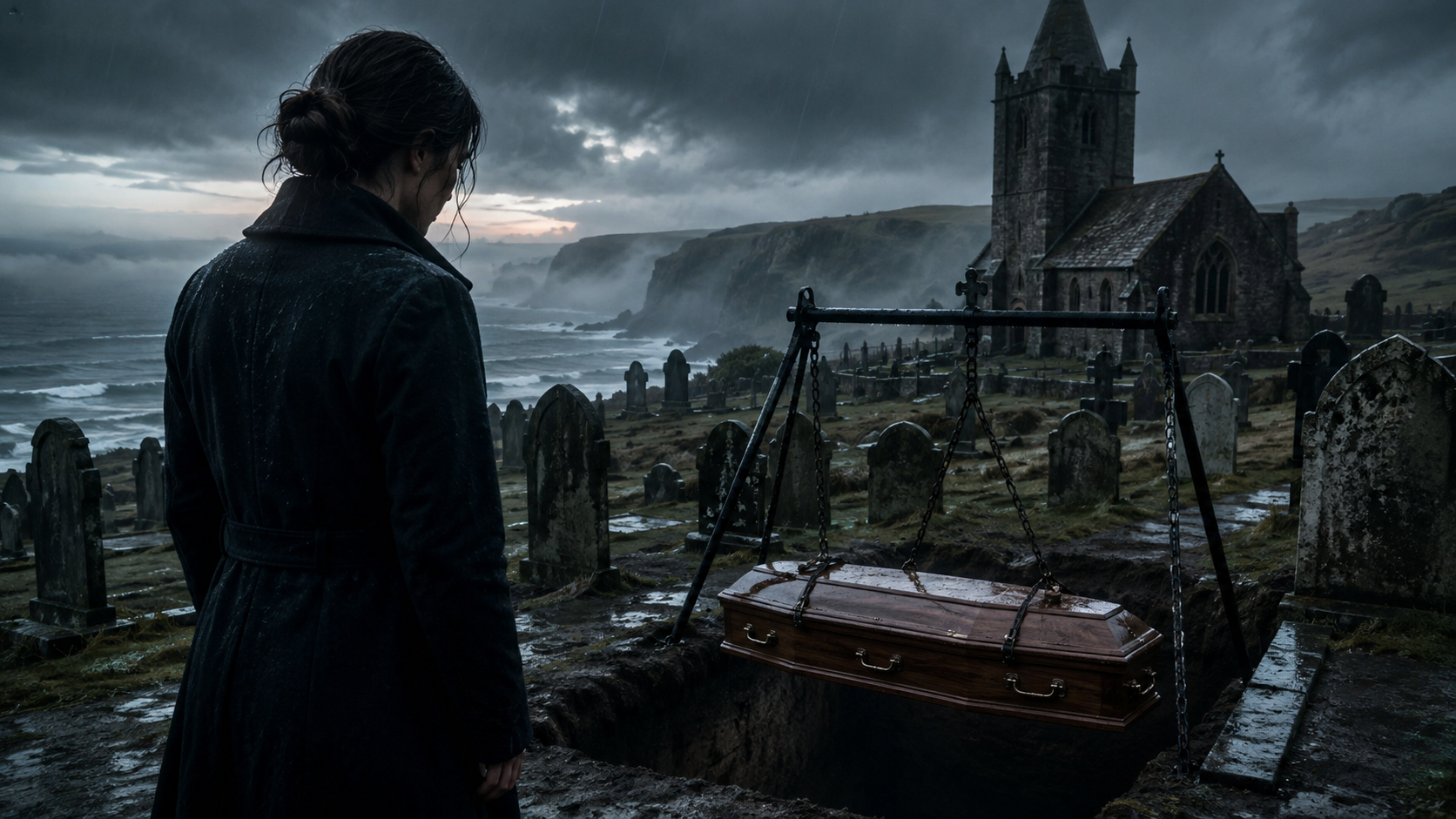
Rain had been falling over Blackwater Bay since dawn.

Not hard rain. Not the kind that sent people running for shelter. It was colder than that—a thin, patient rain that settled into coats, darkened the stones of Saint Orson Cemetery, and covered the cliffs beyond the graveyard in a silver haze.

Rachel Ellison stood beside her sister’s coffin and tried not to look at the sea.

Mara had always loved the sea.

That was the cruelest part.

Three days earlier, the police had told Rachel that Mara’s car had been discovered near the old harbor road. The vehicle had gone through a barrier, rolled down an embankment, and caught fire beside an abandoned storage building.

The body inside had been badly burned.

Identification had been made through personal belongings, dental information, and the silver ring Mara had worn every day since she was nineteen.

At least, that was what Rachel had been told.

Now a dark walnut coffin hung above the open grave on two thick straps.

Rachel stared at it as though staring hard enough might reverse time.

Around her stood nearly seventy mourners.

Neighbors.

Former classmates.

People from the Harbor Light Foundation, where Mara had worked as a financial investigator.

Hospital staff who knew Rachel.

A few reporters waited beyond the cemetery gates, kept at a respectful distance by two uniformed officers.

And beside Rachel stood Gideon Shaw.

Mara’s fiancé.

His black coat was immaculate despite the rain. His dark hair was combed neatly back, and his expression had remained controlled throughout the entire service.

Too controlled, Rachel had thought once.

Then she had hated herself for thinking it.

Everyone grieved differently.

Gideon reached for her hand.

Rachel let him take it.

The priest lowered his head.

“May she find the peace that this world could not give her.”

One of the cemetery workers reached for the mechanism that would lower the coffin.

And somewhere behind the mourners, a child shouted.

“Stop the ropes!”

The worker froze.

The priest raised his head.

Rachel turned.

A boy was running between the rows of wet gravestones.

He looked about eleven.

His jacket was too large for him, the sleeves hanging over his hands. Mud covered one knee of his jeans. Rain plastered his black hair against his forehead.

A cemetery attendant stepped into his path.

The boy dodged around him.

“Stop!” he shouted again.

Every face turned toward him.

The boy reached the grave and nearly slipped on the grass.

He caught himself against a stone angel, breathing hard.

Gideon stepped forward.

“This is a private service.”

The boy barely looked at him.

His eyes found Rachel.

“Are you Mara’s sister?”

Rachel felt something tighten in her chest.

“Yes.”

The boy nodded toward the coffin.

“That isn’t Mara.”

Nobody spoke.

For a moment, even the rain seemed quieter.

Gideon gave a short, incredulous laugh.

“Someone get him out of here.”

The boy’s face changed when Gideon spoke.

Not confusion.

Fear.

Rachel saw it immediately.

She had worked in emergency medicine for fourteen years. She knew fear when she saw it.

The boy stepped backward.

Gideon noticed.

So did Rachel.

She moved between them.

“What’s your name?”

“Luca Bell.”

“How did you know my sister?”

Luca reached beneath his oversized jacket.

One of the police officers immediately moved closer.

“Easy,” Rachel said.

The boy pulled out a small object wrapped in plastic.

It was an origami bird.

Blue paper.

Rachel stopped breathing.

She knew that paper.

She knew the ridiculous little birds.

When Rachel and Mara were children, their father had worked night shifts at the ferry terminal. On nights when storms kept him away, the girls would sit at the kitchen table folding birds out of whatever paper they could find.

Mara had never stopped.

Even as an adult, she folded them when she was nervous.

Rachel took the bird.

There were words written inside.

Not ordinary words.

Numbers.

7-1-18-4-5-14.

Rachel stared at them.

Gideon came closer.

“What is it?”

Rachel folded the bird shut.

“Nothing.”

But it was not nothing.

When they were children, Rachel and Mara had invented a simple alphabet code.

Their father called it their secret language.

Seven.

One.

Eighteen.

Four.

Five.

Fourteen.

GARDEN.

Rachel looked at Luca.

“Where did you get this?”

“Mara gave it to me four nights ago.”

Gideon’s face went still.

Rachel heard several mourners whisper.

“That’s impossible,” someone said.

Rachel did the calculation automatically.

Four nights ago.

That would have been the night after Mara was supposedly killed.

Gideon crouched so that he was level with Luca.

His voice became gentle.

Almost warm.

“You’re confused, son.”

“I’m not your son.”

“Of course not. I only mean—”

“She said you talk like that.”

Gideon stopped.

Luca’s voice shook, but he continued.

“She said when you get scared, you get polite.”

Something cold passed through Rachel.

Gideon stood.

“This is absurd.”

He looked toward the police officer.

“Officer, please.”

The officer hesitated.

Rachel closed her hand around the paper bird.

“Wait.”

Gideon turned toward her.

“Rachel.”

“She gave him our code.”

“He could have found it somewhere.”

“No.”

“You’re grieving.”

“And you’re trying very hard to make him leave.”

A murmur moved through the crowd.

Gideon lowered his voice.

“Think about what you’re doing.”

“I am.”

Rachel turned to Luca.

“You said that isn’t Mara.”

Luca looked at the coffin.

Then he said something nobody there expected.

“The woman in there is my mother.”

A gasp came from somewhere near the first row.

Rachel stared at him.

“What?”

“My mother’s name was Alicia Bell.”

His lips trembled.

“She disappeared six weeks ago.”

Gideon looked toward the police again.

“This needs to stop.”

Luca ignored him.

“My mom worked at Harbor Light.”

Rachel slowly turned.

The Harbor Light Foundation.

Gideon was its executive director.

Mara had been its internal auditor.

Luca continued.

“My mom kept the accounts for the housing program. She told me she found something bad. Then one night she didn’t come home.”

Gideon’s jaw tightened.

Rachel saw it.

Only for a second.

But she saw it.

“Mara started visiting me after that,” Luca said. “She said she was looking for my mom.”

Rachel looked at Gideon.

“You knew about this?”

“No.”

“You ran the foundation.”

“I don’t personally supervise every employee.”

Luca pointed toward the coffin.

“Mara said they were going to make everyone believe she died. She said if there was a funeral, I had to find Rachel and stop them before the coffin went underground.”

The cemetery worker had stepped away from the lowering mechanism.

Nobody seemed eager to touch it now.

Rachel looked at the coffin.

All morning she had wanted the service to end.

Now she wanted the exact opposite.

“I want it opened.”

Gideon stared at her.

“No.”

Rachel looked at him.

It was the speed of his answer that frightened her most.

The funeral director, Celia Ward, stepped forward.

She was a thin woman in her late fifties, dressed in charcoal gray.

“Ms. Ellison, I understand this is distressing, but there are legal and health considerations.”

“I’m Mara’s next of kin.”

“Mara designated Gideon to handle the arrangements.”

Rachel turned sharply.

“She did what?”

Gideon gave Celia a warning look.

Too late.

Rachel had already seen it.

“My sister never told me that.”

“She completed the paperwork months ago,” Gideon said.

“Show it to me.”

“Rachel, not here.”

“Show it to me.”

The first police officer approached.

“Ms. Ellison, perhaps we should move everyone inside while we sort this out.”

“No.”

Rachel pointed toward the coffin.

“If that is my sister, opening it changes nothing.”

Nobody answered.

“And if it isn’t my sister,” Rachel continued, “then somebody is about to bury evidence.”

Silence.

The second officer exchanged a glance with the first.

Finally, the senior officer nodded toward the funeral director.

“Open it.”

Celia went pale.

Gideon stepped toward him.

“You cannot make that decision based on the claim of a child.”

“I can delay a burial until we establish that the person in the coffin is the person named on the paperwork.”

Celia swallowed.

Then she gestured to her employees.

The coffin was lifted away from the grave.

The mourners backed away.

Some left immediately.

Others remained, unable to resist the terrible gravity of what was happening.

Rachel stayed beside the coffin.

Luca stood behind her.

Gideon stood ten feet away.

The lid opened.

Rachel had been warned not to view the body.

She understood why.

Fire had taken away much of the woman’s recognizable appearance.

Rachel’s knees weakened.

For one horrible instant grief returned with such force that she nearly believed she had made a terrible mistake.

Then her training took over.

She looked past the damage.

Past the flowers.

Past the clothing.

She looked at the body as a nurse.

Mara had broken her right collarbone in a cycling accident when she was twenty-two. The fracture had required surgery. A thin, pale scar remained beneath the collarbone.

Rachel leaned closer.

Nothing.

She checked again.

“No,” she whispered.

Gideon stiffened.

Rachel looked at the left hand.

Mara’s silver ring was there.

But that meant nothing anymore.

Rachel touched the officer’s arm.

“My sister had surgery here.”

She indicated the collarbone.

“There should be a scar.”

“Could the fire have—”

“No.”

She shook her head.

“No. I treated the wound after the operation. I know exactly where it was.”

Luca had moved closer.

The moment he saw the woman’s hand, he made a sound that Rachel would remember for the rest of her life.

Not a scream.

Something smaller.

“Mom.”

He pointed.

On the inside of the dead woman’s index finger was a tiny tattoo.

A black crescent moon.

“My mom had that,” Luca whispered.

His legs folded beneath him.

Rachel caught him before he hit the ground.

Gideon turned away.

“Officer,” Rachel said.

The policeman was already reaching for his radio.

Gideon began walking toward the cemetery gate.

“Mr. Shaw,” the officer called. “Stay here.”

“I’m calling my attorney.”

“You can do that from here.”

Gideon stopped.

Slowly, he looked back.

For the first time that morning, his composure was gone.

Luca grabbed Rachel’s sleeve.

“There’s more.”

“What?”

“Mara said if they opened the coffin, we had to go to the garden.”

Rachel remembered the coded word.

GARDEN.

She looked toward the old stone church.

Behind it was a neglected memorial garden that had once belonged to a convent.

“What’s in the garden?”

“I don’t know.”

“Did she tell you?”

“She said you would understand the second part.”

Luca reached into his jacket again.

This time he removed a small brass key.

A piece of red thread was tied through the circular handle.

Rachel stared at it.

Their father used to mark spare keys with red thread.

Another childhood habit.

Another message meant only for her.

She looked at Gideon.

He was watching them.

And he was no longer pretending not to be afraid.

Rachel closed her fingers around the key.

“Officer, don’t let him leave.”

Then she took Luca’s hand.

They walked toward the garden.

Behind the church, the cemetery changed.

The carefully trimmed lawns ended at a stone wall covered in ivy. Beyond it stood twisted apple trees, empty flower beds, and a tiny greenhouse that had not been used in decades.

Rachel remembered coming here with Mara after their mother died.

Mara had been fourteen.

Rachel seventeen.

They would sit in the broken greenhouse during storms because nobody ever looked for them there.

Rachel stopped.

The greenhouse.

Of course.

She ran.

The door was chained.

The brass key fit the lock.

Inside, dead vines hung from rusted frames.

Broken glass covered the floor.

A wooden gardening table stood against the back wall.

Nothing else.

Luca looked disappointed.

“There’s nobody here.”

Rachel walked to the table.

Her pulse quickened.

Carved into the wood was a tiny bird.

Mara had carved it when she was fourteen.

Rachel remembered yelling at her for ruining the table.

She pushed the table aside.

Behind it was a narrow wooden door almost completely hidden by ivy and old shelving.

The key opened that too.

Cold air rose from below.

Stone steps descended into darkness.

“Stay here,” Rachel said.

“No.”

“Luca—”

“She saved me.”

Rachel turned.

The boy wiped rainwater from his face.

“I’m going.”

They descended together.

The passage beneath the greenhouse had once connected the convent to the church cellar. Rachel remembered hearing stories about it, although she had never been inside.

Their footsteps echoed through the dark.

Thirty feet ahead, a weak yellow light flickered.

Rachel smelled blood before she saw her sister.

Mara was sitting against the wall beneath an old emergency lamp.

Alive.

Rachel stopped.

Everything inside her shattered at once.

“Mara?”

Her sister opened her eyes.

For several seconds she simply stared.

Then she smiled.

A tired, broken smile.

“Took you long enough.”

Rachel ran to her.

She dropped to her knees and wrapped her arms around Mara so hard that Mara cried out.

“Sorry.”

Rachel pulled back.

There was dried blood across Mara’s side.

Her left hand was bandaged.

Her face was bruised.

But she was alive.

Actually alive.

Rachel touched her face as though she needed physical proof.

“I buried you in my head a thousand times.”

“I know.”

“I hated you for dying.”

“That seems unfair.”

Rachel laughed and sobbed at the same time.

Then Mara saw Luca.

Her expression changed.

“You did it.”

Luca nodded.

“They opened it.”

Mara shut her eyes.

For a moment she looked relieved.

Then Luca whispered, “It was her.”

Mara opened her eyes again.

“My mom.”

Mara reached for him.

Luca went to her.

“I’m sorry,” she whispered.

He collapsed against her shoulder.

Rachel looked away.

She gave them several seconds before asking the question she was afraid to hear answered.

“What happened?”

Mara looked toward the stairs.

“We don’t have much time.”

“Gideon?”

Mara nodded.

“Alicia discovered money disappearing from Harbor Light. Not hundreds. Millions.”

Rachel stared at her.

“Gideon was stealing from the foundation?”

“He was moving money through temporary housing accounts. Fake contractors. Dead beneficiaries. Companies that existed for three months and vanished.”

“Why didn’t you go to the police?”

“I did.”

Rachel felt colder.

“What?”

“I spoke to Detective Crane.”

The officer who had originally handled Mara’s accident.

“He told Gideon.”

Rachel remembered him standing in her kitchen three days earlier, telling her there was no reason to suspect foul play.

Mara continued.

“Alicia copied the records before she disappeared. Gideon thought she had given them to me.”

“Had she?”

“Yes.”

“Where are they?”

Mara pointed toward Luca.

Rachel looked at the boy.

Luca touched the plastic digital watch on his wrist.

Mara smiled faintly.

“Not a watch.”

Rachel stared.

“It’s a storage drive inside a cheap watch casing. Alicia made it. Luca has been wearing the evidence for six weeks.”

Luca looked down at his wrist.

“My mom told me never to take it off.”

“She knew someone might search her apartment,” Mara said.

A sound came from above.

The greenhouse door.

Rachel froze.

Mara’s expression changed instantly.

“Turn off the lamp.”

Rachel reached for it.

Darkness swallowed the passage.

Footsteps descended the stairs.

Slow.

Unhurried.

A man’s voice drifted through the tunnel.

“Rachel?”

Gideon.

Luca gripped Rachel’s hand.

Mara whispered, “How did he get away?”

“He wasn’t under arrest.”

The footsteps came closer.

“Rachel, I know you’re down there.”

A flashlight beam swept across the passage.

“Come out,” Gideon said. “There’s been enough confusion today.”

Mara quietly reached behind a loose stone.

She removed a small metal object.

Rachel expected a gun.

Instead, Mara placed a portable audio recorder in her hand.

“Keep this.”

“What is it?”

“His insurance policy against himself.”

The footsteps stopped.

Twenty feet away, Gideon stood in the passage.

His flashlight illuminated the three of them.

When he saw Mara, his face became strangely calm.

“So,” he said.

“You really are difficult to kill.”

Luca recoiled.

Rachel moved in front of him.

Gideon lowered the flashlight.

There was a pistol in his other hand.

Rachel’s mouth went dry.

“You killed Alicia.”

Gideon looked at Luca.

Something almost like regret passed over his face.

“She made a decision.”

“She found out you were stealing.”

“She found numbers she didn’t understand.”

“My mother understood numbers better than you,” Luca said.

Gideon’s expression hardened.

Mara slowly pushed herself to her feet.

“You put Alicia’s body in my car.”

“I solved two problems with one accident.”

Rachel felt sick.

“You burned a woman and dressed her as Mara?”

“She was already dead.”

Luca made a broken sound.

Gideon glanced toward him.

“That came out wrong.”

Rachel stared at him.

“You think?”

He raised the gun.

“I never intended the boy to be involved.”

“Children usually become involved when you murder their parents,” Mara said.

“Still sarcastic.”

“Still stealing from charities.”

He smiled without humor.

“Do you know what people like you never understand? Institutions are built to lose money. Everyone expects waste. Everyone expects incompetence. A little disappears here, a little there, and nobody cares until someone decides to become heroic.”

“Alicia cared.”

“And now Alicia is dead.”

Luca lunged.

Rachel grabbed him before he could reach Gideon.

“Don’t.”

Gideon pointed the gun directly at Rachel.

Mara saw it.

“Gideon.”

He looked at her.

She held up her injured hand.

“You want the files?”

“I want the drive.”

“You can’t use it.”

“I don’t need to use it. I need to destroy it.”

Mara nodded toward Luca.

“Then you’ll have to shoot a child.”

Silence filled the tunnel.

Gideon looked at Luca.

Then at Rachel.

Then back at Mara.

“I was hoping you wouldn’t make me say yes.”

A bell rang above them.

Once.

Deep and enormous.

The church bell.

Gideon flinched.

Then came a second sound.

Not a bell.

Sirens.

Several of them.

Growing louder.

Gideon’s head snapped toward the stairs.

Mara smiled.

“I told Luca to stop the burial.”

Gideon stared at her.

“I never told him to come alone.”

Rachel suddenly understood.

The crowd.

The police.

The opened coffin.

The dead woman who wasn’t Mara.

A crime that could no longer quietly disappear beneath six feet of soil.

“You wanted witnesses,” Rachel said.

“I wanted seventy witnesses,” Mara replied.

Voices came from above.

Not just local police.

State investigators.

Gideon stepped backward.

Mara raised the recorder.

“And I wanted you to talk.”

His face changed.

He lunged.

Rachel slammed into him.

The gun fired.

The explosion inside the narrow tunnel was deafening.

Stone dust fell from the ceiling.

Luca screamed.

Mara struck Gideon’s wrist with both hands.

The pistol skidded across the floor.

Gideon threw Rachel against the wall.

Then he ran.

Not toward the stairs.

Deeper into the passage.

“Where does that go?” Mara asked.

Rachel remembered suddenly.

“The cliffs.”

They followed.

The tunnel descended sharply and ended at an iron door overlooking the sea.

Gideon kicked it open.

Rain exploded through the doorway.

Beyond it was a narrow maintenance path carved into the cliffside.

Gideon ran onto it.

He made it perhaps twenty yards.

Then stopped.

Three figures were coming from the opposite direction.

State police.

Behind him stood Rachel and Mara.

Below him, the Atlantic hammered the rocks.

For the first time, Gideon had nowhere left to go.

He looked at Mara.

“You’ve destroyed everything.”

“No,” Mara said.

“You did.”

He glanced toward the edge.

Rachel knew what he was thinking.

“Don’t.”

Gideon gave her a bitter smile.

“You still think you’re saving people.”

Then Luca stepped through the doorway behind them.

Gideon stared at him.

Luca said nothing.

He simply held up the watch his mother had given him.

Something in Gideon’s face collapsed.

He lowered his head.

The officers approached.

This time, when someone took Gideon Shaw away, nobody allowed him to call it a misunderstanding.

Three weeks later, the rain finally stopped.

Alicia Bell was buried beneath her own name.

There were fewer people at her funeral.

No reporters.

No foundation executives.

No politicians.

Just people who had actually known her.

Luca stood beside the grave holding a folded blue paper bird.

Mara stood beside him.

Her ribs were still healing. A bandage remained around her left hand.

Rachel stood on his other side.

When the service ended, Luca placed the paper bird on his mother’s coffin.

“What did you write inside?” Mara asked.

He looked at her.

“A secret.”

Mara nodded.

“Fair enough.”

The coffin was lowered.

Nobody stopped it.

This time, the right person was being laid to rest.

And the truth was staying above ground.

As they walked away, Rachel noticed Mara had stopped.

Her sister was looking toward the cemetery gate.

“What is it?”

Mara removed a folded page from her coat.

“I found this in the files from Luca’s watch.”

Rachel looked at it.

“What?”

“A payment list.”

“To Gideon?”

“From Gideon.”

Rachel frowned.

Mara handed her the page.

Most of the names meant nothing to Rachel.

Lawyers.

Contractors.

Consultants.

One police detective.

One county official.

Then she reached the final line.

Her stomach tightened.

The name belonged to someone who had attended Mara’s funeral.

Someone who had stood only a few feet from the coffin.

Someone who had cried.

Someone Rachel had known her entire life.

She slowly lifted her eyes.

“You’re sure?”

Mara looked toward the road.

A dark vehicle was disappearing around the distant bend.

“No,” she said.

“That’s why we don’t tell anyone yet.”

Luca walked back toward them.

“Are we going home?”

Rachel folded the paper.

Mara took Luca’s hand.

“Yes.”

The three of them started toward the gate.

Behind them, the cemetery bell rang once.

Rachel turned.

The bell tower was empty.

No priest.

No caretaker.

Nobody near the rope.

Then it rang a second time.

Mara stopped walking.

For the first time since Rachel had found her alive beneath the greenhouse, her sister looked genuinely frightened.

“What?” Rachel asked.

Mara stared at the bell tower.

“I only told one other person about the two bells.”

“Who?”

Mara did not answer immediately.

Then she looked down at the payment list in Rachel’s hand.

“The person whose name is at the bottom.”

Far beyond the cemetery wall, the dark vehicle disappeared into the coastal fog.

And Rachel finally understood.

Gideon Shaw had been caught.

Alicia Bell had been given back her name.

Mara had survived.

But the conspiracy that had almost buried all three truths had not ended at the cemetery.

It had only lost its first man.

And somewhere beyond Blackwater Bay, someone already knew they had found the list.