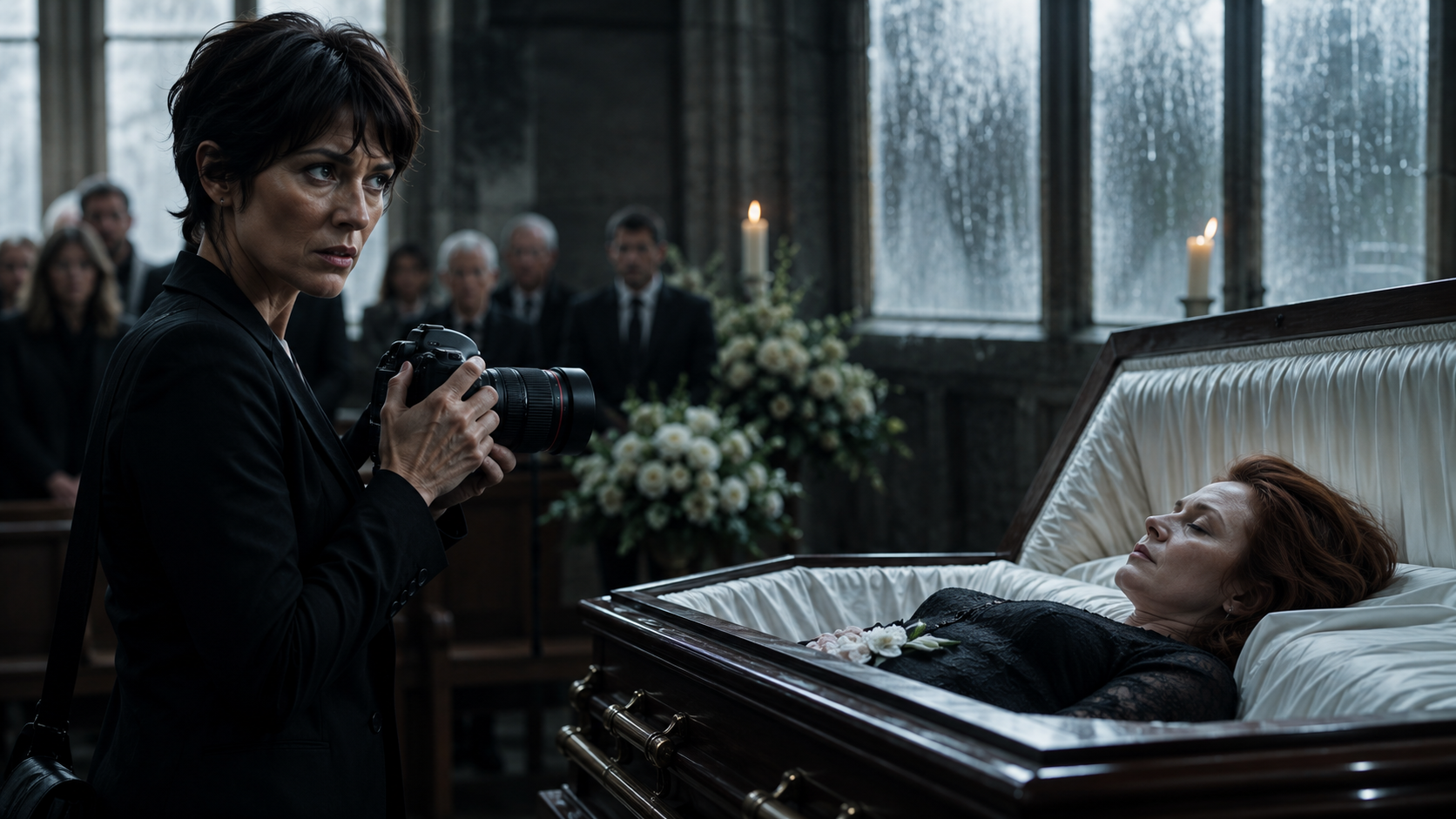
The Last Photograph at Hollowmere Chapel

By the time Tessa Ward realized something was wrong with the woman in the coffin, the funeral was almost over.

Rain had been falling over Hollowmere since dawn, covering the old stone chapel in a silver haze. Water slid down the tall windows in uneven streams, blurring the black umbrellas outside and turning the cemetery beyond them into a watercolor of gray monuments and bare trees.

Inside, nearly a hundred people had gathered to say goodbye to Adrienne Vale.

At forty-six, Adrienne had been too young for the photograph displayed beside the altar. She was smiling in it, standing on a windy beach with her auburn hair blown across her face, one hand raised as if she had been caught halfway through telling the photographer to stop.

Tessa had taken that picture three summers earlier.

Now she stood near the final row of pews with the same camera hanging from her shoulder.

She had almost left it at home.

Bringing a camera to a funeral felt wrong, even though Adrienne’s husband, Owen, had quietly asked her to take a few photographs for relatives who could not attend.

“Nothing intrusive,” he had said. “Just the flowers, the chapel, maybe the family afterward.”

Tessa had agreed because saying no to Owen seemed cruel.

She had known Adrienne for twenty-two years.

They had survived bad apartments, worse relationships, career changes, one disastrous road trip through Scotland, and more arguments than Tessa could remember.

Adrienne had always joked that Tessa saw the world differently because she spent too much time looking through a lens.

“You notice the things everyone else edits out,” she once told her.

At the time, Tessa had laughed.

Standing inside Hollowmere Chapel, she wished it weren’t true.

The minister finished the final prayer.

Owen Vale sat in the front pew beside Adrienne’s younger brother, Marcus. Both men stared at the coffin.

Adrienne had requested a simple service. No speeches longer than five minutes. No sentimental music. No public viewing before the ceremony.

Yet Owen had changed one detail.

The coffin had been left open during the final prayer.

Tessa didn’t know why.

Perhaps he had needed to see her one last time.

Adrienne rested against ivory satin beneath a blanket of white lilies. Her face appeared peaceful, though unnaturally pale beneath the chapel lights. Her hands had been folded at her waist.

No embalming had been performed.

Adrienne had supposedly been clear about that in her funeral instructions.

She wanted cremation.

The cremation was scheduled for that afternoon.

The minister stepped away.

Two attendants approached the coffin.

One reached for the lid.

Tessa lifted her camera.

She intended to take one final photograph.

The shutter clicked three times.

Once.

Twice.

Three times.

Then she lowered the camera.

Something bothered her.

She looked at the coffin again.

Nothing had changed.

Adrienne remained perfectly still.

Tessa glanced at the photographs on the camera’s screen.

First frame.

Second frame.

Third frame.

She enlarged the second image.

Then the third.

Her stomach tightened.

“Wait.”

The word came out louder than she intended.

One of the attendants stopped.

People turned.

Tessa ignored them.

She zoomed in on Adrienne’s face.

The first photograph showed a tiny reflection from one of the chapel candles inside Adrienne’s right eye.

The second showed the same reflection.

But the pupil looked different.

Tessa frowned.

That could be the angle.

She changed images again.

There was something else.

A tiny line of moisture at the corner of Adrienne’s eye.

Tessa looked toward the coffin.

The lid began moving again.

“Don’t close it.”

This time everyone heard her.

The attendant froze.

Owen stood.

“Tessa?”

She walked forward.

Her heels sounded impossibly loud against the stone floor.

Click.

Click.

Click.

Several people moved aside.

“Tessa,” Owen said again. “What’s wrong?”

“I don’t know yet.”

That answer produced an uncomfortable murmur.

Tessa reached the coffin.

Up close, Adrienne looked even more unreal.

Too still.

Too carefully arranged.

Tessa leaned forward without touching her.

“Tessa,” Marcus whispered. “Please.”

She raised one finger.

“Give me ten seconds.”

“For what?”

She didn’t answer.

Instead, she removed the small inspection light she carried in her camera bag.

Years earlier, before becoming a documentary photographer, Tessa had spent four years photographing accident scenes for an insurance investigation firm. She knew enough about bodies to know what she didn’t know.

She also knew that dead eyes did not normally react to light.

She passed the beam across Adrienne’s face.

Once.

Nothing.

Again.

Tessa moved closer.

The pupil narrowed.

Barely.

But it narrowed.

Her heart slammed against her ribs.

“Owen.”

He was standing directly behind her now.

“What?”

“Who pronounced her dead?”

His expression changed.

Not dramatically.

Just enough for Tessa to notice.

“Dr. Kessler.”

“At the hospital?”

“At the Meridian clinic.”

“Was she examined at a hospital afterward?”

Owen stared at her.

“Tessa, what does this have to do with anything?”

“Was she?”

“No.”

Marcus stepped closer.

“What are you saying?”

Tessa looked down at Adrienne.

Then she saw it.

A movement beneath the skin of her throat.

Small enough that anyone blinking would have missed it.

Tessa stopped breathing.

“Get a mirror.”

Nobody moved.

She turned sharply.

“Get me a mirror!”

An elderly woman gasped.

One of the funeral attendants hurried toward a side room.

Owen looked horrified.

“She was declared dead two days ago.”

“I know.”

“Tessa.”

“I know what they told you.”

The attendant returned carrying a small rectangular mirror.

Tessa held it beneath Adrienne’s nose.

Five seconds passed.

Nothing.

Ten.

Someone behind her whispered that this was insane.

Then a faint cloud appeared against the glass.

It vanished almost immediately.

Tessa moved the mirror closer.

Another cloud.

This one was unmistakable.

Marcus made a choking sound.

Owen grabbed the edge of the coffin.

“No.”

Tessa looked at him.

“She’s breathing.”

For several seconds, Hollowmere Chapel became completely silent.

Then everything happened at once.

Someone screamed.

Marcus shouted for an ambulance.

Several guests rushed toward the coffin while others backed away. A chair fell over. The minister stood near the altar with both hands covering his mouth.

Owen remained frozen.

One of the guests, a retired emergency-room nurse named Helen Shaw, pushed through the crowd.

“Move.”

Tessa stepped aside.

Helen placed two fingers against Adrienne’s neck.

Nothing happened.

Three seconds.

Five.

Then Helen’s eyes widened.

“I have something.”

Marcus leaned forward.

“What?”

“A pulse. Very weak.”

The chapel exploded into noise.

Owen collapsed onto the front pew.

Marcus started crying.

Tessa couldn’t move.

She simply stared at Adrienne’s face.

The woman everyone had come to bury was alive.

Barely.

But alive.

Paramedics arrived eleven minutes later.

Adrienne was taken out of Hollowmere Chapel on a stretcher while rain hammered the stone steps.

The funeral guests followed in stunned silence.

Nobody knew what to say.

Nobody understood how it could have happened.

But Tessa had another question.

Why had Adrienne’s cremation been scheduled so quickly?

At St. Matthew’s Medical Centre, doctors worked on Adrienne for hours.

Tessa stayed with Owen and Marcus in the waiting room.

Nobody mentioned the funeral.

Nobody mentioned the coffin.

Eventually, a physician named Dr. Salazar entered.

“She’s stable.”

Marcus covered his face.

Owen closed his eyes.

Tessa felt her knees weaken.

Dr. Salazar continued.

“She’s not conscious yet, but her heart rhythm is improving. Her body temperature was extremely low when she arrived, and her respiration was dangerously suppressed.”

Owen stared at him.

“How does someone like that get pronounced dead?”

The doctor hesitated.

“We’re trying to understand that.”

“Trying?”

“There are medications that can drastically suppress neurological and cardiovascular activity. But I’m not going to speculate until we have laboratory results.”

Tessa looked at Owen.

“What medications was she taking?”

“Nothing unusual.”

“Adrienne was being treated at Meridian.”

“That was for insomnia.”

Tessa remembered the name.

Meridian NeuroRest Institute.

A private clinic located outside the city, famous for treating executives, politicians, musicians, and wealthy patients who wanted privacy.

Adrienne had started going there three months earlier.

She had barely mentioned it.

Tessa suddenly remembered something else.

The last time they had dinner together, Adrienne had seemed distracted.

She had checked the restaurant entrance repeatedly.

At one point she had asked Tessa an odd question.

“If you knew something dangerous about powerful people, would you publish it?”

Tessa had laughed.

“What kind of dangerous?”

Adrienne hadn’t laughed back.

“The kind people would rather keep buried.”

Tessa had assumed she was talking about one of her corporate clients.

Now the memory felt different.

Much darker.

That evening, Owen went home to sleep.

Marcus refused to leave the hospital.

Tessa drove to her apartment.

She did not sleep.

At 2:13 in the morning, she opened every message Adrienne had sent her during the previous six months.

Most were ordinary.

Photos.

Jokes.

Dinner invitations.

Complaints about work.

Then Tessa found a message from twelve days earlier.

It contained only one sentence.

If anything ever happens to me, remember the blue envelope.

Tessa stared at the screen.

She had no idea what it meant.

Then she remembered Adrienne visiting her studio two weeks earlier.

Tessa had been developing a large exhibition print when Adrienne appeared unexpectedly.

She stayed only ten minutes.

Before leaving, she had placed something inside the old metal filing cabinet beside Tessa’s desk.

Tessa hadn’t asked about it.

She drove to the studio immediately.

The blue envelope was still there.

Inside were twelve pages.

The first was a patient consent form from Meridian NeuroRest Institute.

The second was a confidential description of an experimental sleep protocol called Project Lumen.

The next several pages contained dosage records.

Then came an internal safety report.

Tessa didn’t understand most of the medical terminology.

But she understood the sentence Adrienne had circled in red ink.

Three patients had experienced episodes of profound metabolic suppression in which vital signs became extremely difficult to detect using standard portable equipment.

Tessa read it twice.

Then a third time.

There was another document.

An email printed on Meridian letterhead.

Dr. Adrian Kessler, the director of the clinic, had ordered staff not to discuss the incidents outside the research team.

At the bottom, Adrienne had written three words by hand.

They know already.

Tessa called Marcus.

He answered on the first ring.

“She’s awake.”

Tessa almost dropped the phone.

“What?”

“She opened her eyes ten minutes ago.”

“I’m coming.”

“Tessa.”

Something in his voice stopped her.

“What?”

“She keeps asking for you.”

Adrienne looked impossibly small in the hospital bed.

Machines surrounded her.

An oxygen line rested beneath her nose. Her hair had been pulled away from her face.

But when Tessa entered the room, Adrienne’s eyes moved toward her.

“Tess.”

Her voice was almost inaudible.

Tessa sat beside the bed.

“I’m here.”

Adrienne stared at her for several seconds.

Then she whispered, “Did they burn me?”

Tessa felt every hair on her arms rise.

“No.”

Adrienne closed her eyes.

A tear slipped down her cheek.

“I thought they would.”

“What happened?”

Adrienne’s lips trembled.

“Meridian.”

“I found the envelope.”

Her eyes opened again.

“You found it?”

“Yes.”

Adrienne looked toward the door.

“Lock it.”

Tessa did.

Then she returned to the bed.

Adrienne spoke slowly, stopping often to breathe.

Project Lumen had not begun as anything sinister.

It was supposed to be a revolutionary treatment for chronic insomnia, using a new compound that could push the brain into a deep restorative state without traditional sedation.

Adrienne had joined the program because she had spent years sleeping only three or four hours a night.

For the first month, the treatment seemed miraculous.

Then she accidentally received a file that Meridian had meant to send to one of its legal advisers.

The file showed that several patients had suffered frightening complications.

One had been unconscious for seventeen hours.

Another had displayed almost no measurable pulse for more than twenty minutes.

Instead of stopping the study, Meridian had quietly changed the reporting language.

“They were afraid investors would leave,” Adrienne whispered.

Tessa stared at her.

“You threatened to expose them.”

Adrienne nodded.

“Dr. Kessler asked me to come in and discuss it.”

“When?”

“The night I supposedly died.”

Tessa felt cold.

Adrienne remembered drinking tea in Kessler’s office.

She remembered feeling dizzy.

She remembered trying to stand.

Then darkness.

But the darkness had not lasted.

At some point, Adrienne had become aware again.

She could hear voices.

She could feel pressure.

She could sense movement.

But she could not open her eyes.

She could not speak.

She could not lift a finger.

“I heard someone say I had no pulse.”

Tessa leaned closer.

Adrienne continued.

“I heard Kessler.”

“What did he say?”

“He said there was nothing more to do.”

The hospital monitor continued its steady rhythm.

Beep.

Beep.

Beep.

“I tried to scream,” Adrienne whispered. “I couldn’t.”

Tessa swallowed.

“Do you remember the funeral?”

Adrienne looked directly at her.

“All of it.”

Tessa’s mouth went dry.

“The chapel?”

“The minister. Marcus crying. Owen talking to me.”

She paused.

“And your camera.”

Tessa stopped.

“My camera?”

Adrienne gave the smallest possible smile.

“I knew that sound.”

Tears filled Tessa’s eyes.

“I kept thinking… if you were taking pictures, you were close enough to see me.”

Tessa reached for her hand.

“I almost didn’t.”

“But you did.”

A knock came from the door.

Both women froze.

Tessa stood.

The handle moved.

Another knock.

“Tessa?”

It was Owen.

She unlocked the door.

Owen entered, followed by Marcus.

For the first time in two days, there was relief in the room.

It lasted less than an hour.

At 8:40 that morning, two investigators arrived from the regional police department.

At 9:15, they took possession of the documents from the blue envelope.

By noon, Meridian NeuroRest Institute had issued a statement denying wrongdoing.

By three in the afternoon, Dr. Kessler had disappeared.

The police found his car at the airport.

They found no evidence he had boarded a flight.

Tessa returned to her studio shortly after sunset.

She wanted clothes.

Her laptop.

Nothing more.

The building was supposed to be empty.

It wasn’t.

When she opened the studio door, the lights were already on.

The metal filing cabinet stood open.

Drawers had been pulled out.

Papers covered the floor.

Tessa stopped in the doorway.

Then she heard a voice behind her.

“You should have left the envelope where it was.”

Dr. Kessler stood near the stairwell.

He looked nothing like the polished doctor from Meridian’s advertisements.

His coat was wet from the rain.

His hair was disordered.

His face looked exhausted.

Tessa slowly stepped backward.

“The police already have copies.”

“I know.”

“Then why are you here?”

Kessler looked toward her cameras.

“I need the originals.”

“What originals?”

“Adrienne told me what you do.”

Tessa said nothing.

“She photographed documents.”

Tessa understood.

Adrienne had not only left printed copies.

Weeks earlier, she had asked Tessa if she could use the high-resolution scanner in her studio.

At the time, Tessa hadn’t thought twice about it.

Kessler stepped closer.

“Where are the files?”

“Somewhere you can’t reach them.”

His expression hardened.

“You have no idea what you’re involved in.”

“I know you let a living woman be sent to a funeral home.”

“It wasn’t supposed to happen.”

Tessa stared at him.

“That’s your defense?”

“The dose was calculated correctly.”

“She was alive.”

“We couldn’t detect anything.”

“You knew the protocol could make that happen.”

Kessler looked away.

That single movement told her everything.

“You knew.”

He said nothing.

“You knew she might still be alive.”

“Meridian employs four hundred people. The research was worth hundreds of millions. One scandal would have destroyed everything.”

“One scandal?”

Tessa’s voice shook with anger.

“You were going to let them cremate her.”

Kessler took another step toward her.

“They told me the family had already authorized it.”

“Who told you?”

He didn’t answer.

A blue light suddenly flashed across the studio windows.

Then another.

Kessler turned.

Police vehicles stopped outside.

Tessa exhaled.

She had activated the silent emergency button beneath her desk the moment she entered the studio and saw the open cabinet.

Kessler looked back at her.

For the first time, he seemed afraid.

“You planned this.”

Tessa shook her head.

“No.”

Footsteps thundered up the stairs.

“I just notice things.”

Three months later, Meridian NeuroRest Institute closed its doors.

The investigation uncovered suppressed safety reports, altered patient records, unauthorized experimental doses, and payments designed to keep former employees silent.

Dr. Kessler was charged with multiple offenses connected to the trial and the attempt to conceal what had happened to Adrienne.

Several other executives were investigated.

Adrienne spent seven weeks recovering.

She had nerve damage in one hand and sometimes woke from nightmares believing she was still inside the coffin, hearing people mourn her while she desperately tried to move.

But she survived.

On the first warm afternoon of spring, Tessa took her back to Hollowmere.

Not to the chapel.

To the hill beyond the cemetery.

Wildflowers had begun growing between the old stones.

Adrienne stood beneath a pale blue sky while Tessa adjusted her camera.

“No coffins this time,” Adrienne said.

Tessa smiled.

“Not in the budget.”

Adrienne laughed.

It was the first time Tessa had heard that laugh since before the funeral.

She raised the camera.

“Ready?”

Adrienne looked toward the lens.

“Wait.”

Tessa lowered it.

“What?”

Adrienne walked closer.

“There’s something I’ve never told you.”

Tessa waited.

“When I was lying there, I couldn’t feel my hands or my legs. I couldn’t open my eyes. I wasn’t even sure I was still alive.”

Her smile faded.

“Then I heard your shutter.”

Tessa didn’t speak.

“Three clicks.”

Adrienne closed her eyes for a moment.

“I thought, Tessa is looking at me.”

Her voice broke slightly.

“So I kept trying to move my eyes. I thought maybe the light from your camera would give me something to fight against.”

Tessa remembered those photographs.

The changing pupil.

The tiny trace of moisture.

Signs so small she had nearly dismissed them.

“I thought I saved you,” Tessa said.

Adrienne shook her head.

“You gave me a reason to keep trying.”

For a moment neither woman spoke.

Then Adrienne returned to her place beneath the tree.

Tessa lifted the camera.

Sunlight moved across Adrienne’s face.

She was thinner now.

There were shadows beneath her eyes.

A faint scar crossed the back of her hand.

Tessa left all of it exactly as it was.

No retouching.

No attempt to make the picture prettier than the truth.

She pressed the shutter.

Click.

Adrienne smiled.

Click.

A gust of wind caught her hair.

Click.

Tessa lowered the camera.

Years later, that photograph would become the most famous image she ever took.

People would ask about the woman standing beneath the tree.

They would ask why she looked both exhausted and impossibly happy.

They would ask what had happened before the photograph was taken.

Tessa never gave them the entire story.

Some stories belonged to the people who survived them.

But whenever someone asked why she had become so obsessed with small details, Tessa always gave the same answer.

Because sometimes the difference between what everyone believes and what is actually true is almost invisible.

Sometimes it is nothing more than a reflection changing inside an eye.

A breath appearing on a piece of glass.

A hand that refuses to move.

And one person willing to look twice.