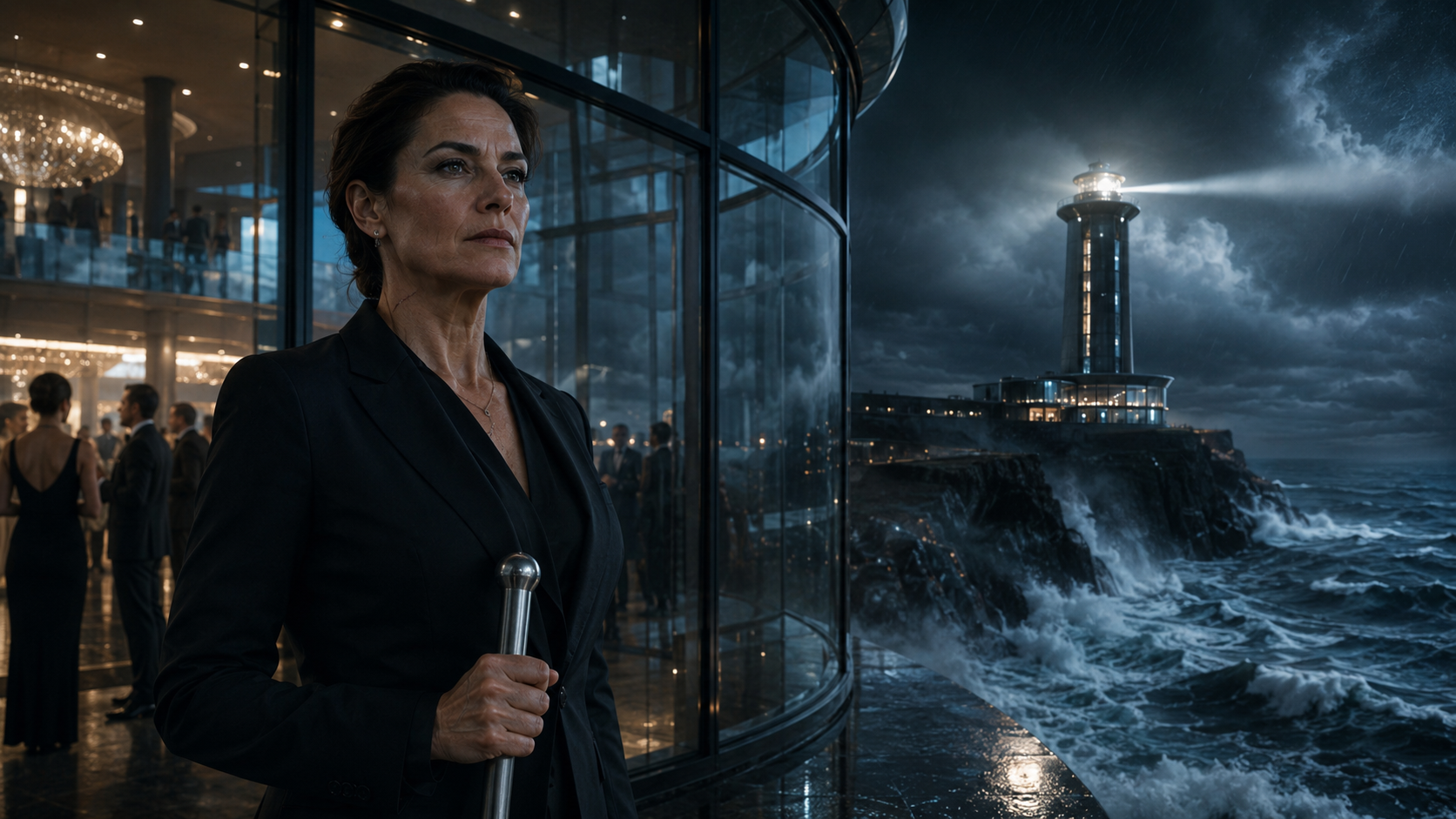
Everyone had been invited to witness Eleanor Vane surrender her life’s work.
The invitation described the evening as a celebration.
There would be champagne beneath the glass roof of Asterion Point, a chamber orchestra overlooking the black Atlantic, and a formal announcement concerning the future of Vane Maritime Technologies.
No one used the word retirement.
No one mentioned the explosion.
And no one dared say that the woman who had built the most powerful marine-engineering company in Europe was expected to sign away control before midnight.
But that was why they had come.
The guests crossed the illuminated bridge leading to Asterion Point in polished cars and private shuttles. Investors stepped out wearing tailored dinner jackets. Politicians arrived with discreet security teams. Technology executives smiled for photographers while pretending they had not already discussed how Eleanor’s patents would be divided after the sale.
Beyond them, waves struck the cliffs with enough force to shake the glass walls.
Asterion Point had been Eleanor’s masterpiece.
Part research laboratory, part lighthouse and part fortress, the structure rose from the rocks like a blade of silver driven into the coast. Deep beneath it, submerged turbines converted the violence of the ocean into clean energy.
For eighteen years, Eleanor had told anyone willing to listen that the sea did not need to be conquered.
It needed to be understood.
Then, seven months earlier, an explosion had torn through one of her experimental vessels.
Three engineers died.
Eleanor survived.
Barely.
The blast damaged the nerves along the right side of her body. It left a silver scar beneath her jaw and reduced her once-commanding voice to a strained whisper. For several weeks, she could not recognize written words. For two months, she could not hold a cup without assistance.
The newspapers called her survival miraculous.
Her younger brother called it tragic.
Malcolm Vane had spent most of his adult life standing several steps behind Eleanor.
He had inherited their father’s charm, their mother’s aristocratic features and none of Eleanor’s discipline. Where Eleanor studied tidal systems, Malcolm studied people. He remembered birthdays, marriages, rivalries and weaknesses. He could enter a room of strangers and leave with three invitations, two secrets and a promise of money.
For years, Eleanor had kept him close enough to protect the family name but far enough from the company’s engineering divisions to prevent disaster.
After the explosion, that distance disappeared.
Malcolm began attending board meetings on Eleanor’s behalf.
He assured investors that his sister needed peace.
He told senior engineers that difficult decisions could worsen her condition.
He informed journalists that Eleanor’s recovery remained uncertain.
Beside him stood Sabine Keller, Asterion’s chief operating officer.
Sabine had worked with Eleanor for twelve years. She understood the company’s contracts, patents and debts better than anyone except Eleanor herself.
During Eleanor’s recovery, Sabine became the calm voice of continuity.
She redirected projects.
Replaced department heads.
Restricted access to technical archives.
And negotiated a secret acquisition agreement with Northstar Global, Asterion’s largest competitor.
The agreement would make Malcolm wealthy.
It would make Sabine indispensable.
And it would end Eleanor’s control permanently.
Tonight, all Eleanor had to do was sign.
At eight fifteen, the orchestra began playing.
The guests gathered beneath suspended lights shaped like drops of water. Waiters carried trays between tables decorated with white orchids and polished fragments of sea glass.
At the northern end of the hall stood a raised platform.
A black folder rested on a narrow table at its center.
Inside were the transfer documents.
Malcolm stood near the platform, greeting investors with the confidence of a man already imagining his new office.
Sabine remained beside him.
She wore a dark silver gown and no jewelry except Eleanor’s old company pin.
It had been presented to her ten years earlier after she saved an important research program from bankruptcy.
Eleanor had trusted her then.
That memory no longer seemed to trouble Sabine.
“Has she arrived?” Malcolm asked quietly.
Sabine checked the time.
“Her driver crossed the bridge six minutes ago.”
“Is she bringing the nurse?”
“The rehabilitation specialist.”
Malcolm frowned.
“That was not the agreement.”
“She still needs assistance walking.”
“She needs assistance thinking.”
Sabine looked toward him.
“Do not underestimate her in public.”
Malcolm smiled.
“That warning is seven months too late.”
The orchestra changed tempo.
A murmur moved through the hall.
Eleanor Vane had entered.