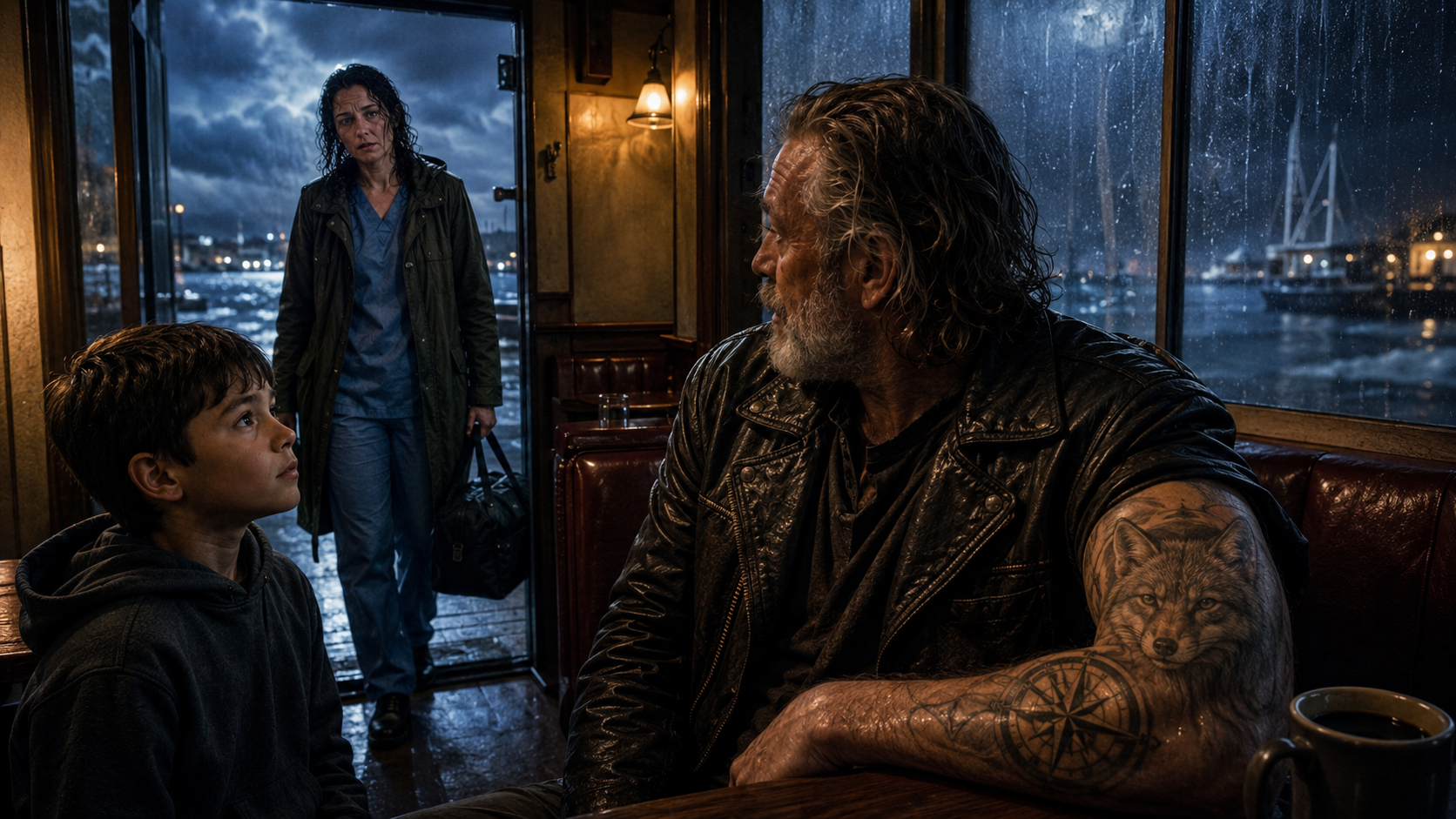
By the time the storm reached Port Alder, the ocean had vanished.
It was still there, somewhere beyond the black windows of the Breakwater Café, but the rain had swallowed the harbor, the fishing boats, and the row of weathered buildings along the shore. Wind hammered the glass hard enough to make the coffee cups tremble in their saucers.
Nine-year-old Theo Vale sat alone in the last booth.
His red backpack rested beside him. One strap had been repaired with silver tape, and the zipper no longer closed properly. A library book about sea monsters stuck out of the top.
In front of Theo stood a mug of cocoa that had stopped steaming nearly an hour ago.
He had drawn a maze in the condensation on the window. At the center of it, he had made a tiny house. Outside the maze, he had drawn two figures holding hands.
One was small.
The other wore a long coat and had dark curls.
Lorna Bell, the café’s owner, watched him from behind the counter as she polished the same glass for the third time.
“Your mother called again,” she said. “The highway is moving slowly, but she’s coming.”
Theo nodded.
“She always comes.”
“I know she does.”
Lorna placed a warm cinnamon roll beside his cold cocoa.
Theo looked at it but did not touch it.
His mother had told him not to accept free food when they could not pay for it. Lorna had told him that cinnamon rolls left on the counter after eight o’clock belonged to nobody.
They had been having that argument for months.
Camille Vale worked as a home-care nurse. She drove through coastal towns, mountain communities, and isolated farms to visit patients who could no longer travel to a clinic. Some nights she came home smelling of antiseptic. Other nights she smelled of woodsmoke, wet dogs, or whatever meal an elderly patient had insisted on feeding her.
Lately, she came home later than usual.
She also checked the mailbox before Theo could reach it.
When bills arrived, she folded them in half and placed them beneath a chipped blue bowl on top of the refrigerator.
Theo knew more than she believed he did.
He knew their apartment building had been sold.
He knew the new owner wanted everyone out before winter.
He knew Camille’s car made a grinding sound whenever she turned left.
He knew she sometimes skipped dinner and claimed she had eaten with a patient.
But she always came for him.
Even in rain.
Even in snow.
Even when her eyes were red with exhaustion and she had to sit in the car for a minute before pretending everything was fine.
So Theo waited.
At 8:17 p.m., six motorcycles rolled into the parking lot.
Their headlights appeared first, floating through the rain like pale moons. Then the machines emerged from the darkness, black and silver, water flying from their tires.
The riders parked beneath the broken awning.
Five men and one woman entered the café.
The room changed the moment they stepped inside.
They wore weather-darkened jackets, heavy boots, and gloves stained by years of oil and road dust. Rain gleamed on their shoulders. Their faces carried old scars, windburn, and the calm expressions of people who had spent too much time in dangerous places.
The woman removed her helmet first.
She was tall, perhaps sixty, with close-cropped white hair and a narrow scar through one eyebrow. A coil of rope hung from her pack.
Behind her came a broad man with a gray beard, a thin rider with a mechanical brace around one knee, and two younger men carrying waterproof tool cases.
The last rider through the door was the oldest.
He moved slowly, but the others unconsciously made space for him.
He had a weathered face, deep-set eyes, and silver hair tied at the back of his neck. His leather jacket bore no club name. There was only a small patch on the left shoulder: a silver fox standing beneath an eight-pointed star.
Lorna pointed toward the largest table.
“Coffee?”
“All of it,” the white-haired woman said.
A few customers smiled nervously.
The oldest rider did not.
He looked toward the windows and listened to the storm as though it were speaking a language only he understood.
The riders settled at the long table near the counter. They spoke quietly about the flooded highway, a fallen tree near Grayson Point, and whether the bridge north of town would remain open.
Theo watched them over the edge of his book.
He had seen motorcyclists before. Port Alder sat along a famous coastal road, and every summer brought riders from distant cities. These people were different.
They did not laugh loudly or try to frighten anyone.
They checked the weather radar.
They placed a battery-powered radio between the sugar jar and the napkin holder.
One of the younger men spread a paper map across the table.
The oldest rider removed his wet jacket and rolled up his sleeves.
That was when Theo saw the tattoo.