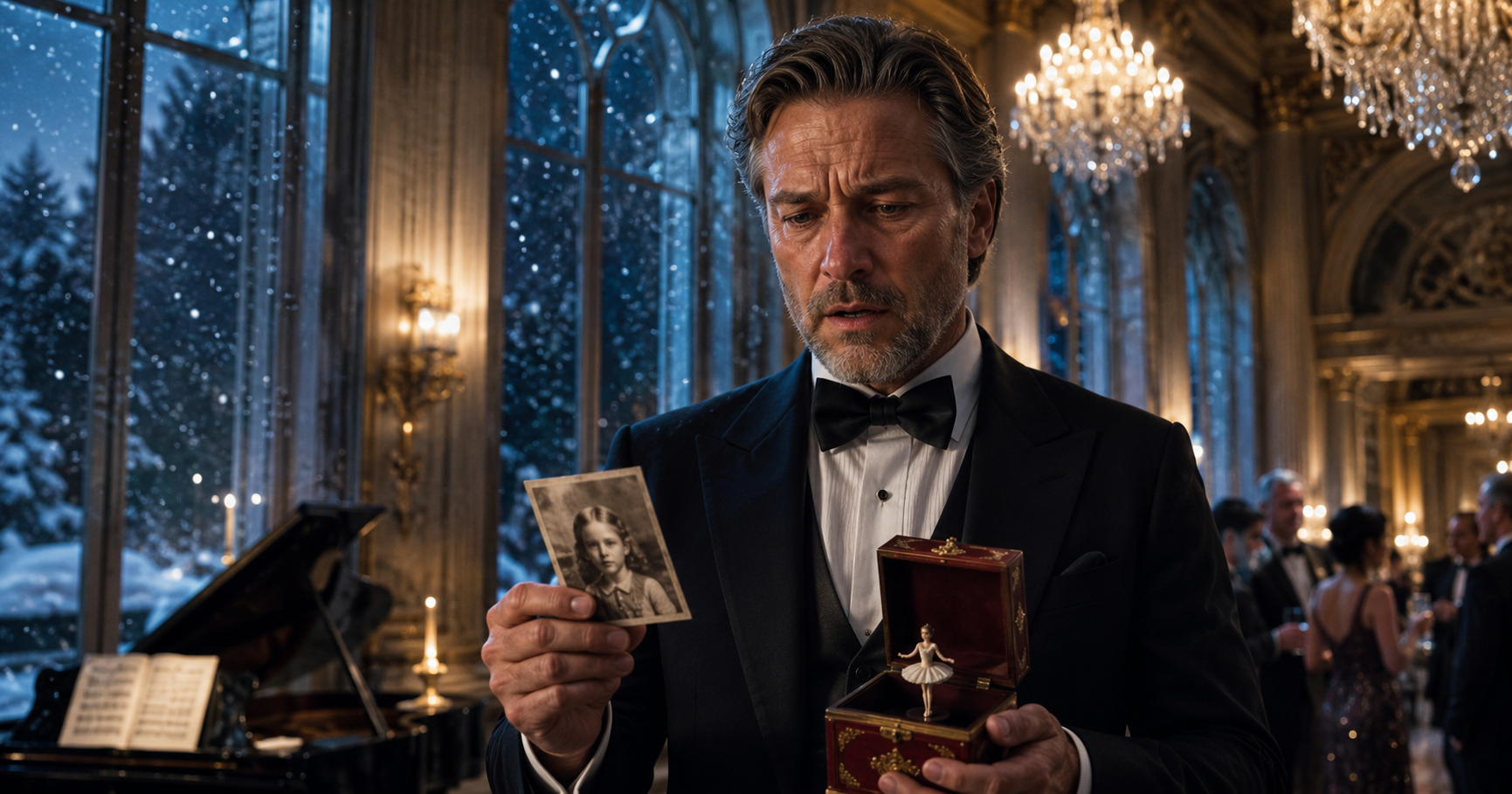
Adrian Voss had spent eleven years surrounded by sound he could no longer hear.
Music followed him everywhere. It played in the elevators of the hotels he owned, inside the restaurants carrying his name, and through the wireless speakers produced by the technology empire that had made him one of the richest men in Europe.
To everyone else, Adrian Voss was the man who had changed the way the world listened.
To Adrian, the world had been silent since the night his car went through a mountain barrier during a snowstorm.
The surgeons saved his life. They repaired his spine, rebuilt part of his jaw, and installed an experimental hearing device behind his left ear. Nothing restored the music.
Since then, Adrian had learned to read lips with unsettling precision. He could understand a conversation across a crowded room. He could detect lies from the smallest hesitation in a person’s mouth. He could silence an entire board of directors by lifting one finger.
But he could not hear his own footsteps.
He could not hear rain against glass.
And he could not remember the exact sound of his daughter’s voice.
That was the loss he never admitted.
On the final evening of December, Adrian sat beneath the crystal ceiling of the Marlowe Grand Hotel while six hundred guests celebrated his company’s twenty-fifth anniversary.
Golden lights reflected from champagne glasses. An orchestra played on a raised stage. Famous actors, politicians, and business leaders applauded whenever Adrian’s face appeared on the enormous screens behind the musicians.
Adrian watched them from a private table near the stage.
Beside him sat Victor Crane, the company’s chief legal officer and Adrian’s closest adviser. Victor had remained at Adrian’s side through the accident, the surgeries, and the disappearance of Adrian’s only child.
“You should smile,” Victor said slowly, making sure Adrian could read every word. “They came here for you.”
Adrian glanced toward the crowd.
“They came because they want something.”
Victor smiled. “That is why anyone comes anywhere.”
A waiter placed a silver plate in front of Adrian. He did not touch it. Food had tasted different since the accident, and public celebrations exhausted him. He had already decided to leave immediately after the charity auction.
Onstage, the orchestra finished a piece. The audience rose in applause.
Adrian saw hands coming together but heard nothing.
Then the doors at the back of the ballroom opened.
A girl entered carrying a baby.
She could not have been older than thirteen. Her oversized green coat was soaked with snow, and strands of dark hair clung to her face. A boy of about nine followed her, holding a battered violin case against his chest.
They did not belong among silk dresses, black tuxedos, and diamond necklaces.
Two security officers moved toward them.
The girl stepped onto a chair.
“Mr. Voss!”
Adrian did not hear her voice, but he saw the shape of his name on her lips.
Several guests turned. Victor signaled to security.
The girl raised the baby higher.
“You built machines that made everyone listen,” she shouted. “But you never listened to your own daughter.”
Adrian stood.
The movement was so sudden that Victor nearly knocked over his glass.
“What did she say?” Adrian demanded.
Victor’s expression remained calm. “Nothing important. Some children looking for attention.”
Adrian looked directly at the girl.
“Bring her here.”
Victor touched his sleeve. “Adrian, this is a private event.”
“Bring her here.”
The security officers escorted the children through the ballroom. Guests whispered as the girl approached Adrian’s table, still holding the baby tightly against her chest.
Up close, Adrian could see that the child was shivering.
The younger boy remained behind his sister. His fingers were white around the handle of the violin case.
“What is your name?” Adrian asked.
“Mira.”
“And the boy?”
“My brother, Benji.”
Adrian looked at the infant.
“And the baby?”
The girl hesitated.
“His name is Sol.”
Victor stepped between them.
“You have interrupted a private celebration. Give your contact information to security, and someone will speak with you tomorrow.”
“We don’t have a telephone,” Mira replied.
“Then leave an address.”
“We don’t have one of those either.”
Victor’s smile disappeared.
Adrian watched the girl’s face. She was frightened, but not of him. Her eyes kept moving toward Victor.
“Why did you mention my daughter?” Adrian asked.
Mira looked around at the crowded ballroom.
“Because our mother told us to find you.”
Adrian felt something tighten beneath his ribs.
“Who is your mother?”
The girl slowly placed the baby into Benji’s arms. Then she opened the old violin case.
There was no violin inside.
The case contained a red music box, several sealed envelopes, a small brass key, and a photograph wrapped in plastic.
Mira handed Adrian the picture.
It showed a young woman standing beside a frozen lake. Her hair was shorter, and there were shadows beneath her eyes, but Adrian recognized her immediately.
Elara.
His daughter.
The person he had been told was dead.
Adrian gripped the photograph so tightly that the plastic covering bent.
“This is impossible.”
“It was taken three months ago,” Mira said.
Victor reached for the picture, but Adrian pulled it away.
“Where is she?”
“In a hospital outside Bellmere.”
Victor shook his head.
“Adrian, this is clearly a fraud. Anyone can alter a photograph.”
Mira opened one of the envelopes.
“Our mother knew you would say that. She said to give you this.”
Inside was a sheet of paper covered with handwritten musical notes.
Adrian stared at them.
Years earlier, when Elara had been unable to sleep, Adrian had composed a lullaby for her. He called it “Winter Lanterns.” He had never recorded it, published it, or played it for anyone outside their home.
After Elara disappeared, Adrian destroyed every copy he could find.
Yet the melody was now resting in his hands.
At the bottom of the page, someone had written:
You always forgot the final note, Dad.
Adrian’s vision blurred.
He looked at Victor.
“You told me she died in Prague.”
Victor lowered his voice.
“That was the information we received.”
“You identified the body.”
“I identified the documents attached to the report. You were recovering from surgery. You asked me to handle everything.”
Mira turned the key on the side of the music box.
The cylinder began to rotate.
Adrian heard nothing, but the baby reacted immediately.
Sol lifted his head from Benji’s shoulder and smiled. Then he began to hum along with the melody.
It was not a song a baby should have known.
Adrian placed his hand on the polished table. Through the wood, he felt the faint rhythm of the music box.
One vibration.
Then another.
The experimental device behind his ear gave a sudden pulse.
Adrian flinched.
A thin sound pierced the silence.
It was weak and distorted, almost like a note traveling through deep water, but it was there.
For the first time in eleven years, Adrian heard something.
Sol hummed again.
The sound sharpened.
Adrian stared at the baby as a fragile sequence of notes entered his silent world. The melody was broken, imperfect and distant, but he recognized it.
Winter Lanterns.
The lullaby he had written for Elara.
Adrian sank back into his chair. Tears moved down his face before he realized he was crying.
Victor leaned toward him.
“Your implant must be malfunctioning.”
“No,” Adrian whispered.
He could not clearly hear his own voice, but he felt it in his chest.
“It is working.”
The ballroom had become motionless. Hundreds of people watched as one of the most powerful men in the country wept in front of three homeless children.
Adrian wiped his face.
“How does the baby know that melody?”
Mira looked at Sol.
“Our mother sang it every night.”
“Is he her child?”
“Yes.”
Adrian’s eyes moved from Sol to Mira and then to Benji.
“And you?”
“We are all hers.”
The truth reached him slowly.
These children were not strangers asking for money.
They were his grandchildren.
Adrian turned toward Victor.
“Why did Elara believe I had abandoned her?”
Victor’s expression hardened.
“I have no idea.”
Mira took out the brass key.
“She said this opens a room beneath the old Lyric Theatre. She said the proof is there.”
Victor’s face changed.
Only for a second, but Adrian saw it.
That second was enough.
“Seal the ballroom,” Adrian ordered.
Victor stepped back.
“You are allowing an emotional performance to distort your judgment.”
“You knew about the theatre.”
“I know dozens of properties in this city.”
“The Lyric was never listed among our properties.”
Victor looked toward the exits.
Adrian’s security chief moved into his path.
For the first time in twenty years, Victor Crane appeared uncertain.
Adrian turned to Mira.
“Take me there.”
The Lyric Theatre had been closed since the fire that damaged its eastern wing eight years earlier. Snow covered the faded entrance, and the letters above the doors had begun to fall away.
Adrian entered with the children, two security officers, and the hotel physician. Victor followed under guard.
Mira led them beneath the stage.
Behind a row of broken scenery panels stood a narrow metal door. The brass key opened it.
Inside, they found shelves filled with boxes.
Letters.
Medical records.
Photographs.
Bank statements.
Recordings.
Every box carried Adrian’s name.
For years, Elara had written to her father. She had sent photographs of Mira’s birth, Benji’s first day of school, and Sol sleeping in her arms.
None of the letters had reached him.
Victor had intercepted them.
Elara had discovered that Victor was moving company money through false charities. When she threatened to tell Adrian, Victor used the chaos following the accident to separate them. He told Elara that her father blamed her for the crash. He told Adrian that Elara had disappeared with a criminal and later died abroad.
The lie protected Victor’s position and gave him control over Adrian while Adrian recovered.
At the back of the room, Benji found a small recording device.
Mira pressed the button.
A woman appeared on its cracked screen.
Elara sat in a hospital bed. She looked exhausted, but her eyes were unmistakably Adrian’s.
“Dad,” she said, looking into the camera, “I don’t know whether this will reach you. I don’t even know whether you want it to.”
Adrian watched her lips. His hearing device produced only fragments of sound.
“Victor told me you never wanted to see me again. For years, I believed him. Then I found copies of the letters you sent before the accident. You were looking for me.”
Elara paused to breathe.
“I should have tried sooner. I was ashamed, angry, and afraid. But my children deserve to know they have a family.”
She looked away from the camera.
“If Mira finds you, please listen to her. She is braver than either of us.”
The recording ended.
Adrian remained still.
Then he faced Victor.
“You took eleven years from us.”
Victor’s confidence returned in a final, desperate flash.
“I protected the company. Your daughter would have destroyed everything you built.”
Adrian stepped closer.
“No. She tried to save it from you.”
Before dawn, police vehicles surrounded the theatre.
Adrian traveled with the children to Bellmere.
The hospital stood beside a frozen river, far from the shining towers that carried the Voss name. Elara was in a small room on the third floor.
When Adrian entered, she turned toward him.
For several seconds, neither of them moved.
He saw the woman she had become, but he also saw the child who used to wait beside his piano, correcting him whenever he played the final note of her lullaby incorrectly.
Elara’s lips trembled.
“You came.”
The device behind Adrian’s ear crackled.
He heard only two words.
But they were her words.
Her voice.
Older, softer, and wounded by time, yet still hers.
Adrian crossed the room.
“I should have come eleven years ago.”
Elara began to cry.
He sat beside her and took her hand.
“I believed a lie because it was easier than admitting I had failed you.”
“You didn’t know.”
“I should have searched harder.”
She looked toward the doorway, where Mira stood with Benji and Sol.
“You can start now.”
Weeks later, Victor Crane was charged with fraud, unlawful surveillance, falsification of medical records, and conspiracy. Adrian opened every intercepted letter in the theatre room and read them in the order Elara had written them.
He did not try to buy forgiveness.
Instead, he stayed.
He attended Elara’s treatments. He learned how Mira liked her tea, why Benji feared locked doors, and which songs made Sol laugh. He reopened the Lyric Theatre as a home and education center for families without permanent housing.
Adrian’s hearing never completely returned.
Some days, he heard voices as though they were coming through a wall. On other days, the silence closed around him again.
But every evening, Elara sat beside the old piano in his house while the children gathered nearby.
Adrian played “Winter Lanterns.”
Mira sang.
Benji corrected the rhythm.
Sol struck random keys with both hands.
And whenever Adrian forgot the final note, Elara leaned close enough for him to read her lips.
“You always forget that one, Dad.”
This time, Adrian smiled.
Then he played it correctly.

