THE THIRD KNOCK AT GREYHAVEN HARBOR

The first knock was so faint that Mina Vale thought it had come from the chapel roof.

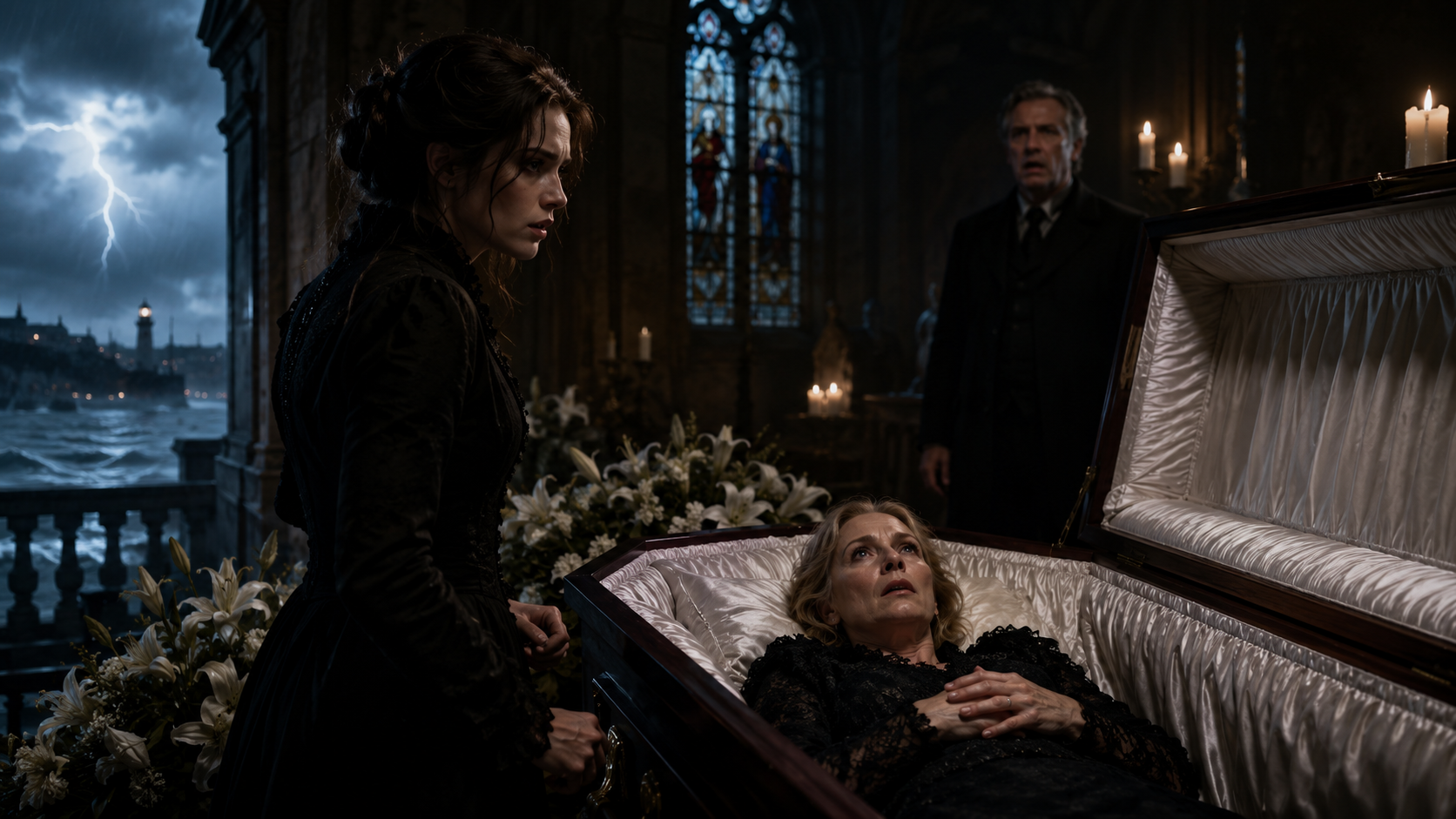
Rain had been striking the old copper panels since dawn. Wind pushed against the stained-glass windows, making the saints tremble inside their frames. Beyond the chapel walls, Greyhaven Harbor had disappeared beneath a curtain of fog.

Mina lowered her eyes.

At the front of the room stood a dark walnut coffin surrounded by white lilies.

Her mother lay inside it.

Elara Vale had been fifty-one years old when a housekeeper found her unconscious beside the fireplace in her private study. The family physician had declared that her heart had stopped. By the time the ambulance arrived, there had been nothing left for the paramedics to do.

That was what everyone had been told.

That was what Mina had tried to believe.

Her mother was dead.

The woman who had taught her to swim in winter water, read the weather from the color of the clouds, and repair a boat engine with a kitchen knife was gone.

At the pulpit, Gideon Vale placed one hand over his heart.

He wore a perfectly tailored black suit. His silver hair had been combed neatly away from his forehead, and his expression carried exactly the right balance of dignity and pain.

“My wife believed that every life could be saved,” he told the mourners. “Even when the rest of us had surrendered hope, Elara continued searching for a way through the storm.”

Several people began to cry.

Mina did not.

She watched Gideon carefully.

He had been married to Elara for twenty-three years. To the people of Greyhaven, he was a grieving husband, a respected businessman, and the generous chairman of the Vale Maritime Rescue Foundation.

To Mina, he had always been something more difficult to define.

He had paid for her education. He had attended her birthdays. He had smiled for family photographs and introduced her proudly as his daughter.

But he had never once looked at her with warmth.

Elara had adopted Mina after the Meridian ferry disaster left her without parents. Gideon had accepted the arrangement, but Mina had always sensed that he regarded her as a permanent reminder of something he wanted forgotten.

The second knock came while the priest was speaking.

This time Mina lifted her head.

She looked toward the coffin.

Nobody else reacted.

The mourners sat with their hands folded. Gideon remained beside the pulpit. The priest continued reading from his book.

Mina leaned forward.

Her heart began to beat faster.

Three soft sounds had once been part of a private language between Mina and her mother.

When Mina was a child, storms terrified her. During the worst nights, Elara would sit on the other side of her bedroom wall and tap three times.

Knock.

Knock.

Knock.

It meant: I am here.

Mina would answer with the same pattern.

Now the chapel fell momentarily silent as the priest turned a page.

From inside the coffin came the third knock.

Mina stood so suddenly that her chair struck the stone floor.

Every face turned toward her.

“Mina?” Gideon said.

She walked into the center aisle.

“I heard something.”

A murmur passed through the room.

Gideon descended from the pulpit. His expression remained calm, but a small muscle moved beside his right eye.

“You are exhausted,” he said gently. “Come and sit down.”

Mina continued toward the coffin.

“I heard three knocks.”

Several mourners exchanged worried glances.

Gideon caught her arm.

“Your mother is gone.”

Mina pulled away.

“Then opening the coffin won’t hurt her.”

The priest stepped between them.

“This is neither the time nor the place.”

Another sound came from beneath the polished lid.

It was not a knock.

It was a scrape.

Mina ran to the coffin.

Someone tried to stop her, but she grabbed the brass pole supporting a ceremonial banner and forced its pointed end beneath the lid.

Gideon’s calm expression disappeared.

“Get her away from there!”

Two men moved forward.

Mina pushed down with all her weight.

The lid shifted.

A hiss of trapped air escaped from the coffin.

People screamed and stumbled backward.

The priest dropped his book.

Mina forced the lid higher.

Elara Vale lay beneath a layer of white silk.

Her skin was pale, and her lips carried a faint blue shadow. For one terrible moment, she appeared exactly as a dead woman should.

Then her chest moved.

Only slightly.

But it moved.

“Call an ambulance!” Mina shouted.

Elara’s eyelids fluttered.

Her right hand trembled against the silk lining.

Mina leaned closer.

“Mom, I’m here.”

Elara opened her eyes.

They were unfocused at first. Then they found Mina’s face.

Relief appeared in them.

It lasted less than a second.

Elara looked past her daughter.

Directly at Gideon.

Her lips moved, but no sound emerged.

Mina lowered her ear.

“What are you trying to say?”

Elara drew a shallow, painful breath.

“He sank the Meridian.”

Gideon lost all color.

The ambulance arrived nine minutes later.

By then, the chapel had become a place of panic. Paramedics pushed through the crowd while police officers tried to separate witnesses. Someone had recorded the opening of the coffin, and the video was already spreading across the city.

Mina rode beside her mother to Greyhaven Memorial Hospital.

Gideon attempted to follow, but Mina blocked the ambulance door.

“You heard what she said.”

“She was barely conscious.”

“She said your name.”

“She said something about a ship.”

“She said you sank it.”

Gideon glanced at the gathering crowd.

When he looked back at Mina, grief had vanished from his face.

In its place was something cold.

“Your mother has been under enormous pressure,” he said. “When she wakes properly, she may not remember any of this.”

The ambulance doors closed between them.

Elara survived the night.

Doctors placed her in intensive care and ran every test available. Her heartbeat had become so weak that ordinary equipment had failed to detect it. Her breathing had slowed until it was almost invisible.

But the condition had not occurred naturally.

A toxicology specialist found traces of an experimental paralytic compound in her bloodstream. It had shut down her muscles and reduced her vital signs without immediately killing her.

Someone had wanted Elara to appear dead.

Someone had nearly succeeded.

The police questioned Gideon.

He told them that Elara had been alone in her study on the evening she collapsed. He said she had been anxious, sleeping poorly, and taking several medications. He described her accusation in the chapel as the confusion of an oxygen-starved brain.

By morning, he had been released.

There was no direct evidence linking him to the poison.

Elara regained full consciousness two days later.

Mina was sitting beside her bed when she opened her eyes.

The hospital room was dark except for the green light of the monitoring equipment. Rain moved quietly against the window.

Elara looked at the closed door.

“Is he here?”

“No.”

“Are you certain?”

“I told security not to let him upstairs.”

Elara reached for Mina’s hand.

Her fingers were still weak.

“He knows about the recording.”

“What recording?”

“The original Meridian distress transmission.”

Mina felt the room grow smaller.

The Meridian had sunk seventeen years earlier during a winter crossing between Greyhaven and the northern islands. The official investigation concluded that a rogue wave had damaged the ferry’s electrical system and flooded its lower deck.

One hundred and six people had died.

Among them were Mina’s parents.

Only thirty-two passengers survived.

Gideon Vale had been one of them.

At the time, he was a young shipping contractor traveling aboard the ferry. Newspapers called him a hero after he helped lower a damaged lifeboat and pulled two children from the sea.

His reputation following the disaster had made him famous.

His fame had brought investors.

The investors had made him rich.

“What did you find?” Mina asked.

Elara closed her eyes for a moment, gathering strength.

“The investigation used an edited transmission from the ferry. Twelve minutes were missing. Everyone assumed the storm had interrupted the signal.”

“But it didn’t?”

“No.”

Elara looked at her daughter.

“Someone removed those twelve minutes.”

Years earlier, while cataloguing equipment in the foundation’s maritime archive, Elara had discovered a box of damaged emergency radio components. One device had been taken from an abandoned coastguard station after the Meridian disaster.

Inside it was an old backup recording unit.

The tape had survived.

It contained the missing transmission.

On the recording, the Meridian’s chief engineer could be heard arguing with someone on the bridge. He reported that ballast controls had been deliberately overridden. A lower cargo compartment had been flooded, causing the ferry to list during the storm.

The engineer also mentioned unauthorized chemical drums stored beneath the vehicle deck.

Those drums belonged to one of Gideon’s former companies.

“He was transporting industrial waste illegally,” Elara whispered. “The crew discovered it during the crossing. The captain threatened to contact the authorities as soon as they reached Greyhaven.”

Mina stared at her.

“So Gideon flooded the ship?”

“He says it was an accident.”

“You spoke to him?”

“I confronted him the night I collapsed.”

Elara’s voice began to shake.

Gideon had entered her study carrying two glasses of wine. Elara had placed the restored recording on her desk and asked him to explain it.

At first, he denied everything.

Then he said the ferry was already in danger. The cargo had shifted. The captain was panicking. Gideon had attempted to stabilize the vessel by adjusting the ballast system.

But he had opened the wrong valves.

Water rushed into the lower deck.

The ferry turned broadside to the waves.

By the time Gideon understood what he had done, the Meridian was dying.

He could have admitted his mistake.

Instead, he damaged the radio equipment, destroyed the cargo records, and spent the following years building a heroic version of himself.

“Did he put the poison in your wine?” Mina asked.

“I never drank it.”

“Then how?”

“The fireplace.”

Elara explained that Gideon had dropped a small capsule into the flames. The substance vaporized instantly. She remembered a bitter smell, a sudden weakness in her legs, and Gideon watching her fall.

The last thing she saw was him kneeling beside her.

Not to help.

To check her pulse.

“He thought I was dead,” Elara said. “But he still needed the recording.”

“Where is it?”

“I gave it to Jonas Pike.”

Mina knew the name.

Jonas was a retired rescue diver who lived in an old signal house beyond the eastern breakwater. He had worked on the recovery operation after the Meridian sank.

“He hid it inside Red Nine,” Elara continued.

“Red Nine?”

“The warning buoy near Wren Head.”

Mina looked toward the window.

The storm outside was strengthening. Wren Head stood several miles beyond the harbor wall, where submerged rocks formed a narrow channel. Red Nine warned ships away from the most dangerous section.

During severe weather, the buoy was often removed before it broke free.

“When will the harbor crew bring it in?” Mina asked.

“At first light.”

“And Gideon knows?”

“He heard part of my conversation with Jonas.”

Mina stood.

“I’m going to get it.”

“No.”

“It proves what happened to my parents.”

“It is too dangerous.”

“So is leaving it where Gideon can reach it.”

Elara tightened her grip.

“Mina, listen to me. Gideon has spent seventeen years protecting this secret. He has already tried to bury me once.”

Mina looked at her mother.

“Then he won’t expect you to have raised someone who knows how to survive a storm.”

Jonas Pike did not look surprised when Mina arrived at his signal house.

He stood in the doorway wearing a heavy waterproof coat. His white beard moved in the wind, and an old diving lamp burned on the table behind him.

“Elara woke up,” Mina said.

“I heard.”

“She told me about Red Nine.”

Jonas studied her face.

“Then we don’t have much time.”

His boat was a narrow rescue launch named Patience.

It had a reinforced hull, two powerful engines, and more repairs than original parts. Mina climbed aboard while Jonas released the ropes.

They left the harbor without navigation lights.

Fog covered the water. Rain moved horizontally across the deck. Each wave lifted the launch and dropped it into a black hollow.

Mina held the railing.

“Why didn’t you take the recording to the police?”

“I did, seventeen years ago.”

She turned toward him.

Jonas kept his eyes on the compass.

“I reported that part of the transmission was missing. I told the investigators someone had interfered with the radio. Two days later, my house was searched. The notes I had made disappeared.”

“Gideon?”

“I couldn’t prove it.”

“Why help my mother now?”

“Because she believed me.”

The light on Red Nine appeared through the fog.

The buoy rose and vanished between the waves. A steel bell beneath its frame rang with each movement, producing a lonely, uneven sound.

Jonas brought the launch alongside it.

Mina secured a line and climbed onto the narrow maintenance platform. Cold water struck her boots.

At the center of the buoy was a sealed electrical housing.

She removed the panel.

Behind the wiring, wrapped in waterproof material, was a black metal cylinder.

“I found it!” she shouted.

A second engine answered from the fog.

Jonas turned.

A larger vessel approached without lights.

Mina recognized Gideon’s private patrol boat.

A voice came through its loudspeaker.

“Bring the cylinder to me.”

Gideon stood near the bow.

Two men waited behind him.

One was the head of security at the Vale Foundation. The other was the harbor commissioner.

Mina held the cylinder against her chest.

“You tried to kill her.”

“I tried to stop a frightened woman from destroying everything we built.”

“One hundred and six people died.”

“And thousands have been saved by the foundation since then.”

“You used their deaths to make yourself a hero.”

Gideon’s boat struck the side of the Patience.

The impact threw Mina against the buoy railing.

Jonas reached for her, but one of Gideon’s men jumped onto the rescue launch. The two men struggled near the controls.

Gideon extended his hand.

“Give me the cylinder, Mina.”

She looked at him across the dark water.

“Did you know my parents were trapped below deck?”

His expression changed.

Only slightly.

But she saw the answer.

“The emergency doors jammed,” he said. “There was nothing anyone could do.”

“You flooded that deck.”

“The ferry was going down either way.”

“You don’t know that.”

“I know storms. I know ships. I know what panic does to people.”

Mina stepped backward.

Gideon moved closer.

“You were a child,” he said. “Elara gave you a home because I allowed it. Everything you have came from the life we built after that night.”

“No.”

Mina held up the cylinder.

“Everything you have came from the people you left underwater.”

A wave struck both vessels.

The buoy tilted violently.

Mina lost her footing.

The cylinder slipped from her hands.

Gideon reached for it.

Mina caught the steel chain beneath the buoy platform. The cylinder struck the deck, rolled between Gideon’s feet, and disappeared over the side.

He stared into the water.

Then he looked at Mina with naked fury.

“You have no idea what you’ve done.”

A small red light began blinking beneath Mina’s coat.

Gideon froze.

Mina removed a waterproof transmitter from her pocket.

“The cylinder was never the only copy.”

Jonas had duplicated the recording before hiding the original. Ten minutes earlier, Mina had sent the digital file to the harbor control station using the Patience’s emergency transmitter.

But that was not the only thing she had transmitted.

Their entire conversation had been broadcast over the harbor’s open rescue frequency.

Every coastguard operator had heard Gideon.

Every patrol vessel had heard him.

And, inside Greyhaven Memorial Hospital, Elara had heard him too.

The radio on Gideon’s boat crackled.

Her voice emerged through the speaker.

“Tell them what happened, Gideon.”

He looked toward the radio as though a ghost had spoken.

“Elara?”

“You said the ferry was going down anyway.”

“You don’t understand what the captain was doing.”

“Then explain it.”

Gideon stepped toward the radio.

“The cargo had broken loose. The ship was unstable. I opened the ballast valves to correct the list.”

“You opened the port valves while the ferry was already leaning to port.”

“I made a mistake.”

“And then you destroyed the distress recording.”

“I was afraid.”

“You watched them drown.”

“I survived!”

His shout crossed the open frequency.

For several seconds, only the storm answered.

Then Elara spoke again.

“And you tried to kill me to survive a second time.”

Blue lights appeared through the fog.

A coastguard cutter approached from the south. Two police launches followed it.

Gideon’s men raised their hands.

The harbor commissioner sat down heavily against the railing.

Gideon remained standing.

He looked at Mina, then at the black water where the cylinder had vanished.

“You think the truth will make you whole?” he asked.

“No,” Mina replied. “But it will stop you from deciding which lives matter.”

Gideon was arrested before sunrise.

The investigation that followed lasted almost a year.

Divers recovered the metal cylinder from the seabed near Red Nine. Audio specialists authenticated the recording. Archived company documents confirmed that Gideon had arranged the illegal cargo shipment. Technical experts concluded that the Meridian might have survived the storm if its ballast system had not been deliberately altered.

The harbor commissioner admitted helping Gideon suppress evidence.

Several former investigators were charged with corruption.

Gideon was convicted of attempted murder, evidence tampering, criminal conspiracy, and offences connected to the Meridian disaster.

During the trial, he never looked at Elara.

He looked at Mina only once.

She did not look away.

The Vale Maritime Rescue Foundation was dissolved and rebuilt under a new name: the Meridian Trust.

Its first project was a memorial at Greyhaven Harbor.

One hundred and six narrow lights were installed along the eastern breakwater. Every evening, they illuminated the path toward the sea.

Mina’s parents were represented by two lights placed side by side.

Elara recovered slowly.

Some mornings, her hands still shook. Some nights, she woke believing that the coffin lid remained above her face.

Whenever that happened, Mina sat on the other side of her bedroom wall.

She knocked three times.

Elara always answered.

One year after the funeral, they walked together to the end of the breakwater.

The sea was calm. Fishing boats moved across the horizon, and the newly restored Red Nine buoy rang beyond the harbor mouth.

Mina stopped beside her parents’ lights.

“Do you regret taking me home?” she asked.

Elara turned toward her.

“Never.”

“Even though looking at me reminded Gideon of the Meridian?”

“I didn’t adopt you because of what happened on that ship.”

“Why did you?”

Elara smiled.

“Because the first time I held your hand, you refused to let go.”

They stood together until the sun disappeared.

Behind them, Greyhaven began to shine.

Ahead of them, the water carried the sound of the buoy bell toward the open sea.

For seventeen years, the truth had remained trapped beneath silence, fear, and carefully manufactured lies.

But the sea had not erased it.

The storm had not buried it.

And death itself had not been enough to keep Elara Vale from bringing it home.

THE THIRD KNOCK AT GREYHAVEN HARBOR
The Ring Made for the Child He Never Knew