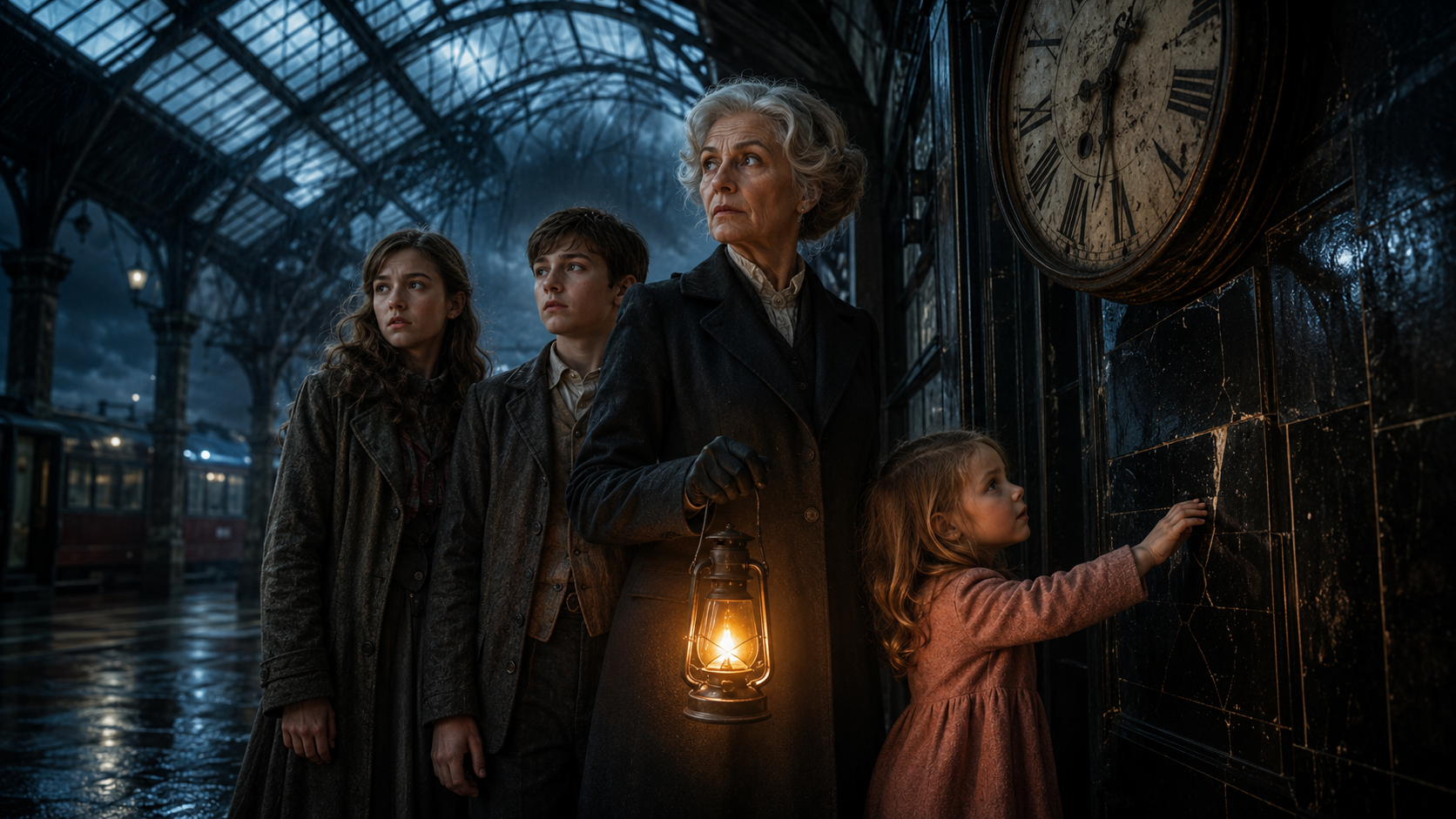
THE LAST TRAIN TO BLACKTHORN STATION

Every Thursday at eleven forty-five, Elese without telling anyone where she was going.

Her driver believed she visited an old friend.

Her housekeeper assumed she attended a private church service.

The newspapers, which had followed Eleanor’s life for nearly five decades, had stopped asking questions years ago.

At seventy-two, she was still one of the wealthiest women in the country. Her family had built railways, hotels, warehouses, and half the industrial district along the northern coast. Her name appeared on university buildings and hospital wings. Politicians returned her calls immediately. Bank directors stood when she entered a room.

But every Thursday night, Eleanor Shaw rode alone to a place that no longer appeared on modern railway maps.

Blackthorn Station.

The station had been abandoned for twenty-six years.

Its glass roof was cracked. Rainwater gathered in the ticket hall. Rust covered the iron benches, and weeds grew between the tracks where express trains had once arrived in clouds of steam.

The city had offered to demolish it many times.

Eleanor had refused every proposal.

She owned the land.

She owned the building.

And she owned the memory buried inside it.

At exactly midnight, she would stand beneath the broken clock above Platform Nine and look toward the dark tunnel.

Then she would wait.

She knew no train was coming.

She knew the rails had been disconnected long ago.

Still, she waited until twelve fifteen.

That was the time her five-year-old son had disappeared.

His name was Daniel.

On a stormy night twenty-six years earlier, Eleanor had brought him to Blackthorn Station to meet her husband, who was returning from a business trip. The station had been crowded. A freight train had derailed outside the eastern tunnel. Smoke poured into the platforms. People screamed and pushed toward the exits.

Eleanor remembered holding Daniel’s hand.

She remembered the explosion.

She remembered falling.

When she opened her eyes, Daniel was gone.

Police searched the station, the tunnels, the nearby river, and every hospital in the city. They questioned passengers, railway workers, beggars, and criminals.

They found Daniel’s red scarf beside a burned service carriage.

They never found his body.

Eleanor’s husband died three years later, broken by grief.

Eleanor survived.

At least, that was what people said.

She continued running the family company. She attended meetings, negotiated contracts, and transformed a regional railway business into an international transportation empire.

Yet something inside her had remained at Blackthorn Station.

Every Thursday, she returned to look for it.

That night, the rain was heavier than usual.

Eleanor stepped out of the car carrying a small lantern.

“Wait by the gate,” she told her driver.

“Mrs. Shaw, the storm is getting worse.”

“I will be fifteen minutes.”

“The building isn’t safe.”

“It has not been safe for twenty-six years.”

Her tone ended the discussion.

She entered through a side door that had been unlocked for her by the property caretaker. Wind moved through the empty ticket hall, stirring old newspapers and dead leaves across the floor.

Eleanor walked slowly toward Platform Nine.

The station clock had stopped at twelve fifteen.

She had ordered every other clock in the building removed, but that one remained untouched.

Her lantern illuminated the platform edge.

She stood beneath the clock and listened to the rain.

Then she heard a child crying.

Eleanor turned sharply.

The sound came from the old waiting room.

“Who is there?”

The crying stopped.

Eleanor raised the lantern.

Three figures were hiding behind a row of wooden benches.

The oldest was a girl of about sixteen. Her dark hair was wet, and she wore a coat several sizes too large. Beside her stood a boy who looked twelve or thirteen. A much younger girl was pressed against his chest.

The smallest child could not have been older than four.

The older girl stepped in front of the others.

“We’re leaving,” she said. “We didn’t break anything.”

“You are trespassing.”

“We know.”

“How did you get inside?”

“There’s a gap beneath the fence near the river.”

Eleanor looked at their soaked clothes and muddy shoes.

“Why are you here?”

The girl glanced at the younger children.

“We needed somewhere dry.”

“There are shelters in the city.”

“They separate families.”

Eleanor studied her.

“What are your names?”

The girl hesitated.

“I’m Ruby. That’s my brother, Owen. The little one is Maisie.”

“And where are your parents?”

“Our mother died two months ago.”

“What about your father?”

“We’ve never met him.”

Eleanor had heard countless sad stories. Over the years, people had approached her with requests for money, employment, medical treatment, legal assistance, or publicity.

She had learned to recognize rehearsed tears.

These children were not performing.

Ruby’s expression held no expectation of rescue. She looked prepared to run.

The little girl, Maisie, lifted her head.

She stared at Eleanor’s lantern.

Then she pointed toward Platform Nine.

“Does she want something?” Eleanor asked.

Owen shook his head.

“She doesn’t talk.”

“Has she always been unable to speak?”

“She used to talk all the time,” Ruby said. “She stopped after our mother died.”

Maisie pulled away from her brother.

She walked onto the platform.

“Keep her back from the tracks,” Eleanor warned.

Owen moved after her, but Maisie suddenly knelt beneath the broken clock.

She placed her small hand against one of the black tiles on the wall.

Tap.

Tap.

Tap.

Eleanor’s breath caught.

The child tapped three times, paused, and tapped twice more.

It was a simple rhythm.

But Eleanor knew it.

Daniel had used it whenever he wanted her attention.

Three taps.

A pause.

Two taps.

It had been their private signal.

“Where did she learn that?” Eleanor asked.

Ruby frowned.

“Learn what?”

“That pattern.”

“I don’t know.”

Eleanor approached Maisie.

The little girl looked up at her, then tapped the wall again.

Three times.

A pause.

Twice.

“Who taught you to do that?” Eleanor whispered.

Maisie did not answer.

Owen reached into his coat.

“Our mother used to do it.”

Eleanor turned toward him.

“What did you say?”

“She tapped on doors like that when she came home. Maisie copied her.”

The platform seemed to tilt beneath Eleanor’s feet.

“What was your mother’s name?”

“Mara Cole.”

The name meant nothing to her.

Yet her hands had started trembling.

Ruby noticed.

“Are you all right?”

Eleanor ignored the question.

“How old was your mother?”

“Thirty-one.”

“Where was she born?”

“She didn’t know. She grew up in foster homes.”

“Did she ever talk about this station?”

Ruby looked toward the tunnel.

“She talked about it before she died. That’s why we came here.”

Eleanor felt a coldness that had nothing to do with the rain.

“What exactly did she say?”

Ruby opened her coat and pulled out a waterproof plastic bag. Inside it was a small metal box scratched by years of use.

“Our mother left this for us. She said we should open it at Blackthorn Station, under the clock that never moved.”

Eleanor stared at the box.

A faded silver emblem was engraved on the lid.

A hawthorn branch crossing a railway wheel.

The Shaw family crest.

“Give it to me.”

Ruby pulled the box closer.

“It belonged to our mother.”

“I know that symbol.”

“So did she.”

Eleanor took a step forward.

Ruby stepped back.

Owen positioned himself beside his sister, ready to protect her.

Eleanor stopped.

For the first time, she understood how she must appear to them: an elegantly dressed stranger in an abandoned station, demanding the only possession their mother had left behind.

“I am Eleanor Shaw,” she said more gently. “My family built this station.”

Ruby’s expression changed.

“Our mother mentioned you.”

“What did she say?”

“She said you would either help us or have us arrested.”

Eleanor almost smiled, but the expression would not come.

“That sounds like someone who understood me.”

Ruby examined her face.

“She also said you had been waiting here for a boy.”

The lantern shook in Eleanor’s hand.

“Open the box.”

Ruby knelt beneath the clock. She turned the small metal key attached to the handle.

Inside lay a pocket watch, a photograph, and a sealed envelope.

Eleanor recognized the watch first.

She had given it to Daniel on his fifth birthday, even though he had been too young to understand its value. It had belonged to his grandfather. His initials had been engraved inside the case.

D.E.S.

Daniel Edward Shaw.

Eleanor’s knees weakened.

“Where did she get that?”

“We don’t know,” Ruby said.

Eleanor took the photograph.

It showed a young man standing beside a fishing boat. He was perhaps thirty years old, with windblown hair and a tired smile. One arm was wrapped around a pregnant woman.

Eleanor stared into the man’s face.

The shape of his eyes.

The curve of his mouth.

The small scar near his left eyebrow.

Daniel had received that scar after falling from a tree when he was four.

“No,” Eleanor whispered.

Her fingers tightened around the photograph.

“No, this is impossible.”

Ruby watched her carefully.

“Our mother said the man was her father.”

Eleanor looked at her.

“Where is he?”

“He died before Maisie was born. An accident at sea.”

“What was his name?”

“David Cole.”

Eleanor closed her eyes.

Someone had changed Daniel’s name.

Someone had hidden him.

But the man in the photograph was her son.

Older.

Bearded.

Alive long after the night she had been told there was no hope.

Eleanor opened the envelope.

The letter inside had been written by Mara.

Mrs. Shaw,

My father spent his entire life believing you abandoned him.

He remembered very little about the night at the station, but he remembered your face. He remembered holding your hand. He remembered the explosion.

When he woke, a man told him his mother was dead.

Eleanor stopped reading.

The sound of the rain became distant.

Ruby moved closer.

“What does it say?”

Eleanor continued.

My father was taken north and placed with a family who had been paid to raise him under a different name. They were told never to contact the police.

Years later, the payments stopped.

The family disappeared.

My father entered foster care.

He searched for you, but someone intercepted every letter.

He eventually decided the man at the station had told the truth: that you did not want him.

Eleanor pressed the paper against her chest.

“Who?” she whispered. “Who told him that?”

The next paragraph answered her.

Before my father died, he remembered something important. The man who carried him out of the smoke wore a railway company ring. One side had the Shaw crest. The other had the initials V.H.

Eleanor knew those initials.

Victor Hale.

Her family’s attorney.

Her husband’s closest adviser.

The man who had managed the search for Daniel.

The man who had stood beside Eleanor during the funeral service for an empty coffin.

The man who now served as chairman of the Shaw Foundation.

Eleanor read the final lines.

I found proof hidden in a storage locker beneath Blackthorn Station. Victor Hale used Platform Nine to move stolen company money through unregistered freight cars. My father saw him meeting smugglers on the night of the accident.

The derailment gave Hale an opportunity.

He removed the only witness and convinced everyone the boy was dead.

I tried to confront him.

After that, someone began following me.

If you are reading this, I may not have survived long enough to bring you the evidence myself.

The entrance to the storage room is behind the black tile beneath the clock.

My children have no one else.

Please believe them.

Eleanor lowered the letter.

Ruby’s voice was barely audible.

“Our mother’s death wasn’t an accident, was it?”

“How did she die?”

“Her car went off a bridge.”

“Were the police suspicious?”

“They said she was driving too fast.”

“Did she drive too fast?”

“Never.”

Lightning flashed through the broken roof.

Eleanor looked at the black tile Maisie had touched.

Three taps.

A pause.

Two taps.

Daniel’s signal.

Not magic.

Memory.

Perhaps he had taught it to Mara, and Mara had taught it to her children.

Or perhaps some habits traveled through families without explanation.

Eleanor handed the lantern to Owen.

“Stand back.”

She removed the silver tip from her walking cane and pressed it into a narrow opening beside the tile. The tile shifted.

A metal handle appeared behind it.

Together, Eleanor and Ruby pulled.

Part of the wall opened inward.

A staircase descended beneath the platform.

Cold air rose from the darkness.

“We’re not going down there,” Owen said.

“We have to,” Ruby replied.

“No,” Eleanor said. “The children will remain here.”

“We are the children,” Ruby said.

Eleanor looked at the determination in her face and recognized something of herself.

“Then stay close.”

They descended the narrow steps.

Maisie held Eleanor’s hand.

At the bottom, they found a tunnel running parallel to the tracks. The walls were lined with old electrical cables and iron pipes.

Twenty meters ahead stood a red door.

Maisie stopped walking.

She pointed.

Ruby looked shocked.

“She draws that door.”

“What?”

“Since our mother died. Every day. A red door with a black handle.”

Eleanor approached it.

The door was locked, but the metal frame had weakened with age. Owen found a length of pipe, and after several attempts, the lock broke.

Inside was a forgotten railway office.

Shelves held account books, shipping documents, photographs, and boxes of cassette tapes. An old desk stood against the wall.

On it was a modern digital recorder.

Ruby pressed the button.

Her mother’s voice filled the room.

“My name is Mara Cole. If this recording is found, Victor Hale is responsible for what happened to my father and for anything that happens to me.”

Maisie made a small sound.

Owen lowered his head.

The recording continued.

Mara described bank transfers, false freight records, secret payments, and letters sent by Daniel to Eleanor that had never reached her. She named police officers, company executives, and private investigators who had helped Victor hide the truth.

Then another voice appeared on the recording.

Victor Hale.

“You should have left the past buried,” he said.

“You stole a child,” Mara replied.

“I protected a company.”

“You destroyed a family.”

“Families recover. Empires do not.”

The recording ended.

For several seconds, no one moved.

Then applause came from the doorway.

Slow.

Calm.

Deliberate.

Victor Hale stood in the corridor.

He was seventy-eight, silver-haired and immaculately dressed. Eleanor had known him since she was a young woman. He had attended birthdays, weddings, board meetings, and funerals.

Two men stood behind him.

One held Eleanor’s driver by the arm.

Victor smiled.

“You always were stubborn, Eleanor.”

Ruby pulled Maisie behind her.

Eleanor stepped between Victor and the children.

“You took my son.”

“I saved the Shaw company.”

“You told Daniel I was dead.”

“He was five years old. Children adapt.”

“He spent his life believing I abandoned him.”

Victor’s expression remained cold.

“Your husband planned to sell the railway after the derailment. The company would have collapsed. Thousands of employees would have lost their jobs.”

“So you kidnapped a child?”

“Daniel saw something he should not have seen. At first, I intended to keep him hidden for a few days. Then the investigators became involved. The story grew too large to reverse.”

“You could have brought him home.”

“And confessed everything?”

Eleanor’s voice broke.

“He was my son.”

“He was a risk.”

Ruby reached into her pocket.

Victor noticed.

“Give me the telephone.”

Ruby did not move.

One of Victor’s men stepped forward.

Suddenly every light in the station turned on.

The corridor blazed white.

Victor covered his eyes.

From above came the sound of boots, radios, and shouted commands.

Police officers entered from both ends of the tunnel.

Victor’s men raised their hands.

Eleanor looked toward her driver.

He smiled despite the blood on his lip.

“When you entered the station, I called the police,” he said. “You never stay longer than fifteen minutes.”

Victor stared at Eleanor.

“You planned this?”

“No,” she replied. “You simply underestimated how many people would notice if I disappeared.”

An officer placed handcuffs around Victor’s wrists.

As he was led away, Victor turned back.

“You think these children will replace Daniel?”

Eleanor looked at Ruby, Owen, and Maisie.

“No one can replace him.”

Victor smiled bitterly.

“Then you still have nothing.”

Eleanor stepped closer.

“I have the truth.”

For the first time that night, Victor looked afraid.

By sunrise, the police had removed dozens of boxes from the hidden office.

The evidence exposed a criminal network that had operated for more than three decades. Several former executives were arrested. Old cases were reopened. Mara’s death was reclassified as murder.

Eleanor took the children to her house.

Ruby refused to unpack.

“We’re not staying permanently,” she said.

“You may stay as long as you wish.”

“We don’t need charity.”

“Neither do I.”

Ruby looked confused.

Eleanor placed Daniel’s pocket watch on the table between them.

“For twenty-six years, I believed my son died at Blackthorn Station. Last night, you brought him home.”

“We brought you a watch and a photograph.”

“You brought me his life. You brought me the truth about who he became.”

“That doesn’t make us your responsibility.”

“No,” Eleanor said. “It makes you my family.”

Owen looked toward the enormous windows overlooking the garden.

“Are you saying you’re our great-grandmother?”

“I believe that is the correct term.”

Ruby folded her arms.

“You don’t look like anyone’s great-grandmother.”

“I will consider that a compliment.”

For the first time, Ruby smiled.

Maisie stood beside Eleanor’s chair.

She placed one hand on Eleanor’s knee.

Then she tapped the wooden armrest.

Three times.

A pause.

Twice.

Eleanor answered with the same pattern.

Maisie looked into her eyes.

Her lips moved.

At first, no sound came.

Then she whispered a single word.

“Home.”

Ruby covered her mouth.

Owen stared at his little sister.

Eleanor did not trust herself to speak.

Maisie climbed into her lap and rested her head against Eleanor’s chest.

For twenty-six years, Eleanor had waited beneath a broken clock for a train that would never arrive.

She had believed her life stopped at twelve fifteen.

She had been wrong.

Time had continued without her.

Daniel had grown up.

He had fallen in love.

He had become a father and a grandfather.

He had laughed, worked, struggled, and watched storms roll across the northern sea. He had carried the pocket watch she gave him until the day he died.

Eleanor could not recover the years that had been stolen.

She could not hold her son as a child again.

She could not hear his adult voice or tell him that she had never stopped searching.

But she could protect what he had left behind.

A week later, workers arrived at Blackthorn Station.

The city expected Eleanor to announce its demolition.

Instead, she ordered a complete restoration.

The main hall became a public center for missing children and separated families. The old offices were converted into temporary housing. Lawyers, investigators, counselors, and volunteers worked there without charge.

Platform Nine remained almost unchanged.

The broken clock was repaired, but Eleanor asked the engineers to preserve the old hands inside a glass case.

They would always show twelve fifteen.

Not as the hour her life ended.

As the hour the truth began waiting for her.

On the night the station reopened, hundreds of people gathered beneath the restored glass roof.

Ruby stood beside Eleanor in a dark blue dress. Owen examined the polished locomotive displayed near the entrance. Maisie ran between them, laughing and talking so quickly that no one could answer all her questions.

A reporter approached Eleanor.

“Mrs. Shaw, after everything that happened here, how can you bear to return?”

Eleanor looked toward the platform.

For years, she had imagined Daniel standing there alone, calling for her through smoke and darkness.

Now she pictured him differently.

A grown man beside a fishing boat.

One arm around the woman he loved.

A pocket watch resting against his heart.

“I used to come here because this was where I lost my family,” Eleanor said.

Maisie slipped her hand into Eleanor’s.

“And now?” the reporter asked.

Eleanor looked down at the child.

“Now I come here because this is where they found me.”

Far beyond the station, thunder rolled across the city.

A train entered the restored platform, its windows glowing in the evening rain.

Passengers stepped onto the platform.

Families embraced.

Children called out to their parents.

And for the first time in twenty-six years, the clock above Platform Nine continued moving.