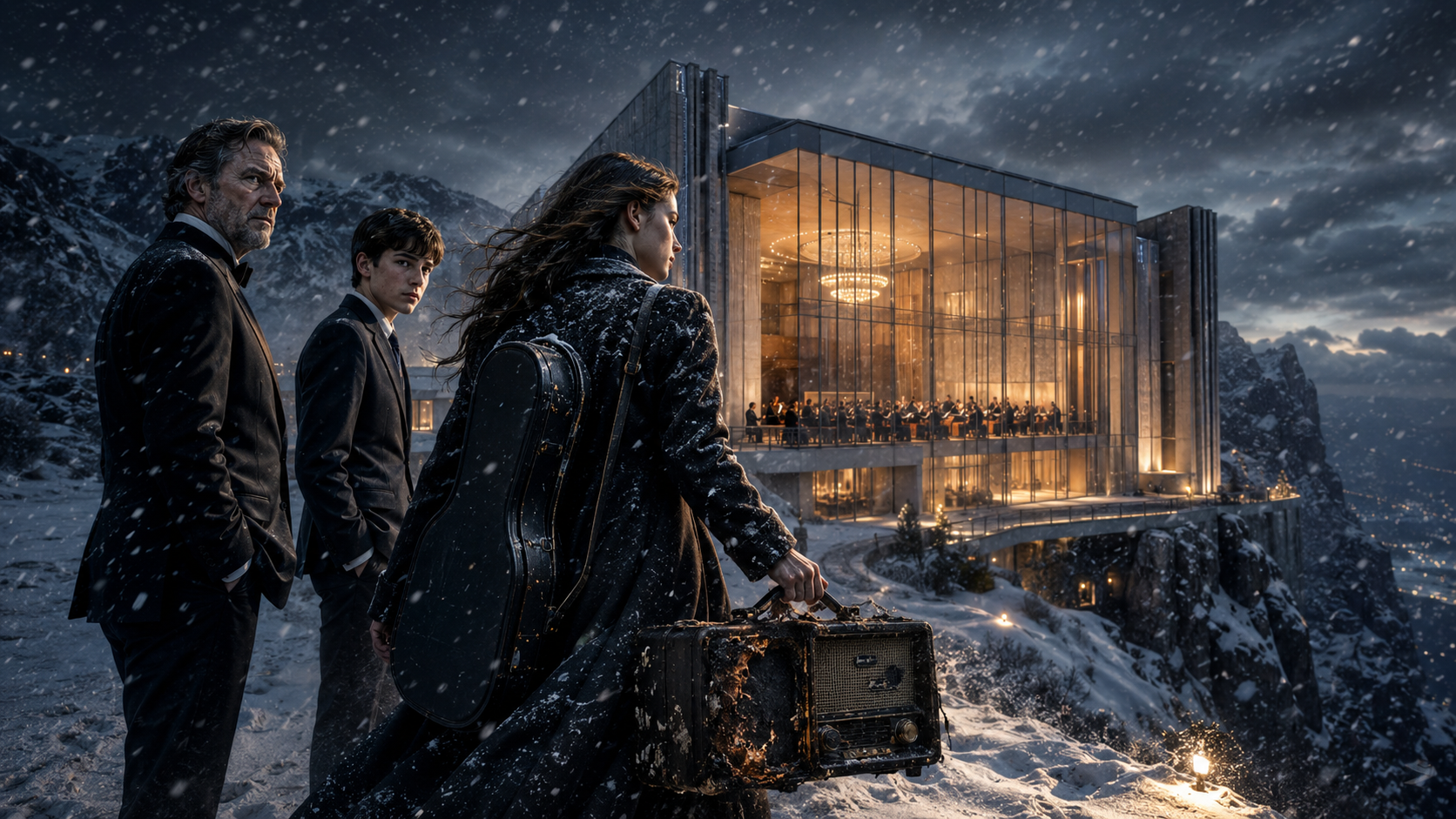
Winter Hall had been built where no concert hall should have survived.
It stood high above the northern valley, balanced against the black shoulder of Mount Varin. Its walls were made of pale stone and enormous sheets of glass that reflected the surrounding peaks. During daylight, the building seemed to float among the clouds. At night, when hundreds of lamps glowed behind its windows, it looked like a lantern suspended over the frozen wilderness.
For decades, the world’s greatest musicians had traveled there to perform.
Then came the avalanche.
The eastern wing was destroyed. Seven people died. The concert season ended overnight, and Winter Hall remained silent for four years.
Tonight, at last, its doors were open again.
Luxury cars climbed the narrow mountain road through falling snow. Politicians, actors, industrialists, conductors, and patrons of the arts entered beneath the newly restored stone archway. Inside, waiters carried crystal glasses between marble columns while a chamber orchestra performed beneath a ceiling painted with silver stars.
Reporters gathered near the main staircase.
Television cameras faced the stage.
The reopening concert was being broadcast to millions of viewers.
Yet the audience had not come only to see the building.
They had come for Julian Crowe.
Julian was the most celebrated composer of his generation. His symphonies had filled opera houses from Vienna to New York. He had conducted for kings, presidents, and audiences who waited years to hear him perform.
But four years earlier, Winter Hall had taken something from him that no success could replace.
His wife, Celeste Crowe, had died during the avalanche.
Their eleven-year-old son, Theo, had survived.
Theo had not spoken since.
He was fifteen now.
He stood beside his father near the edge of the stage, dressed in a dark formal suit. He was tall for his age, with Celeste’s gray eyes and Julian’s serious expression. His hands remained folded behind his back while hundreds of guests watched him with careful, uncomfortable sympathy.
Some people smiled at him.
Others quickly looked away.
Theo noticed every one of them.
He always noticed.
He simply never responded.
Doctors had called his condition traumatic mutism. Specialists had explained that his voice was physically unharmed. There was no injury to his throat, his lungs, or his brain. According to every medical examination, Theo was capable of speaking.
He had only chosen not to.
Julian had spent four years trying to understand why.
He had taken his son to private clinics, quiet coastal towns, mountain retreats, and therapists whose names appeared in international journals. He had tried patience, music, silence, routine, and travel.
Nothing had brought Theo’s voice back.
Tonight was not supposed to be another attempt.
Julian had promised him that.
The reopening concert was intended to honor Celeste, restore Winter Hall, and introduce Julian’s unfinished symphony—the final work he and his wife had written together.
At least, that was what the official program claimed.
Shortly before nine o’clock, Marcus Vane stepped onto the stage.
Marcus was the director of the Winter Arts Foundation and the man who had supervised the restoration. His silver hair was perfectly arranged, his tuxedo immaculate, his smile measured for the cameras.
“Ladies and gentlemen,” he began, “four years ago, this mountain answered music with silence.”
The orchestra stopped playing.
The guests turned toward him.
“Tonight,” Marcus continued, “we answer that silence with music.”
Applause filled the hall.
Julian placed one hand on Theo’s shoulder. The boy did not move.
Marcus spoke about courage, memory, and renewal. He praised the architects, rescue workers, donors, and musicians who had made the evening possible.
He spoke Celeste’s name with solemn affection.
Julian lowered his eyes.
Theo stared directly at Marcus.
When the speech ended, Marcus invited Julian to the conductor’s platform.
The applause grew louder.
Julian walked toward the center of the stage, but before he reached the podium, a disturbance broke out near the rear entrance.
A woman was arguing with security.
She appeared to be in her early thirties. Snow covered the shoulders of her long brown coat, and strands of dark hair had escaped from a loose knot behind her head. She carried a narrow violin case in one hand and an old metal box in the other.
The box looked badly damaged.
One side was blackened by fire. Several wires protruded through a crack in its casing.
“You cannot bring that inside,” a security officer told her.
“I was invited by the restoration committee.”
“Your invitation was withdrawn.”
“By whom?”
The officer did not answer.
Marcus heard the exchange from the stage.
For the first time that evening, his confident expression disappeared.