The Barefoot Woman Who Walked Into the Wedding Carrying the Truth

The music stopped before anyone understood why.

One moment, a string quartet was playing beneath the crystal chandeliers of Bellweather House. The next, the final note trembled through the ballroom and vanished, leaving more than two hundred guests suspended in a silence so complete that the rain striking the tall windows sounded like fingertips tapping on glass.

Everyone turned toward the entrance.

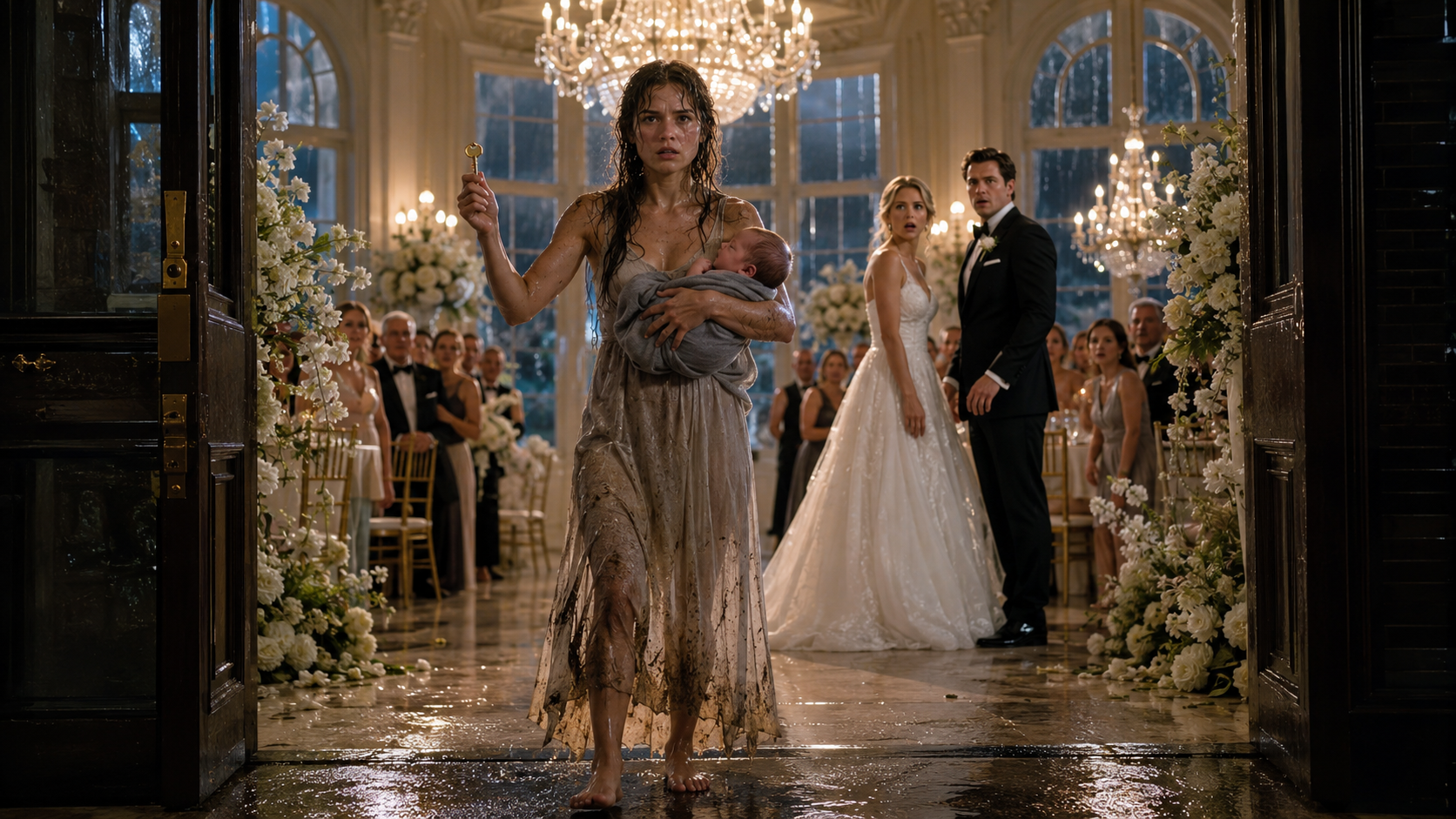
A young woman stood between the open doors.

She was barefoot.

Mud covered her ankles, and the hem of her faded green dress was soaked nearly to her knees. Wet strands of dark hair clung to her cheeks. She looked as though she had crossed a river, a forest, or perhaps an entire life to reach that room.

Against her chest, she held a sleeping newborn wrapped in a gray wool blanket.

In her other hand was a small brass key.

For several seconds, nobody moved.

The ballroom had been designed to make ordinary people feel insignificant. White roses climbed the marble columns. Hundreds of candles floated in glass bowls. Silver cutlery gleamed beside hand-painted porcelain. Beyond the windows, the private gardens descended toward the sea, where black waves rolled beneath a storm-darkened sky.

The barefoot woman did not belong among any of it.

Yet the moment she entered, everything else seemed false.

At the front of the room, Julian Hale slowly lowered the champagne glass in his hand.

He had married Elara Whitmore less than twenty minutes earlier.

At thirty-one, Julian was the new chairman of Hale Maritime, a shipping empire whose name appeared on ports, warehouses, hospitals, and university buildings across the country. His tailored black suit fitted him perfectly. His silver cuff links had belonged to his grandfather. His smile had been photographed all afternoon from every possible angle.

That smile was gone now.

Elara noticed the change before anyone else did.

She had known Julian for three years. She knew the expression he wore when he was irritated, the one he wore when he was calculating, and the carefully sympathetic look he used during uncomfortable business conversations.

What she saw on his face now was different.

It was recognition.

And fear.

“Close the doors,” Julian said.

His voice was quiet, but two security guards immediately stepped forward.

The barefoot woman raised the brass key.

“Touch me,” she said, “and everyone in this room will learn why Adrian Hale died.”

The guards stopped.

A murmur moved through the ballroom.

Adrian Hale had been Julian’s older brother.

He had died eleven months earlier when his sailing boat caught fire several miles off the northern coast. His body had never been recovered. Newspapers called it a tragic accident. The Hale family held a memorial service attended by politicians, executives, and television cameras.

Julian had delivered the eulogy.

He had spoken about brotherhood, grief, and carrying Adrian’s legacy into the future.

Now he stared at the woman as if she had brought the dead man into the room with her.

Elara placed her bouquet on the nearest table.

“Who are you?” she asked.

The woman looked at her.

There was no triumph in her expression. No jealousy. No satisfaction at having interrupted a wedding that reportedly cost more than most people earned in a lifetime.

Only exhaustion.

“My name is Mara Voss.”

Julian’s father, Conrad Hale, rose from his seat in the front row. He was a tall, silver-haired man whose authority had remained intact even after officially retiring from the company.

“I don’t know what performance you think you’re giving,” Conrad said, “but you will leave immediately.”

Mara looked at him without lowering her eyes.

“You know exactly who I am.”

“I have never seen you before.”

“That is the first lie of the evening.”

A few guests shifted uncomfortably.

Conrad signaled to the security guards again.

Mara adjusted the baby against her chest.

“I have copies,” she said. “Documents, recordings, photographs. Everything has already been sent to three people outside this building. If I do not contact them within the hour, they will release it.”

Julian stepped down from the platform.

“What do you want?”

It was the wrong question.

Elara heard it immediately.

He had not asked whether Mara was lying. He had not demanded proof. He had asked what she wanted.

Mara heard it too.

“I want you to open the room beneath the eastern library.”

The silence changed.

It was no longer merely shocked.

It became watchful.

Bellweather House had belonged to the Hale family for four generations. Elara had visited the estate many times, but she had never heard of a room beneath the eastern library.

Julian’s mother covered her mouth with one hand.

Conrad’s face remained motionless, but a muscle pulsed near his jaw.

“There is no room beneath the library,” he said.

Mara held up the key.

“Then you have nothing to fear.”

Elara turned toward her husband.

“Is there a room?”

Julian avoided her eyes.

“Today is not the time for this.”

“That was not my question.”

“Elara, she is trying to manipulate you.”

“Then answer me.”

The baby stirred inside the blanket and released a small, uncertain sound.

Mara gently rocked him.

Julian looked at the child.

Elara saw another flicker of recognition cross his face.

Her throat tightened.

“Whose baby is that?” she asked.

Mara’s gaze softened.

“His name is Elias.”

“That isn’t what I asked.”

“No,” Mara said. “It isn’t.”

She took one step into the ballroom.

Guests moved aside, creating a path without being asked.

“Elias is Adrian Hale’s son.”

The words struck the room with more force than a scream.

Julian closed his eyes for a fraction of a second.

Conrad Hale did not move at all.

Elara looked from the child to Mara.

“You and Adrian…”

“We were married.”

“That is impossible,” Conrad said immediately. “My son was not married.”

“He was.”

“We would have known.”

“You did know.”

Mara reached into the folds of the blanket and removed a transparent waterproof envelope. Inside was a document bearing two signatures and an official seal.

She handed it to Elara.

The paper was creased from being folded many times, but the words remained clear.

Certificate of Marriage.

Adrian Samuel Hale.

Mara Elise Voss.

The date was fourteen months earlier.

Elara read it twice.

Then she looked at Julian.

“Did you know?”

Julian said nothing.

“Did you know your brother was married?”

“They signed a document in a municipal office,” he said eventually. “Adrian was not thinking clearly.”

Mara’s tired expression hardened.

“He knew exactly what he was doing.”

“He had known you for four months.”

“Seven.”

“You worked in a repair yard near one of our ports.”

“I designed marine electrical systems.”

“You were trying to attach yourself to him.”

Mara gave a quiet, humorless laugh.

“That is what your father said.”

Conrad stepped forward.

“This woman targeted Adrian while he was emotionally unstable. We protected him.”

“You threatened me,” Mara replied. “You had me followed. You offered me money to disappear. When I refused, you told Adrian that I had accepted it.”

Conrad’s eyes narrowed.

“Be very careful.”

“I was careful for eleven months. Careful while I moved between rented rooms. Careful while strangers watched my building. Careful while I gave birth using a false address because I was afraid someone would take my son.”

The baby made another soft sound.

Mara touched her cheek to his forehead.

“I am finished being careful.”

Elara looked around the ballroom. Several members of the Hale family were staring at the floor. Others appeared genuinely confused. Julian’s mother was crying silently.

“How did Adrian die?” Elara asked.

Julian turned sharply toward her.

“The investigation concluded that an electrical failure caused the fire.”

Mara looked at him.

“No. The investigation concluded that an electrical failure was the most likely cause because the control unit was never recovered.”

“It burned.”

“It was removed before the boat left the marina.”

The room erupted in whispers.

Julian walked toward Mara.

“Stop.”

She did not retreat.

“Adrian discovered that Hale Maritime had been falsifying safety inspections on twelve cargo vessels. The ships were operating with damaged fire-suppression systems. He wanted to report it to the maritime authority.”

“That is absurd.”

“He recorded his meetings with you.”

Julian’s face lost what little color remained.

Mara continued.

“He was supposed to meet an investigator the morning after the accident. The night before, he told me that if anything happened to him, I should find the brass key.”

She lifted it again.

“He said the truth was hidden where your family kept everything it could not afford to destroy.”

Conrad looked toward Julian.

It was a small movement, but Elara saw it.

So did Mara.

“You told me there was no room beneath the library,” Mara said. “But both of you just looked in its direction.”

Elara removed her wedding ring.

Julian stared at her hand.

“What are you doing?”

“I haven’t decided yet.”

“Elara, this woman appears at our wedding with an invented story and a child no one has verified, and you are listening to her?”

“I am listening because you are frightened.”

“I am angry.”

“No. I know what you look like when you’re angry.”

She placed the ring beside her bouquet.

“This is fear.”

For the first time since entering the ballroom, Mara looked surprised.

Elara turned toward the head of security.

“Mr. Dane, take us to the eastern library.”

The security chief hesitated.

Julian’s voice became sharp.

“You work for my family.”

Mr. Dane looked at Elara, then at the gathered guests.

“Tonight,” he said, “I am responsible for everyone in this house.”

Conrad moved to block the path.

“This spectacle ends now.”

Elara’s father rose from his table. He was a retired judge, soft-spoken and usually reluctant to involve himself in public conflict.

“Conrad,” he said, “stepping in front of that door will not make you appear innocent.”

Nobody spoke after that.

The eastern library was located at the end of a long corridor lined with portraits of Hale ancestors. Dozens of guests followed, no longer behaving like wedding attendees but like witnesses being drawn toward the scene of a crime.

Rain battered the windows.

Mara walked slowly, her bare feet leaving faint prints on the polished floor.

Elara remained beside her.

“Why are you barefoot?” she asked quietly.

“My car went off the road near the lower gate. I climbed out through the passenger window. My shoes were trapped under the dashboard.”

“You walked from the gate in this weather?”

“Three miles.”

“With a newborn?”

Mara looked down at Elias.

“I had already come too far to turn around.”

They reached the library.

Dark wooden shelves covered every wall. A stone fireplace stood beneath a portrait of Bellweather House painted in winter. Julian insisted there was no hidden entrance, but Mara crossed directly to the portrait.

Behind its frame, she found a small brass lock.

Her key fitted perfectly.

A section of the shelving released with a deep mechanical click.

Several guests gasped.

Behind it was a narrow staircase descending into darkness.

Conrad Hale sat down in the nearest chair.

No one tried to stop Mara now.

Mr. Dane switched on the lights.

The underground room was colder than the library. Metal cabinets stood along the walls. Shelves held company ledgers, contracts, computer drives, and boxes labeled only with dates.

In the center was an old wooden desk.

Mara approached it and opened the lowest drawer with the same key.

Inside was a black waterproof case.

Her hands began to tremble.

For the first time, her certainty seemed to falter.

Elara moved closer.

“You don’t have to open it alone.”

Mara looked at her, then nodded.

Inside the case were two encrypted drives, a stack of inspection reports, Adrian’s passport, and a small digital recorder.

There was also a letter.

Mara’s name was written across the envelope.

She pressed the recorder’s power button.

Static filled the room.

Then Adrian Hale’s voice emerged from the tiny speaker.

“Mara, if you are hearing this, I failed to come back.”

Mara closed her eyes.

The baby remained asleep against her.

Adrian’s recording continued.

“My father believes the company must survive at any cost. Julian believes survival and control are the same thing. They have delayed repairs, altered reports, and pressured inspectors. I gave Julian one final chance to help me disclose everything.”

A pause followed.

“He refused.”

Julian pushed through the people gathered near the staircase.

“Turn it off.”

Mr. Dane stepped into his path.

The recording continued.

“The control unit from my boat has been removed twice this month. Julian says it is routine maintenance, but the marina has no record of the work. I have installed a second tracker and stored copies of the safety files beneath the library.”

Julian’s breathing became audible.

“If the boat fails,” Adrian said, “it will not be an accident.”

The recording ended.

No one moved.

Even the storm seemed to withdraw from the house.

Elara stared at Julian.

“Did you damage his boat?”

“No.”

“Did you order someone to remove the control unit?”

“No.”

“Then why did he believe you had?”

“He was paranoid. He had become obsessed with destroying the company.”

Mara picked up one of the drives.

“His tracker recorded the boat’s route. It also recorded another vessel beside it thirty minutes before the fire.”

“That proves nothing.”

“The vessel belonged to a security contractor employed by Hale Maritime.”

Conrad’s voice came from the library above them.

“That is enough.”

He descended the stairs slowly, looking older with every step.

Julian turned toward him.

“Father, do not say anything.”

Conrad stopped at the bottom.

For decades, people had described him as a man who could dominate any room. In the hidden archive, surrounded by documents he had never expected outsiders to see, he seemed strangely small.

“I ordered the boat brought back,” he said.

Julian stared at him.

Conrad continued before anyone could interrupt.

“Adrian had company records with him. I told the crew to intercept him before he reached the authorities.”

Mara held Elias more tightly.

“What happened?”

“The men were instructed to disable the engine and tow the boat to shore.”

“Did they start the fire?”

“I don’t know.”

“You never asked?”

Conrad looked at her.

“I was told the fuel line ruptured during the interception.”

“And Adrian?”

“The crew searched the water.”

“For how long?”

Conrad did not answer.

Mara’s voice broke.

“For how long?”

“Eleven minutes.”

A terrible sound escaped her—not quite a cry, not quite a word.

Elara reached for her before she fell.

Julian stepped toward his father.

“You said there had been no contact with the boat.”

Conrad looked at him with contempt.

“You knew I was sending the crew.”

“I thought they were going to speak to him.”

“You removed the control unit.”

“To delay him. Not to kill him.”

The confession seemed to surprise Julian as soon as it left his mouth.

Everyone heard it.

Elara looked at the man she had married less than an hour earlier.

“You sabotaged your brother’s boat.”

“I removed one component. There were backups.”

“You knew he was sailing into open water.”

“I needed time.”

“For what?”

“To bring him to his senses.”

“No,” Mara said. Tears moved silently down her face. “You needed time to frighten him.”

Julian’s composure shattered.

“You knew nothing about him. You entered his life, filled his head with heroic ideas, and convinced him to throw away generations of work.”

“Adrian was trying to stop people from dying on unsafe ships.”

“You made him reckless.”

“I made him believe he did not have to become you.”

Julian moved toward her.

Mr. Dane restrained him.

The newborn woke and began to cry.

The sound transformed the room.

It was small, frightened, and completely innocent.

Mara rocked him while her own body shook.

Elara turned to her father.

“Call the police.”

Julian twisted against the security chief’s grip.

“Elara, listen to me. Think about what this will do. To both families. To the company. To thousands of employees.”

She looked down at her white wedding dress, now stained with mud where she had supported Mara.

Then she looked at the hidden cabinets, the altered reports, and the recorded warning of a man whose own family had valued its reputation more than his life.

“You still think this is about your company.”

“Elara—”

“You removed the control unit from your brother’s boat. You concealed his marriage. You helped erase his child. And after all of that, you stood in front of everyone we know and promised to be honest with me.”

“I can explain.”

“You have been explaining yourself all evening.”

She picked up Mara’s marriage certificate and handed it back to her.

“I believe her.”

Those three words ended the wedding more completely than any legal document could have done.

The police arrived before midnight.

Investigators sealed the underground archive and removed dozens of boxes. Conrad Hale was taken away for questioning. Julian followed in a separate vehicle after attempting to contact the company’s attorneys.

The guests left through the rain in silence.

Nobody collected the monogrammed wedding favors.

Nobody cut the seven-tier cake.

In a private sitting room, Elara found dry clothes for Mara and asked a doctor who had attended the ceremony to examine the baby.

Elias was cold and hungry but healthy.

Mara refused to sleep until she knew the documents were in official custody.

“You should hate me,” she told Elara as dawn approached.

Elara sat across from her, still wearing the lower half of her wedding dress and a borrowed sweater.

“For what?”

“For walking into your wedding.”

“You walked into a lie. It only happened to be decorated like a wedding.”

Mara looked down at Elias.

“I did not know whether anyone would believe me.”

“I almost didn’t.”

“Why did you?”

Elara considered the question.

“Because Julian looked at you as though the truth had finally learned his address.”

For the first time, Mara smiled.

It was brief and exhausted, but real.

The investigation lasted eighteen months.

Authorities recovered navigation records, internal correspondence, altered safety reports, and payments made to the crew that had intercepted Adrian’s boat. One crew member eventually admitted that the collision had ruptured a fuel line. The men had fled after the fire began, afraid that their unauthorized operation would be discovered.

Adrian’s body was never found.

Conrad Hale was convicted of obstruction, conspiracy, and multiple corporate safety violations. Julian pleaded guilty to evidence tampering and reckless endangerment. Hale Maritime was reorganized under court supervision, and several executives were removed.

The twelve unsafe ships were taken out of service.

Repairs began within weeks.

Investigators later estimated that Adrian’s evidence may have prevented hundreds of crew members from continuing to work aboard vessels with defective emergency systems.

The company tried to challenge Elias’s inheritance rights.

It failed.

Mara’s marriage certificate was valid. Adrian’s letter identified the unborn child as his. A DNA test confirmed what she had never doubted.

Elias Hale became the legal owner of the shares that should have passed from his father.

Mara placed them in a protected trust.

She did not buy a mansion or move into Bellweather House. She rented a modest home near the coast and returned to engineering work when Elias was old enough to stay with a trusted caregiver.

Elara annulled the marriage.

Reporters waited outside her home for weeks, hoping she would describe herself as a victim. She refused.

“I was deceived,” she said in her only public statement. “Mara Voss was threatened, displaced, and nearly erased. Adrian Hale lost his life. Please understand the difference.”

She later created an independent organization that helped employees report safety violations without losing their livelihoods.

Mara became one of its technical advisers.

They did not become inseparable friends. Their lives were too different, and the night they met carried too much pain for easy closeness.

But every year, on Adrian’s birthday, Elara visited the small house near the sea.

She brought no cameras and made no speeches.

She sat with Mara on the back porch while Elias played in the grass.

When the boy was old enough to ask about his father, Mara told him the truth carefully.

She told him Adrian had been brave, but not fearless. That courage was not the absence of fear. It was the decision that something else mattered more.

Years later, Elias asked why his mother had gone to Bellweather House without shoes.

Mara laughed softly.

She told him about the storm, the damaged car, and the long road from the gate.

“But weren’t you scared?” he asked.

“Terrified.”

“Then why did you keep walking?”

She looked toward the sea.

“Because you were in my arms.”

The newspapers eventually stopped writing about the wedding.

Bellweather House was sold. The hidden room beneath the library was emptied, catalogued, and sealed. The white roses were removed from the ballroom. The champagne was poured away.

But the people who had been there remembered.

They remembered the moment the music stopped.

They remembered the barefoot woman standing beneath the chandeliers with rain in her hair, a newborn against her heart, and a brass key raised in one hand.

She had entered a house built on wealth, silence, and carefully preserved appearances.

She possessed none of those things.

She had no powerful name. No attorneys waiting in the corridor. No expensive dress to make strangers respect her.

She had crossed three miles of mud carrying the one thing the Hale family had spent generations learning to fear.

The truth.

And when the doors opened, the truth did not arrive dressed for the occasion.

It arrived barefoot.

The Barefoot Woman Who Walked Into the Wedding Carrying the Truth
Women who dared to go naked – Bikinis on their way to power