The Briefcase at Blackthorn Ridge

The storm arrived without rain.

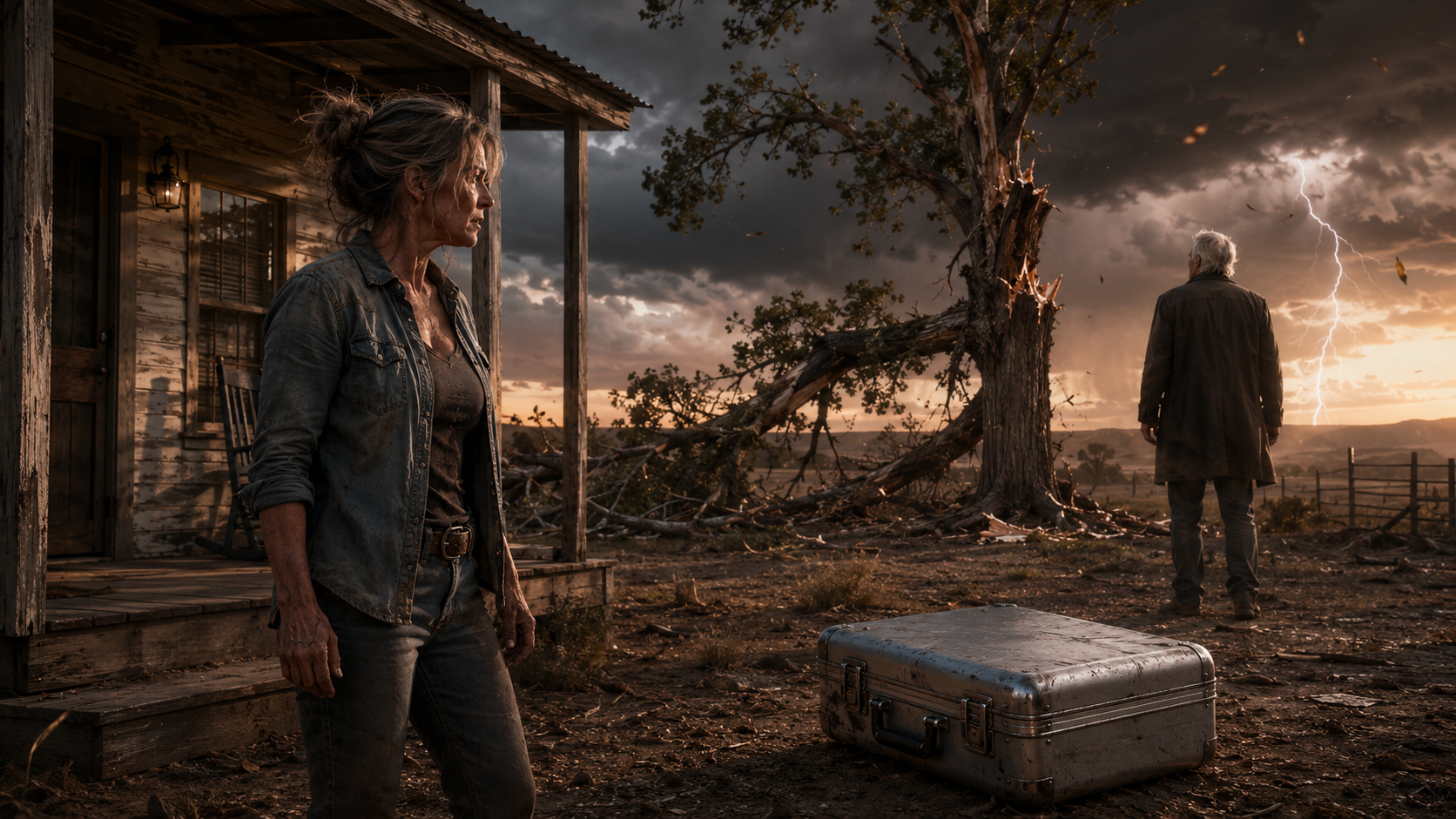
It rolled over the western hills as a wall of bruised clouds, dragging long shadows across Blackthorn Ridge Ranch. The wind bent the dry grass, rattled the loose tin above the horse stalls, and sent spirals of dust racing across the empty yard.

Mara Bell stood beneath the porch roof with a mug of coffee cooling between her hands.

At fifty-nine, she had learned not to trust clouds.

Some promised rain and delivered lightning. Others passed silently, leaving the land thirstier than before. People could be the same way. Her late husband had taught her that, although he had never intended to.

Beyond the fence, the old cottonwood groaned.

The tree had stood beside the ranch road longer than the house itself. Its trunk was wide enough that Mara and her daughter, Leah, had once needed both pairs of arms to circle it. Daniel used to say that as long as the cottonwood remained standing, the Bell family would remain on Blackthorn Ridge.

Daniel had been dead for eight years.

Leah had not returned in six.

The ranch was scheduled to be sold in two days.

Mara lifted the mug to her lips, but before she could drink, lightning flashed behind the hills. The thunder followed immediately.

The cottonwood split down the middle.

One half remained standing. The other crashed across the road in an explosion of branches, dust, and pale wood.

Mara did not move.

She watched leaves tumble through the air like frightened green birds.

Then she heard an engine.

A dark pickup appeared beyond the fallen tree. It approached slowly, stopped a few yards from the broken branches, and idled in the road.

The truck was old but carefully maintained. Mud covered the wheel wells. There were no company markings on the doors and no visible license plate on the front.

A man stepped out.

He appeared to be in his early sixties, tall but slightly stooped, with silver hair and a deeply lined face. He wore a brown coat despite the heat. In his right hand, he carried a rectangular metal briefcase.

Mara set her coffee on the porch railing.

The man climbed over the fallen branches and continued toward the house.

“Far enough,” Mara called.

He stopped outside the gate.

“I’m looking for Mara Bell.”

“You found her.”

His eyes moved briefly toward the house, the barn, and the split cottonwood.

“Then I arrived at the right time.”

“I didn’t invite anyone.”

“No,” he said. “Daniel did.”

The name struck with the clean force of a hammer.

Mara’s hand moved instinctively toward the porch post.

“My husband is dead.”

“I know.”

“Then he isn’t inviting anyone anywhere.”

The stranger looked down at the briefcase.

“He told me to bring this after the cottonwood split.”

For several seconds, there was only the wind.

Mara glanced toward the ruined tree. Fresh wood shone inside the broken trunk.

“What did you say?”

“He said I would know it was time when the cottonwood split. I thought he was speaking in riddles. Daniel often did when he was afraid someone might be listening.”

Mara descended one porch step.

“Who are you?”

“My name is Silas Ward.”

“That doesn’t tell me anything.”

“I used to work for Northstar Geological.”

The name was familiar.

Northstar had surveyed the valley more than twenty years earlier. The company had vanished after a merger, but its successor, Vantage Earth Resources, was now purchasing land throughout the county.

Vantage was also buying Blackthorn Ridge.

Mara’s expression hardened.

“Get off my property.”

Silas did not move.

“You haven’t sold it yet.”

“You have thirty seconds before I call the sheriff.”

“If you open this case, you won’t sign those papers on Thursday.”

“That sounds like a threat.”

“It’s a warning.”

Mara walked to the gate but did not open it.

“Daniel never mentioned you.”

“He had good reasons.”

“He had a talent for secrets.”

Silas accepted the accusation without defending him.

“Yes,” he said quietly. “He did.”

He placed the briefcase on the ground outside the gate.

It was made of brushed aluminum, scratched at the corners and secured by two black latches. A narrow strip of faded blue paint crossed the lid.

Silas reached into his coat and withdrew a small brass key attached to a leather cord.

Mara did not take it.

“What’s inside?”

“Enough to save the ranch.”

“I don’t want to save it.”

“That isn’t true.”

“You don’t know me.”

“No,” he said. “But I knew Daniel.”

“That makes one of us.”

Pain flickered across Silas’s face.

He placed the key on top of the case.

“Open it before tomorrow morning. After that, people from Vantage may come looking for it.”

“What people?”

“The kind who don’t knock at the gate.”

Mara studied him.

“Why didn’t you bring it sooner?”

“Because I was a coward.”

His answer came without hesitation.

Silas looked toward the broken cottonwood one final time.

“And because Daniel made me promise.”

He turned and walked back toward his truck.

Mara called after him.

“If this is some trick, I will find you.”

He paused beside the fallen branches.

“I hope you do.”

Then he climbed across the tree, entered the pickup, and disappeared down the dirt road.

The storm moved east without releasing a single drop of rain.

The briefcase remained outside the gate.

For nearly an hour, Mara refused to touch it.

She returned to the porch, poured out her cold coffee, and tried to continue the day as though a stranger had not spoken her dead husband’s name.

She carried feed to the hens.

She checked the horses’ water.

She examined the leaking pipe beside the western trough.

Each time she crossed the yard, the case waited in the dust.

At sunset, she brought it inside.

She placed it on the kitchen table beneath the hanging lamp. It looked foreign among the chipped plates, faded curtains, and jars of dried herbs.

The key slid easily into the lock.

Mara turned it but did not lift the lid.

Six years earlier, Leah had stood in this same room with both hands pressed against the table.

“You know he lied,” her daughter had said.

“Your father did what he believed was necessary.”

“He diverted the creek, Mom. Three farms lost their wells.”

“He was trying to protect our cattle.”

“That’s what he told everyone.”

“You think your father wanted those families to suffer?”

“I think he was afraid of losing this ranch.”

“So am I.”

“And that’s the problem.”

Leah had packed her car that night.

She had called several times during the first year. Mara answered twice. Both conversations became arguments about Daniel, the creek, the dying orchards downstream, and the silence that had settled over the valley.

Eventually, Leah stopped calling.

Mara stared at the briefcase.

“Whatever you did,” she whispered to her dead husband, “you can’t ask me to defend you again.”

She opened it.

Inside lay a portable audio recorder, several sealed glass containers, a thick folder, a bundle of survey maps, and a white envelope bearing her name.

Mara recognized Daniel’s handwriting immediately.

She sat down.

For a long moment, she only touched the envelope.

Then she tore it open.

Mara,

If you are reading this, the cottonwood has fallen, Silas has kept his promise, and Vantage has returned for the land.

I wish I had told you the truth while I was alive.

I told myself silence would protect you and Leah. Perhaps it did for a while. In the end, silence became another kind of poison.

Do not sign anything until you listen to the recorder.

Whatever you decide afterward, let it be your decision—not mine, not theirs, and not the decision fear makes for us.

Forgive me if you can.

Daniel

Mara read the letter twice.

Then she picked up the recorder.

The machine was old, with physical buttons and a small speaker. A strip of masking tape had been placed across the back. Daniel had written one word on it:

PLAY.

Mara pressed the button.

Static filled the kitchen.

Then Daniel’s voice emerged.

Older than she remembered. Tired. Cautious.

“My name is Daniel Bell. I am recording this on October seventeenth. If this is being heard, I was unable to deliver the evidence myself.”

Mara’s breath caught.

Eight years vanished.

Daniel was suddenly in the room again, sitting across from her with dust on his boots and sunburn along his neck.

The recording continued.

“Twenty-three years ago, Northstar Geological drilled three exploratory wells north of Blackthorn Ridge. They were looking for rare mineral deposits. During the third drilling operation, the crew broke into a pressurized underground formation containing arsenic and other heavy metals.”

Mara looked at the glass containers inside the case.

“The company sealed the well and altered its records. They expected the contamination to remain underground. It didn’t. The pressure pushed polluted water toward the shallow aquifer feeding the western creek.”

Mara leaned closer to the recorder.

“When I discovered dead cattle near the creek, I sent samples to a private laboratory. Northstar learned what I had done. They offered me money. When I refused, they threatened to seize the ranch through a fabricated debt and warned that Mara and Leah would be ruined with me.”

The recording clicked.

Daniel inhaled slowly.

“I diverted the creek before the contamination reached the community reservoir. I knew the farms below us would lose water. I knew people would hate me. But if I had announced the reason, Northstar would have destroyed the evidence before state inspectors arrived. Silas Ward, one of their survey engineers, helped me collect records and samples.”

Mara covered her mouth.

“I believed we needed a few weeks. Then Northstar’s legal department obtained an injunction. The laboratory withdrew its report. Silas disappeared. I was left with claims I could not prove.”

The voice on the recording grew rougher.

“I allowed everyone to believe I had diverted the creek to save my own ranch. I even allowed Leah to believe it.”

Mara closed her eyes.

“I thought anger would keep her away from Blackthorn Ridge, and distance would keep her safe. I told myself I would explain when the investigation reopened.”

Daniel paused.

“It never reopened.”

The recorder went silent for several seconds.

“When I became ill, Vantage Earth Resources had already purchased Northstar’s remaining assets. They did not know Silas had the original survey data. They still do not know where the sealed test well is located.”

Papers rustled in the background.

“The coordinates are in the case. The contaminated formation runs beneath the northern pasture. Vantage is not buying Blackthorn Ridge for minerals. They are buying it so they can control the evidence and prevent independent testing.”

Mara stood so quickly that the chair scraped across the floor.

The Vantage representative had told her the company wanted the land for a solar development.

He had smiled when he said it.

He had praised Daniel’s stewardship.

The recorder continued.

“I created the Blackthorn Water Trust. The signed documents are in the folder. The trust transfers control of the northern pasture and all water access to the families affected by the creek diversion. Mara can activate it, but Leah must agree to serve as scientific trustee.”

Mara stared at the folder.

“I know what I am asking,” Daniel said. “I am asking the two people I hurt most to finish what I was too frightened to complete.”

His voice broke slightly.

“I loved you both. That does not excuse what I did. Love without honesty can become another form of control. I understood that too late.”

A chair creaked on the recording.

“If the cottonwood has split, the roots may have weakened the concrete cap above the old monitoring shaft. Vantage will move quickly. So must you.”

Daniel took one last breath.

“Mara, don’t protect my name. Protect the truth.”

The recording ended.

The kitchen seemed unnaturally still.

Mara pressed play again.

She listened to every word a second time.

Then a third.

At midnight, she took the sale contract from a drawer.

The offered price was more money than she had ever imagined possessing. Enough to buy a house in town, pay every debt, and live without fearing the next drought.

At the bottom of the final page, a blank line waited for her signature.

She placed Daniel’s letter beside it.

Protect the truth.

Mara picked up her phone.

Leah’s number remained in her contacts, though she had not used it in years.

She pressed the call button.

The line rang once.

Twice.

Four times.

A woman answered.

“Hello?”

Mara could not speak.

“Hello?” Leah repeated. “Who is this?”

“It’s me.”

Silence.

Then Leah’s voice changed.

“Mom?”

“Yes.”

“Are you all right?”

“I don’t know.”

“What happened?”

“The cottonwood split.”

Another silence.

Leah remembered the tree.

“Was anyone hurt?”

“No.”

“Then why are you calling me after six years?”

Mara looked at the recorder.

“Because your father left something behind.”

Leah’s voice became guarded.

“I’m not discussing him.”

“You need to hear it.”

“I heard enough when he was alive.”

“You didn’t hear the truth.”

A long breath came through the phone.

“What truth?”

“The creek.”

Leah said nothing.

Mara gripped the edge of the table.

“I need you to come home.”

“That ranch hasn’t been my home for a long time.”

“I know.”

The admission surprised them both.

Mara continued.

“But I need you here before morning. After that, it may be too late.”

“For what?”

“To stop me from selling everything.”

Leah arrived at 4:37 in the morning.

Her vehicle came down the road fast, headlights jumping over the uneven ground. She parked beside the barn and stepped out before the engine had fully stopped.

At thirty-four, Leah had Daniel’s height and Mara’s dark eyes. Her hair was shorter now, and silver framed one temple. She wore jeans, hiking boots, and a rain jacket tied around her waist.

She looked at the broken cottonwood before looking at her mother.

Neither woman moved to embrace the other.

“You look tired,” Mara said.

“I drove three hours.”

“You still live in Stanton?”

“You would know if you answered messages.”

Mara accepted the blow.

“The case is inside.”

Leah followed her into the kitchen.

The briefcase lay open on the table.

“What is all this?”

“Sit down.”

“I don’t want coffee.”

“I wasn’t offering.”

For the briefest moment, something almost like their former relationship passed between them.

Then it vanished.

Mara played the recording.

Leah listened without interrupting.

At first, her face remained hard. When Daniel described the contaminated aquifer, she leaned closer. When he admitted allowing her to believe the worst, her eyes filled with tears, but none fell.

When the recording ended, Leah stood and walked to the window.

Mara waited.

“He knew,” Leah said.

“Yes.”

“He knew I hated him.”

“Yes.”

“And he let me leave.”

“He thought he was protecting you.”

Leah turned sharply.

“Don’t defend him.”

“I’m not.”

“You always defended him.”

“I know.”

“You told me I was selfish. You said I cared more about strangers’ orchards than my own family.”

“I remember.”

“You said I had betrayed him.”

Mara looked down.

“I was wrong.”

Leah stared at her mother as if the words had been spoken in an unfamiliar language.

Mara forced herself to continue.

“I was angry because you questioned him, and I was afraid that if you were right, then my whole life with him would become something I didn’t understand.”

“So you chose not to understand.”

“Yes.”

The answer left no place for argument.

Leah faced the window again.

Outside, the first gray light touched the hills.

“What does the trust require?”

Mara opened the folder.

Leah read quickly. Her work as a hydrologist had taught her how to examine technical reports, property maps, and laboratory records. She moved from page to page, checking signatures and dates.

“These samples are old,” she said. “We’ll need fresh ones.”

“Can you take them?”

“If the monitoring shaft still exists.”

Mara unfolded the survey map.

A red circle marked a location near the broken cottonwood.

Leah studied it.

“The shaft is beneath the root system.”

“Your father said the concrete cap may have cracked.”

“Then we need to find it before anyone contaminates the site or seals it again.”

Headlights swept across the kitchen wall.

A vehicle entered the yard.

Mara looked at the clock.

5:12 a.m.

A white SUV stopped beside Leah’s car.

Conrad Vale stepped out.

He was Vantage Earth Resources’ regional acquisition director. He always wore polished boots that had never done ranch work and shirts that remained clean no matter how much dust surrounded him.

A second man exited from the passenger side.

Leah looked at Mara.

“Were you expecting them?”

“Not until Thursday.”

Conrad knocked twice and entered without waiting.

“Mara, forgive the early visit. We heard about the storm damage and wanted to make sure you were—”

He saw the open briefcase.

His smile disappeared.

The second man closed the door behind them.

Conrad looked at Leah.

“You must be the daughter.”

“Leah Bell.”

“I’ve read some of your groundwater studies.”

“I’m surprised you admit that.”

Conrad glanced at the recorder and folder.

“Where did you get those materials?”

Mara stepped between him and the table.

“They belong to me.”

“They may contain proprietary Northstar records now legally owned by Vantage.”

“Then you recognize them.”

Conrad’s eyes narrowed.

“I recognize stolen documents.”

Leah picked up her phone.

“I’m contacting the state environmental office.”

The second man took one step toward her.

Mara reached behind the kitchen counter and placed Daniel’s old revolver on the table.

She did not point it.

She did not need to.

“Everyone stays where they are,” she said.

Conrad raised both hands.

“There’s no reason to behave dramatically.”

“You came into my house before sunrise with a man who hasn’t introduced himself.”

“My colleague is part of our legal security team.”

“Legal men usually carry briefcases,” Mara said. “Not shoulder holsters.”

The second man’s expression changed.

Leah moved closer to her mother.

Conrad sighed.

“Mara, that ranch is drowning in debt. We offered you a generous way out.”

“You offered to bury something beneath it.”

“You don’t understand the technical history.”

“My daughter does.”

Leah held up one of the maps.

“The original drilling path intersects a pressurized mineral formation. Your modern surveys show the same anomaly, but you classified the northern section as commercially irrelevant. You aren’t buying mineral rights. You’re buying liability.”

Conrad’s calmness began to fracture.

“Those are assumptions.”

“Then you won’t object to independent testing.”

“The site is unstable.”

“So you do know where it is.”

Conrad looked at Mara.

“Daniel made reckless allegations years ago. He damaged this valley, destroyed neighboring farms, and spent the rest of his life inventing excuses.”

Mara’s fingers rested beside the revolver.

“My husband made mistakes.”

“At least we agree on something.”

“But the greatest mistake he made was believing men like you could be defeated quietly.”

The sound of another engine approached.

This one belonged to the old dark pickup.

Silas Ward entered the yard, followed by two county vehicles and a television news van from Stanton.

Conrad moved to the window.

“What have you done?”

Mara looked at Leah.

Her daughter was smiling for the first time.

“Before leaving Stanton,” Leah said, “I called a colleague at the environmental office. I also called a reporter who has been investigating Vantage acquisitions.”

Silas stepped out of his truck carrying a heavy red toolbox.

Behind him, two environmental inspectors began photographing the broken cottonwood and the disturbed ground around its roots.

Conrad turned toward the door.

The second man moved with him.

Mara picked up the revolver.

“Leave the way you came in,” she said. “Slowly.”

Conrad stopped on the porch.

“This sale is your last chance, Mara. Once these accusations become public, the ranch may be declared contaminated. Its value could fall to nothing.”

Mara looked across the dry pastures, the weathered barn, and the hills Daniel had loved badly but completely.

For years, she had measured the ranch by what it was worth.

Now she understood that value and price were not the same thing.

“Then nothing is what I’ll keep.”

Conrad entered the SUV.

Both vehicles disappeared down the road.

Silas came into the kitchen after the inspectors began working.

Leah stood with her arms crossed.

“You helped Northstar hide the drilling accident.”

“Yes.”

“And you waited more than twenty years to speak publicly.”

“Yes.”

“Why should anyone trust you?”

“They shouldn’t,” Silas replied. “They should test the water, examine the documents, and verify every word I say.”

He placed the red toolbox on the floor.

“Inside are the original drill heads and the field notebook I kept during the operation. The metal contains residue from the formation.”

Leah studied him.

“Why now?”

Silas looked toward the split cottonwood.

“Because Daniel believed the roots would eventually expose the monitoring shaft. And because Vantage found me last month.”

“What did they want?”

“The case.”

“Did they threaten you?”

“They offered me enough money to disappear comfortably.”

Mara watched him.

“And you refused?”

“Not immediately.”

Silas gave a humorless smile.

“I stared at their offer for three days.”

“What changed your mind?” Leah asked.

“I visited Daniel’s grave.”

Mara’s expression tightened.

Silas continued.

“I told him I was still a coward. Saying it aloud made the money impossible to accept.”

The inspectors found the shaft shortly after sunrise.

The cottonwood’s roots had cracked the circular concrete cap exactly as Daniel predicted. Beneath it, a narrow steel pipe descended into darkness.

Leah put on gloves and protective glasses. She helped lower sterile sampling equipment into the shaft while Mara watched from behind the temporary barrier.

The first container emerged with clear water.

It looked harmless.

Leah held it toward the rising sun.

“Poison rarely announces itself,” she said.

“How long before you know?” Mara asked.

“Preliminary results may take a day. A complete analysis will take longer.”

“And if Daniel was right?”

Leah looked toward the ranch house.

“Then Vantage will have far more to worry about than losing a land deal.”

News traveled through the valley before noon.

Families who had lost wells after Daniel diverted the creek arrived at the ranch. Some came angry. Some came curious. Others simply stood near the gate, uncertain whether they wanted Daniel Bell’s name cleared after carrying resentment for two decades.

Mara did not ask them to forgive him.

She played the recording.

When it ended, an elderly orchard owner named Tomas Reed removed his hat.

“Daniel should have told us,” he said.

“Yes,” Mara replied.

“My wife died believing he destroyed everything we built.”

“I’m sorry.”

“Sorry doesn’t return those years.”

“No.”

Tomas looked toward Leah, who was sealing another sample.

“But if the creek had carried that water into the reservoir…”

“Hundreds of people might have been exposed,” Leah said.

Tomas stared at the ground.

“So he saved us and ruined us at the same time.”

Mara nodded.

“That sounds like Daniel.”

One week later, the preliminary tests confirmed elevated concentrations of arsenic, lead, and industrial drilling compounds beneath the northern pasture.

Vantage publicly denied responsibility.

The company suspended its local land acquisitions.

State and federal investigators secured the drilling site and seized records from two regional offices. Former Northstar employees began contacting Leah. Some wanted immunity. Others wanted, after decades of silence, to tell the truth.

The sale of Blackthorn Ridge was canceled.

The ranch did not suddenly become prosperous.

Its debts remained. Several pastures were placed under environmental restrictions. Reporters crowded the road for weeks. Lawyers sent letters filled with threats. Mara slept badly and learned to ignore unfamiliar vehicles.

But she was no longer alone.

The Blackthorn Water Trust was activated with Leah as its scientific trustee. Families affected by the old creek diversion received shared control of the northern land and any future compensation obtained through the investigation.

Tomas Reed joined the trust’s board.

So did two other farmers who had once refused even to greet Mara in town.

Silas provided testimony and accepted that he might face charges for his role in the original concealment.

On the evening before his first formal interview with investigators, he visited the ranch.

Mara found him beside the fallen cottonwood.

“Are you frightened?” she asked.

“Yes.”

“Good.”

He gave her a tired smile.

“Daniel would have said the same thing.”

“Daniel said many things when he should have been listening.”

Silas nodded.

“He regretted that.”

“I know.”

“Do you forgive him?”

Mara looked at the ranch house, where Leah was preparing dinner with the windows open.

“I don’t think forgiveness is a gate you walk through once,” she said. “Some days it opens. Some days it doesn’t.”

Silas touched the split trunk.

“What will you do with the tree?”

“Leah wants to turn part of it into a table for the trust office.”

“And the rest?”

“Firewood.”

Silas laughed quietly.

“Daniel would hate that.”

“I know.”

That winter brought the heaviest rain the valley had seen in twelve years.

Water filled the creek but was redirected through a newly constructed safety channel while engineers studied the contaminated aquifer. The hills turned green. Wildflowers appeared beside roads where dust had ruled for years.

Leah remained at Blackthorn Ridge.

At first, she stayed in the guest room because neither woman knew how to discuss the possibility of anything permanent. Then she brought more clothes. Later, books appeared on the shelves and laboratory equipment filled the old storage building beside the barn.

One evening, Mara discovered Leah repainting her childhood bedroom.

“How long are you planning to stay?” Mara asked.

Leah continued rolling pale blue paint across the wall.

“Does that question have a correct answer?”

“No.”

“Then I don’t know.”

Mara nodded.

“There’s soup in the kitchen.”

“Is it the bean soup that could also repair fence posts?”

“It kept you alive for eighteen years.”

“Against all medical probability.”

Mara turned to leave.

“Mom?”

She looked back.

Leah set down the roller.

“I listened to the final part of Dad’s recording again.”

Mara waited.

“He said love without honesty becomes control.”

“Yes.”

“I think he wanted that message to be for both of us.”

Mara felt the old instinct to defend herself.

This time, she allowed it to pass.

“I think you’re right.”

Leah wiped paint from her fingers.

“I don’t want us to lose another six years.”

“Neither do I.”

They stood several feet apart.

Then Leah crossed the room and embraced her.

Mara held her daughter carefully at first, as if Leah might disappear.

When Leah did not pull away, Mara closed her eyes and held her tighter.

Outside, wind moved through the surviving half of the cottonwood.

By spring, new leaves appeared on its broken branches.

The tree would never regain its old shape. One side was scarred and open to the sky. People who saw it from the road assumed it was dying.

They were wrong.

Its roots remained deep.

The briefcase was eventually placed in the small Blackthorn Water Trust office. The maps and evidence had been removed, but Daniel’s recorder remained inside.

Mara kept the case unlocked.

Whenever visitors asked why, she gave them the same answer.

“Because secrets caused enough trouble here.”

Years later, people would tell different versions of the morning the truth was uncovered.

Some said lightning exposed the monitoring shaft.

Others credited Leah’s scientific work, Silas’s confession, or Daniel’s decision to preserve the evidence.

Mara believed all of them were partly right.

But she also knew the truth had not begun with the storm.

It had been waiting beneath their feet for more than twenty years—under the pasture, under the arguments, under every silence at the dinner table.

The storm had merely broken open the place where it was buried.

And sometimes, Mara thought as she watched Leah walk across the green field toward the trust office, broken things were not asking to be hidden or repaired.

Sometimes they were asking to become openings.

Places where light could finally enter.

The Briefcase at Blackthorn Ridge
Тест статьи