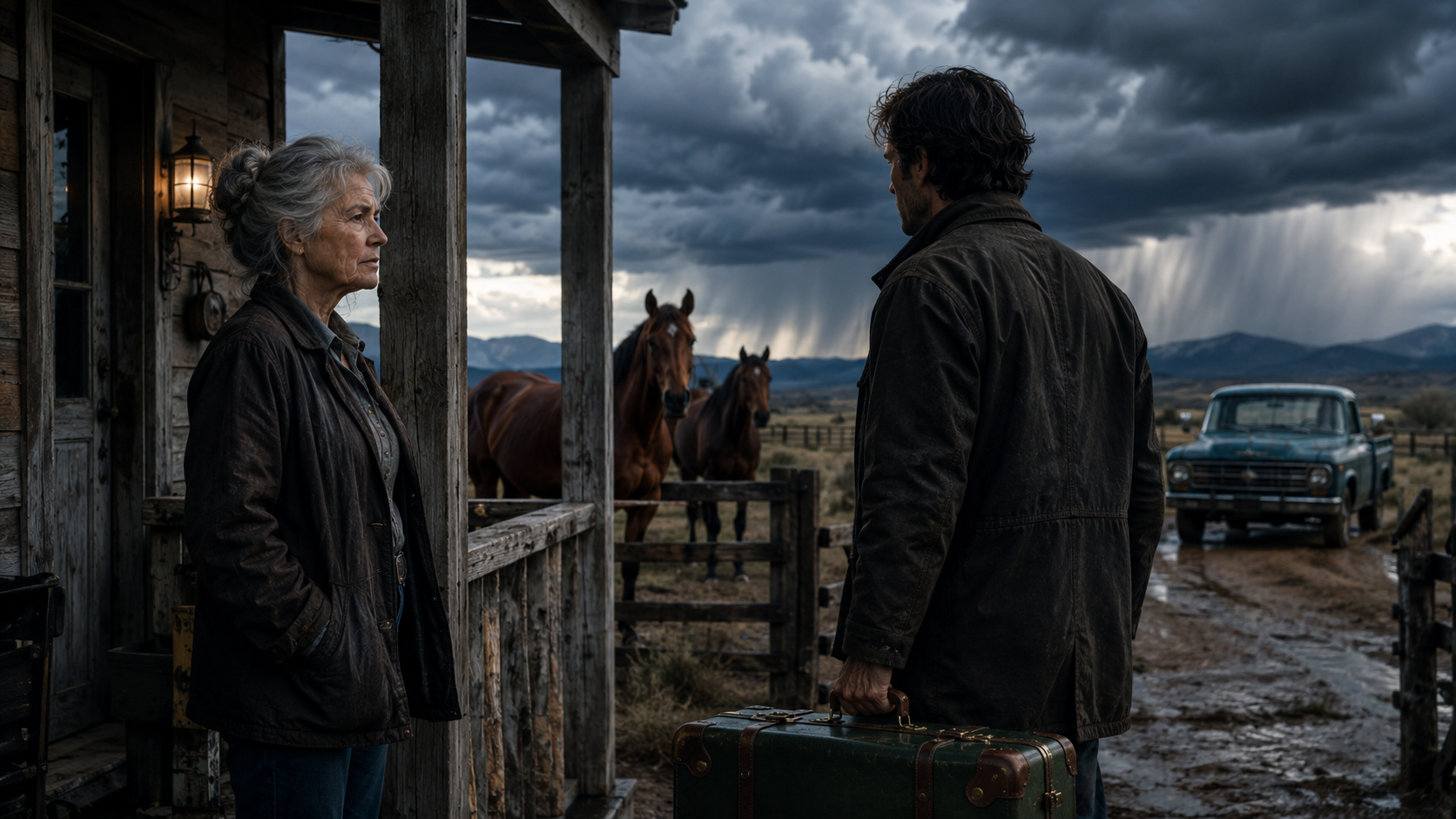
The first sound Margaret Sloan heard was not the approaching truck.
It was the horses.
All four of them raised their heads at once, ears turning toward the eastern road. Jasper, the old gray gelding who rarely reacted to anything more exciting than a rattling feed bucket, stepped away from the fence and released a low, uneasy breath.
Margaret stopped repairing the leather strap in her hands.
The afternoon had been quiet until then. Too quiet, perhaps. Even the wind had abandoned Red Willow Ranch, leaving the cottonwood leaves motionless beneath a sky the color of faded steel.
Then she heard the engine.
It came slowly along the dirt road, coughing whenever the driver changed gears. A brown cloud rose behind the vehicle and hung over the fields like smoke.
Margaret placed the strap on the porch rail.
Visitors did not arrive at Red Willow without calling first.
The ranch stood almost twenty miles from the nearest town, hidden beyond two cattle gates and a bridge that looked as though it had been built before automobiles existed. Delivery drivers left packages at the gas station. Neighbors used the telephone. Anyone else had no reason to come.
The truck appeared around the final bend.
It was dark blue, old but well maintained. Mud covered the lower doors, and there was no company name painted on the side. The driver stopped outside the wooden gate and switched off the engine.
For several seconds, nothing happened.
Margaret reached behind the porch column and wrapped her fingers around the handle of the small revolver she kept there. She did not raise it. She simply wanted to know it was close.
The driver’s door opened.
A man stepped out carrying a rectangular suitcase.
He looked to be in his early fifties. Tall, narrow-shouldered, with silver beginning to show in his dark hair. He wore a plain jacket, work boots, and no hat, despite the threatening sky.
The suitcase was unusual. It was made of faded green leather, reinforced with brass corners and secured by two metal clasps and a circular combination lock.
The man stopped outside the gate.
“Mrs. Margaret Sloan?”
Margaret remained on the porch.
“Who’s asking?”
“My name is Adrian Cole.”
“That doesn’t answer my question.”
He glanced at the revolver half hidden behind the column. His expression did not change.
“I came to deliver something.”
“I’m not expecting anything.”
“I know.”
That answer made her tighten her grip.
Adrian placed the suitcase on the ground but kept one hand on its handle.
“I was asked to bring this directly to you. I was told not to leave it with a neighbor, a police officer, or anyone from the county.”
“Asked by whom?”
He looked past her toward the ranch house.
The porch boards were warped. The paint around the windows had peeled away in long white curls. A section of gutter sagged above the kitchen. Red Willow had once been one of the finest horse ranches in the valley. Now it seemed to be growing tired alongside its owner.
“The woman who gave me the suitcase died six days ago,” Adrian said.
Margaret studied him.
“Then I suppose she won’t mind if you tell me her name.”
“Eleanor Ward.”
The name meant nothing to her.
“I never knew anyone called Eleanor Ward.”
“She knew about you.”
“That isn’t the same thing.”
“No,” Adrian agreed. “It isn’t.”
Thunder rolled somewhere beyond the hills.
The horses moved toward the shelter.
Margaret released the revolver but remained beside the column.
“What’s inside?”
“Things that should have reached you twenty-two years ago.”
Every muscle in her body seemed to become still.
Twenty-two years.
Not twenty. Not a long time ago. Not when you were younger.
Twenty-two.
That was exactly how long it had been since the Cottonwood Valley Hospital fire.
Exactly how long since Margaret’s daughter, Hannah, had entered that hospital carrying a newborn baby and walked out without one.
Margaret descended the porch steps.
“What did you say?”
Adrian lifted the suitcase.
“I think you heard me.”
She crossed the yard but stopped several feet from the gate.
“Did Eleanor Ward work at Cottonwood Valley Hospital?”
“She was a maternity nurse.”
Margaret stared at the suitcase.
For two decades, she had trained herself not to react whenever someone mentioned the hospital. She had learned to breathe through the memories: the black smoke, the emergency vehicles, Hannah screaming at a doctor, the white sheet covering a crib that Margaret had never been allowed to approach.
The official report had been simple.
An electrical fire started in a storage room during the night. Smoke entered the maternity wing. Several patients were evacuated. Two nurses were injured. One newborn child died.
Grace Sloan.
Hannah’s daughter.
Margaret’s only grandchild.
“This is some kind of trick,” Margaret said.
“No.”
“You expect me to believe that a nurse waited twenty-two years and then sent a stranger to my ranch?”
“I don’t expect you to believe anything until you open the suitcase.”
“Why didn’t she come herself?”
“She was afraid.”
“Of me?”
“Of what she had done.”
A drop of rain struck the dust between them.
Then another.
Margaret opened the gate.
Adrian handed her the suitcase. It was heavier than she expected.
The leather smelled faintly of smoke.
“There’s a three-number lock,” he said.
“I can see that.”
“Eleanor said you would know the combination.”
“I told you, I never knew her.”
“The combination isn’t about her.”
Margaret looked at the lock.
Three empty windows waited above the turning dial.
“What number?”
“She wouldn’t tell me. She said it had to come from you.”
“Then she sent you on a wasted journey.”
Adrian turned toward his truck.
Margaret’s voice stopped him.
“Why are you involved?”
He stood with his back to her.
“For the last eight months, I’ve been helping Eleanor organize her records. She hired me after she learned she was dying.”
“What kind of work do you do?”
“I used to investigate insurance fraud.”
“Used to?”
“I made enough mistakes to lose my license.”
At least that sounded honest.
He opened the truck door.
“Wait,” Margaret said. “Are you leaving?”
“My instructions were to deliver the suitcase.”
“You drive all this way, tell me a dead nurse knew something about my granddaughter, and now you’re simply driving away?”
Adrian looked toward the darkening road.
“There’s a motel in Cedar Junction. I’ll stay there tonight. My telephone number is inside the suitcase.”
“What happens when I open it?”
“That depends on what you decide to do afterward.”
He climbed into the truck.
Margaret stood beneath the first cold drops of rain, holding the suitcase against her chest.
Adrian started the engine.
Before pulling away, he lowered the window.
“Mrs. Sloan?”
“What?”
“Whatever you find in there, remember that Eleanor was not asking to be forgiven. She only wanted the truth to reach the person from whom it had been stolen.”
The truck rolled away.
Margaret remained at the gate until the dust and rain erased it from view.
The Number Only Hannah Would Remember
The storm reached the ranch before sunset.
Rain struck the roof in hard, uneven bursts. The power flickered twice while Margaret carried the suitcase into the kitchen and placed it on the table.
She did not touch the lock immediately.
Instead, she made coffee.
She filled Jasper’s feed bucket.
She checked every window.
She moved the revolver from the porch to the kitchen counter.
Only then did she sit across from the green suitcase.
Three numbers.
A combination she was supposed to know.
Margaret tried Hannah’s birthday. February 11.
Two, one, one.
The lock did not open.
She tried Grace’s birthday. August 6.
Eight, zero, six.
Nothing.
She tried the address of the old hospital, the number of Hannah’s room and the final three digits of their telephone number from twenty-two years ago.
The lock remained closed.
Rainwater streamed down the windows.
Margaret pressed her palms against the table and closed her eyes.
The night of the fire returned in fragments.
Hannah had been nineteen. Too young to be a mother, everyone had said, though no one had dared say it to her face. The baby’s father had disappeared before Grace was born. Hannah had refused to tell Margaret where he had gone.
Yet the moment she held her daughter, Hannah had seemed older.
Not happier. Not less frightened.
Simply certain.
“She knows my voice,” Hannah had whispered from the hospital bed. “Look, Mom. She turns her head when I speak.”
Grace had been a small, red-faced baby with a cap of dark hair and one hand that refused to remain inside the blanket.
Margaret had held her for eleven minutes.
She knew because the wall clock had read 2:06 when the nurse placed Grace in her arms.
At 2:17, the fire alarm began.
Margaret opened her eyes.
Two seventeen.
Her breath caught.
She turned the lock.
Two.
One.
Seven.
The mechanism clicked.
Margaret pulled her hand away as though the suitcase had become hot.
For several moments, she listened only to the rain.
Then she opened the clasps.
The lid rose slowly.
The first thing she saw was a yellow infant blanket.
Its edges were worn, and one corner carried a small embroidered bird. Margaret recognized it before she touched it.
Hannah had sewn that bird during the final month of her pregnancy. Her stitches had been crooked. Margaret had offered to fix them, but Hannah refused.
“I want Grace to know I made it,” she had said.
Margaret lifted the blanket with both hands.
Beneath it lay a hospital identification bracelet, a digital voice recorder, a thick folder bound with a red ribbon, and several photographs.
The top photograph showed a young woman standing beside the ocean.
She appeared to be twenty-one or twenty-two. Her brown hair blew across her face, and she was laughing at someone outside the frame.
Margaret felt the room tilt.
The young woman had Hannah’s eyes.
Not eyes that resembled Hannah’s.
Hannah’s eyes.
The same dark outer ring. The same slight upward angle. The same small crease beneath the left eye that appeared whenever she smiled.
Margaret picked up the photograph.
On the back, someone had written a name and a date.
Sophie Bellamy. Age twenty-one.
Margaret dropped it.
Her chair scraped backward.
“No,” she whispered.
The power went out.
Darkness swallowed the kitchen. A second later, lightning illuminated the windows, turning the room white.
Margaret found the emergency lamp in the drawer and switched it on. Its weak glow fell across the open suitcase.
She reached for the voice recorder.
A strip of tape had been placed over the play button.
Press first.
Margaret removed the tape and pressed the button.
Static filled the kitchen.
Then an old woman began to speak.
“My name is Eleanor Ward. From 1987 until 2009, I worked as a registered nurse at Cottonwood Valley Hospital. What I am about to confess happened on the night of August sixth, twenty-two years ago.”
Margaret stopped breathing.
“I was working in the maternity wing when the fire alarm sounded at 2:17 in the morning. The smoke was not yet inside the nursery, but the evacuation was disorganized. We had six newborns, three mothers unable to walk without assistance, and only four staff members in the wing.”
Eleanor’s voice shook.
“During the evacuation, I carried two infants to the eastern stairwell. One was Grace Sloan. The other was the newborn son of Nathaniel and Rebecca Bellamy.”
The Bellamy name was familiar.
Everyone in the state knew Bellamy Agricultural Holdings. They owned cattle operations, food-processing plants, trucking companies and more land than some counties.
“The Bellamy infant had been born with severe complications,” Eleanor continued. “He stopped breathing during the evacuation. Despite our efforts, he could not be revived.”
Margaret covered her mouth.
“Rebecca Bellamy was sedated. Her husband arrived before the fire department allowed families back into the building. When he learned that his child had died, he demanded to see the nursery supervisor privately.”
The recording paused.
When Eleanor spoke again, she sounded as though each word hurt.
“Nathaniel Bellamy offered us money to change the identification bracelets. He said his wife would not survive losing another child. He said the Sloan baby had no father, no wealthy family and no future that could compare with the one he could provide.”
Margaret struck the table with her fist.
The lamp jumped.
On the recording, Eleanor began to cry.
“I wish I could tell you that I refused. I did not. The supervisor agreed first. I agreed afterward. We placed the Bellamy bracelet on Grace Sloan. We placed Grace’s bracelet on the child who had died.”
Margaret pressed the recorder against the table as if she could force the voice to stop.
But she could not make herself turn it off.
“The fire damaged records in the wing. The confusion protected us. The dead infant was identified as Grace Sloan. The living baby left the hospital three days later with Nathaniel and Rebecca Bellamy.”
A sound escaped Margaret’s throat.
Not a word.
Not quite a cry.
“Hannah,” she whispered.
After the fire, Hannah had never recovered.
She blamed herself for returning Grace to the nursery so she could sleep. She blamed Margaret for going downstairs to buy coffee. She blamed the nurses, the hospital and God.
Six months later, she left Red Willow Ranch.
For the next four years, postcards arrived from different states. Then the postcards stopped.
A highway patrol officer came to Margaret’s door one winter morning. Hannah had been killed when her car slid from an icy road in northern Idaho.
She had died believing her child was buried beneath a small stone in Cottonwood Cemetery.
“She never knew,” Margaret said.
The old woman’s recorded voice continued.
“I kept copies of the original documents. The supervisor destroyed hers. Nathaniel Bellamy paid each of us, but I never spent the money. I told myself that the child was safe and loved. I told myself that exposing the truth would only destroy more lives.”
Eleanor coughed for several seconds.
“I understand now that those excuses protected me, not Grace. Her name today is Sophie Bellamy. She does not know how she came into that family. She believes Rebecca Bellamy gave birth to her.”
Margaret gripped the yellow blanket.
“The folder contains copies of the original nursery log, photographs of both identification bracelets, financial records of the payments and a written confession signed before two witnesses. It also contains the results of a private DNA comparison.”
Margaret looked at the folder tied with red ribbon.
“Sophie began asking questions after Rebecca Bellamy died last year. She found inconsistencies in her birth records and contacted a genealogical service. I submitted a sample from an envelope Hannah Sloan mailed to the hospital after the fire. I had kept it with the other evidence.”
Eleanor took a slow breath.
“The probability that Hannah Sloan was Sophie Bellamy’s biological mother is greater than ninety-nine percent.”
Margaret closed her eyes.
Somewhere outside, one of the horses kicked the wall of the shelter.
“I have also included a letter addressed to Sophie. I did not send it. That choice belongs to you, Mrs. Sloan. I have already stolen enough choices from your family.”
The recording grew quieter.
“There is one more thing you must know. Nathaniel Bellamy is alive. He knows Sophie has begun searching. I do not know what he will do to protect his name.”
The recording ended.
A Woman Who Had Never Seen Her Own Face
Margaret sat in the dark kitchen until the storm began to move away.
She opened the folder.
Everything Eleanor had described was there.
Hospital logs.
Copies of checks.
A confession bearing Eleanor’s signature.
Two photographs taken on the night of the fire. In one, the infant bracelets rested side by side on a metal tray. One read Grace Sloan. The other carried the Bellamy name.
There was also a sealed envelope.
For Sophie.
Margaret did not open it.
At the bottom of the folder she found Adrian Cole’s telephone number.
She called him at 10:43.
He answered after the first ring.
“You opened it,” he said.
“Is she alive?”
“Yes.”
“Have you met her?”
“Once.”
“What is she like?”
Adrian remained silent for a moment.
“Intelligent. Direct. She notices when people avoid answering her questions.”
“That sounds like Hannah.”
“I suspected it might.”
“Does she know about me?”
“Not yet.”
Margaret stood and walked to the rain-streaked window.
“Why did Eleanor choose you?”
“Because I investigated Bellamy Agricultural Holdings twelve years ago.”
“What did you find?”
“Enough to know they could make problems disappear. Not enough to prove how.”
“Are you afraid of Nathaniel Bellamy?”
“Yes.”
The honesty calmed her more than reassurance would have.
“What happens if I give Sophie the letter?”
“Her life changes.”
“My life already changed when you drove through my gate.”
“I know.”
“No, Mr. Cole. You don’t.”
He accepted the rebuke without answering.
Margaret looked at the photograph of Sophie beside the ocean.
“Bring her here.”
“I can’t do that without telling her why.”
“Then tell her.”
“I need to be certain.”
“About what?”
“That you understand she may not believe us. She may refuse to come. She may defend the man who raised her.”
“He stole her.”
“He also fed her, cared for her and was the only father she knew.”
Margaret’s hand tightened around the receiver.
“You sound as though you’re protecting him.”
“I’m protecting her from being treated like evidence in someone else’s case.”
Margaret nearly hung up.
Then she looked at the sealed envelope.
“What do you suggest?”
“Let me speak to her tomorrow. I’ll tell her Eleanor left information about her birth and that a woman at Red Willow Ranch may be connected to it. Nothing more until she agrees to see the evidence.”
“And if she doesn’t?”
“Then we respect her decision.”
Margaret hated those words.
For twenty-two years, other people had made decisions about Grace. A nurse. A hospital supervisor. A rich man who believed money gave him the right to choose which mother deserved a child.
Yet Adrian was right.
Sophie was no longer an infant who could be carried through a smoky hallway. She was a grown woman.
“All right,” Margaret said. “Call her.”
“I will.”
“And Mr. Cole?”
“Yes?”
“If Nathaniel Bellamy tries to stop her, tell him Red Willow has survived droughts, fires, banks and men more frightening than he is.”
For the first time, Adrian almost laughed.
“I’ll tell him.”
The Car Beyond the Gate
The following day passed without news.
Margaret worked because she did not know what else to do.
She repaired the broken strap. She cleaned the stalls. She drove into Cedar Junction and bought groceries she did not need. At the pharmacy, she caught herself studying every young woman with dark hair.
Adrian called shortly after six.
“She agreed to come.”
Margaret sat on the edge of her bed.
“When?”
“Tomorrow morning.”
“Does she know?”
“She knows there was a hospital irregularity. She knows you may be her biological grandmother.”
“What did she say?”
“She asked whether you had photographs of Hannah.”
Margaret looked toward the cedar chest beneath the window.
“I have hundreds.”
“Then choose a few. Don’t overwhelm her.”
“You give a great many orders for a man without an investigator’s license.”
“I’m trying to prevent two frightened people from hurting each other.”
“I am not frightened.”
“Yes, you are.”
Margaret ended the call.
She opened the cedar chest.
Hannah’s life waited inside in paper envelopes and old albums.
Hannah at five, standing in a horse trough.
Hannah at nine, missing both front teeth.
Hannah at fourteen, furious because Margaret had photographed her in muddy clothes.
Hannah at nineteen, sitting on the porch with Grace in her arms, looking exhausted and proud.
Margaret chose that photograph.
She placed it beside the green suitcase on the kitchen table.
She did not sleep.
At 9:12 the next morning, a silver car appeared on the eastern road.
Margaret watched from the porch.
Adrian was driving.
A young woman sat beside him.
The car stopped outside the gate.
For a long time, neither passenger moved.
Then the young woman stepped out.
She wore jeans, a dark sweater and brown boots unsuited to ranch mud. Her hair was tied behind her head. She looked toward the house with the expression of someone standing at the entrance to a building that might contain either treasure or disaster.
Margaret descended the steps.
Adrian remained near the car.
The young woman approached the gate.
“Margaret Sloan?”
Her voice was different from Hannah’s.
Softer.
But when she raised one eyebrow, Margaret saw her daughter so clearly that twenty-two years disappeared.
“My name is Sophie,” the young woman said.
“I know.”
“That’s a strange thing to say to someone you’ve never met.”
“You’re right.”
Margaret opened the gate.
Sophie did not enter immediately.
“Mr. Cole said you have documents.”
“They’re inside.”
“And photographs?”
“Yes.”
“Of Hannah?”
Margaret nodded.
Sophie looked across the yard at the horses, the barn and the cottonwoods.
“Did she live here?”
“Until she was twenty.”
“Was she happy?”
“Sometimes.”
“Did she want me?”
The question struck harder than anything inside Eleanor’s confession.
Margaret stepped closer.
“She wanted you from the moment she knew you existed.”
Sophie’s jaw tightened.
“My father said my biological mother abandoned me.”
“Nathaniel Bellamy is not your biological father.”
“He is still my father.”
Margaret forced herself to remain calm.
“I understand.”
“No, you don’t. Everyone keeps telling me what I’m supposed to call people. Birth mother. Adoptive mother. Real father. Fake father. I don’t know what any of those words mean anymore.”
“Then don’t use them today.”
Sophie stared at her.
“What should I call you?”
“Margaret will do.”
A small change appeared in Sophie’s expression. Not trust, but surprise.
She entered the gate.
Inside the kitchen, Margaret showed her the suitcase.
Sophie touched the yellow blanket.
“I dreamed about this color when I was a child,” she said.
Margaret did not respond. She was afraid that speaking would break the fragile calm between them.
Sophie examined the bracelet, the photographs and the hospital records. She listened to Eleanor’s confession without interrupting.
When it ended, she remained still.
Adrian waited near the door.
Margaret placed the photograph of Hannah and Grace on the table.
Sophie picked it up.
“That’s me?”
“Yes.”
“And that’s Hannah?”
“Yes.”
Sophie held the photograph closer.
“She looks tired.”
“She was.”
“Scared?”
“Very.”
“Happy?”
Margaret’s eyes filled.
“Happier than I had ever seen her.”
Sophie turned the photograph over, though nothing was written on the back.
“Where is she?”
Margaret had rehearsed several versions of the answer.
None of them survived the moment.
“She died eighteen years ago.”
Sophie closed her eyes.
“Did she know I was alive?”
“No.”
The photograph trembled in her hand.
“So she spent the rest of her life thinking I died in that fire?”
“Yes.”
Sophie stood so quickly that the chair fell behind her.
She walked out of the kitchen.
Margaret began to follow, but Adrian raised a hand.
“Give her a moment.”
“She shouldn’t be alone.”
“She has been alone with this truth since yesterday.”
Margaret ignored him and went outside.
Sophie stood near the horse fence, facing the open fields.
“I’m sorry,” Margaret said.
Sophie wiped her face.
“For what?”
“For not finding you.”
“You thought I was dead.”
“I should have demanded proof. I should have opened the coffin. I should have questioned every nurse in that hospital.”
“You were grieving.”
“So was Hannah.”
Sophie turned around.
“What was she like?”
Margaret walked to the fence.
“She hated mornings. She loved thunderstorms. She could ride any horse except Jasper, who refused to obey her because they were equally stubborn. She sang badly and loudly. She once broke a boy’s nose for insulting a friend.”
Sophie laughed through her tears.
The sound made Margaret’s knees weak.
“My mother Rebecca hated thunderstorms,” Sophie said. “She would close every curtain.”
“Perhaps she was afraid of remembering the fire.”
Sophie looked toward the house.
“Did she know?”
“I don’t know.”
“My father says she didn’t.”
“You spoke to him?”
“Last night.”
Margaret felt Adrian move closer behind them.
“What did Nathaniel say?”
“That Eleanor Ward was confused and sick. That the records were forged. That you were trying to claim part of the Bellamy estate.”
Margaret gave a dry laugh.
“He clearly hasn’t seen my bank account.”
“He also told me not to come here.”
“But you came.”
Sophie looked again at the photograph.
“I needed to see her face.”
What the Suitcase Changed
Nathaniel Bellamy arrived two hours later.
He came in a black vehicle with an attorney and two security men. Margaret refused to let any of them enter the ranch except Nathaniel.
He looked older than his photographs but carried himself with the confidence of a man who had spent his life watching doors open before he reached them.
Sophie waited on the porch.
“You shouldn’t be here,” Nathaniel told her.
“Neither should you,” she replied.
His gaze moved to Margaret.
“How much do you want?”
Margaret almost admired the speed with which he revealed himself.
“Your money has caused enough trouble.”
“Then what is this about?”
“The truth.”
“The truth is that I raised my daughter.”
“You purchased someone else’s child.”
Pain crossed his face, quickly replaced by anger.
“My wife had lost three pregnancies. Our son died in that hospital. Rebecca was barely conscious when I made the decision.”
“You made it for Hannah too.”
“I gave Sophie a life your daughter could never have provided.”
Sophie stepped down from the porch.
“You don’t get to say that.”
Nathaniel turned toward her.
“I protected you.”
“You lied to me.”
“I loved you.”
“Both things can be true.”
For the first time, Nathaniel had no immediate answer.
Sophie held the photograph of Hannah against her chest.
“I’m going to give the evidence to the state investigators.”
His face changed.
“Sophie, listen to me.”
“I have listened to you my entire life.”
“This will destroy our family.”
“No. What you did destroyed two families. This only makes people see the ruins.”
Nathaniel looked suddenly small beneath the enormous sky.
He left without offering Margaret another dollar.
The investigation lasted nearly a year.
The former nursery supervisor was still alive. Faced with Eleanor’s records, she confessed. Hospital administrators admitted that evidence had disappeared after the fire. Nathaniel Bellamy was charged with kidnapping, falsifying medical records, bribery and conspiracy.
The newspapers surrounded Red Willow Ranch for several weeks.
Margaret disliked every minute of it.
She gave one statement and refused all interviews afterward.
Sophie returned many times.
At first, she stayed for an hour.
Then an afternoon.
Then an entire weekend.
She learned to brush the horses, though she remained suspicious of Jasper. Margaret showed her how to repair a fence and how to recognize rain by the smell of the sagebrush.
Sophie showed Margaret photographs of the life she had lived: schools, birthdays, vacations, Rebecca smiling beside her at graduation.
Margaret never asked her to remove those years from her heart.
Rebecca had participated in a stolen life, knowingly or not. She had also held Sophie through fevers, packed her lunches and waited awake when she came home late.
Human beings, Margaret discovered, could be guilty and loving at the same time.
There was no simple name for such people.
On the first anniversary of the suitcase’s arrival, Sophie brought a small wooden box to the ranch.
“What is it?” Margaret asked.
“A gift.”
Inside was a restored copy of the photograph showing Hannah with newborn Grace.
Beside it, Sophie had placed a new photograph.
It showed Margaret and Sophie at the horse fence, laughing as Jasper attempted to steal Sophie’s hat.
“I thought they should stay together,” Sophie said.
Margaret held the two photographs side by side.
Hannah had not returned.
The years had not been repaired.
No confession could give a young mother back the life stolen from her. No court could erase the grief that had followed Margaret from room to room for more than two decades.
But the truth had opened a door where Margaret had believed only a wall remained.
That evening, she and Sophie carried the green suitcase into the barn.
They placed it on a high shelf above the tack room.
“Shouldn’t we throw it away?” Sophie asked.
Margaret considered the faded leather and brass corners.
“No.”
“Why keep it?”
“Because some things arrive late and still manage to arrive in time.”
Sophie looked toward the open barn doors.
Sunset covered Red Willow Ranch in gold. The cottonwood leaves moved in the evening wind, and the horses crossed the field in a slow line.
“Margaret?”
“Yes?”
“Would it be all right if I called you Grandma someday?”
Margaret looked away, pretending to inspect a saddle.
“You can call me whatever feels honest.”
Sophie slipped her arm through Margaret’s.
“Then Grandma feels honest.”
For the first time in twenty-two years, Margaret allowed herself to imagine that the ranch might outlive her.
Not as a monument to everything she had lost.
As a place to which someone would return.
Above them, the old suitcase remained closed.
It had carried evidence of a crime, the confession of a dying woman and the name of a child who had grown up inside another family’s story.
But its greatest secret was not hidden in the documents.
Its greatest secret stood beside Margaret in the barn, holding her arm and looking out across the land as though she were finally beginning to recognize it.
Some truths destroy the life a person thought they had.
Others uncover the life that was waiting underneath.

