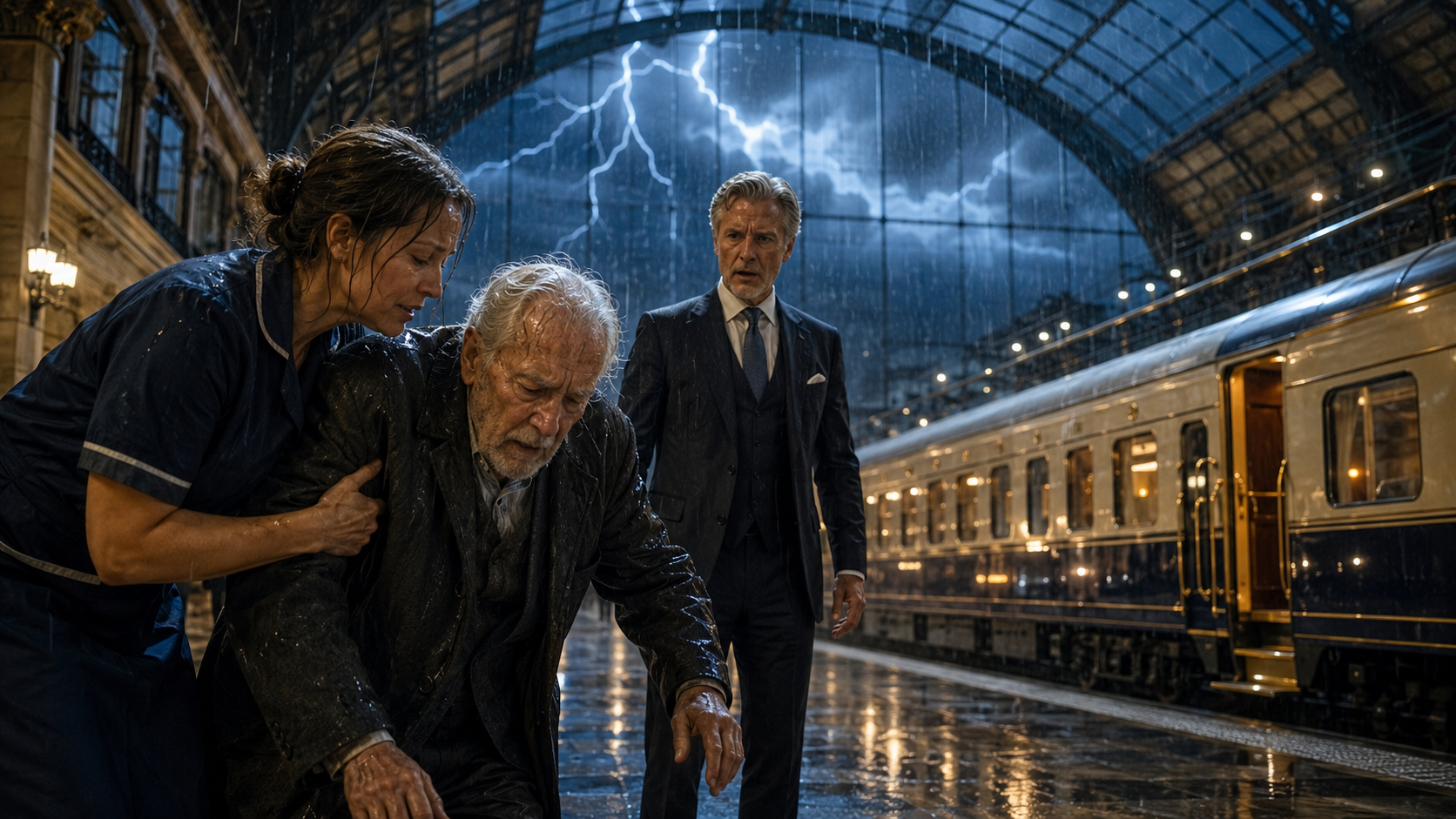
THE LAST SIGNAL BEFORE MIDNIGHT

Rain hammered the glass roof of Raventon Grand Terminal so violently that the building seemed to be traveling through the storm rather than standing beneath it.

Inside, however, the weather had been reduced to decoration.

Crystal lamps burned above polished black marble. A string quartet played beneath the station clock. Waiters moved between investors carrying silver trays of champagne, and every brass railing had been polished until it reflected the thousands of lights strung across the vaulted ceiling.

At midnight, Aurora Meridian Rail would unveil the Northstar Limited, the most expensive private passenger train ever built in America.

The train waited beside Platform One like a dark-blue palace on wheels.

Its owner stood at the edge of the celebration, checking the time.

Bennett Ashford had built his reputation on the belief that delay was simply another word for weakness. Trains departed when he ordered them to depart. Banks returned his calls. Governors adjusted public appearances around his schedule. Newspapers had called him the man who had made rail travel glamorous again.

At forty-two, he controlled terminals, freight corridors, luxury hotels, and a private rail network stretching across eighteen states.

He also controlled his face.

No one watching him would have guessed that he had slept three hours in the last two days or that the launch depended on an investment agreement worth $1.2 billion.

His chief operating officer, Victor Crane, approached with two glasses of champagne.

“The Harrington group is ready to sign,” Victor said. “All they want is proof that tonight runs without embarrassment.”

Bennett did not take the glass.

“Then make certain it does.”

Victor smiled. He was a broad-shouldered man with silver at his temples and the smooth confidence of someone who had spent twenty years deciding which problems deserved attention and which people did not.

“Security has sealed the lower concourse. Protesters are behind the east barricade. The press will remain in Clock Hall until the train departs.”

“And the weather?”

“The storm should move north.”

“Should?”

Victor’s smile tightened.

“The forecast says it will.”

Bennett looked through the glass wall toward the Northstar Limited. Rain streaked down the windows of the observation car.

“Forecasts do not sign contracts.”

“No,” Victor replied. “People do.”

Across the terminal, Elena Marquez emptied a brass wastebasket into a cleaning cart.

Her uniform was dark gray, her shoes were wet, and a loose strand of hair had escaped the knot at the back of her neck. She had already worked ten hours, though her schedule listed eight. Two members of the cleaning staff had called in sick, and the launch gala had tripled the usual workload.

None of that concerned Victor Crane.

What concerned him was that Elena’s cart had briefly appeared in the background of a television interview.

“Keep service employees behind the velvet partitions,” he had ordered.

Service employees.

Elena had repeated the phrase silently while scrubbing champagne from a staircase.

She had a name, an employee number, a daughter waiting at a neighbor’s apartment, and three hundred eighty dollars folded inside an envelope in her handbag.

The money was for Sophie’s seizure medication.

The pharmacy closed at one in the morning. If Elena left the moment the Northstar departed, she could reach it with fifteen minutes to spare.

She checked the clock.

Eleven sixteen.

Forty-four minutes.

Enough time, provided no one created another emergency.

A security guard hurried past her toward the old west entrance.

“Someone got through the construction gate,” he said into his radio. “Male, elderly, possibly intoxicated.”

Elena continued wiping the marble.

A second guard crossed the concourse.

“Crane wants him outside before the investors see him.”

Elena stopped.

Beyond the flower arrangements, near a row of closed ticket windows, an old man stood dripping rainwater onto the floor.

He wore a wool coat that was too large for him and trousers stained with mud below the knees. One shoe had been tied with electrical wire. His white hair lay flat against his forehead, and his left hand shook around a brass railway whistle.

He stared at the departure board as if the names of the cities might rearrange themselves into an answer.

Two security officers approached him.

“You need to come with us, sir.”

The old man looked over his shoulder.

“Platform Seven.”

“There is no passenger service on Platform Seven.”

“My train leaves from Seven.”

“Not tonight.”

“It always leaves from Seven.”

The nearest guard reached for his arm.

The old man recoiled so sharply that his shoulder struck a ticket counter.

“Don’t touch me.”

Several guests turned toward the sound.

Victor Crane appeared almost immediately.

He glanced at the old man, then at the investors beginning to notice.

“Remove him.”

“He appears confused,” one guard said.

“I did not ask for a diagnosis.”

Elena abandoned her cleaning cart.

“Sir,” she called gently.

The old man looked at her.

His eyes were pale blue, frightened but alert.

“My train is late,” he said.

Elena approached slowly.

“What city are you traveling to?”

“I don’t remember.”

“Do you have a ticket?”

He searched his coat pockets. He removed a bent spoon, three buttons, a folded map, and an empty wooden matchbox.

No ticket.

Victor lowered his voice.

“Miss Marquez, return to your assigned area.”

“He may need medical help.”

“He needs to leave.”

The old man studied Victor’s formal suit.

“You work for the railway?”

“I operate it.”

“Then you should know better than to put passengers on the north bridge tonight.”

Victor’s expression changed only slightly.

“The north bridge is not your concern.”

“The ground is moving.”

One of the guards exchanged a doubtful glance with the other.

Victor laughed once.

“The ground is wet. That is what happens during rain.”

The old man tightened his grip on the whistle.

“No. Wet earth settles. Moving earth speaks.”

Victor turned to the guards.

“Take him out through the service entrance.”

The old man’s breathing accelerated. His face lost color.

Elena stepped between him and the guards.

“Give him a minute.”

“You are obstructing security,” Victor said.

“He can barely stand.”

“He stood long enough to enter a private event.”

The old man’s knees buckled.

Elena caught him before his head struck the marble.

The quartet continued playing.

Guests watched over the rims of champagne glasses.

Victor looked less concerned about the collapsed man than about the people observing him.

“Move him behind the partition.”

Elena lowered herself to the floor.

“Sir, can you hear me?”

The old man opened his eyes.

“Signal box,” he whispered.

“What about it?”

“Three short. Two long. Three short.”

His breath smelled of cold rain and hunger.

Elena looked toward the guards.

“Call an ambulance.”

Victor shook his head.

“An ambulance in the main entrance will destroy the launch coverage.”

“He may be having a stroke.”

“There is a private medical office six blocks away. Use the employee entrance and send him there.”

“How?”

“Call a cab.”

Elena stared at him.

“You want a sick man to pay for a taxi to a clinic?”

Victor’s eyes hardened.

“I want this terminal cleared.”

Elena knew what disagreement with Victor Crane could cost.

Two months earlier, a porter had complained about unsafe luggage equipment. His shifts disappeared within a week. A dining-car worker had questioned unpaid overtime and found herself transferred to a route that kept her away from home four nights at a time.

Elena’s job provided the insurance that covered part of Sophie’s treatment.

Part, but not all.

The money in her handbag represented three weeks of skipped lunches, an overdue electricity payment, and the silver bracelet her mother had left her.

She looked at the old man.

His lips were turning gray.

“What is your name?” she asked.

His brow tightened.

“Gideon.”

“Gideon what?”

“I had a name.”

“You still do.”

He looked close to tears.

“I left it somewhere.”

Elena stood and removed the envelope from her handbag.

Victor watched her.

“What are you doing?”

She gave the money to the nearest guard.

“Call the clinic. Tell them we are bringing a confused elderly man with breathing difficulty. Use whatever they need for a deposit.”

Victor glanced at the envelope.

“That is not company money.”

“No.”

“Then you will not be reimbursed.”

Elena thought of Sophie’s medication waiting behind the pharmacy counter.

“I know.”

“You are making an emotional decision.”

“I am making the decision no one else seems willing to make.”

Victor moved closer.

“You will return to your duties after security removes him.”

“I’m going with him.”

“Then you are abandoning your post.”

Elena swallowed.

“Then record it that way.”

A silence opened between them.

Bennett Ashford had crossed half the terminal without Elena noticing.

He stopped near the collapsed man and looked down at the brass whistle in Gideon’s hand.

For a second, something shifted in Bennett’s expression.

Not recognition.

Something more instinctive and less welcome.

Memory without context.

“Who is he?” Bennett asked.

Victor answered first.

“A trespasser. Miss Marquez has decided to interrupt the launch by turning the lobby into a charity ward.”

Elena rose.

“He is disoriented, dehydrated, and possibly seriously ill.”

Bennett’s gaze moved to the envelope in the guard’s hand.

“What is that?”

“My money.”

“For what?”

“A medical deposit.”

Victor exhaled impatiently.

“Her daughter has a prescription due tonight. Miss Marquez appears determined to spend the money on a stranger.”

Elena stared at him. She had never told Victor why she needed to leave on time.

He had clearly examined her scheduling request.

Bennett looked at her.

“Your daughter needs medicine?”

“She has epilepsy.”

“And you are giving away the money?”

“I’m not giving it away.”

“What would you call it?”

“Using it.”

Bennett studied her as though she were a financial statement that refused to balance.

“On a man whose surname you do not know.”

“His surname won’t change whether he survives the night.”

Gideon stirred.

His eyes opened and found Bennett standing above him.

The old man went perfectly still.

The whistle slipped from his hand and struck the marble.

Bennett flinched at the sound.

Gideon raised a trembling hand.

“Ben?”

Bennett’s jaw tightened.

Elena looked between them.

The old man’s voice softened.

“Little Falcon.”

Bennett stepped backward.

No one had called him that in seventeen years.

No one alive should have known the name.

1. THE NAME IN THE STORM

Bennett’s mother had invented the nickname when he was six.

He had climbed onto the roof of his father’s signal workshop, spread his arms, and announced that he could see every train in the world.

His father had shouted at him to get down.

His mother had laughed and called him her little falcon.

After she died, only one person had continued using the name.

Bennett stared at Gideon’s mud-streaked face.

Time had reduced the man he remembered.

The shoulders were narrower. The cheeks had hollowed. The white beard disguised the shape of his mouth.

But the scar above his left eyebrow remained.

Bennett had caused it accidentally at age eleven by releasing a model locomotive before his father was ready. The engine had jumped the track and sent a piece of metal into Gideon’s forehead.

His father had needed seven stitches.

Bennett had cried harder than he had.

“Mr. Ashford?” Elena said.

Bennett heard her from a great distance.

Victor examined the old man.

“Do you know him?”

Bennett forced his voice into its familiar calm.

“No.”

Gideon’s raised hand fell.

The hurt in his eyes arrived before confusion covered it.

“I thought…”

“You are mistaken,” Bennett said.

Elena watched him carefully.

Gideon closed his eyes.

“The storm makes ghosts.”

Bennett turned to the security officer.

“Take him to the executive medical suite.”

Victor blinked.

“We need that space for the Harrington delegation.”

“Move them to the conference car.”

“The suite overlooks the platform. They requested it specifically.”

“Then disappoint them.”

Victor lowered his voice.

“Bennett, the launch begins in thirty minutes.”

“Then you have thirty minutes to solve it.”

The guard handed Elena back her envelope.

Bennett nodded toward it.

“Pick up your daughter’s medication.”

“I should stay until the doctor arrives.”

“That was not a request.”

Elena folded the envelope but did not move.

“Will someone sit with him?”

“A nurse will.”

“He’s frightened of uniforms.”

Victor gave a short laugh.

“He is not a child.”

Gideon opened his eyes.

“Everyone becomes a child when no one believes them.”

Bennett looked away.

Elena slipped the envelope into her handbag.

“I’ll remain until he is stable.”

Victor’s mouth tightened.

“You are already late returning to your assignment.”

Bennett looked at him.

“Miss Marquez is reassigned to the medical suite for the remainder of her shift.”

Victor’s expression became unreadable.

“As you wish.”

A wheelchair arrived.

When Elena helped Gideon into it, he grasped her wrist.

“Do not let them send the train over the bridge.”

“What bridge?”

“The Raven Cut.”

Victor stepped in.

“The Northstar route crosses Raven Cut at twelve forty.”

Gideon’s attention sharpened.

“Then stop it.”

“The line was inspected yesterday.”

“By men who listen to computers.”

“And you listen to mud?”

Gideon looked toward the rain streaming down the terminal windows.

“Mud does not lie to protect a promotion.”

Victor’s face darkened.

Bennett caught the change.

“What does that mean?”

The old man’s clarity vanished as quickly as it had come.

He searched the crowd.

“Where is Abigail?”

Bennett’s mother had been dead for twenty-three years.

A pressure spread behind his ribs.

Elena pushed the wheelchair toward the private elevators.

Before the doors closed, Gideon turned.

“Ben,” he called.

Bennett remained motionless.

“Your mother said you would come home when the trains became quiet.”

The elevator doors met between them.

Victor waited until they were alone.

“Who is he?”

Bennett watched the illuminated floor numbers rise.

“My father.”

Victor said nothing for several seconds.

“I thought Gideon Ashford was dead.”

“So did I.”

“How?”

“My aunt stopped answering calls five years ago. The house was sold. A lawyer told me Gideon had moved into permanent care and wanted no contact.”

“Perhaps he did.”

“He recognized me.”

“Confused people recognize strangers every day.”

Bennett looked at him.

“He used a name only my parents knew.”

Victor’s confidence faltered, then returned.

“You have investors waiting.”

“My father crossed half the city in a storm.”

“And the Harrington group crossed an ocean.”

Bennett turned away from the elevators.

For seventeen years, he had treated the absence of his father as a completed transaction.

No calls.

No meetings.

No reopening the past.

He had converted anger into motion and motion into wealth.

Now the past had appeared barefoot in his terminal, warning him that the ground beneath his empire was moving.

“Have security identify where he came from,” Bennett said. “Quietly.”

Victor nodded.

“And the launch?”

“Continues.”

The answer came too fast.

Bennett knew it.

Victor knew it.

Neither mentioned it.

2. A MAN WHO HEARD THE EARTH

Dr. Priya Nand arrived at the executive suite twelve minutes later.

She found Gideon wrapped in a blanket near the electric fireplace while Elena held a cup of warm water against his lips.

The doctor examined him carefully.

“He is severely dehydrated,” she said. “His blood pressure is unstable, and he has likely missed several doses of medication. I see signs of cognitive impairment, but I cannot determine the cause without records.”

“Can he go to the hospital?” Elena asked.

“He should. The problem is that the roads around the terminal are nearly flooded, and the nearest emergency department is diverting ambulances after a power failure.”

Gideon looked toward the window.

“The trains still run.”

“For now,” Dr. Nand said.

He touched the glass with two fingers.

“Too much water above Raven Cut.”

Dr. Nand glanced at Elena.

“Does that mean something?”

“He believes part of the route is unsafe.”

“Believes?” Gideon asked. “I designed the warning system.”

Elena sat beside him.

“What warning system?”

“The acoustic rods.”

He spoke with sudden precision.

“You bury hollow rods at different depths. Stable ground carries vibration evenly. Moving ground changes the pattern. Three short pulses, two long, three short means lateral pressure against the retaining wall.”

His hand moved through the air as if drawing a diagram.

“The old system sent the rhythm to the signal tower. New owners removed the tower but kept the sensors. Or said they did.”

“You worked for a railway?”

Gideon smiled faintly.

“I worked for the railway before men began saying ‘transportation platform’ because they were embarrassed by trains.”

Elena almost smiled.

“Which railway?”

His expression closed.

“The one that took my boy.”

The suite door opened.

Bennett entered alone.

He had removed his gala jacket, though his white shirt and dark vest remained immaculate. He looked at Dr. Nand rather than at Gideon.

“His condition?”

“Stable for the moment. He needs records, rest, and a neurological assessment. We should transfer him once the hospital can receive patients.”

Bennett nodded.

“Has he said where he came from?”

“A residential facility, perhaps.”

Gideon stared at the fire.

Bennett looked at Elena.

“You have fifteen minutes before the pharmacy closes.”

“I called my neighbor. She’s picking up the prescription.”

“With your money?”

Elena glanced toward Gideon.

“My neighbor used her credit card.”

Bennett understood immediately.

“You still spent the cash on him.”

“The clinic returned the deposit after you moved him here.”

“Then why does your neighbor need to pay?”

“My daughter’s medication costs more than the amount in the envelope.”

Bennett was silent.

Elena rose.

“Her doctor changed the dosage this week. Insurance denied the first request.”

“How much?”

“That isn’t your problem.”

“It became my problem when my executive discussed it publicly.”

“I’ll handle it.”

Bennett had offered money to senators, business partners, former lovers, and people suing him. No one had ever refused with such absence of drama.

“You may submit the expense to employee assistance.”

“We don’t have employee assistance.”

Bennett looked at her.

She held his gaze.

“We have a telephone number,” Elena said. “It plays a recording telling us to contact local charities.”

Bennett turned toward the window.

Below them, the Northstar Limited gleamed beneath the platform lights.

Gideon watched him.

“You stand like your mother when you’re ashamed.”

Bennett’s shoulders stiffened.

Dr. Nand gathered her equipment.

“I need to make several calls. Keep him calm. No alcohol, no heavy food, and do not allow him to walk unassisted.”

When the doctor left, silence filled the suite.

Elena moved toward the door.

“I’ll give you privacy.”

Gideon caught her sleeve.

“No.”

“You’re safe here.”

“Stay until the thunder stops.”

Elena glanced at Bennett.

He made no objection.

She returned to the chair.

Bennett remained near the window.

Gideon looked at him.

“You became tall.”

Bennett’s voice was cool.

“You disappeared.”

“I searched.”

“For what?”

“My son.”

“You knew where I was.”

“I knew where your name was.”

Gideon pointed weakly toward the Northstar.

“On trains. On buildings. In newspapers. A name can become a wall.”

“You had my office address.”

“I wrote.”

“I received nothing.”

“Then the letters got lost.”

“Eleven letters?”

Gideon’s eyes sharpened.

Bennett’s pulse changed.

“How many did you send?”

“I don’t remember.”

“You just said eleven.”

“I remember numbers better than days.”

Bennett stepped closer.

“Where did you send them?”

“Head office. The terminal. Your hotel in Boston. One to a house you sold.”

“And what did they say?”

Gideon looked down at his shaking hands.

“That I was wrong.”

The answer struck Bennett with greater force than an accusation.

He had imagined this meeting a thousand times during the first few years of their separation.

In every version, Gideon remained proud. Gideon demanded obedience. Gideon condemned the company Bennett had built.

Bennett had never imagined his father beginning with surrender.

Gideon looked at Elena.

“Do you have children?”

“One daughter.”

“Do not win arguments with her.”

Elena’s expression softened.

“I try not to.”

“I won every argument with my son.”

He looked back at Bennett.

“That is why I lost him.”

Bennett crossed the room and opened the door.

“The Northstar leaves in seven minutes.”

Elena stared at him.

“You are still sending it out?”

“The route has been cleared.”

“Your father thinks the bridge is unsafe.”

“My father is medically confused.”

“He was clear when he described the sensors.”

Bennett faced her.

“Do you understand railway engineering?”

“No.”

“Geology?”

“No.”

“Then on what basis are you questioning the inspection?”

“On the basis that a man who cannot remember his surname remembers the exact warning pattern of a system he says he designed.”

“That is not evidence.”

“It is enough to check.”

“Everything was checked.”

Gideon’s hand struck the table.

The sound was weak, but both of them turned.

“Ask the tower for Rod Twelve,” he said.

Bennett stared at him.

“What?”

“Raven Cut. Rod Twelve. Ask for the pulse log.”

“There is no tower.”

“Then ask whoever replaced it.”

Bennett removed his phone.

Victor answered immediately.

“Where are you?”

“Get me the monitoring log for the Raven Cut acoustic system.”

Silence.

Then Victor said, “The what?”

“Rod Twelve.”

“That equipment was decommissioned years ago.”

Gideon heard him through the phone.

“Liar.”

Victor continued.

“The corridor uses satellite movement sensors now.”

“Then send me tonight’s readings.”

“They are within limits.”

“Send them.”

“Bennett, the departure ceremony is beginning.”

“Send the readings.”

Victor’s voice lowered.

“We cannot delay because a confused man remembers obsolete machinery.”

Bennett looked at Gideon.

“Did anyone report problems near Raven Cut?”

“No.”

“Are you certain?”

“I would know.”

The station clock began striking midnight.

Music rose from the concourse.

Guests applauded.

Bennett ended the call.

Gideon’s face drained of hope.

“You always believed the man holding the folder.”

Bennett looked at him.

“You always believed fear was wisdom.”

“And one day you decided courage meant ignoring everyone who loved you.”

The final stroke of midnight echoed through the terminal.

Far below, the Northstar Limited’s doors closed.

3. THE EMERGENCY HANDLE

Elena heard the departure bell.

Gideon tried to rise.

His knees failed immediately.

“You have to stop them.”

Bennett caught his arm before Elena could reach him.

For one instant, father and son stood close enough to embrace.

Neither did.

“The route was inspected,” Bennett said.

“By whom?”

“My operations division.”

“Crane?”

“Yes.”

Gideon’s expression changed.

“Victor Crane?”

Bennett felt the old man’s arm tense beneath his hand.

“You know him?”

“He worked in records. Then safety compliance.”

“That was twenty years ago.”

“He hated systems that created delays.”

A vibration moved through the floor as the Northstar began rolling.

Elena went to the window.

The locomotive passed beneath them, gathering speed toward the tunnel beyond the terminal.

Gideon pulled away from Bennett.

“Victor removed the rods.”

“He said they were replaced.”

“He wanted them removed before you bought the Raven corridor. The sensors kept reporting movement, and repairs would have delayed the sale.”

Bennett stared at him.

“How would you know?”

“I refused to certify the replacement plan.”

“When?”

“Before you left.”

The Northstar’s final carriage disappeared into the tunnel.

Elena turned.

“How long until it reaches the bridge?”

Bennett looked at the clock.

“Thirty-eight minutes.”

Gideon shook his head.

“Less in this weather. The engineer will make up time after Mill Junction.”

Bennett called Victor again.

“Stop the Northstar at Mill Junction.”

“What?”

“Hold it until we inspect Raven Cut.”

“We have three hundred guests aboard and international press in the observation car.”

“Stop the train.”

Victor’s voice became flat.

“On whose authority?”

Bennett almost laughed.

“Mine.”

“You transferred route authority to operations for the launch. The dispatch center cannot accept an executive override without a declared emergency.”

“Then declare one.”

“Based on what evidence?”

Bennett looked toward Gideon.

The old man suddenly appeared uncertain again, rubbing the brass whistle between his palms.

Victor continued.

“An unexplained delay will trigger penalty clauses and may collapse the Harrington agreement. Give me ten minutes to confirm the data.”

“You have three.”

Bennett ended the call.

Elena saw something in his face.

“You don’t trust him.”

“I trust documents.”

“Documents are written by people.”

“And memories are damaged by illness.”

Gideon lifted the whistle.

“This belonged to Walter Pike.”

Bennett knew the name.

Walter had been a track inspector with a red beard and a habit of carrying peppermint candies. He had died when Bennett was fourteen.

“He was killed at Raven Cut,” Gideon said. “A retaining wall shifted. Management ignored six warnings because repairs were expensive.”

Bennett remembered the funeral.

He remembered his father standing in the rain without an umbrella.

“After Walter died,” Gideon continued, “I built the rod network so no man would be sent blind into moving earth again.”

His voice grew stronger.

“I made you help me drill the first casing. You complained for four hours.”

Bennett remembered the steel dust on his hands.

He remembered his father saying that a railway was not measured by the speed of its trains but by how many people returned home at the end of a shift.

The memory had been buried beneath years of deliberate contempt.

Elena went to the wall and picked up the internal service phone.

“Who are you calling?” Bennett asked.

“The platform supervisor.”

“You do not have authority.”

“I have a friend in dispatch.”

“Elena.”

She looked at him.

“Fire me tomorrow.”

She dialed.

“Marcus? It’s Elena. Which engineer is driving the Northstar?”

She listened.

“Can you connect me to his cab?”

Bennett approached.

“End the call.”

She held up one hand.

“Marcus, please. Tell him there may be a track emergency at Raven Cut.”

A pause.

“No, I don’t have a code.”

Her face tightened.

“What do you mean, Victor locked external communications?”

Bennett took the phone.

“This is Bennett Ashford. Override the lock.”

The voice on the other end became faintly audible.

“Sir, the system requires the operations code. Mr. Crane issued a communications restriction during the live broadcast.”

Bennett closed his eyes.

Victor had not asked for ten minutes to confirm the data.

He had asked for ten minutes to make the train impossible to stop.

“Where is the nearest manual signal station?”

“Cedar House,” Gideon said immediately.

Bennett looked at him.

“That station closed years ago.”

“The building closed. The relay did not.”

“How do you know?”

“I built it.”

Elena took her coat.

“How far?”

“Eight miles by the maintenance road,” Bennett said.

“In this storm?”

“I can reach it in twelve minutes.”

“You are not going alone,” Elena said.

Bennett looked toward Gideon.

The old man struggled to stand again.

“I am coming.”

“You can barely walk.”

“I can open the relay.”

Bennett hesitated.

Elena moved to Gideon’s side.

“Then we take him.”

Ten minutes later, Bennett’s armored sedan shot through the terminal gates.

Elena sat in the back with Gideon, holding him upright as the car crossed flooded streets.

Bennett drove.

His security team followed in another vehicle, but the storm quickly swallowed their headlights.

“Faster,” Gideon said.

“I am driving ninety.”

“You drove faster when you were sixteen.”

“I was stealing your truck.”

“You returned it without the left mirror.”

Elena looked between them.

“That sounds like recognition.”

Neither man answered.

The maintenance road narrowed beside the railway.

Trees bent in the wind. Water poured across the asphalt. Beyond the guardrail, the river had risen almost to the lower tracks.

Bennett’s phone rang.

Victor.

“Turn around,” Victor said.

Bennett activated the speaker.

“Why?”

“The highway department has issued a slope warning.”

“For Raven Cut?”

“For the region.”

“Stop the train.”

“I cannot confirm an immediate threat.”

“Then explain why you disabled communication with the engineer.”

“To protect the broadcast from unauthorized interference.”

“You locked the owner of the company out of his own train.”

“I protected the launch from panic.”

Gideon leaned forward.

“You never changed.”

Victor went silent.

“Gideon,” he said at last.

“You remember me now?”

“I remember a stubborn old engineer who could not understand progress.”

“I remember a clerk who learned that expensive mistakes disappear when poor men are blamed.”

Bennett’s hands tightened on the steering wheel.

“What did he blame on someone?”

Victor ignored the question.

“The Northstar is seven minutes from Raven Cut. Any emergency stop at current speed could injure passengers.”

“And crossing a collapsed bridge?”

“There is no evidence of collapse.”

Lightning illuminated a low stone building beside the tracks.

Cedar House.

Bennett turned onto the gravel approach.

The car slid sideways, struck a barrier, and stopped inches from a drainage ditch.

They ran through the rain.

Gideon could not move quickly, so Bennett placed one arm around his waist while Elena supported the other side.

The station door had been sealed with a chain.

Bennett kicked it twice.

The wood cracked but held.

Elena seized a loose section of iron pipe and struck the lock until it broke.

Inside, the abandoned signal house smelled of rust, wet stone, and old electrical insulation.

Gideon moved toward a cabinet beneath the control board.

His fingers shook too badly to turn the handle.

Bennett opened it.

Inside were rows of mechanical switches beside newer digital components.

“The red lever,” Gideon said.

Bennett reached for it.

“No. That cuts the western freight line.”

“Which one stops the Northstar?”

Gideon stared at the switches.

For a terrible moment, he did not know.

Elena checked the clock.

“How long?”

“Four minutes,” Bennett said.

Gideon pressed both hands to his temples.

“Blue, yellow, blue…”

His breathing became ragged.

Bennett grabbed his shoulders.

“Dad.”

The word escaped before Bennett could stop it.

Gideon looked at him.

The confusion cleared.

Bennett spoke more quietly.

“You taught me this system. Tell me what to do.”

Gideon’s eyes filled with recognition.

“The copper gate. Behind the lower panel.”

Bennett tore away the panel.

A narrow copper handle rested inside.

“Pull halfway,” Gideon said. “Hold for three seconds. Release. Then pull completely.”

“What happens?”

“The distant signal turns amber first. The engineer reduces speed. Full pull turns the bridge signal red.”

Bennett grasped the handle.

“Now?”

“Now.”

He pulled halfway.

One second.

Two.

Three.

He released it.

Then he pulled with both hands.

The mechanism resisted.

Elena joined him.

Together they dragged the handle downward.

Somewhere inside the wall, an old relay slammed into place.

A bell began ringing.

Once.

Twice.

Then continuously.

On the track outside, a signal light changed from green to amber.

A distant horn sounded through the storm.

Bennett checked the rail monitor.

The Northstar’s speed dropped.

Seventy miles per hour.

Sixty-two.

Fifty.

The bridge signal turned red.

The train’s emergency brakes engaged.

Its location marker stopped less than half a mile from Raven Cut.

Three seconds later, the monitor flashed.

TRACK CIRCUIT LOST.

The building trembled.

A deep roar rolled through the valley.

They ran outside.

Beyond the curve, the hillside collapsed.

Tons of earth, rock, and uprooted trees crashed onto the tracks. The retaining wall folded outward. One section of the Raven Cut bridge twisted and disappeared beneath mud and floodwater.

Elena covered her mouth.

Bennett stood in the rain, unable to move.

The Northstar Limited had stopped close enough for its headlight to illuminate the falling earth.

If they had arrived one minute later, the train would have entered the cut at full speed.

Hundreds of people would have died inside the finest passenger cars money could build.

Gideon watched the ruined bridge.

“The ground spoke,” he said.

Then his knees gave way.

This time, Bennett caught his father and held him.

4. THE LETTERS THAT NEVER ARRIVED

By dawn, Raventon Grand Terminal had become the center of an international news story.

Passengers were evacuated safely from the Northstar. Emergency crews closed the entire northern corridor. Reporters filled the streets around the terminal, demanding to know why the company’s newest train had nearly entered a collapsing section of track.

Victor Crane issued a preliminary statement blaming “an unprecedented weather event.”

Bennett ordered the statement withdrawn.

At seven thirty, he entered Victor’s office.

Victor stood behind his desk with three lawyers and two members of the communications team.

“You should be at the hospital,” Victor said.

“My father is being examined.”

“How is he?”

“You knew he was alive.”

The lawyers looked at one another.

Victor dismissed them.

When the door closed, Bennett placed Gideon’s brass whistle on the desk.

“Seventeen years ago, my father refused to certify removal of the Raven Cut warning rods.”

“I was not responsible for engineering decisions.”

“You supervised compliance records.”

“I supervised thousands of documents.”

“One of them concerned a fatal landslide.”

Victor sat.

“The rods produced false alarms. Every shutdown cost the railway hundreds of thousands of dollars.”

“So you removed them.”

“The board approved modernization.”

“My father blocked it.”

“Until you acquired the corridor.”

Bennett studied him.

“When I bought the line, you told me the warning network had been replaced.”

“It was.”

“With what?”

“Satellite monitoring.”

“Which failed last night.”

“The storm exceeded every historical model.”

Bennett placed a printed maintenance report on the desk.

“The system did not fail last night. It was disabled eleven months ago after repeated slope alerts interfered with freight schedules.”

Victor said nothing.

“The maintenance director sent six warnings,” Bennett continued. “Your office marked them resolved.”

“The readings were unreliable.”

“You did not inspect the site.”

“We were preparing the corridor for expansion.”

“You risked three hundred lives to protect a launch.”

Victor leaned forward.

“I protected the company you built.”

“No. You protected an agreement.”

“An agreement that would employ twelve thousand people.”

“Dead passengers do not make good employees.”

Victor’s eyes narrowed.

“You are emotional because your father appeared.”

“My father saved the train.”

“Your father remembered a lever. Do not turn him into a saint.”

“I remember exactly who he was.”

“Do you?”

Victor stood.

“Gideon humiliated you. He called your plans childish. He told the old board that you would destroy the railway if they gave you authority. When you left, he publicly accused you of abandoning the men who trained you.”

Bennett’s face remained still.

Victor walked around the desk.

“I was the one who gave you the corridor records. I introduced you to the lenders who financed your first acquisition. I helped you turn a failing regional line into Aurora Meridian.”

“And in return, I allowed you to decide which truths reached me.”

Victor’s confidence faltered.

Bennett opened a second folder.

Inside were copies of envelopes.

Each bore Gideon Ashford’s handwriting.

Bennett Ashford, Personal.

Some had been mailed to corporate headquarters. Others had been sent to hotels and terminal offices.

All had been redirected to executive records.

Victor’s department.

“My security team found these in archival storage,” Bennett said.

Victor glanced at the envelopes.

“I receive thousands of unsolicited letters.”

“One says, ‘From Gideon Ashford, father of Bennett Ashford.’”

“I did not personally review every envelope.”

“Your initials are on the routing slip.”

Victor looked at him.

“You had made your feelings clear.”

“My feelings?”

“You ordered that all personal communication from Gideon be rejected.”

“When?”

“Seventeen years ago.”

“For six months. Until the original acquisition was complete.”

“You never rescinded the instruction.”

“So you applied it for seventeen years?”

“I protected you from manipulation.”

Bennett’s voice dropped.

“You protected yourself.”

Victor did not answer.

“My father knew what you had done at Raven Cut. He knew you had suppressed warnings before I purchased the line. If he reached me, I might have reopened the records.”

“That is speculation.”

“Where are the original reports?”

“Destroyed under retention policy.”

“Convenient.”

Victor returned behind the desk.

“You are tired. Your father is sick. This is not the morning to make permanent decisions.”

“It is exactly the morning.”

“Bennett—”

“You are suspended from all operational authority.”

Victor’s face hardened.

“You cannot manage this crisis without me.”

“I nearly did not have a company to manage because of you.”

“You think Elena Marquez saved you? A cleaner with no training pulled an unauthorized signal based on the word of a confused trespasser.”

“She listened when everyone with authority refused.”

“She gambled with your reputation.”

“She gambled her job and her daughter’s medication to help a man she believed was nobody.”

Victor’s mouth twisted.

“No one believes another person is nobody. They simply fail to recognize the price.”

Bennett stared at him.

“That sentence explains everything wrong with you.”

“It explains business.”

“No. It explains why you should never again be responsible for human beings.”

Victor’s eyes turned cold.

“You remove me today, and I will tell every investor that an unstable old man now influences company decisions. I will tell them the emergency stop was reckless. I will show them how your employee violated protocol.”

Bennett collected the letters.

“Do it.”

“You will lose the Harrington agreement.”

“Then I will lose it.”

“The board will remove you.”

“Then they will remove me.”

Victor laughed in disbelief.

“You spent your entire life building this.”

Bennett looked at his father’s handwriting.

“That is why I finally understand what it is worth.”

5. THE PRICE OF ONE NIGHT

Elena found Sophie asleep in a chair beside Gideon’s hospital bed.

Mrs. Alvarez had brought the child to the hospital after the pharmacy visit because the terminal district remained closed by flooding.

Sophie was eight years old, small for her age, and incapable of entering a room quietly. Yet she slept with surprising seriousness, one arm wrapped around a purple backpack containing her emergency medication.

Gideon was awake.

He looked at the child.

“She snores like a locomotive.”

“She does not.”

Sophie made a soft rumbling sound.

Gideon raised his eyebrows.

Elena smiled.

“Maybe a small locomotive.”

He had been cleaned, warmed, and dressed in hospital clothing. Without the mud and rain, he appeared less like a vagrant and more like an exhausted professor who had wandered away from his lecture.

“How are you feeling?” Elena asked.

“Like a bridge fell on me.”

“You were not on the bridge.”

“Then I have no excuse.”

She placed a cup of tea near him.

“Do you remember last night?”

“Pieces.”

“You stopped a train.”

“You pulled the lever.”

“You showed us which one.”

“Then we both behaved irresponsibly.”

“I have been told that.”

Gideon looked toward Sophie.

“You spent her medicine money on me.”

“I got it back.”

“You were not certain you would.”

“No.”

“Why?”

Elena considered the question.

“Years ago, my mother collapsed at a bus station. People walked around her because they thought she was drunk.”

Gideon watched her.

“She had suffered a brain hemorrhage. A teenage boy finally called for help, but too much time had passed.”

“I’m sorry.”

“I remember standing in the hospital afterward and thinking how strange it was that a person could spend her whole life being someone’s mother, sister, neighbor, and friend, then become an obstacle on the floor because strangers did not know her story.”

She adjusted Sophie’s blanket.

“I promised myself I would never need a person’s history before deciding they mattered.”

Gideon’s eyes glistened.

“Your daughter will learn that from you.”

“I hope she learns to be kinder and less impulsive.”

“Kindness without impulse is often only an intention.”

The door opened.

Bennett entered carrying a wooden box.

Sophie woke immediately.

“You’re the train man,” she said.

Bennett stopped.

“I suppose I am.”

“My mom says you own the terminal.”

“Yes.”

“Does that mean you own all the clocks?”

“No.”

“Then why do they all have your name under them?”

Bennett looked at Elena.

“She has had a long night.”

“She gets more direct when she’s tired.”

Sophie examined him.

“Did you fire my mom?”

“No.”

“Are you going to?”

“No.”

“Did she break a rule?”

“Several.”

“Then why aren’t you firing her?”

Bennett glanced at Gideon.

“Because some rules protect people, and some protect powerful people from embarrassment. Your mother understood the difference before I did.”

Sophie considered that.

“Good answer.”

Elena hid a smile.

Bennett approached the bed and placed the wooden box on Gideon’s lap.

“I kept this in storage.”

Gideon opened it.

Inside lay a model locomotive painted green, a signalman’s red flag, several black-and-white photographs, and a small notebook with a cracked leather cover.

Gideon touched the locomotive.

“You broke the front wheel.”

“I repaired it.”

“Badly.”

“I was nine.”

“You used kitchen glue.”

“It was available.”

Gideon opened the notebook.

The first pages contained diagrams of tracks, bridges, and warning systems. Later pages were filled with Bennett’s childhood drawings.

One showed a bird flying above a railway.

Beneath it, in a child’s handwriting, were the words:

THE FALCON LINE — FASTEST TRAIN IN THE WORLD.

Gideon looked at Bennett.

“You named your company Aurora.”

“I was advised that Falcon Rail sounded like a freight service.”

“You always listened to advisers after you stopped listening to me.”

Bennett pulled a chair beside the bed.

“I thought you were dead.”

“I thought you did not care.”

“I received none of your letters.”

“I wrote until the words stopped staying where I put them.”

Bennett looked down.

“Victor intercepted them.”

Gideon closed the notebook.

“Of course.”

“You knew what he was doing?”

“I knew what kind of man he was.”

“Why didn’t you tell me seventeen years ago?”

“I tried. You believed I criticized him because he supported your expansion.”

“I believed you criticized everything I wanted.”

“I did.”

The admission surprised them both.

Gideon continued.

“Your mother died, and I mistook grief for responsibility. I thought preserving the old railway would preserve the life we had with her. Every change felt like another burial.”

Bennett’s voice roughened.

“You told the board I was reckless.”

“You were.”

“You called me disloyal.”

“You were not.”

“You said I wanted to sell the company to strangers.”

“I was afraid strangers would admire you more than I knew how to.”

Bennett looked at him.

Gideon’s hands trembled around the notebook.

“You were brilliant,” he said. “I saw it before anyone. I also saw that you were leaving me behind. Instead of telling you I was afraid, I tried to make you small enough to stay.”

Bennett’s eyes burned.

“You told me I was no longer your son.”

“I remember.”

“I waited for you to take it back.”

“I waited for you to return so I could.”

“For how long?”

“Long enough to become too ashamed to arrive without an invitation.”

Sophie slipped her hand into Elena’s.

The child understood little of the history, but she recognized pain.

Bennett stood and went to the window.

“I built Aurora Meridian to prove you were wrong.”

“I know.”

“Every time we acquired a route, I imagined you reading about it.”

“I did.”

“I wanted you to regret doubting me.”

“I regretted many things.”

“Did you regret me?”

Gideon’s answer came without hesitation.

“Never.”

Bennett pressed one hand against the glass.

“I don’t know what to do with that.”

“You do not have to do anything today.”

“You may not remember me tomorrow.”

“Then tell me again.”

Bennett turned.

Gideon gave a tired smile.

“I have been stubborn longer than I have been ill. Do not confuse the two.”

Bennett returned to the chair.

For several minutes, neither spoke.

Then Bennett reached for his father’s hand.

Gideon held it carefully, as though it were something returned after being lost for many years.

6. THE MAN WHO TRIED TO KEEP THE TRAIN MOVING

Victor Crane did not accept suspension.

By noon, he had contacted two board members, the Harrington investment group, and three reporters.

He described Bennett as emotionally compromised.

He described Gideon as mentally unstable.

He described Elena as an employee who had violated safety procedures and manipulated an elderly man to gain access to the company’s owner.

By two, a photograph of Elena entering Bennett’s car appeared online beside the headline:

CLEANER AT CENTER OF BILLIONAIRE RAIL SCANDAL.

Reporters gathered outside her apartment building.

Someone found Sophie’s school.

Elena was still at the hospital when the principal called to say photographers had approached parents near the entrance.

Bennett listened as Elena argued with the school office.

When the call ended, he said, “My security team will protect your building and the school.”

“No.”

“They have already been assigned.”

“Remove them.”

“Elena—”

“My daughter should not have armed men following her because your executive decided to turn us into a story.”

“They are protection.”

“To you, maybe. To an eight-year-old, they are strangers watching her.”

Bennett paused.

“What would make her feel safe?”

“A driver she meets first. One woman, not a team. No weapons visible. No one enters the school.”

He sent the instructions without argument.

Elena noticed.

“You usually accept correction that easily?”

“No.”

“Then perhaps the landslide damaged you.”

“It has been suggested.”

His assistant, Naomi Price, entered the waiting room carrying a tablet and several folders.

Naomi had worked for Bennett for nine years. She was composed, observant, and one of the few employees who spoke to him as though wealth were a condition rather than a rank.

“We found the care facility,” she said.

Bennett stood.

“Where?”

“Northfield Memory Residence, eighty-six miles west. Gideon disappeared seventeen days ago during an evacuation drill. The facility reported him missing.”

“Why was I not contacted?”

“You were not listed as family.”

“Who was?”

“Your aunt, Margaret Ashford.”

“She died five years ago.”

“The facility continued sending notices to her old legal office. Gideon’s case was transferred twice. No one updated the record.”

Bennett closed his eyes.

Seventeen days.

His father had moved through winter rain, stations, buses, and unfamiliar streets while people passed responsibility from one file to another.

Naomi opened another folder.

“There is more. Margaret left instructions that you be contacted if Gideon’s condition declined. The letter was sent to Aurora Meridian’s legal department four years ago.”

“Victor?”

“His office marked it as a potential inheritance solicitation.”

Elena shook her head.

Naomi continued.

“We also recovered digital copies of Gideon’s letters from Margaret’s files. He wrote twenty-three.”

Bennett sat down.

Twenty-three attempts.

Twenty-three opportunities.

Victor had not merely hidden correspondence. He had managed Bennett’s anger as though it were another company asset.

“What about Raven Cut?” Bennett asked.

“Engineering found the original acoustic logs. The old rod network continued functioning after Victor claimed it was removed. Someone disconnected the alert output from central dispatch but left the maintenance feed active.”

“Why?”

“To prevent automatic shutdowns while preserving enough data to defend the company if a disaster occurred.”

Elena stared at her.

“They kept proof that the ground was dangerous, but only for after people died?”

Naomi’s expression hardened.

“That appears to be the purpose.”

“Who authorized it?”

“Victor and two regional directors.”

“Have them detained for questioning,” Bennett said.

Naomi hesitated.

“There is a complication. Victor still controls the emergency board session scheduled for four. He plans to seek your temporary removal.”

Bennett looked toward Gideon’s room.

“On what grounds?”

“Operational instability and exposure of the company to liability.”

“He caused the liability.”

“He intends to argue that the emergency stop created the accident narrative. According to his version, the landslide occurred after the train would have passed.”

“That is false.”

“We know. The board has not seen the full telemetry.”

“Then show them.”

“The central server archive was deleted thirty minutes ago.”

Bennett’s face became still.

“Can it be recovered?”

“Possibly, but not before the meeting.”

Elena looked at the cracked notebook in Bennett’s hand.

“What about the old signal house?”

Naomi turned.

“What about it?”

“There was a mechanical clock inside the panel. It printed something when we pulled the handle.”

Bennett remembered a narrow paper strip feeding from the relay box.

“The event recorder.”

Gideon called from the hospital room.

“Cedar House keeps two records.”

They entered.

He was sitting upright, listening.

“One paper,” Gideon continued. “One metal.”

Bennett approached the bed.

“What metal record?”

“A wheel beneath the relay. Every signal change cuts a notch into the edge. Time, direction, circuit status.”

Naomi leaned forward.

“Mechanical data?”

“Cannot be deleted from an office.”

Bennett reached for his phone.

Gideon caught his wrist.

“Victor knows the system.”

The two men looked at each other.

“He will go to Cedar House,” Gideon said.

Bennett called security.

No one answered.

Naomi checked her tablet.

“The terminal security network just went offline.”

Elena was already putting on her coat.

“Then we go before he destroys it.”

Bennett shook his head.

“You are staying here.”

“Victor is telling the world I invented this crisis. That recorder clears me too.”

“It may be dangerous.”

Elena looked at him.

“Yesterday I spent my daughter’s medicine money on a stranger and broke into a signal station during a landslide. You cannot suddenly introduce me to caution.”

Gideon smiled faintly.

“I like her.”

Bennett did not smile.

“So do I.”

The admission remained in the room longer than he intended.

Elena pretended not to hear it.

7. CEDAR HOUSE

The storm had weakened, but the maintenance road remained nearly impassable.

Bennett drove with Naomi beside him and Elena in the rear seat.

Two private security vehicles followed at a distance.

When they reached Cedar House, the front door stood open.

A thin line of smoke escaped from a broken window.

“Stay in the car,” Bennett said.

Elena opened her door.

“No.”

Inside, flames had begun climbing the wall behind the relay cabinet.

Victor stood beside the control panel holding a red fuel container.

He looked almost relieved to see Bennett.

“You should have accepted the explanation,” he said.

Bennett moved between Victor and the exit.

“You are burning safety records.”

“I am destroying obsolete equipment that should have been removed years ago.”

Naomi raised her phone.

“You are being recorded.”

Victor threw the fuel container toward her.

Bennett struck it aside.

Elena grabbed a fire extinguisher and sprayed the burning wall.

White powder filled the room.

Victor lunged toward the lower relay cabinet.

Bennett caught him by the shoulder.

The two men crashed against the control board.

Victor drove an elbow into Bennett’s ribs, then reached beneath his coat.

Elena saw the metal first.

“Gun!”

Victor pulled a pistol.

Bennett froze.

Naomi lowered her phone.

Victor’s breathing was ragged.

“You do not understand what happens if those records survive,” he said.

“I understand that you go to prison,” Bennett replied.

“I kept this company alive.”

“You nearly buried a train.”

“I made decisions you were too sentimental to make.”

Bennett laughed bitterly.

“No one has ever accused me of sentimentality.”

“Your father did. Your employees did. Every person who watched you pretend not to care.”

Victor pointed the gun toward the relay cabinet.

“Move.”

Elena looked at the brass piping above him.

The old building’s fire-suppression system had not activated.

A red valve stood near the ceiling, connected to a manual chain.

She moved slowly along the wall.

Victor saw her.

“Stop.”

She did.

“You started this,” he said. “A cleaning woman who could not mind her own business.”

“My business was keeping a man alive.”

“Your business was cleaning floors.”

“My business is whatever human decency requires when men like you refuse to act.”

His finger tightened around the trigger.

Bennett stepped forward.

“Look at me.”

Victor shifted the weapon toward him.

Elena seized the chain and pulled.

Nothing happened.

She pulled again with both hands.

A pipe groaned.

Then freezing water exploded from the ceiling.

Victor flinched.

Bennett struck his wrist.

The gun fired into the floor.

Naomi kicked it beneath the control cabinet.

Security officers entered seconds later and forced Victor against the wall.

The water extinguished the flames.

Elena dropped to her knees beside the relay housing.

“The recorder.”

Bennett joined her.

The paper strip had burned, but the lower steel cover remained intact.

He opened it.

Inside, a thick brass wheel turned slowly beneath a mechanical clock.

Its outer edge held a fresh sequence of cut marks.

Naomi photographed it before removing anything.

Victor laughed from the floor.

“You think a piece of metal saves you?”

“No,” Bennett said. “It saves the truth.”

Victor’s wet hair hung across his forehead.

“You will still lose the board.”

“Possibly.”

“The investors will leave.”

“Possibly.”

“The company will fall.”

Bennett looked around the old signal house his father had designed.

“Then we will rebuild it honestly.”

“You sound like Gideon.”

For the first time, Bennett heard the comment as praise.

8. THE BOARDROOM AT PLATFORM ONE

The emergency board session was moved from corporate headquarters to the terminal.

Bennett insisted that employees attend.

Victor’s allies objected, but news of the fire, the gunshot, and his arrest had already reached the press. Secrecy was no longer available.

At six that evening, more than four hundred railway workers gathered beside Platform One.

Engineers stood beside cleaners. Conductors stood beside kitchen workers, mechanics, dispatchers, porters, and ticket clerks.

The Northstar Limited remained in the station, empty and silent.

Gideon attended in a wheelchair with Dr. Nand beside him. Sophie sat near Elena, clutching the repaired green model locomotive.

Bennett stood on a temporary platform beneath the great clock.

Members of the board appeared on screens behind him.

He began without a speechwriter.

“Last night, Aurora Meridian nearly killed three hundred passengers.”

A murmur moved through the terminal.

“The storm contributed to the failure at Raven Cut. It did not cause our blindness. We had warnings. We had data. We had experienced employees who raised concerns. Those warnings were suppressed because delays were considered more damaging than danger.”

He lifted the brass recorder wheel.

“This mechanism recorded the emergency signal from Cedar House. It also recorded the loss of the bridge circuit forty-one seconds after the Northstar stopped.”

The screens displayed enlarged photographs of the notches and an independent engineer’s analysis.

“The train would have entered Raven Cut before the collapse.”

Several board members lowered their eyes.

Bennett continued.

“Victor Crane and two regional directors disabled automatic alerts, deleted electronic records, intercepted safety reports, and attempted to destroy physical evidence. They will face criminal investigation.”

A board member named Franklin Shaw interrupted from the screen.

“No one disputes Mr. Crane’s conduct. The question before us is whether you remain capable of leading the company. Your decisions last night were influenced by a personal relationship with an unidentified man.”

Gideon shifted in his wheelchair.

Bennett looked at him.

“My father has been identified.”

Workers turned toward Gideon.

Franklin continued.

“His medical condition raises further concerns.”

“My father’s illness does not erase his expertise.”

“It may affect the reliability of his statements.”

“The data confirms his warning.”

“After an unauthorized employee intervention.”

Bennett looked toward Elena.

“Yes. An employee intervened.”

Franklin folded his hands.

“Miss Marquez abandoned her assigned position, used restricted communications, entered a maintenance facility, and participated in an emergency override without certification.”

“That is correct.”

“Then she should be terminated.”

“No.”

“Rules cannot disappear because the outcome was fortunate.”

Bennett stepped closer to the microphone.

“The outcome was not fortunate. It was earned by the only person in this company who treated uncertainty as a reason to investigate instead of an excuse to ignore someone.”

He looked across the employees.

“Elena Marquez saw a sick man in our terminal. She did not know he had railway knowledge. She did not know he was my father. She believed he had nothing to offer her, and she helped him anyway.”

Elena lowered her gaze.

“She risked money reserved for her daughter’s medicine because our company had created a culture in which no manager believed a helpless person deserved inconvenience.”

Franklin’s voice sharpened.

“This is becoming a moral performance.”

“No. It is an operational diagnosis.”

Bennett pointed toward the employees.

“These people see failures before executives do. Cleaners see leaking ceilings. Porters see broken ramps. Conductors hear strange wheels. Kitchen workers notice failing refrigeration. Dispatchers recognize patterns long before an annual report does.”

He faced the board screens.

“We trained them to remain silent because silence protects schedules. Then we congratulated ourselves for efficiency.”

Another director spoke.

“What are you proposing?”

“Immediate independent review of every safety alert dismissed during Victor’s tenure. Employee authority to stop service without retaliation when credible danger is observed. A medical emergency fund. Paid safety training for hourly workers. Direct reporting channels outside operations management.”

Franklin shook his head.

“The cost would be enormous.”

“The cost of Raven Cut would have been measured in coffins.”

Silence spread beneath the glass roof.

Bennett continued.

“I am also canceling the Harrington expansion agreement.”

The terminal erupted in whispers.

One board member stood from his chair.

“You cannot do that unilaterally.”

“The agreement requires us to reduce inspection delays by forty percent. After last night, that target is indefensible.”

“We will lose hundreds of millions.”

“Yes.”

“Our share price will collapse.”

“Possibly.”

Franklin stared at him.

“You are sacrificing the company.”

Gideon raised one hand.

Dr. Nand tried to stop him from standing, but he insisted.

Elena helped him reach the microphone.

His voice was weak, yet the terminal became quiet.

“I built warning systems because a friend died when men decided repairs were too expensive.”

He looked toward the board screens.

“Years later, I drove away my son because I believed his ambition would destroy everything I protected.”

Bennett watched him.

“I was wrong about my son,” Gideon said. “But I was right about one thing. A railway is a promise made to strangers. They enter your train believing you care whether they arrive.”

He turned toward Bennett.

“Money can purchase steel, leather seats, polished stations, and names carved into clocks. It cannot purchase trust after you teach people their lives are less important than your schedule.”

Gideon’s breathing became uneven.

Elena steadied him.

He continued.

“This woman believed me when I looked worthless. My son believed me only after memory proved what pride would not. I do not say that to shame him.”

Bennett’s eyes filled.

“I say it because listening late is still better than never listening.”

Workers began applauding.

Not the board.

The workers.

The sound grew beneath the station roof until mechanics, cleaners, drivers, cooks, and conductors were standing.

Franklin waited for the noise to fade.

“The board will vote on temporary leadership.”

Bennett nodded.

“Proceed.”

He did not leave the platform.

The votes appeared one by one.

Three supported his removal.

Two abstained.

Six voted for him to remain.

Bennett released a breath.

Franklin’s face disappeared from the screen.

The terminal clock struck seven.

For the first time in his career, Bennett Ashford had saved his company by accepting that he might lose it.

9. AFTER THE LAST DEPARTURE

Change did not arrive as a ceremony.

It arrived as paperwork, arguments, canceled routes, angry investors, and engineers working through the night.

Aurora Meridian’s share value fell thirty-two percent during the following month.

Three expansion projects were postponed.

Two directors resigned.

The Harrington group sued.

Bennett sold his private aircraft and one hotel division to finance safety repairs without cutting wages.

Newspapers declared that his empire was shrinking.

He agreed.

Some things needed to become smaller before they could become better.

Elena did not accept the first job he offered her.

“Director of Passenger Compassion?” she said, reading the title.

Bennett sat across from her in his office.

“You dislike it.”

“It sounds like I’ll be paid to smile beside sick people in photographs.”

“That was not the intention.”

“Then choose a title with authority.”

“What do you suggest?”

“Passenger Safety and Human Response.”

He changed it.

She also rejected the salary.

“This is less than the operations managers earn.”

“You have not managed a department before.”

“Then why are you giving me one?”

Bennett adjusted the number.

She rejected the office on the executive floor.

“My staff works near the platforms.”

“You are permitted an office with windows.”

“I need an office near the people who report problems.”

A former baggage room beside Platform Four was renovated instead.

Elena hired a retired paramedic, two dispatchers, a disability-access specialist, and a former dining-car attendant who spoke five languages.

She created training for dementia, seizures, panic attacks, homelessness, trafficking indicators, and medical emergencies.

She also created a rule Bennett disliked.

Any employee could stop a train.

The authority required a documented reason, but no manager could punish an employee for using it in good faith.

“Someone will abuse this,” Bennett warned.

“Then investigate afterward.”

“A false stop could cost hundreds of thousands.”

“A failure to stop could cost lives.”

He approved the rule.

The company’s first medical emergency fund was named the Walter Pike Fund, after the track inspector who died at Raven Cut.

Bennett had suggested naming it after Gideon.

Elena refused.

“Your father is alive.”

“That is usually considered an advantage.”

“Then honor him by listening to him, not by turning him into a plaque.”

Gideon moved into a small restored stationmaster’s cottage beside the terminal gardens. Nurses rotated through the house, but Bennett visited every morning before work and most evenings after the final departure.

Some days Gideon remembered everything.

Other days he believed Bennett was still seventeen.

Once, he demanded that Bennett finish his mathematics homework before touching the signal equipment.

Bennett sat at the kitchen table and completed three pages of equations.

Gideon graded them.

“You have become careless.”

“I run a railway.”

“That is not an excuse for bad fractions.”

On difficult mornings, Gideon asked where Abigail was.

Bennett stopped telling him she had died.

Instead, he said, “She loved the rain.”

Gideon would look through the window and smile.

Sophie became a regular visitor.

She built model bridges across the cottage floor and asked Gideon questions no adult would ask.

“Do you know when you forget something?”

“Sometimes.”

“Where does it go?”

“I imagine it waits in another room.”

“Can you go get it?”

“Not always.”

“Then I’ll remember it for you.”

She began carrying a notebook called Gideon’s Other Room.

Whenever he told her a story, she wrote it down.

Most words were misspelled.

Gideon claimed that improved them.

Bennett and Elena learned to work beside each other before they learned anything else.

They disagreed in meetings.

She accused him of announcing decisions before listening.

He accused her of treating budgets like moral failures.

She reminded him that numbers represented choices.

He reminded her that choices without money remained wishes.

Neither won often.

Both kept returning.

One evening, almost a year after the landslide, they stood alone beside the Northstar Limited.

The train had finally been approved for service after months of testing.

Its first route would avoid Raven Cut until the corridor was completely rebuilt.

Elena ran one hand along the blue carriage.

“You kept the name.”

“It cost too much to repaint.”

“That may be the least romantic statement ever made beside a luxury train.”

Bennett looked at her.

“Was romance expected?”

“No.”

“Good.”

They stood in silence.

Then he said, “Have dinner with me.”

“We have dinner in meetings twice a week.”

“Without reports.”

“We would still argue about work.”

“Probably.”

“Would Sophie come?”

“If she wants.”

“She will.”

“Is that a problem?”

“No.”

Elena studied him.

“You are not offering because you believe you owe me something?”

“No.”

“Or because your father likes me?”

“He likes the pharmacist who gives him peppermints.”

“A strong recommendation.”

“I am asking because every important conversation in my life now contains a sentence I first heard from you.”

“That sounds inconvenient.”

“It is exhausting.”

She smiled.

“All right.”

Their first dinner took place in the terminal café after closing.

Sophie ordered waffles at nine in the evening. Gideon joined them in slippers because he had seen the lights from his cottage and refused to miss what he called “an obvious romantic disaster.”

Nothing dramatic happened.

No photographers.

No expensive gifts.

No announcement.

Bennett spilled coffee.

Elena laughed.

Sophie fell asleep against his arm.

Gideon watched his son with a quiet expression.

On the walk back to the cottage, he said, “Do not build another empire around being afraid.”

Bennett knew exactly what he meant.

“I’m trying.”

“Try faster.”

10. THE TRAIN THAT WAITED

Two years after the night of the storm, Raventon Grand Terminal reopened Platform Seven.

It had not served passengers in decades.

Bennett restored it as a training and emergency-response center, preserving the old signal equipment along one wall.

Gideon attended the opening in a dark suit that he complained was too tight.

Elena stood beside him as employees gathered beneath the restored ironwork.

She was now vice president of Passenger Safety and Human Response.

The title had been Bennett’s idea.

The authority had been hers.

The Walter Pike Fund had helped more than six hundred railway employees and family members pay for medication, emergency housing, and urgent treatment.

The employee stop-authority rule had been used forty-one times.

Thirty-five reports revealed real mechanical, medical, or track hazards.

Six were false alarms.

No one was punished.

Sophie, now ten, carried the ceremonial ribbon scissors.

She had experienced no major seizure in fourteen months.

Gideon watched her carefully.

“Who is that girl?”

“Sophie,” Bennett said. “Elena’s daughter.”

“Is Elena the brave one?”

“Yes.”

“Are you still in love with her?”

Bennett glanced toward Elena.

She had heard him.

“Yes.”

“Have you told her?”

“Many times.”

“Good. I dislike unfinished work.”

Gideon’s memory had declined during the winter.

Some mornings he recognized Bennett immediately. On others, he knew only that the man visiting him felt safe.

Bennett had stopped measuring their relationship by recognition.

Love had become repetition.

The same introduction.

The same stories.

The same hand offered without irritation.

During the ceremony, a warning light appeared on the departure panel.

A maintenance employee named Caleb Reed stepped forward.

“Possible brake-pressure inconsistency on the eleven twenty service.”

The train was carrying a state delegation. Cameras were present. The governor was already aboard.

The old Bennett would have asked whether the reading could wait.

The new Bennett looked at Caleb.

“Do you believe the train should stop?”

“Yes, sir.”

“Then stop it.”

The departure was delayed forty-seven minutes.

A damaged pressure valve was found beneath the second carriage.

Afterward, Bennett thanked Caleb publicly.

No one mentioned the lost schedule.

That evening, after the terminal emptied, Bennett, Elena, Sophie, and Gideon boarded a private observation car.

The Northstar carried them slowly through the rebuilt Raven corridor.

No celebration waited at the other end.

They were simply taking Gideon to see the new bridge.

The train stopped before entering the cut.

Bennett had ordered the engineer to wait as long as Gideon needed.

They stepped onto a protected viewing platform.

Below them, the repaired bridge crossed the river on reinforced stone supports. New acoustic rods ran through the hillside beside modern satellite sensors.

Old knowledge and new technology watched the earth together.

Gideon touched the railing.

“Did I build this?”

“You designed the first warning system,” Bennett said.

“Was it good?”

“It saved a train.”

Gideon nodded, satisfied.

He looked at Elena.

“Did you help?”

“She saved the man who remembered how it worked.”

“Which man?”

“Your father,” Sophie said.

Gideon turned toward Bennett.

“You are my son?”

Bennett felt the familiar ache.

“Yes.”

“Were we close?”

“Not for a long time.”

“Whose fault?”

“Both of ours.”

Gideon considered the answer.

“Did we fix it?”

“We stopped running away.”

“That is not the same as fixing.”

“No.”

“But it is a start.”

Bennett smiled.

“Yes.”

The old man looked toward the bridge.

“Did I love you?”

“Every day.”

“Did you know?”

“Not always.”

Gideon lowered his eyes.

“I should have said it.”

“You are saying it now.”

Gideon reached for him.

Bennett took his hand.

Behind them, Sophie asked Elena why adults waited until they were old to say obvious things.

Elena replied that adults often confused silence with strength.

Bennett looked at her.

She held out her free hand.

He took it.

The train remained still beneath the evening sky.

Passengers on ordinary services would never know that the billionaire owner of Aurora Meridian was delaying his finest train so an elderly man could watch the river.

They would never know that a cleaner’s act of disobedience had changed the rules of an entire railway.

They would never know how close three hundred people had come to vanishing beneath a hillside because powerful men believed punctuality mattered more than doubt.

Most important changes were invisible to the people protected by them.

A checked valve.

A listened-to warning.

A prescription paid for.

A stranger treated as though someone waited for him at home.

Gideon leaned against Bennett’s shoulder.

“The train is late,” he murmured.

“Yes.”

“Does that bother you?”

Bennett looked at the rebuilt bridge, at Elena and Sophie, and at the father he had spent seventeen years pretending not to miss.

“No.”

Gideon closed his eyes.

“Good.”

The Northstar Limited waited until the last light disappeared behind the hills.

Then, only when Gideon was ready, the train moved forward.

Not quickly.

Not perfectly.

But safely, carrying everyone home.