Chapter One
The Empty Chair
On the night Adrian Vale opened the most expensive hotel in Boston, every chair in the grand ballroom was occupied except the one beside him.
Eight hundred guests had gathered beneath chandeliers made from hand-cut Venetian glass. Governors, investors, actors, foreign diplomats, and men whose family names appeared on museums raised crystal glasses beneath a ceiling painted to resemble a summer sky.
Outside, November rain silvered the streets.
Inside, the Halcyon Crown glowed like a palace that had never heard of winter.
Adrian sat at the center table, wearing a black dinner jacket tailored in Milan. He had just delivered a speech about vision, courage, and the future of luxury hospitality. The audience had applauded for nearly three minutes.
Now no one spoke to him.
They waited for him to speak first.
That was the burden of becoming powerful. People stopped approaching you as a person and began approaching you as a door.
To his left, a senator discussed waterfront permits with Adrian’s chief legal officer. To his right, a technology investor laughed too loudly at something that had not been funny. Across the ballroom, Adrian’s company president, Simone Krell, moved from table to table with the calm authority of someone who believed every detail belonged to her.
Adrian lifted his wineglass but did not drink.
He had built thirty-seven hotels in fourteen countries. He owned apartments he rarely visited, cars he never drove, and a vineyard whose wine he did not enjoy. Business magazines called him a visionary. His employees called him demanding when they thought he could not hear them.
His mother, before her death, had called him restless.
A waiter placed a plate of truffle risotto before him.
Adrian stared at it.
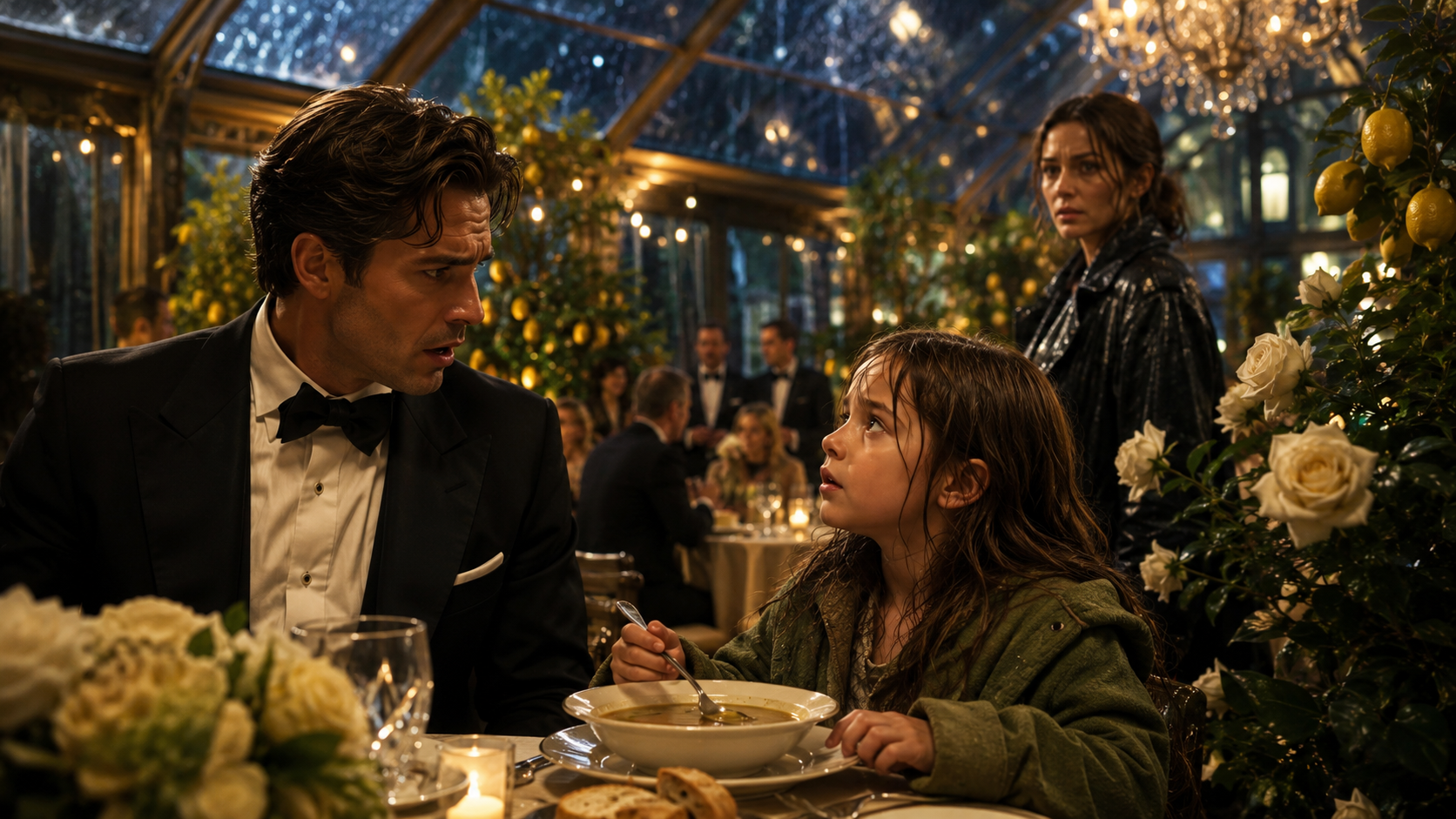
Beyond the ballroom doors stood the hotel’s signature feature: a vast glass garden filled with lemon trees, climbing roses, stone fountains, and warm paths designed to make winter guests feel as though they had stepped into another season.
The garden was the reason investors had supported the Halcyon Crown.
It was also the reason Adrian had become famous.
Every Vale House hotel contained one—a sheltered courtyard where rainwater moved through hidden channels, warm air rose naturally through angled glass, and living walls regulated temperature without visible machinery.
Architectural critics called the design the Vale Garden.
Adrian had accepted the name for fifteen years.
Tonight, however, he felt no pride when he looked through the doors.
He felt watched.
At first, he assumed it was another photographer.
Then he noticed a small face behind one of the lemon trees.
A little girl stood barefoot on the garden stones.
She was perhaps six years old, thin beneath an oversized green coat. Rain had darkened her brown hair, and she held a pair of broken shoes by their straps. A paper hospital bracelet circled one wrist.
She looked at Adrian’s plate.
Not at the chandelier.
Not at the famous guests.
Not at the diamonds or the flowers or the television cameras.
Only at the food.
A security officer noticed her a moment later.
He crossed the garden quickly.
The child stepped backward.
Adrian put down his glass.
“Stop,” he said.
He had not raised his voice, but the security officer froze.
Several guests turned.
Adrian rose and walked through the open doors.
The little girl watched him approach. Her eyes were gray-green, startlingly calm in a face that should have been frightened.
“What are you doing here?” Adrian asked.
The security officer answered for her.
“She came through the service entrance, Mr. Vale. We’ll remove her immediately.”
“I asked her.”
The girl lifted her chin.
“I smelled bread.”
A few guests near the doorway exchanged amused smiles.
Adrian did not.
“Are your parents here?”
“My mother is in the garden.”
He looked around.
“I don’t see her.”
“She told me to stay beside the fountain, but then she sat down because she got dizzy. When I came back, she was gone.”
The security officer touched his earpiece.
“I’ll have the staff locate the mother.”
The girl’s gaze drifted again toward Adrian’s table.
“When did you last eat?” he asked.
She thought carefully.
“Yesterday.”
The answer was delivered without self-pity.
That made it worse.
Adrian turned toward the security officer.
“Find her mother. Don’t frighten either of them.”
“Yes, sir.”
Adrian looked at the child’s bare feet.
“What happened to your shoes?”
“The rain happened.”
“That is usually not enough to destroy shoes.”
“They were already tired.”
Despite himself, Adrian almost smiled.
“What is your name?”
“Lily.”
“Lily what?”
“Lily Ellison.”
The surname struck a place in his memory, but so many years and so many names stood between him and whatever it meant that he could not reach it.
“Would you like something to eat?”
Lily looked toward his table.
“Is that allowed?”
“It is my hotel.”
“That doesn’t mean everything is allowed.”
This time Adrian did smile.
“You may sit at my table.”
The girl hesitated.
“Will the shiny people be angry?”
“The shiny people will survive.”
He offered his hand.
Lily looked at it as though examining a contract. Then she placed her small, cold fingers in his.
The photographers began taking pictures before they reached the ballroom.
Adrian ignored them.
He brought Lily to the empty chair beside him.
A waiter appeared immediately.
“Bring her soup, bread, pasta, and warm milk,” Adrian said. “Nothing too rich.”
Lily climbed onto the chair.
“Can I have the little potatoes?”
“Bring the little potatoes.”
“And carrots?”
“Carrots too.”
“Do they cost a lot?”
“Not enough for you to worry about.”
Lily folded her broken shoes beneath the chair. She held her hands in her lap and studied the plates, forks, and glasses surrounding her.
“Which fork do I use?”
“Whichever one works.”
A woman wearing emerald earrings laughed.
Adrian turned his head.
She stopped.
Lily leaned closer to him.
“Are all these people your friends?”
“Some are colleagues.”
“That means no?”
“It means the answer is complicated.”
“My mother says complicated is sometimes a polite word for no.”
“Your mother sounds observant.”
“She draws buildings.”
Adrian’s attention sharpened.
“What kind of buildings?”
“Buildings that breathe.”
Something moved beneath his ribs.
Before he could ask another question, the soup arrived.
Lily stared at the bowl.
“Is it hot?”
“Yes.”
“Can you wait until I finish?”
“Why?”
“People sometimes take food away when they think you’re done.”
“No one will take it.”
She did not lift the spoon.
Adrian understood.
“I’ll wait.”
Only then did Lily begin to eat.
She took small, disciplined bites at first. Then hunger overcame manners. She tore bread with both hands, dipped it into the soup, and closed her eyes as she swallowed.
Adrian felt the attention of the ballroom gathering around them.
Simone Krell appeared beside his chair.
Her silver dress was as controlled as her expression.
“Adrian, the Japanese delegation is waiting for you in the east salon.”
“They can wait.”
Simone looked at Lily.
“Who is this?”
“My dinner guest.”
“I see.”
Her tone said that she saw a problem.
Lily looked up.
“You have angry eyebrows.”
Simone blinked.
Adrian coughed into his hand to hide another smile.
“We need to speak privately,” Simone said.
“Later.”
“The announcement concerns tomorrow’s merger.”
“Then it will still concern it in twenty minutes.”
Simone’s gaze shifted to the photographers.
“This is becoming a spectacle.”
“A hungry child eating dinner should not qualify as a spectacle.”
“In your hotel, at your table, in front of the international press, everything qualifies.”
Lily pulled her bowl closer.
Simone noticed the hospital bracelet.
“Where is her guardian?”
“Security is looking for her mother.”
Simone lowered her voice.
“You should let the staff handle this.”
Adrian looked at her.
“Why?”
“Because you are about to sign the largest hospitality acquisition in European history.”
“What does that have to do with feeding a child?”
“Nothing, until someone makes it something.”
Lily stopped eating.
Adrian saw fear return to her face.
“That is enough, Simone.”
Simone’s mouth tightened.
“As you wish.”
She walked away, already reaching for her phone.
Lily watched her go.
“She doesn’t like me.”
“She doesn’t like surprises.”
“Are you a surprise?”
“Not usually.”
Lily examined his face.
“You look different from the photograph.”
Adrian became very still.
“What photograph?”
“The one my mother keeps in the blue box.”
The sounds of the ballroom seemed to recede.
“What am I doing in the picture?”
“You’re sitting on the floor with papers everywhere. Mom is behind you, laughing. You have longer hair.”
Adrian could hear his own heartbeat.
There had been an apartment once.
A narrow place above a bakery.
Plans covering the floor.
A woman laughing because he had spilled coffee across a model they had spent six weeks building.
A woman named Mara.
Adrian looked carefully at Lily.
He saw the slight angle of her eyebrows.
The small notch in her left ear.
The way one corner of her mouth rose before the other.
Features could deceive. Memory could invent patterns when fear demanded them.
But the surname no longer floated beyond his reach.
Ellison.
Mara Ellison.
Lily placed her spoon down.
“Are you sick?”
“No.”
“You look sick.”
“I am trying to understand something.”
“What?”
“Why your mother has my photograph.”
Lily’s expression changed.
Hope entered it carefully, as though afraid it might be sent away.
She looked through the glass doors.
Then she looked back at him.
“Maybe because you’re my dad.”
The spoon slipped from Adrian’s fingers.
It struck the plate with a clear, bright sound.
Around them, conversations stopped.
A woman stood beneath the garden arch.
She wore a rain-darkened coat over a plain black dress. Her hair was shorter than Adrian remembered, threaded now with early silver. One hand gripped the stone arch as though she needed it to remain standing.
Her face was thinner.
Her eyes were unchanged.
Mara Ellison looked at the man who had built an empire from the garden she had designed.
Then she looked at their daughter sitting beside him.
“Lily,” she said quietly.
The child turned.
“Mom.”
Adrian rose so quickly that the table shook.
“Mara.”
She did not smile.
“Hello, Adrian.”
Chapter Two
The Woman Beneath the Roses
For fifteen years, Adrian had imagined what he might say if he ever saw Mara again.
In some versions, he apologized.
In others, he accused her of leaving without explanation.
Sometimes she was married. Sometimes she was successful. Sometimes she looked at him with regret.
He had never imagined her standing barefoot beneath the roses while their daughter ate from his plate.
Lily climbed down from the chair.
“I’m sorry I left the fountain.”
Mara opened her arms.
The child ran to her.
Mara held Lily tightly, but Adrian saw her knees weaken under the girl’s weight.
He stepped forward.
“Are you hurt?”
“Don’t.”
The word stopped him.
Mara crouched to examine Lily’s face and hands.
“Did anyone frighten you?”
“No. He gave me soup and little potatoes.”
Mara closed her eyes.
“I told you to wait.”
“You fell asleep.”
“I didn’t fall asleep. I felt faint.”
“That’s almost the same.”
Mara stood slowly.
The hotel guests were no longer pretending not to listen. Phones had appeared at several tables. A camera operator near the stage turned his lens toward them.
Adrian spoke to the head of security.
“Clear the garden.”
Simone approached immediately.
“Adrian—”
“Clear it.”
“This is a public event.”
“It is my event.”
Simone’s gaze moved from Mara to Lily.
Recognition arrived too quickly.
Mara saw it.
“You remember me,” she said.
Simone’s expression became professionally blank.
“I meet thousands of people.”
“But you remember me.”
Adrian looked between them.
“What does that mean?”
“Not here,” Simone said.
Mara laughed once, without amusement.
“Of course. The truth is always badly timed in this building.”
Adrian lowered his voice.
“What truth?”
Mara’s eyes went to the glass roof above them.
Rainwater traveled through narrow channels hidden inside the iron frame. It descended into stone basins, feeding the indoor trees before being filtered and reused.
The system was elegant, efficient, and celebrated.
Mara had drawn the first version on the back of a grocery receipt when she was twenty-four.
Adrian remembered watching her do it.
He had forgotten that memory until now.
“This hotel opened tonight because of my work,” she said.
Simone stepped closer.
“You should be careful.”
“No,” Mara replied. “Careful is how you kept me silent.”
Adrian’s stomach tightened.
“Mara, what are you saying?”
She reached inside her coat and withdrew a thick waterproof envelope.
“I’m saying the design your company calls the Vale Garden was never yours.”
A murmur passed through the nearest guests.
Simone’s voice sharpened.
“That allegation has already been reviewed.”
“By attorneys you hired.”
“The intellectual property belongs to Vale House.”
“The paperwork says it does.”
“The paperwork is legally binding.”
“It was forged.”
The word entered the garden like a crack of thunder.
Adrian stared at Mara.
She held his gaze.
“The signature assigning the design to your company is not mine.”
Adrian shook his head.
“You gave me the plans.”
“I gave you a copy because I trusted you.”
“You said we would build it together.”
“Yes.”
“You disappeared before we could.”
Mara’s face hardened.
“I did not disappear.”
“You emptied the apartment. Your number was disconnected. Your letters stopped.”
“My letters were returned.”
“I never received any letters.”
“I know.”
Her eyes moved toward Simone.
Adrian turned.
Simone remained calm.
Too calm.
“What did you do?” he asked.
“Nothing that should be discussed in front of a child or the press.”
Mara took Lily’s hand.
“That sentence has protected you for seven years.”
Lily looked from one adult to another.
“Mom, is he really my dad?”
Mara’s anger vanished for one terrible moment.
She knelt.
“Yes, sweetheart.”
Lily turned toward Adrian.
The wonder in her face was more difficult to face than hatred would have been.
“Did you know about me?”
Adrian tried to speak.
No answer came.
He searched his memory with sudden desperation.
Seven years earlier, Vale House had been weeks from bankruptcy. The company had needed financing for its first international property. Adrian had lived between airports, conference rooms, and unfinished construction sites.
There had been an envelope delivered to his temporary office in London.
A blue envelope.
Simone had placed it on his desk.
He had seen Mara’s handwriting.
He had also seen a note attached to it from the company’s attorney:
PERSONAL CLAIM. POSSIBLE FINANCIAL DEMAND. REVIEW AFTER CLOSING.
Adrian had pushed the envelope aside.
He had never opened it.
When he returned three weeks later, it was gone.
He had asked no questions.
His face must have revealed something.
Mara rose.
“You did receive one.”
“I saw an envelope.”
Her expression changed as though a final support had been removed from beneath her.
“You saw it?”
“I didn’t open it.”
“Why?”
“I was told it might be a financial claim.”
“So you decided not to know.”
Adrian had negotiated with hostile governments. He had faced bankruptcy, lawsuits, and public investigations without losing control of his voice.
Now he could barely form words.
“I thought you wanted money.”
“I wanted you to know your daughter had been born.”
Lily’s fingers tightened around her mother’s hand.
Adrian looked at the child.
“I didn’t know what was inside.”
“You knew it was from me,” Mara said. “That should have been enough.”
He had no defense.
Simone stepped between them.
“Mara, you came here intending to create a public confrontation.”
“I came because tomorrow he is selling another company the rights to my design.”
“The acquisition has nothing to do with your personal history.”
“It has everything to do with it. The entire merger is valued around the environmental system I created.”
Adrian looked at Simone.
“Is that true?”
“The design portfolio is one component among many.”
“Is it the component securing the European licensing agreement?”
Simone did not answer immediately.
That was answer enough.
Adrian turned toward the guests.
“Everyone out.”
The hotel manager approached.
“Mr. Vale?”
“Close the garden. Now.”
The music stopped.
Waiters guided guests toward the ballroom. Security asked photographers to lower their cameras, though flashes continued until the doors closed.
Within minutes, only Adrian, Mara, Lily, Simone, and two security officers remained among the trees.
Adrian dismissed the officers.
Simone objected.
“That is unwise.”
“So was ignoring my instruction.”
When they were alone, Adrian looked at Mara’s envelope.
“What is in there?”
“Original sketches. Registration drafts. Emails. The notebook pages you said were destroyed in the warehouse flood.”
“I believed they were.”
“Simone knew they weren’t.”
Adrian turned slowly.
Simone’s shoulders remained straight.
“We were insolvent,” she said. “The bank was hours from calling the loan. Investors would not back an untested designer with no completed projects.”
“So you removed her name.”
“I secured the design for the company.”
“You forged the transfer.”
“I regularized ownership.”
Mara stared at her.
“You copied my signature.”
“I instructed counsel to resolve an unclear intellectual property situation.”
“You told them Adrian and I had separated and that I had surrendered the work.”
“You had left the company.”
“I never worked for the company. I worked with him.”
Simone’s gaze hardened.
“And that was the problem. Adrian was attempting to build a global business while you treated it like an art-school romance.”
Adrian stepped closer.
“Be very careful.”
“I have been careful for fifteen years,” Simone replied. “That is why there is an empire for you to defend tonight.”
Lily moved behind Mara.
Adrian saw it and lowered his voice.
“You knew she was pregnant?”
Simone looked at the child.
“I knew Mara claimed she was.”
“Did you tell me?”
“You were closing the Northbank financing.”
“That is not an answer.”
“You had given me authority to remove distractions.”
“A child is not a distraction.”
“You did not know there was a child.”
“Because you prevented me from knowing.”
Simone’s control fractured.
“Because you would have abandoned the financing, flown home, and destroyed everything. Two hundred employees would have lost their jobs. The company would have failed. Your father’s creditors would have taken the last property your family owned.”
“That was my choice.”
“You were not capable of making it rationally.”
Mara’s laugh was quiet.
“There it is. The sentence behind every crime committed for a powerful man. He could not be trusted with his own conscience.”
Simone ignored her.
“You became who you were meant to be, Adrian.”
He looked around the glass garden.
The trees.
The stone channels.
The curved benches.
Every celebrated feature carried pieces of Mara’s early drawings.
He remembered her hands stained with graphite. He remembered her explaining how architecture should not dominate nature but make room for it. He remembered waking in their apartment to find her asleep beside a model, her cheek pressed against tracing paper.
For years, he had allowed interviewers to describe the garden as his personal vision.
At first, he had corrected them.
Later, he had said they had developed the idea as a team.
Eventually, he had stopped mentioning Mara at all.
Simone had created the lie.
Adrian had furnished it, polished it, and lived inside it.
Mara gathered the envelope against her chest.
“I did not come for a reunion,” she said. “I came to stop the merger.”
Adrian looked at Lily.
The child’s untouched dessert waited on the table.
“What does Lily know?”
“She knows you are her father. She knows I tried to find you. She does not know about the forgery.”
Lily spoke from behind her mother.
“I know people stole your drawings.”
Mara turned.
“How?”
“I heard you talking to Mr. Dawson.”
“That was not meant for you.”
“People say lots of things that aren’t meant for children. We still hear them.”
Adrian crouched so he was level with her.
“Lily, I am sorry.”
“For what?”
“For not opening your mother’s letter.”
“Would you have come if you opened it?”
The question silenced everyone.
Adrian could have offered the answer a child wanted.
Instead, he gave her the only answer he still owned.
“I don’t know.”
Lily’s face fell.
Mara closed her eyes.
Adrian continued.
“I would like to believe I would have come immediately. But I was frightened, proud, and obsessed with work. I might have made another terrible choice.”
“Do you still make terrible choices?”
“Yes.”
“Mom does too.”
“Lily,” Mara murmured.
“She says telling the truth is how you stop a mistake from becoming your whole life.”
Adrian looked at Mara.
“She taught you well.”
“She teaches me buildings too.”
Mara took her daughter’s hand.
“We’re leaving.”
Adrian rose.
“Where will you go?”
“That is not your concern.”
“She is my daughter.”
Mara’s expression became ice.
“You learned that nine minutes ago. Do not use it as authority.”
“I’m not claiming authority.”
“You already sound like you are.”
He forced himself to step back.
“What do you need?”
“Tomorrow’s merger canceled.”
“I can suspend it.”
“Not quietly. If you hide the reason, Simone will bury the evidence and call me an extortionist.”
Simone crossed her arms.
“You are demanding control of a multibillion-dollar transaction.”
“I am demanding ownership of my own work.”
Adrian looked at the envelope.
“Let my attorneys examine the evidence tonight.”
Mara shook her head.
“Your attorneys created half of those papers.”
“Then choose an independent firm.”
“I already have.”
“With what money?”
The question escaped before he could stop it.
Mara’s face changed.
Lily looked down at her broken shoes.
Adrian felt ashamed.
“I’m sorry.”
“No,” Mara said. “You wanted to know how someone wearing a mended coat challenged a billionaire. I sold my mother’s house.”
He stared at her.
“The house in Providence?”
“The one with the pear tree.”
“You loved that place.”
“I loved my daughter more.”
Adrian felt something inside him begin to break.
“Where are you staying?”
Mara did not answer.
Lily did.
“At the train station sometimes.”
Mara’s grip tightened.
“Only twice.”
“And the church gym,” Lily continued. “But they make you leave after breakfast.”
Adrian looked at Mara.
She lifted her chin.
“Simone made certain no major architecture firm would hire me. The official explanation was that I had stolen confidential Vale House materials.”
Adrian turned toward Simone.
“Did you blacklist her?”
“I warned partners that she possessed disputed proprietary information.”
“You destroyed her career.”
“I protected ours.”
Adrian took out his phone.
Simone moved toward him.
“What are you doing?”
“Suspending the merger.”
“You cannot do that unilaterally.”
“My signature is required.”
“The board will remove you before morning.”
“Then they should begin preparing.”
“You are throwing away fifteen years over an accusation and a child you have known for less than an hour.”
Adrian looked at Lily.
“No. I threw away seven years before I met her.”
He called his general counsel.
Chapter Three
The Room Above the Bakery
Mara refused Adrian’s car.
She also refused a hotel suite, a private doctor, and the envelope of cash he offered after realizing she had no money for transportation.
Lily solved the argument.
“I want him to see our room.”
Mara looked horrified.
“Absolutely not.”
“Why?”
“Because it is private.”
“He has a house with a hundred rooms. He won’t steal ours.”
Adrian almost corrected her. His Boston residence had only seventeen rooms.
He wisely remained silent.
The rain had weakened to a mist. Mara agreed to let him walk with them, though she kept herself between Adrian and Lily whenever the pavement narrowed.
They traveled away from the glowing hotel, past expensive restaurants and dark offices, into streets where windows were protected by metal grilles and laundromats remained open after midnight.
Lily wore hotel slippers provided by a housekeeper.
She carried a paper bag filled with bread, fruit, and the little potatoes she had been unable to finish.
Adrian had spent most of his adult life being recognized.
That night, wrapped in a borrowed overcoat without his driver or security team, he passed unnoticed.
Mara stopped outside an old bakery with a faded blue awning. The shop had closed years earlier, but the upper floor had been divided into rented rooms.
“You live here?” Adrian asked.
“For now.”
They climbed a narrow staircase that smelled of dust and yeast.
Their room contained one bed, a chair, a hot plate, and a sink with a dripping faucet. A blanket had been hung from the ceiling to create a separate sleeping corner for Lily. Books were stacked in milk crates. Architectural drawings filled the wall above Mara’s table.
The drawings were astonishing.
They showed libraries built around old trees, schools cooled by wind channels, apartment courtyards designed to collect rainwater, and shelters in which every family received a small private garden.
Adrian approached one sheet.
“This is better than the Copenhagen proposal we rejected last year.”
“I submitted it under another name.”
He looked at her.
“Why?”
“Because every proposal bearing mine was rejected before review.”
On the wall beside the plans hung a child’s drawing.
Three figures stood inside a glass house. Mara and Lily held hands. A tall man stood beyond the door with his face left blank.
Adrian stared at it.
Lily climbed onto the bed.
“I didn’t know what your nose looked like.”
“My nose?”
“It’s hard to draw noses when you’ve only seen one old picture.”
He touched his face.
“You could have left it out.”
“Then you couldn’t smell dinner.”
Mara placed the food on the table.
“Lily, wash your hands.”
The child carried a plastic bowl to the sink.
Adrian lowered his voice.
“Why did you bring her to the hotel?”
“I didn’t.”
“You were both in the garden.”
“I came alone to meet an investigative reporter. Lily was supposed to stay with a woman at the church.”
“What happened?”
“The woman’s son was taken to the emergency room. Lily followed me onto the bus before I realized she was there.”
“You entered through the service door?”
“I worked on the original building survey. I knew the old passage still existed.”
“And the hospital bracelet?”
“Lily was treated for dehydration this morning.”
Adrian’s jaw tightened.
“She needed a hospital because she didn’t have enough water?”
“She had a stomach infection.”
“Why wasn’t she admitted?”
“Because she improved.”
“Or because you could not pay?”
Mara turned toward him.
“Do not interrogate me in my room.”
“I’m trying to understand.”
“No. You are trying to locate the problem so you can purchase the solution.”
“What would you have me do?”
“Listen without reaching for your wallet.”
He put his hand back into his coat.
She had noticed.
Lily returned and climbed onto the chair.
“Can we eat the bread?”
“You already ate dinner,” Mara said.
“I’m saving dinner inside me for tomorrow.”
Adrian looked away.
Mara divided the bread into three portions.
She gave the largest to Lily, the second to Adrian, and kept the smallest.
“I’m not hungry,” Adrian said.
“Neither am I,” Mara replied.
Lily looked between them.
“You’re both lying.”
Adrian sat.
They ate in silence.
The bread was slightly stale. It was also the first meal in years during which no one asked Adrian about market expansion, hotel occupancy, or investment forecasts.
Afterward, Lily brought him a thin book about a fox that followed the moon home.
“Read it.”
Mara began arranging blankets.
“He may have somewhere to be.”
Adrian’s phone vibrated for the twelfth time.
The board.
The merger team.
Simone.
His chief financial officer.
A message appeared from Marcus Thorne, the vice chairman:
Emergency meeting at 6:30 a.m. Attend or expect a vote without you.
Adrian switched the phone off.
“I can read.”
Lily sat beside him on the bed.
He began in the same measured voice he used during shareholder presentations.
After two paragraphs, Lily interrupted.
“The fox is lost.”
“Yes.”
“You don’t sound lost.”
“How does lost sound?”
“Like you don’t know what happens next.”
“I have the book. I know exactly what happens next.”
“That’s not acting.”
Mara turned away, but Adrian saw the beginning of a smile.
He tried again, adding uncertainty to the fox’s voice.
“Now he sounds worried about taxes,” Lily said.
Mara laughed.
The sound reached across seven years.
Adrian forgot the next sentence.
Mara covered her mouth.
“I’m sorry.”
“No,” Adrian said. “Don’t be.”
He remembered that laugh in the apartment above the bakery where they had once lived. He remembered Mara painting models at midnight, dancing barefoot while water boiled on the stove, and arguing that buildings should make lonely people feel less alone.
He remembered loving her.
He also remembered choosing a flight to London on the night she asked him to stay.
Lily fell asleep before the fox found its home.
Adrian closed the book.
Mara lifted the child and carried her behind the hanging blanket.
When she returned, Adrian remained seated.
“You should go,” she said.
“I don’t want to.”
“That is not a reason.”
“I missed seven years.”
“You cannot recover them tonight.”
“I know.”
“Do you?”
He looked at the drawings on the wall.
“No.”
Mara sat across from him.
For a while, only the faucet spoke.
Finally Adrian said, “Tell me what happened after I left for London.”
“You know enough.”
“I know Simone lied. I need to know where my choices fit.”
Mara studied him, deciding whether the question was honest.
“I discovered I was pregnant two weeks after you left,” she said. “I called your office. Simone said you were unavailable. I emailed. The messages returned as blocked. I went to your old headquarters, but security escorted me out.”
“I never knew.”
“I mailed the blue envelope after Lily was born.”
“I saw it.”
“Yes.”
The quiet accusation was worse than shouting.
“What did it say?”
“I told you her name. Her weight. That she had your eyes. I included a photograph and a copy of the hospital record. I wrote that I did not want money. I asked you to call before I decided how to explain your absence to her.”
Adrian stared at the floor.
“What happened to the envelope?”
“Simone returned it four months later.”
“She returned it?”
“Inside another package. There was a letter from a law firm stating that you denied paternity and would seek damages if I contacted you publicly.”
“I never authorized that.”
“I believe you.”
“You do?”
“I did not at first. But the language was too polished. You were cruel when frightened, Adrian, but you were never polished.”
He almost laughed.
He did not deserve to.
“Why didn’t you take it to court?”
“I was twenty-six, unemployed, and caring for an infant. Your company had twelve attorneys. The letter warned that you would seek full custody if I made a claim.”
Adrian’s head lifted.
“I would never have done that.”
“I did not know what you would do. The man I loved had left me for a business deal and ignored an envelope with my handwriting on it.”
He accepted the blow.
“What about the design?”
“Six months later, a magazine published photographs of your first completed garden hotel. My water system, my climate angles, my living-wall structure, even the crescent bench I designed after my mother’s garden.”
“I thought the company owned it.”
“You never asked how.”
“No.”
“You accepted a miracle because it arrived when you needed one.”
He looked around the small room.
“You should own half of Vale House.”
“I should own my name.”
“You can have both.”
“There.” Mara leaned back. “You lasted almost seven minutes before trying to buy a solution.”
“I am not trying to buy you.”
“You do not know another language.”
“Teach me.”
The words surprised them both.
Mara looked toward the blanket behind which Lily slept.
“I am not responsible for teaching you how to become human.”
“No. But tell me what you need from me tomorrow.”
“The truth.”
“To whom?”
“Everyone.”
“You understand what that will do.”
“The merger will collapse. Investors will sue. Your board will blame me.”
“Vale House may not survive.”
Mara’s eyes hardened.
“My life did not survive what your company did. It became something else. Why should your corporation be protected from the same consequence?”
Adrian thought of the employees who had mortgages, children, and medical bills. He thought of the hotels filled with workers who had never heard Mara’s name.
“I have to protect the innocent people who work for us.”
“Then protect them. But do not use them as an excuse to protect yourself.”
He nodded slowly.
“You’re right.”
Mara seemed almost angered by his agreement.
“You do not earn forgiveness by agreeing with me.”
“I know.”
“You keep saying that.”
“Because I am discovering how many things I should have known and didn’t.”
Behind the blanket, Lily coughed in her sleep.
Both adults turned.
Mara rose immediately, but Adrian was closer. He stepped behind the curtain and found Lily sitting up, confused.
“Mom?”
“She’s here.”
Lily looked at Adrian.
“Are you leaving?”
He glanced toward Mara.
She did not help him.
“The truth?” he asked.
Lily nodded.
“I have a meeting in the morning that may take away my company.”
“Do you have to go now?”
“No.”
“Then don’t.”
The answer was simple because she did not understand the price.
Perhaps adults invented complexity when the simple answer frightened them.
Adrian removed his coat and placed it over the chair.
“I’ll stay until morning.”
Mara folded her arms.
“There is no second bed.”
“I have slept in airports.”
“This floor is worse.”
“That seems unlikely.”
“It has a nail near the window.”
“I’ll avoid the nail.”
Lily lay down.
“Can he stay, Mom?”
Mara looked at Adrian for a long time.
“One night,” she said.
Adrian lay on the floor beneath a borrowed blanket while rain tapped the window.
His company tried to reach him until his phone battery died.
Chapter Four
The Vote
At dawn, Adrian woke with a pain in his neck and Lily’s hand resting on his shoulder.
She had climbed down from the bed during the night and fallen asleep beside him.
For several minutes, he did not move.
Morning light revealed the room more clearly.
An eviction warning lay beneath Mara’s sketchbook. A jar on the shelf held nine dollars and several coins. Lily’s broken shoes had been placed beside a roll of silver tape, waiting to be repaired again.
Adrian wanted to solve everything before breakfast.
He wanted to call his assistant, move them into a guarded apartment, replace every shoe Lily owned, and send Mara’s drawings to the finest architectural firm in the world.
He remembered her words.
Listen without reaching for your wallet.
So he waited.
Mara woke and found him making oatmeal on the hot plate.
“You’ll burn it.”
“I am capable of boiling water.”
“The smoke coming from the pan disagrees.”
Lily sat up.
“Dad is making breakfast.”
The word entered the room quietly.
Adrian turned.
Mara froze.
Lily looked worried.
“Am I not supposed to call him that?”
Adrian crouched beside her.
“You may call me whatever feels right to you.”
“Mr. Vale sounds like a teacher.”
“Adrian is fine.”
“Can I call you Dad when I’m happy and Adrian when I’m mad?”
“That seems fair.”
Mara watched him carefully.
“Do not make promises because you are frightened of disappointing her.”
“I am already certain I will disappoint her.”
Lily frowned.
“That’s not a good promise.”
“No,” Adrian said. “The promise is that I will not disappear when I do.”
His dead phone lay on the table.
Mara nodded toward it.
“What time is the meeting?”
“Six-thirty.”
It was six-twelve.
“You should go.”
“Do you want me to?”
“No.”
“Then why say it?”
“Because I do not want Lily to believe caring about us requires you to destroy everything else.”
He looked at the drawings.
“I’m not destroying it. I’m deciding whether it deserves to remain as it is.”
At six twenty-five, Adrian used Mara’s old laptop to join the board meeting.
Fourteen directors appeared on the screen.
Marcus Thorne sat in the center chair at Vale House headquarters. Simone sat beside him, immaculate despite having been awake all night.
Marcus began without greeting him.
“Adrian, are you joining us from a rented room?”
“I am joining you from where I need to be.”
“The press is reporting that a homeless woman confronted you during the opening gala and claimed you fathered her child.”
“Her name is Mara Ellison. She is an architect. The child is my daughter.”
The directors began speaking at once.
Marcus raised his hand.
“Have you completed a paternity test?”
“No.”
“Then your statement is irresponsible.”
“My refusal to open a letter seven years ago was irresponsible. Acknowledging the likely consequence is not.”
Simone leaned toward the camera.
“Adrian is experiencing emotional shock. I recommend temporary medical leave.”
“I recommend you remain silent while the company’s independent counsel reviews evidence of your fraud.”
The boardroom went still.
Marcus’s face hardened.
“What fraud?”
“Mara Ellison created the environmental courtyard system marketed as the Vale Garden. Her signature on the intellectual property assignment appears to have been forged.”
A director from Zurich removed his glasses.
“Appears?”
“I saw the original work.”
Simone spoke calmly.
“Ms. Ellison was involved in early conceptual discussions. The final system was developed by Vale House engineers.”
Mara stepped into view behind Adrian.
“The final system contains a pressure flaw in the eastern drainage channel because your engineers copied a preliminary version.”
Simone’s face changed.
Mara continued.
“The corrected calculation appears only in my registered notebook. Every Vale Garden built before 2016 requires additional pumping during heavy rain. The later hotels do not because someone accessed the corrected pages after the Lisbon flooding incident.”
A director looked toward Simone.
“Is that accurate?”
Simone remained silent.
Adrian spoke.
“I am suspending today’s merger announcement.”
Marcus struck the table.
“You do not have unilateral authority after material misconduct.”
“My signature is required under the acquisition agreement.”
“Then the board will vote to remove your signing authority.”
“Vote.”
Simone stared at him.
“You would risk forty thousand jobs.”
“No. We will create an employee protection structure before disclosing the investigation.”
“With what financing?”
“My voting shares.”
Mara turned toward him.
Adrian continued.
“I will place a controlling portion of my personal shares into a temporary trust guaranteeing payroll and operations during the investigation.”
Marcus looked stunned.
“You could lose control permanently.”
“Yes.”
“You built this company.”
Adrian looked at Lily, who was eating smoky oatmeal from a chipped bowl.
“No,” he said. “That is the question we are finally going to investigate.”
The board voted at seven fourteen.
By seven thirty, Adrian was suspended as chief executive.
Marcus became interim chairman.
Simone retained her position pending investigation by the company’s existing legal department—the same department that had approved the disputed documents.
At seven forty-two, Vale House released a statement describing Mara as a former romantic partner presenting “unverified personal and professional allegations.”
Adrian read it once.
Then he called a press conference.
Chapter Five
The Cost of the Truth
By noon, the entrance to the Halcyon Crown was surrounded by reporters.
Mara stood in a private room above the ballroom, watching satellite trucks fill the street.
“You do not have to stand beside me,” Adrian said.
“I know.”
“They will attack you.”
“They already have.”
“They will investigate every address, every debt, every mistake.”
Mara adjusted the sleeves of her borrowed jacket.
“They did that when I had no power to answer. At least today I will have a microphone.”
Lily sat with a hotel employee in another room, drawing pictures and eating strawberries.
Adrian had suggested keeping her at the hotel until reporters left the bakery.
Mara had agreed only after the employee showed identification, references, and the room’s security camera.
Trust, Adrian was learning, was not created by good intentions. It was created by allowing another person to verify them.
The ballroom where he had celebrated his triumph less than twenty-four hours earlier now contained rows of journalists.
Adrian approached the podium alone.
Camera shutters erupted.
He looked at the prepared statement written by the communications team.
It described misunderstandings, preliminary evidence, complex relationships, and the company’s commitment to transparency.
He folded it.
“My name is Adrian Vale,” he began. “For fifteen years, I have allowed the world to credit me with creating the architectural system known as the Vale Garden.”
The room quieted.
“I did not create it.”
A reporter shouted a question.
Adrian continued.
“The original designer is Mara Ellison. She developed the concept before Vale House completed its first hotel. I knew she had created the central idea. I believed, without verifying, that my company had acquired the rights legally.”
Mara watched from the side of the stage.
“That belief benefited me,” Adrian said. “I accepted praise I had not earned. Over time, I corrected the record less often. Eventually, I stopped correcting it at all.”
Simone watched the broadcast from Vale House headquarters.
Marcus instructed staff to prepare an emergency injunction.
Neither could stop what came next.
“Evidence now suggests Ms. Ellison’s signature was forged, her correspondence was intercepted, and her professional reputation was deliberately damaged to prevent her from challenging the company.”
The room erupted.
“Did you order the forgery?”
“Is the merger canceled?”
“Will you resign?”
“Is the child seen with you last night your daughter?”
Adrian gripped the podium.
“The child is seven-year-old Lily Ellison. I have reason to believe she is my daughter.”
“Did you abandon her?”
He looked directly toward the reporter who asked.
“I received a letter from her mother after Lily’s birth. I did not open it.”
The room became silent again.
“I had been warned that the letter might contain a financial demand. I chose convenience over truth. Other people may have manipulated that choice, but the choice was mine.”
Mara’s eyes filled with tears she refused to release.
“I did not know I had a daughter. But I made it easy for powerful people around me to hide anything that interfered with my ambitions. I created a life in which human beings were categorized as opportunities, risks, resources, or distractions.”
A journalist near the front lowered her notebook.
Adrian continued.
“Mara Ellison did not approach me for money. She approached my company because we were preparing to sell international rights to work she says was stolen from her. She has requested independent review, public attribution, and protection from retaliation.”
“Do you believe her?”
“Yes.”
“Why?”
“Because I remember watching her create it.”
A murmur passed through the room.
“And because the person who benefits from forgetting has a greater obligation to question his memory.”
Mara looked down.
Adrian announced that he would surrender executive authority during an external investigation. He would place personal assets into an employee protection fund and provide the original evidence to independent prosecutors.
Vale House shares fell before he left the stage.
The European merger collapsed by afternoon.
Banks froze two development loans.
Three directors resigned.
By evening, financial commentators were describing the press conference as either the most honest act of corporate leadership in a generation or an emotional breakdown that would destroy an international company.
Adrian did not watch them.
He returned to the room above the bakery.
Reporters had surrounded the building, so security brought Mara and Lily through the old delivery entrance.
Lily met him on the stairs.
“Did you tell the truth?”
“I told as much as I know.”
“Are you still rich?”
Mara closed her eyes.
Adrian considered the question.
“Yes.”
“Then it wasn’t very dangerous.”
“It may cost me most of my company.”
“But will you still have dinner?”
“Yes.”
“A bed?”
“Yes.”
“Shoes?”
“Yes.”
Lily shrugged.
“Then you’re still extra rich.”
Adrian followed her upstairs.
Inside the room, Mara removed the borrowed jacket.
“You did not warn me you would admit remembering the design.”
“I remembered.”
“You could have said the evidence was uncertain.”
“That would have protected me.”
“It might have protected the employees.”
“The employee fund will operate for eighteen months even if I lose control.”
Mara stared at him.
“You arranged that overnight?”
“I had attorneys working while Lily was correcting my fox voice.”
“You said your phone was off.”
“I used the laptop when everyone fell asleep.”
A reluctant smile touched her mouth.
Then it vanished.
“Do not mistake one honest speech for redemption.”
“I don’t.”
“Lily is already attached to you.”
“I’m attached to her.”
“That is not reassuring. Attachment can disappear when circumstances become difficult.”
“I know.”
Mara’s anger rose.
“Stop saying you know.”
“What should I say?”
“Say you do not know. Say you have no idea what it is like to comfort a child with a fever while wondering whether the electricity will be shut off. Say you do not understand what your name did to every interview I attended. Say you cannot imagine telling Lily that her father was not coming because I could not bear to tell her he had ignored the envelope.”
Adrian stood very still.
“I don’t know,” he said.
Mara’s breathing changed.
“I don’t understand what you survived,” he continued. “I cannot imagine what my choices cost you. I may never understand it completely.”
For the first time, her anger found no resistance.
Adrian looked toward the curtain where Lily was arranging her drawings.
“But I can remain long enough to learn.”
Mara sank into the chair.
“You lost your company today.”
“Possibly.”
“What happens when you blame us?”
“I won’t.”
“You cannot promise what you will feel.”
“No. But I can promise what I will do with the feeling.”
“And what is that?”
“Tell you. Speak to a therapist. Walk around the block. Break something I own. I will not disappear.”
Mara rubbed her forehead.
“You make staying sound like a business procedure.”
“It may need to be one at first.”
Despite herself, she laughed.
It was brief and exhausted.
But it was real.
Chapter Six
What the Archive Remembered
The investigation began with paper.
Not dramatic confessions or secret recordings.
Paper.
Courier logs showed that Mara had sent eleven packages to Adrian over three years. Nine were marked as rejected by the executive office. Two had been redirected to an outside legal firm.
Security records showed Mara had visited Vale House headquarters three times.
Each visit had been removed from Adrian’s electronic calendar.
A former receptionist remembered Simone instructing staff never to connect calls from Mara Ellison.
Then an archivist named Owen Price found a storage box in a warehouse outside Worcester.
Owen had worked for Vale House during its first years. He had kept old project files because Simone had ordered a rushed office clearance and he feared tax records might be destroyed.
The box contained early drawings of the garden system.
Every page bore Mara’s initials.
Several also contained Adrian’s handwritten comments:
Could we build this above a train station?
Ask Mara about winter airflow.
Mara says trees must come before tables.
One sheet contained a coffee stain shaped like a crescent.
Adrian remembered making it.
Another box held the blue envelope.
It had never been opened.
Simone had preserved it.
Perhaps as insurance.
Perhaps as a trophy.
Adrian received it in the independent investigator’s office.
Mara sat across the table.
Lily was at school for the first time in several weeks, enrolled through a temporary family housing program that Adrian had funded anonymously after Mara refused anything bearing the Vale name.
The envelope was faded but intact.
Adrian turned it in his hands.
“I don’t have the right to open it now.”
Mara looked at him.
“It was written to you.”
“To the man I was seven years ago.”
“He is still part of you.”
“That is what frightens me.”
She considered this.
“Open it.”
Inside was a photograph of newborn Lily wrapped in a yellow blanket.
A hospital document listed Adrian Vale under “father,” followed by a handwritten question mark.
Mara’s letter covered four pages.
Adrian read the first paragraph.
Then he stopped.
His hands began to shake.
Mara looked toward the window.
“Read it aloud.”
“I can’t.”
“You refused to hear it once.”
The words were not cruel.
They were necessary.
Adrian began again.
He read Mara’s description of Lily’s birth. The emergency surgery. The fear. The way the baby quieted whenever rain touched the hospital window.
Mara had written that she did not expect them to repair their relationship immediately. She asked only that Adrian meet his daughter before deciding what place he wanted in her life.
The final paragraph was short.
I loved the man who could see a home inside an empty building. I hope that man still exists somewhere inside the person you are becoming. Lily does not need your empire. She needs the chance to know whether her father will come when she calls.
Adrian finished.
The room remained silent.
“I would have come,” he said.
Mara looked at him.
“I think I would have.”
“That is not something either of us can know.”
“I hate that.”
“So do I.”
He pressed the photograph against the table.
“I let Simone decide who could reach me.”
“Yes.”
“I saw your handwriting and chose not to open it.”
“Yes.”
“I accepted your work without asking how the company obtained it.”
“Yes.”
Each answer removed another place to hide.
“Why are you here?” he asked.
Mara’s expression softened slightly.
“Because Lily asked whether people can become different.”
“What did you tell her?”
“That people can become more honest. Different takes longer.”
The investigation found more than theft.
Simone had used shell companies to receive licensing payments connected to Mara’s designs. She had redirected millions of dollars into accounts controlled by herself and Marcus Thorne.
Marcus had known about the forged assignment.
The planned European merger would have allowed them to move the disputed intellectual property into a new corporate structure, making Mara’s claim almost impossible to pursue.
When the evidence became public, Marcus resigned.
Simone was arrested two days later.
As officers escorted her from Vale House headquarters, she asked to speak with Adrian.
He met her in a conference room under the supervision of attorneys.
She wore no jewelry. Without the silver dresses, glass offices, and people awaiting her instructions, she appeared smaller than he remembered.
“You found the envelope,” she said.
“Yes.”
“I kept it because I knew this day might come.”
“Why?”
“Because part of me wanted proof that I had saved you.”
“You saved a company.”
“I made you powerful.”
“You made yourself necessary.”
Her eyes flashed.
“You would have failed without me.”
“Possibly.”
The answer unsettled her.
Adrian sat across from her.
“I might have returned to Mara and become a terrible father. I might have panicked. I might have chosen work again.”
“You would have.”
“Perhaps. But those failures would have been mine. You stole our right to face them.”
“I protected thousands of employees.”
“You stole millions through shell companies.”
“I earned what you never would have given me.”
“You already owned shares.”
“I owned what you allowed. Mara owned your imagination.”
Adrian finally understood.
“You were jealous.”
“I was realistic. When you were with her, you wanted small things.”
“A home was not a small thing.”
“You wanted to design community buildings. You wanted children. You wanted evenings without calls. I gave you cities.”
“You gave me rooms I slept in alone.”
Simone leaned forward.
“And now what? You become a father because a child ate soup beside you? Mara forgives you? The public applauds your transformation?”
“No.”
“No?”
“Mara may never forgive me. Lily may one day understand enough to hate me. The company may survive without my name.”
“Then I destroyed you.”
Adrian stood.
“No. You revealed what I had already destroyed.”
Simone looked away.
“Do you hate me?”
“I did for several days.”
“And now?”
“Now hatred feels too similar to worship. Both would keep you at the center of my life.”
He left her with the attorneys.
Chapter Seven
Learning the Ordinary
Vale House survived.
It became smaller.
Twelve unfinished properties were sold. The European expansion was abandoned. The board removed Adrian’s name from the environmental design portfolio and formally recognized Mara as its creator.
She received ownership compensation, unpaid licensing revenue, and a significant equity stake.
Mara insisted that part of the settlement fund an independent cooperative for young architects whose work had been taken or suppressed by larger firms.
She named it Open Door Studio.
Adrian asked whether he could contribute.
“You already are,” she said. “Court-ordered restitution counts.”
He accepted the distinction.
He was not immediately restored as chief executive.
Instead, the board appointed an outside leader and offered Adrian a reduced strategic role with strict oversight.
The old Adrian would have considered it humiliation.
The new Adrian was too busy learning how to pack a school lunch.
His first attempt contained imported cheese, olives, and a chocolate pastry prepared by a hotel chef.
Lily returned the lunchbox unopened.
“Children thought it smelled weird.”
“What do other children eat?”
“Sandwiches.”
“What kind?”
“Normal.”
He called Mara.
“What is a normal sandwich?”
“Bread, something in the middle, and no meeting required.”
His second attempt was peanut butter and jelly.
He forgot to check whether Lily’s classroom allowed peanuts.
His third attempt was turkey and cheese cut into perfect rectangles.
Lily examined them.
“They look like office sandwiches.”
“Sandwiches have professional categories?”
“These are worried about being fired.”
He began cutting them into stars.
Lily approved.
Adrian rented an apartment near Mara and Lily rather than moving them into his townhouse. He attended school meetings, dental appointments, and ordinary dinners.
He learned that Lily hated the sound of balloons popping, loved astronomy, and became silent rather than crying when she was deeply hurt.
He learned that Mara drank tea after midnight when she could not sleep.
He learned that she checked the hallway whenever Adrian stayed late, expecting his coat to disappear.
One evening, a delayed board meeting caused him to miss dinner.
He arrived forty minutes late carrying flowers.
Mara opened the door.
Her face was calm.
Too calm.
“I called,” he said.
“I know.”
“My phone battery died afterward.”
“I know.”
“I came as quickly as I could.”
“I know.”
He placed the flowers on the table.
Mara did not touch them.
Lily slept in the next room.
“What is happening?” he asked.
“Nothing.”
“That is not true.”
Mara folded a dish towel.
“You were late.”
“I warned you.”
“Yes.”
“And you’re angry.”
“No.”
“What are you?”
She looked at his overnight bag beside the door.
“Seven years ago, you said you would return from London in three days.”
Adrian stopped.
“You packed a black bag,” she continued. “You left it beside the door while we ate. I asked you to postpone the trip because I felt something was wrong. You said we would talk when you came home.”
“I remember.”
“You never came home.”
“I sent people for my things.”
“Yes.”
He sat.
“This bag reminded you.”
“Everything reminds me when I’m tired.”
He wanted to explain that this time was different.
He wanted to list the calls, the delay, and the traffic.
Instead he moved the bag away from the door.
“I’m here,” he said.
“That does not change what happened.”
“I know.”
They sat in silence.
After several minutes, Mara lowered herself into the chair across from him.
“You usually argue.”
“I’m learning not every accusation requires a defense.”
“I wasn’t accusing you.”
“I know.”
She almost smiled.
He reached for her hand, then stopped before touching it.
Mara noticed.
After a moment, she placed her hand over his.
Trust returned in fragments.
Not as a grand reunion.
As small permissions.
A key to the apartment.
A seat at Lily’s school performance.
A photograph placed on the shelf instead of hidden in a blue box.
The first time Mara left Lily alone with him overnight, she called six times.
Adrian answered every call.
On the seventh, he said, “She is asleep. You may come back and check.”
“I trust you.”
“No, you don’t.”
Silence.
“Not completely.”
“You don’t have to pretend.”
Mara came back at two in the morning.
She found Lily sleeping across Adrian’s chest while a documentary about planets played quietly on the television.
Adrian was awake.
“You waited,” she said.
“I thought you might come.”
Months passed.
Adrian began therapy.
At first, he approached each session like a negotiation. He arrived with prepared topics, desired outcomes, and a schedule.
His therapist refused to cooperate.
“You are trying to become efficient at regret,” she told him.
“Is that not possible?”
“No.”
He learned that ambition had protected him from the fear of becoming like his father, a charming man who made promises easily and kept none of them. Adrian had believed that success would make him dependable.
Instead, success had allowed him to avoid anyone who might depend on him personally.
He told Mara this one evening.
She listened.
Then she said, “Understanding why you hurt people is valuable. It does not make the hurt smaller.”
“I know.”
“But it may stop you from doing it again.”
That was more hope than she had offered before.
Chapter Eight
The Garden Without His Name
One year after the gala, the Halcyon Crown reopened its glass garden following a redesign.
The plaque at the entrance no longer called it the Vale Garden.
It read:
THE ELLISON COURTYARD
ORIGINAL ENVIRONMENTAL DESIGN BY MARA ELLISON
A GARDEN SHOULD MAKE ROOM FOR LIFE.
Mara had resisted the final sentence.
Lily had insisted.
“It sounds like you,” she said.
Adrian attended the reopening as a guest.
He did not deliver a speech.
He stood near the back while Mara explained the restored drainage system to architects, students, and reporters.
She wore a dark blue suit and the silver earrings her mother had left her. She had purchased the earrings back after receiving the settlement.
Lily stood beside Adrian in a yellow dress.
“Mom looks famous,” she whispered.
“She is.”
“Are you jealous?”
“No.”
“You used to be the famous garden person.”
“I was the incorrect garden person.”
Lily considered this.
“Mom says you helped.”
“I held flashlights and carried models.”
“Did you carry them well?”
“Exceptionally.”
After the ceremony, the three of them sat at the same table where Lily had eaten her first bowl of soup.
This time, the chair beside Adrian was not empty.
Mara sat there.
Lily ordered little potatoes.
The waiter recognized her but did not mention the old photographs.
Outside the glass walls, snow began to fall.
Inside, rainwater from the melting roof moved through Mara’s channels and fed the lemon trees.
Lily looked at Adrian.
“Do you remember when I called you Dad?”
“Every second.”
“You looked terrified.”
“I was.”
“Because you didn’t want me?”
“No. Because I understood immediately that I had lost something I could never fully recover.”
“Seven years?”
“Yes.”
Lily dipped a potato into sauce.
“I don’t remember most of those years.”
“Your mother does.”
Mara looked toward the garden.
Adrian continued.
“I will never ask either of you to pretend they did not happen.”
Lily leaned back.
“Are you still extra rich?”
“Less extra than before.”
“You still have a house.”
“Yes.”
“And food.”
“Yes.”
“And too many jackets.”
“According to your mother.”
Mara smiled.
Lily nodded seriously.
“You’re rich enough.”
Adrian looked around the garden once celebrated under his name.
“What do you think being rich means?”
“Having people who notice when you’re missing.”
Mara’s eyes moved toward her daughter.
Adrian swallowed.
“Then I was very poor when we met.”
“You had shiny people.”
“They noticed when my chair was empty. They did not always notice when I was.”
Lily reached across the table and placed her hand over his.
“I noticed.”
“I know.”
After dinner, she ran toward the fountain to watch the lights beneath the water.
Adrian and Mara remained at the table.
“She is happy,” he said.
“She is.”
“Are you?”
Mara considered the question.
“Sometimes.”
“That is honest.”
“I am learning from you.”
He laughed softly.
For months, he had carried a ring in the locked drawer of his desk.
Not an engagement ring.
Mara was not ready for that, and he had no right to hurry her.
It was the thin silver ring she had given him when they were twenty-five, made by a street artist from a piece of twisted wire.
Simone had returned it with Adrian’s personal belongings after Mara disappeared. He had kept it without understanding why.
Now he placed it on the table.
Mara stared at it.
“You kept this?”
“For fifteen years.”
“You stopped wearing it after the first hotel opened.”
“I thought it made me look unprofessional.”
“It cost twelve dollars.”
“Eight. You negotiated.”
She picked it up.
“I thought you threw it away.”
“I threw away many things. Not this.”
“Why are you giving it back?”
“I’m not.”
He held out his hand.
“I’m asking whether I may wear it again.”
Mara looked at him for a long time.
“A ring does not make you trustworthy.”
“No.”
“It does not mean we are returning to what we were.”
“We can’t.”
“It does not promise that I will marry you.”
“I understand.”
She placed the ring in his palm.
“Then wear it.”
His fingers closed around it.
Across the garden, Lily called them.
“Come look! The snow is falling upward!”
Warm air near the glass lifted the smallest snowflakes before they melted.
Mara stood.
Adrian offered his hand.
For a moment, she only looked at it.
Then she took it.
They joined Lily beside the fountain.
Epilogue
The Building That Breathed
Four years later, Lily stood before her class with a cardboard model of a small apartment building.
The roof collected rainwater.
Trees grew through protected openings between the floors.
Every apartment faced a shared garden.
Adrian and Mara sat together in the second row.
They were not married.
Not yet.
Their relationship had grown slowly through therapy, arguments, ordinary mornings, and hundreds of promises small enough to keep.
Adrian had returned to Vale House as chairman of an ethics and design council but never reclaimed complete control. The company’s new charter required shared authorship, independent communication channels, and direct protections for employees who reported executive misconduct.
Mara led Open Door Studio.
Her projects included schools, clinics, transitional housing, and libraries.
She refused to name any building after herself.
Lily disagreed with this policy.
“My project is called the Ellison-Vale House,” she announced to the class.
Mara whispered, “She didn’t tell me that.”
“She didn’t tell me either.”
Lily pointed to the model.
“The garden is in the middle because my mom says buildings should make room for life. There are windows in every hallway because my dad says people make worse choices when they hide in rooms without light.”
Several parents laughed.
Adrian did not.
It was accurate.
“And there is a big table downstairs,” Lily continued. “Anyone who is hungry can eat there. You don’t have to prove you live in the building.”
Her teacher smiled.
“Why is the table important?”
Lily looked toward her parents.
“Because I met my dad at a table when I was hungry.”
The room became quiet.
“He had lots of food, but he was eating alone. My mom says he had made mistakes so big that people built hotels on top of them.”
Mara covered her face.
Adrian whispered, “Still accurate.”
Lily continued.
“My dad gave me dinner. Then my mom made him tell the truth. The truth cost him a lot of money, but Mom says that was not the expensive part.”
“What was the expensive part?” the teacher asked.
“Time.”
Lily touched the tiny cardboard garden.
“You can earn more money. You can build another company. You can buy another house. But you cannot buy the years when someone needed you.”
Adrian looked down.
Mara found his hand.
Lily smiled at them.
“But you can be there for the years that come next.”
After the presentation, they walked home beneath spring rain.
Lily ran ahead, jumping over puddles.
Mara carried the cardboard model. Adrian carried Lily’s backpack and the remains of a volcano project that had collapsed in the school hallway.
“You’re wearing the ring,” Mara said.
“I wear it every day.”
“I still notice.”
They reached the corner where their apartment building stood.
It was not Adrian’s old townhouse.
They had chosen the place together—a renovated brick building with wide windows, imperfect floors, and a shared courtyard designed by Mara.
Adrian stopped at the gate.
“What?” she asked.
“I have a question.”
“If this is about adding another lemon tree, the answer is no.”
“It isn’t.”
He handed her the broken volcano.
Then he removed a small box from his coat.
Mara stared at it.
“Adrian.”
“There are no photographers. No musicians. Lily is approximately thirty feet away and pretending not to watch.”
Lily hid badly behind a tree.
Adrian opened the box.
Inside was a simple ring made by the same street artist who had created the silver band years earlier. Adrian had found her through an old market receipt.
“I cannot promise that fear will never make me selfish,” he said. “I cannot promise that work will never tempt me to hide. I cannot change the years you carried everything alone.”
Mara’s eyes filled.
“But I can promise to remain visible. When I fail, I will stay for the conversation after the failure. When the truth is uncomfortable, I will open the envelope. When something important calls me away, I will remember that importance has a voice, a face, and usually an opinion about my sandwiches.”
From behind the tree, Lily called, “They’re still too square!”
Adrian smiled.
“Mara Ellison, will you continue building a life with me?”
Mara looked at the man she had once loved for his dreams.
Then at the man she had learned to trust because he finally remained when dreams became consequences.
“This is not forgiveness for everything,” she said.
“I know.”
“It is not a perfect ending.”
“I don’t want one.”
“What do you want?”
“A true beginning.”
Mara held out her hand.
“Yes.”
Lily ran from behind the tree.
“I knew it!”
“You were supposed to give us privacy,” Mara said.
“I was guarding the ring.”
Adrian placed it on Mara’s finger.
The three of them entered the courtyard together.
Rain moved through hidden channels beneath the stones. Trees lifted their branches toward the open sky. Warm light shone from the windows surrounding the garden.
The building seemed to breathe around them.
Once, Adrian had believed an empire was proof that he had succeeded.
Now he understood that buildings, companies, and fortunes were only structures. They could shelter a lie as easily as a life.
A home was different.
A home remembered who had arrived hungry.
It remembered who had been missing.
And it became real only when someone chose to stay.

