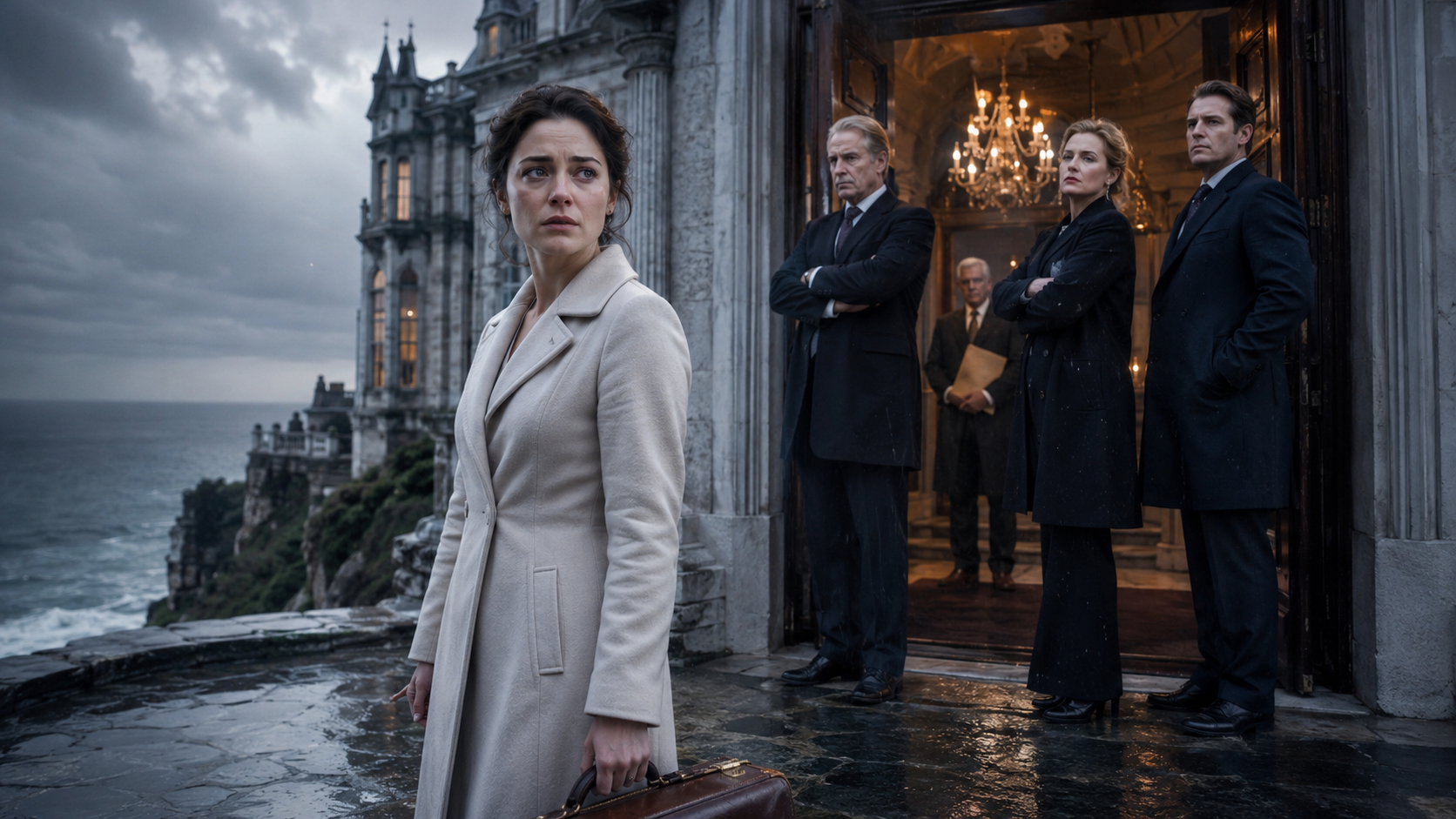
On the night Lenora Ashbourne died, the clocks inside Ashbourne House stopped at exactly 2:17 in the morning.
There was no power failure. No storm had damaged the electrical lines. Yet every clock in the mansion—from the brass carriage clock in the library to the enormous pendulum clock overlooking the main staircase—fell silent at the same moment.
Only one person heard Lenora’s final breath.
Her name was Evelyn Reed.
For eleven months, Evelyn had lived in a modest room at the far end of the servants’ corridor. She was thirty-one years old, a private nurse with calm gray eyes and a voice that rarely rose above a gentle murmur. She had been hired after three other nurses resigned, each complaining that Lenora was demanding, suspicious, and impossible to please.
Evelyn had never considered her impossible.
She had simply considered her lonely.
Ashbourne House stood on a cliff above the cold Atlantic, surrounded by windswept gardens and iron gates blackened by age. The estate had belonged to the Ashbourne family for more than a century. Its stone halls were filled with paintings of solemn men, jeweled women, hunting dogs, military officers, and children who had grown into adults incapable of loving one another.
Lenora had built the family fortune into an empire.
Ashbourne Maritime owned ports, warehouses, cargo vessels, and shipping contracts across three continents. Her children had spent years waiting for her to die so they could divide everything she had created.
Her eldest daughter, Vivian, wanted the estate.
Her son, Charles, wanted control of the company.
Her grandson, Adrian, wanted the money without the inconvenience of responsibility.
None of them wanted Lenora herself.
They visited when the lawyers called. They smiled when photographers were present. They sent flowers chosen by assistants and cards signed by secretaries.
Evelyn was the one who washed Lenora’s hair, read her the morning newspaper, warmed her hands during painful treatments, and listened when the old woman woke from nightmares calling the name of someone named Margaret.
During Lenora’s final hour, the mansion was silent except for the sea striking the cliffs below.
Lenora lay beneath a pale blue blanket, her face thin and almost translucent. Evelyn sat beside her, holding her hand.
“Open the curtains,” Lenora whispered.
“It’s still dark.”
“I know. Open them anyway.”
Evelyn crossed the room and pulled the heavy curtains apart. Beyond the glass, the horizon was beginning to turn silver.
Lenora watched the first weak light appear over the water.
“They think this house belongs to them,” she said.
“You should rest.”
“I have rested for too many years.”
Her fingers tightened around Evelyn’s hand with unexpected strength.
“Promise me something.”
“Anything.”
“When they tell you to leave, do not believe that you have lost.”
Evelyn frowned.
“Why would they tell me to leave?”
Lenora’s lips curved into the faintest smile.
“Because cruel people become careless when they think they have already won.”
Her eyes moved toward the carved wooden cabinet beside the fireplace.
“The truth is not in the jewelry box,” she whispered. “It is in the music.”
Evelyn leaned closer.
“What music?”
But Lenora was looking past her now, toward the distant light beyond the window.
“Margaret,” she breathed.
Then her hand became still.
Evelyn remained beside the bed for several minutes. She did not call the family immediately. She adjusted the blanket, closed Lenora’s eyes, and placed the old woman’s hands gently over her heart.
Only then did she telephone the doctor.
By sunrise, the mansion was no longer quiet.
Cars swept through the gates. Attorneys were called. Employees were ordered from room to room. Florists arrived with white lilies. The kitchen was instructed to prepare breakfast for twelve, although no one seemed hungry.
Vivian Ashbourne entered her mother’s bedroom wearing a black wool coat and pearl earrings. Her eyes were dry.
Behind her came Charles, still speaking into his telephone, and Adrian, who appeared irritated that death had required him to wake before noon.
Vivian glanced at the bed and then at Evelyn.
“What are you still doing here?”
Evelyn stood.
“I was organizing Mrs. Ashbourne’s medical records for the doctor.”
“The doctor has what he needs.”
“There are also instructions from Mr. Bennett. He said everyone mentioned in the estate documents should remain until the reading this afternoon.”
Vivian’s expression hardened.
“You were employed to care for my mother. My mother is dead. Your employment has ended.”
Evelyn lowered her voice.
“She asked me to stay.”
Charles ended his telephone call.
“Our mother was heavily medicated.”
“She was fully aware of what she was saying.”
Adrian wandered toward the cabinet near the fireplace.