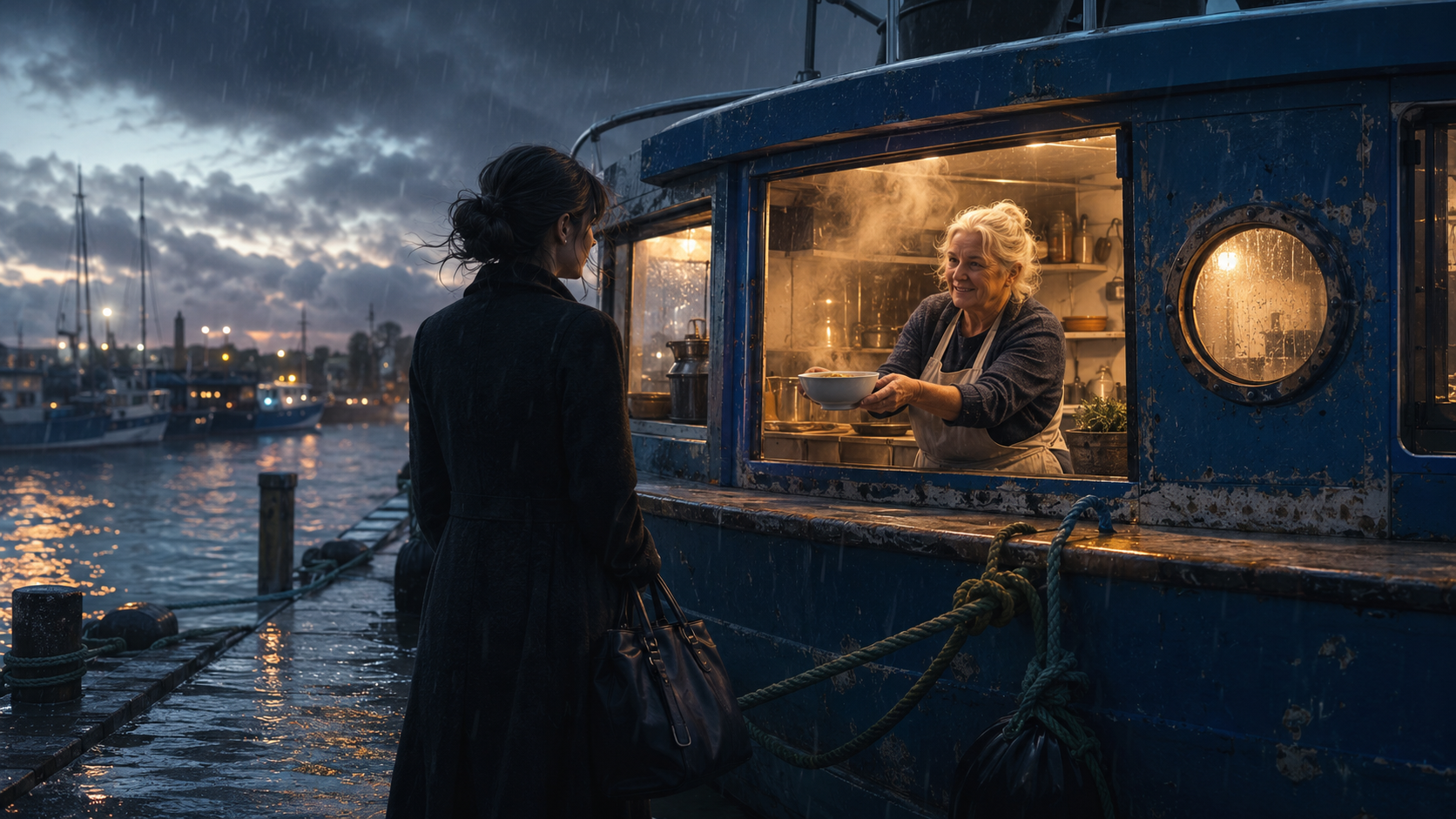
A Bowl Against the Storm

The rain had been falling over Bellhaven since before dawn, polishing the cobblestones until the old harbor looked as though it had been built beneath dark water.

From the rear seat of a black government car, Dr. Lila Hart watched cranes bend above the docks like iron birds. Glass towers had risen where warehouses once stood. Cafés occupied former net-mending sheds, and expensive apartments faced a sea that most of their owners visited only through spotless windows.

Yet one thing had survived.

At the far end of Pier Nine, beyond a row of abandoned fishing boats, a blue wooden vessel rocked against its ropes. Its paint had faded almost to gray. A crooked metal chimney rose from its roof, breathing a thin ribbon of smoke into the rain.

The Blue Lantern.

Lila felt her chest tighten.

“Stop the car,” she said.

Her assistant looked up from his tablet. “Here?”

“Here.”

“Your meeting with the harbor commission begins in twenty minutes.”

“They can wait five.”

The driver pulled beside a chain-link fence. Lila stepped out before anyone could open the door for her. The wind caught her coat immediately, carrying the smell of salt, diesel, wet rope and something warmer.

Onions.

Black pepper.

Smoked fish.

A memory moved through her so suddenly that she had to grip the fence.

Twenty-four years disappeared.

She was eight again, barefoot inside shoes two sizes too large, soaked through, holding her mother’s freezing hand while the storm swallowed every sound in the harbor.

Lila closed her eyes.

Then she walked toward the boat.

A narrow plank connected the pier to the Blue Lantern. Someone had nailed strips of old carpet across it to keep customers from slipping. Beneath a patched canvas roof, three tables stood beside a tiny galley window.

A handwritten menu had once hung there, but rain and time had washed most of the words away.

Inside, an elderly man stirred a dented copper pot.

His shoulders had narrowed. His hair, once red, was now almost white. One side of his face sagged slightly, perhaps from a stroke, and his left hand trembled whenever he lifted the wooden spoon.

But Lila recognized him before he turned around.

Amos Reed.

The man who had saved her life without ever learning what became of her.

He glanced through the serving window.

“We’re not officially open,” he said. “But the soup doesn’t respect business hours.”

Lila almost laughed. The old phrase was still there, unchanged.

“What kind is it?”

“The kind that keeps a person alive.”

He reached for a bowl.

“That sounds expensive.”

“Only to people who can afford to ask the price.”

Amos filled the bowl with thick stew and placed it on the counter. Steam curled between them.

Lila removed her gloves.

“How much?”

He studied her elegant coat, the polished shoes already darkened by rain and the security officer waiting discreetly near the pier.

“For you? Twelve.”

She gave him a banknote.

Amos shook his head. “That’s too much.”

“Keep it.”

“No.”

“It’s only money.”

“That is exactly why I won’t keep it.”

He found her change in an old tobacco tin and pushed the coins toward her.

Lila stared at his hand. A pale scar crossed his thumb, shaped like a crescent moon. She remembered that scar holding a spoon near her mouth because her own fingers had been too cold to close around it.

She carried the bowl to a table beneath the canvas roof.

The first taste brought the past back whole.

Not as an image, but as a sensation.

Cold rain inside her sleeves. Her mother coughing into a handkerchief. The terrible emptiness beneath her ribs. A yellow lamp swinging above the galley door. Amos placing his own coat around her shoulders.

The soup had been thinner then. Mostly broth, potatoes and one small piece of fish divided between two strangers.

To Lila, it had tasted like proof that the world had not forgotten them.

Her eyes filled.

Amos noticed from the window.

“Too much pepper?”

“No,” she whispered. “It’s perfect.”

He returned to the pot. “People only cry over perfect soup when they’ve been hungry for more than food.”

Lila lowered her spoon.

“Do you remember the winter flood?”

“Which one?”

“The one twenty-four years ago. The river broke through the eastern wall.”

Amos grunted. “The water took half the market. Carried a butcher’s freezer all the way to Saint Jude’s Bridge.”

“A woman and her daughter came here that night.”

He stopped stirring.

“The woman was sick,” Lila continued. “The girl had a red scarf and shoes that didn’t fit.”

For several seconds, only the rain spoke.

Amos slowly turned.

His eyes were cloudy with age, but the intelligence inside them remained sharp.

“Her name was Nora,” he said.

Lila’s breath caught.

“You remember her?”

“I remember everyone who arrives during a storm.”

“And the girl?”

Amos leaned closer to the window.

“She refused to eat until her mother had taken the first spoonful. Stubborn little creature. Looked at me as if I were trying to poison them.”

Lila smiled through her tears. “You told her the soup was too bad to be poison.”

“That sounds like something I’d say.”

“You let them sleep beside the stove. In the morning, you found a social worker and a doctor. Before the girl left, you gave her a brass ferry token.”

Amos’ expression changed.

“You told her that when her table was full, she should use it to buy a meal for someone else.”

Lila reached inside her coat.

The token lay in her palm, worn smooth from years of being carried between wallets, desk drawers and coat pockets.

Amos stared at it.

Then he looked at her face.

“Little Lila?”

She nodded.

The wooden spoon slipped from his fingers and struck the floor.

For a moment, neither of them moved.

Then Amos came around the side of the galley. He walked carefully, favoring his right leg. Lila stood and met him beneath the canvas roof.

He placed both hands against her cheeks as if verifying that she was real.

“You survived.”

“You made sure I did.”

“What happened to your mother?”

“She recovered from the pneumonia. We moved inland. She worked in a school laundry until I finished university.”

“And now?”

“She died three years ago.”

Amos lowered his head.

“She talked about you until the end,” Lila said. “Whenever someone called the world cruel, she would say, ‘Not entirely. There is still a blue boat in Bellhaven.’”

The old man’s mouth trembled.

Lila embraced him.

He smelled of smoke, salt and the same rough soap she remembered from childhood. She held him for a long time, letting the rain strike the canvas above them like thousands of small drums.

A harsh voice broke the silence.

“This boat was ordered closed.”

A broad man in a dark green raincoat stood at the entrance to the pier. Two harbor security officers followed him. Beneath one arm, he carried a plastic folder.

Amos stepped away from Lila.

“Commissioner Voss,” he said quietly.

Gareth Voss approached without acknowledging Lila.

“I gave you forty-eight hours to remove your equipment.”

“And I told you this boat is my home.”

“It is an unauthorized commercial structure occupying redevelopment property.”

“It was here before your redevelopment property.”

“That is irrelevant.”

Voss opened the folder and removed an official notice.

“Demolition begins tomorrow at six. Anything left aboard will be discarded.”

Amos’ shoulders sank.

Lila glanced at the red stamp on the document.

“On what grounds?” she asked.

Voss looked at her impatiently. “Safety violations, structural instability and interference with the North Harbor Renewal Project.”

“Has an independent marine engineer inspected the hull?”

“The commission conducted an appropriate review.”

“That wasn’t my question.”

Voss finally examined her more carefully.

“And you are?”

“Someone asking whether an independent engineer inspected the vessel.”

“This is commission business.”

“Then answer as a commissioner.”

His expression hardened.

“The boat is nearly seventy years old. It sits inside the construction perimeter of a two-hundred-million-pound marina. I will not delay an essential development project because an old cook refuses to accept reality.”

Amos gripped the edge of a table.

Lila saw humiliation cross his face. It was worse than fear.

“The Blue Lantern feeds dockworkers who have nowhere else to go,” Amos said. “During storms, people shelter here.”

“The city does not build policy around sentimental stories.”

“No,” Lila replied. “It appears to build policy around property prices.”

Voss turned on her.

“I suggest you leave before security removes you.”

One of the officers recognized her.

His eyes widened.

“Commissioner,” he murmured, “I think this is Dr. Hart.”

Voss frowned. “Who?”

“Dr. Lila Hart. The national flood-resilience director.”

The color drained from Voss’ face.

Lila had spent fifteen years designing coastal defenses across Europe. She had advised governments, rebuilt ports and testified before Parliament. That morning, she had returned to Bellhaven to approve the final stage of the largest flood-prevention project in the city’s history.

The project Commissioner Voss desperately needed her to sign.

Lila picked up the demolition notice.

“You scheduled the destruction of an occupied vessel inside a protected flood zone on the morning before an external review?”

Voss recovered enough to straighten his coat.

“The marina is not part of your flood-barrier assessment.”

“Everything touching the waterline is part of my assessment.”

“The design has already passed local review.”

“Conducted by whom?”

“The harbor development office.”

“Which reports to you.”

Voss said nothing.

Lila folded the notice and placed it back in his folder.

“No demolition will take place tomorrow.”

“You don’t have authority over municipal property decisions.”

“I have authority to suspend every national grant connected to the harbor barrier until the safety review is complete.”

His jaw tightened.

“You would endanger the entire project for this boat?”

“No. I would protect the project from a commissioner willing to hide information.”

Lila looked toward the water.

The tide was unusually high. Waves struck the concrete wall and returned at an angle, colliding near the marina pilings. The pattern was wrong.

She walked to the end of the pier.

“Amos, has the current always turned like this?”

“Not before they drove those new supports into the western channel.”

“How long ago was that?”

“Four months.”

“Any flooding since then?”

“Three times. Even without a major storm.”

Voss gave a dismissive laugh. “An old cook is not a hydrologist.”

“No,” Lila said. “But people who spend their lives beside water often notice what office windows conceal.”

Amos disappeared into the galley.

When he returned, he carried several notebooks tied together with kitchen string.

“I write down the tides,” he said. “Always have.”

Lila opened the first notebook.

Every page contained dates, wind directions, rainfall estimates, tide heights and hand-drawn maps of the current. Some entries went back more than thirty years.

The newer diagrams showed a disturbing change after the marina construction began. Water was being forced toward the oldest residential district, where thousands of low-income families lived below the original sea wall.

Lila studied the pages in silence.

“These readings need to be verified,” she said. “But if they are accurate, the marina is redirecting storm surge toward East Bellhaven.”

“That’s absurd,” Voss snapped.

“Then you have nothing to fear from an investigation.”

The commissioner stepped closer and lowered his voice.

“Think carefully, Dr. Hart. Delays will cost millions. Investors will leave. Jobs will disappear.”

“A flood will cost lives.”

“You cannot place amateur notes above certified models.”

“I don’t. I use them to identify what your models may have ignored.”

Voss looked from Lila to Amos, realizing he had lost control of the conversation.

“This is political theater.”

“No,” Lila said. “This is the moment before the curtain rises.”

She turned to her assistant.

“Cancel the private meeting. Move the review to the public chamber. Invite the press, the independent engineering panel and every resident representative from the eastern district.”

“Today?”

“Today.”

Voss stared at her.

“You are making a serious enemy.”

Lila met his gaze.

“When I was eight years old, I thought hunger was the most frightening thing in the world. Then I learned there was something worse.”

“What?”

“Watching powerful people decide that your life is inconvenient.”

By noon, Bellhaven City Hall was full.

Developers occupied the front rows in tailored suits. Dockworkers stood along the walls. Families from the eastern district crowded the aisles, holding photographs of water entering their homes. Cameras faced the commission table.

Amos sat beside Lila wearing his cleanest sweater. He looked deeply uncomfortable beneath the chamber’s bright lights.

Voss presented first.

He praised economic growth, tourism and modernization. He displayed polished digital images of white yachts, restaurants and apartments glowing at sunset. He described the marina as Bellhaven’s future.

Then Lila stood.

She did not begin with Amos.

She began with water.

She projected tide models across the chamber wall. Independent calculations confirmed what the notebooks had suggested. The new pilings narrowed the western channel and redirected storm energy toward the eastern sea wall.

During a severe storm, the change could raise local flood levels by nearly a meter.

The room became silent.

Voss interrupted.

“These are preliminary projections.”

“Yes,” Lila replied. “Which is why construction should never have proceeded without a complete secondary review.”

She displayed copies of internal messages obtained from the development office that morning. Engineers had raised similar concerns months earlier. Their warnings had been removed from the final report.

Several commissioners turned toward Voss.

He stopped smiling.

Lila then lifted one of Amos’ notebooks.

“The first evidence of the altered current did not come from a laboratory. It came from a man who has watched this harbor every day for thirty-seven years.”

Amos was asked to speak.

He approached the microphone as if it were a dangerous animal.

“I don’t know much about developments,” he began. “I don’t know how to make the pictures they showed you. I cook soup.”

A few people laughed gently.

“But water has a voice. It knocks differently when it has nowhere to go. Four months ago, it started knocking against the eastern wall.”

A woman in the audience raised a photograph of her flooded kitchen.

Amos continued.

“I told the harbor office. They said I was old. I wrote letters. They said I was confused. So I kept writing down what I saw.”

He looked toward Voss.

“People like me are easy to ignore. That doesn’t mean the water ignores us too.”

The chamber erupted in applause.

By evening, Commissioner Voss had been suspended pending a corruption investigation. The marina construction was halted, and the eastern barrier redesign was approved unanimously.

The demolition order against the Blue Lantern was revoked.

Outside City Hall, reporters surrounded Lila and Amos.

One asked whether Lila had intervened only because Amos had helped her as a child.

“No,” she answered. “Personal gratitude brought me to his boat. Evidence brought us here.”

Another reporter raised her voice.

“Dr. Hart, is it true that Mr. Reed saved your life?”

Lila looked at Amos.

“He fed my mother and me during the worst night of our lives. But what he gave us was larger than a meal. He treated us as though our future mattered before there was any proof that it would.”

Amos leaned toward the microphones.

“She was a very suspicious child.”

The crowd laughed.

“And the soup was terrible,” Lila added.

“Still is,” he replied.

Six months later, the Blue Lantern no longer stood alone.

The old vessel had been carefully restored and permanently secured beside the rebuilt pier. Behind it rose a storm shelter designed to withstand the strongest surge predicted for the next century.

The building contained emergency beds, a medical room, classrooms and the largest public kitchen in Bellhaven.

Its official name was the Harbor Resilience Center.

Everyone in the neighborhood called it Amos’ Table.

Amos refused the title of director. He accepted “head cook” only after being assured that no one would ask him to wear a tie.

Young apprentices worked beside him, learning to prepare inexpensive meals from local ingredients. No one was turned away for lacking money.

Above the kitchen entrance hung a row of brass ferry tokens.

Any guest could take one.

The token promised a free meal, no questions asked. The only condition was that someday, when life became kinder, its owner should help another person.

On the night the center opened, a storm rolled in from the northern sea.

Families arrived carrying blankets, medicine and frightened children. Wind shook the windows, but the new sea wall held.

Inside, enormous pots steamed beneath bright kitchen lamps.

Lila stood beside Amos, chopping onions badly.

“You hold the knife like a politician,” he complained.

“I’m an engineer.”

“That is worse.”

A little boy approached the counter. His clothes were wet, and he kept one hand protectively around his younger sister.

“We don’t have money,” he said.

Amos placed two bowls in front of them.

“Good,” he replied. “Money ruins the flavor.”

The boy hesitated.

“Do we have to pay later?”

Lila reached into her pocket and placed the old brass token on the counter.

“Not later,” she said. “Forward.”

The children carried their bowls to a table.

Amos looked at the token.

“You kept it all these years.”

“I thought returning it would repay the debt.”

“And did it?”

Lila watched the crowded room. Dockworkers shared bread with tourists stranded by the storm. Nurses checked an elderly woman’s breathing. Teenagers unfolded beds for families they had never met.

“No,” she said. “I finally understand that some debts aren’t meant to be repaid.”

“What are they meant for?”

“To be continued.”

Amos smiled.

Outside, waves struck the harbor wall with enough force to shake the pier. Inside, spoons touched bowls, children talked and the kitchen filled the shelter with the smell of onions, pepper and smoked fish.

A young girl tasted the soup and looked up at Lila.

“Why does it taste different from normal soup?”

Lila glanced at Amos.

He pretended to concentrate on the stove, but she could see the smile hiding beneath his white mustache.

“Because this one remembers,” Lila said.

“Remembers what?”

“Everyone who shared it before you.”

The girl considered that answer, then broke her bread in half and handed one piece to her brother.

The storm continued through the night.

But no one inside Amos’ Table was cold.

And no one was hungry.