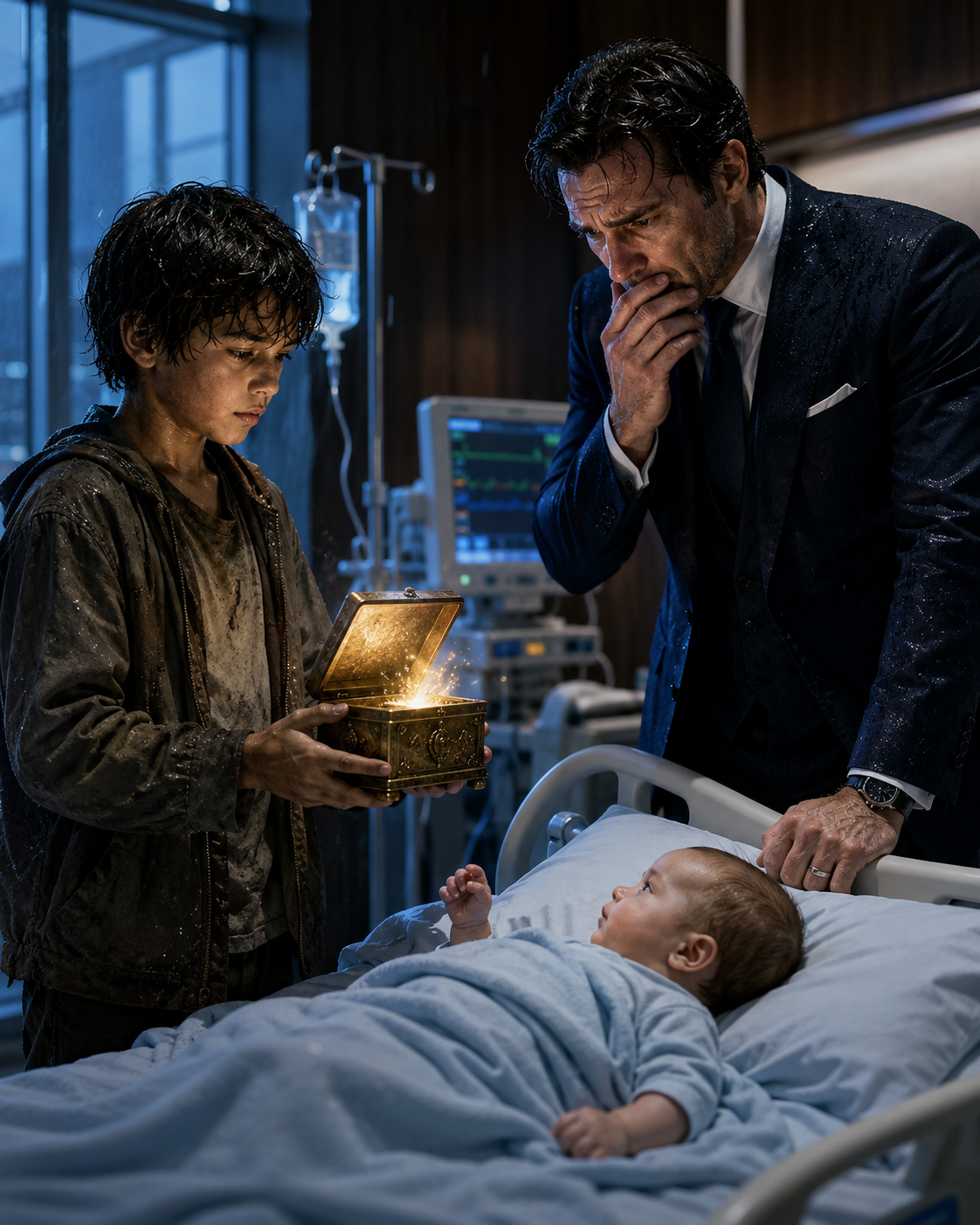
PART ONE: THE SOUND THAT SHOULD NOT HAVE BEEN THERE
The baby had been silent for four minutes.
Inside the private pediatric suite of Alder Children’s Institute, the monitors displayed nothing but motionless lines. The ventilator had been switched to standby. The emergency cart remained beside the bed, its drawers still open after the doctors had exhausted every permitted procedure.
No one touched it.
No one needed it anymore.
Eight-month-old Miles Hart lay beneath a pale-blue blanket. His small hands rested beside his body, his fingers loose and still. Without the machines, the room seemed impossibly quiet.
Dr. Miriam Cole removed her gloves.
She had spent twenty-six years treating children. She had delivered impossible news to hundreds of parents, yet she still hesitated before facing the man beside the bed.
Gideon Hart stood with one hand resting on the metal rail.
Outside the hospital, his name was attached to technology companies, hotels, research foundations and half the new skyline along the Seattle waterfront. Newspapers called him a visionary. Investors followed his decisions. Governments competed for his support.
But none of that power had followed him into the hospital room.
He was simply a father staring at the motionless face of his only son.
Dr. Cole lowered her voice.
“Mr. Hart, I am so sorry.”
Gideon did not respond.
His wife, Evelyn, sat near the window. She wore an elegant gray coat over the clothes she had thrown on after receiving the emergency call. Her dark hair was tied back tightly, as though perfect order could hold the world together.
She had not cried.
Not when the doctors began resuscitation.
Not when the alarms stopped.
Not when Dr. Cole stepped away from the bed.
Gideon kept watching Miles.
“What time?” he asked.
Dr. Cole looked at the clock.
Before she could answer, a boy’s voice came from the doorway.
“Please don’t turn everything off.”
Everyone looked around.
A thin boy stood just outside the suite.
He looked about eleven. Rainwater dripped from his hair onto a faded green jacket. His jeans were torn at one knee, and the soles of his shoes were beginning to separate. A canvas bag filled with crushed aluminum cans hung from his shoulder.
In his right hand, he held a silver card case.
Security officer Paul Danner appeared behind him.
“I’m sorry,” Paul said. “He slipped past the reception desk.”
The boy did not look at the guard.
He stared at Miles.
“Please,” he repeated. “The baby isn’t completely quiet.”
Dr. Cole’s expression hardened.
“This is a restricted medical area.”
“I know.”
“You need to leave.”
The boy shook his head.
“There’s still a sound.”
Gideon finally turned away from the bed.
“What sound?”
The boy looked frightened now that everyone was watching him. He pressed the card case against his chest.
“It’s underneath the silence.”
Paul placed a careful hand near the boy’s shoulder without grabbing him.
“Come with me.”
The boy stepped away.
“I came to return this.”
He held up the silver case.
Gideon recognized it immediately. It contained his identification, several access cards and a small photograph he had carried for years.
He must have dropped it outside the hospital entrance.
“You found that?” Gideon asked.
“Near the black car.”
“You came all the way up here to return it?”
The boy nodded.
“I tried to give it to the receptionist, but she told me to wait. Then I heard the sound.”
Dr. Cole moved between him and the bed.
“There is no sound. The child’s heart has stopped.”
“I don’t mean with my ears.”
A few members of the medical team exchanged uncomfortable glances.
Evelyn rose from her chair.
“Remove him.”
Her voice was calm, but something in it caused Gideon to look at her.
The boy looked at Miles again.
“It’s fading.”
Paul gestured toward the corridor.
“Let’s go.”
“No.”
The single word echoed through the suite.
It had not come from the boy.
Gideon had spoken.
Paul stopped.
Gideon turned to Dr. Cole.
“Give him one minute.”
“Mr. Hart, your son has undergone prolonged resuscitation. This child cannot interfere with—”
“One minute.”
Dr. Cole glanced at the still monitor.
“There is nothing medically useful he can do.”
The boy lowered his canvas bag.
“I don’t need to touch him.”
That surprised everyone.
He removed a small object from beneath his jacket. It was a round brass music box, scratched with age. One side was dented, and the tiny handle had been repaired with wire.
“My mother gave me this,” he explained. “She said every living thing has a rhythm, even when we can’t hear it.”
Evelyn’s face changed.
Only for a second.
But Gideon saw it.
The boy approached the bed slowly. He remained several feet away and turned the handle of the music box.
A delicate melody filled the room.
It was not beautiful in the usual way. Several notes were slightly distorted by the damaged mechanism. One repeated too soon. Another trembled.
Yet the melody carried a strange warmth.
The boy closed his eyes.
“What is your name?” Gideon asked.
“Owen Parker.”
“Owen, what do you think you hear?”
The boy did not answer immediately.
The music box continued playing.
Then Owen pointed toward the base of the bed.
“The machines are covering it.”
Dr. Cole frowned.
“The machines are off.”
“Not that machine.”
He indicated an infusion controller mounted behind the bed. Its display had gone dark, but a faint mechanical vibration continued inside it.
A nurse disconnected the controller.
The room became even quieter.
Owen tilted his head.
“There.”
“There what?” Dr. Cole asked.
“A beat.”
The doctor checked Miles again.
No pulse.
No breath.
Nothing.
Owen began humming with the music box.
The sound was low and uncertain at first. Then his voice found the melody. The damaged notes seemed to straighten when he sang them.
His hands began to shake.
Gideon took a step toward him.
“Owen?”
“Don’t speak.”
The boy’s voice was barely audible.
“Please. He’s trying to follow it.”
A faint tone came from the monitor.
One of the nurses looked at the screen.
A single point appeared on the motionless line.
Then vanished.
Dr. Cole rushed forward.
“Restart the leads.”
The team moved instantly.
The monitor produced another tone.
A second point.
Then a third.
Miles’s left hand tightened slightly beneath the blanket.
Gideon gripped the bed rail.
“Doctor?”
“I don’t know.”
The line rose.
Fell.
Paused.
Then rose again.
Miles drew a thin, uneven breath.
The room exploded into motion.
Dr. Cole called for oxygen. A nurse adjusted the airway. Another physician checked the baby’s pulse while the monitor struggled toward a fragile rhythm.
“He has cardiac activity.”
Gideon stared at her.
“What?”
“We have a pulse.”
Miles breathed again.
The sound was weak and rough, but unmistakable.
Gideon covered his mouth.
Someone behind him began crying.
Owen stopped humming.
The music box slipped from his fingers and landed on the carpet.
His knees buckled.
Paul caught him before he fell.
The boy remained conscious, but his face had lost all color.
“I’m fine,” he whispered.
“You are not fine,” Dr. Cole said.
She motioned toward a nurse.
Owen tried to stand.
“My grandfather is waiting for me.”
“You need to be examined.”
“He worries when I’m late.”
Gideon picked up the silver card case.
It had opened when Owen dropped it.
A photograph lay on the floor.
Gideon bent down and reached for it.
The photograph did not belong to him.
It must have been tucked behind the card case when Owen found it.
A young woman stood in front of an old ferry terminal, smiling into the wind. She had dark curls, a narrow face and a brass music box in her hands.
Gideon stopped breathing.
He knew that face.
He had spent nearly fifteen years trying to forget it.
“Clara,” he said.
Owen looked up from Paul’s arms.
“What did you call her?”
Gideon turned the photograph over. Someone had written a name and date on the back.
Clara Parker.
Owen pushed himself upright.
“That’s my mother.”
The room seemed to contract around Gideon.
“You’re Clara’s son?”
“She died when I was little.”
Gideon stared at the boy.
Clara’s gray eyes looked back at him.
The same eyes.
The same stubbornness.
The same instinct to stand between danger and someone weaker.
Behind them, Miles released a small cry.
It should have been the only sound that mattered.
Instead, Evelyn whispered, “That is impossible.”
Owen heard her.
“Why?”
Evelyn recovered quickly.
“I meant what happened to the baby.”
“No,” Owen said. “You meant me.”
Gideon looked at his wife.
“How did you know Clara?”
“I didn’t.”
“You recognized the photograph.”
“I was surprised.”
“You were frightened.”
Evelyn’s eyes shifted toward the medical staff.
“This is not the time.”
A voice called from the corridor.
“Owen!”
An elderly man hurried into the suite, leaning heavily on a wooden cane. His coat was soaked, and each breath caused a painful wheeze.
Owen’s face filled with relief.
“Grandpa.”
Samuel Parker crossed the room and pulled the boy against him.
“I told you to wait downstairs.”
“I found the man’s card case.”
“I don’t care about the card case.”
Samuel checked Owen’s face and hands.
“Did you use the song?”
Owen did not answer.
Samuel saw the music box on the floor.
His expression collapsed.
“Oh, Owen.”
“The baby was still there.”
“That does not mean you had to follow him.”
“I couldn’t leave him.”
Samuel held the boy more tightly.
Gideon stepped forward.
“You knew this could happen?”
Samuel looked at him for the first time.
Recognition appeared immediately.
Not surprise.
Recognition.
“You,” Samuel said.
Gideon’s chest tightened.
“Have we met?”
“Not properly.”
Samuel’s eyes moved toward Evelyn.
His grip on his cane hardened.
“But I met people who worked for your family.”
Evelyn’s face became rigid.
“Samuel.”
Gideon looked from one to the other.
“You know him.”
Evelyn said nothing.
Samuel moved in front of Owen.
“You have no right to speak his name.”
“I haven’t seen you in years,” Evelyn replied.
“Not because you stopped looking.”
Owen stared at his grandfather.
“What does she mean?”
Samuel ignored the question.
“We’re leaving.”
Dr. Cole blocked the doorway.
“The boy needs medical attention.”
“No blood tests.”
“We can examine him without—”
“No machines. No samples. No scans.”
“Mr. Parker, he nearly collapsed.”
Samuel looked at the doctors surrounding Miles.
“You saw what he did. That means someone else saw it too.”
Gideon glanced toward a camera mounted in the corner of the suite.
Evelyn followed his gaze.
The camera’s small green light had turned red.
She crossed the room and pressed the communication panel.
“Security control, disable every recording from this room.”
No response came.
She pressed it again.
“Security?”
The doors closed.
A magnetic lock clicked.
The lights dimmed.
Miles’s monitor continued beeping, but every other screen in the suite went black.
A calm male voice emerged from the ceiling speaker.
“Evelyn, you always underestimate the speed of a good surveillance system.”
Gideon went completely still.
The voice was older than he remembered.
Thinner.
Yet impossible to mistake.
“Father?”
Samuel’s face drained of color.
Owen looked between them.
Evelyn backed away from the speaker.
Gideon stared upward.
“My father is dead.”
The voice chuckled.
“Your father held a public funeral.”
Gideon’s hands curled into fists.
“I saw the coffin.”
“You saw what you were expected to see.”
Miles began crying more loudly.
Dr. Cole lifted him carefully and checked the monitor.
Gideon did not move.
“Where are you?”
“Close enough to hear my grandson return from death.”
“What have you done?”
“I built the place in which he was saved.”
“Owen saved him.”
“Yes,” the voice replied. “And that is why the boy must remain.”
Samuel drew Owen behind him.
“No.”
The old man in the speaker seemed amused.
“You kept Clara’s son hidden longer than I expected.”
Owen looked up at Samuel.
“Hidden from whom?”
Samuel’s shoulders sagged.
“From Victor Hart.”
The founder of Hart Biomedical.
Gideon’s father.
The man whose portrait occupied the hospital’s entrance hall.
The man newspapers said had died eighteen months earlier.
The man who now controlled the locked room.
Gideon looked at his wife.
“You knew he was alive.”
Evelyn closed her eyes.
“Yes.”
The answer struck harder than a denial.
“You let me bury him.”
“The board believed his death would protect the company.”
“From what?”
Samuel answered.
“From the truth.”
The ceiling speaker crackled.
“Be careful, Samuel.”
“No,” Samuel said. “I spent twelve years being careful.”
He pointed toward the floor.
“Tell your son what is under this hospital.”
Victor’s voice lost its humor.
Gideon looked at Evelyn.
“What is he talking about?”
She seemed unable to speak.
Samuel placed a hand on Owen’s shoulder.
“Your family built a hidden research unit called the Orpheus Wing.”
Dr. Cole turned sharply.
“There is no Orpheus Wing.”
“Not on your maps.”
“What did they research?” Gideon asked.
Samuel looked at the brass music box.
“Children who could hear life disappearing.”
Owen stared at him.
“Children like Mom?”
Samuel’s eyes filled with grief.
“Yes.”
“And like me?”
“Yes.”
The boy stepped away from him.
“You told me the song was only something she taught you.”
“I was trying to give you a childhood.”
“You lied.”
“I was trying to keep you alive.”
The speaker activated again.
“Clara possessed extraordinary sensitivity to biological electrical patterns. She could recognize when a damaged nervous system was still capable of returning.”
Gideon felt sick.
“You experimented on her.”
“We studied her.”
“She was seventeen,” Samuel said.
“She volunteered.”
“She was hungry. Her mother was sick. You promised to pay for treatment.”
Victor remained silent for a moment.
“History is always simplified by angry survivors.”
Samuel raised his cane toward the ceiling.
“You locked her underground.”
Owen’s lower lip trembled.
“What happened to my mother?”
Samuel looked at him.
He had probably rehearsed this moment for years.
It did not help.
“They made her use the song again and again. On injured animals. On patients. On people Victor believed were valuable enough to preserve.”
Owen touched the music box.
“Did it hurt her?”
“Every time.”
“How?”
“The song does not create life,” Samuel said. “It helps a fading body remember its own rhythm. But the person guiding it has to carry part of that confusion. Part of the fear. Part of the silence.”
Owen remembered collapsing.
The cold inside his chest.
The sensation of being trapped beneath dark water.
Samuel continued.
“Your mother became weaker. Victor promised he would stop. Instead, he decided she could lead him farther.”
“To where?” Gideon asked.
Samuel looked up at the speaker.
“Beyond death.”
The lights flickered.
A section of the wall slid open, revealing a narrow service corridor that none of the medical staff had known existed.
Victor spoke.
“Bring the boy downstairs.”
“No,” Gideon said.
A pair of security officers appeared at the far end of the corridor. They wore ordinary hospital uniforms, but neither man belonged to the team Gideon recognized.
Evelyn stepped between them and Owen.
“You said the child would never be involved.”
Victor’s voice became colder.
“Miles was deteriorating. We required confirmation that the inherited response still existed.”
Gideon turned toward her.
“Inherited?”
Evelyn stared at the floor.
Victor answered for her.
“Your son’s medical crisis was not entirely accidental.”
Gideon looked at Miles.
Then at Dr. Cole.
“What does he mean?”
“I don’t know,” she said.
Evelyn’s voice broke.
“I tried to stop the trial.”
Gideon’s expression changed.
“What trial?”
She looked at him with tears in her eyes for the first time that night.
“Your father believed exposure to a controlled neural suppressant might cause Miles to produce the same signal Clara produced.”
“You allowed someone to test something on our baby?”
“I changed the dosage. I thought I had neutralized it.”
Gideon could barely form the words.
“You knew?”
“I was trying to keep Victor from replacing Miles with another child.”
“You protected the program.”
“I was trying to protect our son.”
“You nearly killed him.”
Evelyn flinched.
“I know.”
Miles cried against Dr. Cole’s shoulder.
The sound cut through the room.
Owen looked at the baby, then at Evelyn.
“You were waiting to see whether he came back.”
She could not answer.
That silence told him enough.
The security officers entered.
Gideon moved in front of Owen.
“No one takes him anywhere.”
Victor sighed through the speaker.
“You have spent your life enjoying what I built. Do not discover morality only when it becomes personally inconvenient.”
“You used my child.”
“I tested an heir.”
“You used Clara.”
“I pursued survival.”
“You are already dead.”
“No,” Victor replied. “I am unfinished.”
The hidden corridor lights turned on one after another, descending into the building.
At the far end, an elevator waited with its doors open.
Victor spoke one final time.
“If you want Miles to remain stable, bring Owen to the Orpheus Wing.”
Then the speaker went silent.
Gideon faced Dr. Cole.
“Is my son stable?”
“For the moment.”
“For the moment?”
“His rhythm is holding, but I cannot explain why it returned. I cannot promise it will continue.”
Owen walked toward Miles.
Samuel caught his sleeve.
“No.”
“If I don’t go, the baby might stop again.”
“That is not your responsibility.”
“He brought me back,” Dr. Cole said quietly. “Whatever happened, the child’s return appears connected to Owen.”
Samuel looked at her with anger.
“Then you are already speaking like them.”
Dr. Cole stepped back.
Samuel knelt in front of Owen.
“Listen to me. Compassion is not the same as surrender. Your mother believed she had to save everyone who asked. Victor turned that belief into a chain.”
Owen looked at Miles.
“What happens if I do nothing?”
“No one knows.”
“What happens if I go downstairs?”
Samuel’s face tightened.
“Victor will try to make you believe every life in that building depends on you.”
“Does it?”
Samuel hesitated.
That hesitation frightened Owen more than any answer.
Gideon crouched beside them.
“I will not ask you to save my son again.”
Owen studied his face.
“Do you mean that?”
Gideon looked toward Miles.
Saying the words seemed to tear something from him.
“Yes.”
“What will you do?”
“I will go downstairs.”
“Why?”
“Because my family created that place.”
Samuel shook his head.
“Victor wants the boy, not you.”
“Then Owen stays here.”
The lights went out for two seconds.
When they returned, Miles’s monitor began producing an irregular alarm.
Dr. Cole moved quickly.
“His rhythm is weakening.”
Evelyn covered her mouth.
Victor’s voice returned.
“Time is a luxury available only to people willing to let others die.”
Owen picked up the brass music box.
“Open the elevator.”
Samuel looked devastated.
“Owen.”
“I’m not going to save Victor.”
“He will force you.”
Owen held his grandfather’s gaze.
“Then help me learn how to say no.”
PART TWO: THE FLOOR BENEATH THE BASEMENT
The elevator descended beyond every floor listed on the control panel.
Gideon carried Miles inside a portable medical cradle while Dr. Cole monitored his breathing. Samuel stood beside Owen, one hand resting on the boy’s shoulder. Evelyn remained near the doors, her face reflected in the polished metal.
No one spoke.
The numbers disappeared after the fourth basement level.
Only a white line remained on the display.
As the elevator continued downward, Owen felt the hidden rhythm of the building.
Pumps.
Generators.
Ventilation systems.
Electronic locks.
Hundreds of separate vibrations overlapped inside the walls.
But underneath them was something else.
A slow, exhausted pulse.
Then another.
And another.
Owen gripped the music box.
“There are people down there.”
Evelyn looked at him.
“How many?”
“I don’t know.”
Samuel closed his eyes.
Victor had not been preserving only himself.
The elevator doors opened onto a circular corridor lined with thick glass.
Behind the first window lay a woman in a hospital bed. Her eyes were closed, and dozens of thin cables connected her to a humming metal column.
Behind the next window was an elderly man.
Then a young woman.
Then a boy who looked no older than Owen.
Some were awake.
Most were not.
Their names had been replaced by numbers on small metal plates.
No readable records appeared on the glass. No family photographs. No flowers.
Nothing that suggested they belonged to anyone.
Dr. Cole approached the first room.
“Who are these patients?”
Evelyn’s voice was barely audible.
“Victor called them anchors.”
“Anchors for what?”
“For him.”
A light moved along the ceiling, guiding them through the corridor.
Victor spoke from hidden speakers.
“Every human nervous system produces patterns. Most are ordinary. A few are exceptionally resilient. By connecting those patterns, we built a support network capable of sustaining damaged neural tissue.”
Gideon looked through the glass.
“You are drawing activity from them.”
“Redistributing unused capacity.”
“They are people.”
“They signed agreements.”
Samuel struck his cane against the floor.
“Clara signed an application for financial assistance. You turned it into lifelong consent.”
Victor ignored him.
Owen approached the room containing the sleeping boy.
His own reflection hovered on the glass beside the patient’s face.
“What happens when an anchor becomes weak?”
Evelyn answered.
“They are replaced.”
Owen turned.
“With another person?”
She nodded.
Gideon stared at his wife.
“How long have you known?”
“Seven years.”
“And you stayed?”
“At first I thought the research could help people with catastrophic injuries. Then I understood the network was being built around Victor.”
“Why didn’t you leave?”
“He controlled the company, the hospital and the courts that approved our private medical contracts. He had recordings of everyone involved. He threatened to place Miles in the program before he was born.”
Gideon looked at the cradle.
“So you helped him?”
“I tried to delay him.”
“You lied to me every day.”
“I believed keeping you ignorant kept you alive.”
Samuel gave a bitter laugh.
“That is how these places survive. Everyone tells themselves their silence is protection.”
The guide light led them toward a sealed door.
A scanner waited beside it.
Evelyn entered a code.
The panel rejected her.
Victor’s voice filled the corridor.
“Clara locked the final chamber before she escaped. Her biological signature was the only access profile she could not erase.”
Owen understood.
“You need me to open it.”
“Yes.”
Samuel stood in front of the scanner.
“No.”
Miles’s monitor produced another irregular alarm.
Owen felt the baby’s rhythm trembling like a candle in wind.
He placed his palm against the scanner.
Nothing happened.
Victor said, “The system recognizes more than skin.”
Owen took out the music box.
Samuel grabbed his wrist.
“Once that door opens, you cannot pretend you do not know what is inside.”
“I already know enough.”
“No. You know words. Words are lighter than memories.”
Owen turned the handle.
The damaged melody entered the corridor.
The scanner illuminated.
A white line moved across Owen’s palm.
The door unlocked.
Beyond it was a chamber shaped like a small theater.
At its center stood a transparent medical enclosure. Machines surrounded a narrow bed, and cables disappeared beneath the floor.
Victor Hart lay inside.
The portraits in the hospital showed a tall man with silver hair and confident eyes. The person in the enclosure resembled those images only faintly.
His body had become thin and twisted. Mechanical supports held his arms in place. A breathing system covered part of his face.
But his eyes remained sharp.
A microphone near his throat carried his voice through the room.
He smiled when Owen entered.
“Clara’s son.”
Owen remained near Samuel.
“My name is Owen.”
“Of course.”
Victor looked toward Gideon.
“You finally came to see the work that paid for your empire.”
Gideon placed Miles’s cradle beside Dr. Cole.
“I’m shutting this place down.”
“You said the same thing about three companies when you were twenty-five. All three later became profitable.”
“These are prisoners.”
“These are pioneers.”
One of the machines behind Victor displayed a web of pulsing lights. Each light corresponded to a person in the surrounding rooms.
Owen could feel them.
Every weak pulse fed into the chamber.
“Let them go,” he said.
Victor watched him with interest.
“You hear the network.”
“I hear people trying to wake up.”
“They have little waiting for them outside.”
“That doesn’t make their lives yours.”
Victor smiled.
“Clara said something similar.”
Owen’s hand tightened around the music box.
“You knew my mother?”
“I discovered her.”
“You hurt her.”
“I gave her purpose.”
Samuel stepped forward.
“She already had a purpose. She was a daughter. A musician. A young woman who wanted to teach children.”
Victor’s gaze moved toward him.
“She would have remained invisible.”
“She would have remained alive.”
Owen looked at Samuel.
“How did she escape?”
Samuel hesitated.
“She learned that Victor planned to connect her permanently to the network. She used the music box to disrupt the synchronization system.”
Victor’s expression darkened.
“She damaged years of research.”
“She freed six patients,” Samuel replied.
“What happened after that?” Owen asked.
Samuel’s voice cracked.
“She reached the surface. She gave you to me. Then her heart failed.”
Owen stared at him.
“You told me she died in an accident.”
“You were four.”
“You could have told me later.”
“I was afraid the truth would lead you back here.”
Victor spoke gently.
“Your grandfather did not understand her final request.”
Samuel turned sharply.
“Do not.”
Owen looked at Victor.
“What request?”
“She wanted her work completed.”
“That is a lie.”
Victor’s eyes remained fixed on the boy.
“Clara understood that death is only a pattern losing coherence. She believed the song could restore that pattern permanently.”
“My mother wanted to free people.”
“She wanted to save them.”
“Not you.”
Victor’s smile disappeared.
Miles whimpered in the medical cradle.
The machine beside him sounded another alarm.
Dr. Cole adjusted his oxygen support.
“His heart rate is falling.”
Gideon rushed to her.
“What do you need?”
“I need the medication system upstairs and a full pediatric team.”
Victor answered.
“The elevator has been disabled.”
Evelyn moved toward a control station.
“Restore it.”
“After Owen completes the stabilization.”
Gideon faced the enclosure.
“You would risk your grandson’s life?”
“I am offering him a future without illness. Once Owen restores the central pattern, the network will stabilize everyone connected to it.”
Owen listened.
“Everyone?”
“All the anchors. Miles. Me.”
“And what happens to me?”
Victor said nothing.
Samuel answered.
“You become the new center.”
Owen’s skin went cold.
Victor’s voice remained calm.
“You are stronger than Clara. Your sensitivity is more precise. The burden would be manageable.”
“For how long?”
“A lifetime.”
“My lifetime?”
“A life of comfort, education and importance.”
Victor activated a display in the wall.
Images appeared without readable text: a bright house, a private school, medical care for Samuel, shelves filled with food, a warm bedroom overlooking the ocean.
Owen’s breath caught.
Victor had studied him.
The leaking roof.
Samuel’s medicine.
The unpaid heating bill.
The nights Owen pretended not to be hungry.
“You collect cans in the rain,” Victor said. “Your grandfather chooses between food and medication. I can end all of it.”
Samuel stepped in front of the display.
“Do not look.”
But Owen kept watching.
Victor continued.
“You would never be powerless again.”
“I would never leave this room.”
“You would be necessary.”
“That isn’t the same as being free.”
Miles’s monitor sounded again.
Gideon stood beside the cradle, helpless.
Owen looked at him.
“Ask me.”
Gideon frowned.
“What?”
“Ask me to save him.”
Gideon looked at his son.
Every part of him wanted to beg.
Owen could see it.
Gideon closed his eyes.
Then he shook his head.
“No.”
Victor’s expression hardened.
Gideon continued.
“I will not turn you into a prisoner to keep Miles alive.”
“He may die,” Victor said.
Gideon’s voice broke.
“I know.”
“You would sacrifice your own child for the comfort of a stranger?”
“No. I am refusing to sacrifice someone else’s child for mine.”
The words silenced the room.
Evelyn looked at Gideon with tears streaming down her face.
Victor stared at his son as though he were examining a failed experiment.
“Weakness always disguises itself as virtue.”
Owen approached Miles’s cradle.
He did not touch the baby.
He turned the handle of the music box.
The melody emerged slowly.
Miles’s rhythm flickered inside Owen’s mind.
Weak.
Confused.
But still his own.
Owen began humming.
Victor watched the network display.
Several lights brightened.
“Yes,” he whispered. “You see? The system responds to you.”
Owen changed one note.
The melody shifted.
Samuel looked at him.
“That isn’t Clara’s song.”
“No.”
Owen changed another note.
The lights behind Victor began pulsing out of sequence.
Alarms activated around the chamber.
Victor’s eyes widened.
“What are you doing?”
“Listening.”
“To what?”
“Everyone you made quiet.”
Owen heard the sleeping woman in the first room.
The old man.
The young woman.
The boy behind the glass.
Each possessed a separate rhythm.
The network had forced them to follow Victor’s pattern.
Owen stopped trying to make them harmonize.
Instead, he gave every rhythm space to become different.
The lights scattered across the display.
Victor’s support machines trembled.
“Stop.”
Owen continued humming.
Doors opened throughout the circular corridor.
Dr. Cole looked through the chamber window.
“The patients’ monitors are changing.”
Victor’s voice rose.
“You are destabilizing them.”
“No,” Owen said. “I’m separating them from you.”
“You don’t understand the system.”
“I understand the sound.”
“Owen,” Samuel warned, “you’re becoming pale.”
The boy’s knees shook.
Still, he continued.
One by one, the lights feeding Victor went dark.
Beyond the glass, the anchor patients began breathing in rhythms of their own.
Evelyn worked at the control station.
“The elevators are responding.”
Victor glared at her.
“You will lose everything.”
“I already did.”
“The board will destroy you.”
“I will give investigators every file.”
“You signed the authorizations.”
“Yes.”
“You will go to prison.”
“Then I will go.”
Victor looked at Gideon.
“Stop the boy.”
Gideon stood beside Miles.
“No.”
“I built your life.”
“You built a cage and convinced us it was a kingdom.”
The central machine emitted a sharp alarm.
Victor’s breathing became strained.
“Samuel,” he said, “your daughter would not have allowed this.”
Samuel looked at the man who had stolen Clara’s future.
“My daughter believed every person deserved a choice.”
Owen opened his eyes.
“Then choose.”
Victor stared at him.
“Choose what?”
“Live without stealing anyone else’s heartbeat.”
“My body cannot.”
“Then let it stop when it is ready.”
For the first time, Victor looked afraid.
Not angry.
Not offended.
Afraid.
“I am Victor Hart.”
Owen’s humming weakened.
“That’s only a name.”
“My work changed the world.”
“That doesn’t mean the world belongs to you.”
The final light connecting the network to Victor flickered.
He looked toward Gideon.
“Son.”
Gideon’s face tightened.
It was the first time Victor had called him that since the elevator opened.
“Do not let him erase me.”
Gideon approached the enclosure.
“You erased yourself a long time ago.”
The final light went out.
Victor’s machines continued operating, but no stolen rhythm entered them.
The chamber became strangely peaceful.
His heart monitor slowed.
No one moved to interfere with it.
Victor looked at Owen.
“You could have become extraordinary.”
Owen stopped humming.
He was exhausted, but his voice remained clear.
“I’m already someone.”
Victor tried to answer.
Only a thin breath escaped.
His monitor continued slowing until it reached the rhythm his own body could sustain.
Then it stopped.
This time, no one called him back.
Behind them, Miles released a cry.
Dr. Cole checked the portable monitor.
“His heart rate is rising.”
Gideon approached cautiously.
“Is he stable?”
“He is stabilizing on his own.”
Owen looked at the baby.
For the first time since entering the hospital, he heard no hidden door, no fading echo and no borrowed rhythm.
Only a living heart doing its own work.
Samuel caught Owen as the boy began to fall.
“I’ve got you,” he whispered.
Owen held the music box against his chest.
“Are the others alive?”
Dr. Cole looked through the glass walls.
Doctors and nurses were entering the newly opened rooms.
“Yes.”
“All of them?”
“I don’t know yet.”
Owen nodded weakly.
“That’s their choice now.”
PART THREE: THE BOY WHO KEPT HIS OWN HEARTBEAT
By sunrise, police vehicles surrounded Alder Children’s Institute.
Investigators entered the underground wing wearing protective equipment and body cameras. Ambulances transported the freed patients to independent hospitals. Medical records were seized. Executives were taken from their homes before breakfast.
For the first time in decades, the Hart family could not control what the public would learn.
Evelyn provided the access codes.
She gave investigators the names of physicians, attorneys and board members who had approved the Orpheus Program. She surrendered private recordings, financial transfers and the contracts used to disguise the anchor patients as volunteers.
She did not ask Gideon to forgive her.
She did not claim she had been innocent.
When officers escorted her through the hospital lobby, she stopped beside Miles’s room.
Gideon stood behind the glass, holding their son.
Evelyn pressed one hand against the window.
“I thought cooperating with Victor would keep Miles safe,” she said.
Gideon remained on the other side.
“You chose his system every time you were afraid.”
“I know.”
“You should have told me.”
“I know.”
Miles shifted in his father’s arms.
Evelyn’s eyes filled with tears.
“Will you tell him I loved him?”
Gideon looked down at the baby.
“When he is old enough, I will tell him the truth.”
It was not the promise she had asked for.
But she accepted it.
The officers led her away.
The public story developed quickly.
Reporters spoke of illegal medical trials, falsified deaths, concealed patients and a secret support system built beneath a respected children’s hospital.
Victor Hart’s survival shocked the country.
The existence of the anchor network shocked it more.
Politicians who had praised the Hart Foundation denied knowing anything. Executives resigned. Attorneys claimed they had misunderstood the documents they signed. Former employees began giving interviews.
Gideon refused to protect the family name.
He opened the foundation’s files voluntarily.
He sold two companies to finance medical care for the surviving patients. He transferred the hospital to an independent public trust and created a legal fund for families who had been pressured into experimental programs.
His advisers warned him that the Hart empire might collapse.
“Then let it collapse,” he answered.
Money could not repair what his father had done.
But Gideon could stop using money to hide it.
Samuel and Owen moved into a modest house near Green Lake.
The house did not have marble floors or private security. It had two bedrooms, a small kitchen and a narrow porch where Samuel could sit in the afternoon.
Most importantly, the roof did not leak.
At first, Owen did not sleep well.
Every mechanical hum reminded him of the underground wing. The heating system sounded like the anchor network. The refrigerator’s motor resembled Victor’s support machines.
Samuel often found him sitting on the kitchen floor with the music box in his hands.
“You don’t have to listen to everything,” Samuel told him.
“I’m not trying.”
“I know.”
“What if someone nearby is fading?”
“Then there are doctors, families and people whose job is to help.”
“What if they can’t?”
Samuel sat beside him.
“Your mother asked herself that question every day.”
“What did she decide?”
“That if she heard suffering, it belonged to her.”
“Was she wrong?”
“She was kind. Kindness and wisdom are not always the same thing.”
Owen turned the music box handle once, then stopped it.
“I saved Miles.”
“Yes.”
“I helped the people underground.”
“Yes.”
“I let Victor die.”
Samuel looked at him carefully.
“You removed what he had stolen. His own body made the rest of the decision.”
“It still feels like I chose.”
“You chose not to become his machine.”
Owen stared at the floor.
“Does that make me bad?”
“No.”
Samuel placed his hand over the boy’s.
“It makes you free.”
Miles recovered slowly.
He remained in the hospital for several weeks while independent specialists examined the effects of the experimental substance Victor’s team had used. His heart was healthy, but Gideon refused to celebrate too soon.
He had learned what happened when powerful people treated miracles as guarantees.
Owen visited for the first time one month later.
Gideon met him outside the room.
“You don’t have to go in.”
“I know.”
“No one will ask you to use the music box.”
“I know.”
“If you feel anything unusual, we can leave.”
Owen smiled faintly.
“You sound like Grandpa.”
“That is probably a compliment.”
“It is.”
Miles sat in a padded chair with a nurse nearby. He had grown stronger and rounder. When Owen entered, the baby studied him with serious blue eyes.
Then Miles smiled.
Owen remained several feet away.
“Does he remember me?”
“No one knows what babies remember,” Gideon said.
Miles reached toward him.
Owen hesitated before offering one finger.
The baby gripped it.
Owen listened.
A quick heartbeat.
Warm.
Independent.
Nothing calling from beneath the silence.
Gideon stood near the door.
“I have tried to think of a way to thank you.”
“Don’t build a statue.”
“I was not planning to.”
“Don’t name a building after me.”
“I won’t.”
“Don’t tell reporters I’m a miracle boy.”
Gideon nodded.
“What may I do?”
Owen considered the question.
“You can make sure the children from the Orpheus Wing get their names back.”
“They will.”
“And their families?”
“We are searching for them.”
“And the boy in the glass room?”
“His name is Caleb Torres. His parents were told he died during surgery six years ago.”
Owen’s throat tightened.
“Did they find them?”
“Yes.”
“Did they come?”
“They are with him now.”
Owen looked at Miles.
“Then you’re doing enough today.”
Gideon lowered his head.
He had spent most of his life surrounded by people who wanted something from him.
Owen wanted him to become responsible.
That demand was more difficult than writing any check.
Months passed.
Samuel’s breathing improved once he received proper treatment. He began working part-time repairing instruments at a neighborhood music shop. Owen attended a public school where no one knew the full story of the underground hospital.
Some students knew he had been involved in the Hart investigation.
They invented explanations.
One said Owen had hacked the hospital computers. Another claimed he had discovered a secret tunnel while collecting cans. Someone else insisted he was Gideon Hart’s hidden son.
Owen ignored them.
He joined the school music program.
The teacher placed a cello in front of him.
The first note vibrated through the wooden body of the instrument and into his chest.
Owen smiled.
For once, he was listening to a sound that asked nothing from him.
He learned slowly.
His hands were small, and the instrument felt enormous. Some notes squeaked. Others disappeared. But he practiced until the vibrations became familiar.
The brass music box remained at home.
He did not destroy it.
It belonged to his mother, but it no longer controlled the meaning of her life.
Clara had been more than an ability.
Samuel began telling Owen stories he had once been too frightened to share.
Clara singing badly while cooking.
Clara hiding stray cats in the basement.
Clara saving money for music school.
Clara laughing during thunderstorms.
Clara refusing to let Victor turn her final decision into permission.
On the first anniversary of the Orpheus Wing’s closure, Gideon organized no ceremony.
He invited the surviving patients and their families to a private gathering in Green Lake Park. There were no reporters, corporate banners or speeches.
Caleb Torres attended in a wheelchair with his parents. The woman from the first glass room arrived with her sister. Several former patients were still recovering and could not come.
Miles crawled across a blanket while Gideon attempted to keep him away from a bowl of strawberries.
Owen sat beneath a maple tree with his cello.
Samuel lowered himself onto the grass beside him.
“Your mother would have liked this.”
“Because the patients are free?”
“Because no one is making you perform.”
Owen looked at the cello.
“I might play something.”
“Because you choose to?”
“Yes.”
“Then she would be very proud.”
Gideon approached with Miles in his arms.
The baby was now walking while holding furniture, though he preferred being carried whenever possible.
“Owen,” Gideon said.
“Yes?”
“I brought something.”
He handed Owen a small box.
Owen looked suspicious.
“I said no expensive gifts.”
“It is not expensive.”
Inside was a replacement handle for the brass music box. A local craftsperson had made it from polished maple.
“The old handle was breaking,” Gideon explained. “Samuel said repairing it would not change the sound.”
Owen examined the piece.
“Thank you.”
Gideon smiled.
It was the first time Owen had thanked him without immediately adding a warning.
Miles leaned toward the boy.
Owen allowed the baby to take his finger.
“His heartbeat is loud today,” Owen said.
Gideon became tense.
“Is something wrong?”
“No.”
Owen smiled.
“He’s just excited.”
Miles laughed as though agreeing.
Gideon sat on the grass.
For a while, none of them spoke.
Children played near the lake. Leaves moved in the wind. Samuel watched families reunited after years of lies.
Owen removed the music box from his bag.
He had installed the new wooden handle that morning.
“Are you going to use the song?” Samuel asked.
“Not the old one.”
Owen turned the handle.
The first notes sounded familiar.
Then the melody changed.
He had rebuilt it.
The damaged repetition was gone. The trembling note had become a deliberate pause. Clara’s melody remained inside it, but it no longer ended where hers had ended.
Owen lifted his cello and began playing along.
Miles clapped his hands.
The former patients listened.
No one’s heartbeat depended on the music.
No locked door opened.
No machine demanded a sacrifice.
It was only a song.
When Owen finished, Samuel wiped his eyes.
Gideon looked toward the lake.
“What is it called?” he asked.
Owen thought for a moment.
“Everyone Keeps Their Own Heart.”
Miles reached for the cello strings.
Owen gently moved the instrument away.
“Not yet.”
The baby laughed.
Owen listened to the sound and understood something his mother had never been allowed to learn.
A gift did not belong to the person who discovered it.
It did not belong to the frightened people who needed it.
It did not belong to a hospital, a foundation or a powerful family.
It belonged to the person carrying it.
That person could offer it freely.
That person could protect it.
And that person could refuse.
Owen Parker was not an anchor.
He was not Victor Hart’s unfinished experiment.
He was not the replacement for his mother.
He was an eleven-year-old boy with a repaired music box, a difficult cello piece and a grandfather waiting to walk home with him.
Miles took his finger again.
Owen felt the baby’s heartbeat.
Fast.
Strong.
Entirely his own.
This time Owen did not hear anyone calling from the silence.
He heard life moving forward.