The Silver Star on the Girlream cut through Hawthorne Wildlife Center at exactly eleven forty-seven in the morning.

A second earlier, the wolf observation deck had been filled with ordinary weekday sounds: children arguing over binoculars, teachers counting students, parents folding maps, and paper cups being pushed into overflowing bins.

Then a little girl climbed onto the wooden railing.

Someone shouted for her to stop.

Someone else dropped a camera.

Before any adult could reach her, she swung one leg over the barrier, lowered herself as far as she could, and dropped onto the narrow maintenance path below.

The observation deck erupted.

People rushed toward the railing. Phones rose above heads. A teacher pulled several children away while two security officers ran toward the emergency gate.

But the girl did not look back at the crowd.

She had already seen what everyone else had missed.

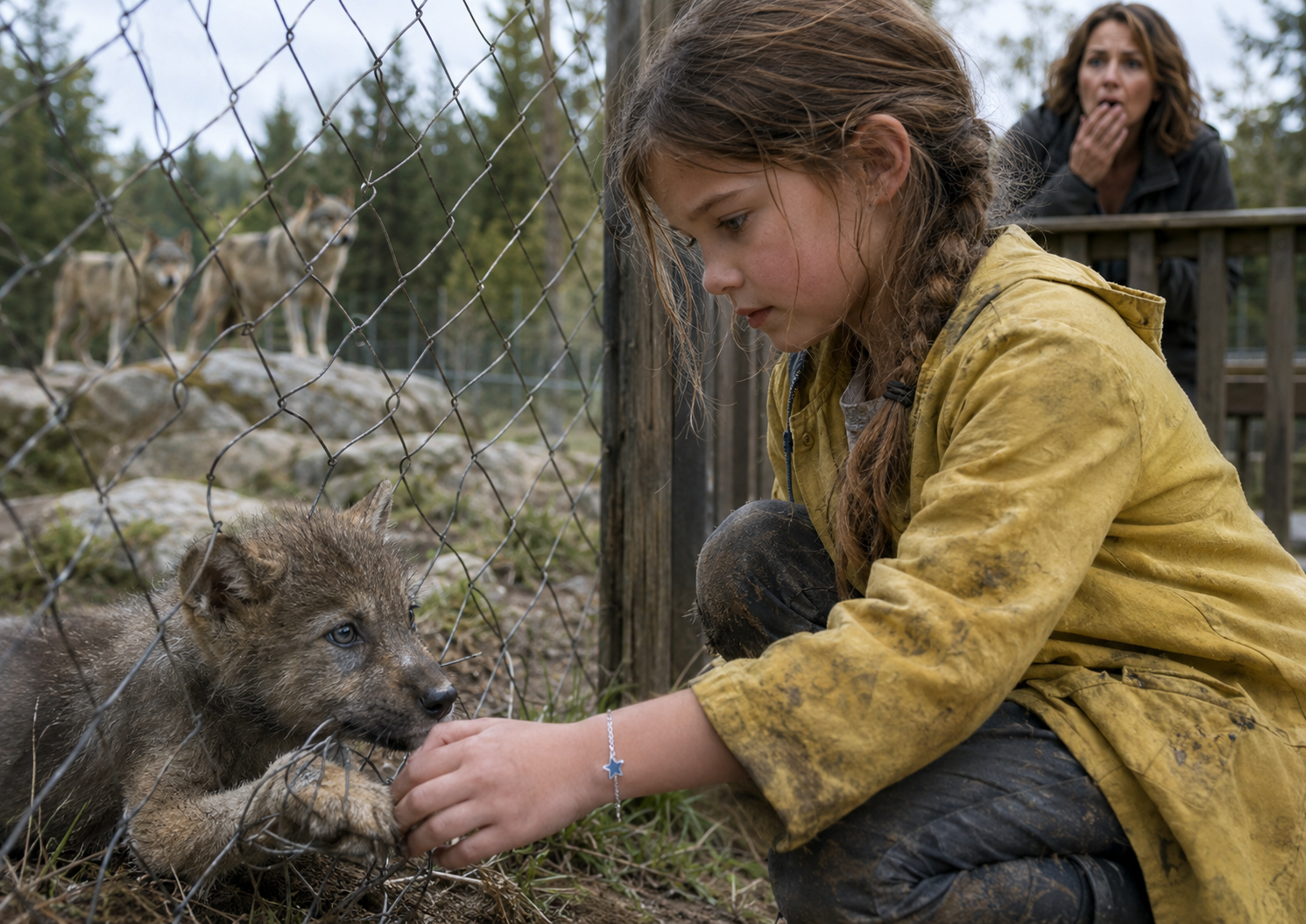
A wolf cub was trapped against the old service fence.

The cub was small enough that its ears still looked too large for its head. One of its front legs had slipped through a damaged section of wire, and the more it struggled, the tighter the twisted metal pulled around it.

The girl had noticed the cub several minutes earlier.

She had watched it try to free itself.

She had looked toward the adults around her, expecting someone else to see what was happening. But everyone had been watching the adult wolves resting on the ridge or taking photographs near the glass viewing wall.

No one had been looking at the narrow strip of land between the main habitat and the service corridor.

No one except her.

Her name was Lila Rowan.

She was eight years old, although people often guessed she was younger because she was small and wore a faded yellow coat that had clearly belonged to another child before her.

She had arrived at Hawthorne Wildlife Center shortly after it opened. Wednesdays were free for families carrying a regional assistance card, and Lila had learned that the wildlife center was one of the few places where she could spend an entire day without anyone asking why she was still there.

She knew the grounds well.

She knew which indoor building stayed warmest during winter.

She knew when the café placed unsold bread near the employee entrance.

And she knew that the wolves were usually quietest before noon.

When Lila landed on the service path, she bent her knees and remained still.

The adult wolves were separated from her by a reinforced inner fence, but they had already noticed the disturbance. Two of them stood on the rocky rise, watching her with motionless intensity.

Lila did not run.

She did not wave her arms.

Instead, she lowered herself and began moving slowly toward the trapped cub.

“Easy,” she whispered. “I’m not going to hurt you.”

The cub pulled backward.

The wire tightened.

Lila stopped immediately.

“Don’t move,” she said softly. “Please don’t move. I can help you, but you have to stay still.”

The cub’s breathing was fast and shallow. Its free paws scraped at the dirt, but exhaustion had weakened its movements.

Lila crouched several feet away and held out one hand. She waited until the cub stopped pulling before moving closer.

Above her, the crowd continued shouting.

“Get her out of there!”

“Where are the keepers?”

“Someone call emergency services!”

The noise frightened the cub. It twisted again, and the wire cut more deeply into the fur around its leg.

Lila looked up at the people leaning over the barrier.

“Please stop yelling!” she shouted. “You’re scaring him!”

For one brief second, the observation deck became almost silent.

Lila turned back to the cub.

“That’s better,” she whispered. “They’re going to be quiet now.”

She reached the damaged fence and examined the wire.

It had not pierced the cub’s leg, but several sharp loops had wrapped around the joint. Lila had no tools, no gloves, and no idea whether the cub might bite her.

She only knew that leaving it trapped was not an option.

She slid her fingers beneath the first loop and began to turn it.

The metal resisted.

The cub whimpered.

“I know,” Lila said. “I know it hurts. Just give me a little time.”

On the observation deck, the crowd had rearranged itself around the crisis. People pressed against the railings while others stood on benches to see.

Two security officers spoke urgently into their radios. A third ran toward the locked service entrance.

Near the rear of the crowd stood Evelyn Mercer.

She was forty-five and had come to the wildlife center with her sister’s son, Noah. Ten minutes earlier, Noah had been beside her, describing every animal he hoped to see. Now he was somewhere near the lynx exhibit with his school friend’s family.

Normally, Evelyn would have gone after him immediately.

But she could not move.

She was staring at the little girl below.

More precisely, she was staring at the girl’s wrist.

A thin silver bracelet hung beneath the sleeve of Lila’s yellow coat. It was delicate and slightly too small, with a single blue enamel star attached near the clasp.

The charm caught the light whenever Lila turned the wire.

Evelyn’s face lost all color.

She knew that star.

She knew the tiny scratch across its lower point.

She knew the unusual double clasp that had been added by a jeweler because the original clasp opened too easily.

And she remembered fastening that bracelet around her daughter’s wrist on the morning of her third birthday.

Evelyn had not seen the bracelet in five years.

She had not seen her daughter in five years either.

“That bracelet,” Evelyn whispered.

The man standing beside her did not hear.

Evelyn stepped closer to the railing.

“That bracelet,” she repeated.

A woman holding a toddler glanced at her.

Evelyn pointed toward the child below.

“It belonged to my daughter.”

The woman stared at her, uncertain whether she had understood correctly.

Evelyn did not explain.

Her attention remained fixed on the silver star moving against Lila’s wrist.

Below them, the emergency gate opened.

Two security officers entered the corridor. One was a broad-shouldered man carrying a restraint pole. The other was younger and wore thick protective gloves.

Lila heard them approaching and turned sharply.

“Don’t rush toward him,” she warned. “He’s almost free.”

The officers stopped.

The younger officer slowly crouched.

“All right,” he said. “We’ll stay here. My name is Daniel. What’s yours?”

“Lila.”

“You’re doing very well, Lila. Tell me what you need.”

“The wire is stuck under his leg,” she said. “I loosened most of it, but the last part won’t move. My hands aren’t strong enough.”

Daniel lifted his gloved hands so she could see them.

“Will these help?”

Lila nodded.

“Come slowly.”

Daniel approached one careful step at a time. When he reached her, he knelt beside the fence without touching the cub.

“You hold that section,” he said quietly. “I’ll turn this one away from the leg.”

Together, they worked the final loop free.

The moment the pressure disappeared, the cub scrambled backward.

Daniel raised one hand to stop Lila from following.

“Let him choose where to go.”

The cub held its injured paw above the ground for several seconds. Then it placed the paw down, shifted its weight, and took one uncertain step.

Another followed.

It retreated toward a low opening in the inner fence, where a keeper waited to guide it into a protected holding area.

Before disappearing, the cub stopped.

It stood several yards away and looked directly at Lila.

The moment lasted only a few seconds, but the crowd seemed to hold its breath.

Then the cub turned and vanished behind the rocks.

Lila sat down in the dirt.

She had not cried while climbing the barrier.

She had not cried while approaching the frightened animal.

She had not cried when the wire scraped her fingers or when the adult wolves began watching from the ridge.

But now the cub was safe.

The danger had passed, and the courage holding her together had nothing left to support.

Tears rolled down her face.

Daniel removed one glove and sat a few feet away from her.

“You did something extraordinary,” he said.

Lila wiped her cheeks with her sleeve.

“Will his leg get better?”

“The veterinary team will examine him,” Daniel replied. “But he was walking, and that’s a good sign.”

“Will they be angry with him for getting through the fence?”

“No one is going to be angry with him.”

Lila looked toward the rocks where the cub had disappeared.

“What about me?”

Daniel tried not to smile.

“We’re going to have a serious conversation about climbing barriers.”

Her shoulders sank.

“But first,” he continued, “we’re going to make sure your hands are all right.”

Lila looked down at the red marks across her fingers.

“I couldn’t leave him there.”

“I know,” Daniel said.

Evelyn had already left the observation deck.

She found the service entrance behind the veterinary building and reached it just as an employee was closing the gate.

“You can’t come through here,” the employee told her.

“I need to speak to the girl.”

“The area is restricted.”

Evelyn gripped the gate.

“The little girl wearing the yellow coat. Please. I need to see her immediately.”

“You’ll have to wait near the public entrance until security—”

“The bracelet she’s wearing belonged to my missing daughter.”

The employee stopped.

Evelyn’s voice trembled, but there was no confusion in it.

“My daughter disappeared five years ago. That bracelet was on her wrist. I bought it. I fastened it myself. Please don’t make me stand outside while that child is in there.”

The employee studied Evelyn’s face.

Then he opened the gate.

“Stay beside me.”

Evelyn barely heard him.

She followed the service path until she saw Lila sitting near the fence with Daniel. Another officer was checking the scratches on the girl’s hands.

Evelyn stopped several steps away.

For years, she had imagined finding her daughter everywhere.

She had searched the faces of children in supermarkets, parks, train stations, and school photographs posted online.

She had followed mistaken reports across three states.

She had opened the front door at midnight because a neighbor thought she had seen a child standing at the end of the street.

Every hope had ended the same way.

Too late.

Wrong child.

No connection.

But the bracelet was real.

The blue star was real.

Evelyn moved closer.

The officer beside Lila stood.

“Ma’am, you need to remain behind the marked line.”

“I only want to ask her one question.”

Lila looked up.

Evelyn saw a narrow face covered with dust, gray-green eyes, and hair that had escaped from a loose braid.

Something inside her seemed to stop.

Her daughter, Ava, had been only three when she disappeared. At that age, her cheeks had been round and her hair had been much lighter.

Five years could change everything.

Evelyn crouched on the opposite side of the line.

“Hello,” she managed.

Lila watched her cautiously.

“My name is Evelyn. I’m sorry to bother you after everything that happened, but I noticed your bracelet.”

Lila looked down at her wrist.

Evelyn pointed toward the charm.

“Can you tell me where you got it?”

“A woman gave it to me.”

“What woman?”

“Mrs. Bell. She lived in the apartments near Riverside Park.”

Evelyn struggled to keep her breathing steady.

“When did she give it to you?”

“Last December. She said she had kept it for a long time.”

“Did she tell you where it came from?”

Lila shook her head.

“She only said it was supposed to belong to someone brave. I helped carry her groceries upstairs when the elevator stopped working. She said that made me brave.”

Evelyn’s eyes filled with tears.

Lila pulled her wrist closer to her chest.

“Am I in trouble?”

“No,” Evelyn said immediately. “You haven’t done anything wrong.”

“Then why are you crying?”

Evelyn looked at the blue star.

“My daughter had a bracelet exactly like yours. I gave it to her when she was three.”

Lila became very still.

“There’s a scratch on the charm,” Evelyn continued. “Across the bottom point. She dropped it on the stone steps outside our house the day after her birthday.”

Lila turned the charm over.

The scratch was there.

Evelyn closed her eyes for a moment.

“I haven’t seen that bracelet for five years.”

Lila studied her face.

Children who grow up surrounded by uncertainty learn to read adults quickly. They notice the hesitation before a lie, the forced smile before bad news, and the difference between someone who wants to help and someone who merely wants answers.

Lila saw something in Evelyn’s expression that made her voice softer.

“Where is your daughter?”

“I don’t know.”

“You lost her?”

Evelyn swallowed.

“She disappeared while we were visiting a street festival. I turned away for less than a minute. When I looked back, she was gone.”

“Did the police search?”

“Everyone searched.”

“And they never found her?”

“No.”

Lila looked again at the bracelet.

“What was her name?”

“Ava.”

“How old would she be now?”

Evelyn stared at the child in front of her.

“Eight.”

Daniel glanced toward Evelyn, then back at Lila.

No one spoke.

Beyond the service corridor, Hawthorne Wildlife Center continued as though nothing had changed. A loudspeaker announced the afternoon bird presentation. Children laughed near the otter pool. A maintenance vehicle hummed somewhere behind the trees.

Lila ran one thumb over the silver star.

“I don’t remember being three,” she said.

Evelyn’s hands began trembling.

“What do you remember?”

“A white room. A woman with glasses. Then different houses.”

Daniel leaned forward slightly.

“Lila, where are your parents?”

“I don’t have parents.”

“Who brought you here today?”

“No one. I took the bus.”

Evelyn looked toward the officer, but he gently raised a hand, asking her to let the girl continue.

Lila kept her eyes on the bracelet.

“They told me I was found near a bus station when I was little. I didn’t know my last name. I couldn’t tell them where I lived.”

Evelyn could barely hear her own voice.

“How old were you when they found you?”

“They said three. Maybe almost four.”

The world seemed to narrow around them.

Evelyn studied the shape of Lila’s eyes, the slight curve of her eyebrows, and the way she pressed her lips together when she was uncertain.

Memories returned with painful clarity: Ava refusing to sleep without the hallway light, Ava singing the same two lines of a song because she had forgotten the rest, Ava sitting at the kitchen table with strawberry jam on her chin.

Evelyn wanted to cross the line.

She wanted to pull the child into her arms and never release her.

But hope had deceived her too many times.

She forced herself to remain still.

“My daughter had a mark on her left wrist,” Evelyn said. “A small birthmark shaped like a crescent moon.”

Lila looked down.

“It was just below where the bracelet rested,” Evelyn continued. “Most people didn’t notice it unless the bracelet moved.”

Slowly, Lila pushed back the sleeve of her yellow coat.

The silver chain slid upward.

Every person in the corridor stopped moving.

Below the bracelet, on the inside of Lila’s left wrist, was a small crescent-shaped birthmark.

Evelyn covered her mouth.

Lila stared at the mark, then raised her eyes to the woman kneeling several feet away.

Neither of them spoke.

They did not need to.

For five years, Evelyn had imagined the moment she might find her daughter.

She had imagined shouting, running, and wrapping her arms around the child she had lost.

But when the moment finally came, all she could do was whisper the name she had carried through every sleepless night.

“Ava?”

The girl’s lips parted.

Somewhere beyond the fence, a wolf called from the ridge.

And the silver star trembled on the child’s wrist.

The Silver Star on the Girlream cut through Hawthorne Wildlife Center at exactly eleven forty-seven in the morning.
Strange decisions and ‘experiments’ on yourself – first ‘stuffing’ your body with mascara and then removing it painfully