The demolition notice was taped to the front window before sunrise.
Arthur Cole found it when he arrived at the Bluebird Diner at five fifteen in the morning, carrying a paper bag of fresh rolls under one arm and fighting with the stubborn lock using his free hand.
At first, he thought the bright orange sheet was an advertisement.
Then he saw the city seal.
He stopped moving.
The rolls slipped from beneath his arm and landed softly on the sidewalk.
Inside the diner, the familiar blue neon bird continued blinking above the counter, unaware that someone had decided the building beneath it had thirty days left to live.
Arthur removed his glasses, wiped them on his shirt, and read the notice again.
The words did not change.
PROPERTY ACQUISITION AND STRUCTURAL CLEARANCE.
The city had approved the final phase of the Harbor Transit Corridor. The block would be cleared to make room for a glass transportation hub, two commercial towers, and a pedestrian plaza surrounded by stores Arthur would never be able to afford.
Bluebird Diner had been designated an obstructing structure.
An obstructing structure.
That was what forty-three years of breakfasts, apologies, celebrations, funerals, first dates, last chances, and unpaid coffee had become.
Arthur pressed one palm against the cold window.
Beyond the glass were twelve blue stools, nine booths, a silver coffee machine that hissed like an irritated cat, and a pie case his late wife, Rose, had bought at an auction before either of them understood how much it cost to repair old equipment.
The diner was not beautiful.
Its floor tiles were cracked.
The ceiling fan trembled whenever it reached its highest setting.
The jukebox accepted coins but played whatever song it wanted.
The letter B in the neon sign had been repaired so many times that it was brighter than the rest of the word.
But the diner had survived.
It had survived recessions.
It had survived floods.
It had survived a kitchen fire, three robberies, six broken refrigerators, and the opening of a fashionable café across the street that sold coffee in cups smaller than Arthur’s sugar bowl.
It had survived Rose’s death.
That had been the hardest winter of all.
Arthur had opened the diner two days after her funeral because he could not bear the silence in their apartment.
He had stood behind the counter wearing the same black suit he had worn at the cemetery.
No one had asked him for a menu.
Mrs. Holloway had brought flowers.
The dockworkers had fixed the leaking sink.
A nurse from Mercy Hospital had made coffee while Arthur sat in Rose’s favorite booth and stared at the empty seat across from him.
The Bluebird had survived because people refused to let Arthur grieve alone.
Now the city was going to erase it with machinery.
A black sedan stopped at the curb.
Arthur did not turn around.
He already knew who it was.
The rear door opened, and Martin Vale stepped onto the sidewalk in an expensive charcoal coat. He was forty, polished, and permanently composed. He represented Northstar Development, the corporation selected to construct the new transit complex.
Martin approached the diner with a leather folder tucked beneath his arm.
“You received the notice,” he said.
Arthur kept looking through the window.
“I found it.”
“I wanted to deliver it personally.”
“You taped it to the glass.”
“My office did.”
“Then your office delivered it.”
Martin took a measured breath.
“We’ve offered you a generous relocation package.”
“You offered enough money to rent a kitchen for eight months.”
“The property is not worth what you believe it is.”
Arthur finally looked at him.
“This property is worth exactly what I believe it is. That is how worth works.”
“Sentiment is not a valuation method.”
“Neither is greed, but your company seems comfortable using it.”
Martin’s jaw tightened.
For months, he had spoken to Arthur in conference rooms, city offices, and once beside the diner’s freezer while Arthur was repairing a pipe.
Every conversation ended the same way.
Martin presented numbers.
Arthur presented memories.
Martin called the building inefficient.
Arthur asked how efficiently a skyscraper could remember someone’s favorite breakfast.
Neither man convinced the other.
“The approval is final,” Martin said. “The demolition contractor begins preparation in thirty days.”
Arthur pulled the notice from the glass.
The tape tore one corner.
“Then he’ll be wasting his time.”
“Mr. Cole, refusing to accept reality will not protect you.”
Arthur folded the orange paper twice and placed it in his coat pocket.
“I’ve been refusing to accept reality since nineteen eighty-three. That is how this place stayed open.”
He picked up the fallen rolls and unlocked the door.
The bell above it gave a tired ring.
Martin remained on the sidewalk.
“Your son signed the preliminary consent form.”
Arthur froze.
He did not turn around.
Martin continued carefully.
“Daniel contacted us three weeks ago. He believes accepting the offer is in your best interest.”
Arthur’s fingers tightened around the bag.
“My son does not own the Bluebird.”
“He will eventually inherit your liabilities.”
Arthur stepped inside.
Before closing the door, he looked at Martin one last time.
“Tell Northstar that thirty days is a long time.”
“For what?”
Arthur glanced at the empty booths, the blue stools, and the framed photograph of Rose beside the register.
“For people to remember what they refuse to lose.”
Then he closed the door.
At six o’clock, Hector Ruiz arrived through the kitchen entrance wearing a red baseball cap and carrying a box of onions.
He had cooked at the Bluebird for thirty-one years.
When Arthur first hired him, Hector claimed the job would be temporary. He had been twenty-four, newly married, and saving money to open his own restaurant.
He never opened it.
Instead, he raised three children while flipping pancakes beneath the Bluebird’s rattling exhaust fan.
He attended Rose’s funeral.
Arthur attended Hector’s daughter’s graduation.
Neither man used the word family because neither needed to.
Hector noticed the demolition notice on the counter.
He read it once.
Then he removed his cap.
“They approved it?”
Arthur filled the coffee machine with water.
“So they say.”
“What did Daniel do?”
Arthur’s hand stopped.
“How do you know Daniel did anything?”
“Because you have the same face you made when he moved to Seattle without telling you.”
Arthur pushed the coffee basket into place.
“He signed something.”
Hector swore quietly in Spanish.
“He thinks he’s helping.”
“That does not make it help.”
“What are we going to do?”
“We open.”
“Arthur.”
“We have customers coming.”
“We might have bulldozers coming.”
“Bulldozers do not order breakfast.”
Hector stared at him for a moment.
Then he placed his cap back on his head.
“I’ll start the bacon.”
By seven, every stool was occupied.
News moved quickly along Harbor Street.
Mrs. Holloway arrived first, leaning heavily on her cane. She had eaten oatmeal at the Bluebird every morning since her husband died.
Then came firefighters finishing an overnight shift, two teachers from the elementary school, a taxi driver named Reggie, three construction workers, and Officer Sarah Kim, who had been drinking Arthur’s coffee since she was a nervous police academy trainee.
No one talked about the orange notice at first.
They discussed rain.
Parking.
Baseball.
The price of eggs.
They studied their menus as if breakfast required serious research.
Finally, Mrs. Holloway put down her spoon.
“How long?”
Arthur stood behind the counter drying a clean glass.
“Thirty days.”
The diner went quiet.
Reggie looked through the window toward the buildings across the street.
“They can’t do that.”
“They already did,” Arthur replied.
Officer Kim shook her head.
“There must be an appeal.”
“Two appeals. We lost both.”
“What about historic protection?” one of the teachers asked.
“The building was renovated too many times. They say it no longer qualifies.”
Mrs. Holloway touched the edge of the counter.
“My Harold proposed to me in that booth.”
Arthur nodded.
“I remember.”
“He dropped the ring in the syrup.”
“I remember that too.”
“He was so nervous.”
“You said yes before I found the ring.”
“I knew what he was trying to ask.”
Around the room, people began offering their own memories.
A firefighter had eaten his first meal there after moving to the city.
The teacher by the window had celebrated passing her certification exam in the corner booth.
Officer Kim remembered hiding in the restroom before her first night patrol because she was terrified. Rose had found her, given her a slice of lemon pie, and told her that courage was often just fear wearing comfortable shoes.
Hector listened from the kitchen opening.
Arthur continued wiping the same glass.
He had known the Bluebird mattered.
He had not understood how many lives had quietly attached themselves to it.
The bell above the door rang.
A tall man in a navy raincoat entered.
Daniel Cole looked like Arthur had looked twenty-five years earlier, except his hair was shorter, his shoes were more expensive, and his expression carried the exhaustion of someone who had rehearsed an argument all night.
Arthur placed the glass on the counter.
Daniel glanced at the customers.
“We need to talk.”
“We are talking.”
“Privately.”
“No one here is interested in your business.”
Every person in the diner immediately became fascinated by a menu, coffee cup, or napkin dispenser.
Daniel lowered his voice.
“Dad.”
Arthur walked toward the empty booth near the kitchen.
Daniel followed.
They sat opposite each other.
For several seconds, neither spoke.
Daniel had grown up in the Bluebird.
He had slept in a basket beneath the register as a baby.
He had learned multiplication by counting sugar packets.
At sixteen, he swore he would never spend his adult life smelling like bacon.
At twenty-three, he left the city.
At thirty-seven, he was a financial consultant with a wife, two daughters, and a house Arthur had only seen in photographs.
Rose had kept them connected.
After she died, father and son spoke mostly through careful holiday calls.
Daniel placed both hands on the table.
“The development agreement is done.”
“So I’ve heard.”
“You cannot fight the city, Northstar, and the bank.”
“I’m not fighting the bank.”
“You owe them nearly one hundred and eighty thousand dollars.”
Arthur looked toward the kitchen.
“Hector tells everyone everything.”
“I spoke to the bank.”
Arthur’s eyes hardened.
“You had no right.”
“I’m trying to stop you from losing everything.”
“You signed permission for them to destroy the building.”
“I signed a preliminary family consent acknowledging the relocation package.”
“Without telling me.”
“Because every time I mention closing, you act as if I’m asking you to bury Mom again.”
The words landed between them.
Daniel’s face changed immediately.
He wanted to take them back.
Arthur looked out the window.
“You should go.”
“Dad, I didn’t mean—”
“You meant exactly what you said.”
“I meant this place is killing you.”
Arthur turned toward him.
“The Bluebird is the reason I get up.”
“That is the problem.”
Daniel’s voice broke.
“You are seventy-one years old. You work fourteen-hour days. You ignore your doctor. You sleep in the office when the pipes freeze. Last winter, Sophie found you unconscious beside the freezer.”
“I slipped.”
“You had pneumonia.”
“I recovered.”
“You always recover until the day you don’t.”
Arthur said nothing.
Daniel leaned forward.
“I am not trying to erase Mom. I am trying to keep my father alive.”
For one dangerous second, Arthur’s anger weakened.
Then he remembered the orange notice.
“You helped men put a date on my door.”
“I helped negotiate money so you would have something left.”
“You should have asked what I wanted left.”
Daniel stood.
“I know what you want. You want time to stop in this room.”
He looked around at the cracked booths and faded photographs.
“But it won’t.”
Arthur’s voice was quiet.
“Then why are you so afraid of thirty more days?”
Daniel had no answer.
He left without finishing his coffee.
Near the window, Mrs. Holloway watched him cross the street.
“He’s scared,” she said.
Arthur picked up Daniel’s untouched cup.
“So am I.”
Two blocks away, a woman named Nora Evans was sitting in the rear of a moving car when she saw the orange notice reflected in the Bluebird’s window.
She told her driver to stop.
The car pulled over beside a loading zone.
Nora stared through rain-speckled glass.
She had not entered the Bluebird in twenty-two years.
She had passed it hundreds of times.
Sometimes deliberately.
Sometimes by accident.
On difficult mornings, she changed her route so she could see whether the blue neon bird was still shining.
She was thirty-four now.
Her dark hair was pinned neatly behind her head. Her gray suit had been tailored in London. Her phone displayed fourteen unread messages from city officials, architects, and reporters waiting for her comments about the transit project.
Nora was the executive director of Common Ground Urban Trust, a national nonprofit that protected community buildings from predatory redevelopment.
Three months earlier, the mayor had appointed her to an independent advisory panel overseeing the Harbor Transit Corridor.
She had reviewed maps.
Budgets.
Environmental reports.
Business relocation plans.
She had seen the parcel number assigned to the Bluebird.
She had recognized the address.
But she had convinced herself that someone else would save it.
Now the final notice was on the glass.
“Cancel the council meeting,” she said.
Her assistant, Priya, turned from the front seat.
“The public hearing begins in forty minutes.”
“Tell them I’m delayed.”
“By what?”
Nora opened her handbag.
Inside was a small metal case.
She rested her fingers on it.
“By something I should have done years ago.”
When Nora was twelve, she and her younger brother, Eli, lived with their mother in a rented room above a laundromat.
Their mother worked nights cleaning offices.
Some weeks, there was food.
Other weeks, there were explanations.
Nora learned to say she had already eaten.
She learned to drink water slowly so her stomach would feel full.
She learned which grocery stores threw away bread before it became completely stale.
One November afternoon, their mother did not come home.
The landlord locked the room after discovering two children alone.
Nora and Eli spent three nights moving between a bus station, a church basement, and the waiting room of a hospital.
On the fourth morning, snow began falling.
Eli had a fever.
Nora had forty-three cents.
She walked into the Bluebird because the windows were warm.
Rose Cole had been working behind the counter.
Arthur was in the kitchen arguing with a delivery driver.
Nora sat in the booth closest to the door.
When Rose placed a menu in front of her, Nora pretended to study it.
“What will you have, sweetheart?”
“Just water.”
“Are you waiting for someone?”
“My father.”
It was a lie.
Nora did not know where her father lived.
Rose brought water.
Then she brought soup.
Nora pushed the bowl away.
“I didn’t order that.”
“Kitchen mistake.”
“It has a spoon beside it.”
“We make very organized mistakes.”
“I can’t pay.”
Rose glanced toward the kitchen.
“Arthur.”
Arthur came out wiping his hands.
“What?”
“This young customer has discovered a flaw in our business.”
Nora prepared to run.
Arthur looked at the untouched soup.
Then at her wet shoes.
Then at the plastic shopping bag beneath the table.
Something moved inside it.
A cough.
Arthur’s expression changed.
“Who is in the bag?”
Nora pulled the bag closer.
“No one.”
Eli coughed again.
Rose knelt beside the booth.
Nora began to cry.
Not loudly.
The tears simply appeared, as if her body had decided secrecy was too heavy.
Arthur carried Eli from beneath the table.
The boy was six years old, shivering, and burning with fever.
Rose called a doctor who ate lunch at the diner.
Hector wrapped Eli in his own coat.
Arthur made grilled cheese.
Nora refused everything until Arthur placed a white cloth napkin on the table.
He drew a small bluebird in one corner.
Beneath it, he wrote:
SEAT SAVED. PAY WHEN THE WORLD IS KINDER.
He pushed the napkin toward her.
“This is your bill.”
Nora read the words twice.
“How much do I owe?”
Arthur pointed to the final sentence.
“You pay when the world is kinder.”
“What does that mean?”
“It means you eat now.”
“And later?”
“Later, you decide what it means.”
Nora folded the napkin carefully.
That night, Arthur and Rose found emergency housing for the children.
Two days later, police located their mother in a hospital after she had collapsed at work.
The family eventually moved away.
Nora never returned to the diner.
But she kept the napkin.
She kept it through foster placements after her mother’s illness worsened.
She kept it through high school, when she worked at a pharmacy and studied after midnight.
She kept it through college, where she slept in the library during winter break because she could not afford a ticket home.
She kept it when Eli dropped out of school.
She kept it when he disappeared for six months.
She kept it during law school interviews, court defeats, and the night she founded Common Ground with two folding tables and a borrowed printer.
She kept it because the words did not say the world was kind.
They said it might become kinder.
That possibility had been enough.
Now Northstar Development planned to demolish the place where someone had first offered her a future.
Nora stepped out of the car.
Inside the Bluebird, Arthur was arguing with a coffee supplier when the bell rang.
He looked toward the door.
Nora stood beneath the faded sign wearing a rain-dampened suit.
No motorcade waited outside.
No reporters followed her.
She looked nervous.
That was the first thing Arthur noticed.
The second was that she seemed to recognize everything.
The pie case.
The jukebox.
The stools.
Rose’s photograph.
Nora approached the counter.
“Are you Arthur Cole?”
“Depends who is asking.”
“Nora Evans.”
The name meant nothing to him.
“I’m with Common Ground Urban Trust.”
Arthur’s expression closed.
“If you’re here to explain my relocation options, Martin Vale already used all the polite words.”
“I’m not here for Northstar.”
“Everyone is here for Northstar eventually.”
Nora placed the metal case on the counter.
Hector appeared at the kitchen opening.
Mrs. Holloway lowered her newspaper.
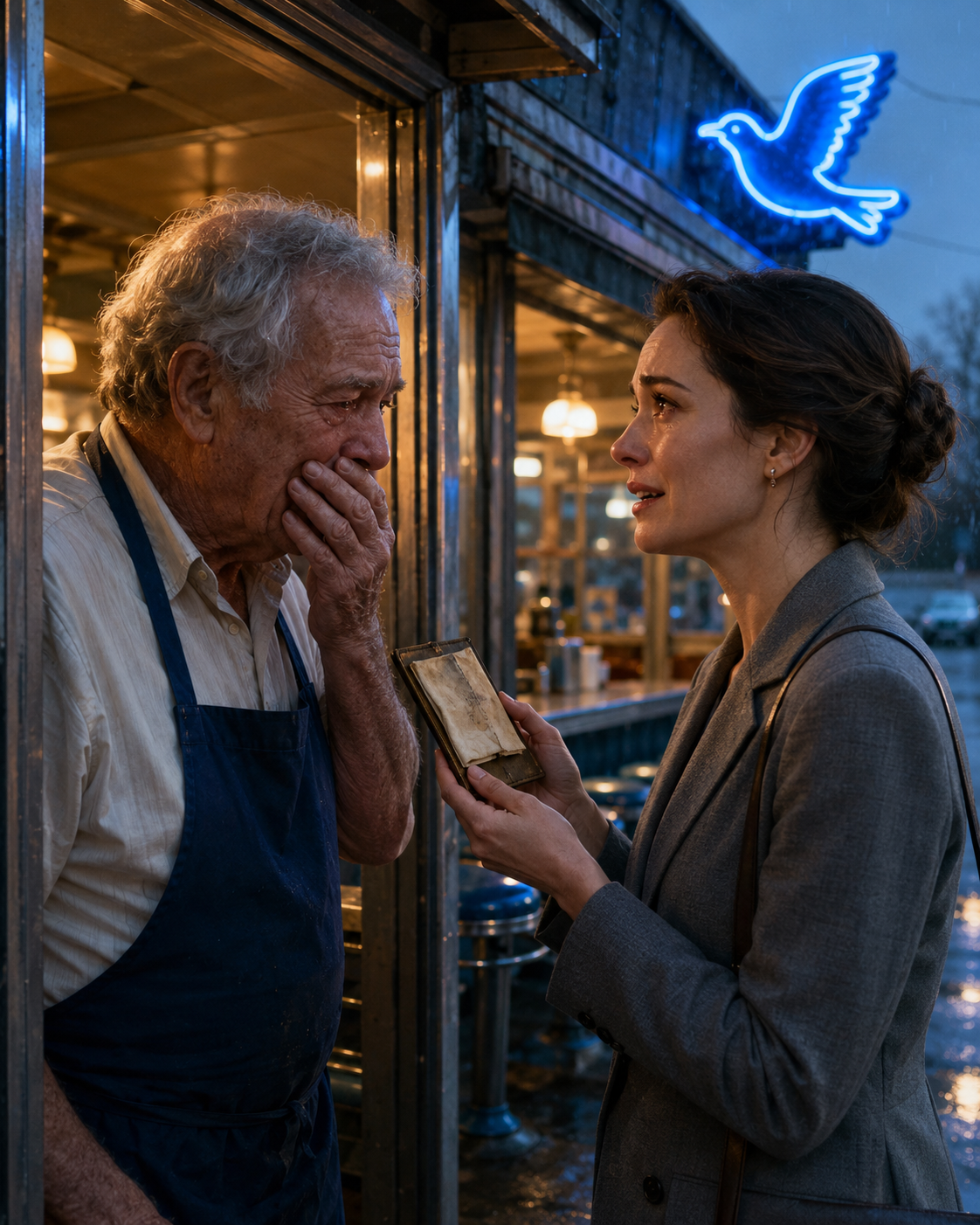
Nora opened the case.
Inside, protected between two clear sheets, was the white napkin.
The ink had faded to blue-gray.
The bird was uneven.
One wing was larger than the other.
The words remained readable.
Arthur stared at it.
His face lost its color.
Hector stepped closer.
“Arthur?”
Arthur did not answer.
He touched the glass protecting the napkin.
“I drew this.”
Nora nodded.
“You did.”
“When?”
“Twenty-two years ago.”
He looked at her eyes.
Memory came slowly.
Snow on the windows.
A girl sitting too close to the door.
A shopping bag beneath the table.
Rose pretending the soup was a mistake.
Arthur gripped the edge of the counter.
“The boy.”
“My brother.”
“Eli.”
Nora inhaled sharply.
“You remember his name?”
“Rose wrote it on the hospital form.”
Arthur looked behind Nora as if the twelve-year-old girl might still be waiting near the door.
“You were so thin.”
“So were you.”
Hector laughed softly.
Arthur ignored him.
“What happened to your mother?”
“She survived the collapse, but her health never fully recovered. We stayed together for another year. Then Eli and I entered foster care.”
Arthur lowered his head.
“We tried to find you.”
“I know. The church kept your letters. I received them much later.”
“Why didn’t you come back?”
Nora looked toward Rose’s photograph.
“Because this place reminded me of the worst week of my life.”
Arthur nodded.
“That makes sense.”
“And the best hour.”
He looked at her again.
“That makes less sense.”
“You gave us a table when everyone else saw a problem.”
“It was soup.”
“It was permission to stop being ashamed.”
Arthur closed the case gently.
“Did the world become kinder?”
Nora considered the question.
“Not by itself.”
Outside, another black sedan stopped.
Martin Vale emerged with two city representatives.
Nora watched him approach.
Arthur saw her expression change.
“You know him.”
“Yes.”
“Friend?”
“No.”
“Enemy?”
“Not exactly.”
“That usually means lawyer.”
“Close.”
Martin entered the diner and stopped when he saw her.
“Nora.”
“Martin.”
“You missed the advisory meeting.”
“I found an error.”
“In the environmental report?”
“In our understanding of this building.”
Martin glanced at the napkin.
His face remained calm, but his eyes hardened.
“The acquisition is complete.”
“No. The approval is complete. Acquisition cannot conclude until the community impact conditions are satisfied.”
“They were satisfied.”
“By a survey conducted on a Tuesday afternoon during street repairs, when half the block was inaccessible.”
“That survey was approved by your panel.”
“I had not seen the raw interviews.”
“You signed the recommendation.”
Nora absorbed the accusation.
Arthur looked between them.
“You helped approve this?”
Nora turned toward him.
“Yes.”
The diner seemed to contract around that word.
Mrs. Holloway closed her newspaper.
Hector folded his arms.
Arthur’s voice became colder.
“You came here to apologize?”
“I came here to stop it.”
“After helping start it.”
“I did not know what the Bluebird was.”
“You knew where it was.”
Nora had no defense.
Arthur pushed the metal case toward her.
“You should leave.”
“Arthur—”
“You kept the napkin.”
“Yes.”
“You kept the promise.”
“I tried.”
“But you signed a paper telling them this place did not matter.”
Pain crossed her face.
Martin remained silent.
Arthur pointed toward the door.
“Leave.”
Nora closed the case.
She picked it up with both hands.
At the threshold, she turned.
“You are right.”
Arthur did not look at her.
“I should have remembered sooner.”
The bell rang as she walked out.
Martin followed.
On the sidewalk, he spoke quietly.
“That could have gone better.”
Nora faced him.
“You knew.”
“Knew what?”
“That the diner was still operating as a community support site.”
“It serves breakfast.”
“It provides free meals through the church network, emergency shelter referrals, and an informal credit system for low-income families.”
“None of that changes its structural classification.”
“You removed those interviews from the executive summary.”
“I condensed irrelevant testimony.”
“You erased evidence.”
“I simplified a planning document.”
Nora stepped closer.
“Withdraw the demolition request.”
“I cannot.”
“You mean you will not.”
“The transit project creates thousands of jobs.”
“And Northstar receives two towers on public land.”
“That agreement funded the station.”
“The station can be redesigned.”
“At an additional cost of forty million dollars.”
“Then redesign it.”
Martin gave a humorless smile.
“You are allowing a childhood memory to influence public infrastructure.”
“No. I am allowing suppressed information to correct a dishonest decision.”
“You signed the recommendation.”
“And I will say publicly that I was wrong.”
He studied her.
“You would destroy your career for a diner?”
Nora looked through the window.
Arthur stood beside Rose’s photograph, pretending not to watch.
“No.”
She held the metal case against her chest.
“I would use my career for the reason I built it.”
By noon, Nora had assembled her legal team in a church basement across the street.
She did not return to the diner.
Arthur had asked her to leave, and she respected the boundary.
Instead, she began making calls.
They requested the unedited survey.
They obtained fire-department records showing that the Bluebird had served as an emergency warming center during three winter power failures.
They found school letters thanking Arthur and Rose for providing breakfast to children during a teachers’ strike.
They located photographs from the nineteen nineties showing neighborhood meetings held in the diner during a housing crisis.
The building might not qualify for architectural landmark status.
But the institution could qualify for cultural preservation protection.
There was one problem.
Applications usually took months.
The demolition would begin in thirty days.
Nora needed an emergency hearing.
She also needed Arthur’s cooperation.
He refused to speak to her.
On the third day, Daniel arrived at the church basement.
Nora recognized him from a family photograph near the Bluebird’s register.
“You are Arthur’s son.”
“And you are the woman who approved the project.”
“Yes.”
“At least you admit it.”
“I am becoming very experienced at admitting it.”
Daniel looked around at the files covering folding tables.
“What are you doing?”
“Trying to prove the diner performs an essential community function.”
“It does.”
“Your father will not sign the declaration.”
“He thinks accepting help is surrender.”
“I noticed.”
Daniel picked up a photograph of Rose serving food during a snowstorm.
“My mother would have signed.”
“Arthur is not Rose.”
“No. Mom knew when stubbornness was useful.”
“And Arthur?”
“He thinks it is a religion.”
Nora offered him a chair.
Daniel remained standing.
“I signed the relocation consent.”
“I know.”
“He told you?”
“Martin did.”
Daniel looked ashamed.
“I thought if the city had our cooperation, they would increase the payment. Dad could retire. He could live near my family.”
“Did you ask him?”
“He would have said no.”
“So you removed his chance to say it.”
Daniel’s expression hardened.
“You do not know my father.”
“No. But I know what it is like when powerful people decide they understand your needs better than you do.”
That silenced him.
Nora continued more gently.
“You were frightened.”
“He is alone in that place.”
“He is not alone.”
“He goes home alone.”
Nora looked toward the ceiling.
There were different kinds of loneliness.
Some were created by empty rooms.
Others by being surrounded by people who loved only the version of you they wanted to save.
“Help me protect the building,” she said. “Then talk to him about what happens afterward.”
Daniel sat down.
“What do you need?”
On the seventh day, the city announced an emergency public hearing.
Northstar responded by accelerating preparatory work.
Survey markers appeared on the sidewalk.
Metal barriers were delivered.
Martin Vale gave an interview describing the diner as a deteriorating private business blocking public progress.
Arthur watched the interview on the small television above the Bluebird counter.
Hector threw a dish towel at the screen.
“That man smiles like a funeral director.”
Arthur turned off the television.
The diner had become busier than it had been in years.
People arrived after reading about the dispute.
Some bought breakfast.
Some donated money.
Some only wanted photographs.
Arthur disliked the attention.
He disliked strangers turning Rose’s booth into a background for social media videos.
He disliked reporters asking how it felt to become a symbol.
“I am not a symbol,” he told one of them. “I am behind on my electric bill.”
But each evening, after the doors closed, he counted the signatures on petitions.
Ten thousand.
Then twenty-five thousand.
Then sixty thousand.
Still, he refused to sign Nora’s cultural protection application.
On the tenth night, Daniel found him repairing the jukebox.
“You know it will still play the wrong song,” Daniel said.
Arthur tightened a screw.
“That is part of its personality.”
Daniel placed the application on the counter.
Arthur did not look at it.
“I said no.”
“This is not Nora’s application. It is yours.”
“I do not want my diner turned into a museum.”
“It won’t be.”
“I do not want a board telling me what color the stools must be.”
“No one will.”
“I do not want people saving this place because they pity an old man.”
Daniel rested his hands on the counter.
“They are not saving it because you are old.”
Arthur looked up.
“They are saving it because you spent forty years making sure no one felt poor while sitting here.”
Arthur’s face shifted.
Daniel took out a stack of photocopies.
Napkins.
Hundreds of them.
Each carried a handwritten message.
Arthur let me pay on Friday when my first paycheck was late.
Rose fed my children during the blackout.
Hector taught me to cook eggs after my father died.
The Bluebird kept my job application behind the register until I found housing.
I met my wife in booth six.
I became sober after Arthur refused to serve me coffee at two in the morning and drove me to the clinic instead.
Arthur read them slowly.
“What is this?”
“Nora asked people to send their Bluebird stories.”
“She should not have done that.”
“She did not publish them. These are statements for the hearing.”
Arthur reached the last page.
It showed the uneven bluebird from Nora’s napkin.
Beneath it was the sentence:
A building becomes important when people trust it with the parts of their lives no official record keeps.
Arthur placed the page down.
“Rose wrote better sentences.”
“She did.”
Daniel sat on a stool.
“I am sorry.”
Arthur remained silent.
“I thought selling the diner would make you choose us.”
Arthur frowned.
“What does that mean?”
“You visit once a year. You leave after two days because Hector calls about a broken freezer. My daughters know the Bluebird better than they know you.”
Arthur looked away.
Daniel’s voice softened.
“I was angry at a building because I did not know how to tell my father I missed him.”
Arthur removed his glasses.
“I did not know you wanted me there.”
“You never asked.”
“You always seemed busy.”
“So did you.”
They stood on opposite sides of the counter.
Years of careful silence pressed between them.
Arthur looked at Rose’s photograph.
“She would be furious with both of us.”
Daniel laughed through sudden tears.
“She would make us peel potatoes until we apologized.”
“Two sacks each.”
“Three for me because I signed the form.”
Arthur walked around the counter.
The embrace was awkward.
Daniel was taller.
Arthur’s shoulder hurt.
Neither let go quickly.
The next morning, Arthur signed the application.
The public hearing took place in a converted warehouse near the harbor.
More than a thousand people arrived.
Only three hundred were allowed inside.
The rest stood outdoors beneath umbrellas, watching a live broadcast on portable screens.
Arthur sat at the front table with Daniel, Hector, Nora, and Priya.
Martin Vale represented Northstar.
Behind him were architects, transportation officials, and attorneys carrying binders thick enough to stop bullets.
The city council chair began with financial projections.
Northstar presented diagrams showing the diner as a small red square inside a complex network of tracks, tunnels, and commercial space.
An engineer explained that preserving the building would require moving a ventilation shaft and narrowing a service road.
The projected cost was thirty-eight million dollars.
Martin spoke clearly.
“We respect the emotional connection some residents feel toward the Bluebird. However, public planning cannot be governed by nostalgia. The city must choose infrastructure serving millions over a single private restaurant.”
Several council members nodded.
Then Nora stood.
She did not begin with the napkin.
She began with evidence.
Emergency response reports.
School meal records.
Neighborhood referral logs.
Testimony from social workers.
Documents proving Northstar’s survey team had categorized community services as anecdotal comments and omitted them from the impact analysis.
Martin objected.
The council chair allowed Nora to continue.
She placed a map on the screen.
It showed the original transit plan.
Then an earlier alternative.
In that version, the ventilation shaft stood thirty yards east of the Bluebird.
“The diner was not an unavoidable obstruction,” Nora said. “It became one after Northstar shifted the commercial tower entrance to maximize retail frontage.”
Murmurs filled the room.
A council member leaned forward.
“Mr. Vale, is that accurate?”
Martin rose.
“The revision improved pedestrian circulation.”
“It also increased Northstar’s rentable ground-floor area by eighteen thousand square feet,” Nora replied.
The room grew louder.
Martin’s composure tightened.
“The change underwent technical review.”
“Using an impact report that excluded the diner’s documented community function.”
Nora turned toward the council.
“I signed the recommendation based on that report. I failed to examine the raw evidence. That failure is mine, and I accept responsibility.”
Outside, cameras focused on her face.
She knew what the admission could cost.
Board members might remove her.
Future city partners might distrust her.
Donors might decide she was reckless.
She continued.
“Professional credibility does not mean defending every decision we make. It means correcting the decisions that evidence proves were wrong.”
Then she opened the metal case.
“This napkin is not legal evidence.”
Martin’s attorneys shifted uneasily.
“It does not establish ownership. It does not change engineering. It is not worth money.”
She held it beneath the document camera.
The uneven bird and faded words appeared on the screen.
“Twenty-two years ago, Arthur and Rose Cole fed two homeless children. They did not demand identification, publicity, or repayment. They gave us a table and allowed us to remain human.”
Arthur lowered his head.
“I kept this napkin because it reminded me that dignity can be offered before it is earned. The Bluebird has repeated that act thousands of times. Most were never recorded because kindness rarely expects to become evidence.”
Behind Nora, Priya uncovered three large display boards.
They were covered in copies of napkins sent by residents.
Hundreds of promises.
Hundreds of memories.
Hundreds of moments the official report had called irrelevant.
Nora faced the council.
“You are not deciding whether one old restaurant is more important than public transportation. That is a false choice created by a private developer seeking additional commercial space. You are deciding whether public progress requires erasing the places that made a community worth reaching.”
Applause erupted outside.
The council chair called for order.
Martin requested a recess.
During the break, he found Nora alone near a service corridor.
“You planned that well,” he said.
“I wish I had found the truth sooner.”
“You are turning an engineering dispute into a morality play.”
“You turned it into a profit calculation.”
“Northstar will sue.”
“Then the documents will enter discovery.”
His eyes narrowed.
“You think the council will cancel a billion-dollar agreement over a napkin?”
“No.”
Nora closed the case.
“I think they will revise it because you falsified the cost of preserving the diner.”
Martin’s silence confirmed what she suspected.
“The thirty-eight million,” she said. “It includes redesign work Northstar already planned for phase two.”
“You cannot prove that.”
“Your former engineering consultant sent us the internal estimate this morning.”
For the first time, Martin Vale looked frightened.
The true cost of preserving the Bluebird was four million dollars.
Northstar could cover it without public funding.
When the hearing resumed, the council suspended demolition authorization pending an ethics investigation.
The crowd outside cheered.
Arthur did not.
He remained seated, staring at the table.
Nora touched his arm.
“We stopped the demolition.”
“For now.”
“For now.”
“What happens next?”
“We build something stronger than an emergency order.”
Over the following weeks, Northstar’s agreement was renegotiated.
Martin resigned before the investigation concluded.
The transit station remained approved, but its entrance shifted east.
The commercial tower lost part of its retail frontage.
The Bluebird remained exactly where it had always been.
That alone did not solve Arthur’s problems.
The bank still expected payment.
The roof still leaked.
The refrigerator still made a sound Hector described as “the dying prayer of an angry whale.”
Nora proposed creating a neighborhood cooperative.
Arthur refused immediately.
Then he listened.
The cooperative would purchase the building using grants, community shares, and a contribution from Common Ground.
Arthur would continue operating the diner.
Employees would receive ownership shares.
No developer could sell the property without community approval.
A training kitchen would open upstairs for young people leaving foster care.
Eli Evans, now a recovery counselor and restaurant manager, would supervise the program.
Arthur stopped her.
“Eli is coming?”
“He is waiting outside.”
Arthur turned toward the door.
A man in his late twenties stood on the sidewalk.
He was broad-shouldered and nervous, holding a plastic shopping bag.
Arthur walked outside.
Eli looked at him for a long moment.
“You carried me out from under a table.”
Arthur smiled.
“You were lighter then.”
Eli held up the bag.
Inside were two grilled-cheese sandwiches.
“My sister said we still owed you.”
Arthur’s eyes filled.
“You paid a long time ago.”
“We would like to overpay.”
Hector came outside and pulled Eli into a hug before anyone introduced them properly.
That evening, Nora, Eli, Daniel, Arthur, Hector, and the regular customers gathered after closing.
They filled the booths with legal papers, calculators, coffee, and pie.
At midnight, Arthur signed the cooperative agreement.
Daniel signed as a founding community member.
Hector signed as an employee-owner.
Nora signed for Common Ground.
Eli signed for the training program.
Mrs. Holloway signed as a neighborhood representative, though she complained that the pen was terrible.
When everything was finished, Arthur placed the original napkin in a wooden frame Rose had once bought for “something important we haven’t found yet.”
They hung it beside the register.
Below it, Arthur installed a small box filled with clean napkins and pens.
A handwritten card read:
TAKE ONE WHEN YOU NEED A PROMISE.
RETURN ONE WHEN YOU CAN GIVE ONE.
The Bluebird reopened after three weeks of repairs.
Its floor was still cracked in several places because Arthur claimed new tiles would make the diner arrogant.
The neon sign was restored, though the B remained brighter than every other letter.
The jukebox continued selecting the wrong songs.
The first official customer was Nora.
She sat in the booth closest to the door.
Arthur brought two bowls of soup.
“I ordered coffee,” she said.
“Kitchen mistake.”
“There are spoons beside them.”
“We make very organized mistakes.”
Eli arrived carrying bread from the bakery.
Daniel entered with his wife and daughters.
Hector rang a metal triangle from the kitchen and announced that anyone allowing food to become cold for emotional reasons would be removed.
People laughed.
Arthur looked around the room.
Rose’s photograph stood beside the register.
For years, he had believed keeping the diner unchanged was the same as keeping her close.
Now he understood that Rose had never loved the Bluebird because it remained unchanged.
She loved it because the door continued opening.
Nora removed the old napkin from its metal case one final time.
Together, she and Arthur placed it in the wooden frame.
“Do you regret giving it to me?” she asked.
“The napkin?”
“The promise.”
Arthur considered the question.
“At the time, I thought I was telling a frightened girl that she could pay later.”
“And now?”
“Now I think you were the one extending credit.”
Nora smiled.
“To you?”
“To all of us.”
Arthur looked across the diner.
Daniel was helping his youngest daughter spin on a blue stool.
Eli was discussing the training kitchen with Hector.
Mrs. Holloway had already complained that the soup needed salt.
Outside, construction cranes moved above the future transit station.
The city was changing.
It would always change.
Some buildings would rise.
Others would fall.
But progress had not required the Bluebird to disappear.
It had required people to decide what deserved to travel with them into the future.
Arthur poured coffee into Nora’s cup.
She lifted the napkin box.
“There is something missing.”
“What?”
“Your first new promise.”
Arthur took a pen.
He thought for a moment, then wrote:
THERE WILL ALWAYS BE A SEAT FOR SOMEONE WHO HAS NOWHERE ELSE TO GO.
He signed it with a small, uneven bluebird.
Nora placed the napkin inside the box.
Before noon, someone took it.
That evening, another napkin appeared in its place.
I WILL HELP MY BROTHER FIND WORK.
The following day:
I WILL DRIVE MRS. HOLLOWAY TO HER APPOINTMENTS.
Then:
I WILL PAY FOR THE NEXT CHILD WHO ORDERS ONLY WATER.
The promises multiplied.
Some were large.
Some were ordinary.
Some were fulfilled quickly.
Others waited months.
Arthur kept every returned napkin in a thick binder beneath the register.
Years later, when reporters asked Nora which legal argument had saved the Bluebird, she explained the survey failure, the engineering estimate, and the cultural protection order.
But when children asked her the same question, she gave a different answer.
She showed them the framed napkin.
She told them that, long ago, two people had fed a frightened girl without asking whether she deserved it.
The girl carried their promise until she became strong enough to return it.
And because kindness had been written down, she remembered exactly where it belonged.
Late one winter night, Arthur locked the diner after the last customer left.
Snow covered Harbor Street.
The transit station shone at the end of the block, its glass roof reflecting hundreds of city lights.
Commuters crossed the plaza carrying briefcases, grocery bags, flowers, and tired children.
Many of them stopped beneath the bright blue sign.
Arthur stood outside with Nora.
He was older now.
Slower.
He worked fewer hours because Daniel had finally convinced him that grandchildren were also a responsibility.
Through the window, Eli was teaching two teenagers how to close the kitchen.
Hector sat at the counter pretending he had retired.
The jukebox began playing Rose’s favorite song.
Arthur laughed.
“That machine has ignored me for forty years.”
“Maybe it finally learned gratitude,” Nora said.
Arthur looked at the framed napkin beside the register.
“Do you think the world became kinder?”
Nora watched a teenage employee carry a container of soup to a man waiting near the station.
“No,” she said.
Arthur raised an eyebrow.
She smiled.
“I think people keep making it kinder before it has a chance to stop them.”
The blue neon bird flickered above the door.
Once.
Twice.
Then it remained steadily illuminated as snow continued falling over the city.
Inside the Bluebird, one empty booth waited beside the window.
The table had already been set.
Two cups.
Two spoons.
And one clean napkin, ready for the next promise.