The orchestra was playing beneath a ceiling painted with pale clouds and golden angels when five-year-old Theo Carrow dropped his crystal glass of lemonade.
It struck the polished floor of Ashcombe House and shattered.
More than two hundred guests turned toward the sound. Politicians, bankers, actors, foundation directors, and old families whose names appeared on hospital wings watched the little boy step away from his nanny.
But Theo was not looking at the broken glass.
He was staring across the ballroom at one of the temporary housekeepers.
The woman stood near the service entrance with a tray balanced against her hip. Her uniform was plain, her dark hair was pinned beneath a white cap, and a thin scar crossed the skin beside her left eyebrow.
She had arrived at the estate only four days earlier.
Theo’s face changed.
His confusion disappeared first. Then his fear. Something brighter and more painful replaced both.
“Mom?”
The orchestra continued for two uncertain notes before the conductor lowered his hands.
The woman nearly dropped the tray.
Theo ran.
His nanny reached for him, but he slipped past her and crossed the ballroom between tables decorated with white roses.
“Mom!” he cried again.
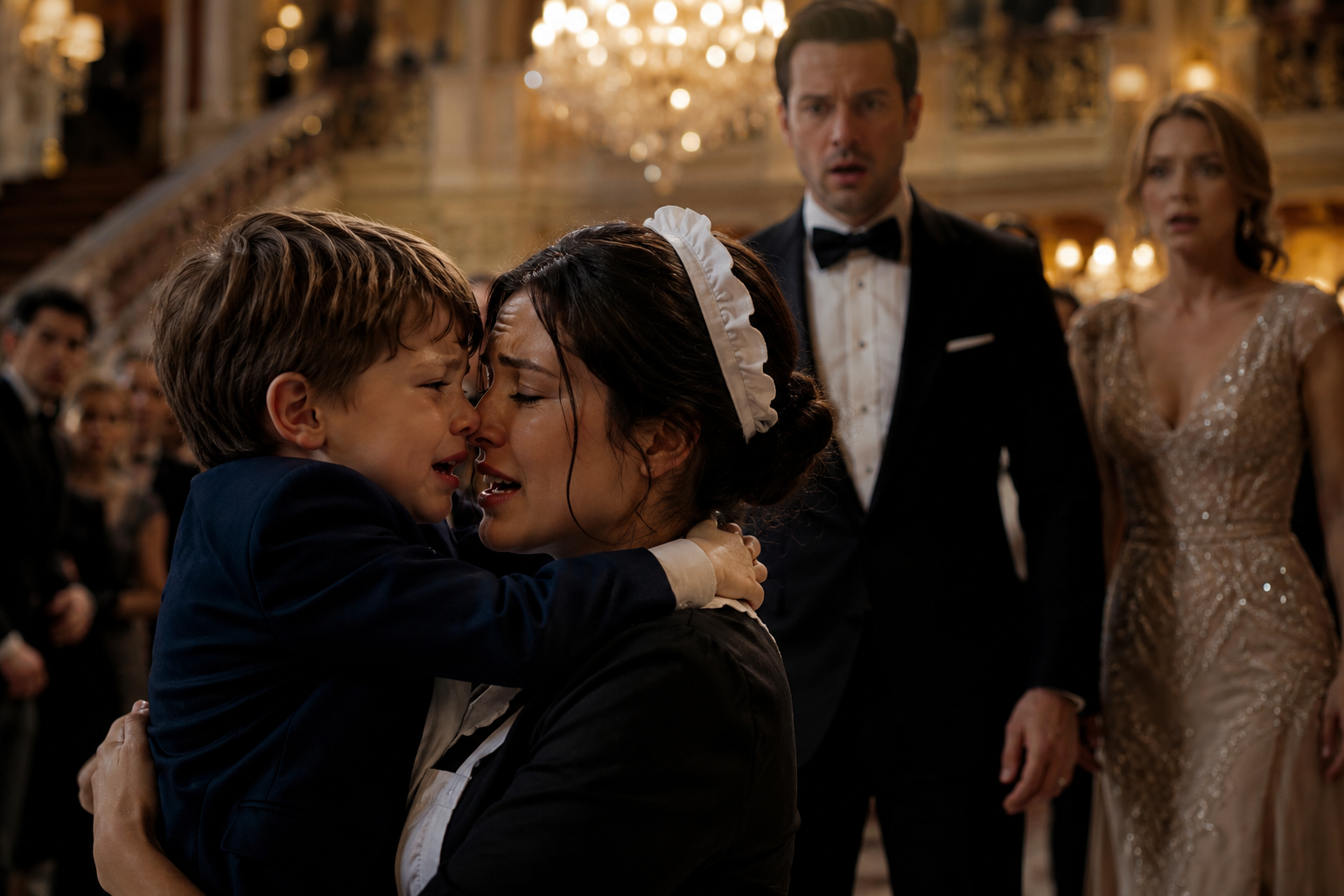
The housekeeper sank to her knees just as he reached her. Theo wrapped his arms around her neck so fiercely that she lost her balance.
The silver tray struck the floor.
She held him instinctively.
Not like a stranger comforting a frightened child.
Like someone whose body remembered him before her mind did.
“Theo,” she whispered.
Jonathan Carrow heard his son’s name and stopped breathing.
He had been standing near the grand staircase beside his fiancée, Beatrice Wycliffe. A moment earlier, he had been preparing to announce the merger of two charitable foundations and, according to half the guests, the date of his second wedding.
Now he stared at the kneeling housekeeper.
Her face was thinner.
Her hair was darker.
The scar had not been there before.
But when she lifted her eyes, Jonathan felt the ballroom disappear around him.
He knew those eyes.
He had seen them laughing beside a lake.
Closing in sleep against his shoulder.
Filling with tears on the morning their son was born.
He had last seen them in a photograph placed beside an empty coffin.
“Lydia?”
The woman flinched as if the name had struck her.
Beatrice caught Jonathan’s sleeve.
“Jonathan, think carefully.”
He pulled his arm away without looking at her.
The housekeeper rose slowly, keeping Theo against her chest. The boy refused to release her.
“My name is Anna Hale,” she said.
Her voice was unsteady.
Jonathan took one step toward her.
“No. Your name is Lydia Carrow.”
A murmur moved through the ballroom.
Every guest knew the story.
Three years earlier, Lydia Carrow had disappeared during a winter storm. Her abandoned car had been discovered near a flooded railway tunnel. Search teams found her coat, one shoe, and traces of blood along the embankment.
No body had ever been recovered.
After four months, the authorities had declared that she could not have survived.
Jonathan had refused to hold a funeral until pressure from Lydia’s family and the trustees of Ashcombe House became unbearable. He had stood beside an empty grave while Theo, only two at the time, cried in the arms of his grandmother.
Now the dead woman was standing beneath the ballroom chandeliers.
Theo touched the scar beside her eyebrow.
“You came back,” he whispered. “I knew you would.”
Anna—or Lydia—looked at him with terror and tenderness.
“I don’t know how I know your name,” she said. “I don’t know why I remember the blue blanket in your room. I don’t know why I can hear you crying when I close my eyes.”
Theo leaned closer.
“You used to sing about the moon boat.”
The woman’s lips parted.
Without realizing it, she began to hum.
Only four notes.
Jonathan turned pale.
It was a melody Lydia had invented during Theo’s first winter. She had never recorded it. She had never sung it outside their home.
Theo rested his head against the woman’s shoulder.
“That’s my song.”
Beatrice stepped forward.
“This must be handled privately.”
Jonathan finally looked at her.
“Did you know?”
Her expression remained controlled, but her fingers had tightened around her evening bag.
“I knew the employment agency had sent a woman who resembled Lydia.”
“You approved her placement.”
“Yes.”
“Why?”
Before Beatrice could answer, an older man pushed through the guests.
Sir Malcolm Carrow was Jonathan’s uncle and chairman of the Ashcombe Trust. At seventy, he still carried himself like a judge entering a courtroom. His silver hair was perfectly combed, and his black dinner jacket seemed untouched by the confusion around him.
He looked at the housekeeper for less than a second.
Then he signaled to security.
“Take the woman into the library.”
Theo tightened his arms around her.
“No!”
Malcolm’s expression hardened.
“The child is distressed. Remove him first.”
Jonathan moved between the guards and his son.
“No one touches either of them.”
“Jonathan,” Malcolm said quietly, “this could be an attempt at fraud.”
“She knew his name.”
“Anyone employed in this house could learn his name.”
“She knew the song.”
The older man’s eyes flickered.
It was brief, but Jonathan saw it.
So did Beatrice.
Malcolm recovered immediately.
“Grief makes people hear what they wish to hear.”
The woman holding Theo looked directly at him.
“I know you.”
Malcolm did not move.
Her breathing quickened.
“A room with green walls,” she whispered. “You were standing by the window. You told someone I had become dangerous.”
The color left Malcolm’s face.
Jonathan saw it.
The guests saw it.
Beatrice opened her evening bag and removed her phone.
Malcolm noticed.
“Put that away.”
“I’m calling Inspector Bell.”
“You will do nothing of the kind.”
His voice was no longer calm.
Every door in the ballroom closed simultaneously.
The sound echoed beneath the painted ceiling.
Security guards moved into position.
But they were not looking at Malcolm.
They were looking toward Jonathan.
Malcolm turned to the guests and raised both hands.
“Ladies and gentlemen, there has clearly been a serious disturbance. For everyone’s safety, please remain where you are while the family resolves this privately.”
Jonathan stared at the guards.
“You changed the security team.”
“I strengthened it.”
“When?”
“This morning.”
Beatrice moved closer to Jonathan and spoke without turning her head.
“Those men do not work for the estate.”
Malcolm heard her.
“Enough.”
The lights went out.
Someone screamed.
Emergency lamps glowed along the walls, casting the ballroom in cold blue light. Guests pushed away from the tables. Chairs scraped across the floor.
Theo buried his face against the woman’s neck.
Jonathan reached them through the darkness.
“Come with me.”
“Where?”
“Away from here.”
A hand grabbed Jonathan’s shoulder.
He turned and drove his elbow backward. A guard stumbled into a table. Beatrice swung her evening bag into another man’s face and seized the housekeeper’s wrist.
“This way.”
They ran through the service entrance.
Behind them, Malcolm shouted for the doors to be sealed.
Beatrice led them through the kitchens, past shocked chefs and towers of untouched desserts. At the end of a pantry, she pushed against a wooden panel disguised as shelving.
It opened onto a narrow passage.
Jonathan stopped.
“You knew about this?”
“Your grandmother showed it to me.”
“My grandmother died twelve years ago.”
“She showed it to me three months before she died.”
Beatrice pulled them inside and closed the panel.
Darkness surrounded them.
Theo began to cry quietly.
The woman whispered his name and stroked his hair. Again, the movement appeared natural, practiced, remembered by her hands.
Beatrice switched on a small flashlight.
The passage descended between stone walls.
Jonathan looked at her.
“Start explaining.”
“Not here.”
“Now.”
She kept moving.
“I was never invited into your life by accident.”
Jonathan stared at her back.
“What does that mean?”
“My father investigated the Ashcombe Trust before he died. He believed money was being taken from medical charities and used to pay private institutions that officially did not exist.”
“You never told me.”
“I had no proof.”
“So you became engaged to me?”
Beatrice stopped and turned.
“At first, I stayed close because of the investigation. Later, my feelings became real. Both things can be true, even if neither excuses what I did.”
Jonathan looked at the woman holding his son.
“And her?”
“I found Anna Hale six months ago.”
The woman’s head lifted.
“You found me?”
Beatrice nodded.
“You were working in a seaside boardinghouse under documents issued three years ago. You had no verifiable history before that. Your photograph matched an age-progressed image of Lydia.”
“Why didn’t you tell me who I was?”
“I tried. You suffered a seizure the first time I showed you a photograph of Ashcombe House. Your doctor warned me that forcing the memories could cause serious harm.”
Jonathan’s anger sharpened.
“So you brought her into my home as a servant?”
“I needed to know who would react when they saw her.”
Malcolm’s face flashed through Jonathan’s mind.
Beatrice continued.
“Someone had been watching Anna. Twice, strangers searched her room. Once, a car followed her from the boardinghouse. The safest place was the one location no one would expect her to enter voluntarily.”
“The estate.”
“Yes.”
The passage opened into an old wine cellar beneath the eastern wing.
Beatrice locked the door behind them.
Theo refused to leave the woman’s arms.
Jonathan stood several feet away, unable to decide whether he wanted to embrace her or demand answers she could not give.
“What do you remember?” he asked.
“Pieces.”
“Of me?”
She studied his face.
“A train platform. You were wearing a gray coat. You had snow in your hair.”
Jonathan closed his eyes.
The memory belonged to the first night they met.
He had missed the final train to London. Lydia had laughed at him for carrying an umbrella while standing beneath a covered platform. They had spent two hours drinking terrible coffee from a vending machine.
“What else?”
“A little house near water.”
“Our cottage.”
“Yellow curtains.”
“You chose them. I hated them.”
For the first time, the edge of a smile appeared on her face.
“I think I knew that.”
Theo lifted his head.
“We still have them.”
The smile vanished into tears.
Jonathan stepped forward but stopped before touching her.
“May I?”
She hesitated.
Then nodded.
He placed one hand against her cheek.
The warmth of her skin nearly destroyed him.
For three years he had lived with absence. He had imagined her final minutes so often that the invented scene had become a memory: Lydia alone in freezing rain, calling his name where no one could hear.
Now she stood before him, alive and frightened.
“I searched,” he said. “I need you to know that.”
“I believe you.”
“I should have continued.”
“You had a child who needed you.”
“He needed both of us.”
Theo placed his small hand over Jonathan’s.
For one fragile moment, they stood together like a family reconstructed from broken glass.
Then a bell rang somewhere beneath the floor.
Beatrice went still.
“What is that?” Jonathan asked.
She crossed the cellar and pulled an old map from behind a loose brick.
“The chapel alarm.”
“Ashcombe Chapel hasn’t been used in decades.”
“Not officially.”
She unfolded the map across a barrel.
The estate had once included a small stone chapel near the northern woods. It had been closed after a roof collapse, and Malcolm had refused every proposal to restore it.
A red circle had been drawn beneath the chapel foundations.
Beatrice pointed to it.
“My father left this map. He wrote one sentence on the back.”
Jonathan turned it over.
THE RECORDS ARE KEPT BELOW THE BELLS.
A heavy impact shook the cellar door.
Malcolm’s men had found the passage.
Beatrice switched off the flashlight.
“There is another exit.”
She led them behind a rack of empty bottles. A steep staircase climbed toward a metal hatch.
The pounding behind them grew louder.
Jonathan lifted the hatch and emerged inside the estate’s abandoned orangery. Rain beat against broken panes of glass. Vines had swallowed the stone walls, and water covered the tiled floor.
A dark car waited beyond the trees.
A woman stepped from behind the wheel.
She was in her sixties, wrapped in a long brown coat. Her white hair had been cut short, and she leaned on a cane.
Jonathan recognized her as Dr. Miriam Rowe, the physician who had delivered Theo.
“You,” he said.
Miriam lowered her eyes.
“I owe your family the truth.”
Theo’s mother became rigid.
“You were in the green room.”
Miriam looked at her.
“Yes.”
“What did you do to me?”
“I kept you alive.”
The cellar hatch rattled behind them.
Beatrice opened the car door.
“Explanations while we move.”
They climbed inside.
Miriam drove without headlights along a service road hidden by trees. Ashcombe House disappeared behind them, its ballroom windows glowing through the rain.
Jonathan looked back.
“My guests are trapped in there.”
“Malcolm won’t harm them,” Miriam said. “Witnesses are useful to him.”
“You sound very certain.”
“I worked for him for twenty-eight years.”
The woman beside Theo stared at her.
“My name is Lydia, isn’t it?”
Miriam gripped the steering wheel.
“Yes.”
“Where was I for three years?”
“In a neurological clinic on the coast.”
“Why?”
“Because you discovered what Malcolm had built beneath the chapel.”
Jonathan leaned forward.
“What was it?”
“A registry.”
“Of stolen money?”
“Of stolen lives.”
The car fell silent except for the rain striking the roof.
Miriam explained that the Ashcombe Trust had begun with legitimate hospitals and orphanages. Decades earlier, however, Malcolm had discovered that desperate wealthy families would pay enormous sums to alter inheritances, conceal births, manufacture guardianships, and remove inconvenient relatives from legal records.
Doctors were bribed.
Birth certificates were replaced.
Patients without close families were declared dead and transferred under new identities.
Children from unstable homes were redirected into private adoptions arranged for powerful clients.
Adults who threatened the operation were sent to clinics where memory problems could be blamed on illness, accidents, or emotional collapse.
“Lydia found the registry while researching the trust’s spending,” Miriam said. “She copied part of it.”
Jonathan looked at his wife.
“Why didn’t you come to me?”
“She was going to,” Miriam answered. “But someone intercepted her before she reached London.”
Lydia closed her eyes.
A memory returned.
Rain on a railway platform.
A man in a station uniform directing her toward a side exit.
A cloth pressed near her face.
A voice saying, “Mrs. Carrow has suffered an accident.”
She opened her eyes sharply.
“My car never crashed.”
“No,” Miriam said. “It was placed near the flooded tunnel afterward. The blood came from a stored medical sample. Malcolm wanted the world to believe you were dead.”
“And you helped him?”
Miriam’s eyes filled with shame.
“I signed the admission papers. I prescribed the drugs that kept your memories confused.”
Theo held his mother’s hand.
“Why did you stop?”
“Because she continued saying your name, even when she could no longer remember her own.”
Miriam glanced at him in the mirror.
“Every night she asked whether Theo was safe.”
Lydia covered her mouth.
“I remember a blue door.”
“The clinic.”
“And birds painted on the ceiling.”
“Yes.”
“A man came to my room.”
Miriam’s expression changed.
“What man?”
“He wore a ring shaped like a lion.”
Jonathan looked at Beatrice.
Malcolm wore the Carrow family crest on his right hand: a crowned lion.
Lydia’s breathing became shallow.
“He told me Jonathan had remarried. He said Theo called another woman his mother. He said returning would only hurt them.”
Jonathan felt sick.
“He came to you himself.”
Miriam nodded.
“He needed to know how much she remembered.”
The car left the service road and entered the northern woods.
Ashcombe Chapel appeared through the rain.
Its tower leaned slightly, and ivy covered the narrow windows. The doors had been reinforced with new steel despite the building’s abandoned appearance.
Beatrice took a key from her bag.
“Your grandmother gave me this.”
Jonathan stared at it.
“Why would she trust you?”
“Because she knew my father was investigating Malcolm. She also knew she was dying.”
They approached the chapel.
The door opened before Beatrice inserted the key.
A young man stood inside.
He was perhaps thirty, with dark hair and a pale line across his chin. He wore a caretaker’s jacket and held an old lantern.
Lydia stopped.
The man looked at her as though he had spent years preparing for this moment and had discovered preparation was useless.
“Hello, Lydia.”
Jonathan stepped in front of her.
“Who are you?”
“My name is Elias North.”
Beatrice’s face tightened.
“That is not your real name.”
“No.”
He looked at Miriam.
“You should have told them before bringing them here.”
Miriam lowered her gaze.
Lydia studied the stranger.
“I’ve seen you.”
“You were eleven.”
A memory moved behind her eyes.
A teenage boy waiting outside her father’s study.
A bruise on his cheek.
Her grandmother giving him food in the kitchen.
“You lived here,” Lydia whispered.
Elias nodded.
“My mother worked in one of the trust’s clinics. When she tried to report what she had seen, Malcolm erased us both. She was declared unfit and confined. I was given a different surname and sent away.”
Theo peered around Jonathan.
“Are you bad?”
Elias looked at the child.
“No. But I have done things I’m not proud of while trying to reach this room.”
He lifted the lantern and led them through the chapel.
Dust covered the pews, yet the floor near the altar had recently been cleaned. Behind the wooden pulpit stood a stone figure of an angel holding a bell.
Elias pressed the bell downward.
The altar moved.
A staircase descended into darkness.
For one second, the hidden room beneath the chapel did not feel like an archive.
It felt like a place built to bury the truth.
Metal cabinets lined the walls. Old computers hummed beside shelves filled with boxes. Photographs, legal files, hospital bracelets, passports, and recording tapes had been catalogued by year.
At the center stood a large oak table.
Lydia approached it slowly.
A child’s wooden fox rested beneath a glass cover.
Theo pointed.
“I have one like that.”
Jonathan looked at him.
Theo always slept with a carved wooden fox Lydia had bought before his birth. It was one of the few belongings he refused to replace.
Lydia touched the glass.
“I made two.”
She remembered sitting in the cottage, painting tiny black eyes on the wooden faces. One fox had gone into Theo’s nursery.
The other had been intended for someone else.
She turned toward Elias.
“Why is this here?”
He removed the glass cover.
“The hollow base contains a storage key.”
Lydia picked up the fox and twisted its tail. A metal cylinder dropped into her palm.
Malcolm had spent three years searching for a digital copy.
Lydia had hidden the access code in an object he had dismissed as a child’s toy.
Beatrice inserted the cylinder into one of the computers.
The screen remained blank.
“It requires a second key,” Elias said.
Theo opened his coat.
Hanging from his neck was a small silver compass.
Jonathan recognized it immediately.
Lydia had placed it in Theo’s crib on the day he was born.
“He never takes it off,” Jonathan said.
Lydia turned the compass over. A tiny geometric pattern had been engraved on the back.
She pressed the pattern against a matching mark beside the computer.
The system awakened.
Hundreds of folders appeared.
Miriam whispered, “You divided the key.”
“So no one could open the records without something belonging to Theo,” Lydia said.
Her memories were returning faster now.
She remembered discovering children listed as financial assets.
She remembered Malcolm’s voice behind her.
She remembered copying the files while the chapel bells rang above her.
She remembered sending Beatrice’s father a coded message.
And she remembered one more thing.
“The records are not the evidence,” she said.
Beatrice frowned.
“What do you mean?”
“They are bait.”
Lydia searched beneath the table and found a brass switch.
A section of the wall opened, revealing recording equipment.
Every conversation held in the archive had been captured automatically.
Malcolm had never trusted his clients. He had recorded them naming judges, doctors, ministers, executives, and hospital directors.
The files could be dismissed as forged.
Their own voices could not.
Jonathan stared at the shelves.
“This could bring down half the people at tonight’s gala.”
“That is why Malcolm gathered them in one building,” Elias said. “He intends to tell them the archive has been compromised and demand enough money to move the operation abroad.”
A speaker crackled overhead.
Malcolm’s voice filled the room.
“You always were clever, Lydia.”
Theo pressed himself against her.
Jonathan looked toward the ceiling.
“Where are you?”
“Returning home.”
Lydia stepped toward the microphone.
“You kept me prisoner.”
“I protected the family from your recklessness.”
“You stole three years from my son.”
“I preserved his inheritance.”
Jonathan spoke through clenched teeth.
“You will never come near him again.”
Malcolm laughed softly.
“You still believe Ashcombe House belongs to you. The estate, the trust, the companies—every significant asset is controlled by agreements stored in this room.”
Beatrice searched the monitors.
A security feed appeared.
Malcolm was walking through the chapel above them with four men. None carried visible weapons, but their size and formation made their purpose clear.
Miriam backed away.
“He knows the lower entrance.”
Elias locked the staircase door.
“It will delay them, not stop them.”
Lydia opened the audio archive.
“Can these recordings be transmitted?”
“Not from here,” Elias said. “Malcolm isolated the network.”
Beatrice examined the old map.
“The chapel bell tower once carried a radio antenna.”
“It was disconnected,” Jonathan said.
“From the house, yes. Perhaps not from the archive.”
Elias opened a cabinet containing cables and switches.
A light marked TOWER RELAY glowed faintly.
“The relay is active.”
Miriam looked upward.
“But the transmitter must be turned on manually from the bell chamber.”
“I’ll go,” Jonathan said.
Lydia caught his hand.
“No.”
“You stay with Theo.”
“I already lost three years because people decided where I should stay.”
Jonathan met her eyes.
“Then we go together.”
Theo began to protest.
Beatrice knelt in front of him.
“I need you to help me protect the computer.”
“I want Mom.”
“She will come back.”
Theo looked at Lydia.
“You promise?”
Lydia placed both hands around his face.
“I promise I will never disappear without fighting my way back to you.”
She kissed his forehead.
Jonathan and Lydia entered a narrow maintenance passage behind the archive. It climbed inside the chapel wall toward the tower.
The staircase was so tight that Jonathan had to turn sideways. Dust fell whenever the wind moved the old bells.
Halfway up, Lydia stopped.
“What is it?”
“I remember this stairway.”
She placed her hand against the stone.
“The night Malcolm took me, I came here first. I wanted to transmit the recordings, but the antenna failed.”
“Then how did you escape the chapel?”
“Your grandmother found me.”
Jonathan stared at her.
“My grandmother?”
“She told me there was someone inside the trust I could still trust. She gave me a name.”
“Whose?”
Lydia looked upward.
“Beatrice.”
At the top of the stairs, they entered the bell chamber.
Rain blew through the cracked wooden shutters. The grounds spread beneath them: forests, the distant lights of Ashcombe House, and a line of approaching cars on the northern road.
Jonathan reached the transmitter controls.
The power switch had been removed.
Lydia searched the room.
A memory surfaced.
She reached behind the largest bell and found a red cord.
When she pulled it, the old bell rang.
The sound rolled across the estate.
Lights awakened on the transmitter.
Below them, Malcolm’s men broke through the archive door.
Beatrice dragged a cabinet across the entrance while Elias activated the upload. Thousands of audio files began transferring through the tower relay.
Malcolm entered the room.
He looked almost disappointed.
“Step away from the console.”
Beatrice stood between him and Theo.
“You arranged my father’s death.”
“Your father suffered a boating accident.”
“He was afraid of water. He never owned a boat.”
Malcolm glanced at the progress bar.
Twelve percent.
“You believe sending those recordings will create justice? It will create panic. Governments will fall. Children will learn their parents bought them. Families will destroy one another.”
Miriam stepped forward.
“Those families deserve the truth.”
“You have no right to speak of truth.”
“I have the right to confess.”
She placed a small voice recorder on the table.
“For the past six months, I documented every procedure you ordered me to perform.”
Malcolm’s composure cracked.
“You foolish woman.”
The upload reached twenty-eight percent.
Malcolm moved toward the computer.
Elias blocked him.
The men with Malcolm advanced, but a new voice came through the chapel above.
“Inspector Bell! Remain where you are!”
Malcolm looked at Beatrice.
“You called the police.”
“No,” she said. “You invited them.”
She held up her phone.
“When you sealed the ballroom, I activated an emergency broadcast. Every word you said to Jonathan’s guests was transmitted to the regional police.”
Malcolm turned toward the security monitor.
Police vehicles surrounded the chapel.
But he smiled.
“They will find nothing. The archive will erase itself before they enter.”
A countdown appeared on the screen.
SYSTEM PURGE: SIXTY SECONDS.
Elias tried to stop it.
“The command is external.”
The upload was only at forty-one percent.
High above them, Jonathan struck the transmitter housing with his palm.
“The signal is weakening.”
Lydia examined the cables. One had been cut years ago and repaired poorly.
She removed the silver pin from her hair and used it to hold the connection in place.
The signal strengthened.
In the archive, the upload jumped to fifty-eight percent.
The countdown reached forty seconds.
Malcolm approached Theo.
“Give me the compass.”
Theo backed against Beatrice.
“No.”
“The object belongs to the Carrow family.”
“My mom gave it to me.”
“Your mother has caused enough damage.”
Theo’s fear disappeared.
“You’re the man who made her go away.”
Malcolm stopped.
Theo held the compass tightly.
“You lied to her. You lied to Dad. You lied to everyone.”
Malcolm reached for him.
Miriam stepped between them.
“You will not touch that child.”
The chapel doors opened above.
Malcolm’s men abandoned him and raised their hands as officers entered.
The upload reached seventy-four percent.
The purge countdown reached twenty seconds.
Elias pulled cables from the main server.
“It won’t be enough.”
Beatrice searched the shelves.
“Where is the physical master?”
Lydia’s voice came through the internal speaker from the tower.
“There isn’t one. Malcolm would never trust a single copy.”
“What are we missing?”
Lydia looked at the transmitter.
Three lights.
Archive.
Tower.
House.
The third light was dark.
“The ballroom,” she whispered.
“What?” Jonathan asked.
“He brought everyone to Ashcombe House because he needed their devices.”
She realized the charity gala’s wireless system had been designed to connect hundreds of guest phones for donations.
“Turn on the estate broadcast,” she said. “Use the gala network.”
“That could send the archive to every device in the house.”
“Exactly.”
Jonathan activated the final switch.
At Ashcombe House, phones began vibrating in pockets and evening bags.
Every guest received an encrypted evidence package.
Judges.
Journalists.
Government officials.
Hospital directors.
People who had paid Malcolm.
People he had deceived.
People who had suspected him but remained silent.
The upload reached one hundred percent with three seconds remaining.
The archive screens went black.
For a moment, no one moved.
Then police entered the hidden room.
Malcolm looked at the dead monitors and began to laugh.
“You think files change power?”
Beatrice answered him.
“No. People deciding they are no longer afraid of you changes power.”
Inspector Bell placed Malcolm under arrest.
He did not resist.
As he was led toward the stairs, he looked at Lydia.
“You will regret learning the truth.”
She stood with Theo in her arms.
“I regretted living inside your lie.”
Outside the chapel, dawn had begun to lighten the clouds.
Guests from Ashcombe House were being interviewed beneath temporary lights. News vehicles crowded the estate road. Across the country, authorities were opening investigations into hospitals, trusts, private clinics, and adoption agencies connected to Malcolm’s archive.
Jonathan stood beside Lydia near the chapel doors.
Theo was asleep against her shoulder.
Beatrice approached them.
Her evening gown was torn at the hem, and rain had loosened her hair.
Jonathan looked at her for a long moment.
“You saved us.”
“I also deceived you.”
“Yes.”
She accepted the answer without defending herself.
“The engagement is over,” she said.
Jonathan nodded.
“It has to be.”
“I know.”
Lydia studied Beatrice.
“You brought me here because you believed Theo might recognize me.”
“Yes.”
“You risked him.”
The accusation hurt, but Beatrice did not look away.
“I believed the estate would be secure during the gala. I underestimated Malcolm. I will answer for that.”
Theo stirred.
His eyes opened halfway.
“Bea?”
Beatrice stepped closer.
“I’m here.”
“Are you leaving?”
She swallowed.
“Your family needs time.”
“You’re family too.”
No one knew how to answer him.
Beatrice kissed two fingers and gently touched them to his sleeve.
“I’ll see you again when everyone is ready.”
She walked toward the waiting police.
Jonathan watched her go before turning back to Lydia.
“I don’t know what happens now.”
“Neither do I.”
“You don’t have to return to Ashcombe House.”
“I don’t know whether I can.”
“We still own the cottage.”
“The one with the yellow curtains?”
He smiled faintly.
“The terrible yellow curtains.”
“They were beautiful.”
“They were violent.”
For the first time since the ballroom, Lydia laughed.
The sound was quiet and uncertain, but Jonathan recognized it.
Theo woke fully.
“Can we go there?”
Lydia brushed the hair from his forehead.
“To the cottage?”
“Yes. All three of us.”
Jonathan looked at her.
She was not the woman he had lost exactly. Three years had changed them both. She carried memories she could not yet reach and wounds that would not disappear because the truth had been revealed.
He was not the husband she remembered either. Grief had hardened parts of him. Guilt had reshaped the rest.
Returning home would not mean pretending nothing had happened.
It would mean learning one another again.
Lydia held out her free hand.
Jonathan took it.
Six months later, the yellow curtains still hung in the lakeside cottage.
Jonathan had attempted to replace them once. Theo caught him carrying the new curtains upstairs and announced the betrayal to Lydia before dinner.
The replacements remained unopened in a cupboard.
Lydia’s memories returned unevenly. Some mornings she remembered entire conversations from ten years earlier. On other days, Jonathan had to explain the meaning of a photograph or the reason a particular room frightened her.
They did not rush.
They attended therapy separately and together. Theo began sleeping through the night again. Miriam Rowe testified in court and surrendered her medical license. Elias North became a key witness in the investigations and later helped create an organization for families whose identities had been altered.
Beatrice visited Theo under careful boundaries.
She never asked Jonathan to forgive her.
She never attempted to restore their engagement.
Instead, she spent her time helping investigators understand her father’s records and assisting people searching for relatives erased by the trust.
Ashcombe House was no longer a private residence.
Under Lydia’s direction, it became a recovery center and legal archive for the people affected by Malcolm’s network. The ballroom where Theo had recognized her was transformed into a public hall filled with counselors, investigators, and families waiting for answers.
One rainy evening, Lydia entered the cottage carrying a wooden box.
Jonathan was helping Theo build a paper ship at the kitchen table.
“What’s that?” Theo asked.
Lydia placed the box in front of him.
Inside was the second wooden fox from the chapel.
Investigators had returned it after the trial.
Theo set his own worn fox beside it.
“They found each other.”
Lydia sat beside him.
“Just like we did.”
Theo considered this.
“Did the little fox know the big fox was alive?”
“I think he hoped.”
“Even for three years?”
“Especially for three years.”
Jonathan watched them from across the table.
Lydia looked up and met his eyes.
There were still difficult questions between them. There were memories she had not recovered and choices he had not forgiven himself for making.
But the questions no longer frightened him.
Truth was not the thing that had destroyed their family.
Silence had.
Theo pushed the two wooden foxes together and returned to his paper ship.
Outside, rain touched the lake.
Inside, Lydia began humming the moon-boat song.
Theo joined her.
After a moment, Jonathan did too.
He remembered only half the melody and sang several notes incorrectly.
Lydia laughed and corrected him.
This time, no one in the room mistook the sound for a ghost.
It was not the voice of a woman returning from the dead.
It was the voice of someone who had survived.
And finally, she was home.