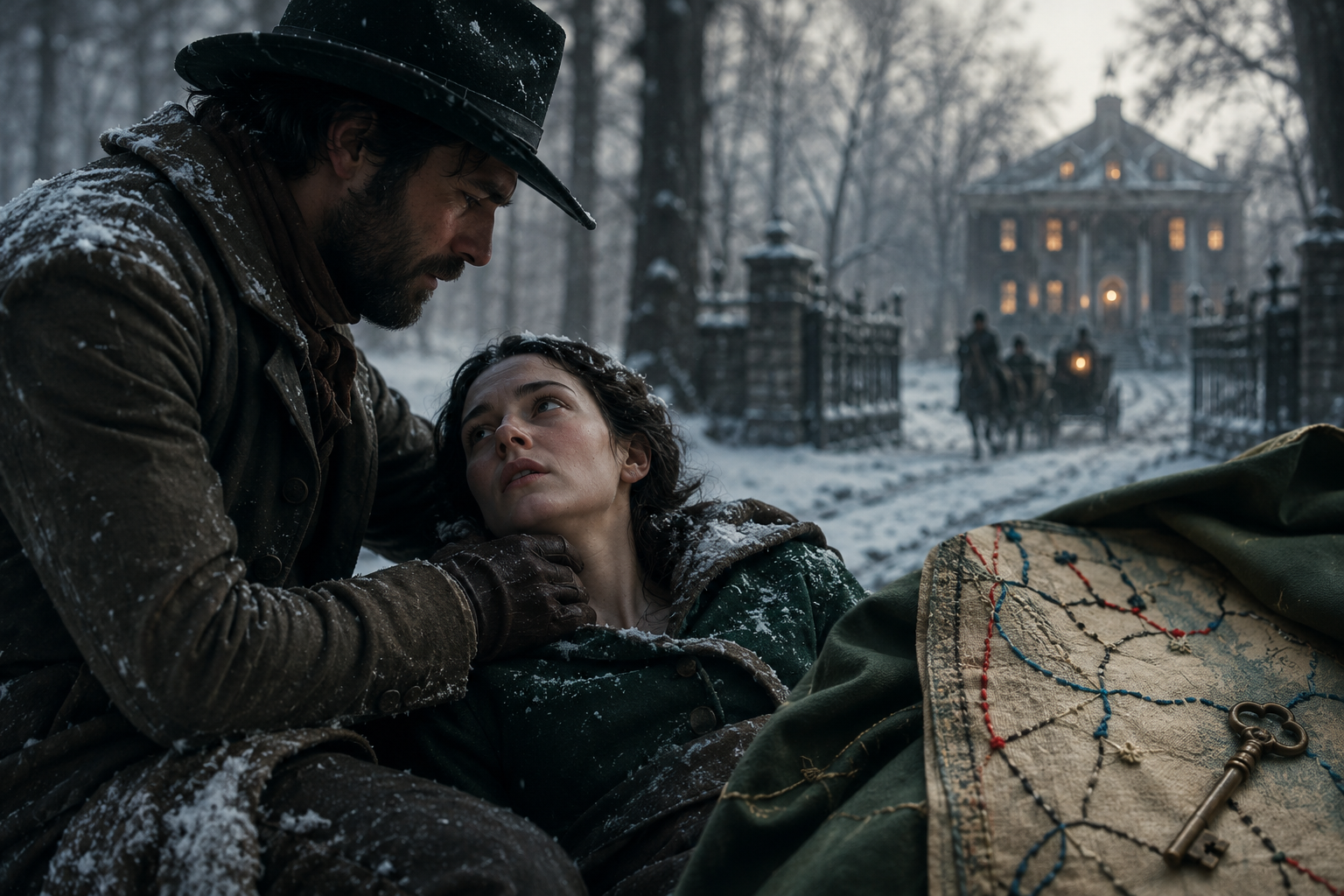
The first snow of the season came quietly to the Natchez Trace.
It settled over the empty road, softened the branches of the bare oaks, and covered the wagon ruts until the wilderness appeared untouched. By midnight, the wind had risen, driving silver sheets of snow between the trees and swallowing every familiar landmark.
Gideon Marsh had no reason to be traveling that night.
He had finished delivering a repaired wagon axle to a settlement twelve miles north and should have remained there until morning. Yet crowded rooms made him restless, and the curious stares of strangers were harder to endure than winter weather.
For seven years, Gideon had lived alone in a cabin beyond Cedar Hollow. The people in town called him a mountain man, although the nearest real mountains stood hundreds of miles away. He hunted, repaired tools, surveyed property lines, and spoke only when necessary.
Most people assumed solitude suited him.
They did not know that silence was simply easier than explaining what he had lost.
His mule suddenly stopped.
Gideon tightened his grip on the reins.
“What is it, Solomon?”
The animal lowered its head and refused to move.
Through the trees, Gideon heard something beneath the wind.
Not an animal.
A human voice.
He climbed down from the wagon, lifted his lantern, and followed the sound toward the edge of the road. At first, he saw only snow and tangled brush. Then the lantern light caught a strip of dark green fabric.
A woman lay beneath a cedar tree.
Her coat was torn at one shoulder, her hands were bare, and ice had formed along the ends of her dark hair. One shoe was missing. The other was soaked through.
Gideon dropped beside her and touched two fingers to her neck.
A pulse.
Weak, but present.
The woman’s eyes opened slightly.
“Don’t take me back,” she whispered.
“Back where?”
Her fingers closed around his sleeve with surprising strength.
“Briarwood.”
The name changed everything.
Briarwood Hall stood twenty miles south, surrounded by thousands of acres controlled by Cassian Wycliffe, one of the wealthiest men along the Mississippi. He owned warehouses, mills, riverboats, and enough land to appear respectable from a distance.
Up close, Briarwood was known for locked gates, armed riders, and workers who rarely stayed long enough to speak about what happened there.
Gideon lifted the woman into his arms.
“You’re not going back tonight.”
Her eyes closed.
He carried her to the wagon, wrapped her in a wool blanket, and turned Solomon toward home.
The journey took nearly three hours.
When Gideon finally reached his cabin, the eastern sky was beginning to pale. He laid the woman near the stove, removed her wet shoe, and covered her with every blanket he owned.
He heated water and cleaned the cuts on her feet. There were bruises around one wrist, but no broken bones. Whoever had been searching for her had not caught her before the storm.
That did not mean they had stopped looking.
Gideon hung her coat near the stove. As the fabric dried, he noticed something unusual about the hem.
The stitching was too new.
Someone had opened the lining and sewn it closed again in a hurry.
He did not touch it.
Whatever the woman was hiding belonged to her.
Several hours later, she woke with a sudden gasp.
She pushed herself backward until her shoulders struck the wall.
“Where am I?”
“Cedar Hollow.”
She looked toward the door.
“Is it locked?”
“No.”
“Are there men outside?”
“Only a mule, and he is not easily persuaded.”
She stared at Gideon, uncertain whether he was mocking her.
He placed a cup of warm broth on the table between them.
“My name is Gideon Marsh. I found you beside the Trace.”
“Elara.”
He waited.
“Elara Wynn,” she added.
The name sounded familiar, although Gideon could not immediately place it.
Then he remembered seeing it printed on an invitation delivered to the Cedar Hollow post office two years earlier.
Elara Wynn was Cassian Wycliffe’s wife.
Gideon looked toward the green coat hanging beside the stove.
“You escaped from your husband?”
Her expression hardened.
“I escaped from a prison with curtains.”
Before Gideon could answer, hoofbeats sounded in the distance.
Elara went completely still.
The riders were approaching quickly.
Gideon extinguished the lantern, crossed the room, and looked through a narrow opening beside the shutter. Three men rode toward the cabin. The leader wore a black coat with a silver clasp.
Gideon recognized him.
Bram Cutter managed Briarwood’s private guards and performed the tasks Cassian Wycliffe preferred not to acknowledge.
Elara whispered, “They found me.”
“Not yet.”
Gideon opened a trapdoor beneath the rug.
The small cellar had been built to store vegetables during summer. It was dry, concealed, and large enough for one person.
Elara hesitated at the opening.
“I cannot be locked underground again.”
Gideon stepped away from the trapdoor.
“Then you may leave through the back window. I won’t force you.”
The hoofbeats grew louder.
Elara looked from the window to the cellar.
Finally, she lowered herself inside.
Gideon left the trapdoor slightly open.
“You control it from below,” he told her. “No one locks it but you.”
A moment later, someone struck the front door.
Gideon opened it.
Bram Cutter stood on the porch with snow melting across his shoulders. Two riders waited behind him.
“You are Gideon Marsh?”
“You already know my name.”
Cutter smiled without warmth.
“A woman belonging to Mr. Wycliffe became confused during the storm.”
“Belonging to him?”
“His wife.”
“That is not the same thing.”
Cutter’s smile disappeared.
“She is ill. She left Briarwood without proper clothing and may harm herself. We followed her tracks north.”
“The snow covered every track before midnight.”
“We found blood near the road.”
Gideon leaned against the doorframe.
“Then perhaps you should look for an injured deer.”
Cutter glanced past him into the cabin.
“You mind if we search?”
“Yes.”
“This is a serious matter.”
“So is entering another man’s home without permission.”
One of the riders moved his hand toward his coat, but Cutter raised a finger and stopped him.
“We are trying to protect Mrs. Wycliffe.”
Gideon looked directly at him.
“Then why is she running from you?”
For several seconds, no one spoke.
Cutter stepped closer.
“If you see her, tell her that her husband forgives her. Tell her that Briarwood is her home.”
Gideon’s voice remained calm.
“A home does not require guards to keep someone inside.”
The two men stared at each other until Cutter finally turned away.
The riders disappeared into the trees, but Gideon knew they had not gone far.
He shut the door.
Elara emerged from the cellar a few moments later.
“They will watch the cabin.”
“Yes.”
“They will return with the sheriff.”
“Probably.”
“You should send me away.”
“You would freeze before reaching Cedar Hollow.”
“Then they will destroy you too.”
Gideon returned to the stove.
“They tried once.”
Elara studied him.
“What did Cassian Wycliffe take from you?”
Gideon’s hand stopped above the firewood.
“My sister.”
Seven years earlier, June Marsh had accepted work at Briarwood Hall. The wages were good, and she planned to remain there only until she had saved enough money to open a dress shop.
Three months later, Gideon received a letter saying she had left for New Orleans.
He never believed it.
June had taken nothing with her. Her clothes remained in the servants’ quarters, along with the silver locket their mother had given her.
Cassian insisted she had run away.
Bram Cutter claimed no one knew where she had gone.
Gideon searched river ports, towns, churches, and burial grounds. He found no trace of her.
Finally, people began telling him to accept the truth.
He never did.
Elara slowly reached for her coat.
Her fingers moved along the newly stitched hem.
“There are names in here.”
Gideon looked at her.
“What names?”
“People who disappeared from Briarwood. Families whose property was taken. Workers blamed for thefts they did not commit. Boat captains who refused Cassian’s private cargo.”
She found a small pair of scissors on Gideon’s table and carefully opened the lining.
A folded sheet of thin cloth slipped into her hand.
It was covered in lines sewn with blue, black, and red thread.
At first, it resembled decorative embroidery. Then Gideon recognized the curves of rivers, roads, and property boundaries.
“A map,” he said.
Elara nodded.
“My father taught me surveying before he died. Cassian believed it was an unsuitable interest for a woman, so I allowed him to think I had forgotten everything.”
Gideon examined the stitched lines.
One red thread followed the Natchez Trace. Several black knots marked estates and abandoned buildings. A blue line led from Briarwood to an old chapel near Willow Crossing.
“What is hidden at the chapel?”
“The original land records.”
Gideon looked up.
Elara sat straighter, although exhaustion remained visible in her face.
“Cassian’s fortune was not built through wise investments,” she said. “It was built through false debts. His clerks altered contracts after they were signed. When families could not pay amounts they had never agreed to, he took their farms, mills, and businesses.”
“Why hide the real records in a chapel?”
“Because his father started the scheme. Before he died, he became frightened that Cassian would kill anyone who knew too much. He moved the original deeds and account books into a crypt beneath the abandoned chapel.”
“How do you know?”
“I found a letter inside his desk.”
Elara opened another part of the coat lining and removed a small brass key.
“Cassian caught me copying the letter. He locked me in the west rooms and told everyone I was suffering from nervous confusion.”
Gideon understood now.
A wealthy husband could describe his wife as unstable, and society would accept his word before listening to hers.
“Why didn’t he destroy the records?” Gideon asked.
“He did not know exactly where they were hidden. The letter mentioned a map, but his father had given the map to a seamstress named Hester Vale.”
Gideon recognized the name.
“Hester lives near Willow Crossing.”
“She served Cassian’s mother for thirty years. She placed the map inside my coat when she helped me escape.”
“Why trust you?”
“Because her two sons disappeared after challenging one of Cassian’s false debts.”
Gideon looked again at the cloth map.
One name had been stitched along its lower edge.
Anna Hale.
The letters were small and almost hidden beneath a line representing the river.
“Who is Anna Hale?”
Elara’s expression changed.
“I hoped you could tell me.”
Gideon’s breathing slowed.
June Marsh had sometimes used the name Anna when traveling. It had belonged to their grandmother, and June once joked that she would use it if she ever needed to disappear.
“Where did you hear that name?” he asked.
“In Briarwood’s private ledger. Anna Hale received food, medicine, and clothing for six years. Everything was delivered to a property called Cypress House.”
“Where is it?”
“I never found out. The page listing its location had been removed.”
Gideon folded the map.
“Then we begin with the chapel.”
They could not leave immediately.
Bram Cutter’s men remained in the forest throughout the day. Gideon saw smoke from a small camp beyond the northern ridge. By evening, a fourth rider had joined them.
The sheriff would arrive next.
Gideon waited until darkness, led Solomon from the stable, and tied blankets across the mule’s back.
“We cannot take the road,” he told Elara. “They will expect that.”
She wore one of Gideon’s heavy coats over her dress.
“What other path is there?”
“A creek bed running west.”
“In this weather?”
“It will be miserable.”
“That still makes it better than Briarwood.”
They left through the rear of the cabin and descended into the frozen creek.
For three hours, they moved through water, snow, and thick forest. Gideon avoided every settlement until they reached a small inn near Willow Crossing shortly before dawn.
The inn was owned by Amos and Ruth Reed, an older couple who had known Gideon since childhood.
Ruth opened the door, saw Elara, and immediately brought them inside.
“You look like death took one glance and decided you were too troublesome,” she told Gideon.
“Good morning to you too.”
Amos barred the door behind them.
“Cutter’s men passed here yesterday,” he said. “They offered fifty dollars for information.”
Ruth set bread and coffee on the table.
“And I offered to introduce them to my skillet.”
Elara almost smiled.
Gideon placed the cloth map before Amos.
“We need to reach the old chapel.”
Amos studied the markings.
“That building has been abandoned for twenty years.”
“Which makes it a useful place to hide records.”
Ruth touched one of the black knots.
“This is not only a map.”
Elara looked at her.
“What do you mean?”
“My mother used stitching like this during the war with Mexico. Knots could represent letters or numbers.”
Ruth turned the cloth.
The black knots formed a sequence.
Three, one, seven, four.
“A combination,” Gideon said.
“For a lock,” Elara added.
Amos stood.
“The chapel doors were removed years ago. But there is an iron gate beneath the altar.”
Gideon folded the map.
“We leave after sunrise.”
Ruth blocked his path.
“You will do no such thing. Cutter has riders on every road.”
“Then we wait until they leave?”
“They will not leave.”
Elara looked toward the window.
“We need a distraction.”
Ruth smiled.
“I have been waiting thirty years for someone to say that.”
At noon, Amos drove his wagon south along the main road. Several empty trunks were tied beneath a canvas cover. Ruth sat beside him wearing Elara’s green coat and a wide hat that concealed her face.
Cutter’s riders followed immediately.
Meanwhile, Gideon and Elara crossed the frozen fields on foot.
The abandoned chapel stood behind a cemetery overgrown with vines. Half the roof had collapsed, and the bell tower leaned toward the east. Snow had drifted through the missing doors.
They entered cautiously.
The altar was cracked, but still standing.
Elara found a carved rose along its base and pressed it. A stone panel shifted, revealing narrow steps descending into darkness.
Gideon lit his lantern.
At the bottom stood an iron gate with four turning wheels.
He entered the numbers from Ruth’s interpretation.
Three.
One.
Seven.
Four.
The gate opened.
Beyond it was a chamber lined with shelves.
Leather books, sealed boxes, rolled surveys, and bundles of letters filled the room. Dust covered everything, but the air was dry.
Elara stared at the hidden archive.
“This could return hundreds of properties.”
“And ruin Cassian.”
“No,” she said. “The truth will ruin him. We are only opening the door.”
They worked quickly.
Gideon selected original surveys bearing official seals. Elara found account books containing both the true debts and the fraudulent versions later presented in court.
Then she stopped.
A narrow ledger lay inside a wooden box.
She opened it and searched the pages.
“Anna Hale,” she whispered.
Gideon crossed the room.
Beside the name was a delivery schedule and a location.
Cypress House stood six miles from Briarwood, hidden near an abandoned cypress mill.
June might be alive.
A sound came from the chapel above them.
Boots crossed the stone floor.
Gideon extinguished the lantern.
Bram Cutter’s voice echoed down the stairs.
“You always were stubborn, Mrs. Wycliffe.”
Elara gripped the ledger.
Cutter descended with two men behind him.
“You should have accepted your husband’s forgiveness,” he said.
“My husband forgives people only after he has buried the evidence.”
Cutter glanced at Gideon.
“And you. Still searching for a sister who abandoned you.”
“She did not abandon me.”
“That is what men tell themselves when the truth is too painful.”
Gideon stood between Cutter and Elara.
“You are not taking her.”
Cutter sighed.
“I was hoping we could avoid unpleasantness.”
“No one needs to be harmed,” Elara said. “The records will be presented to a judge.”
“The judge belongs to Mr. Wycliffe.”
“Not every judge.”
Cutter stepped toward her.
“You are returning to Briarwood.”
A church bell suddenly rang above them.
The chapel had no functioning bell.
The sound came again, louder this time.
Cutter’s men looked toward the stairs.
Amos Reed appeared at the top with Ruth, Hester Vale, and more than twenty residents of Willow Crossing behind them.
Several carried lanterns. Others held tools from their farms and workshops, but no one approached aggressively.
Hester Vale stepped forward.
“I spent half my life protecting the Wycliffe family’s secrets,” she said. “Today I protect the people they stole from.”
Cutter looked at the crowd and understood that he could not remove Elara without witnesses.
“You are making a serious mistake,” he warned them.
Ruth folded her arms.
“Then it will have plenty of company.”
Cutter withdrew, but the danger was not over.
By nightfall, word of the hidden records had spread through the county. Families came to Willow Crossing carrying old receipts, contracts, and court notices. Gideon compared their documents to the original account books.
The evidence was overwhelming.
Cassian had altered interest rates, invented fees, changed boundary lines, and forged signatures. Entire farms had been taken for debts that never existed.
Yet the most important discovery remained six miles from Briarwood.
Cypress House.
Gideon wanted to leave immediately, but Elara stopped him.
“If June is there, Cassian may move her once he learns we found the ledger.”
“That is why we cannot wait.”
“And if Cypress House is guarded?”
“Then I find another way inside.”
“You will not help her by getting yourself killed.”
Gideon looked away.
For seven years, he had imagined finding June in a hundred different places. He had never allowed himself to imagine what condition she might be in.
Elara placed the brass key on the table.
“This opens Briarwood’s private gates. Hester gave it to me.”
“Cypress House is not Briarwood.”
“But its supplies arrive from Briarwood every Thursday morning.”
Tomorrow was Thursday.
Before sunrise, Gideon hid beneath a canvas in Amos Reed’s delivery wagon. Elara accompanied Ruth in a second wagon carrying bread and medicine.
The guards at Cypress House recognized the Briarwood seal on the supply documents and opened the gate.
The property consisted of a small cottage surrounded by high hedges. Its windows were covered from the inside.
Elara kept the guards occupied while Gideon entered through the rear.
He found a woman sitting beside an unlit fireplace.
Her hair, once dark, was streaked with gray. Her face was thin, and she held a silver locket between her fingers.
Gideon could not speak.
The woman looked toward him.
“Gideon?”
He crossed the room in two steps and dropped to his knees before her.
June touched his face as though afraid he might disappear.
“You took your time.”
He laughed and wept at once.
“I searched everywhere.”
“I know.”
“Why didn’t you send word?”
“I tried.”
She showed him scars around one wrist.
Years earlier, June had witnessed Cassian’s father ordering a clerk to falsify land records. When she threatened to tell the authorities, Cassian accused her of stealing jewelry.
Rather than risk a public trial, he offered her a choice: disappear quietly or watch Gideon be accused as her accomplice.
June accepted a new name and confinement at Cypress House to protect him.
Cassian had promised to release her after one year.
Seven years passed.
Elara entered the room.
“We must leave.”
The guards had discovered the supply papers were false.
Gideon helped June into the wagon. They escaped through the orchard before additional riders reached the property.
The reunion gave the people of Willow Crossing something more powerful than financial records.
It gave them a living witness.
Three days later, a public hearing was held in the largest meetinghouse in the county. Cassian arrived in a polished carriage, accompanied by attorneys, clerks, and Sheriff Rafe Cutter, Bram’s older brother.
Elara stood at the front beside Gideon, June, Hester, Amos, and Ruth.
Cassian looked at his wife with the calm disappointment of a man addressing an unruly child.
“Elara has been unwell for several months,” he announced. “Her illness causes suspicion, confusion, and dramatic fantasies.”
Elara did not react.
Cassian continued.
“She stole private papers, fled our home, and allowed dangerous strangers to exploit her condition.”
Gideon stepped forward, but Elara raised her hand.
She would answer for herself.
“My husband is correct about one thing,” she said. “I was confused.”
Cassian smiled.
“I was confused because I believed silence could keep innocent people safe. I believed obedience might soften a cruel man. I believed a beautiful house could still be called a home when every door locked from the outside.”
The room became completely quiet.
Cassian’s smile faded.
Elara placed the hidden ledger on the table.
“These are Briarwood’s true accounts.”
One of Cassian’s attorneys stood.
“Stolen documents cannot be accepted as evidence.”
Judge Miriam Holloway looked over her spectacles.
“That decision belongs to me.”
Elara presented the original contracts, surveys, and letters from the chapel. Gideon explained the altered boundaries. Hester testified about the map. June described her confinement.
Then Anna—June’s name inside the secret ledger—stood before the room.
Cassian looked at her as though seeing a ghost.
“You were given every comfort,” he said.
June’s voice was steady.
“A comfortable prison is still a prison.”
Sheriff Cutter quietly moved toward the door.
Judge Holloway stopped him.
“You will remain where I can see you.”
The final evidence came from Cassian’s own clerk, a frightened young man named Tobias Fenn. He had spent years copying false numbers into official books.
When he saw the room filled with families Cassian had ruined, he could no longer remain silent.
“Mr. Wycliffe ordered every alteration,” Tobias said. “Sheriff Cutter enforced the collections. Bram Cutter removed anyone who threatened to expose them.”
Cassian turned toward him.
“You have no idea what you have done.”
“For the first time,” Tobias replied, “I believe I do.”
The hearing lasted until midnight.
Cassian’s property was frozen pending investigation. Sheriff Cutter was removed from office. Bram fled toward the river but was arrested at a ferry landing after trying to use a false name.
Over the following months, courts reviewed hundreds of stolen deeds.
Farms were returned.
False debts were canceled.
Families who had been forced from their homes came back to fields they believed they would never see again.
Briarwood Hall was sold to pay restitution.
Elara never entered it again.
She settled in Willow Crossing and transformed an abandoned storehouse into a public records office where contracts could be copied, witnessed, and stored without charge. Hester helped organize the deeds. Tobias spent his days correcting the books he had once falsified.
June moved into Gideon’s cabin while she recovered.
At first, Gideon expected Elara to leave once the trials ended. She had relatives in Charleston and enough money from her restored inheritance to begin anywhere.
Instead, she remained.
One spring evening, Gideon found her beside the Natchez Trace, standing near the cedar tree where he had discovered her.
The snow was gone. Wildflowers covered the ditch, and sunlight moved through the new leaves.
“I used to dream about this place,” Elara said.
“About nearly freezing to death?”
“About reaching the tree.”
Gideon stood beside her.
“I thought it marked the place where my old life ended.”
“And now?”
She looked toward the road stretching north.
“Now I think it marked the place where I finally began choosing my own direction.”
Gideon removed something from his pocket.
It was the piece of cloth that had once been hidden inside her coat. The old map was now framed between two thin pieces of polished wood.
Elara traced the stitched lines.
“You kept it.”
“It brought you to the chapel.”
“It brought me to you.”
Gideon looked down at the road.
“I am not very good with words.”
“I noticed.”
“I spent seven years searching for someone I loved. After finding June, I thought the restless feeling would disappear.”
“Did it?”
“No.”
Elara waited.
Gideon finally met her eyes.
“Now I know it was not only grief. Part of me was waiting for a life I had stopped believing I deserved.”
She stepped closer, leaving enough space for him to choose the rest.
“And do you believe you deserve it now?”
“I am trying.”
Elara smiled.
“That is a beginning.”
They walked back toward Cedar Hollow as the evening light turned the Natchez Trace gold.
Years later, travelers would tell stories about the woman found freezing beneath a cedar tree and the silent surveyor who carried her home. Some claimed the secret in her coat was treasure. Others said it was proof of a hidden inheritance.
They were wrong.
The cloth contained no gold.
Its true value came from the names stitched along its border—the names of people powerful men had tried to erase.
Elara preserved every one of them.
And whenever someone asked how she had survived Briarwood, crossed the winter forest, and stood before the man who once controlled her life, she gave the same answer.
“I stopped waiting for someone else to give me permission to speak.”