Part One: The Child the City Refused to See
Westbridge never truly became quiet.
Even before sunrise, delivery trucks groaned through narrow streets, traffic lights changed for empty intersections, and commuters hurried toward the glass towers downtown. By afternoon, the sidewalks were crowded with office workers, students, tourists, and impatient drivers searching for somewhere to park.
Everyone seemed to be going somewhere important.
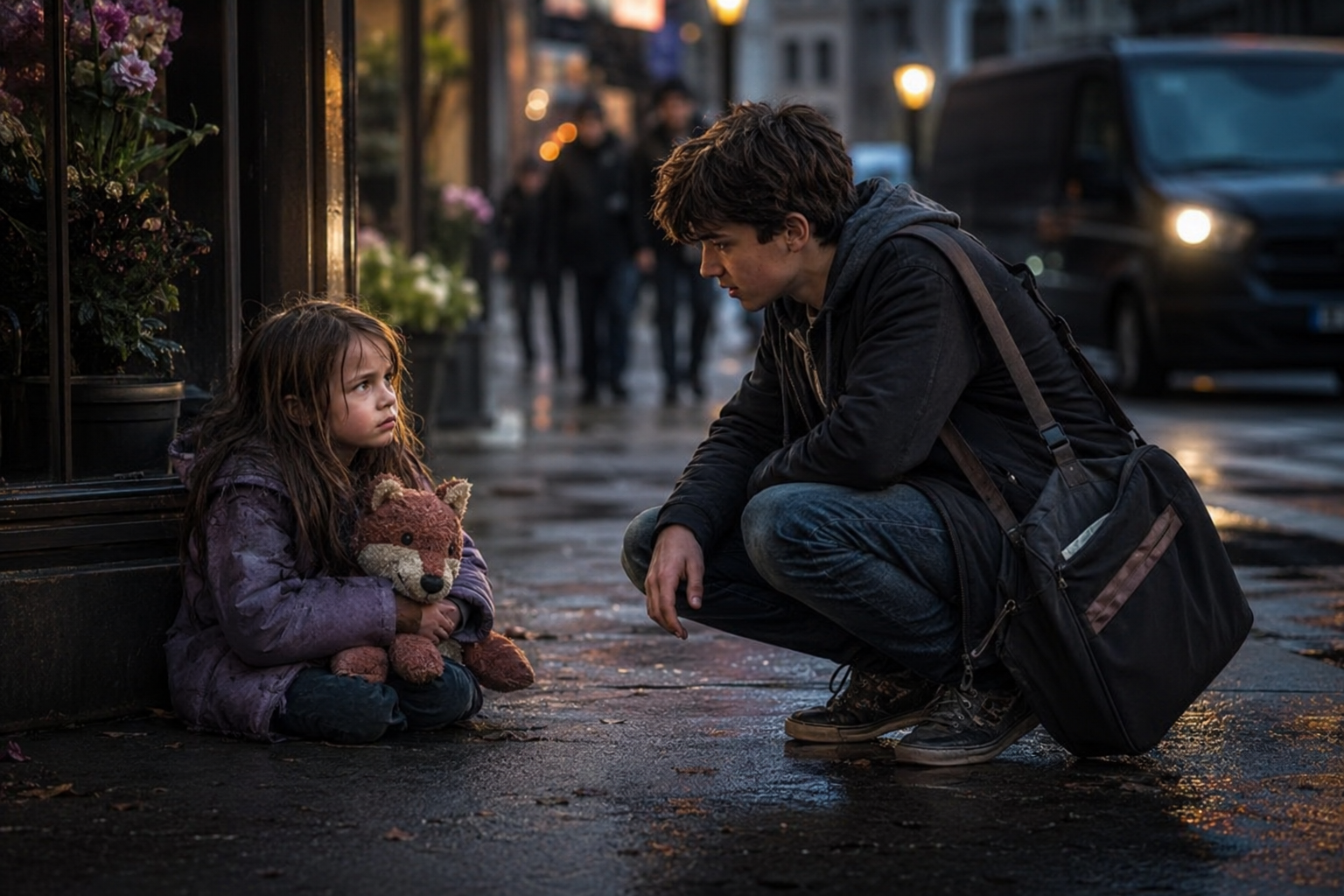
That was why almost no one stopped for the little girl sitting beside a closed flower shop.
She looked no older than six.
Her faded lavender coat was much too thin for the cold autumn wind. One of her socks had slipped beneath her ankle, and the toe of her left shoe was torn open. Her brown hair hung across her face in uneven strands, as though someone had tried to brush it with trembling fingers and given up.
She held a stuffed fox against her chest.
The toy had once been orange, but dust and rain had turned its fur gray around the paws. One of its button eyes was missing.
The girl had been there for hours.
Some pedestrians noticed her and slowed down.
A woman carrying shopping bags glanced over her shoulder before continuing toward a taxi.
A businessman frowned at the child, checked his watch, and walked faster.
Two university students whispered that someone had probably called the police already.
No one had.
The girl never cried out.
She did not ask for food.
She did not approach anyone.
She simply watched the street with wide, frightened eyes and held the stuffed fox so tightly that her knuckles turned white.
Fourteen-year-old Noah Carter might have passed her too.
He was tired, cold, and already late getting home.
Every afternoon after school, Noah delivered newspapers across the eastern neighborhoods of Westbridge. The money was not much, but it helped his grandmother pay for groceries and heating. Since his parents had died in a highway accident when he was eight, Evelyn Carter had been the only family he had.
She never complained about money.
That was precisely why Noah worried about it.
He had finished his route and was cycling toward home when he noticed the child near the flower shop.
At first, she was only another figure in the corner of his vision.
He rode past her.
Twenty feet later, he slowed.
Something about the way she sat bothered him.
She was not looking around like a lost child hoping to recognize someone. She was watching the reflections in the shop windows, as though she was afraid to turn her head.
Noah stopped his bicycle.
Cars rushed past him.
He looked back.
The girl had lowered her face behind the stuffed fox.
For several seconds, Noah argued with himself.
An adult would help her.
A store owner would notice.
The police might already be coming.
But the street remained indifferent.
Noah turned his bicycle around.
As he approached, the girl pressed herself against the locked shop door.
“I’m not going to hurt you,” he said, remaining several steps away. “I just wanted to see whether you’re all right.”
She gave no response.
“My name is Noah.”
Her eyes briefly rose to meet his.
They were dark brown and rimmed with exhaustion.
Noah crouched near the curb without moving closer.
“Do you know where your family is?”
The girl’s gaze dropped immediately.
That reaction made him uneasy.
“You don’t have to tell me anything,” he continued. “But it’s getting cold. Is there someone I can call?”
Her lips moved.
No sound came out.
Noah waited.
Finally, she whispered, “Sophie.”
“What?”
“My name is Sophie.”
He offered a cautious smile.
“Hello, Sophie.”
She did not smile back.
Up close, Noah noticed how pale she was. There was dirt on her cheek, and a faint purple mark circled one wrist. It was partially hidden beneath her sleeve, but not well enough.
His stomach tightened.
“Have you eaten today?”
Sophie shook her head.
Noah opened his delivery bag and found an unopened apple and a small packet of crackers his grandmother had packed that morning.
He placed them on the pavement between them and backed away.
“You can have those.”
Sophie stared at the food but did not reach for it.
“It’s safe,” Noah said. “My grandmother packed it.”
The mention of a grandmother seemed to calm her slightly. She picked up the crackers and tore the packet open with unsteady fingers.
While she ate, Noah examined the street.
A dark blue van stood across the road near an alley.
It was parked beneath a broken streetlamp. The windows were heavily tinted, and the front of the vehicle faced away from them.
There was nothing unusual about a parked van.
Still, Sophie had begun trembling.
Noah followed her gaze.
“Is that what you’re afraid of?”
She stopped chewing.
“Did someone in that van bring you here?”
Sophie pressed the stuffed fox over her mouth.