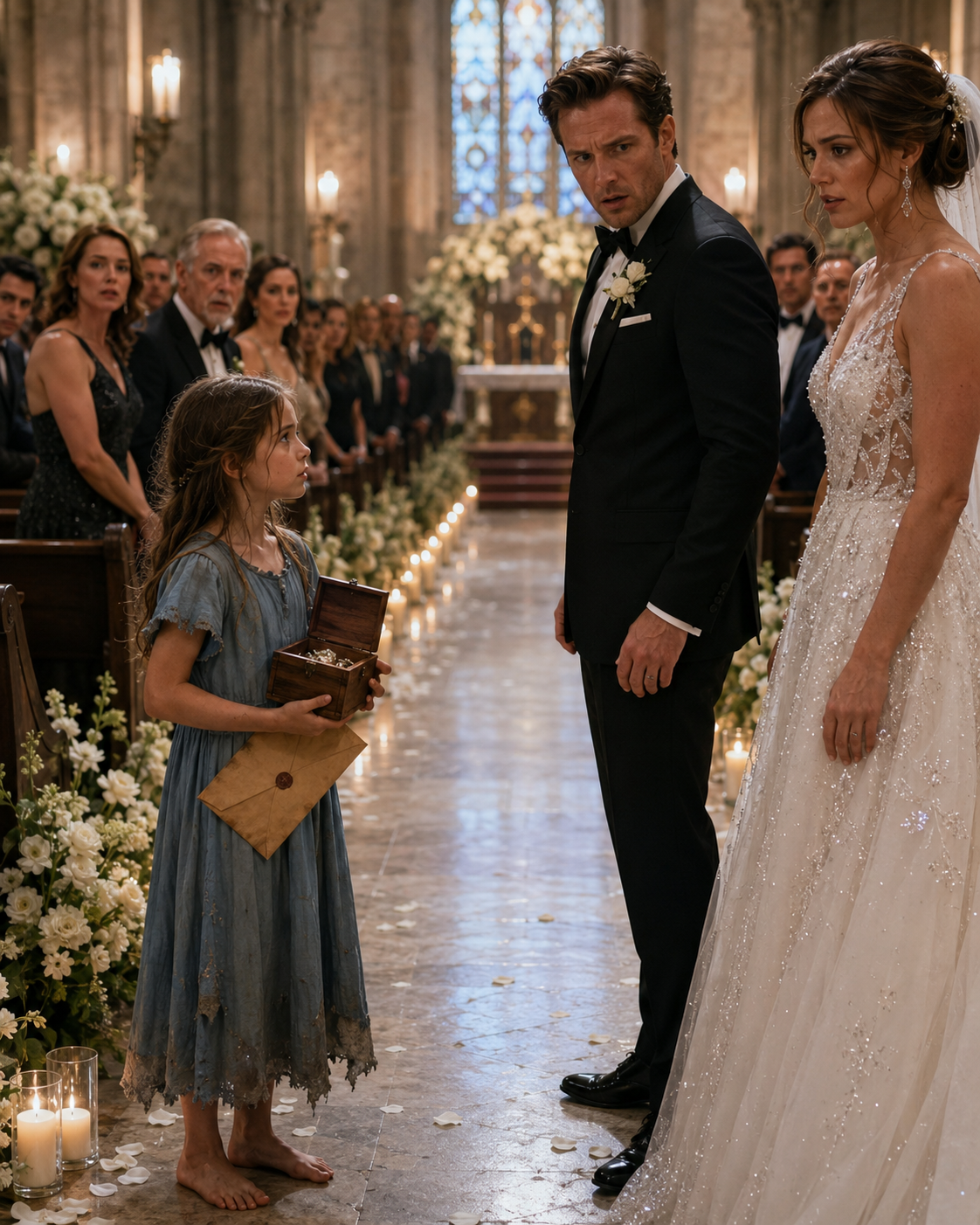
The chapel at Blackwood Manor had never looked more magnificent.
Hundreds of ivory roses climbed the ancient stone columns. Crystal chandeliers glowed beneath the vaulted ceiling, reflecting their light across polished marble floors. A string quartet played softly near the altar, and every pew was occupied by politicians, business leaders, celebrities, and members of families whose names appeared on buildings across the city.
Outside, black cars formed a shining line along the circular driveway. Photographers waited beyond the iron gates, hoping to capture even a distant glimpse of the ceremony society had been discussing for months.
It was supposed to be the wedding of the decade.
At the altar stood Nathaniel Ashford, the thirty-six-year-old head of Ashford International. His company controlled hotels, construction firms, medical foundations, and investment offices in several countries. Newspapers described him as disciplined, private, and almost impossible to impress.
Yet that afternoon, as he watched his bride approaching him, Nathaniel looked less like a powerful businessman and more like a man who believed he had finally found peace.
Celeste Whitmore moved slowly down the aisle beside her father.
Her wedding dress had been designed exclusively for her in Paris. Tiny crystals shimmered along the sleeves, and the long train flowed behind her like liquid silver. Her smile was calm, elegant, and perfectly measured.
Everyone watching believed Celeste was overwhelmed with happiness.
Only Margaret Hale, Nathaniel’s elderly housekeeper, noticed that the bride’s hands were tightly clenched around her bouquet.
Margaret had served the Ashford family for nearly four decades. She knew how people looked when they were nervous.
Celeste did not look nervous.
She looked watchful.
When she reached the altar, Nathaniel took her hand.
“You’re beautiful,” he whispered.
Celeste’s smile softened.
“And you’re finally mine,” she replied.
He gave a quiet laugh, assuming she was teasing.
The officiant welcomed the guests and began speaking about devotion, honesty, and the promises two people made when choosing to build a life together.
Celeste looked directly into Nathaniel’s eyes.
She had spent three years preparing for this moment.
Three years attending charity dinners, charming his relatives, learning his habits, and convincing him that she valued him more than his fortune or his family name.
In less than ten minutes, the marriage certificate would be signed.
After that, everything would become much more difficult to undo.
The officiant turned toward Nathaniel.
“Do you, Nathaniel Ashford, take Celeste Whitmore—”
A loud sound interrupted him.
The chapel doors had opened.
The music stopped.
Every person in the room turned toward the entrance.
A small girl stood beneath the stone archway.
She appeared to be about nine years old. Her faded blue dress was too large for her thin frame, and one of its sleeves had been repaired with mismatched thread. Damp hair clung to her cheeks. She wore no shoes, and dried mud covered her feet and ankles.
In one hand, she held a battered wooden music box.
In the other, she carried a sealed envelope.
For several seconds, nobody moved.
Then whispers spread through the chapel.
“Who is she?”
“How did she get past the gates?”
“Someone call security.”
Two members of the manor’s security team entered behind the girl. They seemed embarrassed and confused.
“We’re sorry, Mr. Ashford,” one of them said. “She slipped through the service entrance.”
Celeste’s father, Richard Whitmore, rose from the first pew.
“Remove her immediately.”
The girl flinched at his voice but did not run.
Instead, she looked toward the altar.
Her eyes settled on Celeste.
The bride’s expression changed.
It lasted less than a second, but Nathaniel felt her fingers tighten around his hand.
“Celeste?” he whispered.
She did not answer.
The girl began walking down the aisle.
Her bare feet made almost no sound against the marble. She passed the expensive dresses, diamond necklaces, and astonished faces without looking at any of them.
Margaret stood near the rear pew.
When the child passed her, the elderly woman stared at the wooden music box and pressed one hand against her mouth.
She recognized it.
Nathaniel saw Margaret’s reaction.
“Wait,” he told the security officers.
Richard Whitmore turned toward him.
“Nathaniel, this is a private ceremony. You cannot allow some street child to turn it into a spectacle.”
The girl stopped halfway down the aisle.
“I didn’t come to ruin the wedding,” she said.
Her voice was quiet, but the silence in the chapel carried it to every corner.
“I came because my mother told me I had to get here before they made him sign anything.”
Nathaniel slowly released Celeste’s hand.
“Before I signed what?”
The girl continued toward him.
Celeste stepped forward.
“This is absurd. She is clearly confused.”
The girl looked directly at her.
“You know who I am.”
A wave of murmurs moved through the guests.
Celeste’s father descended from the pew.
“That is enough.”
He reached toward the girl, but Nathaniel moved between them.
“Do not touch her.”
Richard stopped.
Nathaniel’s voice was controlled, but everyone who worked with him understood that tone. It meant his patience had ended.
He crouched so that he was at the girl’s eye level.
“What is your name?”
“Ellie.”
“Ellie what?”
“Ellie Monroe.”
Nathaniel searched his memory, but the name meant nothing to him.
“Who is your mother?”
Ellie looked down at the music box.
“Her name was Hannah Monroe.”
The elderly housekeeper made a faint sound.
Nathaniel turned.
“Margaret?”
Margaret’s face had gone pale.
“Hannah worked here,” she said. “A long time ago.”
Celeste immediately shook her head.
“Hundreds of people have worked for the Ashford family. That proves nothing.”
Margaret ignored her.
“She was employed in the accounting office of the Ashford Relief Trust. She was intelligent, careful, and painfully honest.”
Nathaniel frowned.
“Why don’t I remember her?”
“Because she disappeared before you returned from London to take control of the company.”
Ellie held out the envelope.
“My mother said this belongs to you.”
Nathaniel accepted it.
The heavy cream paper was stained around the edges. His name had been written across the front in uneven handwriting.
Celeste moved closer.
“Nathaniel, please. This can wait until after the ceremony.”
He looked at her.
“Do you know what is inside?”
“No.”
Her answer came too quickly.
Ellie looked up at him.
“She does.”
The bride’s polished smile vanished.
Richard Whitmore signalled discreetly to one of the security officers.
“Take the child somewhere comfortable,” he said. “We will contact the proper services and determine who sent her.”
“No one sent me,” Ellie replied. “I came by myself.”
Nathaniel studied her muddy feet.
“From where?”
“St. Anne’s Hospital.”
The chapel became even quieter.
“My mother was there,” Ellie continued. “She died this morning.”
Nathaniel’s anger gave way to shock.
“I’m sorry.”
Ellie nodded as though she had heard the words too many times to respond to them.
“She made me promise that I would bring you the envelope and the music box. She said that once Miss Whitmore became your wife, they would move the money again and nobody would ever find it.”
Nathaniel stood.
“What money?”
Celeste turned toward him.
“She is repeating something an adult told her. You cannot seriously believe this.”
“I asked what money.”
Celeste’s father stepped beside her.
“This is neither the time nor the place for a discussion about business.”
Nathaniel looked around at the guests.
A moment earlier, their presence had seemed important. Now they were merely witnesses.
“Apparently, someone worked very hard to make certain this became the time and place.”
He broke the seal.
Inside the envelope were several bank statements, an old photograph, a small brass key, and a handwritten letter.
The photograph showed four people standing outside an Ashford Foundation office nearly ten years earlier.
Margaret was one of them.
Hannah Monroe stood beside her, younger and healthier than the woman Ellie had described. On Hannah’s other side stood Richard Whitmore.
And beside Richard was Celeste.
Nathaniel raised his eyes.
“You told me you had never met anyone named Hannah Monroe.”
Celeste stared at the photograph.
“I don’t remember every employee I met at a foundation event.”
Margaret came forward.
“That was not a foundation event.”
Her voice trembled, but not from fear.
“That photograph was taken the night Hannah discovered the missing accounts.”
Richard Whitmore’s jaw tightened.
“You are an employee, Margaret. Remember your place.”
Margaret faced him.
“I remembered my place for ten years. That was my greatest shame.”
Nathaniel unfolded the letter.
The first line was addressed to him.
Nathaniel,
You do not know me, although your signature changed my life.
He looked up sharply.
“My signature?”
Hannah’s letter explained that she had worked as a junior accountant for the Ashford Relief Trust. While preparing an annual report, she discovered payments being transferred to construction companies that existed only on paper.
The companies had received millions intended for children’s clinics, shelters, and emergency housing.
Each transfer had been approved with Nathaniel’s electronic signature.
But Nathaniel had been abroad during several of the approval dates.
Hannah concluded that someone inside the foundation had copied his authorization credentials.
She gathered evidence and tried to contact him directly.
Before she could reach him, Richard Whitmore and Celeste confronted her.
They offered her money.
When she refused, she was accused of stealing from the foundation herself.
Her employment records disappeared. Her bank account was frozen, and anonymous complaints were sent to every company where she applied for work.
Within months, Hannah lost her apartment.
The scandal was buried before Nathaniel ever learned it had existed.
He continued reading.
Celeste stood completely still.
The letter said Hannah had hidden the original financial ledger before she was dismissed. The brass key opened a private deposit box registered under Margaret’s name.
Nathaniel looked toward the housekeeper.
Margaret lowered her eyes.
“She came to me the night they threatened her,” she admitted. “I helped her rent the box. I wanted to tell your father, but Mr. Whitmore said my son would lose his medical treatment if I spoke.”
Richard laughed without humour.
“This is a collection of accusations written by a desperate woman.”
Ellie lifted the wooden music box.
“My mother said the proof is inside.”
Richard’s confidence disappeared.
Celeste stepped down from the altar.
“Ellie, give that to me.”
The child backed away.
Nathaniel moved in front of her.
“Why do you want it?”
“I don’t. I only think a fragile object should not be handled here.”
Ellie held the box against her chest.
“My mother told me never to let you touch it.”
Celeste’s face tightened.
“That woman poisoned you against me.”
“My mother was afraid of you.”
The words struck with more force than a shout.
Ellie placed the music box in Nathaniel’s hands.
It was decorated with faded painted stars. One side of the wooden case had cracked, and the winding key was missing.
Nathaniel turned it over.
The brass key from Hannah’s envelope fit a tiny lock hidden beneath the base.
When he opened it, he found a memory card wrapped in cloth.
Celeste’s father moved suddenly.
Nathaniel closed his hand around the card before Richard could reach him.
“Security,” Nathaniel said.
Both guards straightened.
“Close the doors. No one leaves.”
Richard stared at him.
“You are making a serious mistake.”
“Then you should have no difficulty proving it.”
Nathaniel handed the memory card to his chief of staff, Daniel Brooks.
“Find a laptop that is not connected to the manor’s network.”
Celeste grabbed Nathaniel’s arm.
“Listen to me. Even if these records are real, they are old. My father may have made mistakes, but that has nothing to do with us.”
Nathaniel looked at her hand until she released him.
“The girl said you were there.”
“She is nine years old.”
“She remembers you visiting her mother.”
Celeste’s eyes flashed toward Ellie.
That glance answered more than any confession could have done.
Nathaniel saw it.
So did Margaret.
“What did you do to Hannah?” he asked.
“Nothing.”
“Look at me and say it.”
Celeste looked at him.
“I did nothing to that woman.”
Ellie opened the envelope again.
“There’s another letter.”
She removed a smaller folded page.
“This one is for Miss Whitmore.”
Celeste made a desperate movement toward it, but Margaret stepped between her and the child.
Ellie read the name written on the front.
Celeste Whitmore.
Nathaniel took the page and unfolded it.
Unlike the first letter, it contained only a few sentences.
Celeste,
You told me poor people disappear because nobody important notices when they are gone.
My daughter noticed.
And one day, she will make sure Nathaniel notices too.
He slowly raised his head.
Celeste was no longer pretending to be calm.
“You don’t understand,” she said. “My father said the foundation would collapse if the missing money became public. Thousands of people would lose their jobs. Your family’s reputation would be destroyed.”
“So you destroyed Hannah instead?”
“I protected what we built.”
“We had not even met when this happened.”
Celeste’s silence made Nathaniel’s expression harden.
The truth was suddenly clear.
Their meeting three years earlier had not been an accident.
She had entered his life because she was afraid of what might happen if someone else gained influence over him.
Marriage would have given her access to his private accounts, his properties, and several of the foundation’s protected archives.
“You never came into my life because you loved me,” he said.
Celeste’s eyes filled with tears.
“At first, no. But that changed.”
The guests reacted with horrified whispers.
Nathaniel barely heard them.
“At first?”
“My father needed someone close to you. Someone you trusted. I was supposed to make certain the old accounts were never reopened.”
Richard seized his daughter’s wrist.
“Stop talking.”
She pulled away.
“You said Hannah had destroyed everything!”
“She would have, if I had not acted.”
Daniel returned carrying an offline laptop.
He inserted the memory card.
Several folders appeared.
One contained scanned financial records. Another held audio files. A third contained a video recorded only six weeks earlier.
Nathaniel opened it.
Hannah Monroe appeared on the screen.
Illness had hollowed her face, but her eyes were steady.
Ellie made a tiny sound when she saw her mother.
Nathaniel knelt beside the child.
“You don’t have to watch.”
Ellie shook her head.
“I promised her I would.”
Daniel increased the volume.
Hannah began speaking.
“Nathaniel, I once believed powerful families protected the people who depended on them. I was wrong. But I do not believe you knew what was done in your name.”
She displayed copies of payment orders, company registrations, and internal messages.
The records connected Richard Whitmore to a network of false contractors.
Celeste’s name appeared on several authorization forms.
The theft had continued for years.
The most recent transfer had been scheduled for the morning after the wedding.
After marrying Nathaniel, Celeste would have gained temporary signing authority over a new charitable investment fund valued at nearly eighty million dollars.
The entire marriage had been part of the final transaction.
Nathaniel closed his eyes.
When he opened them, Celeste stood before him in her wedding dress, surrounded by flowers purchased with money that could have built hospitals and shelters.
She looked beautiful.
She also looked like a stranger.
“You planned to use our marriage to steal from the new fund.”
Celeste’s voice broke.
“My father said the money would be returned after the overseas investments were completed.”
Richard glared at her.
“Say nothing else.”
Nathaniel turned toward Daniel.
“Contact the authorities. Send copies of every file to our external legal counsel and the foundation’s independent auditors.”
Richard moved toward the side exit.
The security officers blocked him.
“You cannot hold me here,” he said.
“No one is holding you,” Nathaniel replied. “You are free to explain to the officers why you were so eager to leave.”
Celeste reached for Nathaniel.
“Please. We can talk privately.”
He stepped away.
“There is nothing private left between us.”
She stared at him as if she still believed she could recover control.
“I love you.”
“No,” he said quietly. “You studied me.”
Her face collapsed.
The officiant closed the ceremonial book.
Nathaniel removed the wedding band he had been holding and placed it on the altar.
“The wedding is over.”
Celeste’s mother began crying in the front pew. Several guests lowered their phones, suddenly ashamed of recording. Others continued watching, unable to look away.
Nathaniel turned toward Ellie.
She had not moved.
While the adults argued about money, reputations, and legal consequences, the child stood barefoot beneath the chandeliers, holding the broken music box her mother had protected for ten years.
Nathaniel removed his jacket and placed it gently around her shoulders.
“Is there anyone waiting for you at the hospital?”
Ellie shook her head.
“A nurse said someone from social services would come.”
“Did you leave without telling them?”
“I had to. They said the wedding would be finished before anyone could bring me here.”
Margaret approached.
“I will call the hospital and explain that she is safe.”
Ellie looked at Nathaniel cautiously.
“My mother said you might not believe me.”
“I should have known what people were doing in my name.”
“You didn’t know her.”
“That does not excuse me.”
Ellie looked toward Celeste.
The bride was sitting on the altar steps now, her expensive train spread across the marble.
For the first time that day, she no longer looked triumphant.
She looked small.
“She came to our apartment last month,” Ellie said. “She told my mother that after the wedding, nobody would listen to her.”
Celeste raised her head.
“I only wanted the accusations to stop.”
“My mother could barely walk. You still frightened her.”
Nathaniel’s voice became cold.
“Do not speak to the child again.”
Celeste’s father scoffed.
“You are going to throw away your future because of one employee and a girl you met five minutes ago?”
Nathaniel faced him.
“My future was what you intended to steal.”
Sirens sounded outside the manor gates.
The guests began whispering again, but Nathaniel no longer cared what they thought.
The authorities arrived with financial investigators and officers from the city’s fraud division. Daniel gave them copies of Hannah’s files. Richard demanded his attorney. Celeste repeatedly insisted that she had never personally taken any money.
Nathaniel answered no questions until Ellie had been examined by a doctor and the hospital confirmed that she could remain temporarily under Margaret’s supervision.
By sunset, the chapel was empty.
The roses still covered the columns. The untouched wedding cake stood in the ballroom. Hundreds of candles continued burning as though the celebration might resume at any moment.
Nathaniel sat alone in the first pew.
Margaret joined him.
“Ellie is asleep in the library,” she said. “The doctor treated her feet. She had walked almost six miles after leaving the hospital.”
Nathaniel stared toward the altar.
“Why didn’t you tell me about Hannah?”
“I was afraid.”
“So was she.”
“Yes.”
“And she still found a way to tell the truth.”
Margaret lowered her head.
“I failed her.”
Nathaniel looked at the old housekeeper who had helped raise him.
“Then help me repair what can still be repaired.”
The investigation lasted several months.
Auditors uncovered years of false invoices, offshore transfers, and hidden partnerships. Richard Whitmore had treated the charitable foundation as his private account. Celeste had helped conceal documents, intimidate witnesses, and maintain access to the Ashford family.
Her engagement to Nathaniel had been carefully planned.
Her feelings for him may eventually have become real, but the relationship had begun as another financial strategy.
Nathaniel refused every request to meet her privately.
He testified, surrendered his authority over the foundation to an independent board, and sold several properties to restore the missing funds before the courts completed the recovery process.
He also reopened every project that had been abandoned because of the stolen money.
A clinic was completed in Hannah Monroe’s neighbourhood.
A legal assistance program was established for whistleblowers and low-income employees.
Nathaniel named neither program after himself.
He named both after Hannah.
Ellie moved into Blackwood Manor under temporary guardianship while the courts searched for relatives. None were able to care for her.
At first, she barely spoke to Nathaniel.
She ate dinner with Margaret in the kitchen and slept with the broken music box on the table beside her bed. Whenever a car stopped outside unexpectedly, she hid behind the curtains.
Nathaniel did not pressure her.
He left books near her door, repaired the loose wheel on her small suitcase, and made certain no employee entered her room without knocking.
Weeks passed.
One rainy evening, he found Ellie sitting at the piano in the dark ballroom.
“I don’t know how to play,” she said.
“Neither do I.”
“You own a piano.”
“I also own three vineyards, and I know almost nothing about grapes.”
Ellie looked at him for several seconds.
Then she laughed.
It was the first time he had heard her do so.
Nathaniel sat beside her and pressed a random key.
The note echoed through the empty room.
“That sounded terrible,” Ellie said.
“It was an experimental composition.”
“It sounded like a doorbell.”
“An emotional doorbell.”
She pressed another key.
Together, they produced a disorderly collection of notes that would have horrified any trained musician.
Margaret watched from the doorway without interrupting.
A year after the wedding that never happened, Nathaniel petitioned to adopt Ellie.
The judge asked the girl whether she understood what adoption meant.
Ellie nodded.
“It means I can stay even when there isn’t a problem to solve.”
Nathaniel looked down, unable to hide his emotion.
The judge smiled.
“Yes. That is exactly what it means.”
After the adoption became official, Ellie asked to visit the chapel.
The wedding decorations had long since been removed. The marble floor was empty, and morning sunlight poured through the tall windows.
She walked to the place where she had first stood before Nathaniel.
“This is where everyone stared at me,” she said.
“They should have been staring at the people who were afraid of you.”
“I was afraid too.”
Nathaniel stood beside her.
“Courage does not mean you weren’t afraid.”
Ellie placed the repaired music box on the altar.
Nathaniel had restored the broken hinge but had left the faded stars untouched.
The melody began playing softly.
“My mother liked this song,” Ellie said.
“She gave you something more valuable than evidence.”
“What?”
“She taught you that the truth still matters, even when powerful people want it buried.”
Ellie looked at him.
“Did I destroy your wedding?”
Nathaniel thought about the question.
“No.”
He looked around the quiet chapel.
“You arrived just in time to save me from it.”
The girl slipped her hand into his.
Together, they walked toward the open doors.
A year earlier, Ellie had entered the chapel barefoot, exhausted, and alone, carrying a secret that wealthy people had spent a decade trying to hide.
She left that day without knowing what would happen next.
Now she walked out wearing new shoes, holding her father’s hand, and carrying no envelope at all.
She no longer needed to deliver the truth.
Everyone had finally heard it.

