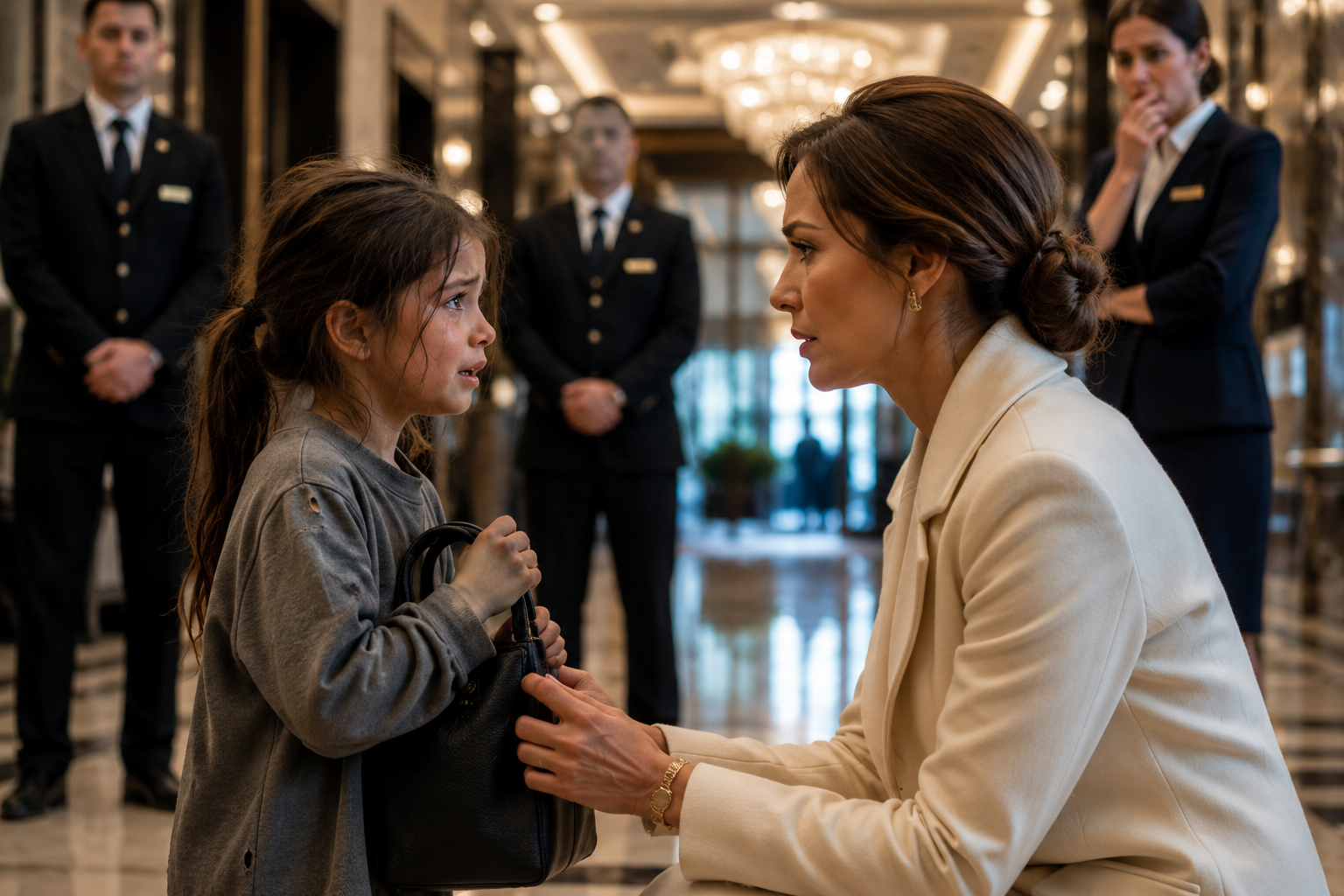
The woman’s furious cry was still echoing between the marble columns of the Royal Crescent Hotel when something unexpected happened.
The little girl did not release the handbag.
She did not run toward the revolving doors or disappear among the guests, as an experienced thief might have done. Instead, she remained in the center of the polished lobby, gripping the leather strap with both hands.
Her thin fingers were trembling.
Tears streamed down her dirty cheeks as she stared up at the elegant woman standing before her.
The girl’s dark hair was tangled around her face. Her faded gray sweatshirt was several sizes too large, and one sleeve had been repaired with uneven blue thread. On her feet were worn pink sandals that looked as though they had already belonged to several children before reaching her.
She could not have been more than nine years old.
And she was crying as though everything she had left in the world depended on that handbag.
A Woman Who Never Had to Wait
At forty-two, Evelyn Hart was accustomed to doors opening before she reached them.
She was the founder of Hart & Rowe, one of the city’s most successful architectural firms. Her company’s name appeared in silver lettering on office towers, luxury residences, and cultural centers across the country.
Three assistants managed her schedule.
She had breakfast with investors, lunch with city officials, and dinner with people who measured time in contracts and money.
Even the handbag the child was clutching had been made by an Italian designer and cost more than many local families earned in several months.
Evelyn was not deliberately cruel.
But she was decisive, impatient, and used to judging situations quickly.
That was why she had shouted the moment she felt someone tugging at her bag.
That was why she had called for security.
And that was why the word “thief” had escaped her lips before she had taken a proper look at the frightened child standing beside her.
Two security guards hurried across the lobby.
Guests stopped beside their luggage. A couple waiting for a taxi turned to watch. A young receptionist named Grace Miller rose slowly from behind the front desk.
The entire lobby seemed to hold its breath.
Then the girl spoke.
“I wasn’t stealing it!” she cried. “I promise I wasn’t!”
Her voice was small, but her desperation carried through the vast room.
“There’s a letter inside! My grandmother said the truth would be inside your bag!”
Evelyn frowned.
For the first time since the commotion had begun, uncertainty appeared on her face.
One of the guards reached for the child’s shoulder.
“Let go of the lady’s property,” he said firmly.
The girl pulled the bag closer to her chest.
“No!”
Her cry was so raw that several people in the lobby flinched.
“She’s my mother!” the girl shouted. “She’s my real mother!”
Silence fell.
Even the soft music playing near the hotel restaurant seemed suddenly too loud.
Evelyn felt a chill move down her spine.
“What did you say?”
The authority had vanished from her voice.
The girl looked directly at her.
“I said you’re my mother.”
Grace came out from behind the reception desk.
She was twenty-four, new to the hotel, and still believed that rules should occasionally make room for compassion.
“Ms. Hart,” she said carefully, “perhaps we should listen to her before doing anything else.”
Evelyn turned toward her with an expression suggesting that the receptionist had proposed something absurd.
But then she looked back at the child.
The girl was not holding the handbag like stolen treasure. She was holding it like a lifeline.
Evelyn slowly raised one hand toward the guards.
“Give her some space.”
The guards stepped back.
“What is your name?” Evelyn asked.
The child swallowed.
“Lily Dawson.”
“And how do you know what is inside my handbag?”
Lily wiped her face with the sleeve of her sweatshirt, leaving a darker streak of dirt across her cheek.
“My grandmother told me. She said you would come here today. She told me to wait near the entrance and look for a woman wearing a cream coat and carrying a black handbag with a silver clasp.”
Evelyn’s gaze dropped to her coat.
Then to the handbag.
“Who was your grandmother?”
Lily hesitated, as though she knew that the answer would change everything.
“Her name was Margaret Dawson.”
The handbag slipped from Evelyn’s fingers.
It struck the marble floor with a dull sound.
Margaret.
A name Evelyn had not spoken aloud in nearly nine years.
A name she had buried beneath work, deadlines, awards, and carefully controlled memories.
Margaret Dawson had worked in Evelyn’s home for more than a decade. She had cleaned the rooms, watered the plants, folded the laundry, and remembered exactly how Evelyn liked her coffee.
She had been quiet, dependable, and unfailingly kind.
And one cold morning in March, Evelyn had dismissed her.
There had been no argument and no dramatic accusation. Evelyn had simply handed her a settlement envelope and said that the household was being reorganized.
A car had been waiting outside.
Margaret had left without protesting.
Now a little girl in worn sandals was claiming that Margaret had sent her with a message from beyond the grave.
Grace bent down, picked up the handbag, and handed it to Evelyn.
The security guards had moved farther away. No one seemed certain whether hotel protocol still applied.
Evelyn opened the bag.
Inside were the familiar objects she carried every day: her wallet, keys, telephone, business cards, a silver pen, and a small case containing her reading glasses.
And beneath them was an envelope.
A plain white envelope.
Her name was written across the front in handwriting she recognized immediately.
For Evelyn. Only for her. Open when the time comes.
The letter had arrived by courier three weeks earlier.
There had been no return address.
Evelyn had placed it in her handbag, telling herself she would open it later, when her schedule was calmer and she was emotionally prepared.
But there was never a convenient time for the things that frightened her.
She looked at Lily.
“Do you know what this says?”
The girl nodded.
“Grandma told me before she died. She said you had to hear it from her, even if she couldn’t be here when you read it.”
Evelyn’s hands shook as she opened the envelope.
Inside were several pages covered with Margaret’s small, precise handwriting.
She began to read.
“Dear Evelyn,
“If you are reading this, then I am no longer there to explain it myself. I am not writing because I am angry with you. I am writing because I have carried a truth for too many years, and carrying it alone has become unfair to everyone involved.”
Evelyn stopped.
She closed her eyes, drew a breath, and continued.
“The girl standing near you is called Lily. You may know her as my granddaughter, but that is not the whole truth.
“She is also your daughter.”
The words blurred before Evelyn’s eyes.
She gripped the page more tightly.
“The baby you delivered when you were nineteen did not die,” the letter continued.
“Your parents arranged for my eldest daughter, Rebecca, to raise her. They said you were too young, that a child would destroy your future, and that your family’s reputation had to be protected.
“I was present when Lily was born. I held her before anyone else. Your parents told you she had not survived, but that was a lie.”
A broken sound escaped Evelyn’s throat.
She stared at the page, unable to breathe properly.
The letter continued.
“Rebecca loved Lily as her own child. She gave her a good home, even when money was scarce. But Rebecca died four months ago after a long illness.
“I tried to care for Lily afterward, but I knew my own health was failing. I could not leave this world without telling both of you the truth.
“Lily deserves to know where she came from.
“And you deserve to know that she exists.”
Evelyn lowered the letter.
For the first time, she truly looked at the child standing in front of her.
She saw the enormous dark eyes.
The small, straight nose.
The stubborn curve of the chin.
And suddenly Evelyn was no longer looking at a stranger.
She was looking at the face she had seen in her own childhood photographs.
A sob rose from somewhere deep inside her.
It was not the graceful, controlled crying of a woman trying to preserve her dignity. It was the sound of twenty-three years of grief breaking open at once.
Grace covered her mouth.
The woman waiting for the taxi began to cry as her husband took her hand.
Evelyn carefully folded the pages and returned them to the envelope. Then she knelt on the marble floor until she was level with Lily.
The girl did not move.
“Did you know?” Evelyn asked. “Did you know who I was?”
“Grandma said you were my first mother,” Lily replied. “But she also said maybe you didn’t know they kept me.”
Evelyn shut her eyes.
She had been nineteen when she became pregnant.
Her parents had treated the pregnancy as a crisis to be managed, not a life to be protected. They had sent her away from the city for several months and told everyone she was studying abroad.
After the delivery, Evelyn had been weak, frightened, and barely conscious.
Her mother had sat beside the bed and told her the baby had died.
Her father had said it was better that way.
They had instructed her to forget, recover, and continue with the future they had designed for her.
And Evelyn, young and devastated, had believed them.
For twenty-three years she had carried the loss like a stone inside her.
Now that stone had a name.
Lily.
And Lily was standing before her in pink sandals, waiting to learn whether she would be rejected again.
“How did you get here?” Evelyn asked.
“I took two buses. Then I walked.”
“Were you alone?”
Lily nodded.
“Grandma gave me the hotel name before she went to the hospital. She told me the date and said you would be here for an important meeting.”
Evelyn looked down at the conference folder still tucked beneath her arm.
She had come to the hotel to negotiate a major development contract.
An hour earlier, she had believed it was the most important meeting of her year.
Now she could not remember the name of the company involved.
She reached carefully toward Lily.
The girl stiffened but did not step away.
“I am sorry,” Evelyn whispered. “I’m sorry I called you a thief.”
Lily looked down.
“I only grabbed the bag because you were walking away. I called your name, but you didn’t hear me.”
“I should have listened.”
“Grandma said sometimes important people forget how.”
The words were not spoken cruelly.
That made them hurt more.
Evelyn nodded.
“Your grandmother was right about many things.”
She remained on her knees, unable to find words large enough for what had happened.
Then Lily reached out and placed her small, dirty hand against Evelyn’s tear-soaked cheek.
“Don’t cry,” she said. “Grandma cried when she talked about you too. But she said tears wash away the things people are afraid to say.”
Evelyn covered Lily’s hand with both of hers.
This time, she did not release it.
The Room Upstairs
Grace arranged a private hotel room where Evelyn and Lily could speak without strangers watching them.
She contacted a child welfare officer and, at Evelyn’s request, called the attorney who had handled the firm’s most confidential legal matters.
Everything had to be done correctly.
Lily was a child who had recently lost the only family she knew. A revelation, no matter how powerful, could not erase legal responsibilities or emotional consequences.
While they waited, Grace brought food.
Lily stared at the neatly arranged sandwiches and fruit as though she was afraid to touch them.
“You can eat whatever you like,” Evelyn said.
“Do I have to pay?”
“No.”
“Are you sure?”
“I’m completely sure.”
Lily chose half a sandwich and ate slowly, saving the other half in a napkin.
Evelyn noticed.
“You can have more later.”
“It’s for tomorrow.”
“There will be food tomorrow.”
Lily looked at her cautiously.
“How do you know?”
The question struck Evelyn harder than any accusation could have.
“Because I will make sure of it,” she said.
Lily did not answer, but she unfolded the napkin and finished the sandwich.
After eating, she took a shower in the hotel bathroom. Evelyn ordered clean clothing from a nearby shop.
When Lily emerged wearing a soft blue sweater and dark trousers, her hair damp and combed, Evelyn had to sit down.
Without the dirt and oversized clothing, the resemblance was undeniable.
It was in the eyebrows, the eyes, the shape of the face, and even the way Lily pressed her lips together when she felt uncertain.
For several seconds, Evelyn could only stare.
Lily shifted uncomfortably.
“Do I look wrong?”
“No,” Evelyn said quickly. “You look like someone I thought I would never meet.”
They talked for hours.
Lily told her about the small house where she had lived with Rebecca and Margaret. The floors were made of concrete, the roof leaked during heavy rain, and two hens wandered through the narrow garden.
She loved books.
She wanted to become a teacher.
She knew the capitals of almost every country in the Western Hemisphere and could recite them in alphabetical order.
Rebecca had worked long hours sewing uniforms. Margaret had grown herbs near the kitchen window and told stories at night when the electricity failed.
Evelyn listened without checking her telephone.
It was the first time in years she had given another person her complete attention.
When it was her turn to speak, she told Lily the truth.
She explained how young she had been, how frightened she was, and how completely she had believed her parents.
“Would you have looked for me?” Lily asked.
Children rarely soften the questions adults spend their lives avoiding.
Evelyn could have lied.
She could have said yes immediately and presented herself as another victim of the deception.
Instead, she chose honesty.
“I don’t know,” she admitted. “At nineteen, I was afraid of everyone. I allowed other people to make decisions for me. I wish I could tell you I would have been brave, but I’m not certain that I would have been.”
Lily studied her.
“But now?”
“Now I will not abandon you.”
“You don’t know me.”
“Then I’ll learn.”
“What if you don’t like me?”
“I already know you took two buses and walked across the city because you were brave enough to bring me the truth. I know you save food for tomorrow. I know you love books and want to teach. I think that is a very good beginning.”
Lily remained silent.
Then she said, “Grandma believed people change when their moment finally arrives.”
Evelyn looked at Margaret’s letter on the table.
“And did she think my moment would arrive?”
“She said it was arriving now.”
Nothing Changed Overnight
The weeks that followed were complicated.
There was no magical moment in which every wound disappeared after one embrace.
There were interviews, records, medical documents, court appointments, and a DNA test that confirmed what Evelyn already knew the first time she looked properly at Lily’s face.
A social worker visited Evelyn’s apartment.
An attorney investigated the arrangements that had been made more than two decades earlier.
A judge reviewed every document before deciding what would happen next.
Lily struggled to sleep in an unfamiliar room.
Some nights she woke calling for Margaret. Other nights she packed her few belongings into a small bag because she feared someone would send her away before morning.
Each time, Evelyn sat beside her until she fell asleep again.
She did not say, “You have nothing to fear.”
Promises like that were too large and too easy to break.
Instead, she said, “I am still here.”
And every morning, she proved it.
Evelyn transformed her apartment and her life with the same determination she had once used to build her company.
But this time she was not trying to win a contract.
She was trying to recover a relationship that had been stolen from both of them.
She reduced her schedule.
She delegated meetings.
She learned which cereal Lily preferred, which stories helped her sleep, and why she became silent whenever someone raised a voice.
Her business partners were shocked.
Several friends did not understand.
Evelyn discovered she no longer cared whether they did.
The most difficult conversation was with her mother.
The telephone call lasted forty minutes.
Evelyn did not shout.
She did not insult her.
She simply asked questions and refused to accept excuses.
Her mother cried, saying the family had believed they were protecting Evelyn’s future.
“You did not protect me,” Evelyn replied. “You decided that my child and my grief were acceptable prices for the future you wanted.”
Her mother asked for forgiveness.
Evelyn told her forgiveness might come one day, but it could not be demanded before accountability.
It was not a conversation of revenge.
It was a conversation of truth.
And sometimes truth leaves deeper marks than anger.
The Woman Who Stopped to Listen
Several weeks later, Grace received a handwritten note from Evelyn.
Inside was a generous check.
Grace telephoned immediately.
“This is far too much,” she said.
“No,” Evelyn replied. “It is exactly what stopping for one moment was worth.”
“I only asked everyone to listen.”
“That was the difference between a frightened child being removed from the hotel and a family discovering the truth.”
Grace eventually accepted the money on one condition: part of it would be donated to a local organization helping children who had lost their caregivers.
Evelyn agreed.
Months passed.
Lily did not begin calling Evelyn “Mom” immediately.
At first she called her “Ms. Hart.”
Then it became “Evelyn.”
Later, one sleepy morning while standing in the kitchen, Lily said, “Mom, where did you put my schoolbook?”
The word was quiet and natural.
Evelyn froze with one hand on the coffee machine.
Lily froze too, as though she wanted to pull the word back.
Evelyn turned slowly.
“It’s beside your backpack,” she said, keeping her voice steady.
Lily nodded and left the room.
Only after she was gone did Evelyn cover her mouth and cry.
Not from grief this time.
From gratitude.
Margaret’s letter was eventually framed and placed on the wall in Lily’s bedroom. Its final words were the only part Evelyn read every day:
“I do not ask you to punish anyone, Evelyn. I ask only that you care for the child I can no longer protect. That is all one mother can ask of another.”
Their story had not begun with a grand ceremony or a carefully prepared reunion.
It had begun in a hotel lobby.
It began when a frightened girl in worn pink sandals clung to an expensive handbag while strangers assumed the worst.
It began when one young receptionist said they should listen.
And it began when a woman who had spent her entire life rushing toward the future finally stopped long enough to face the past.
Sometimes the truth does not arrive politely.
Sometimes it grabs hold of what you value, refuses to let go, and cries out until you are finally willing to listen.

