Chapter One
An Uninvited Guest
The wealthy had a remarkable talent for turning generosity into theater.
That evening, the Grand Halcyon Hotel glittered beneath thousands of crystal lights. White orchids climbed golden pillars. A string quartet played beside a fountain filled with floating candles, while waiters moved through the ballroom carrying silver trays of champagne no ordinary family could afford in a month.
The annual Vale Foundation Gala was supposed to raise money for homeless children.
At least, that was what the invitations claimed.
In reality, the event was a carefully staged celebration of the Vale family itself. Photographers crowded around the entrance. Business leaders praised one another’s compassion. Politicians shook hands beneath enormous floral arrangements. Every donation was announced loudly enough for the press to record it.
I stood near the center of the ballroom in a pale blue silk gown, smiling for cameras and pretending I belonged there.
My name was Audrey Vale.
To the public, I was the graceful youngest daughter of Conrad Vale, founder of Vale Meridian Holdings and one of the most influential men in the country. I attended charity dinners, opened children’s hospitals, and gave polished speeches about responsibility.
Behind closed doors, I had learned that responsibility meant obedience.
My father expected perfection. My older brother, Julian, expected loyalty. Neither of them had ever forgiven me for asking questions about my sister.
Lydia had disappeared eight years earlier.
According to my family, she had stolen money from the foundation and fled abroad with a dangerous man. My father had forbidden us from mentioning her name again. Her photographs vanished from the house. Her belongings were removed overnight. Even the staff behaved as though she had never existed.
But I remembered her.
I remembered how Lydia used to climb into my bed during thunderstorms. I remembered the jasmine perfume she wore and the way she hummed while reading. Most of all, I remembered our final conversation.
She had come into my bedroom after midnight, pale and frightened.
“If anything happens to me,” she had whispered, “don’t believe the first story they tell you.”
The next morning, she was gone.
A burst of applause pulled me back to the present.
My father stood at the podium, silver-haired and commanding, speaking about compassion for children living in poverty.
“We must never look away from suffering,” he declared.
The ballroom doors flew open.
The music stopped in the middle of a note.
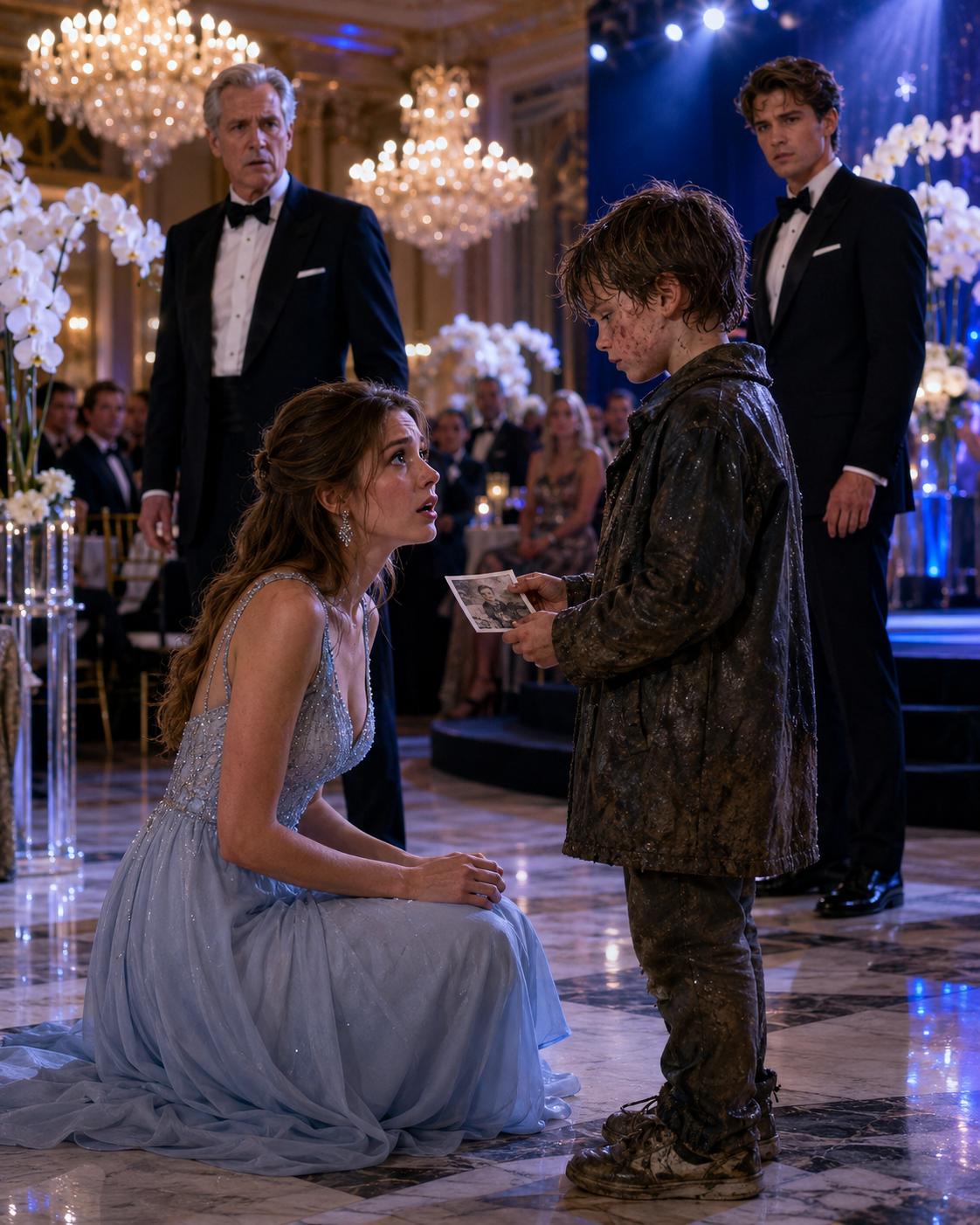
A small boy stumbled into the room.
He looked no older than seven. His oversized coat was soaked with rain, and one sleeve was nearly torn away. Mud covered his trousers. His hair clung to his forehead, and his shoes were so worn that one sole had separated from the leather.
He took several frightened steps across the polished floor.
The guests reacted as if something dangerous had entered the building.
Women lifted the hems of their gowns. Men moved protectively in front of their wives. One donor covered his nose with a handkerchief.
“Where did he come from?”
“Someone call security.”
“How did a child like that get inside?”
My father’s expression changed instantly.
The compassionate benefactor disappeared. The man I knew emerged.
“Remove him,” he ordered sharply.
Four security officers approached the boy.
The child stopped.
He did not try to escape. Instead, he searched the ballroom with desperate amber-colored eyes.
Then he saw me.
His lips trembled.
“Aunt Audrey?”
The words were quiet, but in the sudden silence they carried across the entire room.
My heart seemed to stop.
The security officers reached for him.
“Don’t touch him!”
I pushed through the guests and ran across the marble floor.
Behind me, my father called my name, but I ignored him.
I reached the boy and knelt in front of him. Up close, I could see how exhausted he was. His cheeks were hollow. A small cut marked his chin, and his hands shook uncontrollably.
“How do you know my name?” I asked.
The child stared at my face as though he had spent years imagining it.
“My mother told me to find you.”
“Who is your mother?”
Instead of answering, he reached into the inner pocket of his coat.
Julian stepped down from the stage.
“Audrey, move away from him,” he said. “This could be a trick.”
The boy flinched at the sound of his voice.
That reaction told me more than Julian realized.
I positioned myself between them.
“You’re safe,” I told the child. “No one is going to take you anywhere.”
He pulled a small object from his coat. It was wrapped in cloudy plastic and tied with a piece of thread.
With trembling fingers, he opened it.
Inside was an old photograph.
The image had faded, and deep creases crossed the surface, but I recognized the woman immediately.
Lydia.
My sister sat beside a window, holding a newborn baby against her chest. She was thinner than I remembered, but she was smiling.
On her wrist was a silver bracelet decorated with three tiny stars.
I had given her that bracelet on her twenty-first birthday.
The boy pointed to the woman in the photograph.
“That’s my mother.”
The ballroom seemed to tilt beneath me.
I looked from the photograph to his amber eyes.
Lydia’s eyes.
“What is your name?” I whispered.
“Noah.”
I struggled to breathe.
“Where is your mother, Noah?”
His face crumpled.
“She’s sick. She can’t get out of bed anymore.”
A murmur spread among the guests.
My father stepped down from the stage.
“This is enough,” he said. “Someone has prepared this child to create a spectacle.”
Noah gripped my arm.
“Mom said you would believe me.”
“I do believe you.”
“She said I had to give you this.”
He turned over the photograph.
Several words had been written on the back in blue ink.
AUDREY, THE FOUNDATION RECORDS ARE FALSE.
DON’T TRUST CONRAD OR JULIAN.
FIND THE RED LEDGER.
My blood turned cold.
My father had moved close enough to read the message.
For a fraction of a second, his carefully controlled expression broke.
It was not confusion.
It was recognition.
Julian saw the photograph as well. He stopped walking.
That was when I understood.
The boy was not lying.
Lydia had never abandoned us.
My family had buried the truth.
Chapter Two
The Sister Who Never Ran Away
“What red ledger?” I asked, staring at my father.
Conrad Vale recovered quickly.
He looked around the ballroom and noticed the cameras, the guests, and the journalists raising their phones.
His voice became calm and paternal.
“My daughter is understandably emotional. This child has clearly been manipulated by someone seeking money.”
“I didn’t ask you what happened to the child,” I said. “I asked about the ledger.”
Julian moved closer.
“Audrey, this is not the place.”
“No,” I replied. “This is exactly the place.”
Noah pressed against my side.
The ballroom had become utterly silent.
For years, my father had controlled our family through silence. Difficult questions disappeared behind closed doors. Uncomfortable people were removed from photographs. Any version of events that threatened the Vale name was replaced with a cleaner one.
But he could not quietly erase a child in front of hundreds of witnesses.
“Where is Lydia?” I demanded.
My father’s jaw tightened.
“You know what your sister did.”
“I know what you told me she did.”
“She stole from the foundation.”
“Then why is her son sleeping in the streets?”
Julian gave a short, humorless laugh.
“You are accepting the word of a child who walked in from an alley.”
Noah looked up at him.
“My mother said you would call her a thief.”
Julian’s face lost its color.
The boy continued in a small, careful voice.
“She said you would say she ran away because you were afraid people would learn where the charity money went.”
Several guests exchanged uneasy looks.
Members of the press moved closer.
My father raised his hand toward security.
“Escort the child to a private room. Treat him kindly, but remove him from the ballroom.”
“No,” I said.
“Audrey.”
“He stays with me.”
“You are embarrassing this family.”
“The family should have thought about embarrassment before abandoning Lydia.”
His eyes hardened.
“You have no idea what you are talking about.”
“Then explain it.”
He said nothing.
I turned to Noah.
“Can you take me to your mother?”
He nodded.
“Tonight?”
Another nod.
I stood and removed the jeweled clasp from the side of my gown so I could walk more easily. The expensive silk gathered around my ankles, but I no longer cared how I looked.
My father stepped into my path.
“You are not leaving with that child.”
The words were quiet enough that only those nearest us could hear.
I met his gaze.
“For eight years, I obeyed you because I thought Lydia had chosen to leave. If you kept her from us, you will never give me another order again.”
His expression became dangerously still.
“You are making a serious mistake.”
“No. Believing you was the mistake.”
I took Noah’s hand.
Before we reached the doors, a woman called my name.
It was Evelyn Hart, the foundation’s former financial director. She had retired suddenly three years after Lydia disappeared.
Evelyn was nearly seventy now, dressed in black and standing alone beside one of the pillars.
She approached us slowly.
“I knew this night would come,” she said.
My father turned on her.
“Stay out of this, Evelyn.”
She looked at him without fear.
“I stayed out of it for eight years. That was eight years too long.”
She handed me a small brass key.
“What does this open?” I asked.
“A deposit box at Union Central Bank.”
My father’s face went rigid.
Evelyn lowered her voice.
“Your sister discovered that money donated through the Vale Foundation was being redirected into shell companies. She copied records, payment instructions, and private correspondence. She intended to take everything to the authorities.”
“What happened to her?”
Evelyn glanced at Julian.
“Someone learned what she was doing.”
Julian stepped forward.
“You should be very careful.”
“No,” Evelyn said. “You should have been careful eight years ago.”
Noah hid behind me.
I looked down and saw pure terror in his face.
He knew Julian.
That realization cut through me.
“Noah,” I said gently, “have you seen my brother before?”
The boy did not answer.
Julian’s confidence returned.
“You’re frightening him with questions.”
But Noah suddenly pointed at him.
“He came to the apartment.”
Every head in the ballroom turned toward Julian.
“When?” I asked.
“Three nights ago.”
“What did he want?”
“He told Mom she had waited too long. He said we had to leave before the gala.”
Julian laughed, but the sound was strained.
“This is absurd.”
Noah reached into his coat again.
This time he removed a silver cuff link.
An engraved letter V shone on its surface.
Julian looked down at his sleeve.
One cuff link was missing.
A dozen cameras captured the moment.
Chapter Three
The Room Above the Laundromat
Noah led me away from the Grand Halcyon through streets that became narrower and darker with every block.
Evelyn came with us. So did Marcus Hale, an investigative journalist who had covered the Vale Foundation for years. I did not completely trust him, but I wanted witnesses.
My father and Julian remained at the hotel, surrounded by reporters and unanswered questions.
The rain had grown heavier.
Noah guided us into a neglected neighborhood on the far side of the river. The towers of the financial district disappeared behind old warehouses and apartment buildings with boarded windows.
We stopped in front of a closed laundromat.
A narrow staircase climbed along the outside wall.
“She’s upstairs,” Noah said.
The apartment consisted of one room.
A broken lamp cast a weak yellow light across peeling wallpaper. Blankets covered the windows. An electric heater stood in the corner, but it was not running.
A woman lay on a narrow bed.
For several seconds, I could not move.
Lydia’s hair, once dark and shining, was threaded with gray. Her face was thin, and shadows filled the hollows beneath her eyes. Yet when she heard the door, she turned her head.
Her gaze found mine.
“Audrey.”
I crossed the room and fell beside the bed.
She reached toward me.
Her hand felt weightless.
“You came,” she whispered.
“I’m sorry.”
The apology broke out of me before I could stop it.
“I’m so sorry. I believed them. I thought you had left.”
“You were nineteen. You couldn’t have known.”
“I should have looked for you.”
“You tried.”
“How do you know?”
A faint smile appeared.
“Every letter you sent was returned. Every private investigator you hired was paid to report that I had crossed the border. Father made sure you would eventually stop.”
I covered my mouth as the truth settled over me.
All those years, my family had not simply lied.
They had built an entire false world around me.
Noah climbed onto the bed and curled beside his mother. Lydia stroked his hair.
“He was so brave,” she said. “I told him there would be hundreds of people, but he only needed to find you.”
“What happened to you?”
Lydia looked toward Evelyn and Marcus.
“Can they be trusted?”
“They know part of it already.”
She closed her eyes briefly, gathering strength.
“The foundation was never just a charity. Father used it to move money between construction firms, political committees, and foreign accounts. Some of the donations were real, but millions disappeared before reaching the programs they were supposed to support.”
“You found proof.”
“I managed the foundation’s legal department. I noticed that invoices from three different companies had identical formatting and bank details. The companies existed only on paper.”
“What did Julian do?”
“He controlled the accounts.”
Noah’s fingers tightened around the blanket.
Lydia noticed and lowered her voice.
“I copied everything into a red ledger. Names, dates, transfers, account numbers. Evelyn helped me access older files.”
Evelyn looked down.
“I should have gone to the authorities with her.”
“You were afraid,” Lydia said.
“I left you alone.”
“You had children. Conrad threatened them.”
I looked at my sister.
“What happened the night you disappeared?”
Lydia stared at the ceiling.
“I was driving to meet a federal investigator. Julian intercepted me in the parking garage. He said Father only wanted to talk.”
Her voice became distant.
“They took my phone and documents. Father told me I could protect the family or destroy it. I refused to sign a statement saying I had stolen the money.”
“So they imprisoned you?”
“At first, they kept me in a private clinic outside the city. They told the staff I was unstable. I was pregnant, though no one in the family knew.”
She touched Noah’s cheek.
“A nurse eventually helped me escape. I changed my name and spent years moving from place to place. Every time I tried to contact the authorities, someone found me.”
“Julian?”
“Usually men working for him.”
“Why didn’t you contact me directly?”
“I did.”
“I never received anything.”
“Because Father watched you. Your assistants, your drivers, even your apartment staff reported to him. I was terrified that contacting you would lead Julian to Noah.”
A tear slid down her cheek.
“But I became ill last year. When Julian found us again, I knew I was running out of time. The gala was my last chance. I knew there would be witnesses.”
“Where is the red ledger?”
Lydia looked at the brass key in my hand.
“Still where Evelyn left it.”
“At Union Central Bank?”
She nodded.
“The ledger is in the deposit box, along with copies of the transfers. But there is something else.”
“What?”
“An audio recording.”
Marcus leaned forward.
“Of whom?”
“Conrad and Julian.”
My sister’s eyes returned to mine.
“They argued after I refused to sign the confession. Julian wanted to make certain I could never speak. Father stopped him, but not because he cared about me. He was worried about the attention my death might attract.”
The room fell silent.
Noah buried his face against his mother’s shoulder.
I took Lydia’s hand.
“They will not reach you again.”
“You don’t know how powerful Father is.”
“I know exactly how powerful he is. He taught me how his world works.”
A car door slammed outside.
Noah sat up sharply.
Lydia’s expression changed.
“They found us.”
Footsteps climbed the metal staircase.
Marcus moved toward the window.
“Three men,” he said. “No visible weapons. One of them is Julian.”
I pulled out my phone.
Before leaving the gala, I had contacted federal investigators and sent them the address of the apartment. I had also activated a live audio connection with an attorney I trusted.
The footsteps stopped outside the door.
Julian knocked.
“Audrey,” he called calmly. “Open the door. We need to solve this before it becomes worse.”
I looked at Lydia.
For eight years, she had survived by hiding.
Now she slowly pushed herself upright.
“Let him in.”
Chapter Four
The Price of Silence
Julian entered wearing the same tuxedo he had worn at the gala.
Rain darkened his shoulders. Without the ballroom lights and admiring guests, he looked less like the heir to an empire and more like a frightened man who had finally lost control.
Two security employees remained on the landing.
Marcus kept his phone pointed toward Julian.
“You’re recording me?” Julian asked.
“Yes.”
“Turn it off.”
“No.”
Julian looked at me.
“You have created a scandal that could destroy thousands of jobs.”
“You mean it could destroy you.”
“Our company employs more than twenty thousand people. Banks, pension funds, and families depend on us.”
Lydia gave a weak laugh.
“You always did hide behind other people.”
His eyes moved to the bed.
For an instant, I saw surprise. He had not expected Lydia to still be alive.
“You should have left when I warned you,” he said.
“You should never have come near my son.”
“I was trying to protect him.”
Noah pressed closer to his mother.
“By frightening him?”
“I offered you money, Lydia. A new home. Medical care. You refused.”
“You wanted the ledger.”
“I wanted this madness to end.”
I stepped between them.
“It ends tonight.”
Julian sighed.
“You don’t understand Father. Once he realizes what you have done, he will protect the company by any means necessary.”
“Is that a warning?”
“It is the truth.”
A second set of footsteps sounded on the stairs.
My father entered the apartment.
Conrad Vale looked utterly out of place beneath the cracked ceiling. His tailored coat was wet, and the anger he had concealed at the gala had finally surfaced.
He stared at Lydia.
“You have always been selfish,” he said.
I could hardly believe the words.
“She was imprisoned because she found evidence of your crimes.”
“I built everything this family has. Do you imagine companies of that size survive through innocence?”
“You stole money meant for children.”
“I redirected capital.”
Lydia shook her head.
“You even have a respectable phrase for theft.”
My father turned to me.
“Come home, Audrey.”
“This is my home now.”
His gaze sharpened.
“You are emotional. In the morning, you will understand the consequences.”
“I understand them tonight.”
“You have enjoyed every privilege my name gave you.”
“And Lydia paid for those privileges.”
“Your sister threatened to destroy all of us.”
“No,” I said. “She threatened to expose you.”
Julian stepped closer to our father.
“We should leave. The press may already be coming.”
Conrad ignored him.
“Give me the bank key.”
I closed my hand around it.
“No.”
“I will arrange the finest doctors for Lydia. The boy will have a home, an education, and complete financial security.”
Noah looked up at him.
“My name is Noah.”
My father barely glanced at him.
The gesture was small but revealing. Noah was his grandson, yet Conrad saw only a problem to be managed.
“You are trying to purchase their silence,” I said.
“I am offering a solution.”
“Silence was your solution eight years ago.”
Sirens sounded in the distance.
Julian turned toward the window.
“What did you do?”
“I called people you can’t fire.”
My father’s composure finally broke.
“You foolish girl.”
“No. I was foolish when I spent eight years believing you.”
He stepped toward me, but the security employees on the landing did not follow.
They had heard the approaching sirens too.
Marcus spoke without lowering his phone.
“The entire conversation has been streamed to my editor.”
Julian stared at him.
“You’re lying.”
“I’m not.”
The color drained from my brother’s face.
My father looked from Marcus to Evelyn and finally to Lydia.
For the first time in my life, Conrad Vale appeared powerless.
Lydia reached beneath her pillow and removed a small voice recorder.
“I made another copy,” she said.
Julian froze.
“I knew someone might reach the deposit box before Audrey.”
She pressed a button.
My father’s younger voice filled the room.
The recording was eight years old, but unmistakable.
“You should have controlled her,” Conrad said.
Julian answered, “She was going to the authorities.”
“You were supposed to recover the ledger, not create a disappearance we now have to explain.”
“She won’t cooperate.”
“Then keep her somewhere quiet until she does.”
The recording ended.
No one spoke.
Federal officers appeared on the staircase moments later.
Their arrival was calm and controlled. They separated my father and brother from the others and asked everyone to remain where they were.
Julian tried to protest.
My father did not.
He simply stared at me while an investigator explained that both men would be taken for questioning.
“You have destroyed your inheritance,” Conrad said.
I looked at Noah beside his mother.
“No,” I replied. “I finally discovered what I inherited.”
Chapter Five
What Remained
The Vale Meridian investigation lasted eighteen months.
The red ledger led investigators through a network of shell companies, false construction contracts, private accounts, and political donations. More than forty people were questioned. Several executives resigned before charges were announced.
Conrad and Julian both insisted they had acted to protect the company.
The evidence told a different story.
The Vale Foundation was dissolved and rebuilt under independent management. Its remaining assets were transferred to organizations that provided housing, legal support, and medical treatment to families in crisis.
I resigned from the corporate board.
For the first time in my adult life, I no longer had a carefully planned public role.
That freedom frightened me.
Then it began to feel like breathing.
Lydia survived.
Her illness required months of treatment, and recovery came slowly. Some mornings she could walk through the garden. On others, she barely had the strength to sit near the window.
But she was no longer hiding.
Noah enrolled in school under his real name. At first, he kept food in his backpack because he feared there would be none at home. He slept with his coat beside the bed and woke whenever a car stopped outside.
Gradually, the fear loosened its grip.
He discovered that he loved astronomy. He filled his bedroom ceiling with glowing stars and insisted on learning the names of every constellation.
One evening, almost a year after the gala, I found him in the kitchen eating strawberries directly from the bowl.
He looked up guiltily.
“Am I in trouble?”
“For eating strawberries?”
He nodded.
“You can have as many as you like.”
He considered this.
“Even the last one?”
“Especially the last one.”
He smiled and handed it to me.
Lydia watched from the doorway, leaning on a cane.
“He likes you,” she said.
“I like him too.”
Noah rolled his eyes.
“I can hear both of you.”
Lydia laughed.
The sound brought back a memory of thunderstorms, jasmine perfume, and two sisters whispering in the dark.
Later that night, she and I sat on the porch.
“Do you miss the old life?” she asked.
“Sometimes.”
She looked surprised.
“I miss believing our father loved us in the way fathers are supposed to love their children.”
Lydia nodded.
“That is different from missing him.”
“Yes.”
We sat in silence for a while.
“I used to think families were held together by blood,” I said. “Father certainly believed that whenever he demanded loyalty.”
“And now?”
“Now I think they are held together by whoever comes back for you.”
Lydia reached for my hand.
Eight years earlier, she had tried to protect me by disappearing.
A frightened little boy had crossed half the city to bring her back.
The newspapers later called him the child who destroyed the Vale empire.
They were wrong.
Noah had not destroyed anything worth saving.
He had walked into a ballroom filled with powerful people and forced them to look at what they had spent years pretending not to see.
He had carried no evidence of wealth, no famous name, and no influence.
Only a damaged photograph, a missing cuff link, and the truth.
In the end, those were enough.