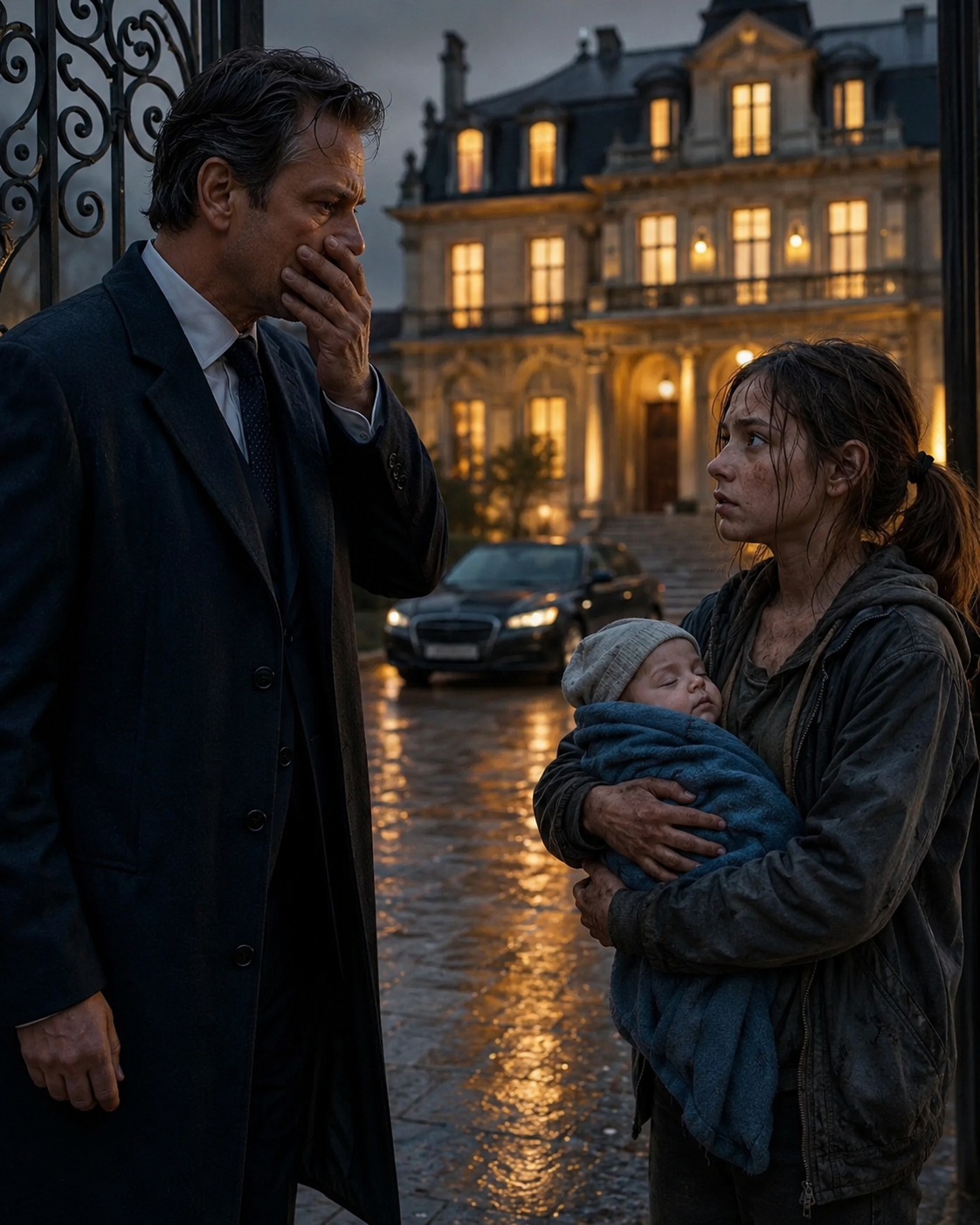
The voice was so small that at first Victor Ashbourne thought it had come from the wind.
He had just stepped out of his black car in front of the tall iron gates of his Kensington estate, one hand already reaching for the polished brass handle, when the words stopped him cold.
“Sir… please.”
Victor turned.
A girl stood near the edge of the pavement, half hidden by the shadow of the stone wall. She could not have been more than seventeen. Her coat was too thin for the sharp London evening, her shoes were split at the sides, and her dark hair hung in tangled waves around a face that looked older than it should have. Across her chest, wrapped carefully in a faded blue blanket, a baby slept with one tiny fist pressed against her cheek.
The girl swallowed hard, forcing herself not to cry.
“Do you need a maid?” she asked. “A cleaner? A kitchen girl? I can scrub floors, wash windows, cook simple meals, anything. I won’t steal. I won’t complain. Just… please give us food. My little sister is hungry.”
Victor Ashbourne had been asked for many things in his life. Money. Favors. Investments. Influence. Mercy, sometimes, by men who had made the mistake of crossing him in business.
But never this.
Not like this.
His first instinct was caution. Wealth had taught him to distrust sudden need, sudden tears, sudden stories told at the gates of a mansion. He had security for a reason. He had lawyers for a reason. He had spent forty-eight years building walls high enough to keep strangers and trouble outside.
But then the girl shifted the baby higher against her chest, and the collar of her worn coat slipped.
Victor saw the mark.
A small, pale crescent just below the left side of her jaw.
The world seemed to narrow around it.
He took one step closer, then stopped as if the ground had turned fragile beneath his shoes.
That birthmark was impossible.
His younger sister, Rosalie, had carried the same mark in the same place. A soft crescent, almost silver in certain light. Their mother used to call it “the moon’s thumbprint.” Rosalie had hated it as a child and hidden it beneath ribbons. Later, when she ran from the family after one final, bitter argument, Victor had remembered that mark more vividly than her last words.
She had disappeared nineteen years ago.
Victor had spent years telling himself she had chosen freedom. That she wanted nothing from him. That searching for her would only reopen old wounds.
Now a starving girl stood at his gate with Rosalie’s moon on her neck.
“What is your name?” he asked.
His voice came out colder than he intended, and the girl flinched.
“Mara,” she whispered. “Mara Bell. And this is my sister, Elsie.”
The baby stirred at the sound of her name, her small mouth trembling in sleep.
“Mara Bell,” Victor repeated slowly. “Where are your parents?”
The girl lowered her eyes.
“My father was never around. My mother died in February.” She tried to keep speaking, but grief caught in her throat. “She was sick for a long time. I did what I could. I worked in a laundry, then in a café, but when she died, the landlord said I couldn’t stay. I had no papers for the flat. No money. No one.”
Victor glanced toward the baby.
“And the child?”
“My sister,” Mara said quickly, as if afraid he might accuse her of something. “My mother had her late. She said Elsie was a miracle. I promised I’d keep her safe.”
The words were simple, but there was iron beneath them.
Victor looked again at the crescent mark.
“Your mother’s name,” he said. “Tell me.”
Mara hesitated. Her hands tightened around the baby’s blanket.
“Rose Bell.”
Victor felt the name strike him in the chest.
Rose.
Rosalie had always hated being called by her full name. As a girl, she had said it sounded like a porcelain doll trapped behind glass. She preferred Rose. After their father died and the family business passed to Victor, she had begged him to let her live quietly, to stop using the Ashbourne name as a cage. Victor had called her ungrateful. She had called him heartless.
The next morning, she was gone.
“Did your mother ever mention a family?” Victor asked carefully.
Mara gave a faint, sad laugh.
“Only once or twice. She said she used to have a brother.” Her eyes lifted to the mansion behind him, then quickly dropped again. “A very rich brother. She said he loved money more than people.”
The words were soft, but they cut with perfect aim.
Victor’s jaw tightened. Behind him, the mansion windows glowed gold against the evening, every room warm, polished, and useless. He owned hotels, shipping contracts, private estates, and enough art to fill a museum wing. Yet his own sister’s child had stood hungry in the street.
He looked at Mara’s face more closely now. The shape of her eyes, the stubborn line of her mouth, the way she held fear down with pride. He saw Rosalie everywhere.
“Wait here,” he said.
Mara stepped back, alarmed.
“Please don’t call the police. We didn’t do anything. I only asked—”
“I am not calling the police.”
Victor turned to his driver. “Bring food. Warm food. Water. Milk if there is any in the kitchen. And ask Mrs. Whitcomb to prepare the blue sitting room.”
The driver stared at him for half a second too long.
“Now,” Victor said.
The man hurried through the gates.
Mara watched, confused and suspicious. She had learned not to trust kindness that arrived too quickly. Kindness often had a price. Sometimes the price came later.
Victor saw that distrust and understood, with a shame that burned, that life had trained her better than any school could have.
“I won’t take your sister from you,” he said quietly.
Mara’s eyes flashed.
“No one can.”
“I believe you.”
They waited in silence until a footman appeared carrying a tray. Steam rose from a bowl of soup. There was bread, sliced fruit, a small bottle of milk, and a clean cloth. Mara stared at the food as though it might vanish if she moved too fast.
“Eat,” Victor said.
She did not sit. She stood by the gate and ate with desperate restraint, breaking bread into tiny pieces, dipping them in soup, tasting first before touching any to the baby’s lips. Every movement was protective. Every glance was watchful.
Victor, who had negotiated with prime ministers and ruthless financiers, found himself unable to speak.
When Mara had eaten enough for color to return faintly to her cheeks, he asked, “Did your mother have the same mark?”
Mara touched her neck.
“Yes. Right here. She used to cover it with scarves.” A shadow crossed her face. “She said it reminded her of a house she couldn’t go back to.”
Victor closed his eyes briefly.
There was no longer any reasonable doubt.
“Your mother,” he said, his voice rougher now, “was my sister.”
Mara froze.
The baby made a small sound in her sleep.
“No,” Mara whispered.
“Yes.”
“No. My mother said her brother forgot her.”
Victor accepted the blow because it was deserved.
“I did,” he said.
The honesty seemed to unsettle her more than any denial would have.
“I told myself she wanted to be left alone,” he continued. “I told myself she would come back if she needed me. I was proud. Angry. Young enough to think silence was strength.” He looked at the child in her arms. “I was wrong.”
Mara stared at him, searching for a lie.
“She waited,” she said, barely audible. “Not at first. But later, when she got sick, sometimes she looked at the post. I didn’t know who she hoped would write.”
Victor looked away.
For nearly twenty years he had thought the past was a locked room. Now the door had opened, and inside it was not anger waiting for him, but hunger, illness, and a child who had watched her mother die hoping for a letter that never came.
“Come inside,” he said.
Mara did not move.
“I asked for work,” she said. “Not pity.”
“It is not pity.”
“Then what is it?”
Victor looked at the crescent on her neck, then at the baby bundled against her heart.
“It is what I should have done long before you had to ask.”
The mansion doors opened. Warm light spilled down the steps. Mrs. Whitcomb, the housekeeper, stood waiting with a wool blanket in her hands and concern written plainly across her face.
Mara looked from the open door to Victor.
“What happens if I go in?”
“You eat properly,” he said. “Your sister sleeps somewhere warm. Tomorrow we find a doctor to check you both. After that, we talk.”
“And if I want to leave?”
“Then you leave.”
“With Elsie?”
“With Elsie.”
Her chin trembled, but she held herself steady.
“You swear?”
Victor Ashbourne had signed billion-pound agreements without hesitation. But this promise felt heavier than all of them.
“I swear.”
Only then did Mara step through the gate.
The first night, she slept on the rug beside the crib because she did not trust the soft bed. Mrs. Whitcomb found her there at dawn, one hand gripping the crib rail, as though the baby might be taken if she closed both eyes. By the second night, she accepted a blanket. By the third, she sat at the kitchen table and ate without hiding half her meal in her pockets for later.
Victor noticed everything.
He noticed the way she startled when a door closed too loudly. He noticed how she called the baby “little star.” He noticed how she read every scrap of printed paper she could find, slowly but eagerly, moving her lips over difficult words. When he asked about school, she shrugged and said she had left early to work.
“You’ll return,” he told her.
Mara stiffened. “I can work here.”
“You can study here.”
“I don’t need charity.”
Victor put down his tea.
“Neither did your mother. That was part of the problem. She and I were both too proud to ask for love in any language except anger.”
Mara looked at him then, not forgiving, but listening.
He hired tutors, but he did not parade her as a rescued relative. He bought clothes, but Mrs. Whitcomb chose simple things so Mara would not feel dressed like a stranger. He placed no reporters at the gate, gave no interviews, made no public gesture of generosity.
For the first time in his life, Victor did something good without needing anyone to know.
Weeks passed.
Elsie grew rounder in the cheeks. Mara began to laugh quietly when the baby threw porridge at Victor’s expensive cufflinks. The mansion, once elegant and silent as a museum, filled with small sounds: a lullaby from the nursery, footsteps on the stairs, Mrs. Whitcomb scolding everyone affectionately, Mara reading aloud in the library.
Still, the past remained between them.
One evening, Victor found Mara in the winter garden. Rain tapped against the glass roof. She stood beside a row of white roses, holding a silver locket Mrs. Whitcomb had found among the few things in Mara’s old bag.
Inside was a faded photograph.
Rosalie at nineteen, smiling fiercely at a world she had not yet learned to fear.
Victor’s throat tightened.
“She kept it,” he said.
Mara nodded. “She said it was from before everything broke.”
He stepped closer, careful not to crowd her.
“I loved her,” he said. “Badly, perhaps. Proudly. Not well enough. But I loved her.”
Mara wiped her cheek with the back of her hand.
“She told me you had kind eyes when you were little.”
Victor gave a broken laugh.
“I am not sure anyone would say that now.”
“She did.”
The rain filled the silence.
Then Mara asked the question that had been waiting since the gate.
“Why didn’t you look for her?”
Victor had answered boardrooms, judges, journalists, and enemies. But no answer had ever cost him this much.
“Because I was afraid I would find out she was happier without me,” he said. “And later, because I was afraid I would find out she was not.”
Mara turned toward him.
For a moment, she looked exactly like her mother.
“That was selfish,” she said.
“Yes.”
“She suffered.”
“I know.”
“You can’t fix that.”
“No,” Victor said. “I can’t.”
She looked down at the locket.
“But Elsie is warm now,” she whispered. “And I’m not afraid every time she cries.”
Victor felt the words settle in him like both punishment and grace.
“I will spend the rest of my life making sure you never have to be afraid of hunger again,” he said. “But I know that does not buy forgiveness.”
Mara closed the locket.
“Maybe forgiveness isn’t bought,” she said. “Maybe it’s built.”
From that day forward, Victor stopped speaking of making things right as though one grand gesture could repair nineteen years. Instead, he built.
He built trust by keeping promises. He built safety by giving Mara choices. He built a future by placing her name beside his legally, not as an act of possession, but as recognition. Mara Bell became Mara Ashbourne-Bell, because she refused to let go of the mother who had raised her.
Years later, people would say Victor Ashbourne changed after taking in the two girls. They would say he became softer, quieter, less interested in winning every room he entered. They would say the great Ashbourne mansion no longer looked like a monument to wealth, but like a home.
Victor never corrected them.
He knew the truth.
A starving girl had arrived at his gate asking to scrub floors for bread.
Instead, she had opened a locked room in his heart and placed a family inside it.
And for the first time in nineteen years, Victor Ashbourne understood what inheritance truly meant.
It was not money.
It was not land.
It was not the name carved above the gate.
It was a baby sleeping safely upstairs, a girl learning to dream again, and the memory of a sister finally honored not by regret, but by love.