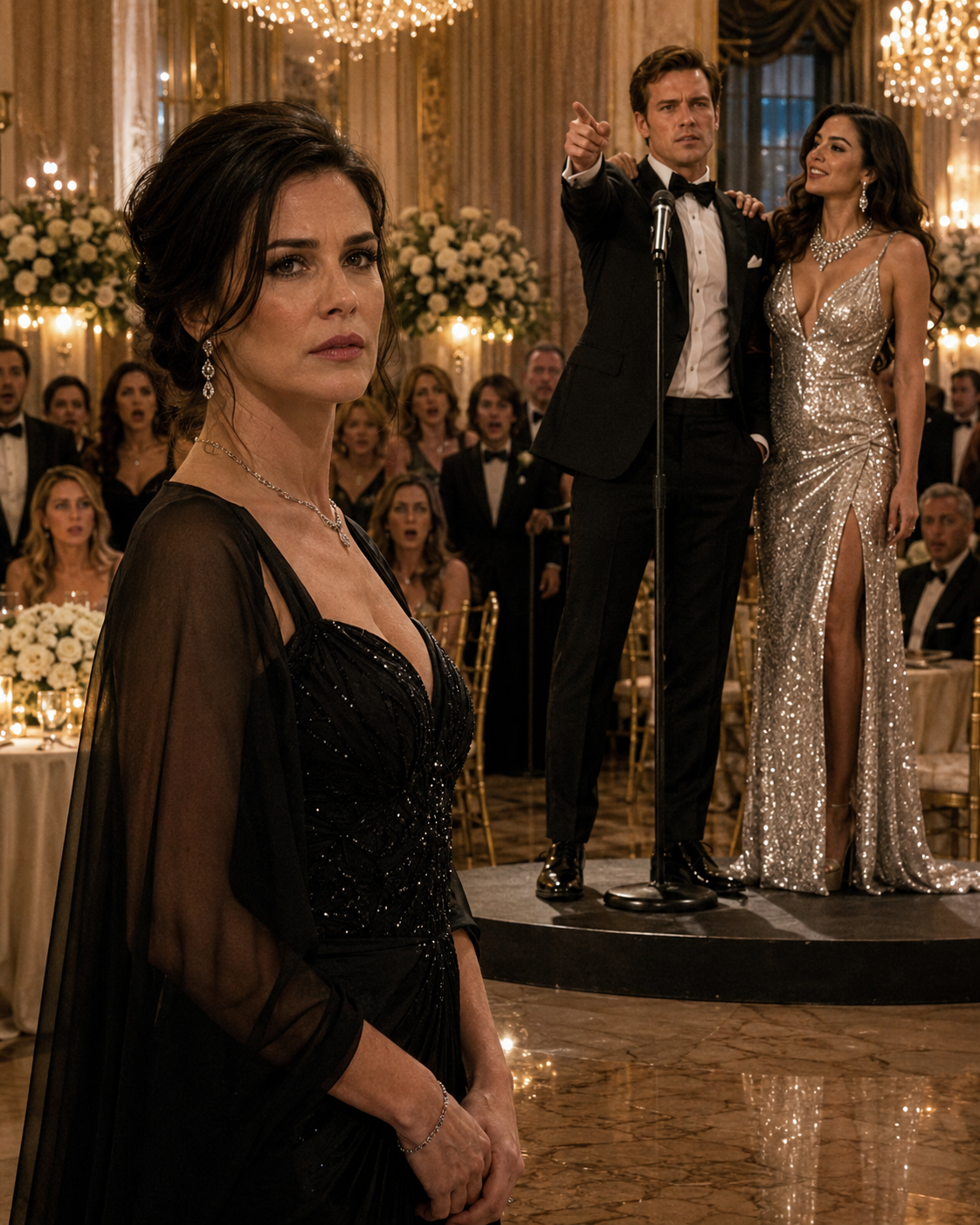
The Mistress Called Me a Broke Parasite — Then My Father’s Security Team Walked Into the Gala

My husband chose our anniversary party to introduce his mistress.

Not quietly. Not shamefully. Not with the nervous guilt of a man who knew he had shattered something sacred.

No, Marcus Vale did it beneath a chandelier made of Venetian glass, in front of three hundred guests, while a string quartet played near the marble staircase and waiters carried champagne through a ballroom my family had owned long before Marcus ever learned how to pronounce the names on the guest list.

He stood on the stage in a black tuxedo, smiling as if the evening had been arranged to celebrate him alone. Beside him stood a woman in a silver dress so tight it looked poured onto her body, her hand resting on his arm with the careless confidence of someone who believed she had already won.

Her name was Celeste Marlow.

She was twenty-six, glossy, ambitious, and wearing my necklace.

Not a similar necklace.

Mine.

A white diamond necklace my grandmother had left me, reset by a jeweler in Paris after my mother’s death. I had not worn it in years because it hurt too much. Marcus knew that. He knew exactly where I kept it. And now it glittered against Celeste’s throat while she looked down at me from the stage with a smile sharp enough to cut glass.

“Evelyn,” Marcus said into the microphone, his voice warm and theatrical, “you have always cared so much about appearances. So I thought tonight was the right moment to stop pretending.”

The room went still.

My fingers tightened around the stem of my untouched glass.

I had known about Celeste for six months. I had known about the apartment, the jewelry, the late meetings, the private trips disguised as investor weekends. I had known about the way Marcus had been draining money from one account to decorate the life he was building with her.

But knowing a humiliation is coming and watching it unfold in front of a room full of people are two different kinds of pain.

Marcus turned to Celeste, then back to the guests.

“My marriage to Evelyn has been over for a long time,” he said. “Some people are born into comfort and still manage to become cold, bitter, and useless.”

A few people shifted uncomfortably.

My sister-in-law looked down at her plate.

Marcus’s mother, Lydia, lifted her chin with satisfaction.

Celeste took the microphone from him.

That was when I knew the cruelty had been rehearsed.

“I know this must be embarrassing for you,” she said, looking directly at me. “But honestly, Evelyn, you should be grateful. Marcus is offering you a clean exit. Most women in your position would beg.”

A soft gasp moved through the ballroom.

I did not move.

Celeste smiled wider.

“I mean, let’s be honest,” she continued. “Without Marcus, what are you? A quiet little woman with old dresses, no career, no social life, and no money of your own. A broke parasite living off a man who outgrew you.”

There are moments in life when the body wants to react before the mind can stop it. My face burned. My stomach twisted. My heart slammed hard enough that I could hear my pulse in my ears.

But I had spent too many years learning silence as a weapon.

So I stayed seated.

Celeste reached into a small silver clutch and pulled out a folder.

A divorce agreement.

She held it as if it were a trophy.

“Marcus has been generous,” she said. “He’s prepared to give you five thousand dollars, your clothes, and three days to leave the house.”

That time, even the people who disliked me looked stunned.

Five thousand dollars.

Three days.

The house.

My house.

The estate where my mother had planted the rose garden. The library where my father had taught me to read annual reports before bedtime. The ballroom where Marcus now stood pretending he had built the world around him.

Marcus stepped forward and gave the room his practiced wounded-husband expression.

“I wanted to handle this privately,” he said. “But Evelyn has always avoided difficult conversations. Sometimes public honesty is the only kindness left.”

Public honesty.

The phrase almost made me laugh.

For nine years, I had allowed Marcus to believe what was useful for him to believe.

That I was estranged from my father.

That my family money had been cut off.

That the small consulting firm I ran from home was merely a hobby.

That the quiet woman who reviewed his contracts at midnight, corrected his investor decks, rebuilt his failing client strategy, and saved his company from collapse twice was just a devoted wife standing in the background.

Marcus had never understood the difference between silence and weakness.

Celeste walked down the stage steps with the folder and a pen. She stopped in front of me and held them out.

“Sign it,” she said softly, though the microphone still caught her voice. “Then you can leave with dignity.”

I looked at the pen.

Then I looked at the necklace on her throat.

“That necklace belonged to my grandmother,” I said.

Celeste touched it with two fingers and laughed. “Marcus gave it to me. Maybe you should have worn it better.”

Marcus’s smile faltered for the first time.

He knew that line had gone too far.

Not because he cared about my grandmother.

Because he sensed the room turning.

I placed my glass on the table, stood slowly, and took the pen.

A ripple went through the guests.

Lydia smiled as if victory had finally arrived.

Celeste leaned closer. “Good girl.”

I signed.

Not because I accepted the terms.

Because the document was worthless.

Marcus should have known better. He had been married to me for almost a decade, and he still had no idea that I read every line before I signed anything.

He should also have known that the agreement Celeste was waving around did not include the correct legal names, did not identify marital assets properly, and had been drafted by one of his drinking friends who thought “aggressive language” was the same thing as law.

I signed the page with calm, elegant letters.

Then I handed the folder back to Celeste.

“There,” she said triumphantly. “That wasn’t so hard.”

“No,” I replied. “It wasn’t.”

The ballroom doors opened.

Every head turned.

My father walked in.

Gideon Harrow was seventy-two years old, tall, silver-haired, and moving with the unhurried certainty of a man who had never needed to raise his voice to be obeyed. Behind him came his chief attorney, two senior financial officers, and four private security staff in dark suits.

They did not rush.

They did not threaten.

They simply entered.

And the room changed temperature.

Marcus went pale.

Not slightly.

Not politely.

His face emptied.

Celeste looked from him to my father and back again, suddenly unsure whether she should keep smiling.

My father stopped at the foot of the stage and looked at me.

“Evelyn,” he said gently. “Are you ready?”

I nodded.

Marcus swallowed. “Mr. Harrow, I didn’t know you were coming.”

“No,” my father said. “That has been the theme of your life, Marcus. You often don’t know enough.”

A nervous silence spread across the ballroom.

My father’s attorney, Miriam Chase, stepped forward with a leather portfolio.

“Mr. Vale,” she said, “as of six o’clock this evening, the Harrow Family Trust has executed its right to freeze all discretionary transfers connected to Vale Meridian Holdings pending a full audit.”

Marcus blinked. “What?”

Miriam continued, calm as winter.

“Additionally, the board has received evidence of unauthorized asset movement, misuse of company accounts, and attempted transfer of personal property belonging to Mrs. Vale.”

Celeste’s hand flew to the necklace.

Miriam looked at her. “That includes the item you are currently wearing.”

Celeste whispered, “Marcus?”

Marcus said nothing.

His eyes were fixed on me.

For the first time in years, he was actually seeing me.

Not the quiet wife.

Not the woman he mocked for not fighting back.

Not the convenient shadow who made his life smooth and asked for very little in return.

Me.

The woman who had been born into the Harrow name, walked away from its noise, and still carried its power in places Marcus had never bothered to look.

“My father doesn’t own my life,” I said softly, “but he does own this building.”

Marcus’s lips parted.

“And I,” I continued, “own sixty-eight percent of the company you have been calling yours.”

A sound passed through the ballroom.

Shock. Recognition. Panic.

Lydia stood so quickly her chair scraped the floor. “That’s impossible.”

I looked at her. “No, Lydia. It was quiet. There’s a difference.”

Marcus stepped off the stage.

“Evelyn,” he said, his voice low, intimate, pleading now. “Let’s talk somewhere private.”

I almost smiled.

“Public honesty,” I reminded him, “is the only kindness left.”

The words landed exactly where I intended.

His jaw tightened.

Celeste took a step away from him.

That was the moment I knew she had not loved him. Not really. She had loved the stage, the money, the borrowed diamonds, the fantasy of replacing a wife she thought had no power.

But fantasy ends quickly when accountants enter the room.

Miriam turned to Marcus.

“You are being removed from active executive authority pending review. Your access cards have been suspended. Your company devices will be collected tonight. You may retain counsel before making any statements.”

Marcus stared at me as though I had betrayed him.

That was the strangest part.

He had lied, stolen, flaunted another woman in my grandmother’s diamonds, and tried to discard me in front of hundreds of people.

Yet in his mind, my refusal to remain small was the real betrayal.

“Evelyn,” he said, softer now. “I made mistakes.”

“No,” I said. “You made plans.”

His expression cracked.

“You planned to humiliate me. You planned to strip me of a home that never belonged to you. You planned to let her wear my family’s necklace while calling me a parasite. The only thing you failed to plan for was the possibility that I had finally stopped protecting you.”

Celeste’s voice trembled. “I didn’t know.”

I turned to her.

For the first time all evening, her confidence was gone. Under the makeup, the diamonds, the expensive dress, she looked very young and very frightened.

“You knew enough,” I said. “You knew you were wearing another woman’s jewelry. You knew you were standing beside a married man. You knew cruelty was part of the performance, and you accepted the role because you thought the ending would benefit you.”

She looked down.

Security approached respectfully.

“Ma’am,” one of them said, “the necklace.”

Celeste unclasped it with shaking hands.

For a second, I thought I would feel satisfaction when it left her throat.

I didn’t.

I only felt tired.

So deeply, unbearably tired.

The necklace was placed in a velvet pouch and handed to Miriam. My father watched silently, his face unreadable except for the grief in his eyes.

He had warned me about Marcus once.

Only once.

On the morning of my wedding, he had stood beside me outside the chapel and said, “A man who needs you to shrink will call it love when you bend.”

I had been too proud to listen.

I had mistaken Marcus’s hunger for ambition. I had mistaken his attention for devotion. I had mistaken my ability to fix his problems for evidence that we were building something together.

We were not.

I was building.

He was taking credit.

Marcus moved closer, but one of the security men stepped gently between us.

No aggression. No drama.

Just a boundary.

The kind I should have placed years earlier.

“Evelyn, please,” Marcus said. “You can’t destroy everything over one mistake.”

I looked around the ballroom.

At the flowers I had chosen.

At the guests who had watched me be insulted and waited to see whether I would break.

At Lydia, whose face had gone gray.

At Celeste, who could no longer meet my eyes.

Then I looked back at my husband.

“One mistake?” I asked. “Marcus, the affair was not the wound. It was only the light that showed me how infected the marriage had become.”

He flinched.

“I gave you loyalty,” I said. “You turned it into invisibility. I gave you help. You turned it into entitlement. I gave you silence. You mistook it for permission.”

The room was so quiet I could hear the candles flicker.

I removed my wedding ring.

It was a simple band, far more modest than anything Marcus had ever given Celeste. I had loved that about it once. I had thought simplicity meant sincerity.

I placed it on the table beside the untouched champagne.

“I’m not fighting for this marriage,” I said. “I’m ending my participation in your performance.”

Marcus’s voice broke. “Where am I supposed to go?”

For nine years, I would have answered that question.

I would have solved the problem. Called someone. Arranged a car. Smoothed the scandal. Protected his pride.

This time, I let the silence answer first.

Then I said, “Ask someone who still believes you’re helpless.”

My father extended his arm to me.

I took it.

As we walked toward the doors, people stepped aside. Some looked ashamed. Some curious. Some impressed. I no longer cared which.

At the threshold, Marcus called my name.

I stopped, but I did not turn around.

“I loved you,” he said.

Maybe he even believed it.

That was the tragedy of men like Marcus. They could confuse possession with love so completely that losing control felt like heartbreak.

“No,” I said quietly. “You loved being forgiven.”

Then I left.

Outside, the night air was cold and clean. Rain had begun to fall lightly over the city, turning the pavement silver beneath the hotel lights. My father’s car waited at the curb.

For a moment, I stood beneath the awning and let myself breathe.

No cameras.

No applause.

No dramatic music.

Just air.

My father stood beside me without speaking. He had never been good with emotional speeches, but he had always understood presence. After my mother died, he had sat outside my bedroom door every night for two weeks because I did not want company, but I did not want to be alone either.

Finally, he said, “I should have come sooner.”

I shook my head. “I had to choose it myself.”

He nodded.

Miriam stepped outside behind us. “The car is ready. The necklace is secure. We’ll file the appropriate motions in the morning.”

“In the morning,” I repeated.

It sounded strange.

There would be a morning after this.

For months, I had imagined the end of my marriage as a collapse. I had pictured myself ruined, embarrassed, abandoned, spoken about in whispers.

But standing there in the rain, I understood something.

What ended in that ballroom was not my life.

Only the lie that had been standing in its place.

The next morning, Marcus called forty-three times.

Celeste called once.

Lydia sent a message that began with, “For the sake of the family…”

I deleted it before reading the rest.

Because the family she meant had never included me.

By noon, the board had confirmed interim leadership. By three, the audit team had entered Marcus’s office. By evening, the gossip pages had the story wrong in six different ways, which was almost funny.

They called me cold.

They called me ruthless.

They called me secretly powerful, as though power only becomes real when someone else notices it.

But the headline I cared about never appeared anywhere.

It was quiet, private, and belonged only to me.

A woman who had been publicly discarded walked out before anyone could decide what she was worth.

And she never looked back.

The Mistress Called Me a Broke Parasite — Then My Father’s Security Team Walked Into the Gala
This year I turned 63. I have outlived two husbands, but I still decided to marry a man 29 years younger than me for the third time, despite my children’s objections.