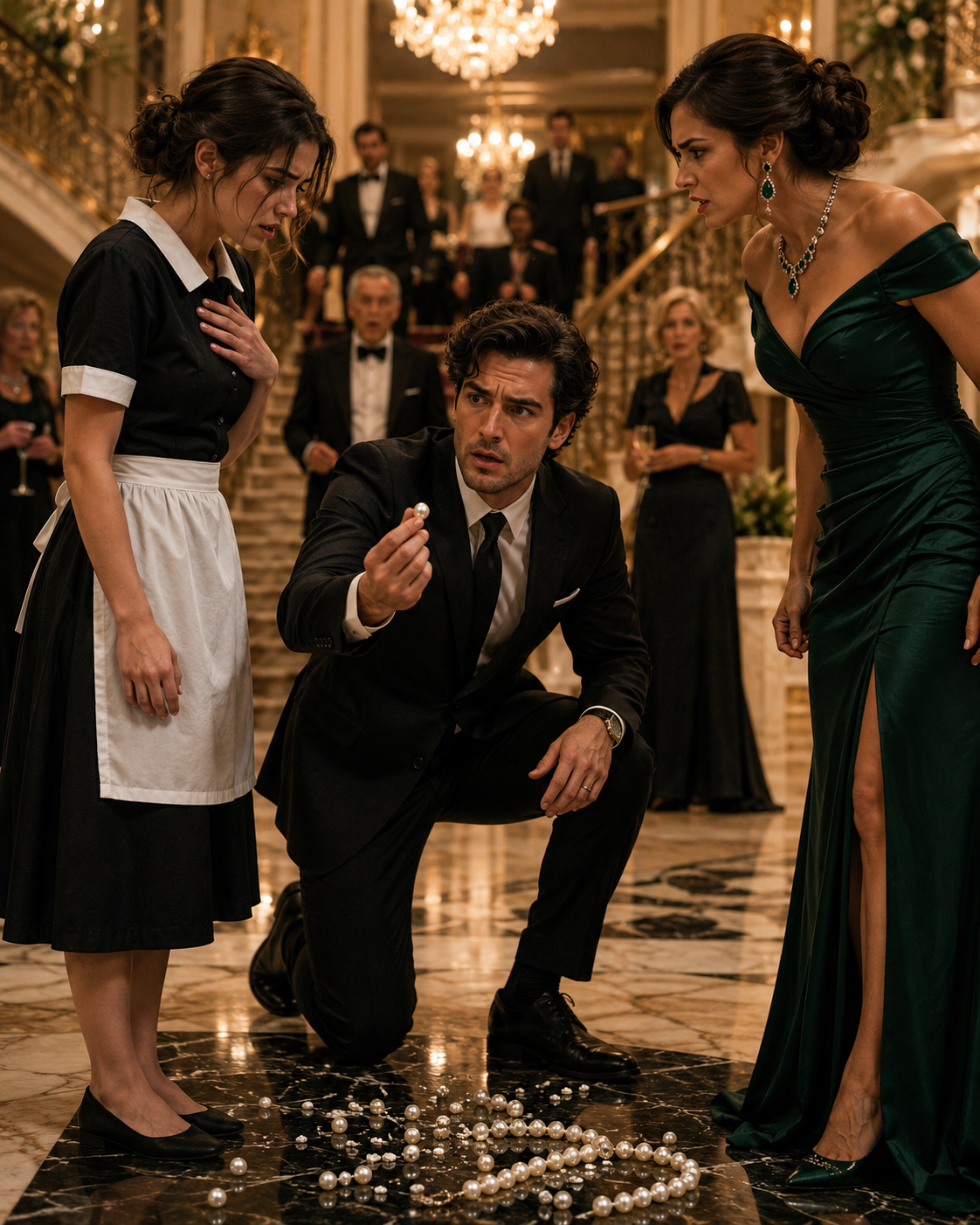
The marble foyer of the Blackthorne estate had been built to impress people who believed they could not be impressed.
Two sweeping staircases curved upward beneath a chandelier bright enough to make every glass of champagne sparkle like liquid gold. Musicians played softly in the gallery above. Servants moved between clusters of guests with silver trays, their steps quiet, their eyes lowered, their presence expected but never acknowledged.
Clara Vale had learned how to disappear in rooms like that.
She knew when to move, when to pause, when to lower her gaze before a guest noticed she had heard too much. She knew which women smiled kindly and which ones used kindness as a blade. She knew which men treated staff like furniture and which ones made eye contact just long enough to prove they considered themselves generous.
But that evening, no amount of careful silence could save her.
Clara was crossing the foyer with a tray of untouched crystal glasses when Selina Marlow saw the necklace.
Selina stood near the staircase in a deep emerald gown, one hand resting on the polished banister, the other wrapped around a champagne flute she had barely touched. She was not officially mistress of the house, but she acted as if the walls had already accepted her. For six years she had lived beside Adrian Blackthorne, hosted his dinners, managed his household, and arranged herself so perfectly into his world that most people assumed marriage was only a matter of timing.
Selina’s eyes narrowed at Clara’s throat.
The necklace was simple. A short strand of old pearls, uneven in shape, softly worn with age. Nothing fashionable. Nothing impressive. Nothing that belonged in a ballroom full of diamonds and emeralds.
But to Clara, it was the only treasure she owned.
Her mother had placed it in her hands three weeks before dying and said, “One day, you may understand why I kept this. Until then, don’t let anyone make you ashamed of it.”
Clara had worn it beneath her uniform every day since.
That night, one pearl had slipped above her collar.
Selina saw it.
“What is that?” she asked.
Clara froze.
The musicians kept playing. Guests kept talking. But Clara felt the question strike her like cold water.
“Madam?”
Selina stepped closer, her smile sharp enough to cut.
“That thing around your neck.”
Clara touched the pearls instinctively. “It belonged to my mother.”
“How sentimental.” Selina’s gaze swept over the strand. “And how inappropriate.”
Clara lowered her hand. “I’m sorry. It wasn’t meant to show.”
“It wasn’t meant to be worn in this house at all.”
Several guests turned. A footman stopped near the archway. Clara could feel every pair of eyes gathering on her, slow and hungry.
Selina set her champagne glass on the tray Clara was holding, making the crystal chime against the others.
“Do you know where you are?” Selina asked softly. “This is the Blackthorne estate. People do not come here wearing cheap little trinkets and pretending they belong.”
Clara’s face burned.
“I’m not pretending anything.”
That was the wrong answer.
Selina’s expression hardened. She reached forward and caught the necklace between two fingers.
Clara stepped back. “Please don’t.”
But Selina pulled.
The old clasp gave way.
Pearls scattered across the marble floor with a sound so delicate and terrible that the entire foyer went silent.
One rolled beneath a console table. Another bounced down the first step of the staircase. A third came to rest beside Selina’s shoe.
Clara stood perfectly still.
For a moment, she could not breathe.
Then she dropped to her knees.
“No,” she whispered, gathering the pearls with shaking hands. “No, no, please…”
Selina looked down at her.
“Don’t wear cheap trash in my house,” she said.
The cruelty of it was so casual that it seemed to echo longer than the broken necklace had.
Then a man’s voice came from the hallway behind them.
“What happened here?”
Adrian Blackthorne had arrived late to his own party.
He was still wearing his overcoat, damp from the November rain, his dark hair wind-touched, his expression already tired before he saw Clara kneeling on the marble. He had spent the day with lawyers, trustees, and old accounts that refused to balance cleanly. He had expected a formal evening, not a servant in tears and Selina standing above her like a queen who had just ordered a punishment.
No one answered at first.
Adrian stepped forward.
Clara tried to rise, but one of the pearls slipped from her palm. Adrian bent to pick it up.
His fingers closed around the largest pearl.
Then he stopped.
The silence in the foyer changed.
At first, no one understood why.
Adrian stared at the pearl in his hand. It was not perfectly round. It had been carved almost invisibly on one side, the mark so small most people would have missed it entirely.
But Adrian had grown up with that mark.
A thorned crown around a blackbird.
The private crest of the Blackthorne women.
His grandmother’s seal.
His mother had worn it on letters. His aunt had used it on wax. His younger sister, Marianne, had once drawn it on the margins of her schoolbooks until their father scolded her for ruining expensive paper.
Adrian’s face lost color.
He turned the pearl toward the chandelier light and looked again.
There was no mistake.
“Where did you get this?” he asked.
Clara looked up, frightened by the change in his voice.
“My mother gave it to me.”
“What was her name?”
Clara pressed the remaining pearls to her chest.
“Nora,” she said. “Nora Vale.”
Adrian did not move.
“Nora,” he repeated.
The name struck something buried so deep inside him that for a moment he felt twenty years younger and unbearably old at the same time.
Nora was the name his sister had chosen after she left.
Not Marianne Blackthorne. Not the daughter of Malcolm Blackthorne. Not the girl who vanished after one final argument and became a wound no one in the family was allowed to touch.
Nora Vale.
His sister had been alive.
His sister had had a daughter.
The young woman kneeling on his foyer floor was not a servant with an old necklace.
She was blood.
Selina seemed to understand the danger before anyone else did.
“Adrian,” she said quickly. “This is absurd. You can’t seriously—”
He raised one hand.
Not loudly. Not angrily.
But Selina stopped speaking.
Adrian looked at Clara again. Really looked at her.
The shape of her mouth. The stubborn lift of her chin. The dark eyes that held fear and dignity in equal measure.
His sister’s eyes.
“How old are you?” he asked.
“Twenty-eight.”
His breath caught.
Marianne had disappeared twenty-nine years ago.
Adrian slowly knelt in front of Clara, careless of his tailored suit on the marble floor.
“Your mother,” he said, his voice rough, “did she ever tell you where she came from?”
Clara shook her head. “She said some families were doors you had to close if you wanted to survive.”
Behind them, someone gasped.
Adrian closed his eyes.
When he opened them, they were wet.
“What did she tell you about the necklace?”
“That it was from the life before me,” Clara whispered. “And that if I ever found the right place, it would speak for her.”
Adrian opened his palm.
The pearl with the hidden crest rested there like a verdict.
“It just did,” he said.
Selina took one step back.
The guests were no longer pretending not to listen.
Adrian stood slowly, bringing Clara up with him. He did not know whether to embrace her, apologize to her, question her, or fall apart in front of half the city.
So he did the only thing he could do.
He turned to Selina.
“You will leave,” he said.
Selina stared at him. “Adrian, you are in shock.”
“I said you will leave.”
“You don’t know who she is.”
“I know exactly what she is.” His voice dropped. “She is someone you humiliated in my house. Someone whose mother may have been my lost sister. Someone wearing my grandmother’s pearls.”
Selina’s lips parted.
The calculation moved across her face before she could hide it.
Grandmother’s pearls meant family.
Family meant inheritance.
Inheritance meant the future Selina had been building for six years was cracking under her feet.
“Adrian,” she said, suddenly soft. “Let’s not make a spectacle.”
“You made the spectacle.”
The foyer remained frozen.
Then Thomas Wren, the elderly butler who had served the Blackthorne family for forty-four years, stepped forward.
He held a small leather box.
Adrian turned. “Thomas?”
The old man’s expression was grave.
“I believe Miss Vale should see this now.”
Selina went still.
That tiny reaction told Adrian everything.
“You knew about this?” he asked.
Thomas did not look away.
“I suspected. I did not know. Not until she arrived here six months ago.”
Clara stared at him. “You knew me?”
“I knew your mother,” Thomas said softly. “And I knew the necklace.”
He placed the leather box on a side table and opened it.
Inside were old photographs, yellowed letters, a birth certificate, and another strand of pearls.
A matching strand.
Whole, unbroken, carrying the same hidden crest.
Clara reached toward it, then stopped as if afraid the past might vanish if she touched it too quickly.
Adrian picked up one of the photographs.
A young woman smiled at the camera, hair loose in the wind, chin lifted with familiar defiance.
Marianne Blackthorne.
Nora Vale.
Clara’s mother.
Clara covered her mouth.
Adrian looked at the birth certificate next.
His hands trembled.
The father’s name was not missing.
It was not unknown.
It was Malcolm Blackthorne.
Adrian’s father.
For a long moment, he did not understand what he was seeing.
Then he understood too much.
Clara was not his niece.
She was his half-sister.
And the woman Selina had just called cheap trash was one of the rightful heirs to the Blackthorne estate.
The next hour did not feel real.
Guests were escorted out with quiet efficiency. Selina tried twice to speak with Adrian privately and was denied both times. Thomas ordered tea no one drank. Clara sat in the library holding the two strands of pearls, one broken, one whole, while Adrian paced between the fireplace and the windows like a man trying to outrun his own guilt.
He had lived in the same house with her for six months.
She had polished silver in rooms where portraits of her ancestors hung above her head.
She had slept in the staff wing while the east bedroom, once belonging to his grandmother, remained empty.
She had carried trays past family members who did not know she was family.
And he had not seen her.
“I should have known,” he said.
Clara looked up. “How could you?”
“Because I spent twenty years searching for my sister.”
“You searched?”
“After my father died, yes. Before that, not enough.”
Thomas stood near the library table, hands folded.
Adrian looked at him. “Tell us everything.”
Thomas did.
He told them about Marianne as a child, clever and fierce, always asking questions the family did not want asked. He told them how Malcolm Blackthorne loved obedience more than truth and reputation more than tenderness. He told them about the final argument, the one that began with hidden accounts and ended with Marianne leaving the house with a single bag.
“She discovered irregularities in your father’s private financial arrangements,” Thomas said. “Not theft, precisely. Not something simple enough to name. But enough to frighten him. Enough that he wanted her quiet.”
Clara listened without blinking.
“My mother never told me.”
“She may have thought silence was protection.”
“From him?”
“From the whole house,” Thomas said.
Adrian sat down heavily.
“My father told me she was unstable. That she wanted to punish us. That she ran because she hated the family.”
“She ran because she understood what staying would cost her,” Thomas replied.
The words settled like ash.
Then Thomas opened another envelope from the box.
“There is more.”
It was a letter written by Malcolm Blackthorne six months after Marianne disappeared.
It had never been sent.
Adrian read it aloud.
At first his voice was steady. Then it faltered.
The letter was not enough. It did not erase what Malcolm had done. It did not excuse the pressure he had placed on his daughter, or the way he had tried to solve human pain with money and silence.
But it admitted more than anyone expected.
Malcolm had known about Clara before Marianne left.
He had known he had another daughter.
He had written that the door remained open.
Then he had locked the letter in a box and done nothing.
When Adrian finished, Clara took the pages from him and read the last lines herself.
Her face changed, not with forgiveness, but with something quieter.
“He knew I existed,” she said.
Adrian looked at her. “Clara—”
“I’m not saying that makes it right.” She folded the letter carefully. “But I spent my whole life feeling like a secret no one had ever admitted. He admitted me somewhere, even if only to himself.”
Thomas bowed his head.
Adrian said, “That is not enough.”
“No,” Clara said. “But it is not nothing.”
By morning, the estate had changed.
Not visibly. The marble still shone. The portraits still watched from the walls. The staff still moved with quiet precision.
But everyone inside the house knew the center of it had shifted.
Selina knew it too.
She did not go home after leaving the estate. She went directly to the office of Leonard Pryce, the kind of attorney whose name did not appear on the building because his clients preferred discretion to advertisements.
She arrived in the same emerald dress, her composure repaired but not restored.
Leonard listened without interrupting.
When she finished, he tapped his pen against his desk once.
“You want the truth or comfort?”
“Truth.”
“You are in a difficult position.”
“How difficult?”
“If the birth certificate is authenticated, if the pearl crest is verified, if the family employee’s testimony stands, and if Adrian has already amended the trust documents, then extremely difficult.”
Selina’s jaw tightened. “Can we challenge it?”
“We can challenge anything. The question is what survives.”
He explained the narrow openings: chain of custody, timing of the DNA test, whether the documents had been properly preserved, whether Clara’s identity could be contested long enough to delay her legal recognition.
Selina listened.
Then she surprised him.
“She is real,” she said.
Leonard looked up.
Selina stared at the window behind him. “I saw it before anyone said it. Something about her always bothered me. Not because she was incompetent. Because she wasn’t. Because she moved through that house as if she had a right to be unnoticed, and somehow that felt like a threat.”
“And your response was to break her necklace.”
Selina’s mouth tightened.
“Yes.”
Leonard made a note.
“That was unfortunate.”
“That was catastrophic.”
“Yes,” he said. “That too.”
Selina built her case anyway.
For three weeks she moved through legal strategy, old correspondence, social leverage, and quiet phone calls. She contacted Adrian’s aunt, Beatrice Blackthorne, who had lived abroad for decades and had her own unresolved history with the family. Selina believed Beatrice might join her challenge if the revised inheritance threatened old trust arrangements.
But Beatrice did not come for Selina.
She came for Clara.
When Beatrice arrived at the estate, she stepped into the sitting room, looked at Clara for three seconds, and began to cry.
“You have Marianne’s face,” she said.
Clara did not know what to do with that.
Beatrice took her hands. “I tried to find you after your mother died. I sent a letter. It came back. I should have done more.”
Clara had heard many apologies in the weeks since the necklace broke. Some were polite. Some were defensive. Some were really requests for absolution wearing the clothing of regret.
Beatrice’s was different.
It asked for nothing.
So Clara held her hands back.
Together, Beatrice, Thomas, Adrian, and Clara built the truth piece by piece.
A former housekeeper named Mrs. Greer arrived with copies of old records she had preserved for years. There were documents showing Malcolm had tried to send money after Marianne left, and that Marianne had refused it. There were notes proving the leather box had existed long before Selina’s challenge. There were dated photographs, private journals, legal references, and finally two independent DNA results.
Selina’s challenge collapsed before it truly began.
The judge confirmed Clara Vale Blackthorne as a direct heir.
For the first time in her life, Clara had more than a name.
She had a place.
But place did not feel simple.
After the hearing, she left the estate for eight days.
Not forever. Not like her mother.
She drove north to a cold coastal town where the wind was sharp enough to make thoughts honest. She walked along the beach in a heavy coat and thought about her mother as a nineteen-year-old girl leaving a mansion with one bag, a pearl necklace, and a child no one had been brave enough to claim properly.
She thought about Malcolm’s letter.
She thought about Adrian’s guilt.
She thought about Thomas waiting for the right moment.
She thought about the east bedroom, the breakfast table, the repaired pearls, and the strange pain of discovering that something had always belonged to you after you had already learned how to live without it.
On the eighth day, she returned.
Adrian met her at the door.
He tried to hide his relief and failed.
At dinner that night, Clara said, “I don’t want to just inherit money.”
Adrian looked at her across the table. “What do you want?”
“I want to build something for girls like me.”
“Girls with secret inheritances?”
“No.” Clara smiled faintly. “Girls standing outside doors they don’t know are theirs.”
That became the beginning.
With Adrian’s support, Beatrice’s foundation, Thomas’s memory, Mrs. Greer’s network, and Clara’s stubborn clarity, they created The Open Door Trust — an organization for young women cut off from family histories, legal claims, guardianship rights, or inheritances they did not know how to access. It was not glamorous work. It did not make fashionable headlines. But Clara understood the gap it filled because she had lived inside that gap.
Months later, Selina asked to meet.
Adrian was cautious. His attorney was more cautious. But Clara agreed.
They met in a neutral hotel room with pale walls, a round table, and no history.
Selina arrived without jewelry.
For once, she looked less arranged.
“I owe you an apology,” she said.
Clara waited.
“I knew something about you frightened me,” Selina continued. “I didn’t know what it was. I only knew that you threatened a future I had spent years building. And instead of asking why, I tried to make you small.” She swallowed. “The necklace was not strategy. It was cruelty. That is worse, in some ways. I am sorry for what I did to your dignity before I knew what your name meant.”
Clara studied her for a long time.
Then she said, “You loved Adrian.”
Selina blinked.
“That was real,” Clara said. “Not all of it. But some of it.”
Selina’s eyes shone before she looked away.
“Yes.”
“I watched you for six months,” Clara said. “From the side people don’t look at. You were ambitious. You were cruel. You were also sometimes genuine. I think truth is more useful than making you a simple villain.”
Selina gave a small, broken laugh.
“You sound like your mother, from what I’ve heard.”
Clara looked down at her hands.
“That is the best thing anyone can tell me.”
Selina accepted a modest settlement for her years of managing the household and left without another challenge.
No one called it forgiveness.
Some things are not clean enough for that word.
But it was an ending.
One year after the night the necklace broke, the Blackthorne estate held a dinner.
No politicians. No strategic guests. No glittering performance of power.
Just Clara, Adrian, Beatrice, Thomas, Mrs. Greer, their attorneys, and the few people who had helped turn a broken inheritance into something living.
After the meal, Adrian brought out the leather box.
Inside he placed a photograph Clara had carried since childhood: her mother on a beach, younger than any of them had known her, holding Clara at seven years old while both of them squinted into the same bright wind.
Beside it he placed Malcolm’s unsent letter.
Then Thomas opened a velvet pouch.
The broken necklace had been restored. Every pearl found. Every gap repaired. The strand was whole again, resting beside its twin.
Clara picked it up with both hands.
“My grandmother split them,” she said softly. “One strand went with my mother. One stayed here. I used to think that meant the family broke in two.”
Thomas said, “Perhaps it did.”
Clara nodded. “But maybe she understood something else. Maybe she knew people get separated. Maybe she wanted both halves to exist in the world until they could find each other again.”
No one spoke.
“A pearl is made because something hurts,” Clara said. “Something gets inside that shouldn’t be there, and beauty grows around it because survival needs a shape. My mother’s leaving hurt. My not knowing hurt. Adrian searching and not finding hurt. Even this house hurt people.”
She looked around the dining room — at the brother she had not known, the aunt who had tried too late and then tried again, the butler who had kept the truth safe, the old house that had finally opened its doors.
“But the damage did not get the final word.”
Adrian reached across the table and gently covered her hand with his.
“She would have said that,” he whispered. “Marianne.”
Clara smiled through tears.
“She did,” Clara said. “Just in different words.”
She placed the necklace back in the box.
Then she changed her mind.
She lifted it again and fastened it around her neck.
Not hidden beneath a servant’s collar.
Not tucked away in shame.
Openly.
Where everyone could see.
Later, Clara stood by the window and looked out at the November garden. It was the same season as the night she arrived with one suitcase, a borrowed reference, and no idea that she was walking into the house that had always been part of her story.
Everything had changed.
And somehow, she was still exactly herself.
Her mother’s daughter.
Her grandmother’s heir.
Her brother’s family.
A woman who had once knelt on a marble floor gathering broken pearls while others watched.
A woman who now knew that even broken things could return whole.
Behind her, Adrian called her name.
Clara turned.
Her family was waiting at the table.
And this time, she went to them without lowering her eyes.

