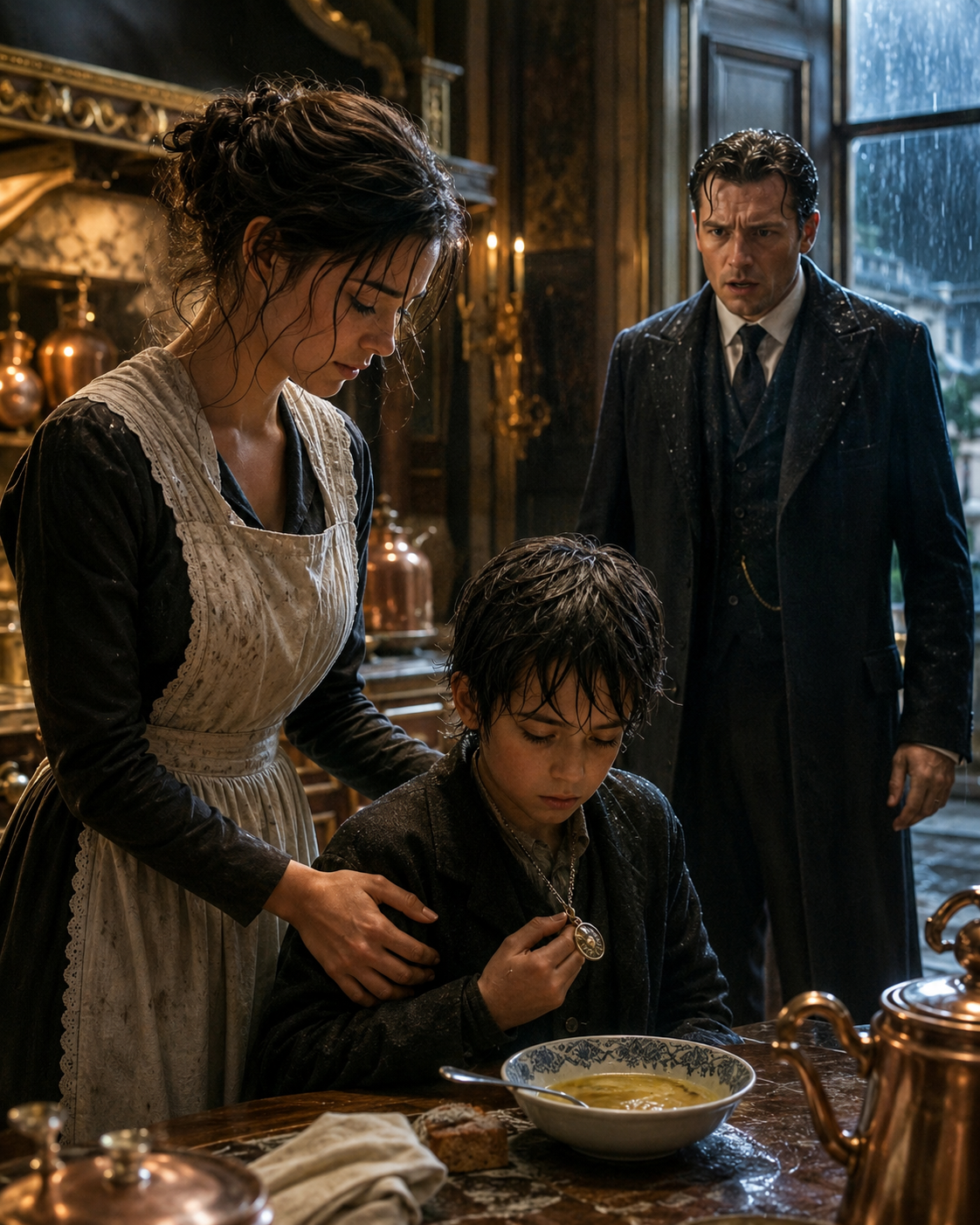
Rain had been falling over Blackwood Hall since morning, not in soft silver lines, but in cold, slanted sheets that made the old estate look as if it were sinking into the earth.
Mara Ellis stood beneath the stone archway near the front entrance, gathering wet leaves from the steps before they could stain the marble. The house behind her was enormous, elegant, and silent — too silent for a place with thirty rooms, three kitchens, two libraries, and enough chandeliers to light a ballroom.
Silence was one of the rules at Blackwood Hall.
Do your work. Keep your head down. Do not ask questions. Do not linger in rooms where you are not needed. And above all, do not bring trouble to Cassian Vale’s door.
Everyone in the house knew those rules.
Cassian Vale was one of the richest men in the country, a man whose name appeared in business magazines and whispered conversations. He owned hotels, shipping companies, towers of glass in cities Mara had only seen in pictures. But inside his own home, he was less like a man and more like a locked door.
He rarely smiled. He rarely raised his voice. He never explained himself.
Mara had worked for him for almost a year, long enough to learn that Blackwood Hall was beautiful only from a distance. Up close, it felt cold enough to freeze a person from the inside.
She was brushing leaves into a copper dustpan when she heard something beyond the gate.
Not a shout.
Not a knock.
A small sound.
A cough, thin and painful, nearly lost beneath the rain.
Mara looked up.
At first, she saw only the iron bars of the gate and the long driveway disappearing into mist. Then a shape shifted near the stone wall.
A child.
He stood just outside the gate, one hand gripping the wet iron, the other pressed against his chest. He could not have been more than ten. His coat was too small, his shoes were split at the toes, and rain had flattened his dark hair against his forehead.
Mara froze.
The guards were not at the entrance. The housekeeper was upstairs. Mr. Vale was supposed to be in the city until late evening.
The boy looked at her but did not speak.
There was something in his face that Mara recognized immediately — not just hunger, not just fear, but the exhausted look of someone who had stopped expecting mercy.
She set the broom aside and walked toward him.
“Are you lost?” she asked gently.
The boy’s lips moved, but no sound came out.
Mara reached through the bars and touched his fingers. They were icy.
“Are you hungry?”
This time, he nodded.
That tiny movement was all it took.
Mara opened the side gate.
She knew she could lose her job for this. She knew the head housekeeper would call it reckless. She knew Mr. Vale would call it unacceptable.
But the child was shivering so hard his teeth clicked together, and Mara had never been good at pretending not to see pain.
“Come in,” she whispered. “Just for a little while.”
The boy stepped through the gate carefully, as if he expected the ground itself to reject him.
Inside the service kitchen, warmth wrapped around him. He stopped at the doorway, eyes wide, staring at the polished counters, copper pans, and glowing stove as though he had entered a palace.
Mara pulled out a chair.
“Sit down.”
He obeyed without a word.
She found leftover chicken stew from lunch, added bread, warmed milk, and placed everything in front of him. The boy stared at the bowl but did not touch it.
“It’s all right,” she said. “No one will take it away.”
Only then did he pick up the spoon.
He ate too fast at first, like he feared the food might disappear. Then he slowed, ashamed of his own hunger. Mara turned away and pretended to wipe the counter so he would not have to feel watched.
“What’s your name?” she asked.
The boy swallowed.
“Eli.”
“Eli,” she repeated softly. “That’s a good name.”
He looked down at the table. “My mother chose it.”
Mara noticed then that one of his hands still held something beneath his shirt. Not tightly, exactly. Protectively.
Before she could ask about it, the front door slammed.
The sound rolled through the house like thunder.
Eli dropped the spoon.
Mara’s heart stopped.
No.
Heavy footsteps crossed the marble hall. Calm. Measured. Familiar.
Cassian Vale was home early.
Mara turned toward the kitchen entrance just as he appeared there, still wearing his dark overcoat, rain shining on his shoulders. His expression was unreadable, but his eyes took in everything at once.
The bowl.
The child.
Mara.
For one terrible second, no one breathed.
Then Mara stepped forward.
“Mr. Vale, I can explain.”
His eyes did not leave the boy.
“I found him outside the gate,” she continued, her voice trembling despite her effort to keep it steady. “He was soaked through. He was hungry. I know I broke the rules, and I’ll accept whatever consequence you decide, but I couldn’t leave him in the rain.”
Cassian said nothing.
That silence was worse than anger.
Eli slid down from the chair, ready to run, but his small hand jerked up to his chest again. The movement pulled the collar of his shirt aside.
A silver locket swung into view.
Cassian’s face changed.
It happened so quickly Mara almost missed it. The hard mask slipped. His eyes sharpened, then widened. Color drained from his cheeks.
He took one step forward.
“Where did you get that?”
Eli backed into the chair.
Mara moved instinctively between them. “Sir, please. He’s frightened.”
Cassian’s voice came lower this time. Not angry. Broken.
“The locket,” he said. “Where did you get it?”
Eli looked at him, confused and terrified.
“My mother gave it to me.”
Cassian stared as if the boy had spoken a language from another life.
“Your mother,” he repeated.
Eli nodded. “She told me not to lose it. She said if I ever found Blackwood Hall… if I ever found a man named Cassian Vale… I should show it to him.”
Mara felt the air leave the room.
Cassian reached for the back of a chair as if the floor had shifted beneath him.
“What was her name?”
The boy’s mouth trembled.
“Livia.”
The name struck Cassian like a blow.
For the first time since Mara had entered his service, she saw him look human. Not powerful. Not distant. Human — wounded, stunned, and suddenly much older than he had seemed moments before.
“Livia was dead,” he whispered.
Eli shook his head. “She was sick. She said people told you she left. But she said that wasn’t true.”
Cassian closed his eyes.
Mara looked from the man to the child and understood that she was standing in the middle of a secret that had been buried for years.
Cassian knelt slowly, bringing himself to Eli’s height.
“May I see it?” he asked.
Eli hesitated.
Then, carefully, he lifted the locket over his head and placed it into Cassian’s shaking hand.
Cassian opened it.
Inside was a tiny faded photograph of a young woman with bright eyes and windblown hair. She held a newborn wrapped in a pale blanket. On the other side was a small pressed blue flower, dry and fragile as memory.
Cassian stared at the photograph.
His lips parted, but no words came.
Mara saw his hand begin to tremble.
“She had a baby,” he said at last. “She had my child.”
Eli’s eyes filled with tears. “She said you didn’t know.”
Cassian looked up.
“What did she tell you?”
“That she tried to come back,” Eli whispered. “That someone stopped her. She said letters were sent, but not to trust the answers. She said if anything happened to her, I had to come here.”
Cassian lowered his head.
The great billionaire of Blackwood Hall, the man everyone feared, knelt on the kitchen floor with rainwater still dripping from his coat and tears sliding down his face.
“How old are you?” he asked.
“Nine.”
Cassian covered his mouth with one hand.
Nine years.
Nine birthdays he had missed. Nine winters. Nine years of a child growing somewhere beyond his reach while he lived in this silent house, believing the woman he loved had chosen to disappear.
Mara stepped back, her own eyes burning.
Eli whispered, “Are you angry?”
Cassian looked at him as if the question had broken what was left of his heart.
“No,” he said. “No, Eli. I am not angry with you.”
“Then why are you crying?”
Cassian reached for him slowly, giving the boy every chance to pull away.
“Because I should have found you sooner.”
Eli stood very still.
Then he stepped forward.
Cassian wrapped his arms around him gently at first, as though he feared the child might vanish. Then Eli began to cry, and Cassian held him tighter, one hand on the back of his head, the other clenched around the open locket.
Mara turned away, but not before she saw Cassian press his face against the boy’s damp hair.
The kitchen, usually ruled by order and polished steel, became the place where Blackwood Hall’s oldest lie began to fall apart.
By nightfall, the entire house had changed.
Cassian did not shout. He did not rage. He became very quiet, and that quiet was more powerful than fury.
He ordered the locked east study opened for the first time in years. He had old boxes carried down from storage. He sent for records, private files, bank statements, and letters that had been hidden under names Mara did not recognize.
The head housekeeper, Mrs. Calder, turned pale when she saw the locket.
The estate manager would not meet Cassian’s eyes.
By midnight, the truth was no longer a shadow.
Livia had never abandoned him.
Letters had been intercepted. Payments had been made. A false story had been built carefully by people who feared that Cassian’s marriage to a woman without status would cost them their positions, their influence, and their access to his fortune.
Livia had been sent away while pregnant.
Cassian had been told she left him.
And Eli had spent his life with a mother who loved him fiercely but carried too much fear to return until it was too late.
Mara listened from the hallway as Cassian dismissed the people who had kept the truth from him. His voice never rose. That made it even more final.
Before dawn, Blackwood Hall was no longer the same house.
Eli slept in a guest room with warm blankets, new clothes folded on the chair, and shoes placed carefully beside the bed. Cassian sat near him through the night, afraid to close his eyes, afraid that grief might wake him from this impossible gift.
Mara came in quietly with tea.
“You should rest, sir,” she said.
Cassian looked up at her. His face was tired, but something in him had softened.
“You saved my son before I even knew he was mine.”
Mara lowered her eyes. “I only gave a hungry child a meal.”
“No,” Cassian said. “You did what everyone else in this house had forgotten how to do. You chose kindness over rules.”
Mara did not know how to answer.
The rain stopped just as morning touched the windows.
Eli stirred, one hand reaching for the locket that was no longer around his neck. Cassian placed it gently in his palm.
“I kept it safe,” he said.
Eli blinked at him, still half asleep.
“Are you really my father?”
Cassian’s breath caught.
“Yes,” he said. “And if you’ll let me, I’m going to spend the rest of my life proving it.”
Eli looked at him for a long moment.
Then he whispered, “Mama said you would cry when you knew.”
Cassian smiled through fresh tears. “She knew me better than anyone.”
Later that morning, Mara found Cassian standing in the kitchen alone, the locket open in his hand. There was something tucked behind the photograph — a folded scrap so small it had gone unnoticed until the chain caught on its edge.
Cassian unfolded it carefully.
Mara saw only a few faded lines written in Livia’s hand.
Cassian read them once.
Then again.
His face changed.
“What is it?” Mara asked softly.
He looked at her, stunned.
“She wrote your name.”
Mara went cold.
“My name?”
Cassian turned the paper toward her.
The message was brief, but it seemed to pull every hidden thread of the past into the light.
If our son reaches Blackwood Hall, trust the woman who feeds him when no one is watching. She will have the courage this house lost.
Mara stared at the words.
She did not understand how Livia could have known. She did not understand why fate had placed her at the gate on that rainy afternoon, with a broom in her hand and a choice in front of her.
But Cassian looked at her not as a servant, not as someone beneath him, but as the person who had opened the door when his own life came knocking.
For years, Blackwood Hall had been a mansion full of locked rooms, polished lies, and beautiful emptiness.
Now there was a boy asleep upstairs.
A father learning how to stay.
A woman whose simple act of mercy had changed everything.
And for the first time in nearly a decade, the great house did not feel haunted.
It felt alive.