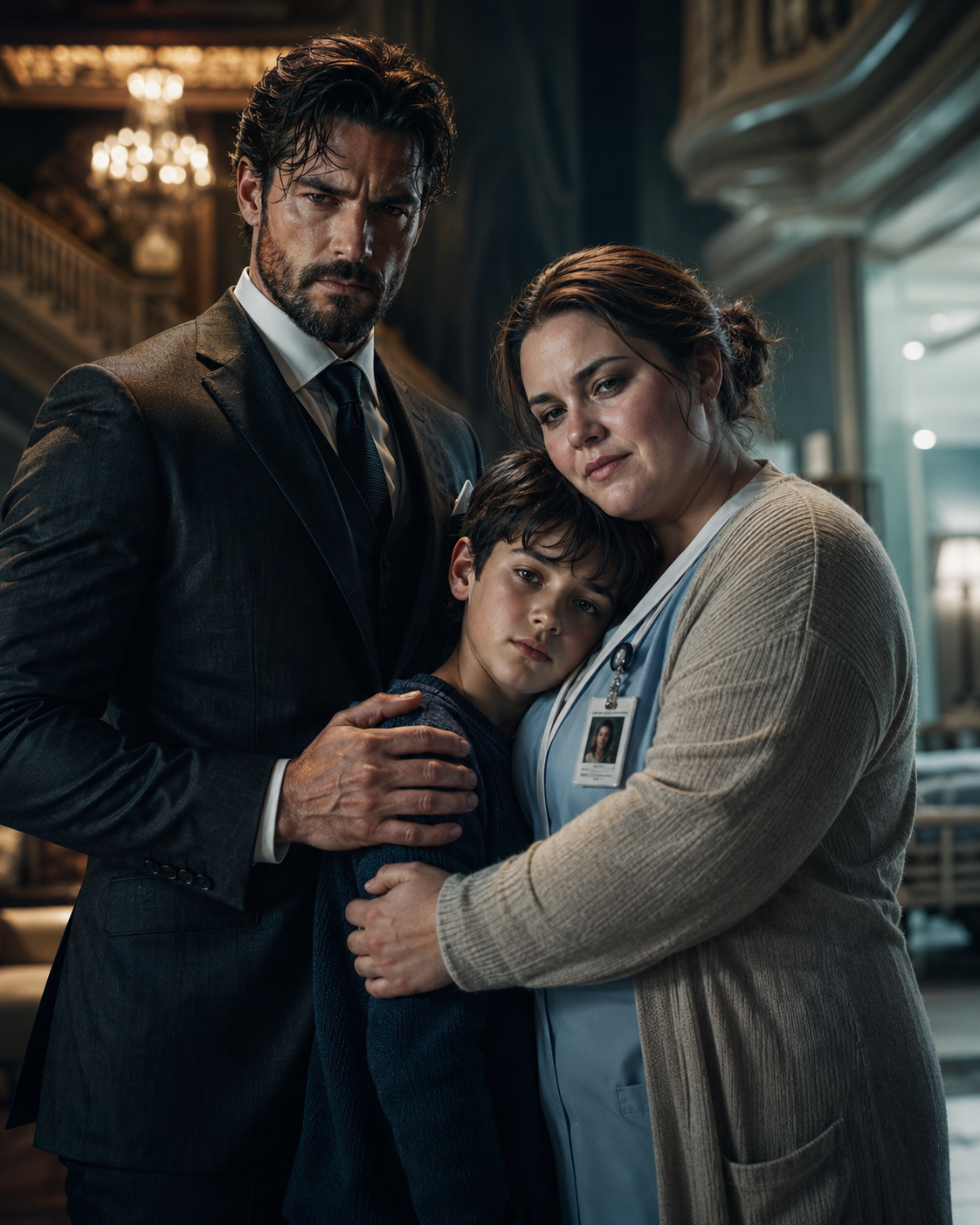
Outside the frosted window, snow moved sideways across the courtyard of Ashbourne Academy. Inside, the radiator hissed, a kettle clicked softly on a shelf, and the boy in the navy school sweater kept one hand pressed against his stomach.
“Pain again?” Evelyn asked.
Lucas shrugged.
That was his answer for everything now.
At eleven years old, he had learned the art of disappearing while still being in the room. He was small for his age, too pale, with dark hair that fell into his eyes and a face that looked too careful for a child’s. Other children slammed doors, cried openly, begged for attention, broke pencils, threw tantrums. Lucas folded himself inward.
Evelyn had seen that kind of silence before.
In emergency rooms. In foster interviews. In children who had discovered too early that adults could look straight at pain and call it attitude.
She sat on the rolling stool instead of standing over him.
“Is it sharp, dull, or twisty?”
He looked up. “Twisty?”
“That is a medical word I invented because children are more honest than textbooks.”
For one second, his mouth almost moved into a smile.
“Twisty,” he said.
Evelyn nodded as if that told her everything. She checked his temperature, his pulse, his color. Nothing dramatic. Nothing that would make a wealthy parent panic. But his hands were cold, his eyes were shadowed, and the lunch tray a teacher had brought with him was nearly untouched.
“You didn’t eat again.”
“I wasn’t hungry.”
“You said that yesterday.”
“I wasn’t hungry yesterday either.”
She did not scold him. Children like Lucas were already carrying enough shame without adults adding more.
Instead, she pulled a packet of crackers from her drawer and placed it beside him.
“Two crackers. Then you can go back to not being hungry.”
He stared at the packet.
“My aunt says snacks ruin discipline.”
“Your aunt is welcome to come discuss crackers with me any time.”
That earned a real smile, small and brief, but alive.
Lucas opened the packet.
Evelyn turned toward her computer and added another careful note to the medical log. Recurring abdominal pain. Reduced appetite. Fatigue. No fever. Possible stress response, but symptoms increasing in frequency. Recommend parent follow-up if pattern continues.
She had written similar notes for three weeks.
No one had answered.
Not his father. Not the house manager. Not the polished woman who always appeared as Lucas’s emergency contact and spoke as if every concern were an inconvenience wrapped in etiquette.
“Miss Hart?”
Evelyn turned. “Yes?”
Lucas was looking at the crackers in his hand.
“My mom used to burn toast.”
The words came out of nowhere, quiet enough to vanish if Evelyn moved too quickly.
So she did not move.
“She did?”
“Every Saturday. She said golden toast was for boring people.” His eyes stayed down. “Dad used to laugh. He doesn’t laugh now.”
Evelyn’s throat tightened.
Lucas Vitale’s mother, Sofia, had died two years earlier. Everyone at Ashbourne knew that much. They also knew his father, Matteo Vitale, was one of the richest and most feared men in New York. They whispered about him in staff rooms and parent receptions. They called him a businessman when children were nearby. They called him other things when they thought no one important could hear.
Evelyn did not care what Matteo Vitale was.
She cared that his son kept coming to her office with stomachaches that seemed to begin wherever loneliness had settled inside him.
“What did the toast smell like?” she asked.
Lucas blinked. “Burned.”
“That makes sense.”
“And butter. She put too much butter on everything.”
“That sounds important.”
He looked at her then, really looked.
Adults usually tried to clean grief up. They rushed it. They softened it. They said things like she would want you to be happy, as if a child could stop missing his mother out of politeness.
Evelyn knew better.
So she let him talk about burned toast.
He told her about Sofia singing badly in the kitchen. About the red mug she used every morning. About how she once tried to make pancakes in the shape of stars and ended up with something that looked like broken clouds. About his father pretending to complain, then eating every piece.
“He loved her,” Lucas whispered.
Evelyn nodded. “I believe you.”
“He loved me too.”
The word too broke something in her.
“He still does,” she said carefully.
Lucas’s face closed again. “He buys things.”
There it was.
Not anger. Not accusation. Just a child’s devastating accuracy.
Evelyn glanced at the school clock.
“You can stay until the bell,” she said.
“Will I be in trouble?”
“No.”
“Will you?”
She smiled, though the question hurt. “For crackers? I’ll risk it.”
Lucas stayed.
He ate one cracker, then half of another. When the bell rang, he folded the rest into his pocket like a secret and returned to class.
Evelyn watched him go, then added one more line to the log.
Student expressed grief related to deceased parent and emotional distance from surviving parent. Recommend family support.
She did not know that Matteo Vitale’s private investigator would read that line forty-eight hours later.
She did not know that in a glass office above the East River, a man who trusted almost no one would stare at her employee photograph with suspicion hardening his face.
And she certainly did not know that the most dangerous mistake Matteo Vitale ever made would begin with assuming kindness had a price.
Matteo Vitale believed in proof.
Not promises. Not tears. Not soft voices. Proof.
Promises had put knives in men’s hands. Tears had opened doors to betrayal. Soft voices had hidden demands, debts, blackmail, hunger. Matteo had built his life by never confusing warmth with safety.
He had money because he suspected everyone.
He had power because he forgave almost nothing.
He had enemies because of both.
And he had a son he barely knew anymore because grief had frightened him more than any rival ever had.
Matteo would never have admitted that last part.
He called it protecting Lucas.
He gave the boy everything: guards who waited outside school, tutors from Europe, doctors with private numbers, a bedroom the size of a small apartment, a driver, a therapist, a trust fund, a chef, a piano teacher, a fencing instructor Lucas did not want, and a summer house Lucas never asked to visit.
What Matteo did not give him was breakfast at the same table.
Or evenings without phone calls.
Or permission to say Sofia’s name without watching his father turn to stone.
His adviser, Renzo Vale, stood across from Matteo’s desk while the file lay open between them.
“Evelyn Hart,” Renzo said. “Thirty-six. Registered nurse. Former pediatric trauma nurse. Hired by Ashbourne Academy six years ago. No criminal record. No suspicious accounts. No connection to reporters, prosecutors, or rival families.”
Matteo looked at the photograph clipped to the first page.
Evelyn Hart stood beside a health fair table, holding a stack of pamphlets and smiling at someone outside the frame. She was a plus-size woman with auburn hair tied loosely behind her head, round cheeks, tired eyes, and a face too open for Matteo’s liking. Her dress was simple. Her cardigan was soft blue. Her shoes looked practical. Nothing about her belonged in the polished world of Ashbourne donors.
That made Matteo more suspicious, not less.
People underestimated ordinary appearances. Matteo did not.
“Debt?” he asked.
“Small student loan balance. Medical debt from her late father, paid off last year. Rent in Queens. Normal expenses.”
“Relationships?”
“None current.”
“Family?”
“One older brother in Vermont. Mother deceased. Father deceased.”
“Ambition?”
Renzo paused. “She appears to like her job.”
Matteo’s eyes lifted.
Renzo sighed. “Yes, I know how that sounds to you.”
“My son has mentioned her six times.”
“He is a child. Children mention teachers.”
“My son barely mentions anything.”
Renzo said nothing.
That was the problem.
Lucas had become quiet after Sofia died, and Matteo had allowed everyone to tell him quiet was normal. The therapist said grief looked different in every child. The house staff said Lucas was polite. His grades were acceptable. His clothes were clean. His schedule was full.
Then, suddenly, he was talking about a school nurse.
Miss Hart says tired feelings can sit in your body.
Miss Hart says Mom’s toast sounds legendary.
Miss Hart says sometimes people need food before advice.
Matteo had listened with a stiff face and changed the subject each time.
Now he wondered if the nurse had seen something useful in Lucas. Not a child. An opening.
“Find what she wants,” Matteo said.
Renzo closed the file. “And if she wants nothing?”
Matteo leaned back in his chair.
“Everyone wants something.”
Ashbourne Academy held its winter donor evening on the first Thursday of December. Matteo usually sent money and avoided the room. His name appeared on plaques. His checks appeared in budgets. His presence was unnecessary.
That year, he came in person.
The temperature of the school lobby changed when he entered.
Parents noticed first. Conversations thinned. Teachers straightened. The headmaster, Dr. Lionel Marsh, hurried forward with both hands extended and a smile so nervous it almost trembled.
“Mr. Vitale, what an honor. We were not expecting—”
“No,” Matteo said.
It was not an apology.
Dr. Marsh laughed as though it were.
Matteo moved past him. His black suit looked severe under the warm holiday lights. Two security men remained near the entrance. Renzo followed at a respectful distance.
Matteo found Evelyn Hart near a table of student ceramics.
She was kneeling beside a little boy whose clay bird had broken in half. The child was sobbing, embarrassed by the size of his own sadness. Other adults hovered uselessly nearby, offering cheerful nonsense.
Evelyn did not tell him it was only a bird.
She did not tell him to stop crying.
She asked if he wanted help making it into something new.
The boy nodded.
She found glue, a strip of ribbon, and a small gold sticker shaped like a star. In three minutes, the ruined bird became a “flying comet bird,” and the boy was laughing through tears.
Matteo watched her.
Nothing about the moment looked performed. She did not glance around to see who noticed. She did not make the child grateful. She simply helped him carry a small heartbreak without humiliation.
It irritated Matteo.
Kindness that easy had to be dangerous.
Evelyn stood and turned, nearly walking into him.
For one second, surprise widened her eyes.
Then she steadied herself.
“Mr. Vitale.”
“You know me.”
“Everyone here knows you.”
Most people said that with fear, awe, or calculation.
Evelyn said it as if she were identifying the weather.
“My son talks about you,” Matteo said.
Her expression changed immediately. Not because Matteo Vitale had addressed her. Because Lucas had been mentioned.
“He is a thoughtful boy.”
The answer came too quickly. Too warmly.
“What happens in your office?”
The question was soft.
The accusation beneath it was not.
Evelyn folded her hands in front of her. “I assess him when he feels unwell. If there is no emergency, I let him rest until he is ready to return to class.”
“He has doctors.”
“I’m glad.”
“He has a therapist.”
“That can help.”
“He has a family.”
Evelyn paused.
Matteo noticed.
“What?”
She drew a slow breath. “Having people around a child is not the same as making that child feel held.”
The words landed between them like a match near gasoline.
Matteo stepped closer. The room seemed to make space around him without being asked.
“I provide everything my son needs.”
Evelyn looked at him then, really looked, and Matteo disliked the steadiness in her gaze.
“Then why does he come to school hungry?”
His jaw tightened.
“Why does he sit alone at lunch?” she continued, her voice lower now. “Why does he apologize before asking for help? Why does he talk about his mother as if remembering her is something he must do in secret?”
No one spoke to Matteo that way.
Not enemies. Not allies. Not family.
Certainly not a school nurse in worn shoes.
“You should choose your words carefully,” he said.
Something sad moved across Evelyn’s face.
“I do,” she replied. “Especially with your son.”
Matteo had no answer.
And then he saw Lucas.
The boy stood near the refreshment table, holding a paper cup of cider with both hands. For a brief, foolish second, his face brightened when he saw his father.
Then he noticed Matteo standing with Evelyn, not looking for him.
The brightness faded.
Evelyn saw it too.
She did not point it out.
That made Matteo hate the moment even more.
Across the lobby, Bianca Vitale watched everything.
Matteo’s younger sister had built an entire life out of appearing harmless. She wore cream silk, pearls, and a smile that made donors feel forgiven before they had confessed. She chaired committees, hosted charity dinners, and spoke about children’s welfare in a voice soft enough to make cruelty sound refined.
Since Sofia’s death, Bianca had moved closer and closer to Lucas.
She arranged dinners. She supervised tutors. She met with school staff. She told Matteo that boys needed structure, that grief required discipline, that Lucas would become weak if everyone kept indulging him.
Matteo had allowed it because Bianca was family.
Because he was tired.
Because letting someone else manage tenderness was easier than standing inside it himself.
Bianca watched Lucas step toward Evelyn later that evening. She watched the nurse bend slightly to hear him over the crowd. She watched Matteo notice.
Her smile did not change.
But something behind it sharpened.
To Bianca, Lucas was not only a grieving child.
He was the heir.
The name.
The fortune.
The future.
A boy who trusted the wrong woman could become a man beyond Bianca’s reach.
And Bianca Vitale had not spent two years weaving herself into her nephew’s life just to lose influence to a plus-size nurse with cheap shoes and honest eyes.
The first whisper appeared three days later.
No one said Evelyn’s name at first. That was how respectable cruelty worked at Ashbourne. It arrived in silk gloves.
A message appeared in a private parent group.
Has anyone else noticed certain staff members forming unusually emotional bonds with vulnerable students from prominent families?
By morning, the message had become a discussion.
By lunch, it had become concern.
By evening, it had become accusation.
Someone mentioned boundaries. Someone else mentioned favoritism. One mother wondered whether wealthy widowers were “too trusting during grief.” Another wrote that some women confused caregiving with access.
Evelyn saw the screenshots because a young English teacher slipped into her office and showed her the phone with a shaking hand.
“I thought you should know,” the teacher whispered.
Evelyn read until the words blurred.
Her first feeling was disbelief.
Then humiliation.
Then a familiar, exhausting shame she had carried since girlhood.
She knew how people looked at women like her. Too big to be elegant. Too kind to be powerful. Too ordinary to be innocent if a rich man’s name appeared beside hers. In school, boys had laughed when she walked past. In nursing rotations, patients had assumed she was slow until they needed her hands steady in an emergency. At Ashbourne, some parents looked at her body before they looked at her badge.
She had survived being underestimated.
But this was different.
This was not mockery.
This was a trap built out of manners.
By Friday, conversations stopped when she entered the staff lounge.
By Monday, Dr. Marsh called her into his office.
He did not meet her eyes at first.
That told her more than his words.
“Evelyn,” he began, “I want you to understand that this is purely procedural.”
She sat across from him. “Procedural usually means someone already decided where to hide the knife.”
His face reddened.
A folder sat on the desk.
Inside were printed complaints, anonymous notes, screenshots, and careful phrases designed to wound without sounding vicious.
Emotional overreach.
Boundary concerns.
Inappropriate attachment.
Potential manipulation of a minor connected to a high-net-worth family.
Evelyn read the words twice because the first time her mind refused them.
“I have never asked Lucas Vitale for anything,” she said. “I have never met him outside school. I have never accepted a gift. I document every visit. The counselor has access to my notes. His guardian contacts have been notified.”
“I know,” Dr. Marsh said quietly.
“Then why am I here?”
His silence answered before his mouth did.
“The board has received concerns. Given the family involved, we have to show that we are taking them seriously.”
“The family involved,” Evelyn repeated. “Or the donations involved?”
Dr. Marsh looked away.
The review was scheduled for Thursday morning.
Until then, Evelyn was permitted to continue working, but another staff member would sit in whenever Lucas visited the nurse’s office.
That nearly broke her.
Not because she feared oversight. She had nothing to hide.
Because Lucas would understand what adults were too cowardly to say.
And he did.
The next day, Lucas came in after lunch, stopped in the doorway, and saw the school counselor sitting in the corner with a clipboard.
His face went blank.
Children recognized betrayal faster than adults named it.
“Am I in trouble?” he asked.
“No,” Evelyn said immediately.
“Are you?”
The counselor stared at her clipboard.
Lucas’s chin trembled. “Aunt Bianca said you might be confused.”
Evelyn’s body went still.
“What did she say?”
“She said sometimes people want to feel important. She said maybe you like me needing you because my dad is rich.”
The words sounded wrong in his mouth. Adult poison carried in a child’s voice.
Evelyn crouched in front of him, ignoring the ache in her knees and the counselor’s watching eyes.
“Lucas, listen to me. You are not your father’s money. You are not his last name. You are not a door into his life. You are Lucas. You matter because you are you.”
His face crumpled.
She wanted to hug him.
She did not.
Not with rumors alive around them. Not with his trust already being turned into evidence.
So she did the safest thing left.
She handed him a tissue.
That evening, Lucas collapsed at dinner.
It happened in the formal dining room beneath a chandelier Sofia had chosen years earlier.
Matteo arrived late. A negotiation had run long. Another problem had required his voice, his signature, his patience. By the time he entered the mansion, Lucas was already at the table, pale and quiet, pushing food across his plate while Bianca spoke gently about boarding school.
“It would give him order,” Bianca was saying. “Distance. New habits. Sometimes children need a clean break from unhealthy attachments.”
Lucas’s fork trembled.
Matteo noticed.
Not enough.
“Eat,” he said, removing his cufflinks.
Lucas tried.
His breathing changed.
Matteo looked up.
“Lucas?”
The boy pressed a hand to his stomach, then to his chest.
“I don’t feel—”
He slid sideways.
Matteo caught him before he hit the floor.
For one terrible second, the entire mansion seemed to stop breathing.
Then everything erupted.
Bianca cried out. Staff rushed in. Security moved without knowing where to go. Matteo shouted for the car, for the doctor, for someone useful, for the world to obey him the way it usually did.
But Lucas lay limp in his arms, and Matteo Vitale discovered there were rooms where power meant nothing.
At the hospital, doctors used words he despised because none of them gave him control.
Reaction.
Dehydration.
Exhaustion.
Stress.
Possible interaction.
Observation.
Testing.
Wait.
Matteo did not wait well.
He stood in a pediatric hospital corridor under fluorescent lights while Renzo spoke quietly with doctors. Bianca sat nearby, dabbing her eyes with a tissue. She looked devastated. She looked graceful. She looked exactly like a woman who knew people were watching.
A resident approached Matteo near dawn.
“Mr. Vitale, there is something you should see.”
He led Matteo into a consultation room and placed a copy of a school medical note on the table.
Evelyn Hart had written it four days earlier.
Recurring abdominal pain, dizziness, reduced appetite, fatigue, emotional distress. Symptoms increasing. Recommend immediate pediatric follow-up and bloodwork if symptoms continue. Guardian contact advised.
Matteo stared at the note.
“Why did I never see this?”
The resident hesitated. “The school contacted the emergency guardian listed for non-urgent medical concerns.”
“Who?”
“Bianca Vitale.”
The room turned very quiet.
Matteo looked at Renzo.
Renzo was already moving.
“Everything,” Matteo said.
Renzo nodded once and left.
Matteo returned to Lucas’s bedside.
His son looked impossibly small beneath the white blanket. A monitor beeped softly. Nurses moved with calm efficiency. Matteo sat beside the bed and took Lucas’s hand as if he had only just remembered that hands were made for holding.
He had seen men beg.
He had seen blood on marble.
He had watched enemies lose everything.
He had never felt fear like this.
In the gray hour before morning, Lucas stirred.
“Dad?”
Matteo stood so quickly the chair scraped back.
“I’m here.”
Lucas blinked slowly. “Is Miss Hart fired?”
The question cut through him.
Not what happened.
Not am I dying.
Not where am I.
Is Miss Hart fired?
Matteo swallowed.
“No.”
It became a promise the moment he said it.
Lucas’s eyes closed halfway. “She told Aunt Bianca something was wrong.”
Matteo went cold.
“What did Bianca say?”
Lucas’s brow tightened with exhaustion. “She said Miss Hart wanted attention.”
By noon, Renzo returned with answers.
They were not complete.
They were enough.
Bianca had arranged to be listed as Lucas’s primary school contact whenever Matteo was unreachable. She had received multiple nurse reports. She had dismissed Evelyn’s concerns. She had spoken privately with parents. She had encouraged the boundary complaints. She had met with two board members before the review was announced.
And she had been giving Lucas an unapproved calming tonic recommended by a private wellness consultant, insisting it would help him sleep.
The doctors believed the tonic, combined with poor eating, stress, and dehydration, had contributed to the collapse.
Renzo’s voice was careful. “There is no evidence she intended to seriously harm him.”
Matteo looked through the hospital window at the city below.
“No,” he said. “She only needed him fragile.”
Renzo said nothing.
Fragile children could be guided.
Lonely children could be controlled.
Grieving children could be taught to distrust the person who let them grieve.
Matteo closed his eyes.
For weeks, he had suspected Evelyn Hart of wanting his money, his name, his protection, his world.
All the while, she had been the only adult paying attention.
She had noticed the hunger.
The isolation.
The bullying.
The changing symptoms.
The grief no one in his house knew how to hold.
She had warned them.
And they had almost destroyed her for it.
No.
Matteo opened his eyes.
That ended now.
The board review took place Thursday morning in Ashbourne Academy’s auditorium.
By nine o’clock, every seat was filled.
Parents came because scandal was a luxury entertainment among people who pretended to be above it. Teachers came because attendance had been “strongly encouraged.” Board members sat behind a long table onstage, faces arranged into professional concern. Dr. Marsh shuffled papers as if procedure could disguise cowardice.
Evelyn sat alone in the front row.
She wore a dark green dress and a gray cardigan. Her hands were folded in her lap. She had slept only two hours. Her eyes burned from crying in her parked car before sunrise, but her back was straight.
She had almost resigned the night before.
Then she thought of Lucas waking in a hospital and asking if she had been fired.
So she came.
Not for the job.
For the child.
Bianca sat three rows behind her in ivory wool, composed and beautiful. When Evelyn glanced back, Bianca offered a small smile full of pity.
The review began with policy language.
Professional boundaries.
Institutional responsibility.
Student welfare.
Reputational risk.
Evelyn listened as parents stood and described concern in voices sweet enough to poison tea.
One mother said staff should not become emotionally indispensable.
Another said grieving children were easy to influence.
A third spoke of “women who mistake proximity to wealth for destiny.”
Evelyn’s face burned.
Then Bianca stood.
The room quieted at once.
“I want to be clear,” Bianca said softly. “This is not an attack on Miss Hart. I am sure she believes she acted with compassion. But compassion without judgment can harm a vulnerable child.”
Several parents nodded.
“My nephew has suffered a terrible loss. He carries a name that attracts attention. He has access to resources most people can only imagine. When an employee forms a private emotional bond with such a child, we must ask difficult questions.”
The implication hung over the room.
Evelyn stood.
Her knees felt weak.
Her voice did not.
“I never wanted anything from Lucas Vitale.”
Silence.
“I never asked him for gifts. I never contacted his father privately. I never met him outside school. I never used his grief for money, attention, or access.”
She looked at the board, then at the parents, then at the teachers who had avoided her eyes for days.
“I listened to a child who was hurting. I documented what I observed. I reported medical concerns when his symptoms changed. I followed every rule this school gave me. And yes, I cared about him.”
Her voice shook once, then steadied.
“I will not apologize for caring about a child who needed help.”
For a moment, the room changed.
A teacher looked down. A parent shifted uncomfortably. Dr. Marsh swallowed.
Bianca lifted a folder.
“Caring is not the issue,” she said. “Judgment is.”
The board chair reached for the folder.
That was when the auditorium doors opened.
Every head turned.
Matteo Vitale walked in.
He was not alone.
Renzo came behind him. So did two attorneys, Lucas’s pediatrician, and the school counselor, pale but determined. Last came Lucas, moving slowly, still tired, but upright.
A murmur swept through the auditorium.
Evelyn’s hand flew to her mouth.
Matteo’s eyes found hers first.
For the first time since she had met him, there was no suspicion in them.
Only apology.
Then he turned to the board.
“I will be brief.”
No one doubted him.
No one interrupted.
Bianca’s face lost color.
Matteo walked to the front with the controlled calm of a man who had ended wars over less public betrayals.
“For weeks,” he said, “Miss Evelyn Hart has been accused of manipulating my son for money.”
The word struck the room like a gavel.
“I believed that might be possible.”
Evelyn flinched.
Matteo did not hide from it.
“That is my shame. Not hers.”
The auditorium went still.
“I investigated her. I searched for debts, hidden motives, outside contacts, schemes. I found none.”
He placed a folder on the board table.
“What I found instead was documentation. Weeks of missed meals, isolation, grief responses, bullying, fatigue, and physical symptoms that changed from emotional distress into medical concern.”
His voice lowered.
“Evelyn Hart saw all of it.”
Dr. Marsh stared at the folder.
“I did not.”
The admission seemed to cost Matteo more than any public threat could have.
“Lucas is my son. I love him more than anything in this world. And still, I missed what she saw.”
Lucas stood near Renzo, eyes shining.
Matteo turned toward Bianca.
“My sister was informed.”
Bianca rose quickly. “Matteo—”
“Sit down.”
Two words.
Quietly spoken.
The room froze.
Bianca sat.
Matteo faced the board again.
“My sister dismissed the warnings. She encouraged suspicion against Miss Hart. She contacted parents. She influenced this review. And while doing so, she gave my son an unapproved calming supplement that contributed to his collapse.”
Gasps broke across the room.
Bianca’s face twisted. “That is not fair. I was trying to help him sleep.”
“No,” Lucas said.
His voice was small, but the auditorium heard it.
Everyone turned.
Matteo looked as if he wanted to stop him, shield him, carry him away from every staring adult in the room.
Evelyn gave the slightest shake of her head.
Let him speak.
Lucas stepped forward.
“Aunt Bianca said Miss Hart made me weak.” His voice trembled. “She said talking about Mom made Dad sad, so I should stop. She said if Miss Hart left, I would learn to be strong.”
Bianca’s lips parted.
Lucas looked at Evelyn.
“But Miss Hart never made me weak. She let me miss my mom without making me feel guilty.”
Someone in the back of the room began to cry.
Lucas turned to his father.
“She saw me.”
Matteo’s jaw tightened as if he were holding himself together by force.
The board chair cleared his throat. “Mr. Vitale, given this information, we will suspend the review pending—”
“No,” Matteo said.
The chair stopped.
“You will finish it publicly. The accusations were allowed to grow publicly. You will clear her publicly.”
The attorneys behind him said nothing.
They did not need to.
The board withdrew for twenty minutes.
During those twenty minutes, no one spoke above a whisper. Bianca tried once to approach Matteo, but Renzo stepped in front of her. Lucas sat near Evelyn, close enough to feel safe, not close enough to feed anyone’s cruelty.
“I’m sorry,” he whispered.
Evelyn wiped her tears and smiled at him.
“You have nothing to be sorry for.”
When the board returned, the chair’s face was red.
“All allegations against Nurse Evelyn Hart are dismissed,” he announced. “There is no evidence of misconduct, inappropriate conduct, boundary violation, or exploitation. The records show that Nurse Hart acted with exceptional professionalism, compassion, and diligence in protecting student welfare.”
For a second, no one moved.
Then one teacher stood and applauded.
Then another.
Then the counselor.
Then slowly, reluctantly, shamefully, parents began to rise too.
The applause filled the auditorium.
Evelyn sat frozen, overwhelmed by relief so heavy it almost hurt. She had not wanted applause. She had only wanted the truth to arrive before the lie ruined everything.
Matteo did not clap.
He stood beside his son, looking at Evelyn with an expression no one in that room had ever seen on his face.
Gratitude.
By sunset, Bianca Vitale had been removed from every trust, board, foundation, and family position connected to Lucas. Matteo did not destroy her publicly. Sofia would not have wanted Lucas’s grief turned into gossip.
But privately, Bianca lost the thing she loved most.
Control.
She was permitted supervised visits only if Lucas requested them.
He did not.
Evelyn expected life to return to normal after the review.
It did not.
Truth did not return people to who they had been. It rearranged them.
Matteo began showing up.
At first, it was awkward.
He attended parent-teacher meetings and sat stiffly in chairs designed for children. He appeared at Lucas’s winter concert and clapped half a beat too late. He came to a soccer game in a black overcoat and looked genuinely confused about which child had scored, but he stayed until the end.
He learned teachers’ names.
He stopped taking calls at dinner.
He kept Saturday mornings free.
One afternoon, he came to Evelyn’s office carrying a paper bag.
She looked up from restocking bandages.
“Mr. Vitale.”
“Matteo,” he said.
She hesitated. “Matteo.”
He placed the bag on her desk.
“If that is expensive, I can’t accept it.”
“It is not.”
Inside was a container of toast.
Badly burned toast.
Evelyn stared.
Matteo cleared his throat. “Lucas and I made it.”
“It looks tragic.”
“It tastes worse.”
A laugh escaped her before she could stop it.
His face softened.
For a moment, he did not look like the most feared man in New York. He looked like a widower who had stood in a kitchen with his son and let smoke fill the air because perfection was no longer the point.
“He talked about Sofia the whole time,” Matteo said. “I listened.”
Evelyn’s smile became gentler.
“Good.”
“I should have done it sooner.”
“Yes,” she said.
He blinked, surprised.
She shrugged. “You brought burned toast. I assumed we were being honest.”
For the first time since she had known him, Matteo Vitale laughed.
Not politely.
Not dangerously.
Really.
It changed his whole face.
Months passed.
Lucas healed, not cleanly, not perfectly, but honestly.
Some mornings grief still came back like weather. But now he spoke Sofia’s name at breakfast. He asked Matteo to tell stories. He carried one of her old recipe cards in his backpack. He made two friends who liked comics, soccer, and jokes that were not funny enough to justify how hard they laughed.
He stopped visiting Evelyn’s office every week.
When he did come, it was usually to say hello.
That, more than anything, told her he was getting better.
Matteo changed too.
Not into a saint. Life was not that simple. Men with blood in their past did not become harmless because a good woman looked at them with disappointed eyes.
But he became present.
He left meetings unfinished to attend school events. He learned that Lucas hated fencing but loved drawing. He stopped buying gifts as substitutes for conversations. He allowed grief to sit at the table without treating it like an enemy.
And slowly, carefully, something grew between him and Evelyn.
It began as gratitude.
Then trust.
Then friendship.
Then silence that felt full instead of empty.
Evelyn resisted it at first.
She knew the difference between love and rescue. She refused to become the kind woman in a story about a dangerous man becoming gentle because she fixed him. Matteo had to do the work himself. He had to choose Lucas without needing Evelyn to remind him. He had to become worthy of peace without trying to buy it.
To his credit, he tried.
A year after the review, Ashbourne held another winter reception.
Evelyn almost skipped it.
Lucas insisted.
“You have to come,” he said. “My painting is better this year.”
“It better not be another emotionally devastating toast portrait.”
“No promises.”
She went.
The auditorium looked different now. Not because the walls had changed, but because she had survived the worst thing that had happened to her there.
Lucas’s painting hung near the front.
It showed a kitchen.
Smoke curled from a toaster. A woman with dark hair stood in the background, painted softly, like memory. A man and a boy stood near the counter, laughing. Near the doorway stood another woman in a blue cardigan, watching without placing herself at the center.
Evelyn stared until her eyes blurred.
Matteo appeared beside her.
“He added you last,” he said. “He said the picture was not honest without you.”
Evelyn wiped under one eye.
“He is trying to ruin my dignity.”
“You are doing well so far.”
“That is because I am heroic.”
“I have noticed.”
They stood shoulder to shoulder for a while, watching Lucas laugh with his friends across the room.
Then Matteo spoke quietly.
“I thought you wanted my money.”
Evelyn looked at him.
He did not hide from the shame anymore.
“I thought kindness like yours had to be a strategy,” he said. “I thought anyone who came close to my son must want the Vitale name, the fortune, the protection, the life. I never considered that you saw him because he needed to be seen.”
Evelyn’s voice softened.
“Most people need to be seen, Matteo. Children just have fewer ways to ask.”
Across the room, Lucas waved.
Matteo waved back.
It was slightly awkward, which made Evelyn love it more than she wanted to admit.
“You saved him,” Matteo said.
“No,” she answered. “I helped him hold on until you came back.”
His eyes moved to hers.
“And if I had come back too late?”
“You didn’t.”
The answer settled something in him.
A slow song began to play. Parents mingled under warm lights. Children chased each other near the refreshment table while teachers pretended not to notice.
Matteo held out his hand.
“Dance with me.”
Evelyn laughed softly. “In a school auditorium?”
“I have done worse things in better rooms.”
“That is not comforting.”
“One dance, Nurse Hart.”
People were watching. They always watched Matteo. They watched Evelyn too, though differently now. Some with respect. Some with curiosity. Some with guilt they had never apologized for.
For most of her life, Evelyn had felt those eyes as judgment.
That night, she decided not to carry them.
She placed her hand in his.
Matteo led her gently into the open space near the stage. He did not dance like a man trying to impress anyone. He danced like a man grateful for a second chance he knew he had not earned but intended to honor.
For once, Evelyn did not feel like the plus-size woman people had underestimated.
She did not feel like the nurse accused of wanting money.
She did not feel like the girl who had once hidden her kindness so no one could mock it.
She felt seen.
Lucas ran past them laughing, his cheeks bright with life.
Matteo watched him, and there it was again.
Presence.
Real presence.
“He looks happy,” Matteo said.
“He is happy.”
Matteo swallowed. “Sometimes I’m afraid.”
“Of what?”
“That I’ll fail him again.”
“You might,” Evelyn said.
His brow lifted.
She smiled gently. “Parents fail. Good ones notice, apologize, and try again.”
He considered that.
“You make mercy sound harder than punishment.”
“It is.”
The song ended, but he did not immediately release her hand.
Years later, people at Ashbourne would still tell the story, though they often told it wrong.
They said a ruthless mafia boss fell in love with a plus-size nurse because she saved his son.
They said he walked into a room full of elites and destroyed them with documents and one cold stare.
They said Bianca Vitale learned never to mistake softness for weakness.
Those versions were dramatic.
Some of them were even true.
But Evelyn knew the real story was quieter.
It was about an eleven-year-old boy whose stomach hurt because grief had nowhere else to go.
It was about a father who bought everything except time, then learned time was the one thing love required.
It was about a woman everyone underestimated because of her body, her job, and her ordinary kindness.
And it was about the truth that saved them all.
Evelyn Hart had never wanted Matteo Vitale’s money.
She had never wanted his empire.
She had never wanted his name.
She had only wanted a child to stop suffering alone.
And somehow, by doing that, she gave a dangerous man back his heart, gave a grieving boy back his father, and gave herself permission to believe that being seen by the right people could heal wounds the wrong people had spent years creating.
On the first Saturday morning after Matteo asked Evelyn to marry him, Lucas burned the toast himself.
The kitchen filled with smoke.
The alarm screamed.
Matteo cursed in Italian.
Evelyn laughed so hard she had to sit down.
And Lucas, standing in the middle of the chaos with butter on his sleeve and joy in his eyes, looked up at the two adults who had finally learned how to love him out loud.
“Mom would have said it has character,” he said.
Matteo went still.
Evelyn reached for his hand.
For a moment, grief stood with them in the kitchen, not as an enemy, but as proof that love had lived there once and still lived there now.
Then Matteo pulled his son close.
“Yes,” he whispered, voice breaking. “She would have.”
The toast was terrible.
They ate every bite.
And for the first time in years, the Vitale house did not feel like a mansion full of expensive things.
It felt like a home.