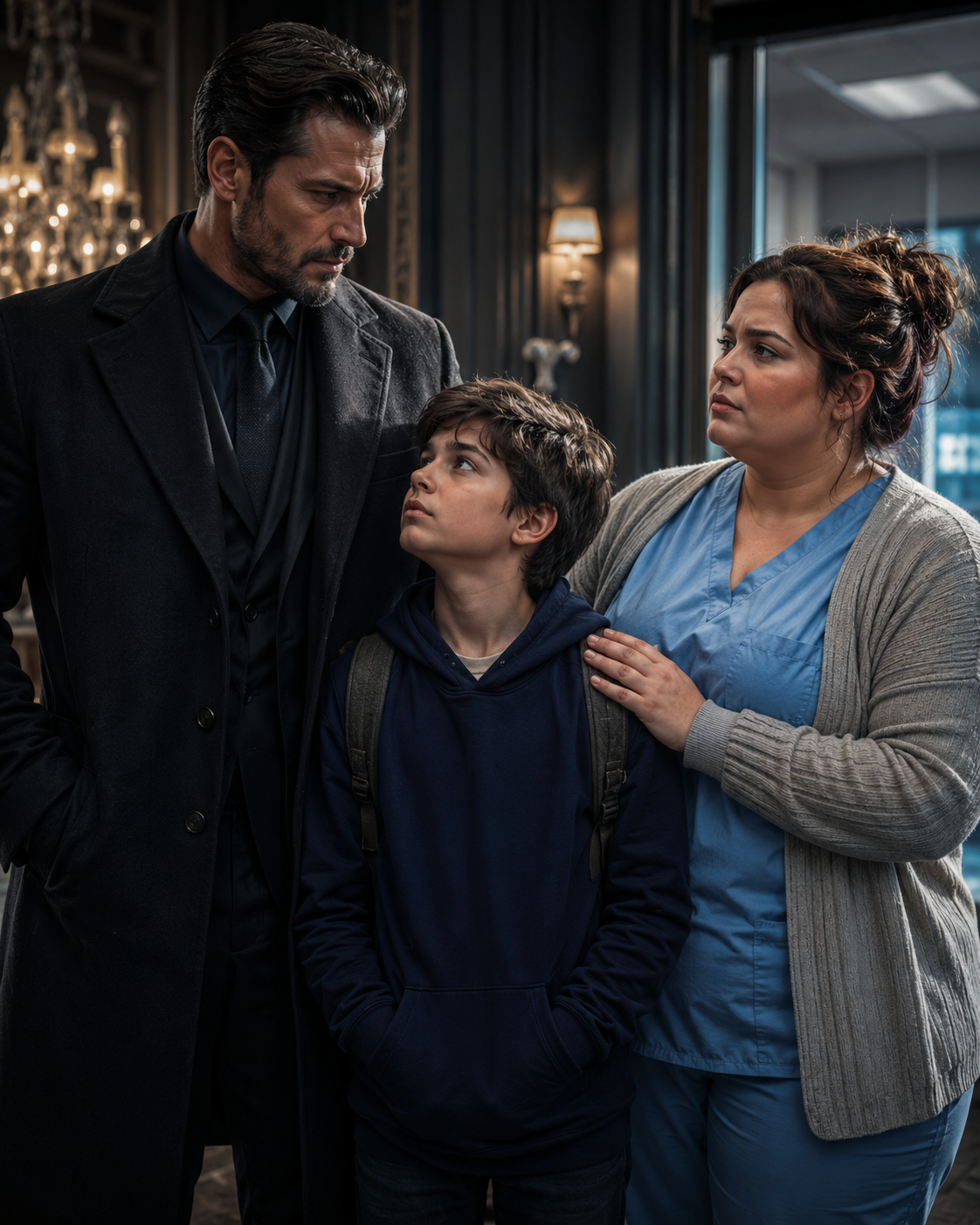
Mara Whitlock knew something was wrong the moment Ethan Vale stopped pretending to be sick.
For three months, the twelve-year-old boy had appeared in her nurse’s office with careful excuses. Headache. Stomachache. A sore throat that vanished when she offered tea. Dizziness that arrived only before lunch. Fatigue that seemed to grow worse whenever the school held events where parents were supposed to attend.
At first, other staff members called him dramatic.
Mara did not.
Children rarely lied for no reason. They lied because the truth felt too heavy, too embarrassing, or too dangerous to carry out loud.
That Tuesday morning, Ethan walked in without knocking. His uniform shirt was buttoned wrong at the collar, his dark hair was messy, and his face had the pale, empty look of a child who had already used up all his courage before breakfast.
Mara lowered the chart in her hand.
“Headache again?” she asked gently.
He shook his head.
“Stomach?”
Another shake.
Mara pushed back her chair and softened her voice. “Then what hurts?”
Ethan stood in the doorway for a long moment. His eyes flicked toward the hallway, as if he expected someone to appear and drag the truth back into his throat.
Then he whispered, “I forgot what her voice sounded like.”
Mara did not move too quickly. She had learned that sudden comfort could frighten a grieving child as much as anger.
She pointed to the chair beside her desk. “Come sit down.”
Ethan sat, but he perched on the edge, shoulders tight.
“My mom,” he said, staring at his shoes. “I remember her singing in the kitchen. I remember she always missed the high notes. I remember she laughed when the toaster burned things. But this morning I tried to hear her saying my name and I couldn’t.”
His mouth twisted with shame.
“What if I forget her completely?”
Mara’s chest tightened.
She had heard adults say all the wrong things to children who mourned. They said time healed everything. They said the dead lived in your heart. They said be strong because your mother would want that. They meant well, but meaning well was not the same as helping.
So Mara opened the bottom drawer of her desk and took out a small packet of crackers.
“Eat two,” she said.
Ethan frowned through tears. “Why?”
“Because grief gets louder when your body is hungry.”
He stared at the crackers as if they were a riddle.
“And after that?” he asked.
“After that, you tell me one thing about her voice. Not the whole voice. Just one piece.”
He ate slowly. Then, after several minutes, he said, “She used to call me moonbug.”
Mara smiled softly. “Moonbug?”
“She said I looked like a little bug crawling under the blankets when I was a baby.”
“Sounds like she loved you very much.”
Ethan’s eyes filled again. “Dad doesn’t say stuff like that anymore.”
Mara waited.
“He used to,” Ethan continued. “Before Mom died. He used to laugh. He made pancakes with her every Sunday, but they were always terrible because they both got distracted. After she got sick, he stopped making them. After the funeral, he stopped talking about her.”
Mara kept her voice calm. “Maybe talking about her hurts him.”
“It hurts me too,” Ethan said. “But when nobody talks about her, it feels like she’s dying again.”
That was the first sentence Mara wrote in her private observation notes that afternoon.
Not because it was dramatic.
Because it mattered.
She did not know that Ethan’s father, Adrian Vale, was reading those same school records two weeks later in a glass office above the Chicago River.
She did not know that Adrian had already ordered one of his men to learn everything about the plus-size nurse whose name kept appearing beside his son’s absences.
And she certainly did not know that the most feared man in Chicago had decided her kindness was suspicious.
Adrian Vale trusted almost no one.
Trust, in his world, was not a virtue. It was a liability people praised right before they used it against you. He had built his empire by assuming every compliment had a price, every apology had a motive, and every act of loyalty had a hidden invoice attached.
People called him ruthless.
Adrian considered that an insult only fools used when they envied discipline.
He owned shipping routes, restaurants, construction firms, security companies, and several businesses that were too clean on paper to explain the fear in men’s eyes when his name was spoken. He had survived betrayals from friends, cousins, partners, politicians, and men who had kissed his ring one day and sold his schedule the next.
So when his son began mentioning a school nurse at dinner, Adrian heard danger before he heard gratitude.
Miss Whitlock says I should keep crackers in my backpack.
Miss Whitlock says Mom’s pancakes sound legendary.
Miss Whitlock says being sad doesn’t make me weak.
Each time, Adrian’s jaw tightened. Each time, he changed the subject. Each time, Ethan grew a little quieter.
Now a file sat open on Adrian’s desk.
Mara Whitlock.
Thirty-six years old. Registered nurse. Former pediatric emergency nurse. Hired by Hawthorne Preparatory School eight years earlier. No criminal record. No suspicious bank deposits. No connection to journalists. No visible ties to rival organizations. No social life that mattered. No husband. No children. A younger brother in Ohio. Parents deceased.
There was a photograph attached.
Mara stood beside a folding table at a school health fair, holding a plastic model of a human heart while laughing at something outside the frame. She wore a plum cardigan over a black dress and comfortable shoes. Her body was full, soft, rounded in a way women in Adrian’s world were trained to disguise or punish. Her brown curls were pinned back messily. Her smile looked open.
Adrian distrusted it immediately.
“Nothing?” he asked.
Across the desk, Silas Monroe stood with his hands folded in front of him. Silas had been Adrian’s adviser, fixer, and only near-friend for sixteen years.
“Nothing useful,” Silas replied. “Student loans paid down. Medical debt from her mother’s illness, finished last year. Rent on the South Side. Charitable donations too small to impress anyone. She lives quietly.”
“Everyone has something useful.”
Silas said nothing.
Adrian tapped the photograph with one finger. “My son has seen her twelve times in six weeks.”
“Children visit the nurse.”
“My son has doctors.”
“Yes.”
“Therapists.”
“Yes.”
“Private staff.”
“Yes.”
“Then why does he keep going to her?”
Silas hesitated.
Adrian looked up.
Silas chose his words carefully. “Maybe because she listens.”
The temperature in the office seemed to drop.
Adrian closed the file.
“Find out what she wants.”
“And if she wants nothing?”
Adrian looked toward the river, its dark water cutting through the city like a blade.
“Then she is better at lying than most.”
Hawthorne Preparatory held its annual winter benefactor evening on the first Friday of December. Adrian had not attended in years. He sent money. He sent auction items. He sent signed checks large enough to make trustees forgive his absence before he committed it.
But that evening, he arrived in person.
The lobby changed when he entered.
Voices lowered. Laughter tightened. Parents turned their heads and then pretended they had not. The headmaster, Dr. Lionel Grant, hurried across the polished floor with a smile so nervous it looked painful.
Adrian barely acknowledged him.
He found Mara Whitlock near a hallway display of student art, kneeling beside a little boy whose nose was bleeding from winter dryness. She was not performing. She was not glancing around to see who noticed her compassion. She spoke to the child in a low, steady voice while pressing tissue gently beneath his nose.
“You’re not embarrassing,” she told him. “Bodies do strange things. That’s why nurses stay employed.”
The boy giggled through tears.
Adrian watched too long.
Mara stood, turned, and nearly walked into him.
For half a second, surprise flashed across her face. Then she stepped back.
“Mr. Vale.”
“You know me.”
“Most people in Chicago know you.”
She said it without flirtation. Without fear. Without trying to impress him.
That annoyed him more than fear would have.
“My son talks about you,” Adrian said.
Her expression changed instantly. Not because Adrian had addressed her. Because Ethan had been mentioned.
“He is a thoughtful boy.”
“He comes to your office often.”
“Yes.”
“Why?”
Mara heard the accusation. Her face remained composed, but her eyes sharpened.
“Sometimes he has physical symptoms. Sometimes he needs a quiet place to regulate before returning to class.”
“He has a therapist.”
“I’m glad.”
“He has a physician.”
“That’s good.”
“He has a father.”
Mara paused.
Adrian noticed.
“What was that pause?”
She clasped her hands in front of her. “Having a father and feeling safe enough to need him are not always the same thing.”
The words struck like a slap delivered in silk.
Around them, the reception continued. Glasses clinked. Parents laughed. A pianist played something delicate near the staircase.
But the space between Adrian and Mara turned cold.
“I provide everything my son needs,” he said.
Mara did not look away. “Then why does he come to school hungry?”
His jaw hardened.
“Why does he eat crackers in my office before lunch?” she continued. “Why does he apologize when he cries? Why does he think mentioning his mother ruins everyone’s day?”
Adrian stepped closer.
People nearby sensed the shift and slowly drifted away.
“You should choose your words carefully,” he said.
“I do,” Mara replied quietly. “Especially when I’m speaking about a child.”
For the first time in a long while, Adrian had no immediate answer.
Then he saw Ethan near the refreshment table.
The boy was watching them.
For one second, his face lit up when he saw his father. It was quick, bright, heartbreaking.
Then Ethan noticed Adrian was speaking to Mara, not looking for him.
The light went out.
Adrian felt something in his chest move. Something he disliked. Something that felt too much like guilt.
Mara saw it too.
She said nothing.
That made it worse.
From the far side of the lobby, Celeste Vale watched everything with a crystal glass in her hand.
Adrian’s younger sister had perfected elegance the way other people perfected weapons. She wore cream silk, pearls, and a smile gentle enough to convince strangers she had no sharp edges. She chaired hospital committees. She hosted charity luncheons. She remembered birthdays, allergies, and scandals.
People called her generous.
Adrian knew generosity was often just control with better manners.
Since the death of Adrian’s wife, Livia, Celeste had slowly inserted herself into Ethan’s life. She arranged family dinners. She chose tutors. She spoke with teachers. She reminded Adrian that a grieving boy needed a woman’s presence. She told anyone who would listen that her brother was too emotionally damaged to raise his son alone.
To outsiders, it looked like devotion.
To Celeste, Ethan was not only a child.
He was inheritance. Legacy. Leverage. The future of everything Adrian controlled.
And now some ordinary school nurse, a woman parents barely noticed except to judge her body, had reached the boy before Celeste could fully claim him.
Celeste smiled.
It was not a warm smile.
The first rumor appeared in the parent message group three days later.
No one named Mara at first. Cowards rarely begin with names. They begin with concern.
Has anyone else noticed certain staff members becoming unusually close to vulnerable students from wealthy families?
By morning, there were twenty-seven replies.
Some parents mentioned “professional boundaries.”
Others wondered whether “grieving children can become attached in unhealthy ways.”
One mother wrote, It’s sad, but people with modest lives sometimes mistake access to important families for affection.
Mara saw the screenshots because a young history teacher came to her office during lunch, pale and apologetic.
“I thought you should know,” the teacher whispered.
Mara looked at the phone until the letters blurred.
She had been underestimated her entire life.
As a child, teachers called her sweet when they meant large. In high school, boys dared each other to flirt with her as a joke. In nursing school, patients assumed she was slow until they watched her handle twelve-hour shifts with calm precision. At Hawthorne, certain mothers looked at her hips before they looked at her badge.
Mara had survived insult.
This was different.
Insult attacked the body.
This attacked the soul.
By Thursday, conversations stopped when she entered the teachers’ lounge.
By Monday, Dr. Grant called her into his office.
He wore the expression of a man about to commit an injustice while hoping to be praised for his sensitivity.
“Mara,” he began, “I want you to understand this is procedural.”
She looked at the folder on his desk.
“Procedural usually means someone already decided who should bleed.”
His smile faltered.
Inside the folder were printed complaints, messages, anonymous statements, and carefully polished accusations.
Emotional dependency.
Boundary concerns.
Unusual influence.
Possible exploitation of a minor connected to a high-net-worth family.
Mara read the words twice. The first time, her mind refused to accept them. The second time, anger steadied her spine.
“I have never asked Ethan for anything,” she said. “I have never accepted gifts. I have never contacted Mr. Vale privately. I have never met Ethan outside school. Every visit is logged. His counselor has access to my notes.”
“I know,” Dr. Grant said softly.
“Then why am I here?”
He removed his glasses and rubbed the bridge of his nose.
“Because several board members are concerned. And because the family involved is—”
“Rich,” Mara said.
His silence answered.
The review was scheduled for Thursday morning.
Until then, Mara could continue working, but another staff member had to be present any time Ethan entered the nurse’s office.
That part nearly broke her.
Not because she feared witnesses. She had nothing to hide.
Because Ethan would understand what adults were too cowardly to say.
And he did.
The next morning, he stopped in the doorway when he saw the counselor sitting in the corner with a clipboard.
His face changed.
“Am I in trouble?” he asked.
“No,” Mara said immediately.
“Are you?”
The counselor looked down.
Ethan’s eyes filled. “Aunt Celeste said people think you want Dad’s money.”
Mara’s breath caught.
There it was.
The source.
Ethan stepped inside slowly. “I told her you don’t. I said you just listen. But she said people can use you and make it feel like love.”
Mara wanted to hug him. She wanted to tell him none of this was his fault. She wanted to put herself between him and every adult who had turned his grief into strategy.
But the counselor was watching.
The rumors were alive.
Her job hung by a thread.
So Mara lowered herself carefully until she was at Ethan’s eye level.
“Listen to me,” she said. “You are not money. You are not a last name. You are not a door into your father’s life. You are Ethan. You are a boy who misses his mother. You are allowed to need help without being someone’s opportunity.”
His mouth trembled.
“I don’t want you to go away.”
Mara felt tears burning behind her eyes.
“I’m here right now.”
It was the safest truth she could give.
That evening, Ethan collapsed in the dining room.
Adrian was late, as usual. A negotiation had run long. Two men had needed reassurance that Adrian’s patience was shorter than their excuses. By the time he entered the mansion, the formal dinner had already begun.
Ethan sat at the long table beneath the chandelier Livia had chosen years before. He looked small in the enormous room, pushing food around his plate while Celeste spoke in a soothing voice about boarding school.
“It might give him structure,” she was saying. “Distance can be healthy after an unhealthy attachment. Children sometimes need clean breaks.”
Ethan’s face had gone pale.
Adrian noticed.
Not enough.
“Eat,” he said, removing his cufflinks.
Ethan lifted his fork. His hand shook.
Celeste sighed. “He has been dramatic all week.”
Ethan’s breathing changed.
Adrian looked up.
“Ethan?”
The boy pressed a hand to his stomach, then to his chest.
“I don’t feel—”
He slid sideways out of the chair.
For one frozen second, the room did not move.
Then Adrian lunged and caught his son before he hit the floor.
The mansion erupted.
Celeste shouted for the housekeeper. Security rushed in. Adrian barked orders for a doctor, a car, anything, anyone. Ethan’s skin looked gray. His pulse fluttered under Adrian’s fingers like a trapped moth.
At the hospital, doctors used words Adrian hated because none of them gave him control.
Severe reaction.
Stress response.
Dehydration.
Nutritional deficiency.
Possible medication interaction.
Observation.
Testing.
Wait.
Adrian Vale did not wait well.
He stood in the pediatric unit hallway with his shirt wrinkled, his hands clenched, and fear moving through him like ice water. Silas stood nearby. Celeste sat in a chair with perfect posture, dabbing her eyes with a tissue as nurses passed.
Then a resident approached.
“Mr. Vale, there is something you need to see.”
The doctor led him into a consultation room and placed a copy of a school health log on the table. The printed text was turned toward Adrian, but he barely needed to read past the first line to feel the world tilt.
Mara Whitlock had written it four days earlier.
Ethan reported recurring stomach pain, dizziness, reduced appetite, fatigue, and chest tightness. Emotional distress may be contributing, but the pattern has changed. Strongly recommend pediatric evaluation, hydration monitoring, and review of any supplements or medications. Guardian contact advised.
Adrian stared at the page.
“Why wasn’t I told?”
The resident hesitated. “The school contacted the guardian listed for medical follow-up.”
Adrian slowly raised his eyes.
“Who?”
“Celeste Vale.”
The room went silent.
Adrian turned to Silas.
“Everything,” he said.
Silas left without another word.
Adrian returned to Ethan’s bedside and sat there through the night.
His son looked impossibly young under the hospital blanket. Machines hummed softly. The city moved beyond the windows as if the world had no right to continue.
Adrian had faced knives, indictments, betrayal, ambush, and men who smiled while planning his funeral.
None of it had scared him like his son’s limp hand inside his own.
At three in the morning, Ethan stirred.
“Dad?”
Adrian leaned forward so fast the chair scraped the floor.
“I’m here.”
Ethan blinked slowly. His voice was faint.
“Is Miss Whitlock fired?”
The question cut deeper than accusation.
Not Where am I?
Not What happened?
Not Am I going to be okay?
Is Miss Whitlock fired?
Adrian swallowed.
“No.”
It became a promise the moment he said it.
Ethan’s eyes closed halfway. “She told Aunt Celeste something was wrong.”
Adrian went still.
“What did Celeste say?”
“She said Miss Whitlock wanted attention.”
By morning, Silas returned with enough truth to begin dismantling the lie.
Celeste had arranged to be listed as secondary guardian during Adrian’s frequent absences.
She had dismissed multiple messages from Hawthorne.
She had spoken privately with board members.
She had encouraged parents to complain.
She had pushed for Mara’s review.
And most dangerously, she had been giving Ethan calming wellness drops suggested by a private consultant, without approval from Ethan’s pediatrician. Combined with stress, poor eating, and dehydration, the drops had likely contributed to the episode.
“She may not have meant to harm him,” Silas said carefully.
Adrian stood by the hospital window, his reflection hard and hollow in the glass.
“No,” he said. “She only needed him weak enough to control.”
Silas did not answer.
Fragile children were easier to direct.
Lonely children were easier to isolate.
Grieving children were easy to convince that the person helping them was the danger.
Adrian closed his eyes.
He had spent weeks investigating Mara Whitlock as if she were a thief standing at the edge of his fortune.
All the while, she had been the only adult paying attention.
She had seen his son’s hunger.
She had seen his loneliness.
She had seen the bullying.
She had seen the symptoms change.
She had warned them.
And Adrian had nearly allowed her to be destroyed.
No.
That ended now.
The review took place Thursday morning in Hawthorne’s auditorium.
Every seat was filled by eight-thirty.
Parents came because scandal among the elite was entertainment disguised as concern. Teachers came because attendance had been strongly encouraged. Board members sat onstage behind polished tables, grave and self-important. Dr. Grant shuffled papers as though procedure could make cowardice respectable.
Mara sat alone in the front row.
She wore a charcoal dress and the same plum cardigan from the reception. Her hands were folded in her lap. Her eyes were swollen from crying in her car before sunrise, but her back remained straight.
She had almost resigned the night before.
Then she remembered Ethan asking whether she had been fired.
So she came.
Not for her reputation.
For the child.
Celeste sat several rows behind her in pale silk, calm as a portrait. When Mara glanced back, Celeste gave her a small smile filled with pity.
The review began with language about boundaries.
A board member summarized the complaints.
A parent stood and said she was uncomfortable with “emotional dependency.”
Another spoke about staff members who “forget their place.”
A third mentioned the danger of “ambitious people attaching themselves to influential families.”
Mara listened until the words sounded distant and underwater.
Then Celeste rose.
The room quieted.
“I want to be clear,” she said, her voice elegant and sorrowful. “This is not personal. Miss Whitlock may believe she acted out of kindness. But kindness without judgment can be harmful.”
Several parents nodded.
“My nephew has suffered a terrible loss. He is vulnerable. He is wealthy. He carries a name that attracts attention from people who may not even understand their own motives.”
Mara’s face burned.
Celeste turned slightly toward her.
“When a staff member becomes emotionally indispensable to a child, especially a child connected to extraordinary resources, difficult questions must be asked.”
The implication hung in the room.
Mara stood.
Her knees felt weak, but her voice came out clear.
“I never wanted anything from Ethan Vale.”
Silence.
“I never asked him for gifts. I never contacted his father. I never met him outside school. I never used his grief for money, attention, or access.”
She looked across the room.
“I listened to a child who was hurting. I documented what I observed. I reported concerns when his symptoms changed. I followed policy. And yes, I cared.”
Her voice shook, but did not break.
“I will not apologize for caring about a child who needed an adult to notice him.”
For one moment, the room shifted.
Some teachers looked ashamed. Some parents looked away. Dr. Grant swallowed hard.
Then Celeste lifted a folder.
“Caring is not the issue,” she said. “Judgment is.”
The board chair reached for the folder.
And that was when the auditorium doors opened.
Every head turned.
Adrian Vale walked in.
He was not alone.
Silas followed him. So did two attorneys, Ethan’s pediatrician, and Hawthorne’s school counselor, who looked terrified but determined. Behind them, walking slowly but upright, came Ethan Vale.
A murmur swept the auditorium.
Mara’s hand flew to her mouth.
Adrian’s eyes found hers first.
Something passed between them then.
An apology.
A promise.
A recognition neither of them was ready to name.
Then Adrian turned to the board.
“I’ll be brief.”
No one doubted him.
No one interrupted.
Celeste’s perfect face lost its color.
Adrian walked to the front of the auditorium with the calm of a man who had made powerful rooms regret underestimating silence.
“For weeks,” he said, “Mara Whitlock has been accused of manipulating my son for money.”
The word landed like a hammer.
“I believed it might be possible.”
Mara flinched.
Adrian did not hide from it.
“That is my shame, not hers.”
The room went still.
“I investigated her. I searched for debts, schemes, hidden contacts, improper communication, any sign that she wanted access to my family. I found nothing.”
His gaze moved across the parents.
“What I found instead was documentation. Missed meals. Panic attacks. Social withdrawal. Bullying. Grief responses. Physical symptoms that changed over time.”
He placed a stack of records on the table.
“Mara Whitlock saw all of it.”
His voice lowered.
“I did not.”
The admission seemed to cost him more than any threat ever could.
“Ethan is my son. I love him more than anything I own, more than anything I built, more than my own life. And still, I missed what she saw.”
Ethan stood beside Silas, his eyes shining.
Adrian continued.
“When my son stopped eating, she noticed. When other children mocked his dead mother, she noticed. When he sat alone, she noticed. When his stomachaches stopped sounding like grief and started sounding medically dangerous, she noticed.”
Then he turned toward Celeste.
“My sister was informed.”
Celeste stood quickly. “Adrian—”
“Sit down.”
Two quiet words.
The room froze.
Celeste sat.
Adrian faced the board again.
“My sister dismissed the warnings. She encouraged suspicion against Miss Whitlock. She contacted parents. She influenced this review. And while doing so, she gave my son unapproved wellness drops that contributed to his collapse.”
Gasps moved through the auditorium.
Celeste’s expression cracked.
“I was trying to help him sleep.”
“No,” Ethan said.
His voice was small, but the room heard him.
Everyone turned.
Ethan stepped forward, trembling.
Adrian looked as if every instinct in him wanted to stop the boy, shield him, carry him away from every staring face.
Mara gave the smallest shake of her head.
Let him speak.
Ethan swallowed.
“Aunt Celeste said Miss Whitlock was making me weak,” he said. “She said talking about Mom made Dad uncomfortable, so I should stop. She said if Miss Whitlock went away, I would learn to be strong.”
Celeste’s lips parted.
Ethan looked at his father.
“But Miss Whitlock never made me weak. She let me be sad without making me feel bad.”
The auditorium fell silent.
Ethan turned to Mara.
“She saved me.”
Mara’s eyes filled.
Adrian’s jaw tightened as he fought for control.
The board chair looked shaken. “Mr. Vale, based on this information, we will suspend the review and consider—”
“No,” Adrian said.
The chair stopped.
“You will finish it. Publicly. You allowed these accusations to become public. You will clear her publicly.”
The attorneys behind him said nothing, which made the warning louder.
The board withdrew for twenty minutes.
During those twenty minutes, no one spoke above a whisper. Celeste tried once to approach Adrian, but Silas stepped in front of her. Ethan sat near Mara, close but not touching, and whispered, “I’m sorry.”
Mara wiped her cheek and smiled at him.
“You have nothing to be sorry for.”
When the board returned, the chair looked as if he had aged five years.
“All allegations against Nurse Mara Whitlock are dismissed,” he announced. “There is no evidence of misconduct, boundary violations, exploitation, or inappropriate conduct. The records show Nurse Whitlock acted with exceptional professionalism, compassion, and diligence in support of student welfare.”
The applause began uncertainly.
One teacher stood.
Then another.
Then the counselor.
Then, slowly, parents began rising too. Not all of them. Enough.
The applause filled the auditorium.
Mara sat frozen beneath it, overwhelmed by relief so heavy it almost hurt.
She had not wanted applause.
She had only wanted the truth to arrive before the lie destroyed her.
Adrian did not clap.
He stood beside his son, watching Mara with an expression few people had ever seen on his face.
Gratitude.
By sunset, Celeste Vale had been removed from every trust connected to Ethan, every family board, and every charitable foundation bearing Adrian’s name.
Adrian did not destroy her in newspapers.
Livia would not have wanted Ethan’s family turned into entertainment.
But privately, Celeste lost the thing she loved most.
Control.
She was permitted contact only if Ethan requested it.
He did not.
Mara expected life to return to normal after that.
It did not.
Normal was not a place people returned to after truth rearranged the furniture inside them.
Adrian began showing up.
At first, it was awkward.
He attended parent-teacher conferences and sat stiffly in chairs made for children. He arrived at Ethan’s school concert and looked startled when the music teacher asked him to help move chairs. He came to a basketball game and cheered at the wrong time so loudly that Ethan covered his face in embarrassment and then laughed for the first time in weeks.
He also appeared one afternoon in Mara’s office holding a brown paper bag.
She looked up from restocking gauze.
“Mr. Vale.”
“Adrian,” he said.
She hesitated. “Adrian.”
He placed the bag on her desk.
“If that is expensive, I cannot accept it.”
“It is not.”
Inside was a container of pancakes.
Burned pancakes.
Mara stared.
Adrian cleared his throat. “Ethan and I made them. Badly.”
A laugh escaped her before she could stop it.
“They’re terrible,” he admitted.
“They’re supposed to be.”
Something softened in his face.
For a moment, he did not look like Chicago’s most feared man. He looked like a widower learning how to stand in a kitchen with his grieving son while smoke filled the air, because perfection was not the point.
“He talked about Livia the whole time,” Adrian said. “I listened.”
Mara’s smile became gentler.
“Good.”
“I should have done that sooner.”
“Yes,” she said.
He looked startled.
She shrugged. “You seemed like a man who needed honesty.”
A slow smile touched his mouth. “Honesty from you is not gentle.”
“It is gentle. It just doesn’t lie.”
He laughed then.
A real laugh.
It changed his whole face.
Months passed.
Ethan healed, not all at once and not perfectly, but honestly.
Some mornings grief still returned like weather. Some days he missed his mother so badly he could not finish breakfast. But now he talked about her. He asked Adrian questions. He carried one of Livia’s old recipe cards in his backpack. He made friends with two boys who loved comic books and terrible jokes. He stopped visiting Mara’s office every week.
When he came, it was usually just to say hello.
That told her more than any medical chart could.
Adrian changed too.
Not into a saint.
Life was not that simple. Men with blood in their history did not become harmless because a good woman looked at them with disappointed eyes.
But he became present.
He learned Ethan’s teachers’ names. He left meetings unfinished to attend games. He stopped taking calls at dinner. He kept Sunday mornings free for burned pancakes.
And slowly, carefully, something grew between him and Mara.
It began as gratitude.
Then trust.
Then friendship.
Then the kind of silence that felt full instead of empty.
Mara resisted it at first.
She knew the difference between love and rescue. She refused to become a story about how a kind woman fixed a dangerous man. Adrian had to fix himself. He had to choose his son without needing Mara to point at the wound. He had to become worthy of the peace he wanted.
To his credit, he tried.
A year after the review, Hawthorne held another winter reception.
Mara nearly skipped it, but Ethan insisted.
“You have to come,” he said. “My painting is better this year.”
“It better not be another emotionally devastating pancake portrait.”
“No promises.”
She went.
The auditorium looked different now. Not because the walls had changed, but because she had survived the worst thing that had happened to her there.
Ethan’s painting hung near the front.
It showed a kitchen.
Smoke curled from a pan. A woman with dark hair stood in the background, painted soft around the edges like memory. A man and a boy stood at the stove, laughing. Near the doorway stood another woman in a plum cardigan, watching over them without stepping into the center.
The title was Friday Morning.
Mara stared until her eyes blurred.
Adrian appeared beside her.
“He added you last,” he said. “He said the picture didn’t feel honest without you.”
Mara wiped under one eye. “He is trying to ruin my dignity.”
“Your dignity survived my family. It can survive watercolor.”
She laughed softly.
For a while, they stood shoulder to shoulder, watching Ethan across the room as he laughed with friends.
Then Adrian spoke quietly.
“I thought you wanted my money.”
Mara looked at him.
He did not hide from the shame now.
“I thought kindness like yours had to be strategy,” he continued. “I thought if someone came close to my son, they wanted the Vale name, the fortune, the protection, the life. I never considered that you saw him because he needed to be seen.”
Mara’s voice softened. “Most people need to be seen, Adrian. Children just have fewer ways to ask.”
Across the room, Ethan waved.
Adrian waved back.
It was slightly awkward, which Mara liked more than she wanted to admit.
“You saved him,” Adrian said.
“No,” Mara replied. “I helped him hold on until you came back.”
His eyes moved to hers.
“And if I had come back too late?”
“You didn’t.”
The answer settled something in him.
A slow song began playing from the reception speakers. Parents mingled beneath warm lights. Children ran near the refreshment table until teachers pretended not to notice.
Adrian held out his hand.
“Dance with me.”
Mara laughed. “In a school auditorium?”
“I have done worse things in better rooms.”
“That is not as reassuring as you think.”
His smile deepened. “One dance, Nurse Whitlock.”
People were watching.
They always watched Adrian.
They watched Mara too, though differently now. Some with respect. Some with guilt. Some with curiosity.
For most of her life, Mara had felt watching eyes as judgment.
That night, she decided not to carry them.
She placed her hand in his.
Adrian led her gently into the open space near the stage. He did not dance like a man trying to impress anyone. He danced like a man grateful for a second chance he knew he had not earned but intended to honor.
For once, Mara did not feel like the plus-size woman people underestimated.
She did not feel like the nurse accused of wanting money.
She did not feel like the girl who had once hidden her kindness so no one could mock it.
She felt seen.
Ethan ran past them, laughing, cheeks flushed with life.
Adrian watched him, and there it was again.
Presence.
Real presence.
“He looks happy,” Adrian said.
“He is happy.”
Adrian swallowed. “Sometimes I’m afraid.”
“Of what?”
“That I’ll fail him again.”
“You might,” Mara said.
His brow lifted.
She smiled gently. “Parents fail. Good ones notice, apologize, and try again.”
He considered that. “You make mercy sound harder than punishment.”
“It is.”
The song ended, but he did not release her hand immediately.
Then Ethan’s name was called for an art award. He ran to the front, grinning as he accepted a small certificate.
Adrian clapped louder than anyone.
Mara laughed through tears.
Years later, people at Hawthorne would still tell the story, though they often told it wrong.
They said a merciless mafia boss fell in love with a plus-size nurse because she saved his son.
They said he walked into an auditorium full of elites and shattered every lie with one stack of records and one deadly calm stare.
They said Celeste Vale learned too late that softness was not weakness.
Those versions were dramatic.
Some of them were even true.
But Mara knew the real story was quieter.
It was about a boy who pretended his stomach hurt because no one had asked where grief lived.
It was about a father who bought everything except time, then learned time was the only thing love required.
It was about a woman everyone underestimated because of her body, her job, and her ordinary kindness.
And it was about the truth that saved them all.
Mara Whitlock had never wanted Adrian Vale’s money.
She had never wanted his empire.
She had never wanted his name.
She had only wanted a child to stop suffering alone.
And somehow, by doing that, she gave a dangerous man back his heart, gave a grieving boy back his father, and gave herself permission to believe that being seen by the right people could heal wounds the wrong people had spent years creating.
On the first Sunday morning after Adrian asked Mara to marry him, Ethan burned the pancakes himself.
The kitchen filled with smoke.
The alarm screamed.
Adrian cursed under his breath.
Mara laughed so hard she had to sit down.
And Ethan, standing in the middle of the chaos with flour on his cheek and joy in his eyes, looked at the two adults who had finally learned how to love him out loud.
“Mom would have said they had character,” he said.
Adrian went still.
Mara reached for his hand.
For a moment, grief stood with them in the kitchen, not as an enemy, but as proof that love had lived there once and still lived there now.
Then Adrian pulled his son close.
“Yes,” he whispered, his voice breaking. “She would have.”
The pancakes were terrible.
They ate every bite.
And for the first time in years, the Vale mansion did not feel like a house full of expensive things.
It felt like home.

