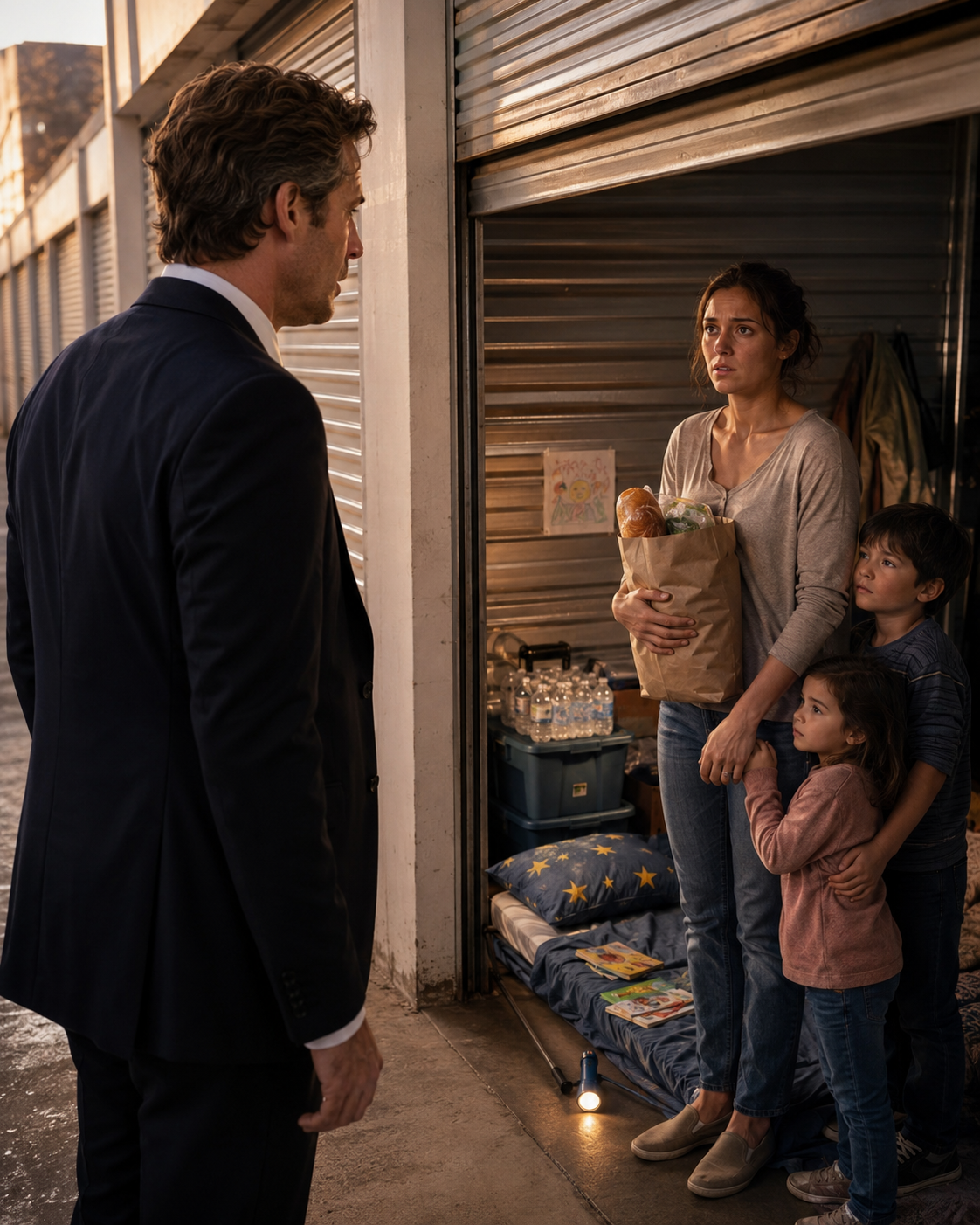
When the Billionaire Landlord Opened Unit 14B, He Found a Secret That Changed the Way He Saw Every Door He Owned

Adrian Vale had built his fortune by knowing the exact value of empty space.

An empty parking lot could become a luxury tower. An old factory could become lofts. A strip of forgotten land by the highway could become a logistics hub before anyone else saw its worth. He had made billions by looking at neglected properties and seeing not what they were, but what they could be sold for.

That was why Harborline Storage should have been an easy decision.

The facility sat on six tired acres near the riverfront in Tampa, between a closed auto shop and a row of warehouses that had once smelled of machine oil and salt. The place had been profitable years ago, before newer storage companies came in with climate control, bright gates, and cheerful signs promising security and convenience. Harborline still had rust on the doors, patched asphalt, and cameras so old they looked more decorative than useful.

Adrian’s advisors had already told him what to do.

Sell it.

A regional developer wanted the land for a distribution center. The numbers were clean. The offer was generous. The closing could happen before the quarter ended. Everyone in his office agreed that Harborline was no longer an asset. It was dead weight.

Adrian agreed with them.

Mostly.

There was one rule he had never abandoned, not even after his company became too large for him to know every property by name. Before selling a site, he visited it once. He walked it himself. He looked at the fences, the gates, the doors, the office, the cracks in the concrete. He told people this was discipline.

The truth was older than discipline.

He had started with one small storage yard and a borrowed truck. Back then, he had fixed locks, swept units, argued with tenants, and slept in his office more than once. Walking a property reminded him that money was supposed to come from something real.

So on a humid Tuesday afternoon, Adrian Vale arrived at Harborline Storage in a black sedan with tinted windows, an unsigned sale approval in his briefcase, and no intention of staying longer than twenty minutes.

Walter Finch, the site manager, was waiting outside the office.

He was sixty-two, narrow-shouldered, sun-browned, and wearing a faded Harborline cap that looked older than some of the buildings. His shirt was clean but frayed at the collar. His hands were clasped in front of him the way people stand when they are ready to be blamed for things they did not cause.

“Mr. Vale,” Walter said.

Adrian shook his hand. “Let’s make it efficient.”

“Yes, sir.”

They began with the gate motor. Then the office. Then the security monitors. Adrian asked direct questions. Walter answered carefully.

How many active tenants?

How many delinquent?

How many units unusable?

Any major incidents?

Any code problems?

Walter answered every question, but his eyes kept moving toward Row B.

Adrian noticed.

He had made a career out of noticing what people avoided.

“What’s on Row B?” he asked.

Walter adjusted his cap. “Standard ten-by-twelves. Mostly household overflow.”

“Mostly?”

“Some contractor equipment. Some long-term tenants.”

Adrian stopped walking. “Show me.”

Walter hesitated for half a second.

It was enough.

They crossed the lot under the hard white sun. Row B was quieter than the rest of the facility. Metal doors lined both sides like closed mouths. Most had dust along the bottom edges, dead leaves stuck against the thresholds, spiderwebs in the corners.

Unit 14B did not.

Its concrete pad was clean. Not freshly cleaned. Maintained. The handle had been wiped so often that the paint around it was lighter. A small strip of weather seal had been neatly repaired. The padlock was not the standard company lock. It was a heavy combination lock, scratched from use.

Adrian looked at Walter.

“Why does this one look different?”

Walter’s jaw tightened. “Tenant takes care of it.”

“Tenant name?”

Walter did not answer quickly enough.

Adrian’s voice changed. “Walter.”

“Marissa Cole,” he said.

“How often does she come here?”

Walter looked down the row before answering. “Often.”

“That is not an answer.”

“No, sir.”

Adrian stepped closer to the door. “Open it.”

Walter’s face lost color. “I don’t think that’s wise.”

“I didn’t ask if it was wise.”

“There are tenant privacy rules.”

“I own the facility.”

Walter lifted his eyes. For the first time, he looked less like a nervous employee and more like a tired man at the end of his patience.

“Ownership doesn’t make every choice decent.”

Adrian stared at him.

People argued with Adrian Vale all the time, but usually from polished conference rooms with lawyers present. He was not used to being morally challenged by a storage manager whose office coffee probably came from a machine older than the company’s website.

“What is inside 14B?” Adrian asked.

Walter swallowed.

The answer was in his silence.

Adrian held out his hand. “Open it.”

Walter removed a folded slip of paper from his pocket. His fingers trembled as he turned the lock. The metal clicked. He gripped the handle and rolled the door upward.

The sound was violent in the quiet row.

Adrian stepped forward.

Then he stopped.

The unit did not look like storage.

It looked like someone had tried to turn a concrete box into a home without allowing it to admit what it was.

A thin mattress was folded against the left wall. Two pillows sat on top of it, one plain gray, one covered in faded yellow stars. A small cooler stood beside a stack of bottled water. There were crackers, apples, peanut butter, a dented kettle, paper plates, a flashlight, a battery fan, and three plastic bins arranged with a precision that made the place more heartbreaking, not less.

A row of children’s books leaned against the back wall.

A little pair of pink sneakers sat beneath them.

There were drawings taped to the concrete, but the tape was curling in the heat. A blue toothbrush lay in a plastic cup. Beside it sat a tiny hairbrush with glitter trapped in the handle.

Adrian smelled laundry soap, bleach, canned soup, and warm air that had nowhere to go.

He had seen poverty before. He had donated to it. He had sat at fundraising tables while people gave speeches about it. He had approved corporate grants with numbers large enough to make newspaper captions.

But this was not a speech.

This was not a statistic.

This was a child’s hairbrush in a windowless storage unit on land he was about to sell.

Walter spoke behind him, his voice low.

“She pays every month.”

Adrian turned slowly.

“What?”

“On time,” Walter said. “Cash. Never late.”

Adrian looked back into the unit.

On a piece of cardboard near the mattress, a child had drawn a map. It showed a square labeled with a house shape, though the house had no roof. A dotted path ran from the square to a school, then to a bus stop, then back again. The lines were careful. Too careful for a child who should have been drawing monsters, superheroes, or suns in the corners of pages.

“How long?” Adrian asked.

Walter closed his eyes.

“Eight months.”

The words entered Adrian like cold water.

Eight months.

A mother and children had been living in a storage unit owned by his company for eight months, and every report he had received had reduced them to one harmless word.

Current.

The account was current.

The rent had been paid.

The property was underperforming.

The tenant was compliant.

The system had seen everything except the people.

Footsteps sounded at the end of the row.

Quick footsteps. Familiar footsteps.

A woman stopped ten feet away, holding a grocery bag against her hip. She was in her early thirties, with dark hair tied at the back of her neck and a work uniform partly hidden under a denim jacket. Her face was thin with exhaustion, but not weakness.

She saw Walter first.

Then Adrian.

Then the open door.

Something crossed her face so quickly most people would have missed it. Not fear exactly. Calculation. She measured the distance to the door, the position of the men, the grocery bag, the time, the fact that her children were not with her.

Then she lifted her chin.

“I’ll clear it out,” she said. “Give me until tonight.”

Walter looked away.

Adrian stepped out of the unit. “Are your children with you?”

The woman’s eyes hardened. “Why?”

“I need to know if they’re safe.”

Her hand tightened on the grocery bag. “They’re at school.”

“What are their names?”

“That is not your business.”

“No,” Adrian said quietly. “Maybe it should have been.”

She let out a humorless breath. “You opened my door without asking. Don’t pretend you’re worried about boundaries now.”

The words struck harder than he expected because they were accurate.

He owned the facility. He owned the land. He owned the door. He owned the contract that said no one could sleep inside a unit. But the pink shoes, the books, the careful bins, the little map — none of those belonged to him.

“I’m Adrian Vale,” he said.

“I know.”

“Then you know I can’t ignore this.”

“I’m not asking you to ignore it,” she said. “I’m asking you to let me tell my children before you make them watch strangers throw their things away.”

Walter made a quiet sound behind Adrian.

“What’s your name?” Adrian asked, though he already had it.

“Marissa Cole.”

“Why here?”

She stared at him as if the question itself proved how little he understood.

“Because it is close to their school.”

“That’s all?”

“That is everything.”

Adrian waited.

Marissa hated that he waited. He could see it. She had the expression of someone who had spent too much of her life answering questions from people who had already made up their minds.

“My son, Ben, gets reading support at that school,” she said at last. “He lost a year moving around. He is finally catching up. My daughter, Ava, has asthma. I work mornings at a diner and evenings cleaning offices. This unit was near the school, near the bus line, and cheap enough that I could keep paying it. That’s the explanation. Not the whole story. Just the part I’m willing to give you.”

Before Adrian could answer, two children appeared at the far end of Row B.

The boy was about ten. Thin, serious, carrying a backpack that looked too heavy. The little girl beside him was maybe six, with two uneven ponytails and a drawing clutched in her hand.

The boy saw the open door.

He stopped.

The little girl bumped into him, then followed his gaze.

“Mom?” the boy called.

Marissa turned, and for the first time her composure cracked.

“It’s okay,” she said immediately.

The boy did not believe her. Children who have been forced to understand adult problems learn the sound of false comfort.

He looked at Adrian’s suit.

Then at Walter.

Then at the open unit.

“Are we getting kicked out?”

Marissa crossed the distance quickly and crouched in front of them. “Listen to me. We are together. We are going to figure this out.”

Ava’s lower lip trembled. “Do we sleep outside now?”

“No, baby.”

Marissa said it too fast.

Everyone heard it.

Adrian had spoken to senators, investors, judges, and executives. He had negotiated deals worth more than entire towns. He had answered impossible questions with a calm face.

But he could not answer a six-year-old girl asking if the sky would be her ceiling.

He looked at the storage unit, then at the children, then at Walter.

The correct corporate procedure unfolded in his mind.

Violation notice.

Immediate removal.

Incident report.

Legal review.

Liability mitigation.

Proceed with sale.

That was the machine he had built. That was how a company stayed clean. Move the problem out of sight, document that you moved it, and call the emptiness order.

But Ava had a yellow-star pillow.

Ben had a map.

And Marissa Cole was standing between her children and ruin with a grocery bag of bruised apples in her hand.

“I’m not removing anyone today,” Adrian said.

Marissa looked at him sharply. “What does that mean?”

“It means no one touches your things tonight. No police. No lock change. No disposal crew.”

“And tomorrow?”

“I come back.”

“For what?”

“To ask better questions.”

Her expression did not soften. “People like you ask questions after you already know the answer.”

“Then don’t trust me.”

“I don’t.”

“I understand.”

“No,” Marissa said. “You don’t.”

Adrian had no defense.

That night, he did not return to his house on Bayshore Boulevard. He went to his downtown office and sat alone in a glass conference room while the city glittered beneath him.

His phone kept lighting up.

The developer wanted confirmation.

His general counsel wanted to discuss liability.

His chief operating officer wanted to know why the sale had paused.

Adrian answered none of them.

Instead, he opened the Harborline file.

Unit 14B.

Tenant: Marissa Cole.

Monthly rent: one hundred eighty-nine dollars.

Status: current.

He stared at the word until it seemed less like an accounting term and more like an accusation.

Current.

As if money arriving on time meant life was in order.

As if a paid bill could prove a child was safe.

Near midnight, Adrian walked into the private bathroom and looked at himself in the mirror. He saw the handmade shirt, the expensive watch, the controlled face, the gray beginning at his temples. He saw a man who had spent decades building distance and calling it achievement.

Then, without warning, he remembered the motel vending machine.

He was nine again, standing barefoot on cold tile while his mother counted coins in her palm. They had lived in a motel for three weeks after his father disappeared with the rent money. Then in a car for eleven nights after that. His mother had brushed his hair in gas station bathrooms, washed his socks in sinks, and told him every morning, “Walk in like you belong somewhere.”

He had built a life so high above that memory that he thought he had escaped it.

He had not.

He had only purchased better walls.

The next morning, Adrian returned to Harborline alone.

Marissa was waiting outside the office, not inside it. Walter had told him she chose the bench by the gate because she could see the exit, the road, and Row B at the same time.

Adrian understood more than he wanted to.

He sat on the other end of the bench, leaving space between them.

For a minute, neither spoke.

Finally, Marissa said, “If you’re here to feel noble, please do it somewhere else.”

Adrian nodded. “Fair.”

“I’ve met men with money before. They love rescuing people long enough to admire themselves.”

“I’m not offering rescue.”

“Then what are you offering?”

“I don’t know yet,” he said. “That’s why I’m here.”

She studied him. “That might be the first honest thing you’ve said.”

“I want to understand what would actually help.”

Marissa laughed once, dry and tired. “People always say that like help is one thing. It’s not one thing. It’s a wall made of things.”

“Tell me the wall.”

She looked away toward Row B.

“First month’s rent. Last month’s rent. Deposit. Application fees. A landlord who won’t see an old eviction and throw my form in the trash. A safe address my ex can’t find. A job that doesn’t start before the buses run. A school zone that keeps Ben where he is. Child care. A place where Ava can breathe. A door that closes and stays closed.”

Adrian listened without interrupting.

Then she turned back. “Can you fit that on a check?”

“No,” he said. “But I can bring people who know how to build the wall properly.”

Her eyes narrowed. “What people?”

“Housing advocates. Legal aid. A domestic safety organization. A school liaison. Someone who works for you, not my company.”

“I’ve had people assigned to me before.”

“Then you decide whether to speak to them.”

“What do you get?”

There it was.

The only question that mattered.

Adrian looked at the cracked pavement between his shoes. He thought of his mother counting coins. He thought of Ben’s map. He thought of Ava asking if they would sleep outside.

“I get a chance,” he said slowly, “to stop pretending I don’t know what it feels like.”

Marissa looked away first.

That was not trust.

It was not forgiveness.

It was only the smallest possible opening.

But openings mattered.

Over the next twelve days, Adrian learned that money could move quickly, but safety could not be rushed without breaking something.

He could have rented Marissa an apartment in an afternoon. He could have bought a condo and handed her keys. He could have made a grand gesture that would look beautiful to people who had never been trapped inside someone else’s generosity.

Marissa refused anything that made her dependent on Adrian personally.

“No home controlled by your mood,” she said.

He almost argued.

Then he stopped.

He was learning.

Ruth Kim, a housing navigator with calm eyes and a voice that made panic feel less useful, met Marissa outside Unit 14B with a clipboard, bottled water, and no expectation of gratitude.

“The paperwork is terrible,” Ruth said. “I won’t lie about that.”

Marissa folded her arms. “Paperwork has never been on my side.”

“Then we’ll make it behave.”

Walter, listening from the office doorway, smiled for the first time in days.

They found the first apartment on Thursday.

Marissa rejected it because the bus route required Ben to cross a six-lane road.

The second apartment had a bedroom window facing an unlit alley. She rejected that too.

The third landlord wanted Adrian’s company to sign the lease directly. Marissa stood in the empty kitchen and said, “I will not live somewhere I can be erased by a phone call between men.”

Adrian’s first instinct was to explain how unnecessary that fear was.

Then he remembered she had survived by respecting fears other people dismissed.

They found the right apartment on the thirteenth day.

It was not elegant. The kitchen cabinets were scratched. The hallway carpet had a stubborn stain. The air conditioner rattled before it settled into a hum. But the locks worked. The windows opened. The school bus stopped nearby. The lease was in Marissa’s name, with support structured through a nonprofit fund, not through Adrian’s personal mercy.

Ava ran to the window and pressed both hands to the glass.

“Is this ours?”

Marissa swallowed. “For now.”

Ben looked at Adrian. “For how long?”

“One year guaranteed,” Adrian said. “Then the program helps your mom renew or move somewhere better.”

Ben’s face remained serious. “Can I read that?”

No one laughed.

Adrian nodded. “Yes.”

That afternoon, a lawyer rewrote the support agreement in plain language because Ben had asked to understand it. He sat at the kitchen table and read the first paragraph aloud, slowly, stopping twice to sound out difficult words.

When he finished, Marissa turned toward the sink.

She did not cry.

But her hand shook against the counter.

Adrian understood then that some people did not break loudly. They broke with their backs straight because children were watching.

On the day they left Unit 14B, Marissa cleaned it.

Walter told her she did not need to.

She cleaned it anyway.

She wiped the floor, folded the mattress, packed the books, removed the children’s drawings, and scrubbed the threshold until the concrete looked almost new. It was not about leaving the place spotless for the company. Adrian knew that.

It was about proving that even in a place never meant to be lived in, she had made order.

Ben stood alone in the unit for a moment with his map. He looked at the square he had drawn where 14B had been their home. Then he took a pencil and wrote one word beneath it.

Before.

He folded the map and put it into his backpack.

At the apartment, Ava placed her yellow-star pillow on her bed and spun in a circle until she fell laughing onto the mattress. The sound startled Adrian. It was the first time he had heard her laugh without fear under it.

Ben walked through the rooms twice.

He checked windows.

He checked locks.

He looked inside closets.

Then he took the small flashlight from his backpack, the one they had used in the storage unit at night, and placed it carefully on the living room shelf.

Marissa noticed. “Why there?”

Ben shrugged. “So we remember.”

“Remember what?”

He looked around the apartment — the donated couch, the secondhand table, the sunlight on the floor, his sister making a kingdom out of blankets.

“That we don’t need it tonight.”

Adrian turned away before anyone could see his face.

The real danger arrived three weeks later.

It came in a folder from a private investigator Adrian had hired after Marissa finally said her ex-husband’s name.

Derek Cole.

Adrian opened the folder expecting records, old complaints, maybe a restraining order.

Instead, he found a job application.

Derek had applied through a subcontractor for security work at three storage facilities in Tampa.

One of them was Harborline.

For several seconds, Adrian did not move.

Derek had not been guessing blindly. He had been searching near schools, low-rent apartments, bus routes, and shelters. He had learned how people disappeared when they had no money. He had looked where desperate mothers might hide.

Adrian drove to Marissa’s apartment himself.

He should have called first. Later, Ruth told him that. Marissa told him too, more sharply. But at that moment, fear made him forget manners.

Marissa opened the door and saw his face.

“What happened?”

He handed her the folder.

She read the first page.

Her skin went pale.

“He knows the area,” she whispered.

“He does not know this address,” Adrian said. “And he won’t get it from us.”

“You can’t promise that.”

“I can control my company.”

“No,” she said, voice hard. “You can control contracts. I know Derek.”

Ben stepped closer to his mother.

Adrian accepted the correction because it was true.

Within the hour, Ruth arrived. Legal aid escalated the protection paperwork. The address confidentiality request became urgent. Adrian terminated the security subcontractor and ordered a review of every vendor who had access to tenant information.

But the confrontation came four days later.

Derek Cole walked into Harborline just before closing, wearing a work shirt from a company Adrian had never heard of and the expression of a man who believed intimidation was a language everyone understood.

Walter stood behind the counter.

“I’m looking for Marissa Cole,” Derek said.

Walter did not blink. “No tenant here by that name.”

Derek smiled without warmth. “Don’t play games.”

Adrian stepped out from the back office.

Derek looked at his suit, his watch, his polished shoes, and made the mistake many angry men make around quiet men.

He mistook restraint for softness.

“You own this place?” Derek asked.

“Yes.”

“My wife was hiding here.”

“Your ex-wife is not here.”

Derek’s jaw shifted. “You don’t know what she is.”

Adrian thought of Marissa scrubbing a concrete floor she never should have had to sleep on. He thought of Ben asking for promises in writing. He thought of Ava laughing at a window.

“I know she kept two children alive while adults with more power failed them.”

Derek stepped closer. “You should stay out of family business.”

Adrian did not move.

“No,” he said. “You should understand where you are. You used false information to seek work near protected addresses. You came here looking for someone covered by legal safeguards. You are being recorded. Security has already been called. Law enforcement is on the way.”

Derek’s confidence flickered.

Then something slipped from Adrian’s folder and landed on the floor.

It was a copy of Ben’s old map.

Derek looked down.

Recognition moved across his face.

Not of the facility.

Of the child’s handwriting.

He reached for it.

Adrian placed his foot gently but firmly over the paper.

“No.”

One word.

Low.

Final.

Derek looked up, and for the first time he seemed to understand that the man in the suit was not afraid of him.

When officers arrived minutes later, Derek argued, then shouted, then tried to leave. Walter stood beside Adrian outside the office as blue and red lights flashed across the metal doors of Row B.

“You all right?” Walter asked.

Adrian picked up the map. There was dust across one corner. He brushed it off carefully.

“No,” he said. “But I can be useful.”

Walter nodded. “Useful beats all right on certain days.”

Six months later, Harborline Storage had not been sold.

Adrian’s board called it emotional decision-making.

His chief operating officer called it a dangerous precedent.

The developer called it a mistake.

Adrian called it an audit.

Not of finances.

Of blindness.

Harborline became the first Vale Community Access Site. The office was renovated into a small resource room where housing navigators came twice a week. Storage managers across the company received new training. If a tenant appeared to be living in a unit, the first response would no longer be disposal, removal, or silence.

There would still be safety checks.

There would still be rules.

But the first question changed.

Not: How quickly can this person be removed?

But: What happened, and who can help before this gets worse?

Walter stayed on with a raise and a title he disliked.

Community Site Lead.

“It sounds like something printed on a badge at a conference,” he complained.

“Choose your own title,” Adrian said.

Walter chose Keeper of Doors.

Human Resources objected.

Adrian approved it anyway.

Other stories surfaced after that.

A retired cafeteria worker in Unit 9C whose medical debt had swallowed her savings. A veteran living out of his truck who rented a unit so his daughter would not know he owned only two bags. A college student sleeping in a climate-controlled unit three nights a week because tuition had eaten rent.

Adrian did not ask Walter how many rules he had broken quietly.

He suspected the number would humble him.

Marissa began a daytime job at a medical supply office and enrolled in evening classes for nursing. She did not transform overnight into someone untouched by fear. She still checked locks twice. She still kept folded cash in an old cookie tin. She still woke at small sounds.

Survival does not disappear just because a lease is signed.

But some things changed.

Ava stopped asking where they would sleep next.

Ben’s reading improved. Slowly at first. Then all at once. One Friday afternoon, he read a whole page aloud in class, and when his teacher praised him, he stared at her as if kindness were a magic trick he had not yet learned to trust.

That evening, Marissa found him at the kitchen table drawing a new map.

This one did not begin at Unit 14B.

It began at Home.

The map still included safe places — the library, the bus stop, the church steps, the grocery store with the kind cashier. Marissa did not correct him. Old routes were not failures. They were proof that a child had kept going.

Adrian visited once a month, always with practical things. School supplies. Grocery cards. A repaired bicycle Ben had found broken near a dumpster. He never brought anything too grand. He had learned that help should not enter a room louder than the people who live there.

One afternoon, Ben handed him an envelope.

“What’s this?” Adrian asked.

“A copy.”

Adrian opened it later in his car.

Inside was a clean version of the old map, redrawn carefully. At the top, Ben had written a sentence in pencil.

For Mr. Vale, so he remembers people are inside places.

Adrian sat in the parking lot for a long time.

A year after he opened Unit 14B, Adrian stood in a hotel ballroom at a housing policy conference he would once have avoided. He had been invited to speak because institutions found it easier to applaud billionaires who changed policies than mothers who survived them.

He understood that now.

So he did not begin with numbers.

He began with a map.

He held up Ben’s copy, with permission.

“A child drew this,” Adrian said. “Not because he loved geography. He drew it because the adults around him had failed so completely that he needed to chart safe lights, bathrooms, bus stops, and corners between a storage unit and a school.”

The room went quiet.

He looked out at investors, city officials, nonprofit directors, planners, executives, and people who spoke fluently about zoning, risk, liability, funding gaps, and square footage.

He had once spoken only that language too.

“I used to believe unused space was wasted money,” Adrian said. “Then I opened a storage unit and realized that a paid bill can still hide a crisis. My company knew the account was current. It did not know two children were sleeping behind a metal door. It did not know a mother had chosen proximity to school over comfort, dignity, and rest. The spreadsheet did not know. But someone could have looked.”

He paused.

“When I was a boy, my mother and I slept in a car for eleven nights because the parking lot was close to my school. I spent my life becoming rich enough to forget that boy. Unit 14B reminded me that forgetting is not the same as escaping.”

At the back of the room, Marissa stood beside Ruth and Walter. She had refused to be introduced. She did not want applause. She did not want to become a symbol to make strangers feel generous. Adrian had promised she would not have to speak.

But she came because Ben wanted to see the city, Ava wanted to ride an elevator in a hotel, and Marissa had learned that sometimes a door opens wider when the person who survived it is standing nearby, even silently.

Adrian ended with something Walter had said the day Harborline changed.

“A unit may be empty on paper,” Adrian said, “but no place is truly empty until you have looked close enough to know who is missing from it.”

Marissa did not cry.

But she nodded once.

That was enough.

That evening, back in Tampa, Marissa unlocked her apartment door. Ava ran inside carrying a tiny hotel soap she considered treasure. Ben placed the conference badge on the shelf beside the old flashlight.

Marissa closed the door and leaned against it for a moment.

She listened.

No metal walls.

No footsteps outside a storage unit.

No waking before dawn to disappear.

Only the hum of the refrigerator, Ava laughing in the bedroom, Ben sharpening a pencil at the kitchen table, and the ordinary sounds of a life no longer built around hiding.

Her phone buzzed.

A message from Adrian.

Tell Ben the map made them listen.

Marissa showed Ben.

He read it twice, slowly, then smiled.

“Good,” he said. “Maps help people who are lost.”

Marissa kissed the top of his head.

“And people finding their way,” she said.

Across town, Adrian Vale sat alone in his office. On his desk were three things he had once considered useless to business.

A child’s map.

A photograph of his mother.

And a small tin box.

Inside the box, he kept keys.

The first key was from Harborline Storage, Unit 14B.

The second was from Marissa’s apartment.

The third was from the new resource office.

He kept them there because some men needed trophies to remember what they had gained.

Adrian needed keys to remember what he had nearly locked away.

And whenever a report crossed his desk marked underperforming property, he opened the tin before signing anything.

Not because he had become sentimental.

Because he had finally understood what his mother had tried to teach him in parking lots, motels, and borrowed rooms long before he owned towers.

Space is never just space.

A lock is never just metal.

And sometimes the future begins when one person opens a door and refuses to look away.

When the Billionaire Landlord Opened Unit 14B, He Found a Secret That Changed the Way He Saw Every Door He Owned
My Boyfriend Kicked Me out after Learning I’m Pregnant, 26 Years Later My Son Paid Him a Visit