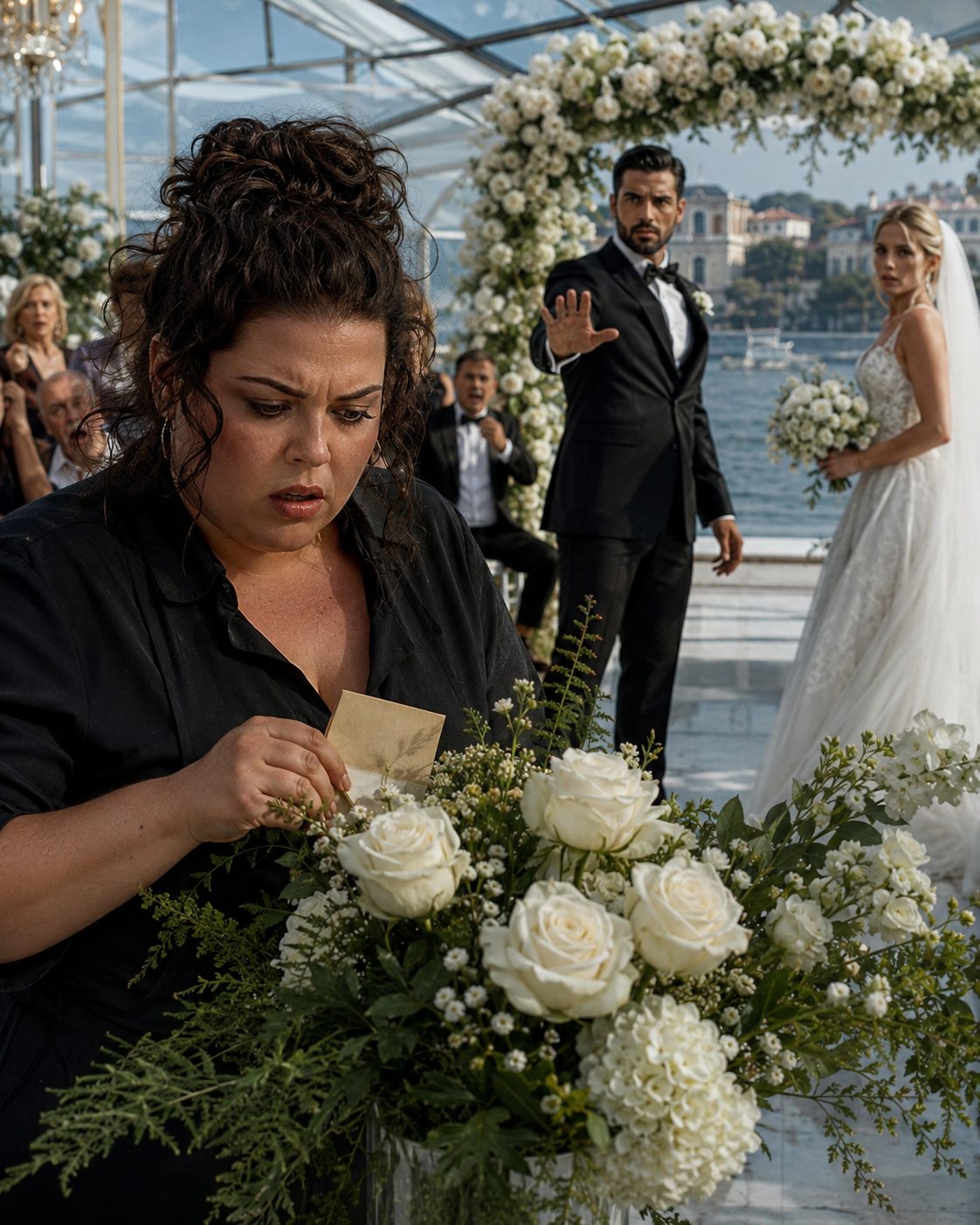
Mara Ellison had learned very early that rich people noticed flowers before they noticed the woman carrying them.
They noticed if the roses were too open, if the peonies leaned too low, if the lilies scented a room too strongly, if the ribbon on a bouquet was half a shade warmer than the table linen. They noticed fingerprints on crystal vases and water spots on marble floors. They noticed everything that could embarrass them in front of other rich people.
But Mara herself?
Most of them looked through her.
At thirty-two, she owned June & Thorn, a small flower shop wedged between a closed tailor’s studio and a bakery in Bay Ridge. The shop had once belonged to her aunt June, who believed flowers were honest because they never pretended to last forever. Mara had inherited the business, the debts, the scratched front counter, the ancient walk-in cooler, and the stubborn belief that beauty still mattered even when the world kept charging rent for it.
She was soft-bodied, broad-hipped, and round-faced, with dark curls she usually twisted into a messy knot by noon. She had hands nicked by thorns, nails ruined by floral dye, and a back that ached after every large event. Brides loved her work until they met her in person. Mothers of brides asked if she had assistants who would be “more suitable” for the front of house. Wedding planners praised her talent while calling her “sweetheart” in a tone that meant servant.
Mara had trained herself to smile through all of it.
Then Dante Bellandi walked into her shop.
He came on a rainy Tuesday afternoon, ten minutes before closing, with two men behind him and silence around him like an expensive coat. He was tall, dark-haired, dressed in a charcoal suit, and calm in a way that made the whole street outside seem louder. Mara knew his name before he introduced himself. Everyone in New York knew the Bellandi name.
Hotels. Restaurants. Import companies. Charity galas. Old money that was not old enough to be clean.
People called Dante Bellandi a businessman when microphones were present. They called him something else when they were whispering.
Mara stood behind the counter with a bucket of half-cleaned garden roses at her feet and tried not to stare.
“Miss Ellison?” he asked.
His voice was deep, controlled, almost polite.
“Mara,” she said. “And you’re early. Your appointment is tomorrow.”
“I dislike waiting.”
“That must be nice.”
One of the men behind him shifted, but Dante only looked at her more closely, as if he had expected fear and found something more inconvenient.
“My fiancée wants your flowers for the wedding,” he said.
“Your planner already told me. White roses. White orchids. White tulips. White everything. Very peaceful. Very expensive. Very easy to photograph.”
“You disapprove.”
“I didn’t say that.”
“You didn’t need to.”
Mara wiped her hands on her apron. “White can be beautiful. But too much of it makes a room look like nobody has ever lived in it.”
For the first time, Dante’s expression almost changed.
“My fiancée likes perfection.”
“Most people who ask for perfection are really asking for control.”
The shop went very still.
Mara heard herself after the words were already out. She had just insulted the bride of a man nobody sensible insulted. She opened her mouth to soften it, but Dante lifted one hand, not threatening, only stopping the room from moving.
“What would you add?” he asked.
“To the flowers?”
“To the perfection.”
Mara glanced down at the bucket beside her. Near the roses, almost hidden, was a single stem of pale blue delphinium that had come in by mistake.
“That,” she said.
Dante looked at the blue flower.
“My fiancée requested white.”
“Then she’ll get white.”
“But you would add blue.”
“I would add one small piece of sky. Something alive. Something that keeps the arrangement from looking like a beautiful apology.”
Dante studied her for a long moment.
Then he said, “Bring samples to the estate tomorrow.”
That was how Mara Ellison became the florist for the most watched wedding of the season.
The Bellandi estate sat above the Hudson behind iron gates, clipped hedges, and enough security cameras to make Mara feel as if even the trees were judging her. The ceremony was to take place on the east lawn under a glass pavilion built just for the wedding. There would be five hundred guests, three orchestras, a private chef from Milan, two magazine photographers, and a floral budget large enough to save Mara’s shop twice over.
The bride, Celeste Arden, was exactly the kind of woman magazines loved. Tall, blond, narrow as a candle flame, with cheekbones sharp enough to make kindness look unfashionable. She greeted Mara with a smile that never reached her eyes.
“So you’re the florist,” Celeste said.
“Mara Ellison. Congratulations.”