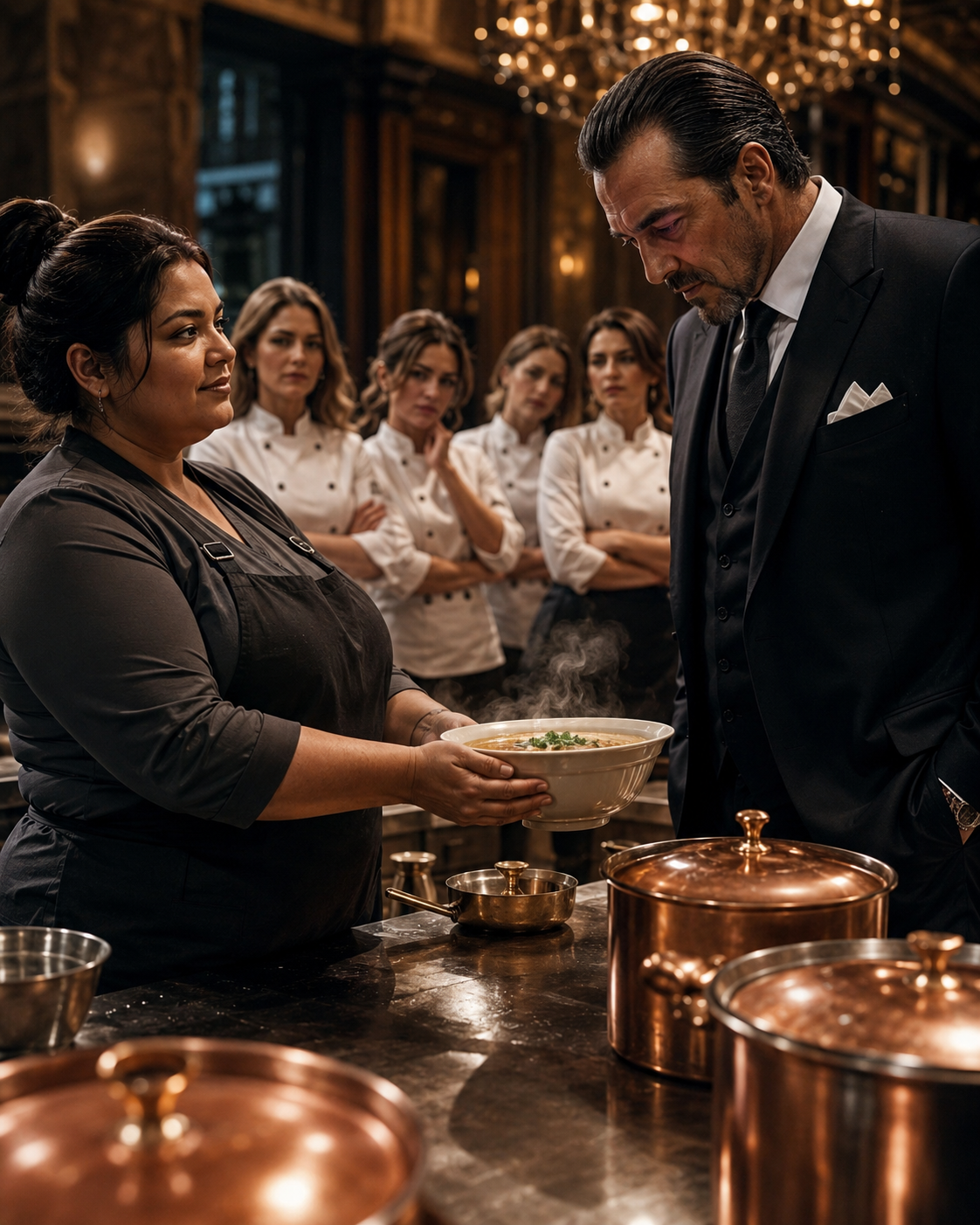
For three years, Celia Ward had worked in the lower kitchen of Blackthorne Hall without once being invited to step through the carved oak doors of the formal dining room.
She knew the room anyway.
She knew it by sound.
The thin ring of crystal when the staff polished glasses too quickly. The restless scrape of expensive chairs across old Italian marble. The soft, measured voices of men who never raised their tone because the world had already learned to listen. The nervous laughter of guests who came to Blackthorne Hall hoping to be seen, then spent the evening wishing they were invisible.
Celia was invisible by profession.
Kitchen maid, they called her, though the title had never fit. She washed copper pots until her wrists ached. She trimmed vegetables when the junior cooks fell behind. She hauled flour sacks from the delivery corridor. She cleaned grease traps no one else wanted to acknowledge existed. She rewrote ruined sauces in silence, saved collapsed custards before banquets, corrected stocks by scent alone, and watched men with whiter jackets and thinner patience receive praise for dinners she had quietly rescued.
She was thirty-two, broad-shouldered, soft around the middle, and built like a woman who had carried too much for too long. In another house, perhaps, her strength might have been admired. In Blackthorne Hall, it made her useful.
Useful people were rarely celebrated.
That evening, however, the house had decided to celebrate food.
Not Celia’s food.
That would have been too honest.
The celebration had been arranged for the arrival of five glamorous chefs hired by Marcellus Vale’s household director to modernize the kitchen. They came through the front entrance instead of the service door, which told Celia everything she needed to know before she saw them.
They arrived laughing under camera lights, each one beautiful in a way that seemed professionally maintained. Polished hair. Sharp cheekbones. White jackets fitted like eveningwear. Gold knives in leather rolls. Perfume strong enough to challenge the garlic roasting in the ovens.
Their names had been printed on ivory place cards for the private tasting: Sabine Frost, Lila March, Evangeline Cole, Maris Bell, and Thea Rourke.
Celia’s name appeared nowhere.
She stood near the dish sink with wet sleeves and a flour mark on her cheek while the five women walked the kitchen as if it were a stage built for them.
“They’re smaller than I imagined,” one of them said, glancing at the ovens.
Another laughed. “Everything important is smaller from the outside.”
Celia lowered her eyes and kept scrubbing the copper pot in front of her.
She had learned early that people revealed themselves most honestly when they believed the room contained no one worth impressing.
At the far end of the kitchen, Julian Crest, the executive chef, clapped his hands twice.
“Attention. Tonight must be perfect. Mr. Vale is hosting a private reconciliation dinner with the Moretti family, and Mrs. Drayton wants the new chefs presented before the first course. No mistakes. No delays. No improvising from the lower staff.”
His gaze landed on Celia for the last sentence.
She did not answer.
Julian hated silence unless he was the one creating it.
“Ward,” he said. “You’ll stay out of the front line tonight.”
“As usual,” murmured one of the junior cooks.
A few people laughed carefully.
Celia rinsed the pot and set it upside down to dry.
Julian’s jaw tightened.
“You will prepare staff soup and keep the prep stations clean,” he continued. “The tasting menu belongs to Chef Frost and her team.”
Sabine Frost smiled without looking at Celia. “How kind.”
Celia turned back to the sink.
The first warning came an hour later.
Not from a shout.
Not from a broken plate.
From cream.
The cream had arrived that afternoon in the usual glass bottles with the usual green seal from Northwell Dairy. Celia had unpacked it herself because the delivery boys always left the crates too close to the freezer door, where the cold could shock the fat and ruin it.
She had known something was wrong the moment she lifted the bottle.
A fraction too heavy.
Not spoiled. Not dangerous. Nothing obvious enough to make a fool of someone who complained. But wrong.
Real Northwell cream had a clean, sweet thickness that clung to the glass as if reluctant to leave. This cream moved heavily and left a dull line behind it. When warmed, it would behave just well enough to pass for expensive, unless the cook understood what it was trying to hide.
Celia had mentioned it to Edwin Pike, the purchasing clerk, three weeks before.
He had smiled at her over his ledger.
“Paperwork says Northwell.”
“I know what the paper says.”
“Then there is no problem.”
“There is if the food tells a different story.”
He had looked at her then the way certain men looked at women they had decided were large enough to be useful but not important enough to be heard.
“Celia, you wash pans. Let the people upstairs handle suppliers.”
So she had done what she always did.
She adjusted.
She worked around the lie.
Tonight, as Sabine Frost’s team prepared a truffle cream velouté for the tasting menu, Celia smelled the lie rise from the saucepan.
The soup looked beautiful. Pale gold, glossy, strained smooth as silk. It would photograph well. It might even impress people who ate with their eyes.
But beneath the truffle oil and roasted shallots, the cream broke half a second early.
Celia knew it the way another woman might know her child’s voice in a crowded street.
She glanced toward Julian.
He stood beside Sabine, nodding as she plated a spoonful for him.
“Elegant,” he said.
“It’s meant to be,” Sabine replied.
Celia looked away.
She was not supposed to save them tonight.
She was not supposed to save anyone.
Still, old habits were stubborn. While the glamorous chefs arranged microgreens with tweezers, Celia took the vegetable trimmings from the prep bins, the chicken bones saved from lunch, the bruised fennel no one wanted, and the last bundle of parsley stems. She set a pot over a low flame and began making soup for the staff.
The kind of soup no one photographed.
The kind that kept people standing.
She roasted the bones until the kitchen smelled warmer. She browned onions until their sweetness deepened into something almost sad. She crushed peppercorns with the flat of a knife, added celery leaves, bay, a heel of parmesan, and the last spoonful of good butter she had hidden in a covered dish behind the pickled lemons.
She did not touch the false cream.
Instead, she clarified the broth with patience, folded in white beans, shaved fennel, black cabbage, and threads of lemon peel so thin they almost vanished. The soup became clear but rich, humble but layered, the kind of dish that told the truth slowly.
At eight-thirty, Marcellus Vale entered the kitchen.
Conversations died as if someone had closed a hand around the room.
Marcellus never needed to announce himself. The house did it for him.
He was forty-six, broad in the shoulders, dressed in a dark suit without a single unnecessary detail. His hair had begun to silver at the temples, which somehow made him look less old than sharpened. He carried power quietly, and that made it heavier. Men like Julian performed authority. Marcellus simply possessed it.
Behind him came Vivienne Drayton, the household director, immaculate in a black dress and pearl earrings. Vivienne had run Blackthorne Hall for eleven years. She knew every contract, every account, every staff rotation, every imported bottle, every person allowed through every door.
Marcellus trusted her completely.
That was why no one questioned her.
“Mr. Vale,” Julian said, stepping forward. “We are ready.”
“Are you?”
“Of course.”
Marcellus looked at the five chefs, then at the plates arranged beneath the warming lights, then at the room itself. His gaze passed over Celia once without stopping.
She was used to that.
Sabine Frost lifted a small porcelain bowl with both hands.
“Our opening soup,” she said. “White truffle cream, smoked leek, and winter herbs.”
Marcellus accepted it.
Everyone watched.
He tasted one spoonful.
His face did not change, but the room felt the change anyway.
He set the bowl down.
“No.”
Sabine blinked.
Julian’s mouth opened slightly.
Vivienne smiled with practiced calm. “Perhaps it needs a touch more salt.”
Marcellus turned his head. “I said no.”
One word. Quiet. Final.
Sabine’s cheeks colored. “Mr. Vale, with respect, that soup is balanced.”
“No,” he said again. “It is dressed.”
Silence tightened.
“The cream is heavy,” Marcellus continued. “The truffle is covering something. The finish is dull.”
Celia’s hand paused over the ladle in her own pot.
Marcellus turned toward the stove where her soup simmered.
“What is that?”
Julian moved quickly. “Staff meal.”
“I asked what it is.”
Celia dried her hands on her apron. “White bean and fennel broth, sir.”
“Who made it?”
She did not look at Julian.
“I did.”
Marcellus studied her now. Properly this time.
“Bring me a bowl.”
Julian laughed once, too sharply. “Mr. Vale, I don’t think—”
Marcellus did not raise his voice.
“That is fortunate, Julian, because I did not ask you to think.”
No one laughed after that.
Celia took a plain bowl from the lower shelf, ladled the soup carefully, wiped the rim with a clean cloth, and carried it to him. She expected him to taste it standing there in the middle of the kitchen like a judge inspecting evidence.
Instead, he took the bowl from her with both hands.
That small courtesy unsettled her more than his power.
He tasted.
For the first time that night, his expression changed.
Not much.
Enough.
The hard line around his mouth eased. Something passed through his eyes so quickly that Celia would have missed it if she had not spent her life reading tiny signs: sauces about to split, dough about to overwork, men about to lie.
He tasted again.
Then a third time.
The five glamorous chefs stood in a row, beautiful and silent.
“Who taught you to make this?” he asked.
Celia could have lied.
She did not.
“My mother.”
“Her name?”
“Ruth Ward.”
The spoon stopped halfway to his mouth.
Celia heard Vivienne inhale behind him.
It was the smallest sound. Almost nothing.
But almost nothing was where truth often hid.
Marcellus lowered the spoon.
“Ruth Ward cooked in the south market district.”
“Yes.”
“She fed boys behind the old boxing hall.”
Celia stared at him.
The room had disappeared around her.
“For years,” she said carefully. “When she could afford to.”
Marcellus looked down at the bowl.
“When I was thirteen, I ate soup from a blue enamel pot behind that hall. I never knew the woman’s name.”
Celia’s throat tightened.
“My mother had a blue pot.”
Marcellus closed his eyes for half a second.
When he opened them, Blackthorne Hall had changed.
Not visibly. Not for everyone.
But Celia felt the shift beneath her feet.
“Send them away,” he said.
Julian went pale. “Sir?”
“The five chefs. The cameras. The tasting menu. Send them away.”
Sabine Frost stepped forward. “Mr. Vale, surely this is a misunderstanding. We were hired for tonight.”
Marcellus placed the bowl on the steel table.
“You were hired to impress people who confuse shine with worth. Tonight I require food that tells the truth.”
Vivienne’s smile remained, but only because she had trained it to survive disasters.
“Marcellus,” she said softly, “the Morettis are arriving in twenty minutes. We cannot change the dinner now.”
“We already have.”
He turned to Celia.
“You know this kitchen?”
“Better than anyone who has been allowed to say so.”
A junior cook made a choking sound and looked at the floor.
Julian’s face hardened.
Marcellus heard the answer beneath her answer.
“Then you cook.”
Celia felt the room turn against her all at once.
Not openly.
Never openly.
But there it was: disbelief, resentment, fear, curiosity, offense. The kind of offense people took when a door they had blocked for years opened from the other side.
Vivienne stepped closer to Marcellus.
“Mr. Vale, Celia is valuable, of course, but she is not trained for a diplomatic dinner of this importance.”
Celia did not speak.
Marcellus looked at Vivienne.
“She just prepared the only honest thing in this room.”
Vivienne bowed her head slightly.
“As you wish.”
But Celia saw it again.
The fraction.
The stillness behind the smile.
The fear that arrived before a person could disguise it.
Marcellus saw Celia seeing it.
His eyes narrowed.
“What else do you taste?” he asked.
The question was dangerous because it was not about soup anymore.
Celia looked at the cream velouté cooling on the counter. She looked at the sealed bottles near the pastry station. She looked at the invoice clipboard hanging by the delivery door.
Then she looked at Vivienne.
“The cream is wrong.”
Julian snapped, “Enough.”
Marcellus did not move.
Celia continued.
“It comes in Northwell bottles, but it is not Northwell cream. Not the batch we used to get. It thickens wrong, breaks early, leaves a waxy finish. Someone is buying cheaper cream and billing the house for premium.”
The room went very still.
Vivienne laughed softly.
It was a beautiful laugh. Elegant. Controlled. A laugh designed to make accusation feel vulgar.
“Celia, dear, that is a serious claim to make based on taste.”
“It is not based on taste only.”
Vivienne’s eyes cooled.
Celia walked to the delivery clipboard, took down the top invoice, and placed it beside the bottles.
“The label says Northwell. The driver who brought these crates was not Northwell. Northwell drivers wear blue waxed jackets. This man wore gray. Their crates are stamped on the short side. These were stamped on the long side. Northwell seals with green wax. This seal is dyed plastic.”
Edwin Pike, the purchasing clerk, appeared near the office door as if summoned by guilt.
Celia glanced at him.
“And three weeks ago, when I mentioned the cream, Mr. Pike told me the paperwork was fine and I should let upstairs handle suppliers.”
Marcellus turned slowly toward Edwin.
Edwin swallowed.
Vivienne did not move.
That was what made Celia certain.
If Vivienne had been innocent, she would have looked surprised.
She looked annoyed.
“Bring me the supplier records,” Marcellus said.
Vivienne folded her hands. “Of course.”
“No,” he said. “Not you. Celia.”
Julian’s voice cracked. “Mr. Vale, she does not have access to—”
“She does now.”
Celia did not know whether to feel fear or victory.
Both arrived together.
She entered the purchasing office for the first time in three years.
It was smaller than she expected, lined with filing cabinets, receipt trays, ledgers, and the quiet arrogance of paper. In the kitchen, truth steamed and burned and spoiled if neglected. Here, truth hid under signatures.
Edwin followed her in, wringing his hands.
“You shouldn’t be here.”
“No,” Celia said, pulling open the dairy drawer. “I should have been here sooner.”
He lowered his voice.
“You don’t understand the house.”
“I understand what comes through the door.”
“That is not the same thing.”
She found the Northwell folder.
Too thin.
Premium dairy for a house the size of Blackthorne Hall should have filled half a drawer. There were invoices, yes. Clean ones. Neat ones. Too neat. Each amount rounded almost perfectly. Each delivery recorded without correction, adjustment, spoilage, or delay.
No real kitchen was that tidy.
She searched the adjacent folders.
Meat.
Oil.
Imported spices.
Produce.
The same pattern repeated in small, careful ways. Not enough to startle someone reading numbers. Enough to offend someone who cooked with the ingredients.
Italian olive oil that tasted flat.
Saffron too bright.
Black pepper that lost heat in the pan.
Wild mushrooms that arrived already sweating in their crates.
She pulled six folders, then paused.
At the back of the drawer was a narrow envelope with no label.
Inside were duplicate delivery slips.
Not from Northwell.
From a wholesaler Celia had never seen listed.
Cheap cream. Common oil. Substitute spices. Bulk produce. Paid in cash.
Her pulse slowed instead of quickening.
Fear, she had learned, was loud at first. Then it became useful.
She took the envelope and returned to the kitchen.
Marcellus stood exactly where she had left him.
The five chefs were gone. Their perfume lingered, but faintly now, losing its fight against onions and stock.
The Moretti guests had arrived. Celia could hear voices beyond the service corridor.
She placed the folders on the steel table.
“The dinner can still be served,” she said.
Marcellus watched her face.
“And the theft?”
“It can wait until dessert.”
A faint flicker touched his mouth. Not quite a smile.
“You are very calm for a woman standing in the middle of a betrayal.”
“No,” Celia said. “I am calm because I have stood in the middle of one for years. I just finally know its name.”
Vivienne’s eyes sharpened.
Celia opened the envelope.
“This is not one mistake. It is a system. Cream, oil, saffron, pepper, mushrooms, veal. Premium prices on paper. Cheaper products at the door. The difference disappears before the kitchen can complain.”
Marcellus looked at Edwin.
Edwin lifted both hands.
“I only filed what I was given.”
“By whom?”
Edwin’s mouth trembled.
Vivienne stepped in smoothly. “This is clearly distressing, but now is not the time to interrogate frightened staff. The Morettis are waiting. Let Celia cook, since you insist, and we will review the matter tomorrow.”
Celia heard it then.
Not in Vivienne’s words.
In their timing.
She wanted the dinner to happen before the truth did.
Celia looked toward the dining room.
“Mr. Vale,” she said, “what was the planned second course?”
Julian answered automatically. “Veal medallions with mushroom cream.”
Celia closed her eyes.
Of course.
The wrong cream. The wrong mushrooms. The wrong veal.
A dish built from lies.
“Do not serve it.”
Julian hissed, “You have no authority to—”
Marcellus turned his head.
Julian stopped.
Celia opened the meat drawer in the refrigerator and pulled out the prepared tray. The veal looked acceptable under the glaze. Expensive lighting could forgive it. Hungry men might forgive it. But as she leaned closer, she smelled the faint sour dampness of meat pushed one day too far and hidden under herbs.
Not rotten.
Not unsafe in the dramatic way stories preferred.
Worse.
Humiliating.
A dish that would not harm the guests but would insult them. Enough to make the Morettis believe Marcellus Vale had served them inferior food at a reconciliation dinner. Enough to turn a fragile peace into mockery.
She stepped back.
“This dinner was meant to fail.”
The kitchen absorbed the words.
Julian whispered, “No.”
Marcellus did not look at him.
He looked at Vivienne.
For the first time, Vivienne’s smile disappeared.
Only for a second.
But the house saw it.
“Explain,” Marcellus said.
Celia answered before Vivienne could.
“Someone replaced key ingredients for weeks, not just to steal money, but to make the kitchen unreliable. Tonight’s menu depends on the worst substitutions. The soup dulls the first impression. The veal insults the table. The cream sauce breaks under heat. The mushrooms taste old. If the Morettis leave angry, everyone blames the kitchen. Or the new chefs. Or me, if I am foolish enough to take charge without checking.”
Marcellus’s voice was soft.
“Were you meant to take charge?”
Celia turned toward Julian.
His face betrayed him before his mouth could lie.
He looked at Vivienne.
There it was.
The thread.
Celia followed it.
Julian had mocked her for years, but mockery was simple. He wanted praise, authority, and applause. He was too vain to build a system this clean.
Edwin was frightened, not clever.
The five chefs had been decoration.
Vivienne had access to contracts, schedules, menus, guest lists, and trust.
Vivienne had made sure the glamorous chefs arrived with cameras. If the dinner failed, their embarrassment would be loud enough to cover the deeper theft. If the staff soup had remained in the back, the false cream might have passed as nerves or bad technique.
But Celia’s soup had reached Marcellus.
And Marcellus had remembered Ruth Ward.
A dead woman’s recipe had pulled a living lie into the light.
Vivienne lifted her chin.
“You are all being manipulated by a kitchen maid who has mistaken resentment for insight.”
Celia felt the words land where they were meant to.
On her body.
On her apron.
On every year she had stood behind thinner women, louder men, cleaner titles.
She took one breath.
Then another.
“No,” she said. “I have mistaken nothing.”
She walked to her soup pot and ladled a spoonful into a tasting cup. Then she took Sabine Frost’s truffle cream and placed it beside her own.
“Mr. Vale, taste them one after the other.”
He did.
Celia spoke so the whole kitchen could hear.
“The first soup is trying to impress you. The second is trying to feed you. The first hides cheap cream under perfume. The second uses scraps honestly. That is the difference between a kitchen and a performance.”
She turned to Vivienne.
“And that is why you kept me at the sink. Not because I was untrained. Because I would taste the difference.”
Vivienne’s face hardened into something truer than elegance.
“You have no idea what I have carried for this house.”
Marcellus’s jaw tightened.
Vivienne laughed once.
“Oh, don’t look wounded, Marcellus. You trusted men who feared you, women who flattered you, cooks who lied to you, accountants who smiled at you. I kept the house running while you played king in the dining room.”
Celia heard a few staff members inhale.
Vivienne had not confessed to everything.
But anger often opened the door before proof walked in.
Marcellus remained still.
“Why?”
Vivienne’s eyes flashed.
“Because loyalty is a word powerful men use when they want underpaid people to feel noble about being used.”
Celia almost understood her.
That was the terrible part.
Almost.
Then she looked at the folders, at the false invoices, at the dinner meant to collapse, at the staff who would have taken the blame, and understanding hardened into refusal.
“You were used,” Celia said quietly. “So you decided to use everyone below you.”
Vivienne turned on her.
“Do not speak to me as if we are the same.”
“We are not.”
The words came out before Celia knew she would say them.
“I made soup.”
The kitchen held its breath.
Marcellus looked at Celia, and something like respect settled plainly on his face.
Not surprise.
Recognition.
“Can the dinner be saved?” he asked.
“Yes.”
“How?”
Celia tied her apron tighter.
“No cream. No veal. No performance.”
Julian made a strangled sound. “There is no time for a new menu.”
“There is enough time for an honest one.”
She began moving before anyone gave permission.
“Marco, pull the root vegetables from cold storage. Roast them hard. Tess, strain the chicken stock. Use the clear pot, not the cloudy one. Andre, slice bread from staff loaves, oil, salt, grill it. Lina, bring the black cabbage and fennel. No mushrooms. No saffron. No cream. We serve broth first, then roasted vegetables with lemon, then herb chicken, then pears in red wine if the fruit is still good.”
Nobody moved.
Celia turned.
“Now.”
They moved.
Not because she shouted.
Because her voice held the shape of the kitchen as it should have been all along.
For the next forty minutes, Blackthorne Hall became honest.
Celia worked the stove with a calm that frightened people more than panic would have. She tasted everything. She corrected salt by instinct. She turned ingredients others had dismissed into dishes that felt deliberate, intimate, impossible to mock.
Marcellus stayed near the pass.
He did not interfere.
That was the first wise thing he did all evening.
When the first course went out, the kitchen waited.
No one breathed properly until the dining room steward returned.
“Mr. Moretti asks who prepared the soup.”
Marcellus looked at Celia.
Celia did not lower her eyes.
“Tell him,” Marcellus said, “Celia Ward did.”
The steward vanished.
Julian stared at the floor.
Vivienne stood by the office door, guarded now by two silent members of Marcellus’s staff. No one touched her. No one threatened her. The truth had made violence unnecessary. That was one of its few mercies.
The second course went out.
Then the third.
In the dining room, voices changed. The hard edges softened. Forks slowed, not from displeasure, but attention. Men who had arrived ready to measure insult found themselves eating food that offered no insult at all.
Food without vanity was difficult to argue with.
Near the end of service, Marcellus leaned close enough that only Celia could hear.
“My mother used to say hunger remembers.”
Celia kept her eyes on the plates.
“Your mother was right.”
“I forgot.”
“No,” Celia said, placing roasted pears into shallow bowls. “You covered it.”
He accepted that without defense.
It made her look at him.
Most powerful men could survive accusation. Few could survive being understood.
The final dish went out with no gold leaf, no spun sugar, no theatrical smoke. Just pears simmered in wine, black pepper, orange peel, and a spoonful of thickened syrup shining dark as garnet.
The steward returned five minutes later.
“Mr. Moretti requests that the chef join the table.”
Julian took half a step forward from habit.
Then stopped.
Celia wiped her hands slowly.
“No.”
Marcellus studied her.
“You do not want the recognition?”
“I want the kitchen to finish clean.”
A ghost of a smile touched his mouth.
“You would refuse a room full of powerful men?”
“I have survived rooms full of powerful men by knowing when not to enter them.”
Marcellus nodded.
Then he walked into the dining room himself.
Celia did not hear every word.
She heard enough.
“This dinner was prepared by Celia Ward,” he said. “She saved it after I nearly allowed vanity into my kitchen and betrayal into my house.”
No one in the kitchen moved.
Celia stared at the cutting board until the grain blurred.
Tess, the youngest prep cook, whispered, “He said your name.”
Celia swallowed.
“Yes.”
“Out there.”
“Yes.”
“Are you all right?”
Celia almost laughed.
“No.”
And then she did laugh, quietly, because the alternative was weeping into the pear syrup.
Later, after the guests left peacefully and the house exhaled, Marcellus called the staff into the kitchen.
Vivienne had been escorted to the office to await a formal review with accountants and attorneys. Edwin had agreed to provide records. Julian stood apart, pale and diminished. The five glamorous chefs were gone from the house, leaving behind only a forgotten knife roll and the faint scent of expensive perfume near the door.
Marcellus placed the supplier folders on the steel table.
“This house was betrayed from inside,” he said. “Not by one bad ingredient. Not by one failed dinner. By the belief that the people closest to the work could be ignored.”
His gaze moved across the staff and stopped on Celia.
“I believed that too.”
No one spoke.
“I was wrong.”
The words landed harder than any threat could have.
Marcellus turned to Julian.
“You are relieved of your position pending review.”
Julian’s mouth opened.
Marcellus raised one hand.
“Do not make your last moment here smaller than it already is.”
Julian closed his mouth.
Then Marcellus looked at Celia.
“The kitchen needs a head.”
Celia felt every eye find her.
She hated that her first feeling was fear.
Not joy.
Fear.
Because invisibility, once lived in long enough, could become a room you knew how to navigate. Recognition was a door to weather.
“I am not interested in being your symbol,” she said.
Marcellus’s expression did not change.
“Good. I have enough symbols.”
“I will not be paraded in front of guests because you discovered humility for one evening.”
“I would deserve that suspicion.”
That answer surprised her.
She continued anyway.
“If I take the kitchen, I choose suppliers. I approve menus. No director overrides food decisions without my signature. Every cook eats before service. Every dishwasher gets staff meal hot, not leftovers scraped cold. And if someone in this house says ‘just a kitchen maid’ again, they can clean grease traps until they learn vocabulary.”
A sound moved through the staff. Not laughter exactly. Something better.
Hope trying not to be foolish.
Marcellus looked at her for a long moment.
“Done.”
Celia blinked.
“You should negotiate.”
“I just did. I accepted the only person tonight who told me the truth.”
His voice lowered.
“And one more condition.”
There it was, she thought.
Power always remembered itself eventually.
“What condition?”
“You teach me that soup.”
The kitchen went still.
Celia stared at him.
Marcellus Vale, feared by half the city and obeyed by the other half, stood beside the steel table like a man asking for something he did not know how to deserve.
“My mother’s soup?”
“The one your mother made behind the boxing hall.”
Celia looked at the pot.
There was barely a ladle left.
“She never wrote it down.”
“Then teach me the way she taught you.”
Celia’s throat tightened again, but this time she did not fight it as hard.
“She taught me by making me chop onions until I stopped complaining.”
“I can chop onions.”
Several staff members looked away, trying not to smile.
Celia considered him.
Then she handed him a knife.
“Not in that suit.”
For the first time all night, Marcellus Vale laughed.
Not loudly.
Not performatively.
But honestly enough that the kitchen changed again.
By midnight, the marble dining room was empty, the accounts were sealed, the false invoices locked away, and the first real change in Blackthorne Hall began not with an announcement, but with onions.
Marcellus removed his jacket.
Celia rolled up her sleeves.
The staff pretended not to watch.
“You cut too close to the root,” she said.
“I have been told I am decisive.”
“You are wasting onion.”
“I stand corrected.”
“You will stand corrected often in my kitchen.”
He glanced at her.
“Your kitchen.”
She looked around.
At the ovens she had saved.
At the tables that had held her silence.
At the staff waiting to see whether the world had truly shifted or only paused before returning to its old shape.
“My kitchen,” she said.
The words did not fit comfortably yet.
But they fit.
In the morning, Blackthorne Hall would still be Blackthorne Hall. Its walls would still remember secrets. Its corridors would still carry the footsteps of dangerous men and elegant liars. Vivienne’s betrayal would widen before it ended. The missing money would lead to accounts, then partners, then names Marcellus would not enjoy discovering.
Celia knew this.
She was not naive enough to believe one bowl of soup could cleanse a house built on power.
But it had done something.
It had made the house taste itself.
And once a lie had been tasted clearly, it could never again pass for the truth.
Marcellus placed a pile of uneven onions into the pot.
Celia inspected them.
“Too thick.”
He sighed.
“Again?”
“Again.”
He reached for another onion.
Celia turned back to the stove, hiding the small smile she was not ready to give him.
Behind her, the lower kitchen of Blackthorne Hall moved with new purpose. Not perfect. Not healed. Not safe from every old habit. But awake.
For three years, Celia Ward had been told she belonged at the sink.
That night, her soup crossed the room before she did.
By dawn, her name was on the kitchen door.
And for the first time in the history of Blackthorne Hall, the most powerful person in the house was not the man who owned it.
It was the woman who could taste the truth.