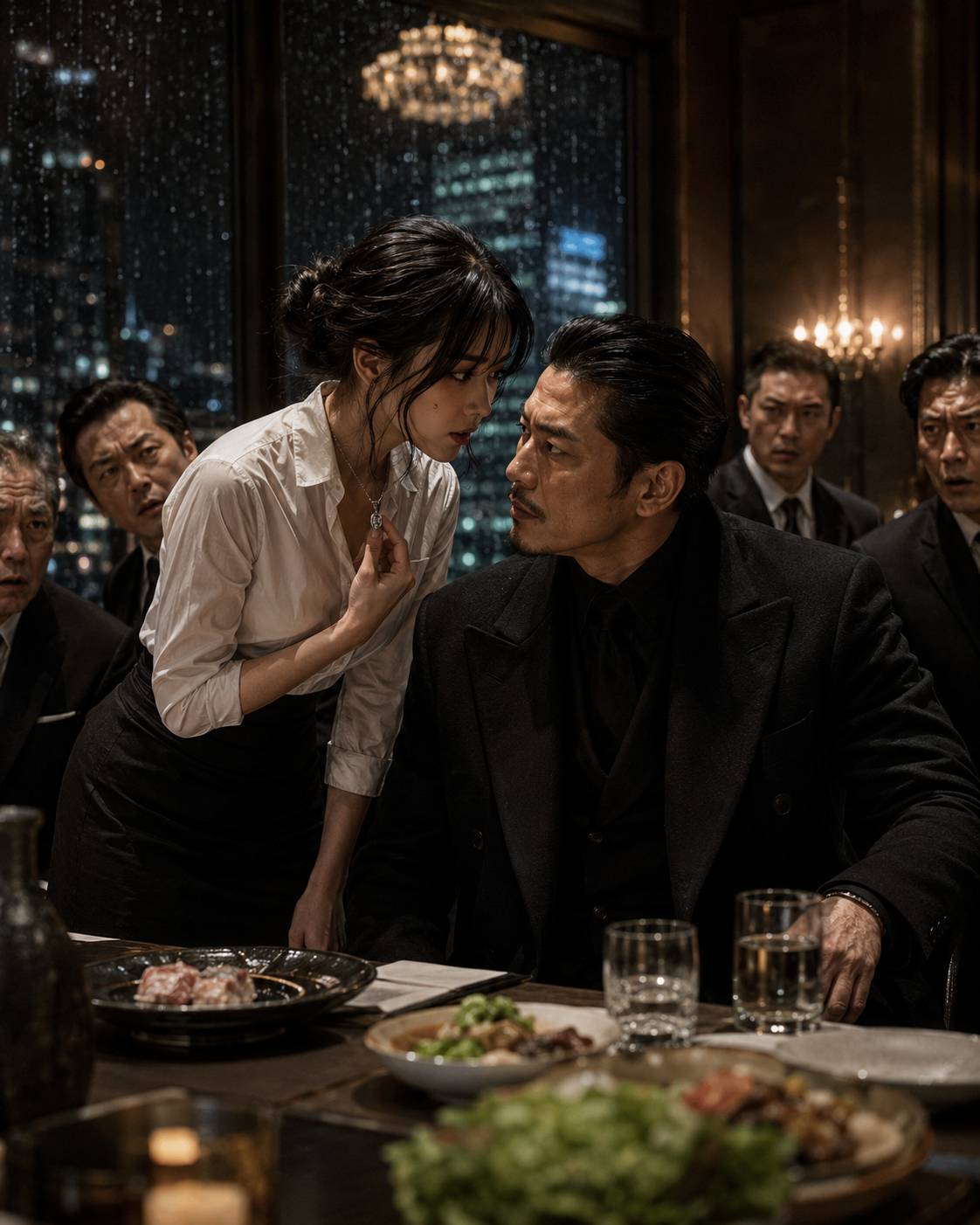
Nobody noticed the waitress until the room went silent.
That was how Clara Bennett had survived for twelve years.
She knew how to refill water without interrupting a sentence, how to replace a dirty plate before a rich man remembered he had finished eating, how to lower her eyes just enough to look harmless without looking afraid. At Sterling Room, one of Chicago’s most expensive private restaurants, invisibility was practically part of the uniform.
White blouse.
Black skirt.
Polished shoes.
Quiet hands.
No opinions.
No past.
No name worth remembering.
That night, the private dining room had been reserved under a false company name. Clara knew it was false because real executives did not arrive with men who scanned exits before removing their coats. They did not ask for the windows to be covered. They did not send the regular interpreter ahead to check every chair, every flower arrangement, every service door.
And they certainly did not make the manager whisper, “Clara, keep your head down tonight. These are not people you want noticing you.”
Clara had almost laughed.
That was exactly why she was good at her job.
The first group arrived at eight.
Marco Santoro entered like a man who believed the city owed him rent. Broad shoulders, silver tie, heavy rings, smile too bright to be friendly. His men spread behind him with the lazy confidence of people who had never cleaned up their own messes.
The second group arrived seven minutes later.
They did not smile.
At the center walked Kenji Arakawa.
He was not the tallest man in the room. He did not need to be. Power moved around him before he spoke, clearing space as if the air itself had learned discipline. His black coat was cut simply, his hair combed back, his face calm in the way deep water was calm.
Behind him came two men.
Dante Cross, broad, scarred, and suspicious of everything with a pulse.
And Silas Ward, thinner, quieter, with pale eyes that noticed too much.
Clara felt those eyes pass over her once while she poured tea.
She kept her breathing even.
She had spent half her life avoiding men who noticed too much.
The hired interpreter, Oliver Grant, stood near the table with a tablet in his hand and arrogance in his posture. He had been recommended by someone important, which meant no one had questioned whether he was good.
He was not.
Clara knew that within three sentences.
Marco leaned back and spoke first.
“Tell him Chicago is not Kyoto. He does not get to walk into my city and demand river access like he owns the bridges.”
Oliver translated into formal Japanese, stiff and wrong.
“Mr. Santoro welcomes your interest in local transportation and hopes for mutual respect.”
Clara kept her face blank.
Kenji’s eyes did not move, but something in his expression sharpened.
Marco continued, “We give him twenty percent of the river intake, no more. He stays away from Dock Nine. And if he tries to bring Osaka rules here, I’ll feed his empire to the unions piece by piece.”
Oliver swallowed and translated, “Mr. Santoro offers a fair partnership of twenty percent and asks that certain docks remain under local management.”
Clara placed a bowl of miso soup beside Kenji.
His gaze flicked to her hands.
Just once.
Then Marco said the sentence that made her blood turn cold.
“And tell him if he touches Warehouse Nine, I’ll make sure the old ghosts in that place wake up hungry.”
Oliver hesitated.
He did not know how to translate that.
Because he did not understand what had just been said.
But Clara did.
Warehouse Nine.
Old ghosts.
Her fingers tightened around the tray.
Kenji noticed.
So did Silas.
Clara lowered her eyes quickly, but it was too late.
Oliver began, “Mr. Santoro says there may be complications regarding storage—”
“No,” Clara said.
The word left her mouth before fear could stop it.
Every head turned.
The manager, standing near the service door, went white.
Marco stared at her as if the furniture had interrupted him.
Oliver blinked. “Excuse me?”
Clara looked at Kenji.
And in a soft Osaka dialect she had not spoken aloud in years, she said, “He did not say storage. He warned you away from Warehouse Nine because someone told him it matters.”
The room changed.
Not loudly.
No chair overturned. No man shouted. No glass broke.
But the air shifted as if a wire had been pulled tight across every throat.
Kenji looked at her fully now.
For the first time that evening, the invisible waitress became the most important person in the room.
“You understand Kansai-ben,” he said in the same dialect.
Clara’s heart slammed once against her ribs.
“I understand enough.”
Dante Cross stepped closer. His hand did not move toward a weapon, but his whole body became one.
Silas Ward watched Clara’s neck.
She remembered the silver pendant under her collar and felt a flash of panic.
Kenji saw it too.
“Who taught you?” he asked.
“No one important.”
“People who say that are usually lying.”
Clara straightened.
“I am here to serve dinner, Mr. Arakawa. Not history.”
Marco slapped the table.
“What the hell is this? Why is the waitress talking?”
Kenji did not look away from Clara.
“Because she is better than the man you paid to lie to me.”
Oliver flushed. “I was not lying.”
Clara turned to him, her voice still calm. “You softened every threat, missed every insult, and failed to translate the only sentence in this room that mattered.”
Marco rose halfway out of his chair.
“Careful, sweetheart.”
Kenji’s fingers rested on the table.
Only that.
Still, Marco’s men stiffened.
Clara had seen storms gather with less warning.
She lifted one hand slowly, palm open, not toward Kenji or Marco, but toward the whole room.
“Everyone came here to leave richer than they arrived,” she said. “No one came here to explain gunfire to police over dessert.”
Marco’s eyes narrowed.
“You think you can talk to me like that?”
“No,” Clara said. “I think you can still take the twenty percent you were going to accept before someone told you to ask about Warehouse Nine.”
Kenji’s mouth curved slightly.
Not a smile.
Recognition.
Marco looked at his men. One of them gave the smallest nod. Clara saw the calculation move across the table. Twenty percent of Arakawa’s Pacific route was more than Santoro’s people made in months.
Marco sat back down.
“Fine. Twenty. No Warehouse Nine. But Carlo Vescari approves the final terms tomorrow.”
At that name, Kenji’s gaze hardened.
Clara heard it.
Carlo Vescari was not supposed to be part of this meeting. Not if this was only about shipping. Not if this was only about money.
Documents appeared. Pens moved. Men signed papers with expensive ink and murderous patience.
For five fragile minutes, Clara thought she had prevented a disaster.
Then she saw the window.
Not the window itself.
The reflection.
Outside, across the narrow service alley, a black maintenance van rolled to a stop with its headlights off. Rain ran down the glass, twisting the reflection, but Clara saw enough.
The side door opened.
A dark figure leaned out.
Not toward Marco.
Not toward Dante.
Toward Kenji.
Clara did not think.
She moved.
“Down!” she shouted in Japanese.
She slammed into Kenji’s side just as the window exploded.
The private dining room shattered into chaos.
Glass rained over the white tablecloths. Wine burst across marble. Men shouted in three languages. Someone screamed in the main restaurant beyond the doors. Kenji hit the floor with Clara beneath him, then rolled instantly, putting his body between her and the broken window.
A piece of glass had cut her wrist.
She barely felt it.
Dante Cross moved like a wall coming alive. Silas vanished into motion. Marco’s men were no longer pretending to be partners.
They were firing across the room.
At Kenji’s people.
“It was a trap,” Clara gasped.
Kenji looked down at her. No panic. No surprise. Just cold understanding.
“You saw it first.”
“The van. South alley. Two men, maybe three.”
“Stay low.”
He rose before she could answer.
Clara pressed herself against the carpet as the world tore itself apart above her. Marco backed toward the side exit, face twisted with fury. He had planned for Kenji to die in the first burst.
He had not planned for a waitress to ruin the timing.
Kenji moved through the chaos with terrifying calm. He did not waste movement. He did not shout. He simply advanced until Marco had nowhere left to go.
“Vescari sends his regards,” Marco spat.
Kenji’s voice was quiet.
“Then I will answer him in person.”
A final crack of sound split the room.
Then the gunfire faded.
The maintenance van screamed away into the rain.
For a few seconds, nobody moved.
Then the world returned.
Sprinklers hissed. Sirens rose in the distance. The main restaurant was full of terrified diners being pushed toward the exits. Dante pressed a hand to his wounded shoulder. Silas stood near the broken window, expression unreadable.
Kenji came back to Clara.
His coat was torn. A thin line of blood marked his cheek. He looked less like a businessman now and more like the kind of man people warned children about in whispers.
He crouched before her.
“You saved my life,” he said in Japanese.
Clara gave a shaky laugh. “I think I ruined the tasting menu.”
His eyes moved over her face, her cut hands, her ruined uniform.
“You are not a waitress.”
“I am absolutely a waitress.”
“Not anymore.”
Those two words unsettled her more than the bullets had.
Because they did not sound like possession.
They sounded like recognition.
And recognition was dangerous.
That was how lonely people became loyal to men who could destroy them.
Dante approached, pale but steady.
“Police in ninety seconds.”
Kenji stood and offered Clara his hand.
“We leave.”
Clara did not take it.
“No.”
The men around them froze.
Kenji looked at her. “No?”
“I saved you. That does not make me yours.”
A faint spark moved through his eyes.
“I did not say you were mine.”
“You said we leave.”
“Because if you stay, you die.”
The words landed harder than any command.
Kenji lowered his voice. “Santoro’s people will watch the footage. Vescari will learn you translated the warning, saw the shooters, and pulled me down before the first shot. He will not care that you carry plates for a living. He will make you an example.”
Clara looked around the ruined room.
Her job was gone.
Her anonymity was gone.
Her carefully built life had broken in less than thirty minutes.
Still, she lifted her chin.
“I have an apartment.”
“They will find it.”
“I have neighbors.”
“They will use them.”
“I have a choice.”
Kenji held her gaze.
“Yes,” he said. “You do.”
That stopped her.
He removed a clean handkerchief from his coat and wrapped it carefully around her bleeding hand without gripping her wrist.
“You can walk out the front door and trust a city that will pretend this room never existed. Or you can walk out the back with me and stay alive long enough to decide what happens next.”
Clara thought of her father’s last warning.
If they hear you speak that way, run.
So Clara ran.
But this time, she ran beside the danger instead of away from it.
The back exit opened into rain and flashing red light.
Black SUVs waited in the alley. Men with earpieces formed a wall around her. Dante climbed into one vehicle with a medic. Silas took the front passenger seat of another, calm as a knife in a drawer.
Kenji sat beside Clara in the center SUV.
He did not touch her unless necessary.
Somehow that frightened her more.
Men who grabbed were easy to hate. Men who gave space while taking control were harder to understand.
Chicago blurred beyond tinted glass. Rain turned neon signs into ribbons. Clara watched Sterling Room disappear behind police lights and emergency workers.
Her old life lay behind her in broken glass.
Kenji spoke rapidly into his phone in Japanese. He ordered roads watched, accounts frozen, safe houses opened, cameras erased, hospitals paid, names checked.
Clara listened despite herself.
His orders were ruthless, but not reckless. He wanted shooters found alive if possible. He wanted Vescari’s routes watched, not families touched. He wanted Santoro’s surviving men separated, not slaughtered.
Alive.
That word mattered.
When the call ended, Kenji looked at her.
“You are listening again.”
“I’m trapped in a car with you. Listening seems sensible.”
“You are angry.”
“I was shot at and then escorted into a stranger’s vehicle by criminals.”
“You chose to come.”
“I chose not to be murdered in my apartment.”
“That is still a choice.”
Clara laughed once, sharp and humorless.
“Men like you love saying that.”
The SUV went quiet.
Kenji studied her.
“Men like me?”
“Men with money. Men with private doctors. Men who create storms and then offer umbrellas.”
Silas glanced back from the front seat.
Kenji did not punish the insult.
He turned toward the window.
“Yes,” he said quietly. “That is what men like me often do.”
The honesty stole a little of her anger.
They stopped at a converted warehouse in the West Loop, the kind of building that looked industrial from the outside and untouchable from within.
Kenji’s penthouse was not what Clara expected.
No gold statues.
No velvet throne.
No ridiculous display of power.
It was quiet. Pale walls, dark wood, winter photographs of Lake Michigan, shelves of old books, a bonsai beneath a warm lamp, and a framed ink painting of a sparrow on a branch.
Clara stared at the sparrow too long.
Kenji noticed.
A doctor arrived and cleaned the cuts in her hands. No stitches. Just bandages and a warning to rest, which was funny because rest had not survived the evening either.
When the doctor left, Kenji brought her tea.
Clara stared at the cup.
“Is this safe?”
“Yes.”
“That is what someone would say if it wasn’t.”
“If I wanted you dead, Miss Bennett, tea would be an inefficient method.”
She took the cup because her hands were shaking and she hated that he saw.
For a while, neither spoke.
Then Kenji said, “Your father was not a restaurant supplier.”
Clara’s cup stopped halfway to her mouth.
There it was.
The door she had spent years holding closed.
“My father is dead.”
“That was not my question.”
“No,” she said. “It was a trap dressed as a statement.”
Kenji sat across from her, not beside her.
“My men heard your dialect. They saw your bow. Silas noticed your pendant. You reacted to Warehouse Nine as if it had a pulse.”
Clara’s fingers went to the silver charm beneath her blouse.
A tiny oval pendant.
Plain unless someone knew how to read the engraving on the back.
Sparrow.
Her father had given it to her when she was twelve, two days before they left Osaka with fake documents and a single suitcase.
“What do you know?” she asked.
Kenji’s voice softened.
“When I was sixteen, my adoptive father employed an American accountant named Peter Bennett. He had kind eyes, terrible suits, and a gift for finding money powerful men tried to bury. He also had a daughter who waited outside his office reading manga in Japanese. Everyone called her Suzume because she listened from corners and remembered everything.”
Clara could not breathe.
Kenji continued.
“One night, Peter Bennett disappeared. So did the girl. A week later, accounts connected to the old Arakawa organization were exposed. Men went to prison. Others died. My adoptive father said Peter betrayed us.”
Clara stood so quickly tea spilled over her hand.
“My father betrayed no one.”
Silas shifted near the door.
Kenji lifted a hand without looking at him.
Clara’s voice trembled, but she did not lower it.
“He found out your organization was moving women through private shipping containers. Girls. Some younger than I was. He copied ledgers and gave them to the only federal contact he trusted. Someone warned the syndicate before the raid. We ran because your people came to our apartment with knives.”
Kenji went still.
“The Arakawa family does not traffic women.”
“Maybe not under you. Maybe not now. But twelve years ago, someone did.”
“My adoptive father executed traffickers.”
“Your adoptive father profited from them.”
The words struck the room like a thrown stone.
For the first time, Clara saw something crack in Kenji’s expression.
Not rage.
Doubt.
Memory.
Silas said quietly, “Careful.”
Clara turned on him.
“I was careful for twelve years. I changed schools, changed names, changed cities. I worked double shifts and lived behind three locks. I watched my father die at fifty-one because running had worn his heart down to thread. So forgive me if I am tired of being careful around men who call themselves honorable while burying the truth.”
Kenji did not move.
Then he asked, “Do you have proof?”
Clara touched the pendant.
Her father had always said never to reveal everything at once.
But the night had already taken everything.
“Yes,” she whispered. “And if Carlo Vescari wants Warehouse Nine, then your past and mine just became the same war.”
The penthouse became colder.
A laptop appeared. A wall screen lit with maps of the river district. Warehouse Nine sat near the South Branch, officially leased by one of Kenji’s logistics companies. Unofficially, Kenji said it held sealed records from old operations, locked away after he took control.
According to Clara’s father, it held something worse.
A missing ledger.
Not just names of criminals.
Judges.
Police commanders.
Customs officials.
Shipping executives.
A skeleton key to the city.
Clara removed the pendant from her neck. She pressed the hidden seam. The oval clicked open, revealing a thin strip of microfilm folded inside.
Dante cursed under his breath.
Silas leaned forward despite himself.
Kenji stared as if he were looking at a ghost.
“My father said there were two copies,” Clara said. “One hidden with me. One hidden where no one could reach it without starting a war.”
“Warehouse Nine,” Kenji said.
She nodded.
“That is why Vescari wants access. Not storage. Evidence.”
“Or blackmail,” Dante said.
“Both,” Clara answered.
Kenji walked to the window. The city glittered below, beautiful and indifferent.
“Who knew?” he asked.
“About me?”
“About the ledger. About the warehouse. About the pendant.”
“My father trusted one federal contact. Her name was Helen Archer. She died in a car accident six months after we escaped. After that, he trusted no one.”
Kenji turned.
“Santoro asked for Warehouse Nine. Vescari sent shooters. But Santoro was not clever enough to connect you to Peter Bennett because you spoke during dinner.”
Clara’s stomach dropped.
He was right.
The trap had been arranged before she opened her mouth.
The meeting.
The restaurant.
The warehouse demand.
The assassination.
It had all been choreography.
Kenji looked at Dante.
“Who chose Sterling Room?”
Dante answered, “The meeting request came through Santoro’s attorney. We verified the chain.”
Kenji’s voice lowered.
“Who chose the restaurant?”
Dante paused.
Then slowly, every eye turned.
Silas Ward stood by the elevator, hands visible, face unreadable.
Kenji said, “Silas.”
Silas sighed.
It was an almost tired sound, and that made Clara’s fear bloom.
“You always ask one question too many,” Silas said.
Dante reached for him.
Silas moved first.
The lights went out.
Darkness swallowed the penthouse.
A shot cracked.
Glass shattered.
Clara dropped as Kenji pulled her behind the sofa. Emergency lights flickered red along the floor. Men shouted. Someone hit the wall hard.
Silas’s voice came from the dark.
“I told Vescari the old files were in Warehouse Nine. I told Santoro to demand access. I told them where you would sit tonight.”
Kenji’s voice remained calm enough to terrify.
“Why?”
Silas laughed bitterly.
“Because your father understood power. You inherited his chair and began pretending we were businessmen. No civilian targets. No trafficking. No children. No old debts collected from families. You weakened us with mercy.”
Kenji said nothing.
“The ledger is worth more than any port treaty,” Silas continued. “With it, Vescari controls judges, unions, police, half the river. And I control Vescari because I know where he got it.”
Clara pressed a hand over her mouth.
Silas had not betrayed Kenji for money alone.
He wanted the old world back.
The world her father had died exposing.
Kenji moved through the red darkness.
Clara heard the struggle before she saw it. A soft step. A hard impact. A weapon skidding across the floor. Silas and Kenji collided near the window, striking like men who had trained beside each other and knew every weakness.
Silas drew a blade.
Kenji caught his wrist.
Silas twisted free.
The blade flashed again.
Clara grabbed the heavy ceramic tea bowl from the table and brought it down on Silas’s hand.
He cried out.
The blade fell.
Dante surged from the floor and slammed Silas against the wall. Within seconds, Silas was on his knees, blood at his mouth, Dante behind him.
“Give me one reason,” Dante growled.
Kenji wiped blood from his lip.
“No.”
Dante froze. “Boss?”
“Silas answers first.”
Silas gave a broken laugh.
“Still mercy.”
“No,” Kenji said. “Evidence.”
Clara looked at him then.
Really looked.
This was a man who had every reason to end his traitor in that moment. His world expected it. His men probably wanted it. Silas himself seemed ready for it.
But Kenji Arakawa chose truth over revenge.
For the first time, Clara wondered if the dangerous man before her had been trying to become someone else long before she ever entered the room.
Then Clara’s phone buzzed.
Every head turned.
Unknown number.
A video message.
Her hands shook as she opened it.
The screen showed her apartment.
Her small kitchen.
Her father’s chipped blue mug.
Then the camera turned.
Mrs. Rivera sat tied to Clara’s kitchen chair.
Her elderly neighbor. The woman who left soup outside Clara’s door when Clara came home too tired to cook. The woman who had no family in the city.
A man’s voice spoke off camera.
“Bring the girl and the pendant to Warehouse Nine by midnight, Arakawa. Or the old woman pays first.”
The video ended.
Silence filled the room.
Clara whispered, “I’m going.”
Kenji turned. “No.”
“She is innocent.”
“That is why you are not walking into a trap.”
“She fed me when my father died.”
Something shifted in his face.
Clara stepped closer, tears burning but not falling.
“You asked if I had proof. You asked if my father told the truth. This is the truth. Innocent people always pay while powerful men argue about honor.”
Kenji looked at the pendant in her hand.
Then at Silas on the floor.
Then at the rain-dark city outside.
When he spoke, his voice was quiet.
“No more.”
Dante looked up.
Kenji took the microfilm, placed it in a metal case, and handed it back to Clara.
“We go to Warehouse Nine. We get Mrs. Rivera. We get the ledger. And we end Vescari’s world.”
Clara searched his face.
“And after?”
“After,” Kenji said, “we decide what kind of men survive the night.”
Warehouse Nine stood beside the river like a monument to everything Chicago pretended not to know.
Rain swept across the docks. Freight cranes loomed over black water. Shipping containers groaned in the wind. The skyline glittered in the distance, clean and bright, as if corruption lived somewhere else.
Clara wore a dark coat over her ruined waitress uniform. Her bandaged hands ached. The pendant rested against her chest, heavier than ever.
Dante checked the area beside her.
“You stay behind me.”
“You do not like me,” Clara said.
“I do not know you.”
“You pointed a gun near me twice tonight.”
“Professional habit.”
Despite everything, Clara almost smiled.
Kenji approached without a visible weapon, though Clara knew better now. His face was calm. Too calm.
“Vescari expects fear,” he said. “We give him uncertainty.”
“That sounds like a terrible plan.”
“It is flexible.”
“That means terrible.”
Dante snorted.
Kenji looked at Clara, and for one moment the docks, the rain, and the danger faded.
“If anything goes wrong, run to the river gate. Dante will take you out.”
“What about Mrs. Rivera?”
“I will not leave her.”
Clara believed him.
That frightened her almost as much as distrusting him had.
They entered through a side door. Inside, Warehouse Nine smelled of rust, dust, cold concrete, and river water. Rows of sealed crates stretched into darkness. Old lights flickered overhead.
At the center of the warehouse, beneath a hanging lamp, Mrs. Rivera sat tied to a chair.
Her gray hair had fallen loose. Fear filled her eyes when she saw Clara.
Beside her stood Carlo Vescari.
He was older than Clara expected, elegant in a camel coat, with silver hair and a face that looked suited to charity dinners. Men like him always looked respectable from a distance.
That was how they survived.
“Mr. Arakawa,” Vescari called. “And the famous little waitress.”
Kenji’s men spread through the shadows.
Vescari’s men did the same.
No one moved too quickly.
Not yet.
Vescari smiled at Clara.
“I admit, Miss Bennett, I did not expect Peter’s daughter to grow up pouring wine.”
“Let her go,” Clara said.
Mrs. Rivera shook her head desperately, trying to warn her away.
Vescari ignored the plea.
“I knew your father. Brilliant man. Very poor instinct for survival. He thought information belonged to justice. I told him information belongs to whoever has the strength to use it.”
“You hunted him for twelve years.”
“He stole from people above him.”
Kenji’s voice cut through the warehouse.
“He exposed traffickers.”
Vescari’s smile thinned.
“Your adoptive father was more practical than you.”
Kenji went still.
There it was again.
The ghost in the room.
The man who raised him.
The shadow that had shaped him.
Vescari seemed pleased to twist the knife.
“Did you think he hated the trade? He hated disorder. There is a difference. He eliminated rivals and called it morality. He sold victims through one door while punishing competitors at another. Your code was built on a lie, Arakawa.”
For a moment, no one spoke.
Clara watched Kenji absorb the truth.
Not deny it.
Not dodge it.
Absorb it.
That was when she understood something essential about him. Kenji was dangerous not because he never doubted himself. He was dangerous because when doubt came, he did not look away.
Vescari extended one hand.
“The pendant, Miss Bennett.”
Clara touched it.
“And the ledger?”
Vescari laughed softly.
“Still hidden. Your father was annoyingly clever. We searched this place for years. But I suspect you know what he meant by sparrow.”
Clara did not.
Not fully.
Her father had used the word as a nickname, a code, a lullaby, a warning.
Sparrows remember where to return.
She looked around the warehouse.
Crates.
Steel beams.
High office windows.
A faded mural on the far wall from an old shipping company.
Birds painted over a blue river.
Sparrows.
Her breath caught.
Her father had brought her here once when she was nine, before everything fell apart. He had told her to count the birds in the painting while he met someone in the office.
There had been twelve.
Now she counted again.
Eleven.
One sparrow’s eye was not paint.
It was a screw.
Clara looked at Kenji.
He followed her gaze instantly.
Vescari noticed.
“Ah,” he said. “There it is.”
Everything happened at once.
Vescari pulled Mrs. Rivera close. His men lifted weapons. Dante shouted. Kenji stepped forward, then stopped when Vescari tightened his grip.
“No closer,” Vescari said. “Pendant first. Then the wall.”
Clara lifted the chain over her head with trembling hands.
Kenji’s voice was low.
“Clara.”
She looked at him.
Then she looked at Mrs. Rivera.
Clara threw the pendant.
Not to Vescari.
To the concrete between two of his men.
The tiny case snapped open when it hit the floor.
Both men looked down.
One second.
That was all Kenji needed.
He moved.
Dante moved.
Clara lunged toward Mrs. Rivera, knocking the chair sideways as chaos broke through the room. A sharp burn tore across Clara’s shoulder. She hit the concrete beside Mrs. Rivera and ignored the pain long enough to pull the tape from the older woman’s mouth.
“Run,” Clara gasped.
Mrs. Rivera sobbed. “Mija, you are hurt.”
“Run.”
Dante appeared beside them.
“Move.”
But Vescari was not running.
He had reached the mural. With shaking hands, he removed the false sparrow eye from the wall. A narrow metal tube slid out.
The ledger.
Vescari smiled like a man who had just bought the city.
Then Silas Ward emerged from the shadows behind him.
For one wild second, Clara thought Silas had escaped to help Vescari.
But his hands were bound.
Blood marked his face.
And his expression had changed.
He slammed his shoulder into Vescari, knocking the metal tube across the floor.
Vescari cried out.
Kenji reached them a heartbeat later.
He disarmed Vescari without killing him.
Vescari fell to his knees, stunned and furious.
Kenji stood over him.
The warehouse held its breath.
This was the moment his world expected.
A traitor exposed.
An enemy kneeling.
A clean death waiting.
Clara pressed one hand to her bleeding shoulder and forced herself upright.
“Kenji,” she said.
He did not look at her.
Vescari laughed through pain.
“Do it. Prove you are your father’s son.”
Kenji’s jaw tightened.
Those words were poison.
Prove the lie continues.
Prove mercy is weakness.
Prove blood is the only language power understands.
Clara stepped closer, every movement agony.
“My father died so the truth could reach daylight,” she said. “Not so another body could hide it.”
Kenji’s hand remained steady.
For one terrible second, Clara thought he would choose the old world.
Then he lowered his weapon.
Dante stared.
Vescari stared.
Even Silas, bleeding against the wall, looked unable to believe it.
Kenji turned to Dante.
“Call the federal contact.”
Dante blinked. “Which one?”
“The one Vescari does not own.”
For the first time that night, real fear entered Vescari’s face.
Kenji crouched before him.
“You wanted the old world back,” he said. “You can have its ending.”
By dawn, Chicago had a scandal too large to bury.
The ledger from Warehouse Nine did not go to one agency. Kenji made sure of that. Copies went to federal prosecutors, national newspapers, an independent judge outside the city, and one retired investigator whose daughter had vanished through a shipping route twelve years earlier.
Names surfaced before breakfast.
A deputy commissioner resigned by noon.
A judge was arrested before he could board a flight.
Three shipping executives were taken from their offices while cameras waited outside.
Carlo Vescari survived, which angered many people at first. But by sunset, when he began trading testimony for protection, his survival became more useful than his death.
Silas Ward died in surgery.
Before he died, he gave Dante three names and one apology.
Clara did not know what to do with the apology, so she left it where it was.
Mrs. Rivera recovered with bruises, a fractured wrist, and a fierce insistence that Clara move into her spare room until “all these handsome criminals stop bringing trouble to your door.”
Clara spent two days in a private clinic under a false name. The wound in her shoulder was ugly but not fatal. Kenji visited once the first night and once the second. He brought no flowers. No jewels. No dramatic promises.
He brought her father’s blue mug from her apartment, wrapped carefully in newspaper.
That nearly broke her.
On the third morning, Clara found him by the clinic window, watching sunlight turn the lake gold.
“You could have killed Vescari,” she said.
“Yes.”
“Why didn’t you?”
Kenji looked at her.
“Because you asked me not to before you spoke.”
Clara’s throat tightened.
“I do not want to be the reason you pretend to be good.”
“You are not.”
“Then what am I?”
He took a long time to answer.
“A witness.”
“To what?”
“To the fact that I still have a choice.”
Clara looked down at the bandage on her shoulder.
For years, she had believed survival meant hiding. Staying small. Pouring wine for powerful men and praying none of them looked closely enough to recognize her.
But hiding had not saved her father.
And silence had never protected the innocent.
“What happens to your organization now?” she asked.
Kenji exhaled slowly.
“The old accounts are being closed. The men who profited from trafficking will face their own evidence. My shipping companies become legitimate or they burn. Some men will leave. Some will try to kill me.”
“You say that like weather.”
“In my life, it often is.”
Clara studied him.
He was still dangerous. She would never lie to herself about that. He was not a prince rescued from darkness by one brave woman. He was a man who had done violent things and might do violent things again.
But he had stood over his enemy and chosen daylight.
That mattered.
Kenji placed her repaired pendant on the table beside her bed.
“I believe this belongs to you.”
Clara touched it but did not put it on.
“For years, I thought it meant run.”
“What does it mean now?”
She looked at the engraved word.
Sparrow.
Small bird.
Fragile bones.
Still, it crossed oceans.
“It means return,” she said.
Kenji nodded as if the answer had cost him something.
When Clara left the clinic, she did not return to Sterling Room as an employee. The restaurant reopened weeks later with a remodeled private room and an unspoken rule that no one mentioned the night a waitress stopped a war by speaking Japanese.
Oliver Grant sent her a handwritten apology and a check for the shoes she had ruined.
She returned the check.
She kept the apology.
Dante began calling her Sparrow with a straight face. It annoyed her until she realized it was his version of respect.
Mrs. Rivera told everyone in her building that Clara had been injured “helping the government,” which was not exactly true but close enough for Chicago.
Three months later, Clara stood inside a community legal center on the South Side, watching the first group of rescued survivors walk into offices funded anonymously through newly legitimate shipping companies.
Kenji stood beside her, hands in his coat pockets.
No bodyguards hovered close enough to frighten anyone.
No cameras waited.
No speeches.
Just help.
Quiet, practical help.
Clara watched a teenage girl accept coffee from Mrs. Rivera and begin to cry into it.
“My father would have liked this,” Clara said.
Kenji’s voice was low.
“I hope so.”
She turned to him.
“Do you ever get tired of carrying ghosts?”
“Yes.”
“Do they get lighter?”
“No.” He looked across the room at the women moving toward lawyers, counselors, food, and safety. “But sometimes they become useful.”
Outside, Chicago moved on. Cars honked. Trains rattled. Rain threatened the afternoon sky. Men in expensive rooms kept secrets. Other men sold lies. The city remained hungry, beautiful, corrupt, and alive.
But somewhere beneath all that noise, a chain had broken.
Clara touched the pendant at her throat.
She no longer wore it as a warning.
She wore it as proof.
A waitress had spoken when silence would have been safer.
A mafia boss had listened when violence would have been easier.
A dead father’s truth had crossed twelve years, two countries, and one ruined dinner table to reach the light.
And when Kenji Arakawa looked at Clara Bennett now, he no longer saw a servant, a witness, or a ghost from Osaka.
He saw the woman who had stepped between him and death, then demanded something harder than loyalty.
She had demanded that he become worthy of the life she saved.
One evening, months after the scandal, Clara returned to Sterling Room.
Not as a waitress.
As a guest.
The new private dining room had pale walls, softer lighting, and reinforced windows thick enough to stop a storm.
Kenji arrived late, because powerful men always seemed to believe clocks were negotiable.
Clara waited at the table in a simple navy dress, the silver sparrow pendant resting at her throat.
He paused when he saw her.
For once, the most feared man in Chicago looked uncertain.
Clara smiled.
“Sit down, Arakawa-san. Dinner is getting cold.”
His mouth curved.
“As you command.”
And for the first time in her life, Clara did not feel invisible in a room built for powerful men.
She felt seen.
Not owned.
Not rescued.
Seen.
That was enough for a beginning.
And this time, when rain began tapping against the windows, nobody reached for a weapon.
They simply listened to it fall.