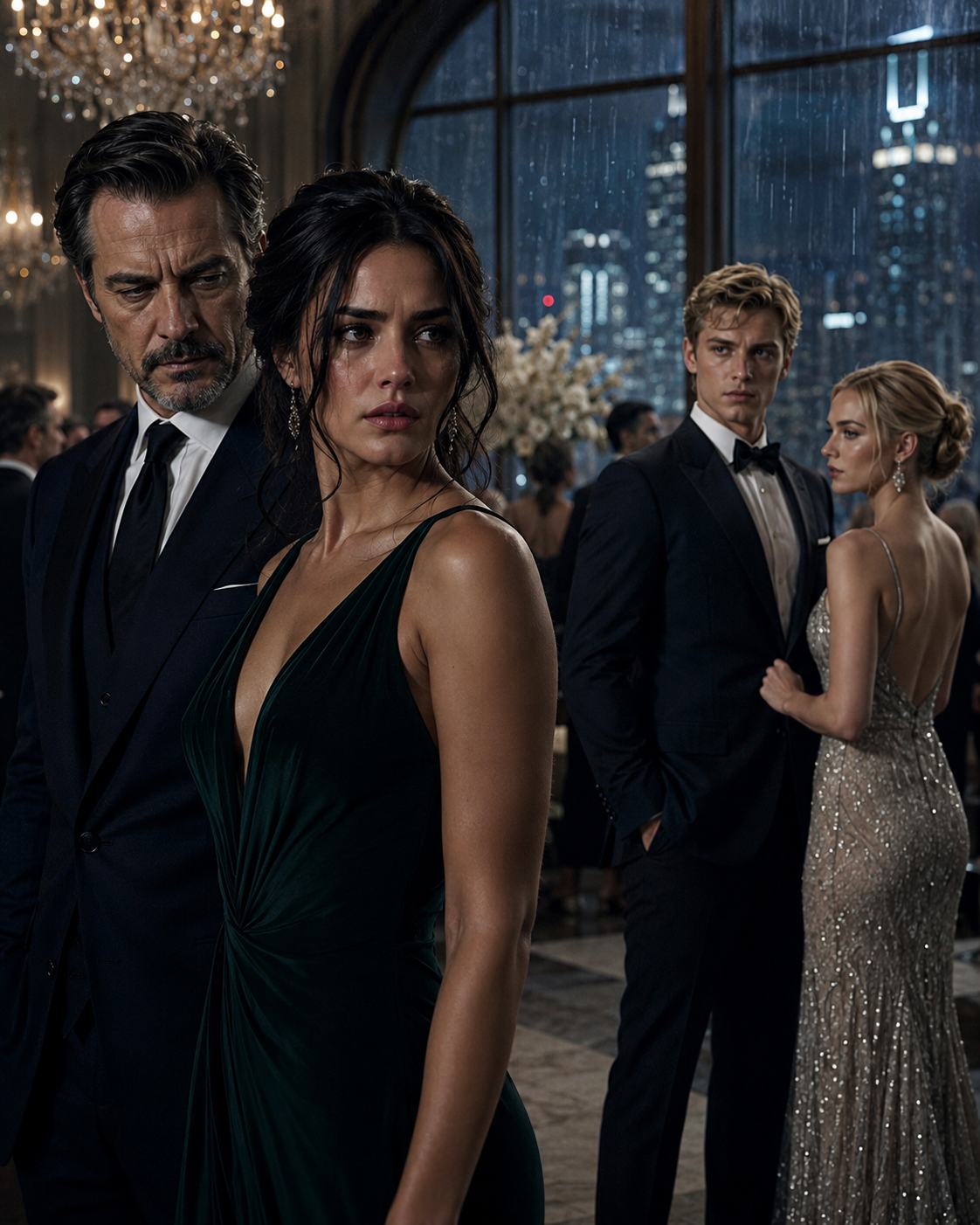
By the time the orchestra began playing beneath the crystal dome of the Harrington Club, everyone in Chicago who mattered had already decided what tonight was supposed to become.
They had decided that Adrian Wolfe, golden heir to a shipping fortune, would finally announce his engagement to Isla Beaumont.
They had decided that Isla, with her champagne hair, practiced laughter, and family diamonds resting against her throat, had been born to stand beside him.
They had decided that Mara Beaumont, Isla’s older sister, would smile from the edge of the ballroom and accept the role she had been given since childhood: useful, quiet, invisible when beauty entered the room.
Mara knew all of this before the first toast.
She knew because her mother had spent the entire afternoon warning her not to “look wounded.”
“You know how people talk,” Helena Beaumont had said while fastening Isla’s bracelet. “Do not give them anything to pity.”
Mara had looked at her mother in the mirror. “You mean do not let them notice.”
Helena’s hand had paused for only a second. “I mean behave with dignity.”
Dignity.
That word had followed Mara into the black car, through the rain-slick streets, up the marble steps of the Harrington Club, and into a ballroom glowing with chandeliers and cold opinions.
For three years, Adrian had called Mara his future.
Not publicly, never loudly, never with the certainty she deserved. But privately, in dark restaurant corners and on midnight calls, he had told her she understood him better than anyone. He had told her Isla was charming but shallow. He had told her his family would never accept Mara until he had enough power to force them to.
And Mara, who had spent her life being second choice in rooms where her sister shone first, had believed him.
That had been her mistake.
The first sign came when Adrian did not meet her at the entrance.
The second came when Isla took his arm as if she had always owned it.
The third came when Adrian’s mother, Vivienne Wolfe, kissed Isla on both cheeks and looked past Mara as though she were a coat someone had left on a chair.
“Mara,” Adrian said when he finally approached her.
He looked perfect. Of course he did. Men like Adrian always looked their best on nights when they intended to betray someone.
His tuxedo fit like power. His blond hair had been combed back with careless precision. His smile was soft enough for cameras and false enough for Mara.
“You’re late,” he said.
“I was on time.”
His eyes flicked over her dark green dress, not with admiration, but with calculation. “You look… serious.”
“Is that a crime tonight?”
“Please don’t start.”
Mara almost laughed. “Start what?”
He leaned closer, lowering his voice. “This is important for my family.”
“And what am I to yours?”
His jaw tightened. “Not here.”
That was when Mara understood. Not fully. Not yet. But enough.
Across the ballroom, Isla stood beneath a cascade of white orchids, surrounded by women who had once ignored her and men who now discovered reasons to laugh at everything she said. She wore silver. She wore diamonds. She wore the expression of a woman who had been promised the ending in advance.
Mara looked back at Adrian.
“You should have told me.”
Something like guilt crossed his face, but it vanished too quickly to matter.
“I tried,” he said.
“No. You avoided trying.”
“Mara, my father’s board is here. My mother’s donors are here. I cannot afford a scene.”
“A scene,” she repeated quietly. “That is what my heart is to you?”
He looked away.
The orchestra stopped.
A hush moved through the room.
Vivienne Wolfe stepped onto the small stage near the grand staircase, her smile polished enough to cut glass. She lifted a flute of champagne.
“Friends,” she said, her voice carrying effortlessly. “Tonight is a celebration of legacy, loyalty, and the future of two families who have long admired one another.”
Mara felt the floor tilt beneath her.
Adrian did not move toward her.
He moved toward Isla.
The room exhaled in pleasure.
Isla lowered her lashes, pretending surprise badly. Adrian took her hand. Cameras rose. Jewels flashed. Somewhere behind Mara, a woman whispered, “Finally.”
Mara stood still.
She did not cry. She did not gasp. She did not give them the theater they had dressed for.
Adrian looked once in her direction.
One glance.
A plea, perhaps. An apology, perhaps. Or worse, a request that she make this easier for him.
Mara gave him nothing.
Vivienne continued speaking. “It gives me great joy to announce that my son, Adrian Wolfe, has chosen the woman who will stand beside him as our family enters its next chapter.”
Chosen.
The word struck harder than the betrayal.
Chosen, as if women were seats at a table.
Chosen, as if Mara had not been held in secret until secrecy became inconvenient.
Adrian slid the ring onto Isla’s finger.
The ballroom erupted.
Mara placed her untouched champagne on a passing tray and walked toward the terrace.
No one stopped her.
That, more than anything, almost broke her.
Outside, the air was cold enough to make her breathe sharply. Rain whispered against the stone railing. Beyond the terrace, Chicago glittered in steel and water, indifferent to one more private humiliation dressed as society news.
Mara gripped the railing.
Behind her, the doors opened.
She did not turn.
“If you came to ask me to smile for the family photographs,” she said, “choose another victim.”
A low voice answered, “I have never asked a woman to smile when a room has earned her silence.”
Mara turned.
The man standing near the doorway did not belong to the bright, hungry world inside.
He wore a black overcoat over an evening suit without a tie. His hair was dark at the temples and silver at the front, as though time had touched him but failed to weaken him. He was tall, composed, and still in the way dangerous men were still: not empty, but contained.
Mara knew his face from whispers.
Dorian Vale.
The name moved through Chicago differently from Adrian Wolfe’s.
Adrian’s name opened clubs, banks, and boardrooms.
Dorian Vale’s closed conversations.
He had built a private empire from salvage yards, freight contracts, security firms, port warehouses, and debts people preferred not to discuss. Some called him a criminal. Some called him a kingmaker. Most called him nothing at all until he had left the room.
And Adrian Wolfe had spent his entire adult life denying the rumor that Dorian Vale was his real father.
Mara stared at him.
“You should not be here,” she said.
“Many people have told me that tonight.”
“Did Adrian invite you?”
Dorian’s mouth curved faintly. “Adrian pretends I do not exist.”
“That sounds familiar.”
His eyes held hers. They were gray, steady, and unreadable.
Inside the ballroom, applause rose again. Isla was probably lifting her hand for the cameras. Adrian was probably wearing that grateful, noble expression he used when praised for doing what benefited him.
Dorian stepped farther onto the terrace, leaving enough distance between them that Mara noticed the courtesy.
“I saw what he did,” he said.
Mara looked back at the city. “Everyone saw.”
“No,” Dorian said. “Most people saw an engagement. I saw a man bury the truth because it embarrassed him.”
She swallowed once.
“I do not need rescue.”
“I did not offer it.”
“Then why are you here?”
Dorian looked through the glass doors toward the ballroom. For one brief second, his face changed. Not softened. Changed. Like something old had moved beneath stone.
“Because I know what it is to be denied by a son in a room full of people eager to believe him.”
Mara should have walked away.
Instead, she asked, “Is it true?”
His gaze returned to her.
“That Adrian is your son?”
“Yes.”
Dorian did not blink. “Yes.”
The truth landed between them with less drama than the lie had carried for years.
Mara looked through the doors. Adrian was laughing now. Isla had her hand pressed against his chest. Vivienne Wolfe stood beside them, regal and victorious, as if she had personally corrected history.
“Does he know?” Mara asked.
“He has always known enough to hate the answer.”
“And you came tonight for what? Revenge?”
“No.” Dorian’s voice stayed calm. “I came because Vivienne asked me to stay away.”
Despite herself, Mara laughed once.
Dorian looked at her with quiet approval, as if her laugh had confirmed something.
“You enjoy disobedience,” she said.
“When the order is insulting.”
The terrace doors opened again.
Adrian stepped out.
The moment he saw Dorian, all color left his face.
Mara had imagined Adrian angry before. Irritated, embarrassed, defensive. But this was different. This was fear braided with shame.
“What are you doing here?” Adrian demanded.
Dorian slipped one hand into his coat pocket. “Attending a public event.”
“You were not invited.”
“I rarely require permission to enter rooms built by men who owe me money.”
Adrian’s eyes flashed toward Mara. “Go inside.”
Mara’s eyebrows lifted. “Excuse me?”
“This does not concern you.”
Dorian spoke before Mara could. “That is a habit of yours, isn’t it? Deciding which truths concern which women.”
Adrian’s face hardened. “Do not speak to me like a father.”
The words rang out into the rain.
For a moment, there was only the city, the music behind glass, and the truth standing between three people who had each been denied something.
Dorian’s expression did not change, but Mara saw the hit land.
“Do not worry,” he said. “You have made that title very difficult to confuse.”
Adrian took a step closer. “Leave.”
Dorian looked at Mara. “Would you like to return inside?”
“No,” she said.
“Would you like me to go?”
Adrian laughed sharply. “She does not want anything from you.”
Mara turned to him then.
The man she had loved was standing before her, not apologizing, not explaining, not even pretending to regret the wound. He was merely annoyed that the wound had chosen witnesses.
“You never asked what I wanted,” she said.
Adrian’s mouth tightened. “Mara, don’t make this uglier.”
“Than choosing my sister in front of half the city?”
His eyes flickered.
“She was the right choice,” he said.
It was meant to end the conversation.
Instead, it ended something inside Mara.
The ache. The hope. The foolish secret loyalty she had carried for him like a candle through bad weather.
All of it went out.
“Then congratulations,” she said.
Adrian looked relieved too quickly.
Mara turned to Dorian.
“You said you know what it is to be denied.”
“Yes.”
“Do you also know how to make a room regret what it celebrated?”
Dorian studied her for a long moment.
Then he said, “Yes.”
Adrian’s voice sharpened. “Mara.”
She ignored him.
Dorian’s gaze did not leave her face. “Revenge is expensive.”
“So is dignity.”
His faint smile returned, but there was no cruelty in it.
“What are you asking me?”
Mara looked through the doors at Isla’s ring, Vivienne’s triumph, the city’s elite applauding a lie because it was convenient.
Then she looked at Adrian, who had hidden her, used her, and expected her to disappear cleanly.
At last she looked at Dorian Vale, the man Chicago feared and Adrian denied.
“I am asking,” Mara said, “whether you would like to walk back into that ballroom with me.”
Dorian’s eyes darkened with interest.
“As what?”
Mara lifted her chin.
“As the man I choose.”
Adrian went still.
Dorian said nothing for several seconds.
Then he offered Mara his arm.
Not touching. Not claiming. Offering.
Mara placed her hand on his sleeve.
The terrace doors opened before them.
Inside, the ballroom was still celebrating Isla.
Until it wasn’t.
The first person to notice was Vivienne Wolfe.
Her smile faltered.
Then a banker near the champagne tower turned.
Then a councilman.
Then Isla, whose hand froze midair.
Then Adrian, stepping in behind them with the face of a man watching his own grave being measured.
The orchestra stumbled.
Dorian Vale entered the Harrington ballroom with Mara Beaumont on his arm, and Chicago’s elite remembered, all at once, how to be afraid.
No one spoke.
Dorian guided Mara to the center of the room with slow, unhurried steps.
Vivienne recovered first. Women like her always did.
“Dorian,” she said, her voice bright and brittle. “How unexpected.”
“Vivienne.”
Her gaze cut to Mara. “Miss Beaumont, I believe your family was looking for you.”
“My family has been watching me all evening,” Mara said. “They simply did not see me.”
A murmur passed through the guests.
Isla’s eyes narrowed. “Mara, what are you doing?”
Mara looked at her sister’s ring.
“For once,” she said, “not stepping aside.”
Adrian moved between them. “Enough.”
Dorian’s hand did not tighten on Mara’s. He did not need to. His stillness was more effective than another man’s threat.
“Careful,” Dorian said.
Adrian rounded on him. “You do not get to come here and ruin my life.”
Dorian tilted his head slightly. “No. You seem capable of that without help.”
Someone gasped.
Mara should have felt shame. Instead, she felt an astonishing calm.
Vivienne lowered her voice. “This is a private family matter.”
Dorian looked around the ballroom, at the cameras, the guests, the raised champagne glasses, the stage where Adrian had publicly chosen Isla.
“You made it public,” he said.
Vivienne’s face went pale beneath her powder.
Mara stepped forward.
“I wish Adrian and Isla happiness,” she said.
No one believed her. That was fine.
“I also wish to announce my own engagement.”
The room froze.
Adrian stared at her. “What?”
Mara looked up at Dorian.
She had expected amusement. Perhaps satisfaction.
Instead, he looked at her with a question in his eyes.
He would let her retreat.
Even now.
Even here.
That choice steadied her more than any vow could have.
Mara turned back to the room.
“To Mr. Dorian Vale.”
Isla made a small sound.
Vivienne’s champagne flute slipped from her fingers and shattered against the marble floor.
The sound was beautiful.
Adrian stepped toward Mara. “You cannot be serious.”
Mara smiled then. Not sweetly. Not gently.
The smile felt like a blade being drawn.
“You taught me seriousness tonight.”
Dorian finally spoke.
“Miss Beaumont and I will discuss the details privately. But since this room seems fond of announcements, I see no reason to deny it one.”
The guests began whispering so loudly the orchestra might as well have packed away its instruments.
Mara’s mother pushed through the crowd, horror written across her face.
“Mara,” Helena hissed. “Have you lost your mind?”
“No,” Mara said. “I found it.”
Isla looked from Mara to Dorian, then to Adrian. For the first time that night, uncertainty disturbed her perfect face.
“Adrian,” she whispered, “say something.”
But Adrian was staring at Dorian.
“You planned this,” he said.
Dorian’s expression cooled. “You flatter yourself. Not every consequence is a conspiracy.”
Mara removed her hand from Dorian’s arm.
For one terrifying second, she stood alone in the center of the room.
Then she faced Adrian.
“You told me once your father was dead.”
The ballroom fell utterly silent.
Adrian’s eyes flashed. “Mara.”
“You said that whatever rumors people repeated about Dorian Vale were disgusting lies invented by jealous men.”
“Mara, stop.”
“You said blood meant nothing.”
Dorian did not move.
Mara looked at him only once. His face was unreadable, but his eyes were no longer cold.
Then she finished.
“It turns out you were right about one thing, Adrian. Blood means nothing when a man has no courage to honor it.”
The words spread through the ballroom like spilled ink.
Adrian’s hand curled into a fist at his side.
Dorian stepped forward, not aggressively, but enough.
Adrian saw it. So did everyone else.
The fist opened.
Mara almost smiled.
The next morning, every society page in Chicago carried the same photograph.
Not Adrian sliding a ring onto Isla’s finger.
Not Vivienne Wolfe’s triumphant toast.
Not the Beaumont sisters side by side.
The photograph that mattered showed Mara leaving the Harrington Club beneath Dorian Vale’s black umbrella, her head held high, his hand hovering near her back without touching it.
The caption read: Unexpected Alliance Shakes Chicago Society.
Mara read it at her kitchen table while her mother paced.
“You have destroyed us,” Helena said.
Mara folded the newspaper.
“No. I embarrassed people who believed they could destroy me quietly.”
Helena stopped. “You announced an engagement to Dorian Vale.”
“Yes.”
“A man like that does not play pretend.”
“I know.”
“You do not know anything.” Helena’s voice cracked. “You think humiliation feels unbearable now? Wait until you are trapped in his world.”
Mara looked toward the sitting room, where Isla sat pale and furious, her engagement ring twisting around her finger.
Adrian had not called.
That should not have hurt.
It did anyway.
“I am not trapped,” Mara said. “Not yet.”
The doorbell rang.
Helena flinched as if the sound had accused her.
The maid opened the door. A moment later, a man entered wearing a dark suit, wire-rimmed glasses, and the careful expression of someone paid to survive powerful clients.
“Miss Beaumont,” he said. “Mr. Vale requests the pleasure of your company.”
Helena gripped the back of a chair.
Isla stood. “Absolutely not.”
Mara looked at her sister.
It was strange how quickly beauty changed when it was no longer winning.
“I did not ask you,” Mara said.
Isla’s mouth opened.
Mara walked past her.
The car waiting outside was not flashy. Black, polished, silent. The driver opened the door.
Dorian Vale sat inside.
He was reading a file. When Mara entered, he closed it immediately.
“Good morning,” he said.
“Is it?”
“That depends on whether you regret last night.”
Mara looked out the window as the car pulled away from the curb.
Chicago moved around them, gray and wet and alive.
“I regret loving a coward,” she said. “I do not regret embarrassing one.”
Dorian’s eyes rested on her profile.
“You understand that society believes we are engaged.”
“You helped them believe it.”
“You invited me to.”
She looked at him then. “And now?”
“Now I offer you a choice before rumor becomes chain.”
The car turned toward the river.
Mara’s fingers tightened in her lap. “What choice?”
“My attorney has prepared three statements.” Dorian lifted the file. “One says the announcement was a misunderstanding caused by a stressful evening. It protects your reputation as much as possible, though some will call you unstable.”
Mara gave a humorless smile. “Of course they will.”
“The second says we are engaged but postponing any plans indefinitely. It keeps people uncertain.”
“And the third?”
Dorian looked at her with that unnerving steadiness.
“The third is a marriage contract.”
Mara went very still.
He continued before she could speak.
“It would be legal. Public. Separate residences if you wish. Separate finances except for the settlement placed in your name. You would retain the right to end it after one year. You would owe me no affection, no obedience, no performance beyond public civility.”
Mara stared at him.
“That sounds rehearsed.”
“It was drafted at three this morning.”
“You expected me to agree?”
“No,” he said. “I expected you to deserve options.”
The sentence unsettled her.
Adrian had given her secrecy.
Her mother had given her warnings.
Isla had given her smiles with knives beneath them.
Dorian Vale, the most feared man in Chicago, had given her options.
“What do you get?” Mara asked.
“Legitimacy in rooms that pretend not to need me.”
“You already have power.”
“Power is not the same as access.”
“And marrying me gives you access?”
“Your name is old. Mine is useful. Together they disturb people who prefer their arrangements predictable.”
Mara leaned back.
“So I am strategy.”
“Yes.”
She appreciated the honesty more than she wanted to.
“And what else?”
Dorian’s gaze shifted briefly to the city outside.
“My son has spent his life denying me because acknowledging me would cost him invitations. Last night, he chose status over truth and your sister over you. If you marry me, he will be forced to sit at tables where the name he buried stands above his own.”
“That sounds like revenge.”
“It is.”
Mara laughed softly despite herself. “At least you admit it.”
“I find lies inefficient.”
The car stopped in front of a stone building overlooking the river. No sign marked the entrance. No name decorated the glass.
Inside, the elevator opened to a private floor with dark wood walls, silent staff, and windows that made the city look like something already conquered.
Dorian’s office was large but not ostentatious. No trophies. No portraits. No sentimental displays. Only books, steel, leather, and a chessboard near the window with a game unfinished.
On the desk lay the contract.
Mara did not sit immediately.
“Why me?” she asked.
Dorian removed his coat and placed it over the back of a chair. “Because last night you were humiliated in front of people trained to smell weakness, and you did not beg, plead, collapse, or flatter them. You changed the balance of the room with one decision.”
“I was angry.”
“Anger is common. Aim is rare.”
Mara looked down at the contract.
The clauses were clear.
Her own apartment, if she wanted one.
Her own bank accounts.
A private security detail only with her approval.
A public charitable trust in her name.
Protection for her mother’s estate, which Mara had not even known was in danger until she saw the attached legal notes.
A quiet fund to settle old Beaumont debts Helena had concealed.
Mara’s throat tightened.
“My mother owes money?”
“Enough for others to become interested.”
“To you?”
“No.”
“Would you buy the debt?”
“I already did.”
Her head snapped up.
Dorian’s face gave nothing away.
“Before last night?” she asked.
“Yes.”
“Why?”
“Because your father once saved my life.”
Mara forgot to breathe.
Her father, Thomas Beaumont, had died six years ago with debts, secrets, and a reputation for generosity that had outlived his money.
“He never mentioned you.”
“He was wise.”
“What did he do?”
Dorian’s eyes lowered to the chessboard. “He gave me a name when I needed one, and he refused payment when payment would have endangered him.”
“So you bought my mother’s debt out of gratitude?”
“Yes.”
“And then you let me announce an engagement to you in front of Adrian.”
“I am grateful,” Dorian said. “Not a saint.”
Mara stared at him.
Then she laughed.
Not because anything was funny, but because the truth was suddenly cleaner than every polished lie she had been raised inside.
Dorian watched her as if he understood the difference.
“Are you dangerous?” she asked.
“Yes.”
“To me?”
“No.”
The answer came too quickly to be prepared.
Mara wanted to distrust it.
She almost did.
But then she remembered Adrian’s face when Dorian entered the ballroom. She remembered her mother telling her to preserve dignity while handing Isla another diamond. She remembered Isla accepting a man who had belonged to Mara in every private promise except the one that mattered.
Mara picked up the pen.
Dorian did not move.
“You should read every line,” he said.
“I did.”
“Have your own lawyer read it.”
“I will.”
“Then do not sign now.”
She looked at him.
“You are a strange kind of villain, Mr. Vale.”
“Only to people who prefer simple stories.”
Mara set the pen down.
“All right,” she said. “I will have a lawyer read it.”
Dorian inclined his head.
“But if the terms remain as written,” she added, “I will marry you.”
His gaze sharpened.
“Why?”
“Because Adrian chose the woman who looked best beside his ambition.”
Mara stepped closer to the desk.
“And I think I would like to choose the man who terrifies it.”
The wedding took place twelve days later.
Not at city hall. Not in secret. Not as a rushed accident people could dismiss.
Dorian rented the east hall of the Blackstone and invited one hundred and fifty guests who had spent years pretending not to know him unless they needed something impossible fixed.
Mara invited twelve.
Her mother came because absence would have been worse gossip.
Isla came because pride dragged her where shame should have kept her away.
Adrian came because Vivienne made him.
The ceremony began at four in the afternoon, as winter light turned the windows silver.
Mara wore ivory silk with long sleeves and no veil.
“No veil?” her lawyer and friend, Simone, asked while fastening the final button.
“I have spent enough of my life hidden.”
Simone smiled. “Good.”
Dorian waited at the front of the room in a charcoal suit. He looked neither pleased nor nervous. But when Mara appeared, something in his stillness shifted.
The guests noticed.
Mara did too.
She walked alone.
Halfway down the aisle, she saw Adrian.
He looked miserable.
The sight gave her no joy. That surprised her. She had imagined satisfaction, triumph, perhaps even the bright heat of revenge. Instead, she felt distance.
He was no longer the wound.
He was only the man who had made the wound visible.
Dorian offered his hand when she reached him.
Mara took it.
His palm was warm.
The judge spoke.
Dorian answered in a voice that did not tremble.
Mara answered in a voice that surprised even herself.
When the judge said Dorian could kiss the bride, the room leaned forward.
Dorian turned to Mara.
The question was silent.
She answered by lifting her face.
He kissed her cheek.
Not her mouth.
Not for show.
Not to satisfy the people waiting to measure ownership.
A murmur moved through the hall.
Mara smiled.
Dorian’s eyes warmed almost imperceptibly.
“Mrs. Vale,” he said quietly.
The name should have felt like a cage.
Instead, it felt like a door she had chosen to open.
At the reception, Isla cornered her near the flowers.
“You cannot possibly think this makes you better than me,” Isla said.
Mara looked at her sister’s perfect face and wondered when she had last truly seen the girl beneath it.
“I do not think about being better than you.”
“That is exactly what someone says when they are trying to win.”
“No,” Mara said. “That is what someone says when she finally stopped competing.”
Isla’s eyes flashed. “Adrian loved you for five minutes because you made him feel deep. He chose me because he knows what kind of woman belongs in his world.”
Mara nodded slowly.
“Then I hope you enjoy being furniture.”
Isla recoiled.
Mara turned to leave.
“Mara,” Isla said, voice lower now. “He will ruin you.”
Mara glanced toward Dorian across the room. He was speaking with two men who looked as though they had forgotten how to breathe comfortably.
“No,” Mara said. “Men like Adrian ruin women by asking them to disappear. Dorian has not asked me to disappear once.”
That night, Dorian took Mara to his house on Astor Street.
It was older than the rumors around him, built of limestone and restraint. The rooms were elegant without warmth, beautiful without invitation. It felt less like a home than a fortress that had learned manners.
A housekeeper named Elian showed Mara to the east wing.
“This is yours,” Dorian said.
The suite had a bedroom, sitting room, private bath, dressing room, and a study overlooking bare winter trees.
Mara walked to the desk.
There were fresh notebooks, fountain pens, a reading lamp, and empty shelves waiting for her books.
“You arranged this?”
“Yes.”
“When?”
“After you said you would have a lawyer read the contract.”
“You were confident.”
“I was prepared.”
She turned.
“And your rooms?”
“West wing.”
“Separate lives,” she said.
“As promised.”
Mara looked at him for a long moment.
“Do promises mean something to you?”
Dorian’s expression changed again, that small movement beneath stone.
“They are the only reason I am not worse.”
He left her at the door.
He did not cross the threshold until she invited him three weeks later.
Marriage to Dorian Vale did not unfold like a romance.
It unfolded like weather.
At first there was distance.
Breakfast at opposite ends of a polished table. Quiet rides in the same car. Public appearances where Dorian placed his hand near Mara’s back but never on it unless she moved closer. Newspapers called her ambitious. Jealous women called her reckless. Men who had once ignored her began greeting her with careful warmth.
Mara learned quickly that power changed the volume of a room.
Before, people had spoken over her.
Now they paused when she inhaled.
She hated that it took a feared man’s surname to grant her what should have been hers already.
Dorian seemed to hate it too.
“You are angry,” he observed one evening after a museum benefit.
Mara removed one earring at her vanity. “I am tired of being respected only because people fear my husband.”
Dorian stood in the doorway, jacket open, tie loosened.
“Then make them fear disappointing you.”
She turned. “Is that your solution to everything?”
“No. Sometimes I recommend patience.”
“Do you practice it?”
“Rarely.”
She laughed before she could stop herself.
Dorian’s eyes softened.
Moments like that became dangerous.
Not because he took anything.
Because he did not.
He waited at doors. He asked before joining her in the garden. He listened when she spoke of turning the Beaumont trust into a legal defense fund for women trapped by family money and reputation. He never mocked the size of her ambitions, never suggested she was emotional, never told her not to make a scene.
When she discovered he had quietly tripled the trust’s opening donation, she confronted him in his library.
“I told you I did not want to be your charity.”
Dorian looked up from his book. “You are not.”
“Then why add money without asking me?”
“Because I was careless.”
That stopped her.
He closed the book.
“I saw the structure, understood the benefit, and acted. I should have asked.”
Mara folded her arms. “That apology was annoyingly competent.”
“I will try to make my next failure more satisfying.”
She tried not to smile.
He noticed.
That was dangerous too.
Adrian began calling after the first month.
Mara ignored him.
Then he sent flowers.
She donated them to a hospital.
Then he appeared outside the Beaumont trust office on a Wednesday afternoon, rain darkening his coat, looking less golden than she remembered.
“Mara,” he said.
She kept walking.
He followed. “Please. Five minutes.”
“You had three years.”
“I made a mistake.”
That stopped her, though she hated herself for it.
Adrian stepped closer, hope lighting his face. “I was under pressure. My mother, the board, the merger with Isla’s family—”
Mara turned.
“You are still explaining your betrayal by listing what you gained from it.”
He flinched.
“I loved you,” he said.
“No,” Mara answered. “You loved the version of yourself reflected in me. The thoughtful son. The misunderstood heir. The man trapped by expectations. I made your cowardice feel complicated.”
Rain slid down his face. Or perhaps not only rain.
“And him?” Adrian demanded. “Do you love him?”
Mara looked past him.
Across the street, Dorian’s car waited at the curb. He had not stepped out. He had not interrupted. He had not claimed authority over a conversation that belonged to her.
“I trust him,” Mara said.
Adrian laughed bitterly. “That is not love.”
“No,” she said. “But it is more than you gave me.”
Adrian’s face twisted.
“He is using you.”
Mara stepped closer.
“Perhaps. But he told me how. That made him more honest than every person in your ballroom.”
Adrian stared at her, then looked toward the car.
“He is my father,” he said suddenly.
The words were small.
Mara went still.
Adrian swallowed. “There. Is that what you wanted? I said it.”
“No,” Mara said softly. “You said it to me. Say it where it costs you.”
His mouth closed.
The silence answered for him.
Mara walked away.
Dorian said nothing when she entered the car.
That was why she spoke first.
“He admitted it.”
Dorian looked ahead. “To you?”
“Yes.”
“Not enough.”
“No.”
The driver pulled into traffic.
After several blocks, Mara said, “Does it hurt?”
Dorian’s jaw tightened.
“Yes.”
She looked at his profile.
The city lights moved across his face, revealing and hiding him by turns.
“Why did you let him deny you for so long?”
“Because his mother made him afraid of being mine. Because I was not clean enough to demand innocence from a child. Because by the time he was old enough to choose, resentment had become easier for him than courage.”
“And now?”
“Now he is a man.”
Mara reached across the seat before she could overthink it.
Her hand covered his.
Dorian looked down.
He did not move.
After a moment, he turned his palm upward and held her hand carefully, as if it were an agreement he had no intention of breaking.
The next scandal came in spring.
Vivienne Wolfe hosted a charity auction at the Lyric Opera House, the kind of event where generosity was measured by photographers per donation. Mara attended with Dorian because her trust had been nominated for a civic award, and because refusing invitations forever was just another kind of hiding.
The room changed when they entered.
Mara no longer stumbled beneath that change.
She had learned to wear attention like a coat.
Dorian leaned slightly toward her. “You dislike this crowd.”
“I dislike that I understand them.”
“That is more useful.”
“You are terrible at comfort.”
“I am excellent at exits.”
She smiled.
Across the room, Adrian saw it.
So did Isla.
Their engagement had become a beautiful prison. Everyone knew it. Isla wore larger diamonds now and smiled less. Adrian drank more. Vivienne watched both of them like investments performing below expectation.
During dinner, the seating chart placed Mara beside a senator’s wife and across from Adrian.
Not an accident.
Vivienne’s work.
Mara almost admired the cruelty.
The senator’s wife made polite conversation. Isla laughed too loudly at something two seats down. Dorian, seated at another table of donors, looked relaxed enough to alarm everyone near him.
Adrian leaned forward.
“You look happy,” he said.
Mara picked up her water glass. “That is not a crime.”
“With him, it might be.”
She set the glass down.
“Do not confuse your fear of him with my experience of him.”
Adrian’s eyes darkened. “You think he is honorable?”
“I think he is honest about being dangerous. You were dangerous while pretending to be gentle.”
The words landed.
Adrian looked away first.
Then the master of ceremonies announced the civic award.
Mara’s trust won.
Applause filled the hall as she walked to the stage.
There was no written speech. She had refused one.
The lights were bright. The faces beyond them were hungry.
Mara took the microphone.
“When I was younger,” she said, “I believed dignity meant enduring pain beautifully. I was taught that silence protected families, that obedience preserved reputations, and that women who named betrayal were more embarrassing than the betrayal itself.”
The room went still.
Mara saw her mother lower her eyes.
She saw Isla stop smiling.
She saw Adrian freeze.
She saw Dorian watching from the back of the room, motionless, his face unreadable except for his eyes.
“I no longer believe that,” Mara continued. “Dignity is not silence. Dignity is ownership of your own name, your own choices, your own future. The Beaumont Vale Trust exists for women who have been told that survival requires permission. It does not.”
The applause began slowly.
Then grew.
Not everyone joined. That made it better.
As Mara stepped down from the stage, Adrian blocked her near the side corridor.
“You enjoyed that,” he said.
Mara sighed. “Do not do this.”
“You humiliated my family.”
“No, Adrian. I described mine.”
He moved closer, voice low. “He has turned you into this.”
Mara stared at him.
“This?”
“Hard. Cold.”
“No,” she said. “You mistook my softness for weakness. Now you mistake its absence for cruelty.”
Adrian reached for her arm.
He never touched it.
Dorian appeared beside them with such silence that Adrian stepped back before realizing he had done it.
“Walk away,” Dorian said.
Adrian’s face flushed. “She was mine before she was yours.”
Mara felt the old pain, but it was distant now. Like hearing a storm from inside a safe house.
Dorian’s voice went quiet.
“She was never yours.”
Adrian looked at Mara, desperate now. “Tell him.”
Mara met his eyes.
“I was never yours.”
Something in Adrian broke then.
Not violently. Not loudly.
He simply looked young. Younger than his suits, younger than his arrogance, younger than the wound he had carried from a father he denied and a mother who made denial profitable.
For one second, Mara pitied him.
Then she chose herself again.
She walked away with Dorian.
In the car, neither of them spoke for a long time.
Finally, Dorian said, “You were magnificent.”
Mara turned toward the window to hide how the words affected her.
“You say things like weapons.”
“I meant that one as a gift.”
She looked back.
Dorian’s face was calm, but his hand rested open on the seat between them.
This time, Mara took it first.
Summer changed the house.
Light entered rooms Mara had thought permanently shadowed. She filled shelves with books, argued with Dorian over art, replaced severe curtains with warmer ones in the breakfast room, and planted white roses in the back garden because she liked the contradiction of delicate things surviving near stone.
Dorian complained only once.
“The house is becoming cheerful.”
“How tragic for you.”
“I have a reputation.”
“You married me. It was already damaged.”
He looked at her over his coffee.
“You are pleased with yourself.”
“Very.”
He smiled.
Fully.
It transformed him.
Mara looked away too quickly.
That evening, a storm rolled over the city. Thunder moved across the lake, and rain struck the windows hard enough to blur the garden lamps. Mara found Dorian in the library, standing near the chessboard.
“Who are you playing?” she asked.
“Myself.”
“Who is winning?”
“The worse man.”
She approached the board. “That sounds exhausting.”
“It is familiar.”
Mara studied the pieces. “Teach me.”
Dorian looked at her. “Chess?”
“Yes.”
“You may not enjoy my teaching style.”
“You may not survive mine.”
He pulled out the chair for her.
For the next hour, he taught her openings, traps, sacrifices, and patience. Mara learned quickly. Dorian seemed unsurprised.
When she captured his bishop, he nodded once.
“Good.”
“Only good?”
“Very good.”
“Painfully restrained praise.”
“Would you prefer applause?”
“I prefer fear.”
His eyes lifted.
For a moment, neither of them spoke.
The rain filled the silence.
Mara realized she was leaning closer.
Dorian realized it too.
He stood suddenly and walked to the fireplace.
Mara’s heart beat once, hard.
“Did I do something wrong?” she asked.
“No.”
“Then why did you move?”
His back remained to her.
“Because I promised you a marriage without expectation.”
Mara rose.
“And if expectation changes?”
Dorian turned.
The restraint on his face cost him something. She could see it now. The tension in his jaw. The care in his distance. The disciplined hunger of a man who had allowed himself everything except what mattered.
“Then it must change because you say so,” he said.
Mara crossed the room.
She stopped close enough to see the silver in his hair, the faint scar near his eyebrow, the guarded loneliness he wore better than any suit.
“I am saying so.”
Dorian did not touch her.
“Say it plainly.”
Her breath trembled, but her voice did not.
“I want you to kiss me.”
For the first time since she had met him, Dorian Vale looked shaken.
Then he lifted his hand to her face with such care that Mara’s eyes burned.
“Last chance,” he whispered.
She smiled.
“You are terrible at romance.”
“I am trying very hard not to be terrible at consent.”
That undid her.
She kissed him first.
It was not the kiss of a contract.
It was not for cameras, not for revenge, not for the room that had once watched her be discarded.
It was quiet, fierce, and entirely hers.
Dorian’s arms came around her only after she stepped into them. When he held her, he did it like a man who had built walls for decades and discovered, too late, that the right person could open a door without breaking anything.
After that night, their marriage stopped being easy to explain.
Not because it became simple.
Because it became true.
Adrian discovered the truth at the worst possible moment.
In September, the Wolfe shipping board gathered for an emergency vote. A failed acquisition, hidden losses, and Vivienne’s reckless loans had pushed the company toward collapse. Adrian needed investors. He needed mercy. He needed doors opened.
The only door left led to Dorian.
Mara attended the meeting as chair of her trust, which now held voting influence through a donor coalition Adrian had once mocked.
She entered the boardroom beside Dorian.
Adrian stood at the head of the table, pale with sleeplessness.
Vivienne sat to his right, rigid with rage.
Isla sat behind them, silent, ring still on her finger but no wedding date in sight.
Dorian took no seat.
Mara did.
That was the first sign the room had changed.
Adrian looked at Dorian. “Are you here to enjoy this?”
“No,” Dorian said. “I have better hobbies than watching incompetence mature.”
A board member coughed.
Mara opened the file in front of her. “The trust coalition is prepared to support a restructuring plan.”
Adrian stared. “You?”
“Yes.”
Vivienne’s voice sliced across the table. “This is absurd.”
Mara looked at her. “The plan removes you from financial oversight.”
Vivienne went white.
Adrian’s eyes flashed. “You cannot ask that.”
“I am not asking.”
He looked at Dorian. “This is your price?”
Dorian’s gaze moved to Mara.
“It is hers.”
That silenced the room more effectively than any threat.
Mara continued. “The company survives. Employees keep their jobs. The pension fund is protected. The board receives independent supervision. Vivienne steps down. Adrian remains only if he publicly corrects the falsehood regarding his parentage.”
Adrian’s face twisted.
“No.”
Mara closed the folder.
“Then the coalition withdraws.”
Vivienne gripped his arm. “Do not you dare.”
Adrian looked at her.
For the first time, Mara saw it clearly: not love between mother and son, but ownership. Vivienne had shaped his shame into ambition, then called the result loyalty.
Dorian stood very still.
Adrian looked at him.
The room held its breath.
“My father,” Adrian said, voice rough, “is Dorian Vale.”
Vivienne made a sound of fury.
Adrian did not look at her.
He looked at Dorian.
“I denied him because I was ashamed of what people would think. And because my mother taught me that his name was useful in private and poisonous in public.”
Dorian’s face did not change.
But Mara knew him now.
She saw the wound open. She saw the restraint. She saw the boy Adrian had once been and the man Dorian had never been allowed to claim.
Adrian swallowed.
“I was a coward.”
No one moved.
Then Dorian said, “Yes.”
Adrian flinched.
“But,” Dorian added, “not irreparably.”
It was not forgiveness.
Not yet.
But it was a door.
Mara watched Adrian understand that.
Weeks later, Isla returned the ring.
Not dramatically. Not publicly. She came to Mara’s office wearing a plain coat and no makeup, looking like someone who had finally grown tired of being admired.
“I did not come to apologize,” Isla said.
Mara leaned back. “That sounds promising.”
Isla looked out the window. “I hated you because Mother measured me against you when no one was watching.”
Mara went still.
“She told me you were smarter. More disciplined. More useful. She said beauty was the only advantage I had, and I should never waste it.”
Mara felt something old and bitter shift inside her.
“I thought she only said things like that to me.”
Isla laughed softly. “She was efficient with cruelty.”
They sat in silence.
Then Isla said, “Adrian never loved me.”
Mara did not answer.
“I knew,” Isla admitted. “Not at first. But before the announcement, I knew.”
That hurt. Less than it once would have. Still enough.
“Why did you go through with it?”
Isla’s eyes filled, though no tears fell.
“Because being chosen in public felt safer than being loved in private.”
Mara looked at her sister for a long time.
There were apologies that repaired nothing but still mattered because they named the ruin honestly.
“I cannot absolve you,” Mara said.
“I know.”
“But I believe you.”
Isla nodded.
It was a beginning.
Not warm. Not easy.
But real.
In December, one year after the night at the Harrington Club, Mara stood again beneath crystal chandeliers.
This time the event was hers.
The Beaumont Vale Trust hosted its first winter gala in the same ballroom where Adrian had chosen Isla and the city had expected Mara to disappear.
Everything was different.
The flowers were deep red instead of white. The orchestra played near the terrace. The guest list included donors, lawyers, shelter directors, journalists, survivors, and women who had once been told they were liabilities.
Mara wore black.
Not for mourning.
For command.
Dorian found her near the terrace doors.
“You chose this room deliberately,” he said.
“Obviously.”
“Does it feel satisfying?”
Mara looked around.
Her mother had not been invited. Isla had come and was speaking quietly with Simone near the auction table. Adrian stood with Dorian across the room earlier, awkward but present. Vivienne Wolfe was absent, which improved the air considerably.
“It feels smaller,” Mara said.
Dorian followed her gaze.
“Rooms often shrink when they lose power over you.”
She smiled. “That was almost poetic.”
“I apologize.”
“No, you don’t.”
“No.”
The music changed.
Dorian offered his hand.
Mara looked at it.
“You dance?”
“When required.”
“By whom?”
“My wife.”
She placed her hand in his.
This time, when they stepped into the center of the ballroom, no one mistook her for an ornament beside him.
They moved slowly.
Dorian was a controlled dancer, unsurprisingly. Mara leaned into the rhythm, aware of every eye in the room and no longer ruled by any of them.
“Do you ever regret it?” she asked.
“Marrying you?”
“Yes.”
Dorian looked genuinely offended. “No.”
“That was quick.”
“I have had a year to consider it.”
“And?”
“And my house has better curtains, my enemies are confused, my son speaks to me once a week with great discomfort, and my wife has made half the city afraid to underestimate her.”
Mara laughed.
Dorian’s hand tightened gently at her waist.
“And,” he said, quieter, “I was lonely before you.”
Her laughter faded.
The ballroom blurred slightly.
Dorian did not look away.
“I was,” he repeated, as if honesty deserved no decoration.
Mara touched his face.
In the same room where Adrian had once chosen another woman in front of everyone, Mara chose her husband again.
Not for revenge.
Not for strategy.
Not because he terrified the people who had hurt her.
Because he had never asked her to become smaller so he could stand taller.
Because he had turned every promise into architecture and given her rooms she could walk through freely.
Because danger, in him, had never been aimed at her.
“I love you,” she said.
Dorian stopped dancing.
The entire room seemed to pause with him.
Mara smiled. “You are supposed to say something.”
His voice was low. “I am deciding whether I heard you correctly.”
“You did.”
“Say it again.”
“No.”
His eyes warmed. “Cruel woman.”
“Careful. I learned from dangerous company.”
Dorian bent his head.
This time, he did not kiss her cheek.
He kissed her as her husband, in front of the city, beneath the chandeliers, with no shame, no secrecy, and no permission requested.
Applause rose around them.
Mara barely heard it.
Across the room, Adrian watched. For once, there was no anger in his face. Only understanding, regret, and perhaps the beginning of peace.
Isla stood beside him, not as his fiancée, not as Mara’s rival, but as a woman learning how to exist without being chosen first.
Dorian drew back just enough to look at Mara.
“You changed my life,” he said.
“No,” Mara whispered. “I walked into it.”
Outside, snow began to fall over Chicago.
Inside, the ballroom glittered.
And Mara Vale, once hidden at the edge of another woman’s celebration, stood at the center of her own life and did not step aside for anyone.