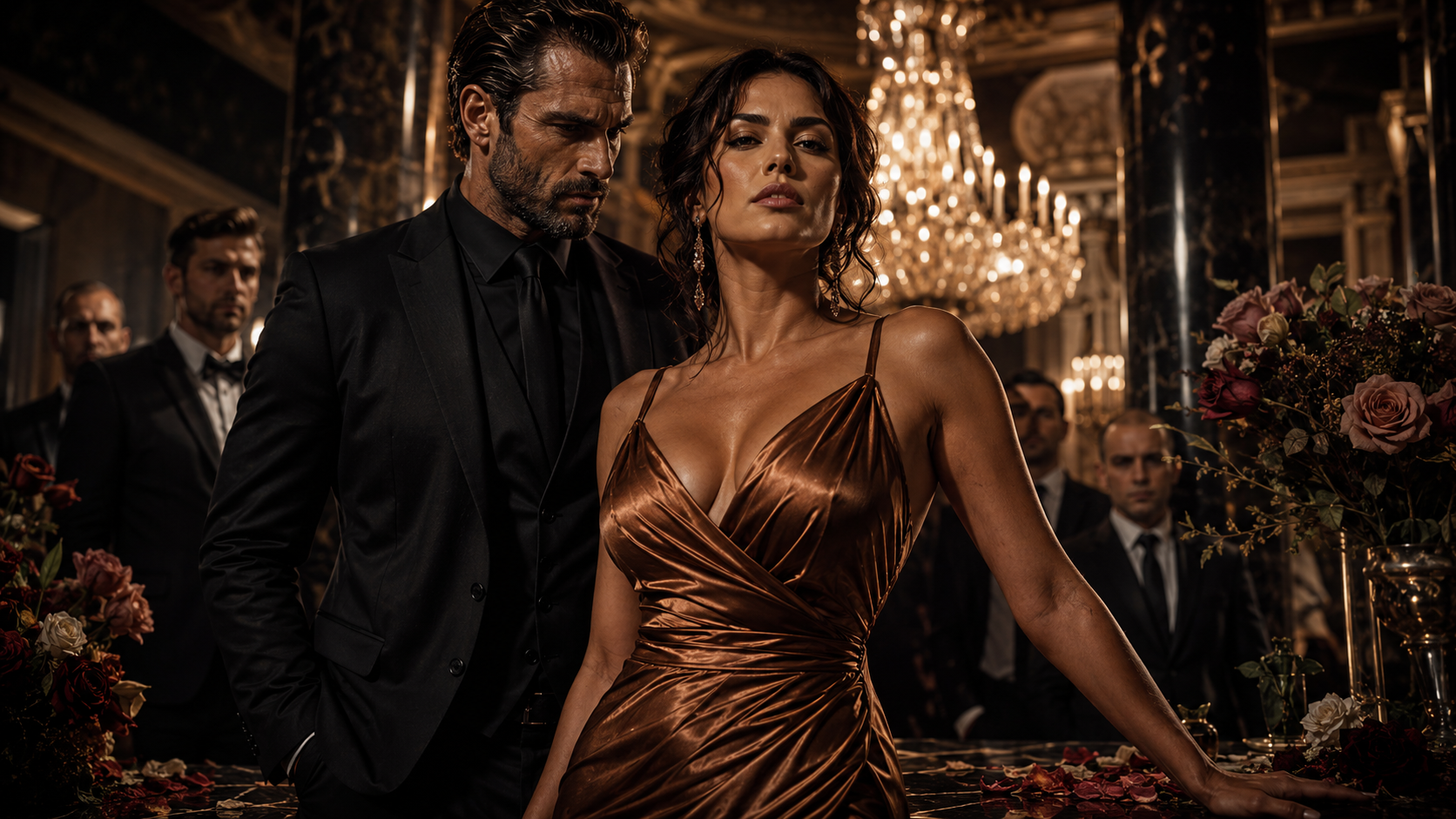
When the Crime Lord Heard Her Say, “Touch Me Again and You’ll Lose the Hand,” He Finally Understood She Was the Woman Who Could Save His Empire

Nobody in the ballroom expected the woman in the copper dress to fight back.

That was the first mistake.

The second mistake was thinking Dorian Kade had brought her there because she was decoration.

And the third—the mistake that would break a criminal dynasty open from the inside—was believing that a woman everyone laughed at could not hear, count, remember, and destroy.

Her name was Lena Hart.

To the guests at the Kade Foundation Gala, she was easy to dismiss. She was not thin enough for their gowns, not rich enough for their circles, not polished enough to pretend she had been born beneath chandeliers. She owned a small wedding flower studio in East Harbor, the kind of place where brides cried over peonies and mothers argued over ribbon colors. She drove a scratched blue van. She paid her bills late, tipped delivery boys too much, and kept a jar of emergency chocolate under her counter.

In that room, among diamond throats and silk shoulders, she was an accident.

At least, that was what they thought.

Lena stood beside a column near the west terrace, one hand wrapped around a glass of champagne she had not touched. The bubbles had gone flat. Her patience was close behind.

Across the ballroom, her younger brother, Theo, sat pale and sweating between two men in dark suits. He looked as if he had aged ten years in one week. His tie was crooked. His eyes kept searching the room for Lena, then dropping away.

He had always been beautiful in a way that made people forgive him too quickly.

Lena did not forgive him quickly.

She loved him. That was worse.

Three nights earlier, Theo had appeared at her apartment door with blood on his lip and terror in his hands. He had confessed to gambling, lying, borrowing from the wrong people, and signing documents he had not read. Then he told her the amount.

Four hundred and eighty thousand dollars.

Lena had laughed at first because the number was too large to fit inside her life.

Then Theo had said the name Dorian Kade, and the laugh died in her throat.

Everyone in East Harbor knew the Kade name. Half the city said Dorian Kade was a businessman. The other half said he owned the men who owned the businesses. He had inherited a criminal empire built on docks, unions, private security, construction contracts, and quiet bodies at the bottom of quiet water.

He was thirty-eight, ruthless, controlled, and handsome in the cold, expensive way of men who never had to ask twice.

Lena had expected a meeting in a basement. Maybe a threat. Maybe a demand.

Instead, a black car came for her at seven o’clock and delivered her to a charity gala where people paid five thousand dollars a plate to pretend they cared about children’s hospitals.

Dorian Kade stood near the center of the ballroom, surrounded by politicians, lawyers, and men whose smiles never reached their eyes.

He wore black.

Not a tuxedo that begged to be admired, but one that simply assumed obedience from the room. His dark hair was swept back. His jaw was clean-shaven. His face held no softness, only angles and restraint. When he looked at someone, that person seemed to remember a secret they had hoped to keep.

Lena had felt his gaze on her twice.

Both times, she refused to look away first.

That may have been when he started paying attention.

The man who approached her was not Dorian.

He was younger, broader, and drunk enough to mistake cruelty for charm. His name, she had heard whispered, was Milo Venn. One of Kade’s captains. A man who laughed too loudly and touched too freely.

“Well,” Milo said, stopping in front of her. “You must be the sister.”

Lena looked at him over the rim of her glass. “That depends on who is asking.”

He grinned. “Someone who thinks Theo Hart has terrible taste in mistakes.”

“You would know.”

A woman nearby hid a laugh behind her hand.

Milo’s smile thinned.

Lena knew that expression. She had seen it in men who hated being mocked by women they considered beneath them.

His eyes moved over her body with lazy insult.

“You clean up better than I expected,” he said. “Still, that dress is brave.”

“It has survived worse than your opinion.”

The woman nearby stopped laughing.

Milo stepped closer.

Lena smelled whiskey and expensive tobacco.

“Careful,” he murmured. “In this room, women who speak like that usually belong to someone powerful.”

Lena set her untouched champagne on a passing tray.

“Then you are in luck,” she said. “I belong to myself.”

The words changed something in him.

His hand shot out, fingers closing around her upper arm.

The ballroom did not go silent all at once. It softened first. A ripple of attention moved through the nearest guests. Conversations became thinner. Faces turned. Then, as always happened in rooms full of cowards, people pretended not to see.

Lena looked at his hand.

Then she looked at his face.

“Remove it.”

Milo chuckled. “Or what?”

She smiled then.

Not sweetly.

Not politely.

The smile of a woman who had spent years lifting buckets of water, carrying funeral arrangements up church steps, managing drunk groomsmen, unpaid invoices, broken coolers, screaming brides, and grief-stricken widows who wanted lilies because lilies were the last flowers their husbands had ever bought them.

A man like Milo thought violence began with fists.

Lena knew violence began with permission.

So she gave him none.

“Touch me again,” she said, clearly enough for the closest tables to hear, “and you’ll lose the hand.”

The air tightened.

Milo’s face darkened.

His grip tightened.

Before he could speak, a voice cut through the room like a blade drawn slowly from silk.

“Let her go.”

Dorian Kade had not raised his voice.

He did not need to.

Milo released her.

Every eye turned.

Dorian crossed the marble floor with unhurried steps, the crowd separating before him. There was no anger on his face. Anger would have been human. This was colder.

He stopped beside Lena, close enough that she could feel the heat of him without being touched.

His eyes were on Milo.

“Did I ask you to entertain my guest?”

Milo swallowed. “No, boss.”

“Did I ask you to put your hands on her?”

“No.”

“Then why are you still standing here?”

Milo’s mouth opened.

Dorian’s gaze did not change.

Milo left.

Quickly.

The ballroom exhaled.

Lena rubbed her arm once, then stopped herself. She would not give anyone the satisfaction of seeing pain.

Dorian turned to her.

Up close, he was worse. Not more handsome. More present. His eyes were gray with a dark ring at the edge, the kind of eyes that made lies feel childish.

“Miss Hart.”

“Mr. Kade.”

“You have a gift for making enemies.”

“I learned from my brother.”

A faint movement touched his mouth. It was not quite a smile.

“Come with me.”

“No.”

The room went still again.

Dorian looked at her for a long second.

“Your brother’s life depends on the conversation we are about to have.”

Lena’s stomach twisted.

She looked across the ballroom. Theo stared back at her, shame bending his shoulders.

Lena hated him a little in that moment.

She hated herself more for following Dorian anyway.

He led her through a side corridor, past two guards, into a private library with green walls, a black marble fireplace, and shelves full of books that looked expensive enough to be unread. The door closed behind them.

Lena stayed near it.

Dorian went to the desk.

“Your brother signed approval papers for transfers totaling four hundred and eighty thousand dollars,” he said.

“He is stupid with cards and worse with women. He is not smart enough to steal from you.”

“He was smart enough to sign.”

“Someone put the papers in front of him.”

Dorian’s eyes sharpened.

Lena stepped forward.

“I do not have your money,” she said. “I can sell my van, my equipment, my lease, maybe the studio if I find someone desperate. I can get you fifty thousand by Monday. Maybe seventy if I ruin myself completely. I’ll pay the rest. But my brother did not steal that amount, and my grandmother had nothing to do with any of this.”

“I know.”

Lena froze.

Dorian’s voice remained calm.

“I do not want your money.”

“That is never good.”

“No.”

The fire shifted softly.

For the first time, Lena noticed the exhaustion beneath his control. Not weakness. Wear. The kind carried by people surrounded by loyalty they could not fully trust.

“When the missing funds appeared,” Dorian said, “my council wanted your brother made into an example. Publicly. They wanted your studio burned, your grandmother removed from her nursing home, and every person connected to Theo Hart taught the cost of embarrassment.”

Lena’s throat closed.

“But you did not do it.”

“Not yet.”

The honesty struck harder than a threat.

“Why?”

Dorian looked toward the closed door.

“Because tonight, I watched seventy people pretend not to see one of my men hurt you. You did not scream. You did not beg. You did not perform helplessness for an audience that had already chosen comfort over courage.”

His eyes returned to her.

“You gave him a warning.”

Lena’s heartbeat changed.

“Admiration from a man like you is not a compliment.”

“No,” Dorian said. “It is information.”

He opened a drawer and placed a folder on the desk.

“My organization is changing. Public contracts. Legal development. Hospital boards. City partnerships. I cannot keep appearing as a gangster prince surrounded by men who solve every problem with blood and women who confuse loyalty with diamonds.”

Lena stared at him.

“You need a wife.”

“I need the appearance of one.”

She laughed once.

“You’re insane.”

“I need a woman with no criminal record, a working-class reputation, a legitimate business, and a spine strong enough not to fold beside me in public. You need your brother breathing, your grandmother safe, and your studio untouched.”

Dorian pushed the folder toward her.

“Ninety days. Public engagement. Private contract. Your brother’s debt is frozen. Your grandmother’s care is paid for. Your business receives protection. You live at Kade House until the threat passes.”

“And if I refuse?”

“Then I cannot promise my council will remain patient.”

Lena stared at the folder.

The words on the page were neat, legal, bloodless.

A fake engagement. Public appearances. Residence at Kade House. No physical obligation. No intimacy required. No marriage without additional written consent. Termination after ninety days. Financial protection for her family. Security for her business.

At least the devil had excellent attorneys.

“You think you can trap me with my brother’s life and dress it up as a proposal?”

“I think you are practical enough to recognize a door when it opens.”

“A cage with expensive hinges is still a cage.”

Dorian’s eyes did not leave hers.

“Yes.”

She almost preferred a lie.

Lena picked up the folder and flipped through the financial exhibits. Vendor names. Account numbers. Transfer dates. Shipping codes. Charitable entities. Construction affiliates.

Something in the numbers snagged at her attention.

She paused.

Dorian noticed.

“What?”

“Nothing.”

His gaze lowered to the page.

Lena closed the folder.

“You do not just need a fiancée,” she said slowly. “You think I can find something your people missed.”

“I think people reveal themselves around those they underestimate.”

“And I am easy to underestimate.”

“Apparently.”

She stepped close to the desk.

“Understand me, Dorian Kade. If I wear your ring, I will not be quiet. I will not be grateful. I will not smile while your men insult me. I will not make your world look clean just because you polish the knives.”

Something shifted in his face.

Not anger.

Recognition.

“Good,” he said.

Lena blinked.

“I have enough obedient people,” he added. “They have become expensive.”

“You may regret choosing me.”

This time, Dorian almost smiled.

“Miss Hart, I suspect regret is about to become everyone else’s problem.”

By Monday morning, Lena’s life had been packed into five suitcases by men who folded sweaters as if they were handling evidence.

She moved from her third-floor apartment above a laundromat into Kade House, a stone estate outside the city with iron gates, black windows, silent staff, and more cameras than paintings.

Her grandmother’s medical bills were paid two years in advance.

Her flower studio’s rent was cleared through the end of the year.

Theo disappeared into a private rehabilitation clinic in the mountains, which Lena suspected was part hospital, part prison, and part warning.

And on her left hand sat a sapphire ring so large strangers would have assumed love if fear had not suited it better.

Dorian kept his word.

He did not touch her.

He did not enter her bedroom.

He did not call her his property in private, though newspapers immediately called her his mysterious fiancée, and society blogs called her an unexpected choice, which was rich-person language for not thin, not polished, not one of us.

Lena read every headline.

Then she turned off her phone and built funeral wreaths for six straight hours in the glass conservatory because rage, like flowers, needed arranging before it rotted.

The first true battle came on the fifth night.

Dorian hosted dinner for his inner circle.

There were captains, lawyers, accountants, political fixers, two old men who looked like retired judges and behaved like wolves, and Dorian’s aunt, Marcella Kade.

Marcella had silver hair, perfect posture, pearls at her throat, and a smile that could cut lace.

She had raised Dorian after his father died.

Everyone treated her with reverence.

Lena distrusted her immediately.

A stylist arrived that afternoon with gowns in black, navy, and dull gray. They were all expensive. They were all designed to apologize for her body.

Lena looked at the safest one.

Then she looked at the stylist.

“No.”

The stylist blinked. “Miss Hart, darker colors will create a more flattering silhouette.”

“Flattering for whom?”

“I only mean—”

“I know what you mean.”

Lena went to her suitcase and removed a dress she had bought three years earlier after her first luxury wedding installation. Deep green velvet. Structured waist. Strong neckline. Sleeves that made her feel like a queen deciding whether to forgive a kingdom.

When she came down the staircase that evening, conversation died in pieces.

A glass stopped halfway to a mouth.

A lawyer forgot the end of his sentence.

One of the captains looked at her as if she had broken a rule written before she was born.

Dorian stood near the fireplace.

For one unguarded second, something hot and startled moved across his face.

Not possession.

Not mockery.

Wonder, quickly buried.

He came to the foot of the stairs.

“You look dangerous,” he said quietly.

“I look like myself.”

“Then I stand corrected.”

She refused to smile.

Mostly.

At dinner, Lena sat to Dorian’s right. Marcella sat across from her, observing every bite as if appetite were a crime. To Lena’s left sat Grant Bell, a captain who controlled several trucking routes and wore arrogance like cologne.

Halfway through the meal, Grant leaned back.

“So,” he said, voice carrying. “A florist.”

The word landed like an insult dressed as conversation.

Lena placed her fork down.

Grant smiled.

“I suppose that explains the dramatic entrance. Tell me, Miss Hart, how does a woman who spends her days arranging roses expect to survive in our world? This is not a bridal shower. Weakness gets people killed.”

Silence spread.

Dorian did not intervene.

Lena felt his attention on her, not abandoning her, but waiting to see which blade she would choose.

She took a sip of wine.

“You’re right, Grant,” she said. “I do arrange flowers.”

His smile widened.

“And running a wedding studio in this city means negotiating with vendors who lie, venues that overcharge, brides who change entire color palettes twelve hours before delivery, suppliers who hide fees in seasonal invoices, and families who expect miracles at wholesale prices.”

The smile faded.

Lena leaned forward.

“It also means I know how to read delivery schedules, fuel charges, labor hours, duplicate receipts, missing signatures, and false urgency.”

No one moved.

“When Dorian gave me the files tied to my brother, I noticed something charming. Your South Pier trucking invoices carry a refrigeration surcharge on vehicles that do not have refrigeration units. Same code every month. Same round number. No matching repair orders. No driver reimbursement. No maintenance record. It adds up to ninety-two thousand dollars monthly.”

Grant went pale.

Marcella’s expression did not change.

Lena smiled.

“So tell me, Grant. Who is weak? The florist who found a leak in ten minutes, or the captain who thought his boss was too busy admiring my dress to notice he was being robbed?”

The room froze.

Grant pushed back his chair. “Boss, this is ridiculous. She does not understand—”

“Grant,” Dorian said.

The man stopped.

Dorian did not look at him at first. His eyes remained on Lena.

“My fiancée,” he said slowly, “understands more than you hoped.”

Then he turned.

“Victor. Take him downstairs. No theater. I want records, names, accounts, and every cent before sunrise.”

Grant was led out shaking.

Marcella looked at Lena across the candles.

“You read ledgers now?”

Lena picked up her fork.

“I read arrangements,” she said. “People hide money the same way they hide dying flowers. Behind something expensive and distracting.”

Dorian laughed softly.

It was the first warm sound Lena had heard from him.

The room feared it more than his anger.

By the second week, Lena understood Kade House.

Everyone watched her.

Everyone underestimated her.

The second fact made the first useful.

The men watched her body and missed her eyes.

The women watched her clothes and missed her hands.

The staff watched her because they were paid to report, but they also began leaving small truths where she would find them: a receipt tucked beneath a vase, an overheard name whispered while she trimmed stems, a copy of an old contract folded inside a napkin.

Lena did not ask anyone to betray Dorian.

She asked one question.

“Who is afraid to speak?”

The answers came like cracks in glass.

A driver whose overtime vanished.

A maid whose cousin lost work after refusing a midnight warehouse delivery.

A groundskeeper who said Marcella’s assistant collected files before audits.

A chef who had seen the same charity envelopes leave through the service entrance every Friday.

Lena began building a map.

She used floral grid paper because no one expected conspiracy to be sketched beside peony orders.

The transfer that condemned Theo did not move like his mistakes.

That bothered her.

Theo was careless. He lied when cornered. He borrowed when ashamed. He chased luck as if luck owed him rent.

But his chaos was messy.

This theft was elegant.

Too elegant.

Money moved through three event vendors, reversed through a consulting line, passed into a waterfront development foundation, and resurfaced beneath a public charity tied to Dorian’s legitimate future.

Kade Civic Renewal.

Board chair: Marcella Kade.

Dorian’s aunt.

The woman who raised him.

The woman no one questioned because she had stood beside the throne for so long people mistook her shadow for loyalty.

Lena wanted to bring the map to Dorian immediately.

Then she remembered the ballroom.

How the guests had looked away.

How Dorian had already known her name before Milo touched her.

How he had already had a contract ready.

Admiration did not erase coercion.

Protection did not erase control.

So Lena kept reading.

The third week brought rain.

It hammered the city for three days, turning streets black and silver, flooding gutters, soaking the awning outside Hart & Stem. Lena refused to abandon her shop. Dorian objected. She argued. The compromise was four guards outside every late shift.

On Thursday night, Lena worked alone after closing, wearing boots, black leggings, and an oversized sweater dusted with pollen. She was wiring white orchids for a funeral arrangement when her phone buzzed.

Dorian.

You should have left twenty minutes ago.

Lena typed back.

You should try asking instead of ordering.

His reply came quickly.

Please leave before I come there and embarrass myself in front of your hydrangeas.

Lena almost smiled.

Then the lights flickered.

She looked toward the front windows.

Rain blurred the street.

The guards were not visible.

That was wrong.

The back door crashed open.

Three men entered.

The one in front held a gun.

Lena recognized him from a photograph in Dorian’s files.

Nico Venn.

Milo’s younger brother.

His face was twisted with grief and rage.

“You,” he said. “You ruined him.”

Lena’s hand remained near her shears.

“Your brother ruined himself.”

Nico laughed.

“He lost his crew, his accounts, his name. All because a woman wanted to play brave.”

“Leave now,” Lena said. “Dorian will not forgive this.”

“Dorian is distracted. That is the point.”

The two men behind him shifted.

Nervous.

Not loyal.

Paid.

That mattered.

Lena’s mind went cold.

“If you came to kill me,” she said, “you would have fired already.”

Nico’s jaw tightened.

“So what did she pay you to do?”

His eyes flickered.

There it was.

She.

Lena grabbed the nearest vase and hurled it at the lights.

Darkness shattered over them.

Nico fired.

The shot exploded through glass and flowers.

Lena dropped behind the worktable, rolled beneath it, and came up with pruning shears in one hand and a steel stem cutter in the other. One attacker lunged toward her. She drove her boot into his knee and slammed the cutter into his wrist. His weapon hit the floor.

The second man grabbed her sweater.

Lena twisted, stabbed the pruning shears through his sleeve into the wooden table, pinning him for half a second, enough to smash a ceramic pot against his face.

Nico came around the table.

She threw a bucket of thorned rose stems into his path.

He stumbled.

She ran toward the front.

The door burst open.

Dorian entered with a pistol drawn, rain blackening his coat, eyes wild in a way she had never seen.

Victor and two guards followed.

Dorian stopped.

He saw the broken glass, the ruined orchids, one man groaning on the floor, another bleeding from the nose, Nico trapped under a collapsed rack of funeral stands, and Lena standing in the middle of it all with shears in her hand and blood on her cheek that did not belong to her.

For one breath, he looked less like a crime lord than a man arriving too late to a nightmare and finding the nightmare afraid of her.

“Lena.”

His voice cracked around her name.

She hated that it moved her.

“I’m fine.”

He crossed the room, then stopped an arm’s length away.

The old Dorian would have taken.

This one asked with his eyes first.

Lena let out a breath.

“Fine,” she said.

He touched her cheek with two fingers, careful as a confession.

Then his face changed.

He looked at Nico.

“Who sent you?”

Nico spat blood. “Go to hell.”

Lena wiped rain from her forehead.

“Marcella.”

The room went still.

Dorian did not look at her.

“What did you say?”

Lena’s chest hurt, but her voice stayed steady.

“It’s Marcella. She framed Theo. She used my brother’s signed approvals as a door. The money went through false vendors into Kade Civic Renewal. Grant was stealing, yes, but he was not the architect. He was a symptom.”

Dorian’s face became unreadable.

“No.”

Lena almost flinched.

It was the first time she had heard denial from him.

Not command. Not strategy. Pain.

“She raised you,” Lena said softly. “That does not mean she loves what you are becoming.”

Dorian turned away.

For a moment, the rain was the only sound.

Then Nico laughed.

“He really did not know.”

Dorian moved so fast Lena barely saw it. He crossed the room, seized Nico by the collar, and lifted him halfway from the wreckage.

“Speak.”

Nico’s laugh died.

Lena stepped forward.

“Dorian.”

He did not release him.

“Dorian.”

This time, he looked at her.

“If you kill him now,” she said, “Marcella wins. Dead men are useful to her. Frightened men talk.”

Dorian’s breathing was hard.

The room waited.

Slowly, he let Nico fall.

“Take him alive,” Dorian said.

Victor nodded.

Dorian looked back at Lena.

“You have proof?”

“Yes.”

“Enough?”

“Enough to make your empire turn on itself.”

“Then we do not give it to the empire.”

Lena understood.

“You want to set a trap.”

His eyes were dark.

“I want to know who chooses her after they know.”

The trap was set for Friday night.

Marcella called an emergency council meeting at Kade House. She believed she had forced it herself. That was important. People like Marcella trusted traps only when they thought they had built them.

Dorian allowed the rumor to spread: Lena had been attacked, evidence had gone missing, Nico had died, and Dorian was unstable.

None of it was true.

Nico was alive in a locked room, singing names to Victor because fear had made him musical.

The evidence had not gone missing.

It had multiplied.

Lena spent eighteen hours with Dorian’s accountants, two lawyers, a retired prosecutor on Kade’s payroll, and a pot of coffee strong enough to qualify as a weapon. She rebuilt the transfers in a language even violent men could understand.

Money in.

Money out.

Names.

Dates.

Signatures.

Photos.

Recordings.

False invoices.

Real accounts.

And at the center, Marcella Kade.

Dorian said little.

But every time Lena placed another page in front of him, something old and trusted died behind his eyes.

Near dawn, Lena found him in the conservatory.

He stood among her unfinished arrangements, jacket off, sleeves rolled to his elbows, tie loose.

“You should sleep,” she said.

“So should you.”

“I’m angry. It keeps me awake.”

He looked at her.

“What keeps you kind?”

The question startled her.

“I’m not kind.”

“You stopped me from killing Nico.”

“That was strategy.”

“You protected my empire after I used your family as leverage.”

“That was survival.”

“You found the truth when everyone paid to protect me missed it.”

“That was competence.”

Dorian stepped closer, stopping before he entered her space.

“And if I say I am sorry?”

Lena’s laugh was quiet.

“Then I would say powerful men often discover apologies when consequences arrive.”

He looked down.

“I deserve that.”

“Yes.”

“I would release you from the contract now.”

Lena’s heart tripped.

“My brother?”

“Cleared if your evidence holds.”

“My grandmother?”

“Protected.”

“My studio?”

“Yours.”

“And me?”

His jaw tightened.

“You walk away whenever you choose.”

The words should have felt like victory.

Instead, they opened a door inside her she had not wanted to see.

“Do not make yourself noble now,” she said. “It does not suit you.”

A faint smile touched his mouth.

“No?”

“No. You are better honest.”

His gaze lifted.

“Then honestly, I do not want you to leave.”

Silence bloomed between them.

Lena could smell roses, rain, coffee, and the sharp green scent of cut stems.

“That is not my problem,” she said.

“No,” Dorian said. “It is mine.”

For the first time, he looked afraid of wanting something.

Not losing power.

Not betrayal.

Her.

Lena should have stepped back.

She did not.

“You still used me.”

“Yes.”

“You threatened my family.”

“Yes.”

“You live in a world where affection can become another form of ownership.”

“Yes.”

“And if I stay one more day, it is not forgiveness.”

“I know.”

“It is not surrender.”

“I would never mistake you for surrendered.”

Her mouth almost softened.

Almost.

“Good.”

The council gathered at nine that evening.

The dining room had been cleared and rearranged. No food. No wine. Just a long table, twelve chairs, and enough silence to bury a man.

Marcella arrived last.

She wore ivory silk and pearls.

When she saw Lena standing beside Dorian, alive and unbroken, something tiny moved behind her eyes.

Then it vanished.

“My dear,” Marcella said. “You look pale. After such a terrible ordeal, you should be resting.”

Lena smiled.

“I find betrayal very energizing.”

A few men shifted.

Dorian stood at the head of the table.

“We are here,” he said, “because my house has been robbed.”

Marcella sighed. “Dorian, this is not the time for dramatics.”

“No,” he said. “It is the time for accounting.”

Lena placed the first folder on the table.

Grant Bell’s theft.

Then the false vendor chain.

Then the offshore account.

Then Kade Civic Renewal.

Then Nico Venn’s recorded confession.

Then the final page.

Marcella’s signature.

No one spoke.

Marcella looked at the papers as if they were something vulgar left on a clean floor.

“This is absurd.”

Lena tilted her head.

“Which part? The shell vendors? The charity transfers? The paid attack? Or the part where you framed my brother because you needed someone disposable to carry the first blame?”

Marcella’s eyes hardened.

“You are a florist.”

“Yes. And you are repetitive.”

A breath moved through the room.

Marcella turned to Dorian.

“You cannot possibly believe this woman over me.”

Dorian said nothing.

That silence frightened her.

“I raised you,” she said.

“You did.”

“I protected you.”

“You did.”

“I built half of what you now call yours.”

Dorian’s voice lowered.

“And then you tried to sell the other half.”

Marcella’s face changed.

There she was.

Not aunt.

Not widow.

Not matriarch.

A queen who had mistaken the throne for blood inheritance.

“You were going to make us weak,” she said. “Hospitals. Civic boards. Press conferences. You wanted applause from men whose fathers would have spat on ours. Your father understood power.”

“My father died because everyone around him understood power and no one understood loyalty.”

Marcella slapped the table.

“Loyalty? You bring this woman into our house, let her insult your captains, let her crawl through our books, and call that loyalty?”

Dorian’s eyes cut toward her.

“She saved what you tried to poison.”

Marcella looked at Lena.

Hatred made her younger.

“You think he respects you? You are a tool he picked up because you were useful.”

Lena felt the hit.

Dorian moved, but she lifted one hand.

“No. Let her finish.”

Marcella smiled.

“He will tire of you. Men like Dorian do not marry women like you. They use your courage because it entertains them. They admire your mouth until it speaks against them. Then they put you back where they found you.”

The words entered the room like smoke.

They hurt because they had roots.

Lena stepped away from Dorian.

“Maybe.”

Dorian’s face tightened.

Lena looked at every person at the table.

“Maybe he is exactly what you say. Maybe this ring is a contract, not a promise. Maybe in ninety days, I return to my shop and spend the rest of my life trying to forget the smell of this house.”

She turned to Marcella.

“But none of that changes the math.”

She opened the last folder.

“You stole from dockworkers’ pensions. You moved money through a children’s charity. You paid men to abduct me. You framed my brother because you thought poverty made him believable as a criminal and me too desperate to fight.”

Marcella said nothing.

Lena’s voice sharpened.

“You looked at me and saw a body to mock, a woman to scare, a civilian to erase. That was your mistake.”

Dorian watched her.

So did the room.

Lena placed both hands on the table.

“I am not here because Dorian chose me. I am here because all of you missed what I saw.”

Silence.

Then Victor, Dorian’s oldest lieutenant, pushed back his chair and stood.

“I stand with Kade.”

One by one, the others followed.

Not all with loyalty.

Some with fear.

Some with calculation.

But they stood.

Marcella remained seated.

Her pearls shone like small bones.

Dorian looked at Victor.

“Escort my aunt to the east wing. No visitors. No phone. No harm unless she forces it.”

Marcella laughed.

“You do not have the stomach.”

Dorian looked at Lena.

Then back at his aunt.

“No,” he said. “I have something worse.”

Marcella’s smile faltered.

“Patience.”

They took her away.

The empire did not collapse that night.

That would have been too easy.

Empires built on fear do not fall in one dramatic scene. They groan. They crack. They demand payment.

For two weeks, Dorian cleaned house.

Grant’s accounts were seized.

Two lawyers vanished into retirement.

Three captains pledged loyalty and were audited anyway.

Kade Civic Renewal was dissolved and rebuilt under public scrutiny with legitimate trustees, real money, and Lena’s name nowhere near it because she refused to become the pretty moral sticker on a dirty machine.

Theo was cleared.

Not forgiven.

Cleared.

Lena visited him once at the clinic. He cried. She let him. Then she told him if he ever gambled with her life again, Dorian Kade would be the least of his problems.

Theo believed her.

Smart boy.

Her grandmother, who had watched too many crime dramas and trusted no man in a black suit, met Dorian from her wheelchair and looked him up and down.

“So you are the dangerous one.”

Dorian glanced at Lena.

“I have been told that is under review.”

Her grandmother snorted.

“He is pretty,” she told Lena. “Pretty men are expensive.”

Lena kissed her cheek.

“I know.”

On the final day of the ninety-day contract, Lena returned to her flower studio.

Hart & Stem smelled of eucalyptus, wet leaves, and home.

Dorian came at closing.

No guards entered with him.

No command filled the room.

He stood near the door like a man who had finally learned thresholds mattered.

Lena finished tying a ribbon around a bouquet.

“Your empire still standing?”

“Because of you.”

“Dangerous thing to admit.”

“I am trying honesty. It is unpleasant.”

She almost smiled.

He placed a small velvet box on the counter.

Lena stared at it.

“If that is another ring, I will throw it at your head.”

“It is not.”

She opened it.

Inside was a brass key.

“To what?”

“The building.”

Lena looked up.

Dorian’s hands were in his coat pockets. His posture was controlled, but his eyes were not.

“I bought it from the landlord three weeks ago. The deed is in your name. No debt. No conditions. No contract.”

Lena closed the box.

“You bought my building.”

“Yes.”

“Without asking.”

“Yes.”

She picked up a pair of scissors.

Dorian’s eyes flicked to them.

“Fair.”

“You still have a terrible habit of confusing gifts with decisions.”

“I know.”

“Do you?”

“I am learning.”

She studied him.

“What do you want, Dorian?”

He answered too quickly for it to be anything but true.

“You.”

Her grip tightened on the scissors.

“Careful.”

“I do not mean to own. I do not mean to purchase. I do not mean to protect you so thoroughly that your life becomes another room in my house.”

His voice dropped.

“I mean I want to know whether the woman who saved my empire might someday choose to stand beside me when no contract requires it.”

Lena looked around the shop.

At the buckets of roses.

At the chipped counter.

At the place she had built before him and would keep after him.

“You threatened my family.”

“Yes.”

“You manipulated me.”

“Yes.”

“You scare people.”

“Yes.”

“You scare yourself?”

Dorian was silent.

Then he said, “Since you, yes.”

That reached her.

She hated that it reached her.

Lena set the scissors down.

“I am not moving back to Kade House.”

“I know.”

“I am not wearing your ring.”

“I know.”

“I am not becoming the soft-focus redemption story of a criminal with good bone structure.”

His mouth twitched.

“I would never dare describe my bone structure as good in your presence.”

“Wise.”

He looked at the key box.

“Keep the building. Throw the key at me if you want. I deserved worse before I walked in.”

“Yes.”

“But?”

Lena sighed.

“But you are improving.”

The hope in his face was subtle.

That made it worse.

She walked around the counter.

Dorian did not move.

Good.

She stopped in front of him.

“I will have dinner with you once.”

His breath changed.

“One dinner,” she said. “In public. No guards at the table. No threats. No contracts. No diamonds. No one gets kidnapped before dessert.”

“I can agree to that.”

“And if you try to manage me—”

“You will make me regret it.”

“No,” Lena said softly. “I will make you understand it.”

Dorian looked at her as if that was the most terrifying promise anyone had ever made him.

Then he smiled.

Small.

Real.

Dangerous.

“I look forward to being educated.”

Lena reached past him and opened the door.

“Tomorrow. Seven. Do not be late.”

“I own half the city. I can control traffic.”

She gave him a look.

He corrected himself.

“I will leave early.”

“Good.”

Dorian stepped outside into the evening.

Before he left, he turned.

“Lena.”

“What?”

“That night at the gala, when you told Milo he would lose the hand…”

“Yes?”

“That was the moment I knew.”

She leaned against the doorframe.

“Knew what?”

“That everyone else had been looking at you wrong.”

The streetlights flickered on behind him.

Lena thought of the ballroom, the laughter, the hands that grabbed, the eyes that dismissed, the empire that nearly fell because powerful men could not imagine a florist reading the fine print.

She smiled.

“Most people do.”

Then she closed the door gently.

Not because she was shutting him out.

Because this time, if Dorian Kade wanted to enter her life, he would knock.

And somewhere across the city, men who had once laughed at Lena Hart began checking their ledgers twice, lowering their voices when she entered a room, and remembering too late the warning she had given before everything changed.

Touch me again.

You’ll lose the hand.

Underestimate me again.

You’ll lose the empire.

When the Crime Lord Heard Her Say, “Touch Me Again and You’ll Lose the Hand,” He Finally Understood She Was the Woman Who Could Save His Empire
Richard Gere spotted old and unrecognizable in prep for new role