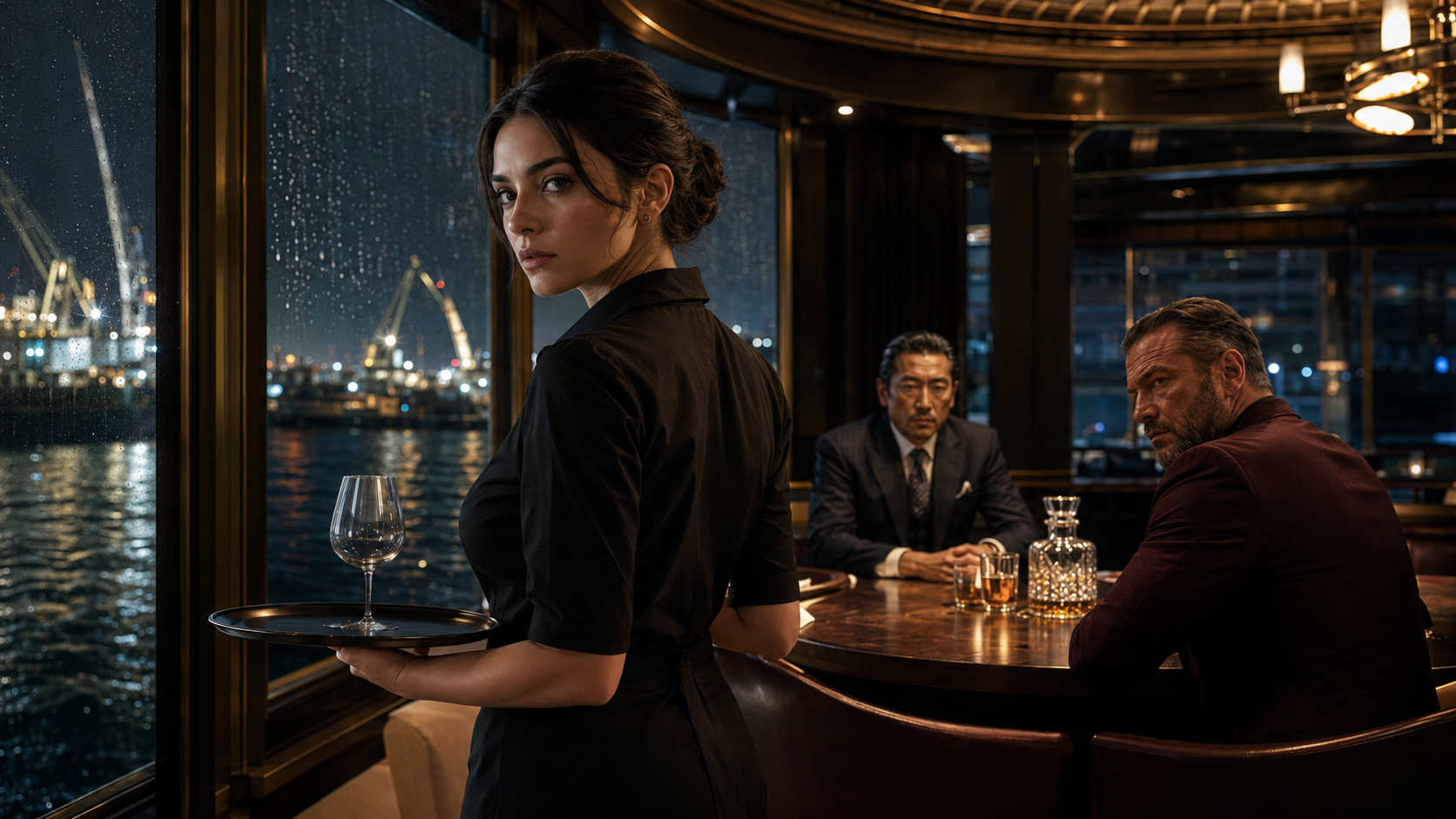
The Waitress Who Spoke the Forgotten Dialect

Nobody at the Lantern Room ever looked twice at Mira Vale.

That was the first rule of expensive places: the richer the guests, the less visible the staff became. Mira could pour wine beside a senator, clear plates from a table of billionaires, refill water for men who owned half the harbor, and none of them would remember the color of her eyes five minutes later.

She had learned to use that.

A woman who was ignored could hear everything.

And on the night the city nearly went to war, Mira heard too much.

The Lantern Room floated above the black water of Port Mercer, built on old pilings at the edge of the industrial district where the skyline met the cranes. From the dining floor, guests could see the whole harbor glittering through sheets of rain: cargo ships crawling like metal islands, tugboats nudging them into place, red warning lights blinking on the cranes, and beyond them the glass towers of downtown pretending the docks did not exist.

The restaurant smelled of cedar smoke, citrus peel, money, and secrets.

Mira moved between tables with a silver tray balanced on one hand. Her black uniform was plain, her hair pinned tightly at the nape of her neck, her face calm enough to be mistaken for empty. That was what people saw when they bothered to see her at all.

A quiet waitress.

A woman paid to smile and disappear.

At table twelve, a man in a navy suit snapped his fingers without looking up.

Mira turned before the sound finished.

“Yes, sir?”

“Another bottle,” he said, tapping the empty one with two thick fingers. “The same.”

“Of course.”

He did not thank her. Men like him believed gratitude was for equals.

Across the room, near the windows, the private table had been prepared for an hour. No menus. No flowers. No candles. Only a black lacquered surface polished until it reflected the ceiling lights like a pool of still water. Six chairs. Two bottles of untouched whiskey. Three security guards standing near the service door, trying not to look like security guards.

Mira had asked no questions.

Questions made people remember you.

At nine seventeen, the first party arrived.

Damon Strake came through the main entrance laughing too loudly. He wore a gray coat over a burgundy suit and moved like a man who believed every room had been waiting for him. His left ear was missing the lower half. Old dockworkers said it had been cut off in a union dispute twenty years ago. Damon said it had been bitten off by a dog. Nobody believed the dog story.

Behind him came four men with flat faces, wet shoulders, and hands that never drifted far from their jackets.

Mira watched them from the service station while polishing a glass that was already clean.

“American side is here,” whispered Tomas, the bartender.

Mira said nothing.

Tomas leaned closer. “You hear who they’re meeting?”

“No.”

“That’s why you’re alive,” he muttered. “You don’t ask.”

“I learned from the best.”

He snorted, but his smile died as the second party entered.

The restaurant changed.

It was not dramatic. No one screamed. No glass shattered. Music kept playing from the hidden speakers. Knives still touched porcelain. But the air tightened, as if every invisible wire in the room had been pulled at once.

Four Japanese men stepped inside first.

Then came the man everyone had been waiting for.

Kaito Ren.

Mira knew his name because the kitchen had been whispering it since lunch. He was younger than she expected, perhaps forty, perhaps less, dressed in a charcoal suit without a tie. He was not large. He did not need to be. He carried stillness like a weapon. His face was composed, almost gentle, but his eyes moved with cold precision over exits, windows, balconies, reflections, staff, guards, and finally Damon Strake.

No smile.

No bow.

No wasted movement.

Beside him walked an older man with silver hair and the calm posture of a priest. Behind them came two bodyguards, both silent, both dangerous in different ways. One was built like a wall. The other was lean, sharp-eyed, and almost bored.

Damon spread his arms.

“Kaito Ren,” he said. “Welcome to Port Mercer.”

Kaito looked at him.

The silver-haired man translated into Japanese.

Kaito answered.

The translator turned back to Damon. “Mr. Ren says he appreciates your hospitality.”

Mira lowered her eyes.

That was not what Kaito had said.

Not exactly.

The translator had softened it.

Kaito had said, This place smells like old fish and new lies.

Mira kept polishing the glass.

Tomas noticed.

“What?” he whispered.

“Nothing.”

But it was not nothing.

Kaito Ren’s Japanese was polished Tokyo boardroom speech. Formal. Controlled. Beautifully clean. But the final word had slipped. Not in standard Japanese. Not in the Osaka dialect Mira heard from tourists. Not in any version most translators would expect from a man like him.

It had been an old island turn of phrase.

A word Mira had not heard since her grandmother died.

Her hand tightened around the stem of the glass.

No.

She pushed the memory down.

That language belonged to a kitchen with paper walls, a woman humming while cutting bitter melon, and a little girl being told never to repeat family words in front of strangers.

Especially not dangerous strangers.

Table twelve snapped again.

Mira moved.

The negotiations began with whiskey.

Damon wanted control of Pier Nine, access to the bonded warehouses, and a guaranteed route through customs inspections twice a week. Kaito wanted silence, punctuality, and the return of three missing containers no one was admitting had been stolen.

They spoke through the silver-haired translator, whose name was Mr. Hoshino. He was good. Very good. He understood tone, insult, threat, and the delicate art of making greed sound like business strategy.

But he did not understand everything.

Mira did.

She drifted near the private table with a tray of water glasses.

Damon leaned back, smiling with too many teeth. “Tell him this city runs on arrangements. He wants his product moved, he respects the people who already own the roads.”

Mr. Hoshino translated.

Kaito listened.

Then he said in Japanese, “Roads can be bought. Rivers remember who poisoned them.”

Mr. Hoshino translated, “Mr. Ren says he respects established local influence, but he does not accept inflated costs.”

Damon laughed. “Inflated? That’s cute.”

Mira set down a glass beside Kaito.

His eyes did not move toward her.

But his fingers stopped for half a second on the table.

He had noticed her.

Not as a woman. Not as a waitress.

As a disturbance.

Mira stepped away.

The rain thickened against the windows.

By the kitchen door, Tomas watched with the pale fascination of a man observing a tiger from inside a cage he hoped was strong enough.

“Stop staring,” Mira murmured as she passed him.

“I’m not staring.”

“You are practically waving.”

“I’m nervous.”

“Then clean something.”

He grabbed a towel and began wiping the same section of bar.

At the private table, Damon’s smile had become meaner.

“You tell your boss,” Damon said, pointing at Mr. Hoshino with his glass, “that I did not invite him here so he could lecture me about costs. My people bled on these docks before he could spell America.”

Mr. Hoshino’s expression did not change.

He translated.

Kaito looked out at the harbor. For a moment, his reflection hovered in the rain-streaked glass like a ghost.

Then he answered quietly.

Mr. Hoshino translated, “Mr. Ren says blood is not a receipt.”

Damon’s men shifted.

Kaito’s men did not.

Mira felt the room lean toward violence.

She had seen it before. Not in rooms like this, not with silk napkins and three-hundred-dollar whiskey, but in apartments where men lowered their voices before raising their fists. Violence had a rhythm. It breathed in before it struck.

Damon placed a folder on the table.

“Fine,” he said. “Let’s talk real numbers. Forty percent of all Pacific freight through Port Mercer. Shared access to Warehouse Seven. And my approval on every outside contractor you bring within five miles of the harbor.”

Mr. Hoshino translated.

Kaito’s face did not move.

But the lean bodyguard’s eyes sharpened.

Mira felt it, too.

Warehouse Seven.

The words entered the room like a lit match.

Kaito answered in Japanese. His voice was soft.

Mr. Hoshino began to translate, then stopped.

Only for a breath.

A tiny break.

Almost invisible.

But Mira saw it.

Mr. Hoshino said, “Mr. Ren refuses Warehouse Seven.”

Damon’s smile faded. “Refuses?”

“He is prepared to offer you twenty-two percent and route protection fees. No warehouse access.”

Damon leaned forward. “You tell him Warehouse Seven is not optional.”

Mr. Hoshino translated.

Kaito spoke again, colder now.

“Ask him who told him to ask for it.”

Mr. Hoshino translated.

Damon lifted one shoulder. “Nobody tells me what to ask for.”

Mira was pouring water at the next table when Damon’s right-hand man leaned close to him and muttered something too low for most people to hear.

Most people.

Mira heard it.

“Rourke said don’t leave without Seven.”

The name went through her like a needle.

Rourke.

Not Damon Strake’s superior. Not a dock boss. Not even a local player.

Elias Rourke was a lawyer with clean hands and a charity board smile. He represented port unions, shipping companies, judges, and men who never appeared in the same room as a crime. If his name was in this room, then this was not a negotiation.

It was a trap.

Mira should have walked away.

She should have gone to the kitchen, untied her apron, taken her coat from the staff locker, and disappeared into the rain. That was what her grandmother would have told her.

When wolves argue, little birds do not sing.

But Kaito Ren said something then.

Not in formal Japanese.

Not to Mr. Hoshino.

To himself.

Six quiet words in the old island dialect.

“Storm birds circle before the drowning.”

The glass in Mira’s hand nearly slipped.

It was not just a phrase. It was a warning from the southern islands, something fishermen used to say when the weather looked calm but the sea had already changed beneath them.

Mira had heard her grandmother say it the night her father failed to come home.

Kaito Ren should not have known it.

No one at that table should have known it.

Damon tapped the folder. “I’m tired of dancing. Forty percent. Warehouse Seven. Contractors approved by me. Or my friends in customs suddenly become very interested in Mr. Ren’s shipments.”

Mr. Hoshino translated.

Kaito’s expression turned unreadable.

His large bodyguard shifted one foot.

Damon’s men noticed.

One of them smiled.

Mira saw the whole thing open in front of her: one wrong word, one hand inside a jacket, one bullet, one dead boss, one harbor war by morning.

And then she saw something else.

Outside the window, beyond the reflection of chandeliers and expensive faces, a service boat drifted too slowly between the pilings. No running lights. No crew visible. Its hull rose and fell with the rain-black water.

Mira knew boats.

Her father had worked docks before he worked security. He used to take her walking by the piers and teach her the difference between a lost vessel and one pretending to be lost.

That boat was waiting.

Her body went cold.

Kaito Ren was not the only target.

Damon Strake was, too.

Someone wanted both sides dead.

Someone wanted a war.

Mira placed her tray down on the nearest empty table.

Tomas saw her face. “Mira?”

She ignored him.

At the private table, Damon was speaking again.

“You think I’m afraid because you flew in with pretty suits and ghost stories? This is my city.”

Mr. Hoshino opened his mouth to translate.

Mira spoke first.

Not in English.

Not in standard Japanese.

In the forgotten island dialect her grandmother had buried in lullabies and kitchen prayers.

“Do not answer the man with the torn ear,” Mira said. “He is not the storm. He is only the gull crying before it.”

The table went silent.

The entire restaurant seemed to lose sound.

Mr. Hoshino turned slowly.

Kaito Ren looked at Mira for the first time fully.

His eyes changed.

Not soft. Never soft.

But awake.

Damon frowned. “What the hell did she just say?”

No one answered him.

The lean bodyguard took one step toward Mira. The larger one reached inside his jacket.

Kaito lifted two fingers.

Both men stopped.

He spoke to Mira in the same dialect, careful now, testing each syllable as if unlocking an old door.

“Who taught you that tongue?”

Mira felt every eye in the room.

Her throat tightened, but her voice did not shake.

“A woman who survived men who thought silence made her harmless.”

Kaito studied her.

Mr. Hoshino looked stunned in a way Mira did not like. His face had lost all diplomatic calm. He was not merely surprised she understood the dialect.

He was afraid.

Damon slammed his palm on the table. “I asked a question.”

Mira turned to him.

“You asked for Warehouse Seven because Elias Rourke told you to ask for it.”

Damon’s face changed before he could stop it.

Kaito saw.

Everyone saw.

Mira continued, “There is a boat outside without lights. It has been drifting for three minutes. It is not lost. It is waiting for the first shot.”

Damon’s men moved.

Kaito’s men moved faster.

Chairs scraped. Jackets opened. The air filled with the metal smell of drawn weapons.

Mira raised her voice.

“If anyone fires, both of your bosses die tonight.”

That stopped them.

Not because they respected her.

Because she was specific.

Specific fear is harder to ignore.

Kaito’s gaze moved past her to the rain-black windows.

The lean bodyguard turned his head slightly, tracking the reflection.

Damon looked furious, but underneath the fury was confusion. Genuine confusion.

He had expected pressure, maybe even violence. He had not expected a waitress to name the man behind his demand.

Kaito spoke quietly. “Explain.”

Mira did not know whether he meant the boat, the warehouse, or herself.

She chose the part that would keep them alive.

“Warehouse Seven sits above the old inspection tunnel,” she said. “Not the one on the city maps. The older one. The one sealed after the flood. If someone controls Seven, they control a hidden route from the harbor to the rail yard.”

Damon stared. “That tunnel’s filled with concrete.”

“No,” Mira said. “The north entrance is. The south entrance was covered, not sealed.”

Damon turned slowly toward his right-hand man.

The man who had whispered Rourke’s name looked away.

There it was.

The crack.

Kaito saw it, too.

His voice was almost pleasant when he spoke. “Mr. Strake, I believe your house has a rat.”

Damon’s right-hand man reached for his gun.

The lean bodyguard crossed the space between them so quickly Mira barely saw him move. There was a sharp crack as the man’s wrist bent the wrong way. The gun hit the carpet. Damon’s men shouted. Kaito’s large guard had his weapon out now, aimed but steady.

Mira stepped backward.

Too late.

The service boat outside flashed.

Not a light.

A muzzle.

“Down!” Mira shouted.

The window exploded inward.

Rain, glass, and gunfire tore through the Lantern Room.

Guests screamed. Tables overturned. Crystal shattered against marble. The pianist, who had been playing near the bar, dove behind the instrument as bullets punched holes through the polished wood.

Mira hit the floor hard.

A second later, Kaito Ren was beside her, one arm braced over her shoulders as glass rained across his suit. He had moved toward her, not away. That made no sense. Men like him preserved themselves first.

Damon roared orders from behind the table.

His men returned fire toward the window, but the angle was bad. Kaito’s lean bodyguard dragged Mr. Hoshino behind a pillar. The large one shielded Kaito with his body while firing measured shots through the shattered glass.

Tomas crawled from behind the bar, white-faced, clutching a bleeding cut on his forehead.

“Mira!”

“Stay down!”

The service boat’s engine growled outside.

Mira lifted her head just enough to see through the broken lower pane. The boat was backing away from the pilings, not fleeing yet, repositioning. A second shooter crouched near the bow with a rifle.

“They’re moving left!” she shouted. “Toward the kitchen windows!”

Kaito looked at her. “How many?”

“Two visible. Maybe one pilot.”

“You can see them?”

“I know water.”

A bullet struck the floor near her hand. Splinters jumped into her skin.

Kaito pulled her back.

“You should not be here,” he said.

Mira laughed once, breathless and bitter. “I was scheduled until closing.”

For the first time, something like amusement touched his face.

Then the room shook.

The kitchen windows blew inward.

Smoke rolled through the service hallway. Cooks shouted. The sprinkler system burst alive, soaking the restaurant in cold water. Fire alarms screamed. The air filled with steam, glass dust, and panic.

Damon grabbed his traitorous right-hand man by the collar and slammed him against the table.

“Who paid you?”

The man spit blood and smiled.

“Too late,” he said.

Mira heard a new sound beneath the alarm.

Ticking.

Not loud.

Not mechanical.

A small, fast clicking from under the service station.

Her heart dropped.

She turned.

There, half-hidden behind stacked linen baskets, was a black case no larger than a lunchbox. A red indicator blinked beneath the handle.

She had passed that service station twenty times tonight.

It had not been there before.

“Kaito,” she said.

He followed her eyes.

His face went still.

The kind of stillness that meant death had entered the room wearing a new mask.

“Everyone out!” he shouted.

Damon looked over. “What?”

“Bomb!”

The word did what bullets had not. It broke the room open.

Men who had been ready to kill one another suddenly moved in the same direction. Kaito barked orders in Japanese. Damon cursed in English. Staff crawled toward the emergency exit. Guests sobbed under tables. Tomas dragged the pianist by the collar toward the kitchen.

Mira should have run.

Instead, she crawled toward the black case.

Kaito caught her wrist. “No.”

“There are people trapped by the bar.”

“My men will take them.”

“There isn’t time.”

“You are not trained for this.”

She looked at him through smoke and sprinkler rain. “Are you?”

He did not answer.

The blinking light quickened.

Mira’s father had worked more than docks. Before he disappeared, he had inspected cargo, security seals, illegal modifications, hidden compartments. He had taught her strange things other fathers did not teach daughters: how to spot a false panel, how to smell burned copper, how to tell a timer from a pressure switch, how to stay calm when panic wanted to own your hands.

She reached the case.

Kaito crouched beside her despite the shouting men behind him.

“Go,” she said.

“No.”

“You are the target.”

“Not anymore.”

The words struck her strangely.

Mira swallowed and looked at the case. No wires outside. Cheap plastic shell. Commercial latch. Too obvious. Too theatrical.

A fear colder than the rain slid through her.

“It’s not the bomb,” she said.

Kaito’s eyes narrowed.

“What?”

“It is meant to make everyone run.”

She turned toward the emergency exits.

The staff exit led to the alley.

The guest exit led to the front drive.

The kitchen exit led to the lower dock.

Three exits.

Three perfect kill zones.

Mira looked toward the old dumbwaiter shaft behind the wine wall.

The building had once been a ferry office. During renovations, most of the old maintenance access had been sealed, but not all. Tomas used to sneak cigarettes in the crawlspace during double shifts. Mira had yelled at him for it twice.

“There is another way,” she said.

Kaito followed her gaze.

“The wall?”

“Behind the wine racks. Old service shaft. It drops to the storage level.”

Damon appeared beside them, soaked and bleeding from one eyebrow. “You’re telling me we run into a hole because the waitress says so?”

Mira looked at him.

“I am telling you Elias Rourke expects you to run outside and die on camera so the city can blame Mr. Ren. If you prefer that version, the front door is open.”

Damon stared at her.

Then he barked, “Move!”

For three impossible minutes, enemies worked together.

Kaito’s men pulled the wine racks away from the wall. Damon’s men shoved tables into barricades. Tomas guided the remaining staff toward the hidden shaft. Mr. Hoshino, pale but composed again, helped an elderly woman climb down first.

Mira stayed near the opening, counting people.

“Go,” Kaito said behind her.

“After Tomas.”

Tomas shook his head. “No, absolutely not. I am not doing heroic scheduling.”

“Go.”

“Mira—”

She shoved him toward the shaft. “Clean something downstairs.”

He vanished with a terrified curse.

The fake bomb continued blinking.

Gunfire sounded outside near the front drive.

A trap closing on empty air.

Damon looked almost impressed. “Rourke really did plan for both of us.”

Mira said, “Men like him do not hate criminals. He hates competition.”

Kaito’s gaze rested on her. “And what do you hate?”

The question was absurd in the middle of smoke, blood, and alarms.

Mira answered anyway.

“Being underestimated.”

Something in his expression shifted.

“Then tonight must be satisfying.”

“No,” she said. “Tonight is inconvenient.”

Damon barked a laugh despite himself.

Then the traitor on the floor moved.

His broken wrist hung useless, but his other hand came up holding a small remote.

Mira saw it first.

She lunged.

Kaito fired.

The shot hit the traitor’s shoulder. The remote skidded across the soaked floor, spinning toward the private table.

Damon dove for it.

Outside, the service boat roared closer again.

Mira heard the pitch of the engine and knew what it meant.

“They’re coming under the restaurant!”

Kaito grabbed her by the arm, not gently this time, and pushed her toward the shaft.

“Down. Now.”

The floor bucked beneath them.

Not an explosion. Impact.

The boat had struck the pilings.

The whole Lantern Room groaned like an old ship in a storm. Lights flickered. Plates slid from tables. Somewhere below, wood cracked and metal screamed.

Damon shoved the remote into his pocket. “Move, Ren!”

Kaito waited until Mira entered the shaft.

It was narrow, dark, and smelled of dust, oil, and old wood. She climbed down the iron rungs fast, hands burning, knees scraping the wall. Above her came Kaito. Above him, Damon. Above Damon, the men who had entered as enemies and were now simply survivors.

They emerged in the storage level beneath the restaurant.

Cold harbor air pushed through cracks in the walls. The lower level was half basement, half dock, built over water that slapped against the pilings below. Old crates lined the walls. Emergency lamps glowed red. Everyone looked ghostly.

Tomas hugged Mira so hard she could barely breathe.

“I hate your job,” he said.

“It is also your job.”

“I hate that more.”

Kaito stepped down behind her. Water dripped from his hair onto his collar. A thin cut marked his cheek. His suit was ruined. His eyes were clear.

Damon Strake climbed down last, breathing hard, his face gray with anger.

“We get out through the east maintenance pier,” Mira said. “It comes up behind the fish market.”

Kaito looked at one of his men. “Cars?”

“Two blocks out. Moving now.”

Damon pointed at his own guard. “Call everyone. Nobody touches Ren’s people. You hear me? Nobody. Rourke wanted a war, we give him a funeral instead.”

Mira turned sharply. “No.”

Damon glared. “Excuse me?”

“No funerals. No street war. No revenge shootings. That is exactly what he wants. Bodies create headlines. Headlines create pressure. Pressure gives Rourke emergency control of the port.”

Damon’s jaw worked.

Kaito watched her, silent.

Mira continued, “You want him? Make him visible. Men like Rourke survive because violent men clean up their problems with more violence. Stop being useful to him.”

Damon looked as if he might explode.

Then, slowly, he smiled.

It was not pleasant.

But it was thinking.

“A waitress just told me I’m predictable.”

“Yes.”

“And stupid.”

“I implied useful.”

Kaito’s mouth curved slightly.

Damon pointed at him. “Don’t enjoy this.”

“I am trying not to.”

For one dangerous second, the absurdity of it almost became laughter.

Then a door slammed somewhere above.

The attackers had entered the restaurant.

Kaito’s men raised their weapons.

Mira led them through the storage level, past old crab traps, stacked chairs, and barrels of cleaning chemicals. She knew every crooked board, every leaking pipe, every place the floor dipped toward the water. Behind her came criminals, translators, cooks, bartenders, and terrified diners, all moving because the invisible woman knew the way out.

At the east maintenance pier, rain hit them sideways.

The fish market was closed, its awnings snapping in the wind. Beyond it, two black cars and one battered delivery van rolled to a stop without headlights.

Kaito’s men opened doors.

Damon’s surviving men gathered around him.

For the first time that night, the two bosses faced one another without a table between them.

Damon held out the remote he had taken from the traitor. “Evidence.”

Kaito accepted it with a nod. “Witnesses?”

Damon jerked his head toward the men around him. “Enough.”

Mira stepped between them before pride could ruin survival.

“You both leave separately,” she said. “No convoy together. No public meeting. No calls from your own phones. No threats. No speeches. In one hour, someone leaks that both of you died in the attack.”

Damon stared. “We did?”

“For tonight, yes. Dead men are hard to frame for retaliation.”

Kaito’s eyes sharpened with approval.

Mr. Hoshino, standing behind him, said softly, “It is a clever move.”

Mira looked at him.

The old translator lowered his gaze.

He knew she had noticed his hesitation earlier. He knew she knew he had understood more than he admitted.

Kaito noticed the look between them.

“Later,” he said.

Mira nodded once.

Damon rubbed rain from his face. “Who are you?”

Mira almost gave the old answer.

A waitress.

The word rose out of habit, armor polished by years of use.

But it was no longer true. Or maybe it had never been the whole truth.

“My name is Mira Vale.”

Kaito went very still.

Mr. Hoshino whispered something in Japanese.

Damon looked between them. “That supposed to mean something?”

Kaito answered without taking his eyes off Mira.

“Her father was Nathan Vale.”

The rain seemed to quiet around her.

Mira had not heard her father’s full name spoken by a stranger in nine years.

Damon frowned. “The port inspector?”

“The mediator,” Kaito said. “The only man both sides trusted before Rourke bought half this city.”

Mira’s hands curled.

“My father died in a ferry accident.”

“No,” Kaito said.

The word was gentle.

That made it worse.

Mira stepped back. “Do not.”

Kaito’s voice lowered. “He disappeared after refusing to certify Warehouse Seven as sealed. Three days later, Elias Rourke acquired the development rights through a shell company.”

The world tilted.

Mira heard the harbor. The rain. Tomas breathing beside her. Damon cursing under his breath. Somewhere far away, sirens.

Her grandmother’s warning returned.

If they ever hear you speak, run.

She had thought it meant the dialect.

Now she understood.

It meant the people who killed her father would know she carried what he knew.

Kaito reached into his inner pocket and removed a small object wrapped in oilskin. He held it out to her.

Mira did not take it.

“What is that?”

“Something your father gave my uncle the week before he vanished.”

The oilskin opened.

Inside was a brass harbor key, old and green at the edges, stamped with a number.

Seven.

Mira felt the breath leave her.

Kaito said, “My uncle believed Nathan Vale hid proof somewhere inside the old tunnel. He was murdered before he could retrieve it.”

Damon’s face hardened. “Rourke.”

“Yes.”

Mira looked at the key. Such a small thing to carry so many ghosts.

“Why bring it tonight?”

“Because I came to Port Mercer for Warehouse Seven,” Kaito said. “Not freight. Not percentages. The warehouse.”

Damon’s anger flared. “You used this meeting.”

“So did your lawyer.”

“He is not my lawyer anymore.”

“No,” Mira said. “Now he is afraid.”

Both men looked at her.

She took the key.

The metal was cold and heavier than it should have been.

“We do not go to war,” she said. “We go to Warehouse Seven.”

Tomas made a sound of disbelief. “I am begging everyone to choose literally any other plan.”

Mira glanced at him. “You are going home.”

“No, I am not. I have made terrible decisions all night and I intend to remain consistent.”

Despite everything, Mira smiled.

Kaito looked at her smile as if it was another language he wanted to understand.

Damon shook his head. “This is insane.”

Mira looked toward the harbor cranes, red lights blinking through the rain like warnings.

“No. Insane is letting a man who kills from boardrooms convince men with guns to die for his paperwork.”

Damon considered that.

Then he laughed once.

“You really are Nathan Vale’s daughter.”

“I am also late closing table twelve.”

Kaito’s expression softened just enough to be dangerous.

“You saved my life twice tonight.”

“You saved mine once. We are not keeping score.”

“In my world,” he said, “debts matter.”

“In mine, choices matter.”

He inclined his head. “Then choose.”

Mira looked at the cars. At the dark restaurant behind them. At the harbor where her father had vanished. At the key in her palm.

All her life she had survived by being unseen.

But invisibility was not safety. It was only a slower kind of disappearance.

She closed her fist around the key.

“I choose answers.”

Damon opened the van door. “Then get in before I regain common sense.”

Kaito stepped aside, letting Mira enter first.

Not ordering.

Not claiming.

Letting.

That mattered more than it should have.

Inside the van, the seats smelled of fish, diesel, and wet canvas. Tomas climbed in beside her, muttering prayers in three languages. Damon took the front passenger seat. Kaito sat across from Mira in the back, his men following in the cars behind.

As the van pulled away from the fish market, the Lantern Room burned behind them.

Flames rose through the rain, bright and hungry, turning the harbor windows orange.

Mira watched until the restaurant disappeared around the corner.

The life she had built there was gone.

The woman who could move through rooms unseen was gone with it.

Kaito looked at the brass key in her hand.

“You know,” he said quietly, “the dialect you spoke tonight is almost dead.”

Mira did not look away from the window.

“No language dies while someone still uses it to tell the truth.”

For a long moment, he said nothing.

Then, in that old island tongue, careful and respectful, Kaito Ren answered, “Then speak, Mira Vale.”

She turned to him.

The rain streaked the glass behind his face. The city blurred into silver and black. Somewhere ahead waited Warehouse Seven, Elias Rourke, her father’s ghost, and the kind of truth people killed to bury.

Mira lifted her chin.

And for the first time in years, she stopped whispering.

The Waitress Who Spoke the Forgotten Dialect
A husband is caught cheating on his wife and he acts as if nothing has happened