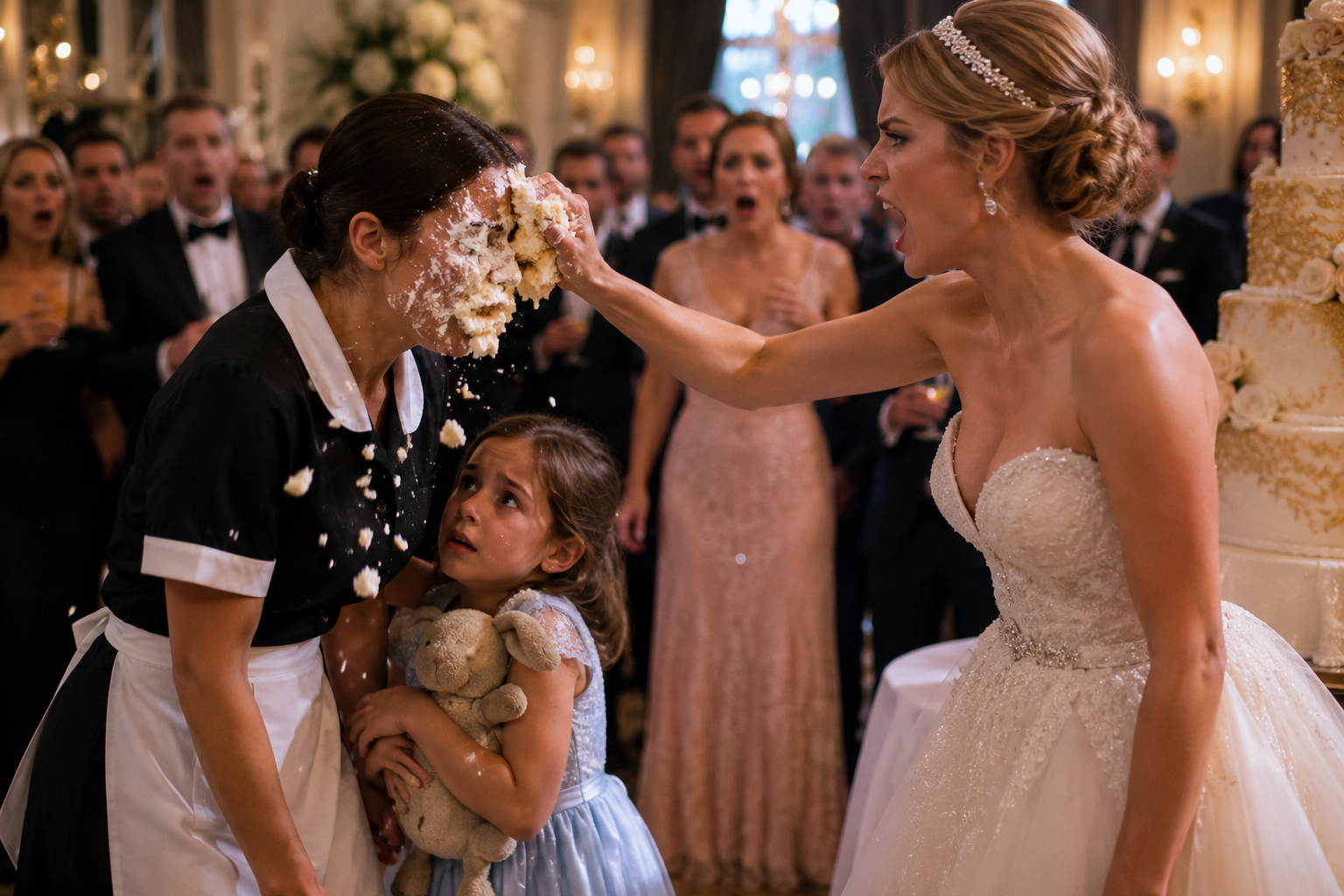
The Bride Threw Cake in the Maid’s Face at the Billionaire Wedding — But the Maid’s Little Girl Revealed One Secret That Destroyed the Ceremony

Elena Hart had spent the whole morning teaching herself how not to be seen.

At Ashbourne Manor, invisibility was a skill. It was folded into the towels, polished into the silver, hidden behind the tall vases of white lilies and the endless crystal glasses waiting beneath the ballroom lights. A good maid moved like a shadow. A good maid heard everything and repeated nothing. A good maid carried other people’s messes away before the important people noticed there had been a mess at all.

And on the day Julian Ashbourne married Vivienne Royce, Elena needed to be the best shadow in the house.

Her black uniform was freshly pressed, though the cuffs were beginning to fray. Her hair was pinned low at the back of her neck. Her shoes were clean but old, the soles softened by years of walking marble corridors before dawn. Beside her, half-hidden behind the service doorway, stood her five-year-old daughter, Rosie, wearing a pale blue dress Elena had bought secondhand and altered by hand the night before.

Rosie clutched a stuffed rabbit with one missing button eye.

His name was Sir Hopswell, and according to Rosie, he was “very brave, but allergic to mean people.”

“Is this where princesses get married?” Rosie whispered, staring through the narrow opening into the ballroom.

Elena almost smiled.

The room did look like something from a fairy tale. White roses climbed the columns. Gold light poured from the chandeliers. A string quartet played near the tall windows, and beyond the terrace the ocean flashed silver under the afternoon sun. Guests moved in silk, diamonds, tailored jackets, and careless laughter. Everything shimmered with money.

“Something like that,” Elena whispered back. “But remember, we stay near the kitchen. We don’t touch anything. We don’t bother anyone. And after the staff toast, we go straight home.”

Rosie nodded seriously. “I’m not bothering. Sir Hopswell is also not bothering.”

“I appreciate his cooperation.”

Elena had not planned to bring Rosie. She had begged the neighbor downstairs to watch her. Then the neighbor’s son woke with a fever, and Elena had been left with two choices: miss the most important workday of the year and risk losing her job, or bring her child quietly and pray nobody important cared enough to be cruel.

She should have known better.

Important people always had time to be cruel when the audience was large enough.

Julian Ashbourne had not minded children in the house. He had never minded much of anything that involved ordinary human inconvenience. He was not soft, exactly. A man did not build Ashbourne Medical Systems into a global empire by being soft. But he had a quiet decency that made the staff loyal to him in ways money alone could not buy.

He remembered birthdays. He knew which gardener had a bad knee. He had once found Rosie crying outside the kitchen because she had broken a glass ornament shaped like a star, and instead of scolding her, he had lifted her gently so she could touch the real crystal stars hanging from the winter tree.

“You see?” he had told her. “Some stars are only decorations. Some stars are meant to survive.”

After that, Rosie called him Mr. Star.

Elena called him Mr. Ashbourne in front of others and Julian only when the house was quiet and he found her late in the kitchen, both of them too tired to pretend titles mattered. She had worked for him for seven years. She had seen him after his mother died, standing in the library at two in the morning with his hands in his pockets, unable to touch a single one of her books. She had seen him forget meals, take calls in the rain, and give away money anonymously because public charity embarrassed him.

And she had seen him become engaged to Vivienne Royce.

Vivienne was beautiful in the kind of way that made people forgive her before she had done anything wrong. Her hair was the color of champagne. Her smile was practiced. Her voice was soft when men were listening and sharp when only women with paychecks were near enough to hear.

From the first week she arrived at Ashbourne Manor, Elena understood that Vivienne did not like her.

Not because Elena had done anything.

Because Elena knew where everything belonged.

Because Julian trusted her.

Because Rosie once ran into the entrance hall and Julian laughed.

Vivienne had seen that laugh.

After that, she stopped calling Elena by name unless there were witnesses.

“Girl,” she would say, though Elena was thirty-two.

“Help.”

“Clean this.”

“Don’t hover.”

“Elena,” Julian would correct her once, calmly.

Vivienne would smile. “Of course. Elena.”

But the smile never reached her eyes.

Now, on the wedding day, Elena hoped the size of the celebration would protect her. There were four hundred guests, photographers, caterers, musicians, florists, security officers, and three wedding planners speaking into headsets as if directing a military operation. One maid and one little girl should have been easy to ignore.

For almost an hour, they were.

Rosie sat on a wooden stool near the service corridor, swinging her feet and whispering observations to Sir Hopswell.

“That lady has a bird on her hat.”

“That man laughs like the coffee machine.”

“The cake is bigger than our fridge.”

Elena carried trays, cleared glasses, corrected a folded napkin at table fourteen, replaced a broken champagne flute before anyone stepped on the glass, and tried to keep Rosie within arm’s reach.

Then Vivienne saw them.

The bride stood beside the six-tier wedding cake, surrounded by bridesmaids in blush satin. Her gown was enormous, white lace falling around her like expensive snow. Diamonds glittered at her ears. Her mouth curved into a smile so polished it made Elena’s stomach tighten.

Vivienne crossed the ballroom slowly.

People noticed. Of course they noticed. Brides did not move unnoticed on their wedding day.

“Elena,” Vivienne said, loud enough for nearby guests to hear. “How sweet. You brought a guest.”

Elena’s fingers closed around Rosie’s shoulder.

“I apologize, Miss Royce,” she said quietly. “My sitter canceled this morning. Rosie has stayed in the service area. We won’t be in anyone’s way.”

Vivienne tilted her head.

“Oh, please. Don’t make it sound tragic.” Her smile widened. “This is a wedding. Everyone should feel included.”

A few guests turned toward them with soft, approving expressions. They thought they were watching generosity. A rich bride welcoming a poor child. A moment to repeat later over dessert.

Rosie looked up at Vivienne.

“You look like a princess,” she said.

Elena felt Vivienne’s hand tighten around her bouquet.

“Do I?” Vivienne asked.

Rosie nodded. “But Sir Hopswell says princesses should be nice.”

The bridesmaids laughed lightly.

Vivienne did not.

She looked at Elena, then at the crowd, then at the cake. On a silver plate near the table, a slice had already been cut for the ceremonial tasting. Thick vanilla sponge. White buttercream. A bright red ribbon of strawberry filling.

Vivienne lifted the slice.

Elena knew before it happened.

Some things announce themselves in the body before the world admits them. The angle of Vivienne’s wrist. The sweetness of her smile. The cruel brightness in her eyes.

“Then let me be nice,” Vivienne said. “Let me personally welcome you.”

“Elena,” Rosie whispered.

The cake hit Elena’s face with a wet, humiliating force.

For one second the entire ballroom stopped breathing.

Buttercream smeared across Elena’s cheek, nose, mouth, and hair. Strawberry filling slid down her uniform and dropped onto the polished marble. A broken piece of cake landed on Rosie’s blue shoe.

Nobody moved.

Then someone laughed.

It was a small sound at first, nervous and uncertain.

Then another person laughed.

Then the laughter spread.

Not everyone laughed. That mattered later. Elena remembered that not everyone laughed. Some guests looked away in shame. One older woman covered her mouth. A waiter near the wall went pale with anger.

But enough people laughed.

Enough to make the room feel colder than winter.

Vivienne leaned close, her perfume sharp and floral.

“There,” she murmured. “Now you’re part of the celebration.”

Elena did not cry.

She had learned years ago that tears could be dangerous when your rent depended on people pretending they had not hurt you. She reached blindly for a napkin. Her hand shook. She wiped frosting from her eyes first, not because she cared how she looked, but because she needed to see Rosie.

Rosie stood frozen, clutching Sir Hopswell so hard his little cloth neck bent sideways.

“Mama?” she whispered.

That broke something in Elena.

Not loudly. Not dramatically. Just a small crack inside, the kind that never quite closes.

Elena bent down, wiped the cake from Rosie’s shoe with the edge of the napkin, and took her daughter’s hand.

“We’re going home, sweetheart.”

Vivienne’s smile stayed in place for the crowd.

“Good idea,” she said softly. “This really isn’t your world.”

Elena looked at her then.

Not with rage.

Not with hatred.

Only with a tired sadness so deep that Vivienne, for the first time all day, looked away first.

Across the ballroom, Julian had not seen it.

He had been near the terrace doors, trapped between two investors, a senator, and an old family friend who kept clapping him on the back. He was smiling, nodding, accepting congratulations, trying not to count the minutes until the performance of the wedding became a private life.

When he finally turned, he saw Elena at the edge of the hallway.

Her face was mostly clean, but not fully. A streak of frosting remained near her ear. Her uniform was stained. Rosie was pressed against her leg, her little face frightened and pale.

Something in Julian’s chest tightened.

“Elena?”

She stopped.

He crossed the space quickly. “What happened?”

“Nothing, Mr. Ashbourne.”

The formality struck him more sharply than the stain on her dress.

She had not called him Mr. Ashbourne in that voice for years.

“Elena,” he said more quietly, “what happened?”

She looked up at him. For one moment, he thought she would tell him. He saw the truth rise behind her eyes.

Then she swallowed it.

“Congratulations,” she said. “The ceremony was beautiful.”

“Elena—”

“Please enjoy your evening.”

She left before he could stop her.

Julian watched her disappear through the service corridor, Rosie’s blue dress vanishing around the corner. The music began again behind him. Someone called his name. Someone laughed too loudly.

The cold feeling stayed.

Outside, Elena buckled Rosie into the back seat of her old gray Honda. She closed the door carefully, sat behind the wheel, and gripped it with both hands.

For a full minute, she did not start the car.

In the mirror, Rosie stared at her lap.

“Why did the princess lady hurt you?” she asked.

Elena closed her eyes.

There were questions a mother wanted to answer with wisdom, and questions that only had ugly answers.

“She made a bad choice,” Elena said.

“Is she bad?”

Elena opened her eyes.

“I don’t know.”

Rosie hugged Sir Hopswell tighter. “She says bad things when nobody sees.”

Elena’s breath changed.

“What do you mean?”

Rosie looked toward the window. The manor glowed behind them, huge and golden, as if nothing inside it could ever be rotten.

“She was talking on the phone by the roses,” Rosie said. “When you cleaned the sunroom glass. She didn’t see me because I was under the bench making Sir Hopswell a cave.”

Elena remembered the day instantly.

Six weeks earlier. Rain in the morning. Sun in the afternoon. Vivienne in the rose garden, pacing with her phone pressed to her ear. Elena had been inside, cleaning the sunroom windows, catching only fragments through the cracked door.

“He trusts me.”

“After the wedding, it won’t matter.”

“No, I don’t love him.”

“Don’t be sentimental.”

“I want the company access, not the man.”

At the time, Elena had frozen with the cloth in her hand.

But fragments were not proof. Suspicion was not evidence. And a maid accusing a billionaire’s fiancée of betrayal was not bravery. It was unemployment.

So Elena had stayed silent.

Now Rosie was still speaking.

“She told the red car man that Mr. Star is lonely, so he is easy.”

Elena turned in the driver’s seat.

“What red car man?”

Rosie frowned in concentration. “The tall man with shiny shoes. He came when the gate was open. He had papers. He kissed her by the roses.”

Elena’s stomach dropped.

The red car belonged to Marcus Vale.

Vivienne had introduced him once as an old family friend. Julian had mentioned him only once, in a tone Elena had not forgotten. Marcus Vale ran ValeGene Therapeutics, a rival company that had been trying for two years to outbid Ashbourne Medical on several government research contracts.

Elena started the car with trembling hands.

At home, she tried to return the world to normal.

She washed Rosie’s face. She gave her warm soup. She helped her into pajamas with little clouds on them. She read two bedtime stories, including the one about the mouse who outsmarted a fox, because Rosie liked brave small things.

But Rosie did not sleep.

She lay stiff under her blanket, Sir Hopswell tucked beneath her chin, staring at the ceiling.

“Mama?”

“Yes, sweetheart?”

“Mr. Star doesn’t know.”

Elena sat on the edge of the bed.

“No,” she whispered.

“She lied to him.”

“Yes.”

Rosie’s eyes filled with tears. “We have to tell.”

Elena touched her hair.

“It’s complicated.”

“Why?”

Because truth did not protect poor women the way it protected rich men.

Because Elena could not afford lawyers, scandal, or revenge.

Because one wrong word could take away the job that kept food in their refrigerator.

Because the world praised honesty only when honesty did not inconvenience anyone powerful.

But Rosie was five.

So Elena only said, “Sometimes adults need proof.”

Rosie sat up suddenly.

“I’m proof.”

“No, baby.”

“Yes, I am.” Her lip trembled. “He was nice to me. He let me touch the star.”

Elena felt the crack inside her widen.

Rosie began to cry.

Not loudly. Not in a tantrum. She cried with the exhausted, stubborn grief of a child who had seen wrong done and could not understand why adults built walls around the truth.

After forty minutes, Elena put on her shoes.

“All right,” she whispered. “We’ll go.”

The wedding reception was still shining when Elena’s Honda returned to Ashbourne Manor.

Security recognized her at the gate and looked confused, but after a short call, the barrier lifted. Elena parked near the service entrance. She carried Rosie because Rosie had cried herself weak, and Sir Hopswell dangled from one small hand like a witness summoned to court.

Julian came down the side hallway himself.

His jacket was open. His tie had been loosened. Concern had replaced the polished expression he wore for guests.

“Elena, what happened?”

She stood before him with Rosie in her arms, humiliated all over again by the stain still faintly visible on her uniform.

“I’m sorry,” she said. “I know I shouldn’t be here. But Rosie wouldn’t sleep. She kept saying she had to tell you something.”

Julian’s face changed.

He crouched so his eyes were level with Rosie’s.

“Rosie,” he said gently. “It’s Mr. Star. What do you need to tell me?”

Rosie took a breath so deep her small shoulders lifted.

“The princess lady doesn’t love you.”

The hallway became very still.

Elena covered her mouth.

Julian did not blink.

Rosie continued, her voice shaking but clear. “She said she only wants your money and your company secrets. She said after the wedding, you can’t stop her. She told the red car man you are easy because you miss your mama.”

Julian looked as if something invisible had struck him in the chest.

“What red car man?” he asked.

“The one who kissed her by the roses,” Rosie said. “He gave her papers. She put them in her bag.”

Elena stepped forward. “Julian, I heard pieces of a conversation weeks ago, but I didn’t have proof. I thought maybe I misunderstood. I was afraid to say anything.”

Julian stood slowly.

His face had gone pale, but his voice remained controlled.

“Did Vivienne do something to you tonight?”

Elena went silent.

The question was too direct. Too dangerous.

Rosie answered for her.

“She hurt Mama,” she said. “She smashed cake in her face. Everybody laughed.”

Julian closed his eyes.

That was the moment the wedding truly ended.

Not when Rosie revealed the secret.

Not when Marcus Vale’s name entered the room.

But when Julian understood that betrayal had not arrived suddenly. It had lived in his house for months, wearing diamonds, smiling for photographers, treating loyal people as disposable while he had been too lonely to notice.

When he opened his eyes again, they were different.

Calm.

Cold.

Awake.

“Elena,” he said, “take Rosie to the kitchen. Mrs. Bell will get her warm milk. Stay there until I come back.”

“Julian—”

“Please.”

Then he turned and walked toward the ballroom.

The first dance was about to begin.

Vivienne stood beneath the chandeliers, laughing with her bridesmaids, her white gown glowing under the lights. The musicians lifted their bows. Guests gathered with phones hidden discreetly in their hands, ready to capture the perfect romantic moment.

Vivienne saw Julian and smiled.

“There you are,” she said. “Everyone is waiting.”

“No,” Julian said.

The word was not loud.

But it cut through the room.

Vivienne blinked. “Excuse me?”

“I need to speak with you.”

“Now?”

“Yes.”

Her smile tightened. “Julian, don’t embarrass me.”

He looked at her for a long moment.

“Strange,” he said quietly. “You didn’t seem concerned about embarrassment when you shoved wedding cake into Elena Hart’s face.”

The ballroom fell silent.

Vivienne’s eyes flashed.

“That was a joke.”

“No,” Julian said. “It was cruelty.”

A murmur moved across the room like wind over dry leaves.

Vivienne laughed once, sharp and false. “Are you really going to ruin our wedding because a maid can’t take a joke?”

“I’m ending this wedding because a child told the truth before any adult in this house found the courage.”

The color drained from Vivienne’s face.

Only a little.

But Julian saw it.

He turned toward the security chief standing near the doors.

“Seal my east study. No one enters except my legal team. Pull every camera file from the rose garden, the private drive, and the service gate for the last ninety days. I also want the office access logs and all document scan alerts from the last two months.”

Vivienne’s expression cracked.

“Julian,” she said softly. “What are you doing?”

He looked back at her.

“Finally paying attention.”

The wedding ended before the first dance.

Guests were told there had been a private family emergency. Rich people accepted the sentence with grave expressions, then whispered it to one another in corners with growing excitement. By midnight, every important household on the coast knew something had happened at Ashbourne Manor.

By morning, Julian’s attorneys knew what.

Security footage showed Marcus Vale’s red sports car entering the service drive three times. Garden cameras caught him with Vivienne near the rose trellis. They were not standing like family friends. They were standing like conspirators who trusted secrecy too much.

The study logs showed unauthorized access.

The office scanner had recorded copied documents.

Vivienne had photographed confidential research timelines, contract proposals, patent notes, and investor communications. She had passed them to Marcus, whose company stood to gain hundreds of millions if Ashbourne Medical lost its upcoming government partnership.

The wedding had not been a romance.

It had been a strategy.

When confronted, Vivienne denied everything.

Then she blamed Marcus.

Then she blamed Julian for being emotionally distant.

Then she cried.

Julian did not soften.

That surprised people. He was known for mercy. Sometimes too much of it. But he understood now that mercy without boundaries was not kindness. It was permission for the next betrayal.

The marriage certificate had not yet been filed.

The wedding was voided.

Vivienne’s family tried to bury the scandal. Julian refused. Marcus Vale became the subject of an investigation. Contracts were frozen. Vivienne left the state within weeks, no longer photographed in bridal magazines, no longer smiling beneath chandeliers.

Elena expected to be fired.

She expected it because life had trained her well. When powerful people were embarrassed, someone powerless usually paid the bill.

For three days, she came to work with a resignation letter folded in her purse.

Julian did not summon her.

He did not ask Rosie to repeat the story.

He did not mention the cake.

He let the house become quiet again.

On the fourth morning, Elena found him alone in the kitchen before sunrise. He stood by the window, looking out at the gardens, holding a cup of coffee he had forgotten to drink.

“Elena,” he said.

She stopped in the doorway.

“Yes, Mr. Ashbourne?”

He winced at the title.

“I owe you an apology.”

“You don’t.”

“I do.”

She looked down.

Julian set the coffee aside.

“I allowed someone into this house who treated you as less than human. I ignored signs because seeing them would have forced me to admit I was wrong. I let loneliness make decisions judgment should have made. Because of that, you and Rosie were hurt under my roof.”

Elena’s eyes burned, but she refused to cry.

“I needed this job,” she said. “That’s why I stayed silent.”

“I know.”

“No,” she said, finally looking at him. “You don’t. You’re kind, Julian, but you don’t know what it feels like to measure dignity against rent. You don’t know what it feels like to tell your child to be quiet because the truth might cost dinner next week.”

The words landed hard.

Julian accepted them.

“You’re right,” he said. “I don’t know. But I want this house to become a place where nobody has to make that calculation again.”

He reached for an envelope on the counter.

Elena stiffened.

“If that’s severance—”

“It isn’t.”

Inside was a formal offer.

Director of Estate Operations.

Triple her current salary.

Full health coverage for her and Rosie.

A small cottage on the property, if she wanted it.

Education support for Rosie.

Elena stared at the paper.

“I don’t understand.”

“You have been running half this estate unofficially for years,” Julian said. “You know the systems. You know the staff. You know what my mother wanted this house to be. This is not charity. This is recognition that should have come sooner.”

Elena’s hands trembled.

“I need time.”

“Take all the time you need.”

She took nine days.

Then she accepted.

The first thing she changed was the staff policy. No more invisible labor disguised as family loyalty. No more emergency shifts without childcare support. No more unpaid hours hidden behind phrases like “we all help out here.” Clear schedules. Clear wages. Clear respect.

Julian approved every line.

Over the next year, Ashbourne Manor changed.

Not dramatically.

Not for photographs.

Deeply.

The ballroom still hosted charity events, but the cold perfection left it. Staff members spoke without flinching. The kitchen had laughter in it again. Rosie started school and no longer hid when important guests passed through the halls.

She still carried Sir Hopswell on difficult mornings, though she insisted he was “retired from dangerous investigations.”

Julian saw Elena often.

At first, he kept a careful distance. He never wanted gratitude to become pressure. He never wanted kindness to become another kind of power.

But trust does not always arrive in grand declarations.

Sometimes it grows over burnt toast during a staff breakfast.

Sometimes it grows when a child demands that a billionaire attend a puppet show because “you are tall enough to be the mountain.”

Sometimes it grows in a quiet library, when a man who has spent years being strong finally stands before his mother’s portrait and breaks.

Elena found Julian there one rainy evening.

She did not touch him.

She did not tell him it would be all right.

She simply stood beside him.

Sometimes that is the kindest thing one human being can do for another.

Two years after the wedding that never became a marriage, Ashbourne Manor hosted a spring benefit for shelters supporting single mothers and children.

The ballroom was full again.

White flowers.

Soft music.

Glasses shining beneath chandeliers.

But this time, Elena stood at the front of the room in a deep green dress, speaking into a microphone about childcare, wages, and the quiet courage of women who keep moving even when the world asks them to disappear.

Her voice shook once.

Then it steadied.

Julian watched from the side of the room.

Rosie, now seven, stood beside him with Sir Hopswell tucked under her arm.

“Mama is brave,” she whispered.

Julian smiled. “She is.”

Rosie looked up at him.

“You were sad before.”

He glanced down, surprised.

“Yes,” he said. “I was.”

“You’re not sad like that now.”

“No,” he said. “Not like that.”

Rosie nodded, satisfied.

Then she said, “You should tell Mama you love her.”

Julian nearly choked on his water.

“Rosie.”

“What? Sir Hopswell agrees.”

“Some things require timing.”

Rosie sighed with the full exhaustion of a child surrounded by foolish adults.

“That’s what grown-ups say when they’re scared.”

Julian looked toward Elena. She was laughing now as the audience applauded, one hand pressed to her heart, her face bright in a way he had never seen on the day of the ruined wedding.

Maybe Rosie had told the truth again.

Later that night, after the guests left and the last glasses were cleared, Julian found Elena on the terrace.

The gardens stretched silver beneath the moon.

“You were extraordinary tonight,” he said.

Elena smiled. “I almost fainted.”

“No one noticed.”

“I noticed.”

They laughed softly.

Then silence settled between them. Not empty silence. Not awkward silence. The kind of silence that holds every word two people are afraid to say.

Julian looked at her.

“Elena, I need to tell you something. You don’t have to answer tonight. You don’t have to answer ever, if you don’t want to.”

Her breath caught.

He continued.

“I spent a long time mistaking beauty for goodness. Charm for loyalty. Attention for love. But you showed me something different. Real love is quieter. It stays. It notices. It protects without needing applause.”

Elena’s eyes shone.

“Julian…”

“I love you,” he said. “Not because Rosie saved me. Not because you stayed. Not because I owe you anything. I love you because when I finally learned how to see clearly, you were there.”

Elena looked away toward the dark garden.

For one terrible moment, Julian thought he had ruined everything.

Then she reached for his hand.

“I’m scared,” she whispered.

“So am I.”

“I won’t let Rosie be hurt.”

“Neither will I.”

She turned back to him.

“Then we go slowly.”

Julian smiled.

“Slowly is perfect.”

A year later, they married in the garden.

Not in the ballroom.

No champagne tower. No crowd of strangers. No six-tier cake waiting under lights. Only close friends, staff who had become family, sunlight through old trees, and Rosie walking first down the aisle with Sir Hopswell wearing a tiny blue ribbon.

The cake was small.

Chocolate, because Rosie declared vanilla had “a suspicious history.”

Everyone laughed.

Elena laughed too.

This time, no one laughed at her.

Julian wrote his own vows.

He did not promise wealth.

He did not promise perfection.

He promised attention.

To notice.

To listen.

To never again let gentleness become invisible in his home.

Elena promised courage.

Not the loud kind.

The daily kind.

The kind that wakes up early, packs lunches, pays bills, tells the truth, and keeps loving even after humiliation tries to teach the heart to close.

When the ceremony ended, Rosie tugged Julian’s sleeve.

“Can I say something?”

Elena laughed nervously. “Oh no.”

Julian lifted Rosie into his arms.

“Always.”

Rosie faced the small gathering. Her curls bounced in the wind. Sir Hopswell hung proudly from one hand.

“When I was little,” she announced, “I told a secret because somebody was lying. But now I have a new secret.”

Everyone leaned closer, smiling.

Rosie grinned.

“My mama is happy.”

Elena covered her mouth.

Julian closed his eyes for one second.

Because some sentences heal places that apologies cannot reach.

People still whispered about Julian Ashbourne’s first wedding for years afterward.

They remembered the cake.

The ruined bride.

The red car.

The little girl in pajamas.

But inside Ashbourne Manor, that was not how the story was told.

Rosie told it differently.

She said there was once a man who lived in a beautiful house but forgot how to see small things. There was a woman who worked too hard and cried too quietly. There was a false princess who lied. And there was a brave rabbit who witnessed everything.

Then, Rosie would say, the truth came out.

And after that, everybody learned.

Julian learned that love without respect is only decoration.

Elena learned that dignity can bend without breaking.

Rosie learned that even the smallest voice can shake the tallest walls when it speaks for someone it loves.

That was the real ending.

Not revenge.

Not money.

Not scandal.

The real ending was a home where no child had to whisper the truth twice.

A home where kindness was not mistaken for weakness.

A home where every spring, white roses bloomed near the terrace — not as symbols of a perfect wedding, but as proof that even after cruelty, something beautiful can still grow.

The Bride Threw Cake in the Maid’s Face at the Billionaire Wedding — But the Maid’s Little Girl Revealed One Secret That Destroyed the Ceremony
Cat painting: 10 famous artists fascinated by cats