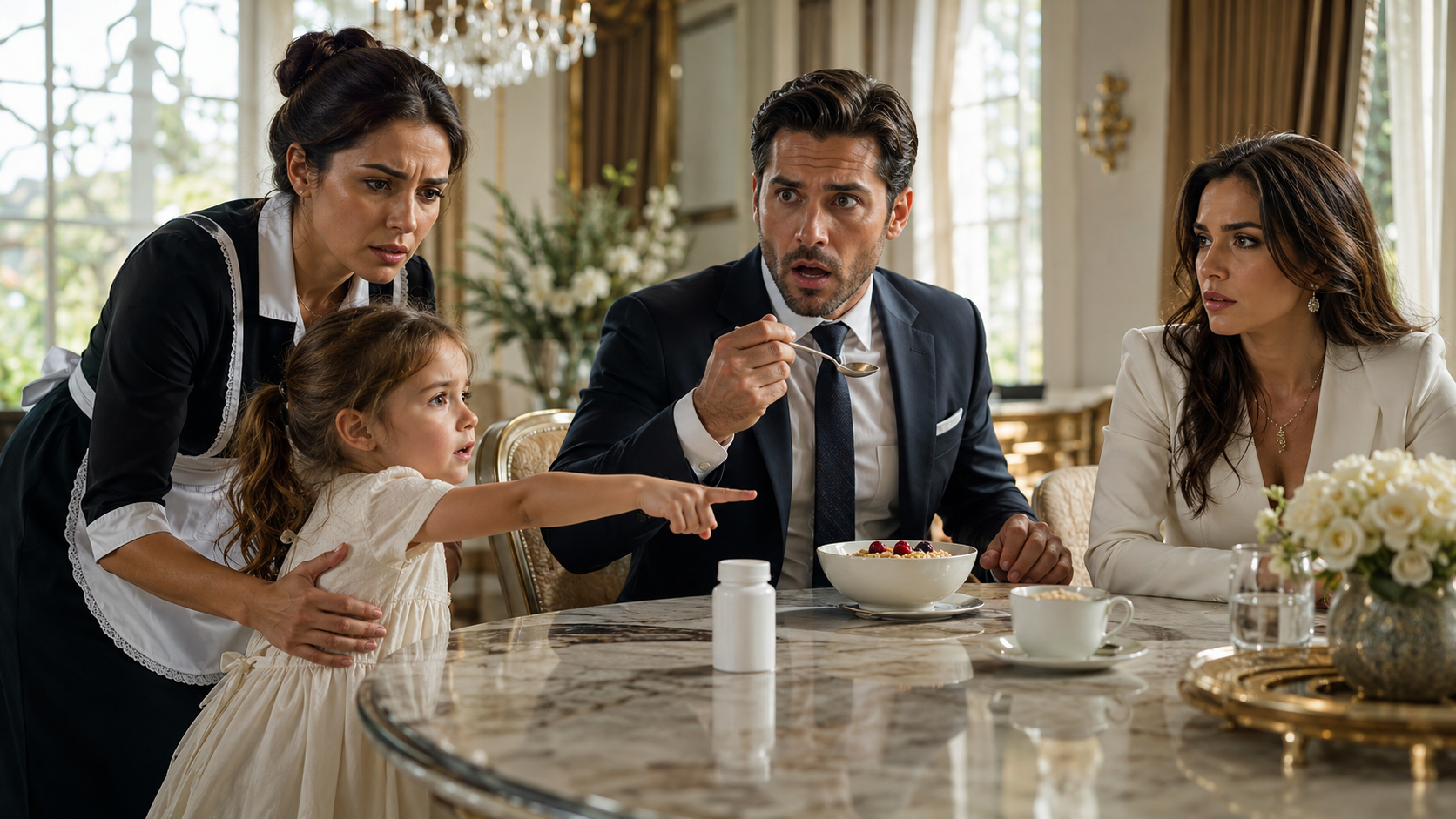
The scream came before the silver spoon touched the porcelain bowl.
“Don’t eat that!”
Every face at the breakfast table turned.
Adrian Blackwell froze with his hand halfway to his mouth. The spoon trembled slightly between his fingers, bright with cream and honey from the bowl of morning oats his fiancée had placed in front of him only seconds earlier.
Across the table, Vivienne Cross lowered her coffee cup so slowly that the movement looked rehearsed. Her diamond engagement ring caught a blade of sunlight and flashed like something sharp.
“What did you say, Ava?” Adrian asked.
His voice was calm, but the room was not.
The kitchen in Blackwell House had always felt too large for ordinary mornings. Marble floors, high windows, polished brass, servants moving quietly along the walls. But now even the air seemed to stop moving.
Ava, five years old, stood near the doorway in pink socks, clutching a stuffed rabbit by one ear. Her dark curls were messy from sleep. Her eyes were huge.
“She put something in it,” the child said, pointing straight at Vivienne. “I saw her.”
Lena Ortiz felt her blood turn cold.
She had only stepped out of the room for a minute to answer the delivery entrance. One minute. She had left her daughter with crayons at the little breakfast nook near the pantry, close enough to watch, far enough to stay out of the way.
Now Ava was staring at the woman everyone in the house called the future Mrs. Blackwell.
Vivienne gave a small, delicate laugh.
“Adrian,” she said, tilting her head with practiced softness, “please. She is a child. A dramatic child.”
Ava shook her head hard.
“I am not dramatic. I saw the tiny bottle. She opened it and poured it in the white jar. Then she stirred it. Then she smiled like this.”
The little girl pulled her mouth into a strange, tight smile.
Nobody laughed.
Adrian lowered the spoon and set it beside the bowl with almost frightening care.
“Vivienne,” he said, “sit down.”
Her smile vanished.
“I am already sitting.”
“Then stay seated.”
The command changed the room.
Lena had worked in Adrian Blackwell’s house for three years. She had seen him gentle with old employees, ruthless with dishonest contractors, generous with charities, distant with guests who loved his money more than his company. She had never seen him like this.
He was not angry.
That made it worse.
He looked like a man standing at the edge of a cliff, realizing the ground beneath him had been cut away by someone he trusted.
Vivienne’s eyes narrowed.
“You cannot possibly be taking this seriously.”
Adrian picked up his phone.
“I need Dr. Rowan at the house immediately,” he said when the call connected. “Bring a full toxicology kit. Test food, drink, supplements—everything on the table. Yes, now.”
Vivienne stood so quickly her chair scraped the floor.
“This is humiliating.”
Adrian looked at her.
“Then sit down and be humiliated quietly.”
Lena drew Ava against her side. The child’s tiny fingers twisted into her apron.
“Mommy,” Ava whispered, “is he mad at me?”
Adrian heard her. His expression softened at once.
“No, sweetheart,” he said. “I think you may have been the bravest person in this house.”
Vivienne laughed again, but this time it broke in the middle.
“So now the maid’s daughter decides whether your fiancée is a murderer?”
The word maid landed with all the ugliness Vivienne had been hiding for months.
Lena stiffened, but she did not lower her eyes.
Adrian did not look away from Vivienne.
“Choose your next words carefully.”
Vivienne’s face flushed. For a moment, the polished woman in the silk blouse disappeared, and something bitter showed through the cracks.
“You are insane,” she whispered.
“No,” Adrian said. “For the first time in a long while, I think I may be awake.”
Dr. Helena Rowan arrived forty-one minutes later. By then, the breakfast had become evidence.
The cream jar remained untouched. The coffee cooled. The oats thickened in their bowl. The house staff whispered behind closed doors, and the security guards stood at the kitchen exits with expressions carved from stone.
Vivienne tried tears first.
She pressed trembling fingers to her throat and said she could not believe Adrian would let a servant and a child destroy her reputation. When that did not work, she tried outrage. Then silence. Then wounded tenderness.
“Our wedding is in six weeks,” she said softly. “Do you understand what you are doing to us?”
Adrian did not answer.
Dr. Rowan moved through the room with clinical precision. She tested the coffee. She tested the oats. She tested the little glass jar of cream powder Vivienne had insisted Adrian use every morning because, as she often said, successful men had to protect their health.
The first two tests showed nothing.
Vivienne exhaled loudly.
“You see?”
Dr. Rowan did not respond. She opened the white jar.
Ava buried her face against Lena’s dress.
“That one,” the child whispered.
The doctor dipped a thin test strip into the powder, waited, then repeated the process with another vial.
Her face changed.
It was a small change, almost invisible to anyone who did not understand fear. But Adrian understood it. Lena understood it too.
Vivienne stopped breathing.
Dr. Rowan looked at Adrian.
“We need to speak privately.”
“No,” Adrian said. “Say it here.”
The doctor hesitated.
“Adrian—”
“Here.”
Dr. Rowan set the test kit down.
“There appears to be a cardiac-reactive compound mixed into the supplement powder. I cannot give a full laboratory confirmation from a field test, but the initial reaction is consistent with a substance that could trigger severe arrhythmia, especially in someone taking the medication you take.”
Lena’s hand flew to her mouth.
Vivienne went pale.
Adrian turned to his fiancée.
“Why?”
It was one word. No shouting. No accusation dressed as drama.
Just a man asking why the woman who wore his ring had planned his funeral over breakfast.
Vivienne opened her mouth, but for the first time since Lena had known her, nothing beautiful came out.
The police arrived without sirens.
By sunset, the world knew enough to be hungry.
Billionaire investor Adrian Blackwell’s fiancée had been arrested after an alleged poisoning attempt uncovered by a five-year-old witness. Cameras lined the gates of Blackwell House. Reporters shouted questions through the iron bars. Former friends gave careful statements about being “shocked” and “heartbroken.” Social media built its own version of the crime before the detectives finished collecting evidence.
But the public did not know the worst of it.
They did not know Vivienne Cross had been broke for nearly two years.
They did not know her family’s shipping fortune had collapsed under lawsuits, secret loans, and desperate refinancing deals hidden behind gala invitations and designer gowns.
They did not know she had convinced Adrian to update his estate documents ninety days before the wedding.
They did not know she had smiled through cake tastings while calculating what his death would be worth.
And they did not know she had help.
That truth surfaced two months later.
Adrian was alone in his office when his attorney called.
“Are you sitting down?”
Adrian closed his eyes.
“I hate that question now.”
“Adrian, listen carefully. The compound has been traced through a private medical supplier connected to Sterling Vane.”
The silence that followed seemed to swallow the room.
Sterling Vane was not a stranger.
He was Adrian’s mentor.
The man who had funded Adrian’s first project when every bank in New York had laughed him out of the room. The man who had toasted him at board dinners. The man who had called him son in public and in private.
“The supplier is tied to Sterling?” Adrian asked.
“Yes.”
“That is impossible.”
“I wish it were.”
But impossible things were still real when paper, money, and phone records proved them.
Sterling had been stealing from one of Adrian’s investment funds for years. Adrian had noticed irregularities but had not yet confronted him. He had planned to wait until after the wedding, because despite everything he had survived in business, part of him still believed family deserved mercy.
Sterling had mistaken mercy for weakness.
Vivienne needed Adrian’s fortune.
Sterling needed Adrian’s silence.
Together they built a murder and dressed it as care.
The trial lasted eight months.
Vivienne cried on the stand. Sterling denied everything with the calm dignity of a man who had spent a lifetime convincing rooms to believe him. Lawyers argued. Experts testified. Financial records unfolded like maps of greed.
But the sentence that stayed with the jury came from a child.
“She poured the bad drops into the white powder.”
Ava said it gently, with a counselor beside her and Lena holding her hand. She did not embellish. She did not perform. She simply told the truth.
The truth was enough.
Vivienne was sentenced to twenty-seven years.
Sterling received thirty-two.
Adrian did not attend the sentencing.
He stayed home.
That morning, Lena found him in the kitchen long after breakfast had gone cold. He stood near the same table, facing the chair where Vivienne used to sit.
“I should have known,” he said.
Lena set a cup of coffee beside him.
“You trusted someone you loved.”
“She almost killed me.”
“No,” Lena said quietly. “She almost killed you. Your trust did not commit the crime.”
Adrian turned toward her.
There were deep shadows beneath his eyes. For months he had moved through the house like a man who had survived a fire but could still smell smoke.
“You and Ava were the only honest things under this roof,” he said.
Lena looked away.
“We were employees.”
“You were more than that.”
The words remained between them, dangerous because they were true.
For three years, Lena had cleaned his house, managed his kitchen, remembered his appointments when he forgot them, made sure he ate when board meetings devoured whole days, and raised her daughter in the small apartment over the carriage house because rent in the city had become impossible after her husband died.
She had told herself distance was protection.
He was Adrian Blackwell.
She was Lena Ortiz.
He owned buildings that touched the clouds.
She counted grocery money on Sunday nights.
But pain makes certain lies harder to keep.
After the trial, Adrian sold Blackwell House.
People said he was running from scandal. They were wrong. He was leaving a place that had become too full of ghosts.
He bought a smaller home outside the city, built of stone and cedar, with old trees leaning over the driveway and a kitchen that filled with golden light each morning.
Lena remained as his house manager at first.
That was what they called it.
Ava called it something else.
One Saturday morning, while sitting at the counter eating blueberry pancakes, she looked at Adrian over her orange juice and said, “Are you going to marry my mommy?”
Lena dropped a pan.
Adrian coughed so hard he nearly spilled his coffee.
“Ava Sofia Ortiz,” Lena said, horrified.
Ava blinked.
“What? I’m just asking. He looks at you like you are the last cookie.”
Adrian laughed.
It was the first real laugh Lena had heard from him since the morning of the poisoning.
Then he looked at her.
She looked back.
For a moment, nobody moved.
Something that had been quietly waiting in corners finally stepped into the light.
Their love did not begin with fireworks.
It began with small things.
Coffee waiting before dawn.
A coat placed over Lena’s shoulders when she fell asleep beside Ava on the couch.
Adrian learning how to braid hair from online videos and doing it badly enough that Ava declared him “artistically hopeless.”
Lena noticing when his hands shook after a nightmare and sitting beside him without asking questions he was not ready to answer.
Three weeks after Ava’s pancake interrogation, Adrian asked Lena to dinner.
She said no.
Then she cried in the laundry room.
The next morning, she found him in the garden.
“I was afraid,” she said.
“So was I,” he answered.
Their first dinner was not glamorous. No private chef. No rooftop. No photographers. Just a small restaurant with candles in cloudy glass jars, where Adrian spent fifteen minutes trying to admit he was nervous.
Lena smiled.
“You negotiate billion-dollar deals.”
“Yes,” he said. “Those are simpler.”
Two years after the breakfast that nearly ended his life, Adrian married Lena beneath the old maple tree behind their home.
There were no society cameras. No politicians. No polished strangers pretending affection for influence.
There were thirty-four guests, a crooked flower arch, Ava in a yellow dress, and a golden retriever named Biscuit who escaped twice before the vows.
Halfway down the aisle, Ava turned to the guests and announced, “Just so everyone knows, I saved him first.”
Everyone laughed.
Adrian cried.
During his vows, he took Lena’s hands and said, “I spent my life building higher walls because I thought safety meant no one could reach me. Then I met you and learned that safety is not distance. Safety is being known. You saw me without the name, without the money, without the armor. You loved the man who was still afraid. That love gave me back a life I did not know how to ask for.”
Then he knelt in front of Ava.
The child’s eyes widened.
From his pocket, Adrian took a small velvet box. Inside was not a ring. It was a necklace with a tiny silver key.
“Ava,” he said, his voice breaking, “you told the truth when grown people tried to hide behind lies. You saved my life once. But after that, you gave me something even greater. You gave me a home. If you want, I would be honored to be your father.”
Ava stared at him.
“Can I still call you Mr. Adrian when you annoy me?”
He laughed through tears.
“Always.”
“And can Biscuit sleep on my bed?”
Lena covered her face.
Adrian glanced at his new wife, then nodded solemnly.
“Yes.”
Ava threw her arms around his neck.
“Okay, Dad.”
Six months later, the adoption papers became official.
Years after that, people still asked Adrian Blackwell what changed him most. They expected him to speak about betrayal, prison, money, survival, or power.
He never did.
He always told them about a little girl in pink socks with a stuffed rabbit in her hand.
A child small enough to be dismissed.
Brave enough to be believed.
And honest enough to stop a murder before it reached a man’s mouth.
Because sometimes truth does not enter politely.
Sometimes it does not wait for permission.
Sometimes it stands in a doorway, points at evil, and screams.
“Don’t eat that.”
And in that one terrible, beautiful moment, everything false begins to collapse.
So everything real can finally begin.

