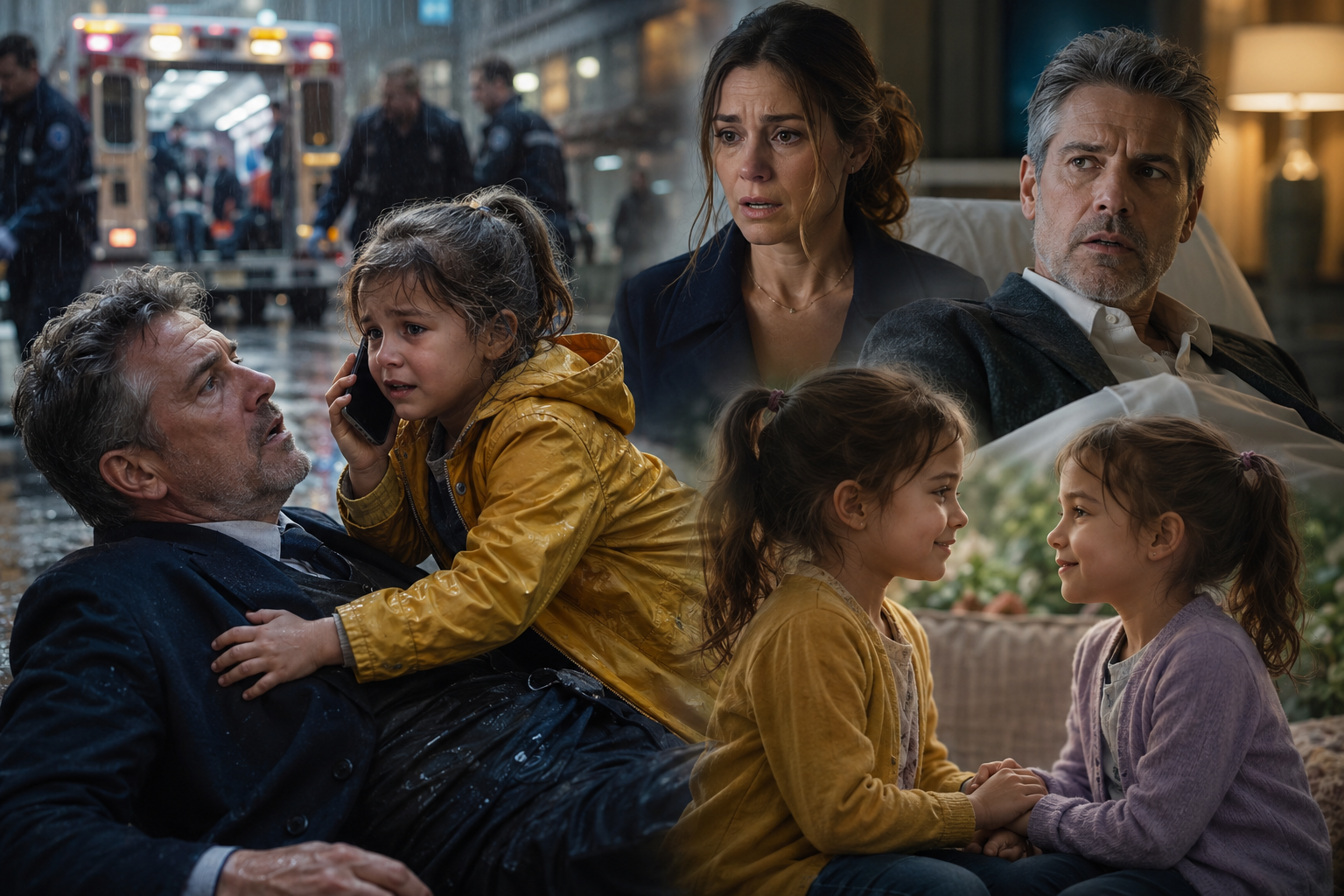
The Little Girl Who Dialed 911 for a Dying Billionaire

The first thing Cassian Vale remembered was the rain.

Not the pain in his chest. Not the crowd gathering around him. Not the glass roof of the old harbor market blurring above his face like a cracked aquarium. Only the rain, hard and cold, beating against the windows while the world around him folded into gray.

Then came a child’s voice.

Small. Clear. Shaking, but determined.

“Don’t close your eyes, mister. My mom says if people close their eyes too long, you have to keep talking to them.”

Cassian tried to answer, but his breath came in broken pieces. His right hand twitched against the wet pavement. His cane had rolled away. His body, which had carried him through boardrooms, private airports, hostile takeovers, and decades of men twice his size trying to destroy him, suddenly felt like something borrowed and failing.

The little girl leaned over him. She had dark curls stuck to her cheeks from the rain and a yellow coat too bright for such a gloomy afternoon. In one hand she held a stuffed rabbit with one button eye. In the other, she clutched Cassian’s phone.

“I called 911,” she said, as if reporting to a teacher. “They said help is coming. I told them you’re breathing weird.”

Somewhere behind her, people were shouting.

“Give him space!”

“Does anyone know CPR?”

“Is that Cassian Vale?”

Cassian heard his own name ripple through the crowd like a bad secret.

The little girl ignored them. She knelt beside him, her small knees pressing into a puddle.

“What’s your name?” she asked.

Cassian swallowed against the iron taste in his mouth.

“Cassian,” he managed.

“That’s a serious name.”

He almost smiled. Almost.

“What’s yours?”

“Juno,” she said. “But my real name is Juniper. Nobody calls me that unless I’m in trouble.”

“Are you in trouble now?”

“No,” she said firmly. “You are.”

A siren cried in the distance.

Cassian’s vision narrowed until the girl’s face became the only sharp thing left in the world. Her eyes were gray-green. Not just gray, not just green. Storm-colored. Familiar in a way that made no sense.

For one impossible second, he thought of Lyra.

Lyra Hart at twenty-five, standing barefoot in the kitchen of his first apartment, laughing because he had burned toast so badly the smoke alarm gave up and died.

Lyra Hart in the rain outside the university library, telling him that money made men lazy when it came to courage.

Lyra Hart disappearing from his life without one last call, one last explanation, one last chance.

The child squeezed his hand.

“Cassian,” she said, serious as a judge, “the ambulance is here.”

Then everything went white.

When Cassian opened his eyes again, the world smelled of disinfectant, plastic tubes, and expensive flowers.

He was in a private hospital room high above the city, connected to machines that made soft, accusing sounds. His chest ached. His throat burned. A nurse adjusted a line in his arm and told him he had suffered a major cardiac event in a very calm voice, as if his heart had simply missed an appointment.

His assistant, Corbin, stood near the window with a tablet against his chest.

“You are not allowed to die,” Corbin said. “You have three meetings Monday.”

Cassian closed his eyes.

“Fire everyone who scheduled them.”

“I already canceled them.”

“Then rehire them and fire them again.”

Corbin smiled, but it didn’t reach his eyes.

“You were lucky,” he said.

Cassian turned his head slowly. “The girl.”

“The child who called emergency services?”

“Juno.”

Corbin’s expression shifted.

“She’s become something of a local hero. Someone filmed part of it. The clip is everywhere.”

Cassian hated being filmed. He hated headlines. He hated public gratitude, public pity, public anything. But he held out his hand.

“Show me.”

Corbin hesitated.

“Now.”

The video was shaky. Rain streaked across the lens. A crowd had formed in a half circle. Cassian saw himself on the ground, pale and ruined, nothing like the man magazine covers insisted on calling untouchable.

And there she was.

The girl in the yellow coat, one hand pressed to his shoulder, the other gripping the phone.

“My name is Juno Hart,” she said into the device. “I’m seven. I’m at Harbor Market near the flower stand. The man is old but not too old, and I think his heart is mad.”

A paramedic’s voice from off-camera said, “Good job, sweetheart. Keep talking to him.”

Juno bent close to Cassian.

“You hear that? They said I’m doing good. You have to do good too.”

The crowd laughed nervously. Even in the video, Cassian could hear the fear underneath.

Then the camera swung toward a woman pushing through the crowd.

“Juno!”

The woman wore a navy raincoat, her hair twisted at the back of her neck, her face pale with panic.

Cassian stopped breathing.

The heart monitor complained sharply.

Corbin stepped forward. “Sir?”

Cassian stared at the screen.

The woman grabbed Juno, checked her face, her hands, her knees, then looked down at Cassian.

For half a second, the camera caught her fully.

Lyra Hart.

Older. Tired. Still beautiful in the way that had once made Cassian forget the rest of the room existed.

Alive.

Not vanished into another man’s life overseas, as he had been told.

Not unreachable.

Not cruel.

Standing in the rain with a child who had Lyra’s mouth and Cassian’s eyes.

Cassian’s fingers tightened around the tablet.

“Find them,” he said.

Corbin went still.

“Sir?”

“Lyra Hart. The little girl. Find them.”

“Do you know her?”

Cassian did not answer at first. He watched the clip again, and again, until Juno’s face filled the screen.

“I knew her mother,” he said at last. “Before my life became a machine.”

Two days later, Lyra Hart received a white envelope delivered by a man in a black car who looked uncomfortable on her small front porch.

The letter inside was formal, careful, and expensive.

Mr. Cassian Vale wished to thank Miss Juniper Hart in person for her extraordinary courage. Transportation would be provided. The meeting would take place only with Ms. Hart’s consent. There would be no press, no photography, and no obligation.

Lyra read it once in the kitchen.

Then again by the sink.

Then a third time while Juno sat at the table, feeding cereal to the stuffed rabbit.

“Is the man okay?” Juno asked.

Lyra looked at her daughter.

“He’s alive.”

“Good. He promised me he’d try.”

“He promised you?”

Juno nodded. “With his eyes.”

Lyra folded the letter and unfolded it again.

She had spent eight years teaching herself not to think about Cassian Vale. She had become skilled at it. She had built a small life out of work, bus schedules, school forms, grocery lists, bedtime stories, and quiet grief. She had learned that survival was not a grand act. It was washing dishes while your heart hurt. It was smiling at your child when the past knocked on the door.

And now the past had sent a car.

“Do we have to go?” Juno asked.

“No.”

“Should we?”

Lyra looked toward the rain tapping the window.

Cassian Vale had once been the man she loved so fiercely she had believed love could outargue families, money, ambition, and fear.

Then he had married Seraphina Rowe.

And Lyra had learned that love did not always lose loudly. Sometimes it disappeared through unanswered calls, returned letters, and silence so complete it began to look like choice.

“I don’t know,” Lyra whispered.

Juno slid from her chair and came to stand beside her.

“Mommy, if somebody says thank you, you’re supposed to say you’re welcome.”

Lyra laughed once, softly and painfully.

“You make things sound very simple.”

“They are simple,” Juno said. “Grown-ups just add furniture.”

The next morning, Lyra dressed Juno in her best blue dress and brushed her curls until Juno complained that beauty was exhausting. A car took them across the city to a hospital wing where the floors shone like mirrors and every door seemed to open before anyone touched it.

Cassian was sitting by the window when they entered.

He looked thinner than Lyra remembered. The years had sharpened him. Silver threaded his dark hair. His face carried the controlled calm of a man used to hiding damage behind excellent tailoring.

But when he saw Lyra, control failed him.

For a moment, neither of them spoke.

Juno looked from one adult to the other.

“Do you know my mom?”

Cassian’s gaze moved to the child.

“I did,” he said. “A long time ago.”

“Was she nice?”

Cassian’s mouth trembled.

“She was impossible.”

Juno nodded seriously. “That sounds right.”

Lyra closed her eyes for one second.

Cassian laughed, and the sound broke something in the room.

Juno walked to the bed and held up her stuffed rabbit.

“This is Captain Bun. He was there when you almost died.”

“I owe Captain Bun my gratitude.”

“He accepts carrots.”

“I’ll remember that.”

Juno studied him. “You look less gray now.”

“Thank you.”

“That was a compliment.”

“I took it as one.”

Lyra stood near the door, her hands folded so tightly her knuckles hurt.

Cassian looked at her.

“Lyra.”

“Cassian.”

Eight years stood between their names.

Juno climbed into the chair beside the bed without asking. She told Cassian about the ambulance, the paramedic named Luis, the lady who cried even though she didn’t know him, and the fact that adults were surprisingly bad at remembering the number 911 when scared.

Cassian listened as if she were giving testimony that might save his life again.

After a while, Juno looked around the room.

“Do you have kids?”

Lyra’s stomach tightened.

Cassian paused.

“Yes.”

Juno brightened. “A girl or a boy?”

“A girl.”

“What’s her name?”

“Maren.”

“Is she seven?”

Cassian’s eyes flickered.

“Yes.”

Juno smiled. “I’m seven.”

“I know.”

“Maybe we can be friends.”

Lyra felt the floor move beneath her.

Cassian’s gaze found hers, and she saw it then. Not suspicion. Not yet. Something worse.

Recognition.

That evening, Cassian returned home against medical advice because he had built an empire by treating advice as a decorative object.

The Vale house sat above the bay, all stone, glass, and controlled beauty. Seraphina Vale was waiting in the drawing room with a crystal glass untouched beside her. She wore cream silk and diamonds small enough to suggest taste rather than hunger. Her blond hair was smooth. Her posture was perfect.

She had always been perfect.

That was what had frightened Cassian most about her.

“You should be in the hospital,” she said.

“I met the child who saved me.”

Seraphina’s eyes did not move.

“How sweet.”

“Her name is Juno Hart.”

A tiny silence entered the room.

Cassian heard it.

He had spent years negotiating with men who lied for sport. He knew the sound of a truth being buried.

“Her mother is Lyra.”

Seraphina lifted the glass, then seemed to remember she had not drunk from it.

“I see.”

Cassian watched her fingers.

“She looks like Maren.”

“Children look alike at that age.”

“No.”

Seraphina’s mouth hardened.

“You nearly died three days ago. You are emotional.”

“I am many things. Emotional is not usually one of them.”

“That is debatable.”

“I want a DNA test.”

The glass struck the table too sharply.

“For what possible reason?”

“Because I looked at that child and saw my daughter.”

“You have a daughter.”

“I may have two.”

Seraphina stood.

“This is obscene.”

“What is?”

“Dragging some woman from your past into our family because you had a medical scare and saw ghosts.”

Cassian rose slowly. Pain crossed his face, but he remained standing.

“I saw fear in your face when I said Lyra’s name.”

“You saw anger.”

“No,” he said quietly. “I know the difference.”

The next day, Cassian called Lyra.

She nearly did not answer.

When she did, neither of them wasted time pretending.

“Was Juno born in March?” he asked.

Lyra sat down on the edge of her bed.

“How do you know that?”

“Was she born at St. Aurelia Hospital?”

Her silence was answer enough.

Cassian closed his eyes.

“Lyra, I need to ask you something, and I need you to understand I would not ask if it didn’t matter.”

“What?”

“Was there another baby?”

The room disappeared.

Lyra was back under white lights, exhausted, terrified, hearing a doctor say words that no mother should hear while her body still searched for two cries.

One survived.

One did not.

A daughter placed in her arms.

Another taken away before she could say goodbye.

She had mourned a child whose face she had never touched.

“Lyra?”

Her voice came out small.

“They told me Juno’s twin died.”

Cassian did not speak.

Lyra gripped the phone.

“Cassian, why are you asking me this?”

“Because Seraphina and I have a daughter named Maren. She is seven. She was brought home from St. Aurelia two days after Juno was born.”

Lyra stopped breathing.

“No.”

“I don’t know the truth yet.”

“No.”

“But I think someone does.”

The DNA test took four days.

To Lyra, it felt like four years.

She moved through them like a woman underwater. She packed Juno’s lunches. She answered client emails at the small design firm where she worked. She read bedtime stories and forgot every word. She watched her daughter sleep and tried not to imagine another child somewhere in the city with the same face, the same hands, the same laugh waiting in a life built from theft.

Cassian waited differently.

He hired investigators. He obtained sealed hospital records through legal channels that bent under the weight of his name. He spoke to doctors who suddenly remembered nothing. He found a retired night nurse in a coastal town who hung up the moment he said St. Aurelia.

Then the report arrived.

Cassian and Lyra opened it together in his attorney’s office.

Neither sat down.

The attorney read the conclusion aloud, though the words were already there in black ink.

Juniper Hart and Maren Vale were monozygotic twins.

Identical.

The same mother.

The same father.

Separated at birth.

Lyra made no sound. She simply folded forward as if a cord had been cut inside her.

Cassian caught her before she hit the floor.

For a moment she let him hold her. Not because she forgave him. Not because the past had healed. But because grief had weight, and his arms were the nearest place that did not feel like falling.

“She was alive,” Lyra whispered.

Cassian’s face changed in a way no boardroom opponent had ever seen.

“Yes.”

“They told me she died.”

“I know.”

“My baby was alive.”

“I know.”

Lyra pulled away from him, shaking.

“Do not say you know. You do not know what that sentence did to me.”

Cassian accepted the blow because it was deserved by the world, if not entirely by him.

“No,” he said. “I don’t.”

Seraphina confessed three nights later.

Not because of guilt.

Because Cassian placed the DNA report, the hospital transfer logs, and a recorded statement from the retired nurse on the dining table between them.

Maren was upstairs practicing piano. The same six notes repeated again and again, innocent and uneven.

Seraphina looked at the papers for a long time.

“You were going to leave me,” she said finally.

Cassian stared at her.

“What did you do?”

“You were going to leave me for her.”

“What did you do?”

Seraphina’s eyes filled with tears that seemed more angry than sad.

“My father had arranged everything. The merger. The marriage. The board votes. You think I had choices?”

“Yes,” Cassian said. “You had many. You chose the worst one.”

“She was alone,” Seraphina said. “Lyra. No family. No power. No one to question the doctors.”

Cassian’s voice dropped.

“So you took her child.”

“I saved my marriage.”

“You stole a baby.”

“I loved Maren.”

“That does not clean the blood off the lie.”

Seraphina flinched.

“The nurse said one twin was weak. She said no one would ask questions if records were changed. Your mother knew people at the hospital. She said scandals disappear when enough important families agree they never existed.”

Cassian went very still.

“My mother knew?”

Seraphina looked away.

That was enough.

The scandal erupted like a storm over dry ground.

Police came. Lawyers came. Reporters came. St. Aurelia Hospital issued statements full of sorrow and responsibility without admitting enough of either. The retired nurse was arrested. A former administrator disappeared for two days and returned with an attorney. Cassian’s mother denied everything until old bank transfers surfaced with her signature buried beneath years of dust and influence.

Seraphina was charged.

Cassian filed for divorce before the first hearing.

But none of that mattered to Lyra as much as the question sleeping in a pink bedroom above the bay.

How do you return a stolen child without stealing her again?

Maren Vale had not asked to be a secret.

She had not chosen the woman who raised her. She had not chosen the lie that wrapped around her like a second skin. She was seven years old. She liked strawberry jam, hated thunder, collected sea glass, and believed Cassian hung the moon because he always checked under her bed for monsters.

Lyra hated Seraphina.

She hated the nurse.

She hated Cassian’s mother with a quiet precision that frightened even herself.

But she could not hate Maren.

The first meeting was arranged in a private garden behind a children’s therapy center. No cameras. No reporters. No dramatic reunion staged for adults hungry for meaning.

Juno wore her yellow coat, though the day was clear.

Maren wore a lavender sweater and held Cassian’s hand so tightly his fingers had gone pale.

Lyra stood with Juno near a fountain. Cassian approached with Maren. Both adults looked wrecked by hope.

The girls saw each other.

The world seemed to pause.

Juno tilted her head.

Maren did the same.

Juno whispered, “You have my face.”

Maren whispered, “You have mine.”

Juno took one step forward.

Maren took one step too.

“Do you like rabbits?” Juno asked.

“I like horses,” Maren said.

“That’s okay. Nobody’s perfect.”

Maren smiled.

It was Juno’s smile.

Lyra covered her mouth.

Cassian looked away because his eyes had filled.

The girls sat beside the fountain. At first, they spoke carefully, like strangers meeting in a dream. Then Juno showed Maren Captain Bun. Maren showed Juno a smooth green piece of sea glass. Within twenty minutes, they were inventing a kingdom where rabbits rode horses and all villains had to eat broccoli forever.

Lyra watched the daughter she had raised and the daughter she had mourned sit shoulder to shoulder in the sunlight.

She had imagined this moment as thunder.

Instead, it came gently.

That made it hurt more.

The trial lasted months.

Seraphina’s attorneys argued desperation. Influence. Pressure. A powerful family’s machinery. They tried to make her seem less like a woman who had stolen a child and more like a woman swallowed by expectation.

Lyra testified for eleven minutes.

She did not cry.

She told the court about waking in a hospital bed and asking for her babies.

She told them about being handed one daughter and a death certificate for another.

She told them about birthdays where she bought one cupcake and lit two candles in secret.

She told them about Juno asking, at age five, why her mother sometimes looked sad on March mornings.

Then she looked at Seraphina.

“You did not only take my daughter,” Lyra said. “You made grief live in my house and call it truth.”

No one moved.

Cassian testified the next day. He spoke about forged messages, intercepted calls, family pressure, and the cruel architecture of a lie that had separated two children before they knew how to breathe the same air.

When asked whether he blamed Seraphina alone, he said no.

“I blame everyone who believed money could edit a mother’s reality.”

Seraphina was convicted.

The nurse was convicted.

Cassian’s mother died before her trial concluded, leaving behind a handwritten letter Cassian never showed Lyra because it contained apology without accountability, and he had learned the difference.

Custody was not simple.

Nothing good ever is after something evil has been done carefully.

Maren wanted Cassian.

Juno wanted Maren.

Lyra wanted both daughters under her roof and knew that wanting was not the same as healing.

So the adults did what the children deserved.

They built a bridge.

Maren spent afternoons with Lyra first, then weekends. Juno spent time at Cassian’s house, where she declared the kitchen too clean and taught the chef how to make pancakes shaped like animals. The girls began therapy together. They learned the truth in pieces small enough to hold.

“You were born together,” Lyra told them.

“Someone made a very wrong choice,” Cassian said.

“You were always sisters,” Lyra added.

“Even when you didn’t know,” Cassian said.

Maren asked if loving Seraphina made her bad.

Lyra knelt in front of her.

“No, sweetheart. Children are allowed to love the people who cared for them. Adults are responsible for adult choices. Not you.”

Maren cried then, and Lyra held her for the first time as a mother holds a child who has finally stopped being brave.

Cassian stood in the hallway and pressed one hand against the wall.

He did not ask Lyra for forgiveness.

At first, that was the only decent thing about him.

Then he did more.

He came to school meetings and sat in chairs too small for him. He learned which teacher made Juno anxious and which songs helped Maren sleep after nightmares. He stopped letting assistants buy birthday gifts and spent an entire Saturday choosing two music boxes because the girls had different tastes and deserved to be known separately, not treated as one miracle split in half.

He apologized when apology was useful.

He stayed silent when silence was kinder.

He never once said, “I lost years too,” though he had.

Lyra noticed.

She did not want to.

But she did.

One autumn afternoon, nearly two years after the day at Harbor Market, Lyra stood again beneath the glass roof where the rain had once hammered down and a child’s phone call had cracked open the truth.

The market was warm with cinnamon, coffee, flowers, and voices.

Juno and Maren ran ahead, both in yellow coats because they had insisted on matching, though Juno’s had a rabbit pin and Maren’s had a horse pin. Captain Bun rode in Maren’s backpack today. The sea glass hung on a cord around Juno’s neck.

Cassian walked beside Lyra with two paper cups of coffee.

“You still hate this place?” he asked.

Lyra watched the flower stand where he had fallen.

“No.”

“Do you love it?”

“No.”

“That seems fair.”

She accepted the coffee.

For a while, they watched the girls argue over which pastry was largest. Maren accused Juno of using geometry unfairly. Juno said geometry was legal in pastry matters.

Cassian smiled.

Lyra looked at him.

“You’re different now.”

“I had poor material to work with before.”

“That sounds almost humble.”

“I’m practicing.”

She laughed before she could stop herself.

The sound surprised them both.

Cassian’s expression softened, but he did not reach for her. He had learned not to take one open door as permission to enter every room.

Lyra respected that.

Across the market, Juno turned.

“Mom! Cassian! Hurry up!”

Maren cupped her hands around her mouth.

“We’re choosing for everybody, and Juno makes terrible choices!”

“I make brave choices!” Juno shouted.

“You chose raisin bread yesterday!”

“That was an accident!”

Lyra shook her head.

Cassian looked at her.

“She saved my life,” he said quietly.

Lyra watched Juno grab Maren’s hand and pull her toward the bakery.

“She saved more than that.”

Cassian nodded.

Years earlier, Lyra had believed fate was a thief.

It had taken love. It had taken trust. It had taken a daughter and left a grave where a cradle should have been.

But fate was not one thing.

Sometimes it was cruel.

Sometimes it was late.

Sometimes it arrived wearing a yellow coat, carrying a stuffed rabbit, and remembering three numbers when every adult froze.

Juno never understood why people called her a hero.

When reporters asked, years later, why she had called 911 for a stranger, she shrugged.

“He wasn’t a stranger,” she said. “He was a person.”

And maybe that was the whole miracle.

Not the fortune.

Not the mansion above the bay.

Not the headlines or the courtroom or the famous name everyone suddenly pretended not to fear.

Just a little girl who saw someone falling and decided that falling people should not be left alone.

Because she called for help, a dying man lived.

Because he lived, a lie died.

Because the lie died, two sisters found each other.

And because two sisters found each other, everyone who had been broken by the truth finally learned that a family is not always restored in one grand moment.

Sometimes it is rebuilt slowly.

With two toothbrushes by the sink.

Two lunch boxes on the counter.

Two girls laughing in the next room.

And one brave child who once held a phone in the rain and refused to let a stranger close his eyes.

The Little Girl Who Dialed 911 for a Dying Billionaire
The actress from the 2000s that everyone adores. However, her life was far from easy….