The first mistake Dante Marrow made was believing that language could be a locked room.
The second was believing that a woman carrying plates through a crowded restaurant could not possibly own the key.
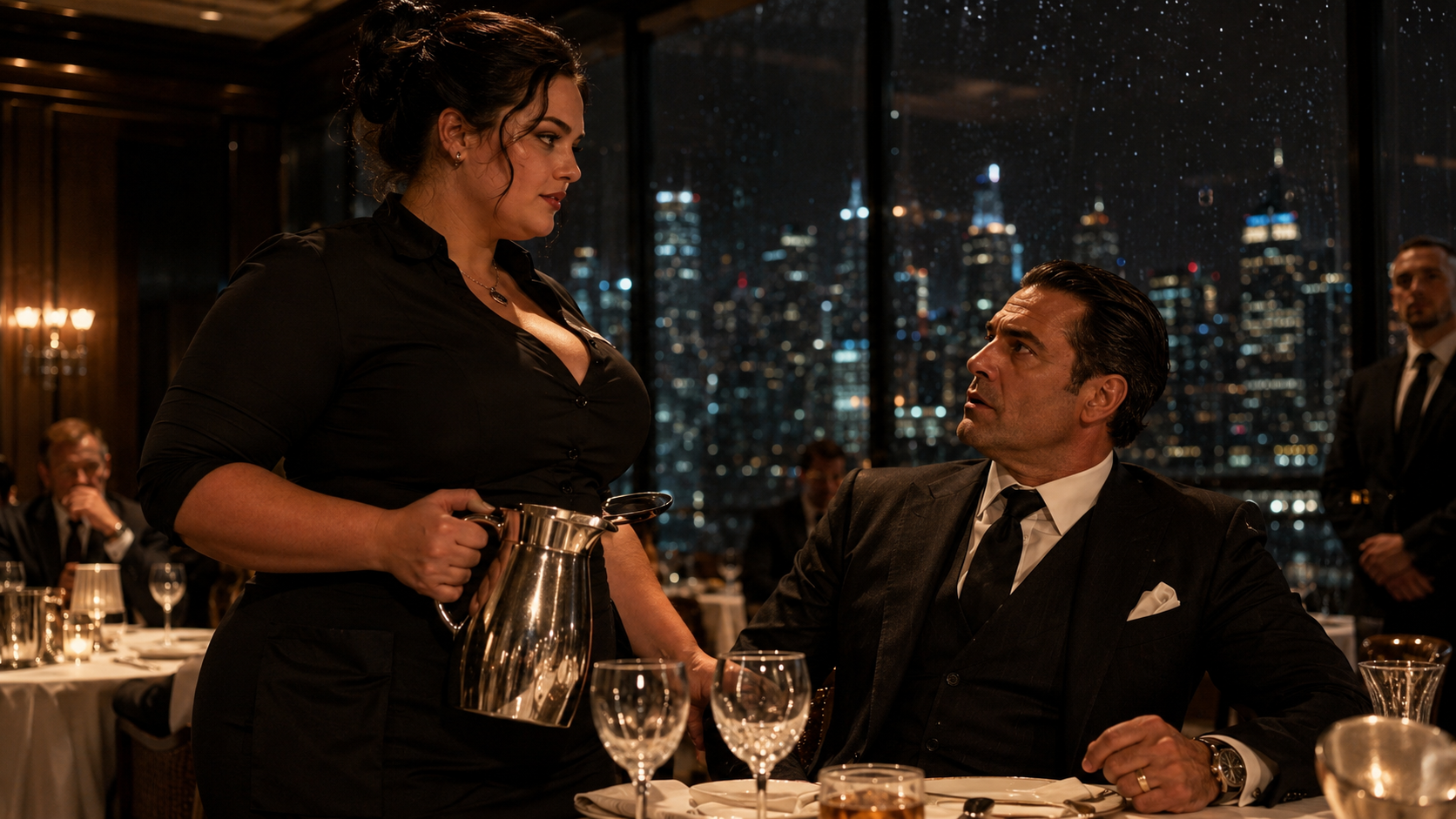
The Sapphire Room sat on the forty-second floor of a glass tower above Manhattan, shining like a jewel built for people who liked to be seen pretending they wanted privacy. Its windows looked down over the river, the bridges, the traffic, and the thousand small lives moving far below the men who ordered bottles of wine worth more than a month of rent.
Lena Ward had worked there for nine months.
Long enough to know which billionaires tipped badly.
Long enough to know which senators drank before meetings.
Long enough to know which men were dangerous because they shouted, and which were dangerous because they never needed to.
Dante Marrow belonged to the second kind.
He arrived at 9:10 on a rain-dark Thursday night with six men, one woman in a silver suit, and a silence that moved ahead of him like weather. The maître d’ went pale. The pianist changed songs without being asked. Two tables near the corner were suddenly “relocated for their comfort,” which meant wealthy people who had never been asked to move in their lives were now standing with their wineglasses and pretending not to be terrified.
Dante took the corner table.
He did not look like the rumors.
Rumors made him larger. Crueler. Almost inhuman. They said he ran half the docks, half the construction crews, and every illegal card room between Brooklyn and Newark. They said judges answered his calls, police captains accepted his envelopes, and men who betrayed him did not get funerals because there was never enough left to bury.
But the man at table seventeen looked calm. Elegant. Mid-forties. Black hair with one silver streak at the temple. A tailored charcoal suit. No jewelry except a watch with a face as dark as oil. His eyes were not wild. That made them worse.
Lena had served worse men.
That was what she told herself as she smoothed her black apron over her hips and lifted the wine bucket.
She was not thin, and she had stopped apologizing for it years ago. The restaurant uniform had been designed for narrow girls with narrow shoulders and narrow lives, but Lena wore it the way she wore everything now: fitted, clean, and without asking permission to exist. Her body had survived grief, hunger, fear, and too many small humiliations to be shamed by a stranger’s stare.
Still, when she approached Dante’s table, she felt the air change.
The woman in the silver suit looked up first. Her eyes moved quickly over Lena’s face, hands, name tag, tray. Assessing. Filing. Remembering.
Dante did not look at Lena at all.
“Good evening,” Lena said. “I’ll be taking care of you tonight.”
One of the men snorted softly.
Dante lifted two fingers without glancing up. “Water. No lemon.”
His voice was low. Smooth. The kind of voice that made refusal sound childish.
“Of course.”
She poured water around the table. When she reached Dante, one of his guards shifted his chair back without warning. The chair leg hit Lena’s ankle. Pain shot up her calf, but she steadied the pitcher before it could tip.
Only three drops landed on the white tablecloth.
Three drops too many.
The guard smirked.
Dante finally looked at her.
Not at the water.
At her.
His gaze traveled over her shoulders, her chest, her waist, her hips. Not with attraction. Not even with ordinary rudeness. With the cold amusement of a man watching an inconvenience roll into his path.
Then he turned slightly toward the woman in the silver suit and spoke in Arabic.
Not the formal Arabic of textbooks or news anchors. Not the careful language of embassies. His words carried the clipped rhythm of Beirut streets, softened by money and sharpened by contempt.
“Tell them not to send the wide one again,” he murmured. “She moves like she is carrying the whole kitchen inside her.”
The guard laughed.
The woman in the silver suit did not.
For one heartbeat, Lena’s hand tightened around the pitcher.
The restaurant kept breathing around them. Crystal chimed. Silverware whispered. The piano played something slow and expensive. Nobody at the table expected the waitress to understand. Nobody expected the plus-size woman with the water pitcher and the black apron to belong anywhere outside their assumptions.
Lena set the pitcher down carefully.
Then she answered in Arabic.
“Careful, Mr. Marrow. A man who hides insults inside another language usually has other things hidden there too.”
The table went silent.
The guard stopped laughing so suddenly his mouth remained open.
The woman in the silver suit went still.
Dante did not blink.
Lena leaned slightly closer, keeping her voice soft enough that only his table could hear.
“And if you ever speak about my body again, choose a language you are brave enough to be understood in.”
A muscle moved in Dante’s jaw.
For the first time all night, he looked at her as though she had become real.
The guard started to rise.
Dante lifted one hand.
The guard froze.
Lena switched back to English and straightened.
“I’ll give you a moment with the menu.”
Then she turned and walked away.
Her back stayed straight until she reached the service corridor.
Only then did she grab the wall.
Her ankle throbbed. Her heart slammed against her ribs. In the kitchen, steam rose from boiling pans, cooks shouted orders, and someone dropped a tray with a crash that made her flinch.
Her best friend, Nora, caught her by the elbow.
“What happened?”
Lena shook her head. “I may have just insulted Dante Marrow.”
Nora’s face emptied of color. “You may have what?”
“He insulted me in Arabic.”
“And you understood him?”
“Yes.”
“Why do you understand Arabic?”
Lena looked toward the dining room doors.
Because my mother translated refugee interviews in Queens for twenty years.
Because my father taught language at community centers until a car bomb outside a courthouse in Tripoli took his hearing in one ear and his courage in both.
Because I grew up falling asleep to Arabic, Spanish, and English mixing through the walls of our apartment.
Because language had fed us before restaurants did.
Because men like Dante Marrow always thought knowledge had to wear a suit before it became dangerous.
Instead, Lena only said, “Long story.”
Nora grabbed both her shoulders. “Make it a short story. Are we dying tonight?”
“Probably not tonight.”
“That does not comfort me.”
For the rest of the evening, Dante Marrow’s table needed nothing.
No wine recommendations.
No dessert.
No extra napkins.
No attention.
They paid in cash. The tip was five hundred dollars.
Lena did not touch it.
She left it on the table and went home in the rain.
Her apartment was on the third floor of an old brick building in Astoria, above a laundromat that smelled like detergent and hot coins. She locked the door twice, kicked off her shoes, and sat in the dark with her swollen ankle resting on a pillow.
At 12:43 a.m., her phone rang.
Unknown number.
She let it ring.
It stopped.
Then a message appeared.
You speak beautifully. We should talk.
Lena stared at the screen until it went black.
The next morning, she changed her number.
By noon, someone had sent flowers to the restaurant.
White lilies.
No card.
Nora threw them in the trash.
By Saturday, Lena had convinced herself the worst had passed.
Men like Dante Marrow did not waste time on waitresses. They had warehouses to own, witnesses to silence, politicians to feed, and enemies to bury. Her pride had made him uncomfortable for thirty seconds. His world would move on.
But on Sunday night, five minutes before closing, the elevators to The Sapphire Room opened and every conversation died.
Dante’s men entered first.
They were polite.
That made it worse.
They paid every guest’s bill. They arranged cars. They apologized for the inconvenience. They tipped the staff as if kindness could be used as a weapon when delivered by people with guns under their jackets.
Within ten minutes, the restaurant was empty.
The city glittered outside the windows.
Lena stood behind the bar with Nora gripping her wrist so tightly it hurt.
Dante Marrow sat at table seventeen.
Alone.
The woman in the silver suit stood near the elevators.
Dante looked across the room and pointed to the chair opposite him.
Lena did not move.
The woman in silver approached. “Mr. Marrow would like a conversation.”
Lena looked at her. “Does Mr. Marrow know conversations usually require consent?”
Something like respect flickered in the woman’s eyes.
“He knows many things,” she said. “Consent is not always one of them.”
Lena almost smiled despite herself.
“What’s your name?”
“Imani.”
“You work for him?”
“I survive near him.”
“That sounds exhausting.”
“It is.”
Dante’s voice cut across the room. “Miss Ward.”
Lena’s stomach dropped.
He knew her last name.
Of course he knew her last name.
She walked to the table and sat. Not because he ordered it. Because she would not tremble standing up.
Dante studied her with that same cold focus, but the mockery was gone.
“You embarrassed me,” he said.
“You embarrassed yourself.”
Imani’s mouth twitched.
Dante noticed. “You find that amusing?”
Imani looked straight ahead. “No.”
Lena folded her hands on the table. “Why am I here?”
“I need a translator.”
She laughed once. “Hire one.”
“I did. Three. One lied, one was bought, and one disappeared.”
“That is supposed to persuade me?”
“It is supposed to explain urgency.”
“I serve food.”
“You understand dialect.”
“I understand when men are cruel because they think no one can hear them.”
Dante’s eyes darkened. “You think I brought you here because of what I said?”
“I think you brought me here because I answered.”
“Yes.”
“At least you’re honest.”
“Not often.”
Lena leaned back. “Then enjoy the rare experience and keep going.”
Dante reached into his jacket.
Nora made a sound from the bar.
He withdrew an old photograph and placed it on the table.
Lena stopped breathing.
The photo showed her father twenty years younger, standing outside a courthouse beside a dark-haired man in a cheap suit. Behind them was a banner in Arabic and English. Human Rights Documentation Project. Beirut. 2004.
Her father’s smile was tired but alive.
Lena touched the edge of the photograph.
“Where did you get this?”
“The man beside him was named Elias Haddour.”
“I don’t know him.”
“You should. He died three days after this picture was taken.”
“My father said a lot of people died then.”
“Your father tried to give evidence to federal investigators after he returned to New York. The evidence vanished. So did the case.”
Lena looked up slowly.
“My father was a translator. A teacher.”
“He was also a witness.”
The restaurant felt suddenly too high above the city. Too far from the ground. Lena heard the hum of the refrigerators behind the bar, the distant rain against the windows, Nora’s frightened breathing.
“What do you want from me?”
Dante placed a small recorder on the table.
“Tomorrow night, I meet with a man named Kareem Sayegh. He believes he can speak freely in Arabic because my people only understand enough to negotiate. I need someone who hears what he does not intend me to hear.”
“Why me?”
“Because when I insulted you, you did not just understand the words. You understood the cowardice inside them.”
Lena swallowed.
“That almost sounded like an apology.”
“It was not.”
“Then try harder.”
The room held its breath.
Dante looked at her for a long moment.
Then he lowered his eyes.
“What I said was vile. It was small. It was beneath you, and it should have been beneath me.”
Lena had expected threats.
She had expected money.
She had not expected a criminal king to apologize like each word cost him blood.
It did not soften her.
It made her angrier, because it meant he knew better.
“No,” she said.
Dante’s gaze lifted.
“No?”
“No meeting. No translation. No secret jobs. Whatever you and Kareem Sayegh are doing, leave me out of it.”
She stood.
Dante said one sentence before she could turn away.
“Kareem Sayegh ordered the attack that destroyed your father’s hearing.”
The world narrowed.
Lena gripped the back of the chair.
Dante continued quietly. “Your father survived because the device was placed badly. Others did not. Sayegh has lived under different names for years. Tomorrow, he comes to New York to move money through my docks.”
Lena looked at the photograph again.
Her father had been gone for four years now. Heart failure, the doctors said. Too much stress. Too many years of pain. In his last months, he had forgotten names, dates, and sometimes his own kitchen, but he never forgot Arabic songs. He would hum them softly while Lena cut his food into small pieces and pretended not to cry.
“What happens if I help you?” she asked.
“I get what I need. You walk away.”
“And Sayegh?”
Dante’s expression became unreadable.
Lena understood.
“No,” she said. “If I help, he goes to prison. Not a river. Not a warehouse. Not an unmarked hole.”
Dante almost smiled. “You believe prison can hold men like him?”
“I believe men like you use that argument whenever law is less convenient than murder.”
Imani looked down.
Dante stared at Lena.
For a moment, the man behind the empire appeared. Not good. Not gentle. But tired. Deeply tired.
“You ask for a clean ending in a dirty world,” he said.
“No. I ask you to stop pretending dirty is the only world available.”
He stood. “Tomorrow night. Ten o’clock. Wear flat shoes.”
“I said no.”
“You said prison. I heard a condition.”
Lena hated him for being right.
The meeting happened in an abandoned ferry terminal near the river, where broken ticket windows reflected the moon and rainwater dripped steadily through the roof.
Dante sent a car. Lena almost did not get in.
Then she thought of her father in the photograph.
She got in.
Inside the car, Imani sat beside her.
“Do you trust him?” Lena asked.
“No.”
“That was fast.”
“You asked the wrong question.”
“What’s the right question?”
“Do I trust what he wants tonight?”
“And do you?”
Imani watched the wet streets slide past the window.
“Tonight, yes.”
At the terminal, Dante waited beneath a dead clock. His coat was black. His face was calm. Men stood in the shadows with hands folded, eyes moving, weapons hidden but not hidden enough.
“You came,” he said.
“I came for my father.”
“I know.”
“No, you don’t.” Lena stepped close enough that his guards shifted. “You know evidence. You know leverage. You know men’s names on paper. You do not know what it means to watch a brave man shrink inside his own body because violence stole the world from him piece by piece.”
Dante said nothing.
Good, Lena thought.
Let him carry one sentence without buying his way out of it.
Kareem Sayegh arrived with laughter.
That was what Lena noticed first.
Not the cars. Not the guards. Not the gold ring on his little finger. The laughter. Easy, warm, practiced. He entered the terminal like a favorite uncle arriving late to dinner, smiling at everyone as if affection were another form of camouflage.
He greeted Dante in English.
Then Arabic.
Then French.
A man showing knives from every sleeve.
Dante introduced Lena as an assistant.
Kareem looked at her and dismissed her in half a second.
Lena had been dismissed by experts. He was not even original.
The negotiation began.
Shipping routes. Customs schedules. Shell companies. Containers marked as medical equipment. Money moving through charities, restaurants, import licenses.
Lena translated when Dante asked.
Mostly, she listened.
Kareem’s Arabic was smooth. Too smooth. He used old phrases, polite phrases, the kind of phrases men used when they wanted to sound like fathers while arranging the sale of children, drugs, guns, anything that paid.
Then he said a name.
Not loudly.
Not dramatically.
Just a name tucked into a sentence about insurance.
Marwan.
Lena’s pulse stopped.
Her father’s name.
Dante looked at her.
He had heard the change in her breathing.
Kareem kept speaking. “Some ghosts are useful,” he said in Arabic, smiling at Dante. “They frighten the living into obedience. Marwan Ward was useful that way. His daughter may be useful too, if she knows how to listen.”
The terminal seemed to tilt.
Dante’s hand moved slightly toward his coat.
Lena touched his wrist.
A warning.
Not yet.
Kareem saw it.
His smile widened.
“So she understands,” he said in Arabic.
Lena answered before Dante could stop her.
“Yes,” she said. “And I record.”
Kareem’s smile vanished.
For one impossible second, nobody moved.
Then all hell broke open.
A shot cracked from the upper balcony. Glass exploded above them. Dante grabbed Lena and pulled her behind a concrete pillar as bullets punched into the walls. Men shouted in English, Arabic, and panic. The dead clock shattered, raining old dust and metal onto the floor.
Lena hit the ground hard.
Dante crouched over her, gun drawn.
“Stay behind me!”
“I am very motivated to do that!”
Imani fired twice from behind a ticket booth. One of Kareem’s men fell. Another ran for the doors. Somewhere in the chaos, Kareem shouted orders in Arabic, his voice no longer warm.
Lena heard one phrase through the gunfire.
“The woman first.”
She looked up.
A man on the balcony aimed at her.
She grabbed the only thing near her hand: a broken metal signpost.
She swung it upward with everything she had.
It struck the man’s knee. He slipped, cursed, and his shot went wild. Dante fired once. The man disappeared from view.
Dante stared at her for half a second.
“You hit him with a sign?”
“You brought me to a gunfight with a recorder!”
Despite the blood and smoke, something like a laugh escaped him.
Then Imani shouted, “Move!”
They ran through the terminal toward the river exit. Rain blew in sideways. Sirens wailed in the distance.
Kareem tried to reach his car.
Dante raised his gun.
Lena grabbed his arm.
“Prison,” she said.
Dante looked at her.
In his eyes was every easy answer his world had ever taught him.
Shoot.
End it.
Own the silence.
Then he lowered the gun.
Imani tackled Kareem from the side just as federal agents flooded the terminal.
Lena stared.
Dante turned away before the agents could see his face.
“You called them?” she whispered.
“You demanded prison.”
“I didn’t think you listened.”
“I usually don’t.”
He took one step, then stopped.
Blood darkened the sleeve of his coat.
Lena grabbed him before he fell.
For the first time since she had met him, Dante Marrow looked less like a king than a man who had been standing too long in a burning room.
The next forty-eight hours tore open a city.
Kareem Sayegh’s arrest led to ledgers, recordings, hidden accounts, port schedules, and names that had been protected for years. Judges resigned. Customs officials disappeared before dawn. Two councilmen suddenly developed medical emergencies. A charity office in Queens was raided before sunrise.
Lena gave testimony in a federal building with no windows.
Dante did not appear.
At least not officially.
But evidence arrived in clean envelopes. Recordings from private meetings. Bank trails. Cargo numbers. Names of men who had believed themselves untouchable because they had been useful to Dante Marrow.
By the third day, everyone understood the truth.
Dante had not merely helped destroy Kareem.
He had exposed half his own empire to do it.
That was the secret.
Not that Dante Marrow was powerful.
Everyone knew that.
The secret was that his power had always depended on men worse than him staying hidden. Once their names were dragged into daylight, his throne cracked under him.
Some called him a traitor.
Some called him strategic.
Lena called him what he was.
Late.
Two weeks after the ferry terminal, Dante came to the community language clinic where Lena volunteered on Monday mornings. He arrived without guards inside the building, though she spotted two across the street pretending to read newspapers in the rain.
Children chased each other between plastic chairs. An old Yemeni man argued cheerfully with a receptionist about paperwork. A mother from Aleppo bounced a baby on her hip while Lena helped fill out housing forms.
Dante stood near the doorway, uncomfortable among ordinary need.
Good, Lena thought.
Let him feel small somewhere.
When her shift ended, she found him waiting in the hallway beside a bulletin board covered in flyers.
“No suit?” she asked.
He looked down at his dark sweater. “I was told I frighten people less this way.”
“Who told you that?”
“Imani.”
“She’s right.”
He almost smiled.
Lena crossed her arms. “Why are you here?”
He handed her a folder.
She did not take it.
“If that is money, leave.”
“It is the deed to this building.”
Her expression hardened. “Absolutely not.”
“Not to you. To the clinic. Through a foundation. Fully legal. No conditions.”
“There are always conditions with men like you.”
“Yes,” Dante said. “That is why I had lawyers remove mine.”
Lena stared at him.
He looked tired. The wound in his arm had healed enough that he no longer favored it, but something else in him seemed newly broken open.
“My organization is changing,” he said.
“Into what?”
“I don’t know yet.”
“That is not comforting.”
“No.”
“Are you asking me to forgive you?”
“No.”
“Good.”
“I am asking whether a man can become different before the world finishes punishing him for what he was.”
Lena looked through the glass door at the clinic. At the people waiting with folders, fears, children, accents, hope. At the kind of world men like Dante had always used without seeing.
“Becoming different is not a speech,” she said. “It is rent paid with clean money. It is names given to prosecutors. It is men protected from your men. It is women believed the first time they speak. It is choosing the harder door every day until people stop applauding you for finding it.”
Dante listened.
No interruption.
No argument.
No performance.
At last he nodded. “Then I will start there.”
Months passed.
Kareem Sayegh’s trial became the kind of public spectacle the city pretended to hate and secretly devoured. Lena testified in a navy dress and flat shoes. She spoke in English. She translated Arabic recordings without shaking. When Kareem’s lawyer tried to make her look emotional, confused, unreliable, she looked at the jury and said, “Understanding cruelty in more than one language does not make me confused. It makes him exposed.”
The quote ran across newspapers the next morning.
Lena hated the attention.
Nora framed the article anyway.
Dante’s name surfaced slowly. Not as a defendant. Not as a hero. As a shadow behind evidence nobody could explain. His empire shrank. Men left him. Some tried to kill him. A few succeeded in killing each other first.
Imani took over the legal businesses.
The illegal ones became smaller, then quieter, then gone in ways Lena did not ask about because she knew change did not arrive pure. Not in Dante’s world. Not in any world built on fear.
But change arrived.
The Sapphire Room offered Lena her job back with a raise after firing the manager who had once told her she should “move more delicately around premium guests.”
Lena declined.
She opened her own translation office on the second floor of the clinic building. Ward Language Services. Legal interpretation. Medical forms. Immigration hearings. Emergency calls. No one turned away for inability to pay.
On opening day, a white envelope arrived.
No lilies.
Just a note.
Your father would have understood the power of this room.
No signature.
Lena knew.
She kept the note in a drawer and told herself it meant nothing.
A year after the night at The Sapphire Room, the clinic hosted a fundraiser in the building Dante had given away and Lena had refused to let him control. There was music, food, crowded tables, children running underfoot, old women laughing, young lawyers networking too loudly, translators switching languages mid-sentence without noticing.
Lena wore a deep green dress that fit her body without apology.
Dante arrived late.
No entourage.
No silver watch.
No arrogance sharp enough to cut the air.
He found her near the balcony overlooking the street.
“You look powerful,” he said.
“I was powerful before the dress.”
“I know.”
That answer surprised her.
She looked at him carefully.
The danger was still there. Dante Marrow would never become harmless. But he no longer seemed proud of that. He carried his violence like a scar instead of a crown.
“You changed,” she said.
“I am changing.”
“Better.”
“I learned from a difficult woman.”
Lena raised an eyebrow.
He corrected himself immediately. “A brilliant woman.”
“Better again.”
A quiet smile moved across his face.
For a moment, they stood side by side, listening to the party behind them.
“Do you remember the first thing you said to me?” Lena asked.
Pain crossed his face. “Yes.”
“Good. Keep remembering.”
“I do.”
“And the first thing I said to you?”
“That I hid insults inside languages because I hid other things there too.”
“You did.”
“Yes.”
“And now?”
Dante looked through the balcony glass at the room full of people his money had once ignored and now protected.
“Now I am trying to live in a language where I can be understood.”
Lena did not answer quickly.
She had learned not to mistake regret for redemption, not to mistake generosity for goodness, not to mistake a powerful man’s attention for love. She had also learned that some doors only opened because someone brave enough pushed from the other side.
Dante had opened some.
She had opened more.
At midnight, after the guests began leaving and the music softened, Dante walked her to the front steps. Rain fell lightly over Manhattan, turning the streetlights gold.
He looked at her as though asking permission before speaking.
That mattered.
“I love you,” he said.
No demand.
No bargain.
No kingdom placed at her feet like bait.
Just words.
Lena looked at the rain, the clinic, the city, the man beside her.
Once, he had mocked her body because he thought she was powerless.
Then he learned she understood more than his insult.
She understood the secret language of cowardice. Of money. Of fear. Of men who believed they were trapped because power had made every easy choice available.
And she had answered him.
Not only in Arabic.
In truth.
“I love you too,” she said. “But listen carefully, Dante Marrow. I will never belong to your world.”
He nodded slowly.
She took his hand.
“You can stand beside me in mine.”
For the first time, Dante looked not victorious, not dangerous, not untouchable.
He looked grateful.
Years later, people would still exaggerate the story.
They would say a waitress destroyed a crime empire with one sentence in Arabic.
They would say a mafia king changed because he fell in love.
They would say Lena Ward was brave because she did not fear Dante Marrow.
The truth was better.
She had feared him.
She had feared him and answered anyway.
Because courage was not the absence of fear.
Courage was hearing an insult meant to make you small, lifting your head, and speaking back in a language powerful enough to make the whole room understand.
The language was truth.
And Dante Marrow, at last, had no place left to hide.

