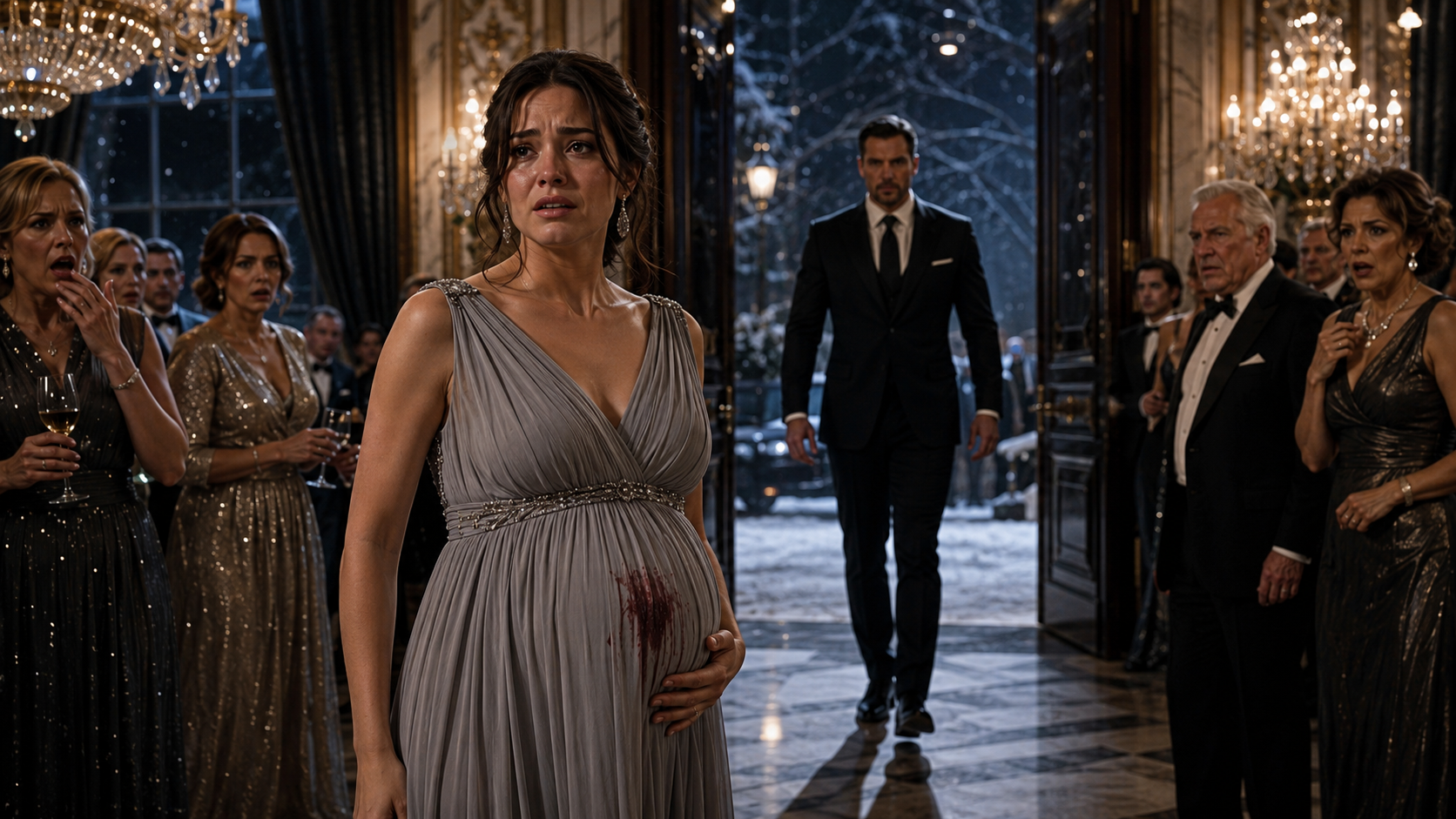
By the time Elena Ward reached the top of the marble staircase, she already knew she had made a mistake.
Not because of the dress.
The dress was simple, yes. A soft pearl-gray gown with long sleeves, a modest neckline, and a satin ribbon that rested gently above the curve of her six-month pregnancy. It was not a designer piece shipped from Milan. It had not been chosen by a stylist or guarded in a velvet garment bag. She had found it herself in a quiet boutique near the river, and when she tried it on, she had smiled at her reflection for the first time in weeks.
She had liked the woman in the mirror.
She looked calm.
She looked strong.
She looked like someone who belonged beside Adrian Blackwell.
But the moment Elena entered the grand ballroom of the St. Aurelia Hotel, she felt every eye decide otherwise.
Crystal chandeliers burned above her like frozen fire. A string quartet played near the stage, their music polished and expensive. Men in black tuxedos moved through the room with the practiced confidence of people who had never wondered whether they were welcome. Women glittered in diamonds, silk, emerald velvet, and judgment.
The Winter Mercy Gala was the most exclusive charity event in Manhattan. It raised money for children needing critical surgeries, and the guest list was almost impossible to enter unless your name opened doors before you touched them.
Elena’s name opened nothing.
Adrian’s opened everything.
That was why she had come alone.
He had called an hour earlier, his voice quiet and tight with apology. A board emergency. A last-minute legal meeting. A delay he could not avoid.
“Stay in the car until I arrive,” he had told her.
“I’ll be fine,” Elena had answered.
There had been a pause.
“Elena.”
She had laughed softly then, trying to make him less worried. “I am not made of glass.”
“No,” Adrian had said. “But people in rooms like that like to pretend they are made of gold.”
She should have listened.
Now she stood at the edge of a ballroom filled with people who had known Adrian Blackwell for years but had never bothered to know the woman he married. Some looked away as soon as she caught them staring. Others looked longer, as if she were a stain on a white tablecloth.
Elena placed one hand over her stomach.
Her baby shifted beneath her palm.
“It’s all right,” she whispered.
A waiter passed with champagne. Elena took a glass of sparkling water instead and moved toward the window, hoping to become invisible until Adrian arrived. Snow drifted outside, softening the city beyond the glass. The view was beautiful enough to hide in.
For almost five minutes, it worked.
Then Celeste Harrington saw her.
Celeste was the kind of woman whose smile could open society doors and close careers. She was tall, sharp, dressed in white silk, with a diamond collar at her throat and a voice trained to sound gentle while cutting skin.
She approached Elena with three women beside her.
One of them, Bianca Rowe, was already laughing.
“Elena, isn’t it?” Celeste asked.
Elena turned politely. “Yes.”
“Celeste Harrington,” the woman said, as if the name itself were a gift.
“I know,” Elena replied. “It’s nice to meet you.”
That made Bianca laugh harder.
Celeste’s gaze traveled slowly over Elena’s dress, her shoes, her hands, and finally her stomach.
“How brave of you to come alone,” Celeste said. “Most women in your position would wait for their husbands.”
Elena tried to keep her voice warm. “Adrian was delayed. He’ll be here soon.”
“Of course he will.” Celeste lifted her champagne glass. “Men like Adrian are always delayed by important things.”
Bianca tilted her head. “I heard he married someone outside our circle. I didn’t realize how far outside.”
The third woman, Lillian Cross, covered her mouth in a little gesture of fake shock. “Bianca.”
“What?” Bianca said. “I’m only admiring the romance of it. A billionaire marries a bakery girl. It sounds like one of those movies people cry over on airplanes.”
Elena felt heat rise behind her eyes.
“I worked in a bakery,” she said. “Before that, I worked in a clinic. And before that, I worked wherever I needed to work.”
Celeste smiled.
“How practical.”
The word practical sounded, in her mouth, like dirty.
Elena turned slightly toward the window again. She could have walked away. She should have walked away. But her feet remained still, and something inside her refused to give these women the satisfaction of seeing her retreat.
Bianca stepped closer.
“Is it true Adrian bought your mother’s house?”
Elena’s fingers tightened around her glass.
Celeste gave Bianca a warning glance, but it was not a warning to stop. It was a warning to enjoy the cruelty more elegantly.
Elena answered slowly. “My mother’s house was facing foreclosure. Adrian helped us keep it.”
“How generous,” Celeste said. “He does enjoy rescue projects.”
The baby kicked.
Elena breathed in through her nose.
“She is not a project,” Elena said.
All three women looked at her stomach.
Bianca smiled. “Already defending the little heiress?”
“My daughter,” Elena said, “doesn’t need to be an heiress to deserve respect.”
For one second, the smile disappeared from Celeste’s face.
Then she laughed.
It was soft.
That made it worse.
“My dear,” Celeste said, “respect is not announced. It is inherited, earned, or purchased. You seem to be relying on the third option.”
Elena’s throat tightened. “I didn’t purchase anything.”
“No,” Celeste said. “Adrian did.”
The words landed quietly, but they landed like glass.
A few nearby guests turned their heads.
Elena realized then that Celeste had not come to speak with her. She had come to perform. Every cruel sentence was meant for the room, for the women pretending not to listen, for the men pretending not to care, for the invisible court of wealth that decided who belonged and who should be punished for entering.
Elena could feel the old part of herself waking up.
The girl who had counted coins behind the bakery counter.
The young woman who had watched hospital bills swallow months of work.
The daughter who had learned how to smile at rude customers because rent did not care about pride.
She had survived more than a ballroom.
But survival did not mean humiliation stopped hurting.
“I’m going to get some air,” Elena said.
She took one step.
Bianca moved at the same time.
It looked accidental.
It was not.
Her shoulder brushed Elena’s arm. The sparkling water splashed down the front of Elena’s dress, darkening the pearl-gray fabric across her belly.
“Oh!” Bianca gasped. “How clumsy of me.”
Celeste’s eyes glittered.
Lillian whispered, “Someone get a napkin.”
No one moved.
Elena looked down at the spreading stain. The cold liquid soaked through the satin and touched her skin. Her first instinct was apology. It rose automatically, trained into her by years of service work, by years of making herself smaller so other people would feel comfortable taking up space.
“I’m sorry,” she whispered.
Bianca smiled. “You’re sorry?”
The women laughed.
A man nearby gave a short cough that might have been amusement. Another guest turned away, pretending not to have seen anything. The quartet continued playing, but the music suddenly sounded far away.
Elena reached for a napkin from a nearby table.
Before she could touch it, Celeste lifted a glass of red wine.
“Elena,” she said sweetly, “let me help.”
The glass tilted.
For one impossible second, Elena watched the wine fall.
It struck the front of her dress in a dark red splash, spilling over the water stain, dripping down the fabric, shocking and bright against the gray. The glass slipped from Celeste’s fingers and shattered at Elena’s feet.
The music faltered.
A few people gasped.
Then Bianca laughed.
That gave the room permission.
The laughter spread slowly at first, then wider. Quiet, polished, hidden behind hands and champagne flutes. The kind of laughter people used when they wanted cruelty to seem tasteful.
Elena stood perfectly still.
One hand covered her stomach.
The other hung at her side.
Red wine dripped onto the marble floor.
Celeste leaned close enough for only Elena to hear.
“This is what happens,” she whispered, “when women mistake marriage for entrance.”
Elena did not cry.
She wanted to.
Her eyes burned until the chandeliers blurred. But she did not let the tears fall. She stared straight ahead, past Celeste, past Bianca, past every person who had chosen silence because silence was cheaper than courage.
She thought of her daughter.
She thought of holding that little girl one day and teaching her not to bow to rooms that had no right to judge her.
Then the ballroom doors opened.
At first, Elena did not look.
She heard the change before she saw it.
The laughter stopped.
Not faded.
Stopped.
The air shifted. Conversations died mid-sentence. Glasses lowered. Shoulders straightened. Men who had stood confidently a moment before suddenly seemed to remember appointments elsewhere.
Elena knew before anyone spoke.
Adrian.
His footsteps were unhurried against the marble.
He did not enter like a man seeking attention. He entered like a storm that did not need thunder.
Adrian Blackwell wore a black suit, no tie, and an expression so calm that it frightened people more than anger would have. His dark hair was slightly damp from the snow. His eyes moved through the room once, taking in every frozen face, every guilty posture, every shard of crystal near his wife’s feet.
Then he saw Elena.
The calm cracked.
Only for a second.
Only enough for Elena to see the pain beneath it.
He crossed the ballroom without speaking. People stepped back before him. Celeste’s smile collapsed. Bianca’s face went pale. Lillian looked down at the floor.
Adrian stopped in front of Elena.
For a moment, there was no ballroom.
No chandeliers.
No crowd.
Only his hand lifting carefully toward her face, stopping just before touching her, as if he were asking permission without words.
“Elena,” he said.
Her name in his voice nearly broke her.
“I’m all right,” she said quickly.
His eyes dropped to the wine on her dress. Then to the broken glass. Then to her hand over her stomach.
“Are you hurt?”
“No.”
“The baby?”
“She kicked a minute ago.”
Something in Adrian’s jaw tightened.
He removed his jacket and wrapped it around her shoulders, covering the ruined front of her dress. His hand rested lightly over hers on her stomach.
“Look at me,” he said softly.
She did.
“I should have waited in the car,” she whispered.
“No.” His voice changed. “They should have behaved like human beings.”
A silence heavy enough to crush diamonds filled the ballroom.
Adrian turned.
The gentleness vanished from his face.
“What happened?”
No one answered.
The quartet had stopped completely now. Even the waiters stood still near the walls.
Adrian’s gaze moved across the guests.
“I asked a question.”
Celeste took a careful breath. “Adrian, there was a small accident.”
He looked at her.
“A small accident.”
His voice was almost mild.
Celeste swallowed. “Elena dropped a glass. Everyone is being dramatic.”
Bianca nodded too quickly. “Yes. It was nothing.”
Adrian glanced at Elena.
She said nothing.
That silence told him more than words.
He looked back at Celeste.
“My wife is six months pregnant. I find her standing in a room full of people, covered in wine, with broken glass at her feet, while guests who call themselves respectable are laughing.” He paused. “And you are calling that nothing.”
Celeste lifted her chin, trying to recover the version of herself that ruled rooms. “You’re making this bigger than it needs to be.”
Adrian nodded once.
“That is where you are wrong.”
He took his phone from his pocket.
A dozen people stiffened.
Adrian made one call.
“Marcus,” he said. “I’m in the St. Aurelia ballroom. Pull the security footage from the last twenty minutes. Every camera. Send it to my phone and to hotel legal.”
Celeste’s lips parted.
Adrian continued, his eyes never leaving her.
“Also get me the guest list. Full names, companies, board memberships, political donations, pending deals, debt exposure, charity filings, and any current litigation.”
A whisper moved through the room.
Bianca looked as if she might faint.
Adrian ended the call.
Celeste forced a laugh. “Adrian, this is absurd.”
“No,” he said. “What happened here was absurd. What happens next is consequence.”
Lillian stepped forward suddenly. “I didn’t do anything.”
Adrian looked at her.
“Did you laugh?”
Lillian said nothing.
“Did you watch?”
Her mouth trembled.
“Did you step between them and my wife?”
“No,” she whispered.
“Then you did something.”
The words moved through the room like a verdict.
Bianca’s voice cracked. “It was a joke.”
Adrian turned to her.
“A joke requires that someone be laughing with you.”
Bianca’s eyes filled. “We didn’t know she was so important to you.”
Elena lowered her head.
That sentence hurt more than the wine.
Adrian heard it too.
His expression became colder than the snow against the windows.
“You didn’t know she was important,” he repeated.
Bianca began to cry.
Adrian stepped closer, but he did not raise his voice.
“If she had been a waitress serving you tonight, would humiliation have been acceptable?”
Bianca shook her head, but no answer came.
“If she had no wealthy husband, would she have deserved your cruelty?”
“No,” Bianca whispered.
“If she had been alone, with no one powerful walking through that door, would any of you have apologized?”
The room remained silent.
Adrian looked at all of them.
“That is what I thought.”
Elena touched his sleeve. “Adrian.”
He turned back to her immediately.
There was still fire in him, but for her it softened.
“I don’t want revenge,” she said quietly.
“I know.”
“I don’t want them destroyed because of me.”
“They are not being judged because of you,” he said. “They are being revealed because of themselves.”
Celeste laughed suddenly, brittle and desperate. “This is theatrical. You can’t threaten everyone here because your wife is embarrassed.”
Adrian’s eyes returned to her.
“My wife is not embarrassed,” he said. “She was mistreated.”
Celeste opened her mouth.
He cut her off.
“And you will not reduce cruelty to etiquette.”
No one breathed.
Adrian looked toward the gala chairman, an older man with silver hair and a terrified expression.
“Mr. Hollis,” Adrian said. “This event is raising money for the pediatric wing, correct?”
“Yes,” the chairman replied hoarsely.
“What is the goal tonight?”
“Six million dollars.”
“And what has been raised?”
Mr. Hollis glanced toward the donation board near the stage. “Four point two.”
Adrian nodded.
“Then we have work to do.”
Celeste blinked. “What?”
Adrian faced the room.
“Every person who laughed, watched, or allowed this to continue will make a donation tonight.”
Someone muttered, “You can’t force—”
Adrian turned his head.
The man stopped speaking.
“I cannot force generosity,” Adrian said. “But I can make very clear what cowardice costs when it hides behind reputation.”
Celeste’s voice shook now. “How much are you expecting?”
Adrian looked at Elena.
Then back at Celeste.
“Enough to make memory expensive.”
Bianca covered her mouth.
Adrian pointed toward the stage.
“Mr. Hollis, reopen the pledge desk.”
The chairman moved quickly.
The ballroom changed.
It did not change beautifully.
It changed because fear pulled money from wallets faster than compassion had. Guests who had spent the evening pretending not to see Elena suddenly discovered their consciences. Men called assistants. Women wrote checks with shaking hands. Executives authorized transfers. Families who once treated charity like decoration now treated it like absolution.
The number on the screen climbed.
Four point five.
Five.
Five point seven.
Six.
The room applauded weakly when the goal was reached.
Adrian did not move.
The number kept climbing.
Seven.
Eight.
Nine million.
Elena watched the digits change, stunned.
Her humiliation, somehow, was becoming hospital beds.
Surgeries.
Medicine.
Second chances for children who would never know her name.
Her eyes filled again, but these tears were different.
A young server approached slowly, holding a folded piece of paper.
She looked no older than twenty.
“Mrs. Blackwell?” she whispered.
Elena turned. “Yes?”
The server’s hands trembled. “I’m sorry to interrupt. I wasn’t going to say anything, but I heard what happened.”
Celeste’s face changed.
The server noticed and looked afraid.
Adrian’s voice softened. “What is your name?”
“Maya.”
“You are safe, Maya. Speak.”
Maya held out the folded paper. “One of the ladies gave this to a waiter earlier. She told him to make sure Mrs. Blackwell had an accident before you arrived. He refused, so she said she’d do it herself.”
Elena stared at the paper.
Adrian took it.
He unfolded it.
His face went still.
Celeste whispered, “That’s not mine.”
Adrian looked at the handwriting.
“Interesting,” he said. “Because your name is embossed at the top.”
Celeste’s knees seemed to weaken.
Bianca stepped back from her.
Adrian read the note aloud, his voice low enough that everyone leaned in despite themselves.
“Make sure she is embarrassed before Adrian gets here. She needs to learn what rooms like this do to women like her.”
A sound moved through the ballroom.
Not laughter this time.
Disgust.
Celeste’s mask finally shattered.
“I was angry,” she said. “You were supposed to marry into one of our families. You were supposed to understand what your name meant.”
Adrian folded the note.
“My name means nothing if it is used to excuse this.”
Celeste’s eyes filled with furious tears. “She took your place.”
Elena looked up.
“My place?” she asked.
Celeste turned on her. “Do you know what he was before you? Do you know what doors he could have opened, what alliances he could have made?”
Elena’s voice was quiet. “I know who he was when he came to the bakery every Thursday and ordered coffee he didn’t like because he wanted to talk to me.”
A few people looked at Adrian.
For the first time that night, something almost like a smile crossed his face.
Elena continued, “I know who he was when he sat beside my mother during chemotherapy because I was too exhausted to speak. I know who he was when he asked me to marry him in my kitchen, with flour on the floor and rain leaking through the ceiling.”
Her hand settled over the baby.
“And I know who he is now.”
The ballroom was silent.
Elena looked at Celeste.
“You thought I came here to steal something. I didn’t. I came because my husband asked me to stand beside him at a charity event for sick children. You turned that into a trial.”
Celeste’s lips trembled.
Elena’s voice remained steady.
“But you do not get to decide my worth. Not tonight. Not ever.”
Adrian looked at her with such pride that Elena nearly forgot the ruined dress, the broken glass, and the cold stain drying beneath his jacket.
Then he faced Celeste.
“You will apologize,” he said.
Celeste drew herself up. “I already said—”
“No,” Adrian interrupted. “You explained. You defended. You lied. Now you will apologize.”
Celeste looked around for support.
No one met her eyes.
The empire of cruelty was lonely when power moved away from it.
Celeste turned toward Elena.
“I apologize,” she said stiffly, “for the accident.”
Adrian’s voice cut through the room.
“Again.”
Celeste flushed.
Elena waited.
The waiting was stronger than shouting.
Celeste swallowed. “I apologize for planning to embarrass you.”
“Again,” Adrian said.
Celeste’s face twisted. “For mocking you. For judging you. For treating you as if you did not deserve to be here.”
Elena looked at her for a long moment.
Then she said, “Thank you.”
Bianca sobbed. “I’m sorry too. I laughed because I wanted Celeste to like me. That’s not an excuse. I know it isn’t. I’m sorry.”
Lillian stepped forward next. “I watched. I should have stopped it. I’m sorry.”
One by one, others followed.
Some apologized with sincerity.
Some apologized because Adrian Blackwell was looking at them.
Elena could tell the difference.
But she accepted none of them too quickly.
She let them stand in the silence they had created.
When the last apology ended, Adrian turned to Maya, the server.
“You did the right thing.”
Maya shook her head. “I almost didn’t.”
“But you did.”
He looked toward Mr. Hollis.
“Make sure Maya’s name is given to my office. If she wants school paid for, it will be paid for. If she wants a job with better protection than this hotel gave her tonight, she will have one.”
Maya began to cry.
Elena reached for her hand.
“Thank you,” Elena said.
Maya whispered, “I know what it feels like when people think you’re invisible.”
Elena squeezed her hand.
“So do I.”
That was the moment the room truly changed.
Not because Adrian had threatened reputations.
Not because money had moved.
Because the woman they had tried to make invisible had become the only person worth watching.
Adrian turned to Elena.
“We can leave.”
She glanced around the ballroom, at the donation board now glowing with more than ten million dollars, at the guests standing ashamed among their diamonds, at Celeste Harrington holding the ruins of her pride.
Then Elena shook her head.
“No.”
Adrian studied her.
“I want to stay.”
“Elena, you don’t have to prove anything.”
“I know.” She lifted her chin. “That is why I want to stay.”
Something warm moved through his expression.
He offered her his arm.
She took it.
Together, they walked toward the front of the ballroom.
The crowd parted again, but this time Elena did not lower her eyes. She walked slowly, Adrian’s jacket over her shoulders, her ruined gown hidden but not erased, her hand resting over their daughter.
At the stage, Mr. Hollis handed Adrian the microphone.
Adrian offered it to Elena instead.
A ripple of surprise moved through the room.
Elena hesitated.
Then she accepted it.
Her voice trembled at first, but only at first.
“When I was nineteen,” she said, “my younger brother needed surgery my family could not afford. A charity like this one paid for it. That is why I agreed to come tonight. Not because of gowns or names or status. Because I know what it means to sit in a hospital hallway and pray that strangers will be kind.”
The room was utterly still.
“Elena,” Adrian whispered, not stopping her, only supporting her.
She continued.
“Tonight, many of you gave because you were afraid. I hope tomorrow you give because you remember. Not me. The children. The parents. The nurses working double shifts. The families counting hours and bills and heartbeats.”
Her voice grew stronger.
“If this room can turn cruelty into ten million dollars, imagine what it could do with compassion.”
No one clapped immediately.
They were too ashamed.
Then Maya began.
One pair of hands in the back of the ballroom.
Then another.
Then another.
The applause rose slowly, not glamorous, not polished, but real.
Elena stepped down from the stage.
Adrian took the microphone only long enough to say, “The Blackwell Foundation will match tonight’s final total.”
The room erupted.
Mr. Hollis looked as if he might collapse.
Elena stared at Adrian. “You didn’t tell me.”
He leaned close. “You were making the better speech.”
She laughed then.
A small laugh.
A cracked laugh.
But it was hers.
Celeste left before dessert was served.
By midnight, three board members had resigned from her foundation. By morning, the hotel had opened an investigation. By the end of the week, the story of what happened at the Winter Mercy Gala traveled through Manhattan without Elena needing to tell it once.
People exaggerated Adrian’s fury.
They whispered about his phone call, his influence, his power.
They said he had made half the room beg.
But the people who had been there remembered something else.
They remembered Elena Blackwell standing on a stage in a stained dress beneath her husband’s jacket, telling a room full of powerful people that compassion should not need fear as a teacher.
Months later, the new pediatric recovery wing opened.
Elena arrived holding a newborn girl in her arms.
They named her Grace.
Not because the world had shown much of it that night.
But because Elena had.
Adrian stood beside her as a gold plaque was unveiled outside the wing. It did not carry Celeste Harrington’s name. It did not carry the names of the guests who wrote checks to save themselves.
It read:
For every person who has ever felt invisible.
You are seen.
Elena looked at the words for a long time.
Then she looked down at her daughter.
Grace slept peacefully, one tiny hand curled against Elena’s chest.
Adrian touched Elena’s shoulder.
“Are you all right?”
She smiled.
This time, she meant it.
“Yes,” she said. “I am.”
And somewhere far across the city, in ballrooms where people still mistook wealth for worth, the story continued to travel.
Not as a warning about Adrian Blackwell.
As a warning about Elena.
The woman they had laughed at.
The woman they had underestimated.
The woman who entered alone, stood through humiliation, and left with the whole room learning her name.

