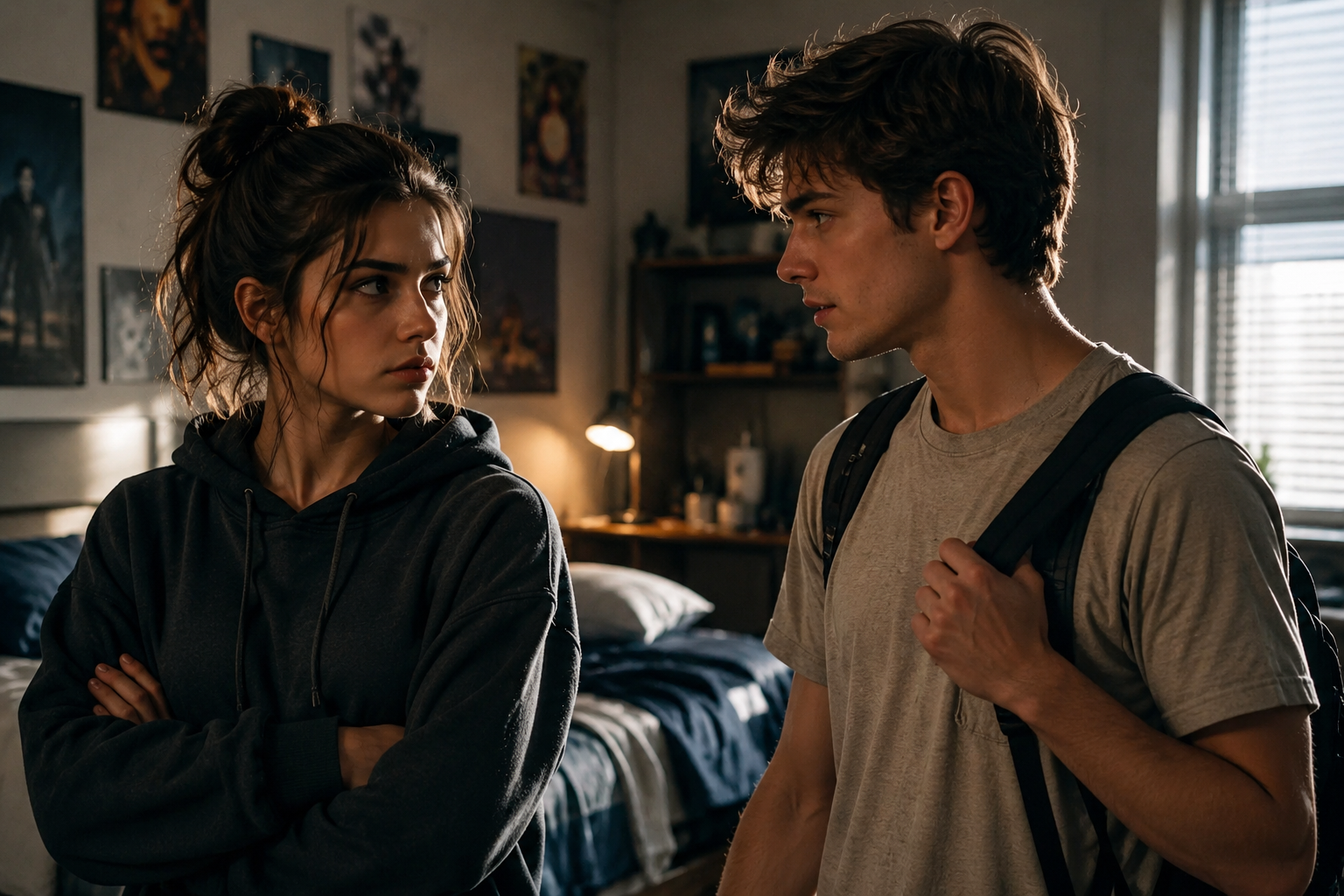
By eight-thirty on his first night in apartment 4B, Julian Hart had learned three things.
First, old buildings made noises that sounded personal.
Second, carrying six boxes up four flights of stairs in the rain was a choice made by a man who had overestimated his own character.
Third, his new roommate, Mara Venn, had no interest in pretending she was happy he existed.
She watched him from the kitchen doorway while he dragged the last box inside, his hoodie soaked through, one shoelace untied, and a streak of dust across his cheek that made him look like he had lost a quiet battle with a basement.
“You know,” she said, “most people ask about elevator access before signing a lease.”
Julian dropped the box by his bedroom door and tried to breathe like a person who still had lungs. “The listing said fourth floor.”
“It did.”
“It also said charming walk-up.”
“That means inconvenient with moldings.”
He looked around. The apartment was narrow but warm, with tall windows facing a wet Baltimore street, bookshelves bolted to brick walls, low kitchen cabinets, and a hallway so carefully clear it looked less decorated than negotiated. A strip of dark green tape ran along the floor near the kitchen island.
Julian pointed at it. “Is that decorative?”
“No.”
“Warning line?”
“Yes.”
“For what?”
“For people who enjoy keeping their kneecaps.”
Mara rolled farther into the kitchen, her wheelchair moving with smooth, practiced precision. She had cropped black hair, sharp eyes, and the kind of posture that made every silence feel supervised. She wore a charcoal sweater and loose linen pants, and she looked at Julian as if he were a complicated appliance she had not requested.
He picked up one of his bags. “I can move this stuff out of the hallway.”
“You can and you will.”
“Great. I love a roommate relationship built on mutual confidence.”
“Don’t mistake instructions for confidence.”
Julian smiled despite himself. “Fair.”
Mara’s expression did not change, but something in her eyes flickered. Not amusement exactly. More like she had noticed he was not instantly offended, and that information had been filed somewhere.
On the kitchen counter sat two paper containers of hot food. Steam curled from under the lids. Julian had not eaten since noon, unless three gas station crackers counted as food, which he privately believed they did not.
Mara tapped one container with a fork. “Vegetable curry. Unless you hate coconut, in which case tonight becomes a tragedy.”
Julian blinked. “You ordered for me?”
“No. I ordered too much and decided waste was immoral.”
“That sounds suspiciously like kindness wearing a disguise.”
“That sounds suspiciously like you want to sleep in the stairwell.”
He took the container. “Curry is perfect.”
“Of course it is. I have taste.”
They ate at the island with the green tape between them. The rain hit the windows in soft, restless lines. Below, a bus sighed at the curb. Somewhere in the building, a child laughed once, then someone told him to brush his teeth like it was a legal emergency.
For a while, neither of them spoke.
Julian liked silence when it was comfortable. This was not comfortable. It had corners.
Finally, Mara said, “You have income?”
He looked up. “That’s a very romantic first dinner question.”
“It’s not dinner. It’s a lease survival interview.”
“I edit audio for documentaries. Mostly podcasts. Sometimes corporate training videos when I’ve angered God.”
“Stable?”
“Stable enough to pay rent. Unstable enough to have opinions about microphone placement.”
She considered him. “So you make people sound smarter than they are.”
“Only if they pay extra.”
“That explains the headphones.”
He smiled. “You say that like headphones once betrayed you.”
“Men with headphones block doorways and call it focus.”
“I promise not to block doorways.”
Mara leaned back. “You promise too early.”
“I’m trying to start strong.”
“You won’t last a week.”
There it was. Not a joke. Not exactly a threat either. A warning, offered flatly, like weather.
Julian held her gaze. “Living with you?”
“Living here.”
“Because of the stairs?”
“Because of the rules.”
“I can follow rules.”
“Everyone says that before the rules apply to them.”
“That sounds like it comes from experience.”
“It does.”
He waited.
Mara did not continue.
Julian knew how to recognize a locked door. His mother had raised three sons and one private grief; his older brother had survived a war and returned allergic to questions; his last relationship had ended with a woman telling him he was kind, which somehow felt worse than being called selfish. He knew that not every silence wanted to be rescued.
So he only nodded. “Then I’ll try not to become everyone.”
Mara looked at him for a long second.
“Put your boxes inside your room before midnight,” she said. “I don’t want to discover your biography with my wheels.”
“Yes, ma’am.”
“Don’t ma’am me.”
“Yes, apartment authority.”
“Worse.”
“Still workshopping.”
“Work quietly.”
He did.
That first night, Julian learned the map of apartment 4B. The narrow table by the door belonged to Mara’s keys, gloves, folded cane, and emergency pouch. The hallway stayed clear at all times, not “mostly clear,” not “just for a second,” but clear, because a blocked hallway was not clutter; it was someone else deciding where she could move. Kitchen items lived below shoulder height. Nothing balanced on chair backs. Nothing leaned against the bathroom door. If he used the last coffee filter, he replaced the box. If he moved a chair, he put it back exactly where it had been.
Mara explained every rule without apology.
Julian listened without making jokes until she was finished.
That seemed to surprise her more than the jokes.
At midnight, he finally dragged himself into his new room. It was small, with a radiator that knocked like a polite ghost and a window looking into the brick wall of the next building. His mattress was still rolled in plastic. His books were in a box labeled KITCHEN because past-Julian had been optimistic and tired.
He lay on the bare floor for one minute and stared at the ceiling.
From the other side of the wall, he heard Mara’s chair move across hardwood, then the faint clink of dishes, then music: old jazz, low and smoky.
He closed his eyes.
He had no idea if he would last a week.
But he had signed a six-month lease, and at that moment, with curry warming his chest and rain tapping the glass, six months sounded less impossible than the stairs had made it seem.
The next morning, Julian woke to the smell of coffee strong enough to raise legal questions. He entered the kitchen half asleep, wearing a shirt that said SOUND GUYS DO IT IN POST, which he regretted the second Mara noticed it.
She sat at the island with a laptop open, hair damp from a shower, eyes bright with the terrible focus of someone who had already won an argument before breakfast.
She looked at his shirt.
He looked down at his shirt.
“Laundry day,” he said.
“Is the laundry ashamed?”
“It should be.”
“Coffee’s in the pot.”
“Is this a peace offering or a trap?”
“Yes.”
He poured a mug. The cups were on the lowest shelf. The spoons lay in a drawer with labeled dividers. Creamer sat in a small fridge shelf at a reachable height. Every object had been placed with intention, not for appearance but for use.
Julian suddenly remembered every apartment he had ever lived in: shoes everywhere, cabinets too high, chargers crossing floors like tripwire, chairs shoved wherever space happened to remain. He had called those places normal. He had never wondered who normal had excluded.
Mara looked up. “You’re staring at the mugs like they’ve taught you morality.”
“They might have.”
“Don’t let it happen before coffee.”
“What do you do?” he asked, leaning against the counter, then immediately checking whether he was in the way.
Mara noticed the check.
Again, that flicker.
“I design museum exhibits,” she said. “Accessible layouts, sensory routes, audio pathways, seating plans, emergency movement, all the things people remember after the building is already hostile.”
“That sounds important.”
“It is. People prefer when I call it inclusive storytelling. Makes them feel less sued.”
“You make spaces let people stay.”
Her fingers paused above the keyboard.
Julian realized too late that he had said something sincere before breakfast, which felt illegal in their household.
Mara’s mouth tightened. “Careful.”
“Too meaningful?”
“Dangerously.”
“I’ll ruin it next time.”
“See that you do.”
By the end of the first week, Julian had not moved out.
Mara marked the occasion by sliding a folded piece of paper across the island.
“What’s this?” he asked.
“Your rent receipt.”
“Not a certificate?”
“You get continued shelter.”
“No gold star?”
“You didn’t block the hallway for seven days. Don’t become arrogant.”
“I’d like to thank the academy.”
“I’d like you to take out the recycling.”
He took out the recycling.
Living with Mara was not easy, but it was honest. She did not hint. She did not soften truth until it became useless. If Julian left a cabinet open, she told him. If he put a grocery bag in the wrong place, she told him. If he reached once, without thinking, to move her chair back from the sink, she turned so fast he almost dropped a jar of olives.
“Don’t touch my chair,” she said.
The words were cold enough to stop him.
Julian stepped back immediately. “You’re right. I’m sorry.”
Her eyes narrowed. “Most people say they were only trying to help.”
“I wasn’t helping. I was taking over without permission.”
That answer changed the room.
Not warmly. Not dramatically. But something loosened.
Mara watched him for a moment, then nodded once. “Okay.”
That was all.
But after that, tiny things began appearing between them like cautious lights.
A note on the coffee pot: Meeting until noon. Don’t commit crimes against caffeine.
An extra towel left near the bathroom after he came home soaked from work.
A text at 7:14 p.m.: If you buy crackers, not the rosemary ones. They taste like a candle pretending to be dinner.
Julian replied: What crackers taste like emotional stability?
Mara: None. That’s why society is collapsing.
He found himself smiling at his phone in the editing studio, surrounded by waveforms and stale coffee and people saying things like “Can we make this silence feel more premium?”
Mara stayed in his head.
Not romantically at first. Or at least, not in any way he trusted.
She was brilliant and difficult and funny in the way knives were shiny. She had a way of making apology feel unnecessary when respect would do. She hated pity so intensely that kindness had to approach sideways and identify itself at the door.
One Thursday night, Julian came home late and found her on a video call, her voice sharp enough to cut wire.
“No,” she said. “I am not putting a smiling volunteer beside the wheelchair entrance.”
A man’s voice crackled through the laptop. “Mara, the donor board wants warmth.”
“The donor board wants evidence that disabled visitors are being lovingly managed by able-bodied saints.”
“That’s not fair.”
“It’s accurate, which is why you don’t like it.”
Julian tried to slip quietly toward his room.
Mara pointed at him without looking away from the screen. “You. Soup in the fridge. Eat it before it becomes science.”
He pointed at himself.
She mouthed, “You.”
The man on the call sighed. “We’re just trying to make accessibility feel welcoming.”
“Then make it actually welcoming,” Mara snapped. “A ramp that leads to a locked side door is not welcome. A quiet room used for storage is not welcome. A map that assumes everyone can read tiny gray print under theatrical lighting is not welcome. Don’t photograph gratitude. Fix the route.”
Julian froze in the hallway.
That was the first time he saw the fire beneath her sarcasm. It was not bitterness. It was fury with a blueprint.
After the call ended, she shut the laptop.
“Bad meeting?” he asked.
“Bad assumptions.”
“Worse.”
She looked at him. “You heard that.”
“You were loudly educational.”
“I was angry.”
“Those can overlap.”
Mara studied him like she was searching for the hidden condescension. He gave her none.
Finally, she said, “Eat the soup.”
He ate the soup.
A month passed.
Then came the envelope.
Julian found it on the kitchen island beneath Mara’s hand. Thick cream paper. Gold seal. Expensive in the way that wanted to be noticed. She sat in front of it without moving, her face stripped of its usual armor.
He set down the grocery bags carefully. “Do you want me to pretend I didn’t see that?”
“Yes.”
“Done.”
He put away the food, making sure nothing went above the shelves she used most. Then he walked to his room and left the door partly open—not an invitation, exactly. More like a light left on.
Fifteen minutes later, she appeared in the hallway.
“My ex is getting honored,” she said.
Julian looked up from untangling a microphone cable. “Honored?”
“At a museum gala.”
“That sounds punishable.”
“It should be.”
She rolled into the room but stopped near the doorway, the envelope balanced on her lap like evidence.
“His name is Adrian Vale,” she said. “He used to be a curator at the North Harbor Museum. He’s being awarded for his work on accessible public art programming.”
Julian waited.
Mara laughed once, flat and humorless. “Funny, right?”
“Depends how much of the work was yours.”
Her silence answered.
Julian felt anger rise in him, hot and immediate, but he kept his voice steady. “How much?”
“The original program design. The visitor route models. The sensory room concept. The community advisory plan. The part where the museum stopped treating access as a special request and started treating it like infrastructure.”
“That seems like more than a little.”
“I was consulting for them before the accident.”
He had known there had been an accident. Not details. Just the way people in the building sometimes lowered their voices around Mara when mentioning winter, hospitals, or the intersection at Calvert and King.
She looked at the envelope.
“Two years ago, a delivery truck ran a red light. I woke up after surgery and learned my spine had become the most interesting thing about me.”
Julian’s chest tightened. “I’m sorry.”
Her eyes snapped to him.
He held up one hand. “Not like you died. I’m sorry something violent happened and people made you carry the meaning of it.”
The sharpness in her face softened by half a degree.
“Better,” she said.
He nodded.
“Adrian was perfect at first,” she continued. “Hospital visits. Flowers. Public devotion. Everyone loved him for loving me through tragedy. He gave interviews about resilience. He said my strength changed him.”
Julian already hated him.
“Then rehab got boring. Pain got boring. My anger got boring. My body didn’t become a neat inspirational chapter quickly enough.” Mara looked down. “He said he missed the woman I used to be.”
The room went quiet.
Julian said, “That’s a cruel thing to say to someone who survived.”
“That wasn’t the cruelest part.” She held up the invitation. “He built his new program from my notes and told everyone my recovery inspired him.”
Julian stared.
Mara’s mouth twisted. “People love a stolen idea more when it comes with a man speaking gently into a microphone.”
The gala was in three weeks.
Mara swore she would not go.
Then the museum announced that the board would choose the lead designer for its new community wing during the gala weekend. Mara had applied months earlier. Adrian’s team had applied too.
“It’s strategic,” she said, glaring at her calendar.
Julian leaned in the kitchen doorway. “The public celebration of your idea thief is strategic?”
“The board dinner is strategic. The award ceremony is an unfortunate parasite.”
“And you want to go?”
“No. I want to enter the room before he turns my work into his redemption story.”
Julian nodded. “What do you need?”
She looked at him.
He expected sarcasm.
Instead, she said, “Come with me.”
The words seemed to surprise her more than him.
“As a roommate,” she added quickly. “A witness. A neutral civilian. Not a date.”
“Obviously.”
“Don’t say obviously like you’ve suffered.”
“I’m honored to be considered a neutral civilian.”
“You’re barely neutral.”
“I own one suit.”
“That may elevate you.”
The gala was held inside the North Harbor Museum, a marble building with wide steps in front and a side ramp hidden so far from the main entrance that Julian nearly laughed from anger.
Mara wore a dark red velvet jacket, black trousers, and silver earrings shaped like small moons. Her hair was swept back, her lipstick deep, her expression calm enough to terrify anyone paying attention.
Julian walked beside her, not behind her, not hovering, not touching the handles of her chair. He had practiced spacing in grocery aisles and on sidewalks because he knew she would notice, and because he wanted noticing to matter.
“Good distance,” she murmured.
“I trained with shopping carts.”
“Heroic.”
“Neutral.”
She glanced at him. Her mouth almost smiled.
Inside, the museum glowed with warm lights and expensive flowers. People moved in clusters, holding glasses and opinions. Some looked at Mara too long. Others looked away too fast. Both choices felt like staring with extra steps.
Adrian saw her near the sculpture hall.
He was handsome in a polished, sorrowful way, with gray at his temples arranged like evidence of depth. His face changed when he saw Mara, then rearranged itself into tenderness for the room.
“Mara,” he said, stepping forward. “You came.”
“I was invited.”
His eyes shifted to Julian. “And you are?”
“Julian Hart,” Julian said. “Roommate. Neutral civilian.”
Mara looked down like she was hiding a laugh.
Adrian blinked. “Right.”
A woman in blue silk approached next. Camille, according to Mara’s earlier briefing. Adrian’s new fiancée. She worked in development. She had the careful smile of someone who knew she had entered a story halfway through and chosen the easiest version.
“Mara,” Camille said. “It’s good to see you.”
“Is it?”
Camille flushed.
Adrian placed a hand at her lower back. “We’re all adults here.”
Julian nearly admired the audacity. Men like Adrian loved calling everyone adult after behaving like weather.
Before Mara could answer, an older woman swept in wearing pearls and a perfume that arrived before she did.
“Mara, darling,” she said, opening her arms without coming close enough to touch. “How brave of you.”
Mara went still.
There it was.
Brave.
The word people used when they wanted to praise someone without examining the room that made bravery necessary.
Mara smiled. “How rehearsed of you, Celeste.”
The woman’s expression flickered.
Julian looked at the floor and bit the inside of his cheek.
Celeste recovered quickly. “I only meant this must be emotional.”
“Watching your son accept an award for work he took from me? Yes. But I’ve sat through worse panel discussions.”
Adrian’s jaw tightened.
Camille looked at her glass.
Celeste’s smile thinned. “Still sharp.”
“Still accurate,” Mara said.
In that moment, Julian knew two things with absolute clarity.
One, Mara Venn did not need saving.
Two, if she asked him to fight a marble statue, he would need a moment to consider the logistics.
The award ceremony was beautiful in the sterile way expensive rooms often were. Adrian spoke under soft lights about public access, dignity, community, and the woman whose courage had inspired him. He did not say Mara’s name until everyone already knew who he meant. He did not credit her work. He turned her injury into the emotional lighting of his career.
Julian sat beside Mara near the aisle. Her face was calm, but her hand rested tight in her lap.
He wanted to take it.
He did not.
Then Mara moved her hand just enough that her knuckles brushed his.
Julian looked down.
She did not look at him.
He turned his palm upward on the chair between them.
After a moment, she placed her hand in his.
He held it gently. Not like rescue. Not like proof. Just like presence.
When Adrian finished, the room applauded.
Mara did not.
At the board dinner later, the true ugliness came dressed as admiration.
A woman leaned down and said, “You look wonderful, considering.”
Mara tilted her head. “Considering what?”
The woman fled.
A donor said, “Your story is so inspiring.”
Mara said, “My invoice is more useful.”
A curator said, “It’s amazing you still work in this field.”
Mara said, “It’s amazing the field still needs adults to explain doorways.”
Julian spent most of the evening pretending not to enjoy it.
Then Dr. Helena Ross, the museum director, approached.
“Mara Venn,” she said. “I’ve reviewed your community wing proposal.”
Mara’s posture changed. Professional. Focused. Dangerous in a cleaner way.
“I hope it was clear,” she said.
“Very. Some board members had concerns about cost.”
“Of course they did. Access always looks expensive when exclusion has already been paid for.”
Dr. Ross’s eyebrows lifted.
Julian watched interest sharpen in her face.
Mara continued. “Build access into the bones of the project, and it becomes design. Add it later, and it becomes apology. I’m not interested in designing apologies.”
For a long moment, Dr. Ross said nothing.
Then she smiled. “You should present tomorrow morning.”
“I planned to.”
“Good.”
Adrian appeared at the edge of the conversation, pale with irritation.
Celeste slid in beside him. “Mara has always had strong opinions.”
Mara smiled. “Some people call that expertise.”
Dr. Ross laughed.
Celeste did not.
Then her eyes landed on Julian. “And you, Mr. Hart, are you here to assist Mara?”
The air changed.
Mara’s face went blank.
Julian felt the trap open.
He answered evenly. “No. I’m here because she invited me.”
Celeste’s smile sharpened. “Of course.”
“And because formal shoes on marble floors are a public safety issue.”
Dr. Ross laughed again.
Mara looked at Julian with something unreadable in her eyes.
Later, after too many speeches and a dessert shaped like architecture, Mara asked to leave before the dancing began. Julian did not ask if she was sure. He got her coat, walked beside her through the side exit, and waited while she transferred into the passenger seat without turning it into a performance.
In the car, the city lights blurred through the windshield.
“You were decent tonight,” she said.
“High praise.”
“You didn’t overdo it.”
“I considered insulting Celeste’s pearls, but I restrained myself.”
“A loss for jewelry criticism.”
He smiled. “You were incredible.”
Her face turned toward him. “Careful.”
“I mean professionally.”
“No, you don’t.”
Julian kept his eyes on the road. “Not only professionally.”
Silence filled the car.
“That’s inconvenient,” Mara said.
“I know.”
“We live together.”
“I know.”
“I warned you I was difficult.”
“You warned me I wouldn’t last a week. I’m still waiting for the disaster.”
She turned sharply. “Don’t romanticize me.”
“I’m not.”
“You are. People do this. They meet me, decide I’m strong, and then they fall in love with the idea of standing near strength. Until strength has bad days. Until pain is boring. Until access is annoying. Until they realize I’m not here to make them feel noble.”
Julian pulled into a quiet side street and stopped the car.
Then he looked at her.
“I like you because you’re exacting, funny, terrifying before coffee, and able to insult a floor plan like it owes you money. I like that you label your drawers like a courtroom exhibit. I like that you order food and pretend leftovers are a moral problem. I like that you fight people who mistake access for charity. I like you because you’re Mara. Not because you’re a lesson.”
Her face changed.
For once, she had no quick answer.
“That was a speech,” she said finally.
“A medium one.”
“I hate speeches.”
“I know.”
“I hated that one less than expected.”
“That’s practically a sonnet from you.”
She looked away, but he saw her smile reflected in the window.
The next morning, Mara destroyed the board presentation.
She did not raise her voice. She did not beg. She did not tell a tragic story. She showed maps, traffic patterns, seating options, lighting alternatives, quiet routes, tactile models, audio stations, rest zones, and emergency plans. She explained that accessibility was not a side entrance. It was not a special button. It was not a paragraph at the end of a grant proposal. It was whether people could arrive, stay, move, participate, leave safely, and return without feeling like burdens.
“Access,” she said, looking directly at the board, “is not generosity. It is architecture admitting reality.”
Julian sat at the back, proud enough to be embarrassing.
Adrian watched from near the doorway, wearing the expression of a man realizing he had mistaken a whole person for a supporting character.
By noon, Dr. Ross offered Mara the lead design contract.
Adrian congratulated her through clenched teeth.
Celeste did not clap.
Camille did.
That surprised Mara enough that she looked over.
After the room emptied, Camille approached alone.
“I’m sorry,” she said.
Mara’s face closed. “For which part?”
Camille swallowed. “For believing his version because it was easier. For telling myself the program was his work because asking questions would have made my life complicated. You don’t have to forgive me. I just didn’t want to keep benefiting from silence.”
Mara studied her for a long time.
Then she said, “That may be the first honest sentence anyone in your circle has spoken all weekend.”
Camille nodded, eyes bright. “Congratulations on the contract.”
“Congratulations on the difficult fiancé.”
A sad laugh escaped Camille. “I’m starting to notice.”
They did not hug. Julian thought that was probably the most Mara version of mercy available.
When they returned to apartment 4B, something had shifted. Neither of them named it.
They went back to coffee, deadlines, museum plans, audio edits, shared takeout, and careful distances that grew less careful by the day.
Julian learned that Mara loved old jazz, hated scented candles, read architectural lawsuits for entertainment, and cried once during a documentary about an injured whale while insisting she was having “a humidity response.”
Mara learned that Julian talked to himself while editing, apologized to furniture when he bumped into it, remembered everyone’s coffee order, and could not fold fitted sheets without turning them into a philosophical problem.
One night, during a thunderstorm, the power went out. They sat on the living room floor with battery lamps and cold noodles. Mara had transferred from her chair to the rug because she liked being near the low table during storms. Julian sat across from her, close but not crowding.
“You’re still here,” she said.
“In the apartment?”
“In general.”
“I live here.”
“People leave places they live all the time.”
He heard what she was really asking.
Julian set down his food. “Do you want me to promise I won’t?”
“No.”
“Okay.”
She frowned. “That’s it?”
“I don’t want to make a promise just because the lights went out and the room got emotional.”
Her eyes softened despite herself. “Then what do I get?”
“The truth,” he said. “I care about you. I’m not planning to leave. And if that ever changes, I’ll tell you honestly instead of disappearing slowly and calling it kindness.”
Mara looked down at her hands.
“That’s better than a promise,” she said quietly.
“I hoped it would be.”
She reached across the table and took his hand.
This time, she looked at him when she did it.
Their first kiss happened two weeks later in the kitchen because Julian burned toast.
Mara rolled beside him, inspected the pan, and said, “That bread has entered the afterlife.”
“It’s smoky.”
“It’s evidence.”
“You’re harsh under pressure.”
“You’re dangerous near carbohydrates.”
He turned to defend himself and found her closer than expected. She looked up at him, amused and warm and nervous in a way he had never seen before.
For a moment, neither of them moved.
Then Mara said, “If you make this strange, I’ll raise your portion of the internet bill.”
Julian smiled. “Understood.”
He bent slightly, leaving her room to meet him or refuse.
She met him.
The kiss was soft, careful, and too brief. When it ended, Mara looked annoyed by how happy she was.
“The toast is definitely dead now,” she said.
“Worth the funeral.”
“Don’t be charming.”
“I’m barely operational.”
She kissed him again.
For a while, happiness arrived quietly. Not like fireworks. Not like violins. It came through shared grocery lists, hands brushing near the sink, Mara falling asleep on the couch while Julian edited late-night narration, Julian learning the difference between helping and taking over, Mara learning that needing someone did not mean surrendering herself.
But peace rarely stayed untested.
Adrian returned in November.
Julian opened the apartment door on a Saturday morning and found him standing in the hallway with white flowers and the haunted look of a man who wanted forgiveness to arrive before consequences.
“Is Mara here?” Adrian asked.
“Does she know you’re coming?”
“No.”
“Then no.”
Adrian’s jaw tightened. “I need to speak with her.”
“Then message her and let her decide.”
Adrian looked past him. “Mara.”
Julian turned.
Mara was at the end of the hallway in a gray sweatshirt, her face unreadable.
“It’s okay,” she said.
Julian stepped aside, but he stayed near the door.
Adrian entered like a visitor walking through the life he had forfeited. His eyes moved over the low shelves, the plans pinned to the wall, the jazz records, Julian’s jacket on the chair, two mugs by the sink. Ordinary intimacy everywhere.
Mara positioned herself by the kitchen island. “Why are you here?”
Adrian looked at the flowers as if realizing they were useless. “Camille left.”
Mara blinked once. “Efficient.”
“She said I was still building a career out of your accident.”
Julian liked Camille more by the second.
Adrian swallowed. “She was right.”
Mara said nothing.
“I treated you terribly,” he continued. “I told myself I was grieving what happened to us. But I made your injury about my loss. I wanted praise for staying, and when staying became hard, I punished you for not being easy.”
Mara’s face remained calm, but Julian saw her fingers tighten.
“I don’t expect forgiveness,” Adrian said. “I just wanted to say it.”
“You could have emailed.”
“I wanted to say it face-to-face.”
“Because that helped me, or because it made you feel braver?”
Adrian flinched.
Julian looked down to hide his satisfaction.
“For me,” Adrian admitted. “Probably.”
“At least that’s honest.”
Adrian glanced at Julian. “Are you with him?”
Mara’s voice was steady. “Yes.”
Adrian looked hurt, which Julian found almost impressive.
“I’m glad,” Adrian said, though he did not sound glad.
Mara studied him. “I hope someday you learn how to stop using women as mirrors for your guilt.”
He closed his eyes briefly. “I deserved that.”
“Yes,” she said. “You did.”
After he left, the flowers remained on the kitchen table.
Julian picked them up. “Trash?”
Mara looked at the bouquet, then at the door.
“No. Give them to Mrs. Bell downstairs. She likes dramatic flowers and has better taste than Adrian.”
“Excellent destination.”
That night, Mara was quiet. Julian did not crowd her. He made pasta, burned nothing, and left space beside him on the couch.
After an hour, she transferred beside him.
“I thought hearing him apologize would fix something,” she said.
“Did it?”
“A little. Not the part I wanted.”
“What part did you want?”
She stared at the dark television screen. “The part that still wonders why I wasn’t enough.”
Julian’s heart ached.
“Mara.”
“I know,” she said quickly. “I know logically. I know him leaving says more about him than me. I know all the correct sentences.”
“Correct sentences don’t always reach the wound.”
She looked at him then, eyes shining.
“No,” she whispered. “They don’t.”
Julian took her hand. “You were enough before the accident. You were enough after it. You were enough when he failed you. You were enough before I met you. I don’t make that true. I just get to notice.”
Mara closed her eyes.
A tear slipped down her cheek, and this time she did not make a joke to cover it.
Winter settled over Baltimore in hard rain and silver mornings. Mara began work on the museum wing and hired two assistants. Julian got a steady contract editing an investigative series and bought a microphone so expensive he introduced it to the apartment as “my financially irresponsible child.”
They fought sometimes.
Real fights.
Julian occasionally tried so hard not to overstep that he became useless in decorative ways. Mara sometimes used sarcasm like a locked door and forgot Julian was not trying to break it down. But they learned.
The most important fight happened over the building’s stair lift.
The mechanism failed on a freezing Tuesday evening, leaving Mara stuck in the lobby after a client meeting. Julian arrived twenty minutes later to find her furious, exhausted, and surrounded by a landlord, a maintenance worker, and two neighbors offering solutions that all sounded like humiliation with good intentions.
The landlord sighed. “Repair company can come tomorrow.”
Mara’s face went white with anger. “Tomorrow.”
“It’s an old building.”
“It’s a building you advertised as accessible.”
The landlord looked at Julian. “Maybe you can carry her up just for tonight?”
The lobby went still.
Mara’s expression shut down.
Julian stepped forward, voice controlled. “Don’t talk about her like she’s furniture.”
The landlord blinked.
Julian continued, “The stair lift is not a convenience. It is access to her home. You need to pay for an accessible hotel room tonight, arrange transportation, and send a written repair schedule before midnight. Or Mara will make this expensive, and I will happily edit the phone recording into a very clear file for her lawyer.”
The landlord looked at Mara.
Mara smiled coldly. “He’s new to saying it. I’m not.”
By midnight, the landlord had paid for the hotel. By Friday, Mara had written a letter so precise and terrifying that repairs, inspections, and policy changes happened within two weeks.
Later, Julian worried he had overstepped.
Mara sat on the hotel bed, city lights behind her. “You didn’t speak for me.”
“I didn’t?”
“You spoke to someone who tried to erase me from the conversation. Then you handed the room back.”
Julian exhaled.
“That’s the line,” she said.
“I’m still learning.”
“I know.” She took his hand. “That’s why you lasted longer than a week.”
One year after Julian moved in, Mara found the first box he had brought into the apartment flattened behind his closet.
“You kept this?” she asked, dragging it into the hallway with theatrical disgust.
Julian looked up from his laptop. “That box carried my books through a personal crisis. Show respect.”
“It says discount printer paper.”
“It has history.”
“It has structural weakness.”
“I relate to it.”
She rolled her eyes, but she was smiling.
That night, they hosted dinner for friends in apartment 4B. The hallway stayed clear. Chairs went back where they belonged. People learned quickly not to block the kitchen entrance unless they wanted Mara to educate them with kindness sharpened into a blade.
The apartment was full of laughter, music, food, and the ordinary ease of people moving through a space designed not around performance, but around reality.
Julian watched Mara from the kitchen while she argued with a museum board member about exhibit lighting and somehow won without raising her voice. She looked alive, brilliant, difficult, beautiful, and entirely herself.
She caught him staring.
“What?” she mouthed.
He shook his head.
Later, after everyone left, they sat by the window while rain blurred the streetlights below. Mara’s shoulder rested against Julian’s arm. His hand lay open on his knee, available but not demanding.
She took it.
“You know,” she said, “when you moved in, I really thought you’d leave.”
“I know.”
“I wanted you to leave a little.”
“I know that too.”
She looked at him. “That doesn’t offend you?”
“No.”
“Why?”
“Because you weren’t trying to get rid of me. You were trying to prove it wouldn’t hurt when I went.”
Mara looked toward the rain.
For a moment, she said nothing.
Then she whispered, “And then you didn’t.”
Julian squeezed her hand gently. “No. I didn’t.”
She leaned her head against his shoulder. “I’m glad your terrible shirt survived laundry day.”
He laughed softly. “That’s the most romantic thing you’ve ever said to me.”
“Don’t ruin it.”
“I wouldn’t dare.”
Inside, apartment 4B was quiet. The green tape still marked the kitchen floor. The table by the door still held Mara’s gloves, keys, pouch, and folded cane. The hallway stayed clear. The shelves stayed reachable. Nothing important was accidental.
But now there were pieces of Julian there too.
His books on the low shelf. His ridiculous headphones on the desk. His running shoes by the door, never blocking the path. His chipped mug beside Mara’s favorite cup. His jacket on the chair she pretended to hate and secretly wore when the apartment got cold.
Apartment 4B had not become a story about a man saving a woman.
Mara did not need saving.
It became a story about two people learning how to stay without taking over, how to love without turning love into debt, and how to build a home where care did not arrive dressed as pity.
A year earlier, Mara had warned Julian he would not last a week.
She had been wrong.
But only because Julian understood something the others had not.
Lasting with Mara did not mean tolerating her life.
It meant respecting it.
It meant leaving the hallway clear. It meant asking before helping. It meant knowing when to speak, when to step aside, when to hold a hand, and when to let silence be a room instead of a wall.
And on rainy nights in Baltimore, when the windows glowed and the buses hissed below, Julian still remembered the first real warning she had given him.
“You won’t last a week.”
Now, whenever she teased him about it, he always gave the same answer.
“Good thing I never moved in like I was temporary.”

