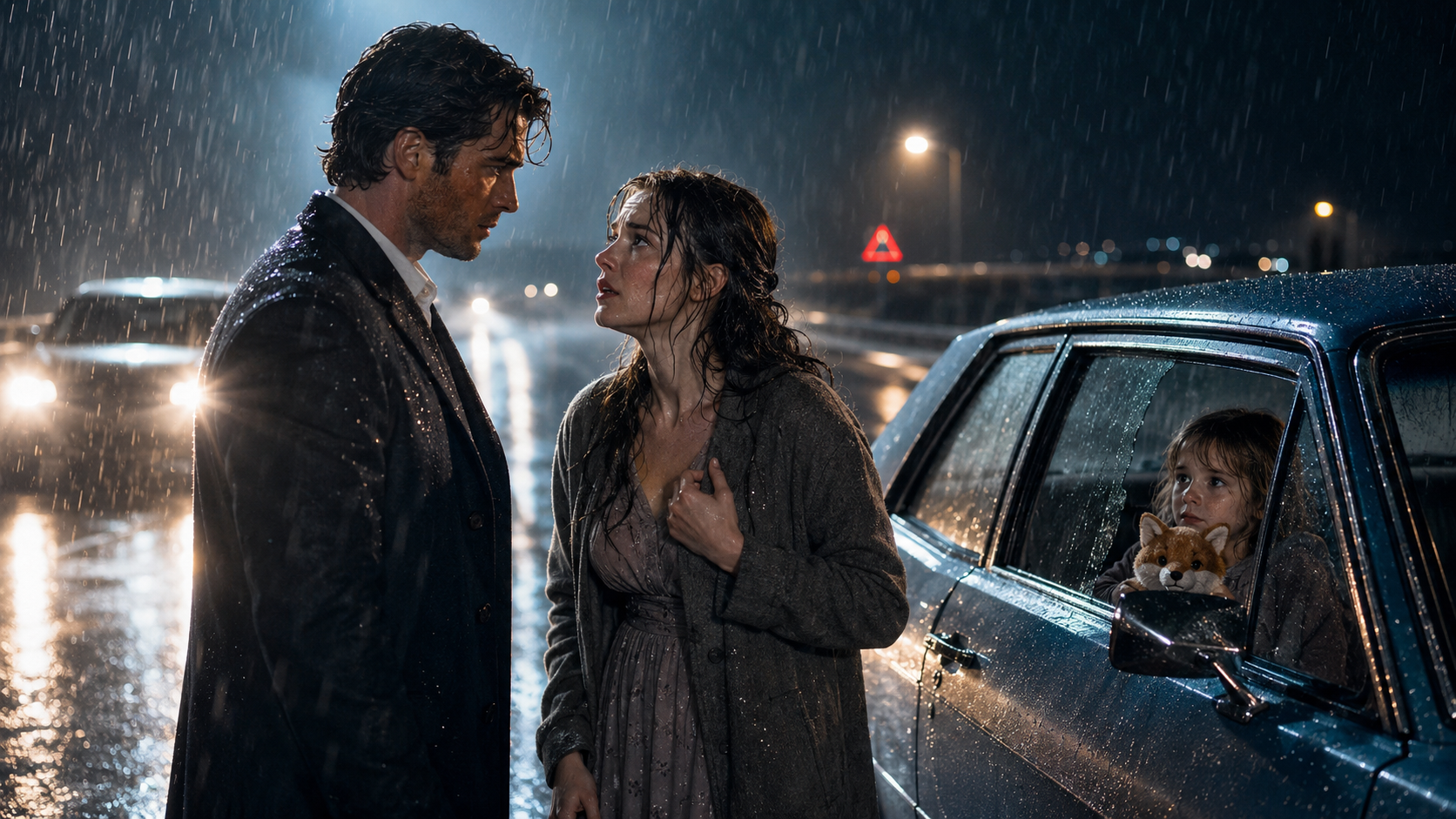
Rain had turned the highway into a silver river.

It came down in hard, slanted sheets, beating against the windshield of Julian Cross’s black car so violently that even the wipers seemed to struggle. Beyond the glass, the road curved along the cliffs, disappearing into fog and darkness. On most nights, Julian would have been in the back seat, answering calls, reading contracts, or ignoring another invitation to another charity dinner where people smiled as if money could make loneliness respectable.

But tonight he was driving himself.

He had dismissed his driver after a long meeting in the city, telling everyone he needed the quiet. That was what Julian called it now—quiet. In truth, it was emptiness. The kind that followed him from penthouses to boardrooms, from private jets to hotel suites, always waiting after the applause faded.

His phone buzzed again in the cup holder.

He ignored it.

Then his headlights caught something ahead.

A small blue car sat crooked on the shoulder, hazard lights blinking weakly through the rain. The hood was raised. A woman stood beside it with one hand shielding her face, the other holding the door open as she leaned inside to speak to someone. A child, Julian realized. A little girl in the back seat.

He slowed.

For a second, the old habits of his world whispered at him. Call roadside service. Keep moving. Let professionals handle it. Men like Julian Cross did not stop on lonely roads in storms. They sent help. They delegated trouble. They avoided mess.

But the woman turned slightly, and the beam of his headlights touched her face.

Julian’s foot hit the brake.

The car stopped so suddenly that his seat belt locked against his chest.

It couldn’t be.

The rain blurred her features, years had changed the shape of her life, and exhaustion had drawn shadows beneath her eyes, but Julian knew her before his mind allowed the truth to arrive.

Mara Bennett.

The girl from the old summer pier. The girl with wind in her hair and paint on her fingers. The girl who had once told him that ambition was only beautiful if it didn’t make a man forget how to be kind. The girl he had loved before money had built walls around him.

The woman he had spent twelve years pretending not to search for in every crowded room.

Julian opened his door and stepped into the storm.

The rain soaked through his coat in seconds. Mara looked up sharply, fear flashing across her face before recognition slowly replaced it.

For a moment, neither of them spoke.

Only the rain did.

“Julian?” she whispered.

Her voice struck him harder than thunder.

“Mara,” he said.

The little girl in the back seat pressed her face against the window, her eyes wide and curious. She had dark curls plastered to her forehead and clutched a small stuffed fox against her chest.

Mara quickly straightened, as if remembering the life she was standing in.

“You should go,” she said.

Julian almost laughed, but nothing about this felt light enough for laughter.

“Your car is dead.”

“I know that.”

“You’re standing on the side of a cliff road in a storm with a child.”

“I know that too.”

“Then I’m not going anywhere.”

Mara looked away, jaw tight. She was thinner than he remembered, not fragile, but sharpened by life. Her raincoat was old, one sleeve torn near the cuff. Her shoes were soaked. There was a bruise of tiredness around her eyes that made something ancient and protective wake in him.

He stepped closer. “What happened?”

“The engine overheated. Then everything shut down. My phone has three percent battery, and the tow company said two hours.”

“In this weather?”

“That was their optimistic estimate.”

The child opened the door a crack. “Mommy, is he a robber?”

Mara turned quickly. “No, sweetheart. Stay inside.”

Julian crouched slightly so the little girl could see him without feeling cornered.

“I’m not a robber,” he said gently. “My name is Julian.”

The girl studied him with the grave suspicion only children possess. “Why are you wearing a fancy coat in the rain?”

“Because I made a poor decision.”

Her eyes narrowed. “Do you make those a lot?”

Behind the worry in Mara’s face, the smallest smile appeared and disappeared.

Julian felt it like sunlight.

“More than people think,” he answered.

The girl seemed to consider this. “I’m Poppy.”

“Hello, Poppy.”

“This is Captain Fox.”

Julian nodded solemnly toward the stuffed animal. “Captain.”

Poppy held the fox tighter. “He doesn’t trust people fast.”

“Smart fox.”

Mara shut the rear door again and turned to Julian. “I can handle this.”

“I know you can.”

“Then why are you still standing here?”

“Because handling something alone and needing to handle it alone aren’t the same thing.”

Her expression changed. Not softened exactly. More like something inside her flinched because it had been touched too carefully.

Julian took out his phone. Within a minute, he had arranged a tow truck, a mechanic, and a car service to meet them at the nearest town. He spoke quickly, calmly, with the efficiency of a man accustomed to having his instructions obeyed.

Mara watched him with folded arms.

When he ended the call, she said, “You still do that.”

“Do what?”

“Make the world move out of your way.”

Julian looked at her. “It doesn’t always.”

The words hung between them, heavier than the rain.

Mara looked back toward her daughter. “We can wait in the car.”

“No. It’s freezing, and the road isn’t safe. Let me drive you home.”

“No.”

“Mara—”

“No, Julian.”

He stopped. The tone was familiar. Once, long ago, that voice had stopped him from racing his motorcycle too fast down the coast, from signing away his first invention to a greedy investor, from becoming cruel when ambition scared him.

He lowered his voice. “All right. Not home. Then at least to the diner in Bellwick. It’s ten minutes away. Warm lights, coffee, people around. You can wait there for the tow.”

She wanted to refuse. He could see it in the way her shoulders pulled back, pride gathering like armor. But then Poppy coughed from inside the car, a small tired sound that cut through everything.

Mara closed her eyes.

“Fine,” she said. “To the diner. That’s all.”

Julian opened the back door of his car and turned the heat up high. Mara buckled Poppy in, murmuring reassurances while the little girl asked whether rich people’s cars had secret buttons, snack drawers, or beds inside them.

Julian answered each question as seriously as she asked it.

“No secret buttons.”

“That sounds fake.”

“One snack drawer.”

Poppy gasped. “Mommy, he’s rich rich.”

Mara gave Julian a warning look.

He pressed his lips together to hide a smile.

When Mara finally slid into the passenger seat, the space inside the car changed. Julian became aware of everything at once—the rain on her hair, the faint scent of vanilla and damp wool, the tremor in her hands as she fastened her seat belt, the fact that twelve years had passed and his heart still remembered her before reason could interfere.

He drove carefully.

For several minutes, the only sounds were the storm, the heater, and Poppy whispering to Captain Fox about the suspicious snack drawer.

Then Mara said, “You shouldn’t have stopped.”

Julian kept his eyes on the road. “I’ve spent half my life regretting the times I didn’t.”

She turned toward the window.

“You look different,” he said.

“That’s what happens when people get older.”

“No. That’s not what I mean.”

“Then don’t say what you mean.”

He accepted that. For now.

Bellwick appeared through the rain like a town drawn in charcoal: a gas station, a closed pharmacy, a diner with yellow windows glowing against the dark. Julian parked near the entrance, but Mara didn’t move immediately.

Poppy had fallen asleep, cheek pressed against Captain Fox.

Julian looked at the child in the mirror. “She’s beautiful.”

Mara’s voice softened despite herself. “She is.”

“How old?”

“Six.”

He nodded slowly.

There was a question he did not ask. There was math he did not do aloud. There was an old dream he refused to drag into the present without permission.

Mara understood anyway.

“She isn’t yours,” she said.

Julian’s hands tightened once on the steering wheel before he released them.

“I wasn’t going to ask.”

“Yes, you were.”

He looked at her then. “I wanted to. That’s not the same thing.”

Her eyes shone briefly, then hardened. “Her father left before she learned how to spell his name. He remembers her on holidays when guilt or boredom reminds him.”

Julian felt anger rise, clean and dangerous. “Does he help you?”

Mara laughed once, without humor. “He helps himself to excuses.”

They sat in silence.

The diner door opened, releasing a bell chime and a ribbon of warm air. Julian should have taken them inside. He should have kept this practical. Safe. Simple.

But nothing about Mara had ever been simple for him.

“Why did you disappear?” he asked.

Her face changed.

“Not tonight,” she said.

“Mara.”

“No.”

“I wrote to you.”

“I know.”

“I came back.”

“I know.”

“I waited at the pier every night for a week.”

She squeezed her eyes shut, and when she opened them, the pain there stunned him.

“I know, Julian.”

He stared at her, the rain distorting the world beyond the windshield.

“Then why?”

Poppy shifted in her sleep, and Mara looked back at her daughter as if the child were the only thing keeping her from breaking apart.

“Because your father came to see me,” she said.

Julian went still.

“My father?”

“He told me you had a future that would die if I stayed in it. He said you had investors, meetings, a company people were finally taking seriously. He said I was a small-town distraction with paint under my nails and no family name worth mentioning.”

Julian’s voice dropped. “He had no right.”

“No. But he had power, and I was nineteen, and my mother was sick, and the rent was late, and he knew exactly where to press until I believed loving you meant letting you go.”

Julian could barely breathe.

“He told me you would hate me one day,” Mara continued, her voice thin now, almost swallowed by the rain. “He said one day you would look at me and see every door I closed for you. I thought leaving was the only gift I could give.”

“It was not a gift.”

A tear slipped down her cheek, and she wiped it away quickly, angry with herself.

“I know that now.”

Julian looked out at the diner lights. His father had been dead for four years, buried with a name polished clean by newspapers that loved powerful men more than honest stories. Julian had made peace with many things. His father’s coldness. His contempt. His ability to treat affection like a weakness to be corrected.

But this.

This was new.

“He told me you stopped loving me,” Julian said quietly.

Mara turned.

Julian swallowed hard. “He said he had seen you with someone else. He said you laughed when he mentioned my name. I didn’t believe him at first. Then your letters stopped.”

“My letters never stopped,” she whispered.

The truth moved through the car like lightning.

Poppy woke with a small sound. “Mommy?”

Mara turned immediately. “I’m here, baby.”

“I’m hungry.”

Julian wiped his face with one hand, though he could not tell whether it was rain or something else.

“Then let’s get you pancakes,” he said.

Poppy blinked. “At night?”

Julian opened the door. “Especially at night.”

Inside the diner, Poppy ordered pancakes with whipped cream, Mara ordered coffee she barely touched, and Julian sat across from the life he might have had if two young people had been braver, richer, older, or simply less alone.

The waitress recognized him after fifteen minutes.

Her eyes widened, then darted to Mara, then to Poppy. Julian saw the question forming. He had lived long enough in public to know how quickly strangers turned human moments into stories they could sell, share, twist, or devour.

He paid in cash and kept his head down.

Mara noticed.

“Still famous?” she asked.

“Annoyingly.”

“That must be terrible for your ego.”

“My ego survives hardship.”

For the first time that night, she laughed.

It was small and tired, but real.

Poppy looked between them. “Do you two know each other from old times?”

Mara hesitated.

Julian said, “Yes.”

“Were you friends?”

“Yes.”

“Best friends?”

Mara’s eyes dropped to her coffee.

Julian answered softly. “Something like that.”

Poppy considered this. “Did you fight?”

Mara let out a breath. “A little.”

“Say sorry.”

Julian looked at Mara. “I’m sorry.”

Her face tightened. “For what?”

“For believing he could know your heart better than I did. For becoming exactly the kind of man who was easier to reach through an assistant than through honesty. For letting pride dress itself up as pain.”

Mara stared at him.

Poppy nodded approvingly and stabbed a pancake with her fork. “Good sorry.”

Mara gave a broken laugh, but her eyes were wet again.

“I’m sorry too,” she said. “For deciding your future without asking you what kind of future you wanted.”

Julian’s chest ached.

After the tow truck came and the mechanic confirmed what Mara already seemed to fear—that her car would cost more to repair than it was worth—Julian drove them home. Home was a narrow apartment above a closed flower shop, with peeling stairs, one stubborn porch plant, and a window where paper stars had been taped from the inside.

Mara carried Poppy upstairs, refusing Julian’s help until the child’s sleepy head slipped against her shoulder and nearly woke. Then she allowed him to carry the backpack and Captain Fox.

Inside, the apartment was small but clean. There were children’s drawings on the fridge, folded laundry on a chair, library books stacked by the sofa, and a chipped blue mug full of paintbrushes near the sink.

Julian stood in the doorway, taking in the quiet evidence of survival.

Mara saw him looking.

“Don’t,” she said.

“Don’t what?”

“Don’t feel sorry for me.”

“I don’t.”

“You do.”

“No,” he said. “I feel angry that life demanded this much from you and impressed that you gave more.”

Her mouth trembled before she turned away.

He placed Captain Fox beside Poppy after Mara tucked her into bed. The child stirred and whispered, “Don’t let the rain come in.”

Julian adjusted the blanket. “I won’t.”

Mara watched from the doorway, and something in her expression made him stand carefully, as if sudden movement might scare away whatever fragile trust had entered the room.

In the kitchen, she offered him tea.

It was cheap tea in a cracked mug, and Julian accepted it like it mattered. Because it did.

“You can’t fix this,” she said.

He leaned against the counter. “I know.”

“Do you?”

“Yes.”

“I don’t need a rescue.”

“I know that too.”

“Men always say that right before they try to buy the ending they want.”

Julian looked at her for a long moment. “Then I won’t buy anything.”

She raised an eyebrow.

“I can call the mechanic tomorrow and ask for a fair estimate. I can help you find programs for emergency transportation. I can give you names, not money. Choices, not pressure.”

Mara looked skeptical.

“And after that?”

“After that, you decide whether I’m allowed to call you.”

She folded her arms. “You’re very careful now.”

“I learned late.”

“From who?”

He looked toward Poppy’s room. “From losing what mattered.”

Mara looked away.

He left after midnight.

He did not kiss her. He did not ask for forgiveness she was not ready to give. He did not promise that money could repair what fear had broken.

But before he stepped into the stairwell, Mara said his name.

Julian turned.

She stood in the doorway, tired, damp-haired, uncertain, and more beautiful than every polished woman who had ever stood beside him for a photograph.

“You can call,” she said.

He nodded once.

Outside, the rain had softened.

Over the next three weeks, Julian entered Mara’s life the way a careful man enters a room where someone is sleeping: slowly, quietly, with respect for what might wake.

He called before visiting. He asked before helping. He listened when she said no and remembered what she said yes to. He connected her with a community transportation grant, then stepped back so the process did not feel like charity. He found a mechanic who spoke to Mara directly instead of through him. He brought groceries once and was firmly told never to do that again unless invited.

So the next time, he brought a single loaf of cinnamon bread from the bakery Poppy liked.

“That’s still groceries,” Mara said.

“It’s diplomacy.”

Poppy accepted the bread on behalf of the household.

Julian learned the rhythms of their small apartment. Tuesdays were laundry nights. Fridays were library days. Poppy hated carrots unless they were in soup. Mara painted after midnight when the world finally stopped needing her. She worked mornings at a clinic reception desk and evenings restoring old furniture in a workshop behind the flower shop.

One Saturday, Julian found her sanding a broken rocking chair, hair tied up, hands dusty, music playing softly from an old radio.

“You still paint furniture,” he said.

“I still make ugly things feel wanted.”

The sentence hit him harder than she intended.

She noticed. “That wasn’t about you.”

“I know.”

But maybe it was. Maybe everything was, if he listened too closely.

Poppy adored him with alarming speed. She asked him to attend her school’s “family breakfast,” then became furious when Mara explained that Julian might be busy.

“I’m not busy,” he said immediately.

Mara gave him a look. “You run a global company.”

“It can survive toast.”

So he attended, sitting in a school cafeteria at eight in the morning while Poppy introduced him as “Mommy’s old almost-best-friend.” Children asked if he owned a castle. One boy asked if billionaires had to brush their teeth. Julian answered every question, then spent ten minutes trying to open a stubborn orange juice carton while Poppy shouted encouragement.

Mara laughed so hard she had to cover her mouth.

Julian would have lost ten companies to hear that sound again.

But happiness, Mara had learned, always made noise before danger arrived.

His name was Colin Voss, and he returned on a bright afternoon as if storms were only for better men.

Mara saw him from the workshop window first. He was leaning against a silver motorcycle, sunglasses on, smile ready. The kind of smile that made apologies sound rehearsed before they were spoken.

Her hands went cold.

Poppy was inside doing homework at the kitchen table.

Julian was in New York, or London, or some other city where buildings touched clouds and problems wore suits.

Mara stepped outside and shut the door behind her.

“What are you doing here?” she asked.

Colin removed his sunglasses. “That’s no way to greet your daughter’s father.”

“You lost the right to call yourself that when you stopped showing up.”

He winced dramatically. “I was young.”

“You were thirty.”

“I was confused.”

“You were selfish.”

His smile thinned. “Still sharp, Mara.”

“Leave.”

“I heard things.” His gaze moved over the building, the workshop, the upstairs windows. “Heard you found yourself a rich man.”

Mara’s stomach turned. “This has nothing to do with Julian.”

“Sure it does. Suddenly you’re doing better. Suddenly my little girl is having breakfast with a billionaire.”

“She is not your little girl when it suits your ego.”

Colin stepped closer. “Careful.”

Mara did not move. “No. You be careful. Poppy is not a door back into my life. She is not a bargaining chip. She is not proof that you can still own a piece of me.”

His expression hardened.

“I have rights,” he said.

“You also have six years of absence.”

“I can explain that.”

“To a judge?”

“If I have to.”

Mara felt fear, but beneath it was something stronger. Exhaustion had once made her quiet. Motherhood had made her fierce.

“Then do it,” she said. “But don’t come here again without notice.”

Colin smiled again, and this time there was nothing charming in it.

“Let’s see what your billionaire thinks when this gets messy.”

It got messy quickly.

Colin filed for partial custody two weeks later. His statement was a polished collection of lies: Mara had kept Poppy from him, Mara had unstable relationships, Mara was exposing their daughter to public attention through Julian. He suggested that Julian’s presence was inappropriate, that money had changed Mara’s judgment, that Poppy needed “balance.”

Mara read the papers at the kitchen table while Poppy slept in the next room.

Julian sat across from her, silent.

Finally, she pushed the papers away. “Say something.”

“He won’t win.”

“You don’t know that.”

“No,” Julian said. “But I know what cowards sound like when they discover legal stationery.”

She almost smiled.

Almost.

Julian helped exactly as he had promised: by finding options, not taking control. A family attorney named Serena Vale agreed to meet Mara through a legal aid network Julian supported but did not direct. Serena was calm, practical, and unimpressed by powerful men on either side.

“Your story matters,” Serena told Mara. “But documents matter too. Messages. Missed birthdays. Bank records. School forms. Medical contacts. Everything.”

So Mara gathered the proof of every absence.

Every unanswered message. Every birthday Colin missed. Every doctor’s form with only her name listed. Every school event where Poppy had scanned the door and stopped scanning because disappointment had become familiar.

It hurt to organize abandonment into folders.

But Mara did it.

Julian stayed near without crowding her. He took Poppy to the library when Mara met Serena. He learned how to make the soup Poppy liked. He sat on the floor and let Captain Fox judge his block towers. He answered business calls from the stairwell and came back smelling faintly of rain and expensive cologne, looking at home in a place too small for his life and somehow exactly sized for his heart.

Then the photograph appeared.

Someone took it outside Poppy’s school: Julian holding Poppy’s backpack while Mara bent to tie her daughter’s shoe. By evening, it was everywhere.

BILLIONAIRE JULIAN CROSS SPOTTED PLAYING FAMILY WITH SMALL-TOWN SINGLE MOTHER.

Mara saw the headline during her lunch break.

Her hands shook so badly she dropped her phone.

By the next morning, strangers had found her workplace. A woman at the clinic whispered loudly that some people were very lucky. A man outside the workshop asked whether she had “planned the whole thing.” Poppy came home confused because another child had asked if her mom was famous for being poor.

That night, Mara told Julian not to come over.

He came anyway—but only to stand outside under the awning when she refused to let him in.

“I’m sorry,” he said through the half-open door.

“This is your world.”

“I know.”

“I can’t breathe in it.”

“I know.”

“No, you don’t.” Her voice broke. “You can fly above it. You can hire people to manage it. You can disappear behind gates and lawyers and assistants. I have to walk Poppy into school while people decide what kind of woman I am from a photograph.”

Julian looked as if she had struck him.

“I’ll release a statement.”

“No statements.”

“I can sue.”

“No lawsuits.”

“Then tell me what to do.”

Mara gripped the doorframe. “Nothing. That’s what scares you, isn’t it? That there are things your money can’t command into silence.”

He swallowed.

“Yes,” he said.

The honesty undid her more than an argument would have.

“I don’t know how to be with you,” she whispered.

Julian nodded slowly. “Then I’ll give you space.”

“I didn’t ask for that.”

“You didn’t have to.”

He stepped back into the rain.

For eight days, he did not visit. He called only once each evening to ask whether Poppy was all right and whether Serena needed anything. He never asked if Mara missed him.

She did.

She missed him in small, humiliating ways. The extra mug on the counter. Poppy’s disappointed glance toward the door. The silence after bedtime, when loneliness stretched its legs and sat beside her.

On the ninth day, Poppy asked, “Did Julian go away because of me?”

Mara dropped the towel she had been folding.

“No, baby. Never because of you.”

“Daddy went away.”

“I know.”

“People say they won’t, but they do.”

Mara sat beside her daughter and pulled her close, feeling the full cruelty of promises adults made and children had to survive.

“Julian is trying not to hurt us,” she said.

Poppy frowned. “Not coming hurts.”

That night, Mara called him.

He answered on the first ring.

“Is Poppy okay?”

“Yes.”

“Are you okay?”

Mara closed her eyes. “No.”

His silence was immediate and complete.

“I don’t need you to fix it,” she said. “I just need you to come tomorrow. If you still want to.”

His voice was rough. “I never stopped wanting to.”

The custody hearing took place on a Thursday morning under a sky too blue for such an ugly thing.

Colin arrived in a navy suit, looking like a man auditioning for fatherhood. He brought a lawyer, a folder, and a face full of practiced regret.

Mara brought Serena, documents, and the truth.

Julian came too, but he sat in the back, not beside her, because this was not his battle to own.

Colin spoke beautifully. He said he had made mistakes. He said he wanted to reconnect. He said Mara’s new relationship had created an unstable environment. He said a child needed her father.

Then Serena asked him Poppy’s teacher’s name.

He didn’t know.

Her doctor?

He guessed wrong.

Her allergies?

He looked at his lawyer.

The room shifted.

Mara spoke last. Her voice shook at first, then strengthened.

“I have never kept my daughter from love,” she said. “I have only protected her from being treated like an option. If Colin wants to earn trust, he can start slowly, safely, and consistently. But I will not let him walk in and out of her life whenever pride or jealousy makes him remember she exists.”

The judge ordered supervised visitation, gradual review, and no unscheduled contact.

Colin was furious.

Mara cried in the courthouse bathroom afterward, not because she had lost, but because she had been believed.

When she came out, Julian was waiting near the vending machines with two paper cups of terrible coffee.

“I didn’t know what else to do,” he said.

She took one.

“It’s awful,” she said after one sip.

“I know.”

She laughed through tears.

Julian’s eyes softened. “May I hug you?”

That question broke something open.

Mara stepped into his arms.

He held her carefully at first, then tighter when she did not pull away. For a moment, the courthouse, the storm, the lost years, the headlines, the fear—all of it faded into the simple fact of being held by someone who had learned how to ask before reaching.

Months passed.

Not perfectly. Nothing real ever does.

Colin attended supervised visits, missed two, arrived late to three, and slowly revealed the difference between wanting access and wanting responsibility. Poppy learned to enjoy him cautiously and expect little. Mara learned that protecting her daughter did not mean protecting her from every disappointment, only making sure disappointment never had the final word.

Julian learned ordinary love.

He learned that showing up mattered more than grand declarations. He learned the school pickup line. He learned which grocery store had the peaches Poppy liked. He learned that Mara became quiet when overwhelmed and that she needed patience, not pursuit. He learned that love after damage was not a rescue mission. It was a house built one trustworthy day at a time.

One evening in late autumn, the town held a lantern festival by the harbor.

Mara had restored a set of old wooden booths for the event, painting them in deep blues and warm golds. Poppy wore a yellow coat and carried a paper lantern shaped like a moon. Julian arrived late from a meeting, tie loosened, hair windblown, apology already in his eyes.

Poppy ran to him.

“You came!”

He caught her carefully. “I said I would.”

She nodded, as if this fact still amazed her.

Mara watched them from near the pier.

Julian set Poppy down, then walked to Mara.

“You painted the whole harbor,” he said.

“Only the parts that were falling apart.”

“That’s your specialty.”

She smiled. “Apparently.”

They stood side by side as lanterns rose into the darkening sky, each one carrying a small flame against the wind.

Julian reached into his coat pocket.

Mara saw the movement and stiffened.

He noticed immediately and stopped.

“It’s not a ring,” he said.

She let out a startled laugh. “That obvious?”

“I’m learning.”

He took out a small envelope instead.

“What is it?” she asked.

“The deed transfer for the old flower shop.”

Her smile vanished.

“Julian.”

“Before you get angry, read the second page.”

She opened it carefully.

The building was not in her name.

It was being transferred into a community arts trust, with Mara listed as founding director if she chose to accept. The upstairs apartment would remain available to her at protected rent. The downstairs would become a workshop and gallery for local artists, single parents, and kids who needed somewhere safe to make something beautiful.

Mara read the papers twice.

“You bought my building?”

“I bought a failing property from a landlord who was planning to sell it to developers,” Julian said. “But I didn’t buy it for you. I bought time. Structure. Protection. You decide what happens next. If you hate it, the trust can be managed by someone else.”

She stared at him.

“No grand gestures?” she asked.

He looked worried. “This may be a medium gesture.”

“It is a massive gesture wearing glasses and pretending to be paperwork.”

“I can take it back.”

“No,” she said quickly.

Then she laughed, covering her mouth as tears filled her eyes.

“No, don’t take it back.”

Julian exhaled.

Mara looked at the lanterns, then at the man beside her. The boy she had loved had wanted to build something big enough to prove he mattered. The man had finally learned to build something that could shelter other people.

“I’m scared,” she said.

“I know.”

“I still don’t trust happiness when it arrives too loudly.”

“Then we’ll keep it quiet.”

She looked at him. “And if I need time?”

“I’ll give you time.”

“And if I get impossible?”

“I’ll ask questions.”

“And if I push you away?”

“I’ll step back. But I won’t disappear unless you ask me to.”

The wind moved between them, carrying salt, rain, and the faint music from the festival.

Mara reached for his hand.

Julian looked down as if her fingers were a miracle he had no right to expect.

Poppy ran back to them, breathless. “Can we send a lantern together?”

Mara looked at Julian.

Together.

The word no longer felt like a trap. It felt like a door.

They lit one lantern between the three of them. Poppy made a wish and refused to tell it because “wishes are shy.” Julian held the frame steady while Mara touched the flame to the wick.

The lantern rose slowly.

Poppy slipped one hand into her mother’s and one into Julian’s.

For years, Mara had believed love was something that asked women to shrink, sacrifice, forgive too quickly, or accept too little. Julian had believed success would someday fill the empty room inside him. They had both been wrong in different ways.

Love, real love, did not arrive like a rescue.

It arrived like a man stopping in the rain and staying after the storm.

It arrived like a woman brave enough to open the door without surrendering the lock.

It arrived like a child looking up at two wounded adults and deciding, with the wild faith of children, that maybe people could learn to come back.

Above them, the lantern joined the others, a small gold light in a sky that had once seemed endless and dark.

Mara leaned her head against Julian’s shoulder.

“You know,” she said softly, “Poppy wished for you not to leave.”

Julian’s throat tightened.

“How do you know?”

“She always makes the same wish.”

He looked down at the little girl, then at Mara.

“Then tell her,” he said, voice low, “some wishes are not too much to ask.”

Poppy looked up. “What?”

Mara smiled through tears. “Julian says your wish is reasonable.”

Poppy considered this, then nodded with great seriousness. “Good.”

Julian laughed, and Mara laughed with him.

The sound drifted across the harbor, warm and alive, mingling with music, wind, and the soft applause of strangers watching lanterns climb into the night.

And for the first time in years, Mara did not feel like life was something she had to survive alone.

She felt it opening.

Not perfectly.

Not easily.

But honestly.

And Julian, who had once believed the world could be conquered if he only became powerful enough, finally understood that the greatest thing he would ever build was not a company, a tower, or a fortune.

It was trust.

One night in the rain had brought him back to the woman he never stopped loving.

But staying—gently, patiently, without demanding the ending—

That was how he became worthy of the life he had never stopped wanting.

Rain had turned the highway into a silver river.
The 96-year-old Italian film star has changed a lot: you won’t believe who she is