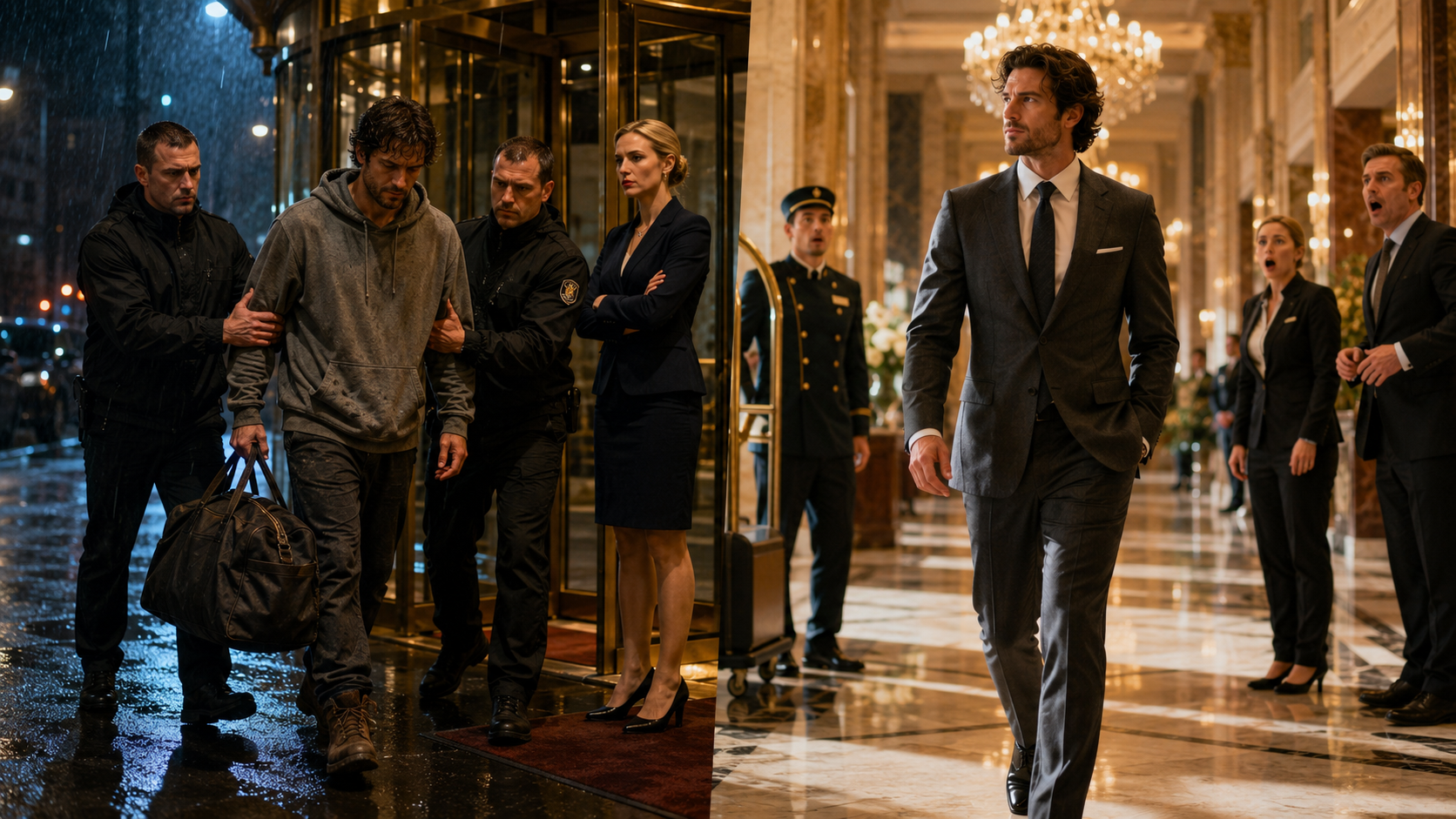
THE MAN THEY THREW OUT OF THE LUXURY HOTEL

The first thing Mara Ellison noticed about the stranger was not his clothes.

Everyone else seemed to notice those immediately.

The faded gray hoodie. The worn leather duffel bag. The scuffed boots that looked as if they had crossed a dozen airports, two train stations, and at least one storm. The plain black cap pulled low over his eyes. In the lobby of the Meridian Crown Hotel, where guests entered beneath chandeliers the size of small moons and where the marble floors were polished so carefully that people appeared richer in their own reflections, the man looked out of place.

But Mara noticed his hands.

They were steady.

Not nervous, not fidgeting, not apologetic. He held the strap of his bag with one hand and rested the other lightly against the reception counter as if he had every right to stand there.

Mara had worked at the Meridian Crown for eleven months, long enough to understand that the hotel had two kinds of rules. There were the official rules, printed in training manuals and recited during onboarding: greet every guest warmly, anticipate needs, preserve dignity, never make assumptions. Then there were the rules people learned by watching managers like Vanessa Pryce move through the lobby with a smile sharp enough to cut velvet: wealth must look like wealth, discomfort must be hidden, and some people were to be welcomed only after they proved they belonged.

The stranger had not proved anything yet.

That made him dangerous.

“Good evening,” Mara said, forcing her professional smile into place. “Welcome to the Meridian Crown. How may I help you?”

The man lifted his head. His face was calm, a little tired, but his eyes were alert.

“I’d like a room,” he said.

His voice was low and even. Not demanding. Not uncertain.

“Of course,” Mara replied. “Do you have a reservation?”

“No.”

“No problem. Let me check our availability.”

Before Mara could touch the keyboard, Vanessa appeared beside her like a shadow in cream silk.

Vanessa Pryce was the front office director, though she carried herself as if she had personally invented hospitality. Her blond hair was pinned into a flawless twist, her diamond earrings were small enough to look tasteful but bright enough to be noticed, and her smile never reached her eyes unless a guest arrived wearing a watch worth more than a junior employee’s annual salary.

“Good evening,” Vanessa said to the stranger. “Is there something we can assist you with?”

Mara looked down at the screen. Vanessa had heard the request. She simply wanted him to repeat it.

“I’d like a room,” the man said.

Vanessa’s eyes moved over him with the speed and precision of a scanner. Hoodie. Duffel. Boots. No visible watch. No driver waiting outside. No companion. No luggage cart.

“I’m afraid we’re fully committed tonight,” Vanessa said.

Mara froze.

They were not fully committed. The hotel had nine rooms available, including two deluxe suites and a city-view king that had just been released ten minutes earlier.

The stranger looked from Vanessa to Mara, then back again.

“Fully committed,” he repeated.

“Yes,” Vanessa said. “We are hosting several private events this week.”

Mara could feel her heart pushing against her ribs. She should say something. She should at least pretend to check. But Vanessa was standing close enough that Mara could smell her perfume, and every employee at the Meridian Crown knew what happened to people who embarrassed Vanessa in front of the lobby.

The man nodded once.

“Then I’ll take dinner,” he said. “Your restaurant is open until eleven.”

Vanessa’s smile thinned.

“The restaurant is for hotel guests and reservation holders.”

“That isn’t what your website says.”

A flicker of annoyance crossed Vanessa’s face. “Our policies are subject to management discretion.”

Mara glanced toward the lounge entrance. Several empty tables sat beneath low golden lamps. A couple in designer sneakers had walked in without a reservation twenty minutes earlier and had been seated with complimentary champagne because the husband claimed to know someone on the board.

The stranger did not raise his voice.

“May I speak with the restaurant manager?” he asked.

“I’m speaking on behalf of the property,” Vanessa said.

“That wasn’t my question.”

The air changed.

Not loudly. Not dramatically. But enough that the bell captain looked over, and one of the security guards near the revolving doors shifted his stance.

Vanessa’s face stayed polished, but her eyes hardened.

“Sir,” she said, placing a soft emphasis on the word as if she were doing him a favor by using it, “this is a private luxury establishment. We maintain standards for the comfort and safety of our guests.”

The stranger studied her for a moment.

“What standard have I violated?”

Mara’s fingers curled beneath the counter.

Vanessa gave a small, almost sympathetic laugh.

“This conversation is no longer productive.”

“I asked for a room. You said there were none. I asked for dinner. You said I needed a reservation. Now I’m asking what rule I broke.”

Vanessa turned slightly toward the guard. That was all it took.

Mara whispered, “Ms. Pryce—”

Vanessa did not look at her. “Mara, please return to your duties.”

The guard approached. His name was Owen. He was broad-shouldered, usually kind to staff, and visibly uncomfortable.

“Sir,” Owen said, “I’m going to have to ask you to leave.”

The stranger turned to him. “Are you asking or ordering?”

Owen swallowed. “Ordering, sir.”

“On whose authority?”

Vanessa stepped forward. “Mine.”

For the first time, something like disappointment appeared in the stranger’s face.

Not anger. Not humiliation.

Disappointment.

As if the hotel had failed a test it did not know it was taking.

“All right,” he said.

He picked up his duffel bag.

Mara expected him to argue. Wealthy guests argued over everything: minibar charges, pillow firmness, whether the rain had been properly announced. But this man simply adjusted the strap on his shoulder and walked toward the doors with the guard beside him.

The lobby watched without watching. A woman near the flower arrangement pretended to study her phone. A man at the bar lowered his newspaper and then raised it again. Two guests waiting for their car whispered, then fell silent when Vanessa looked their way.

At the entrance, the stranger paused and turned back.

His eyes found Mara.

Not accusingly.

That made it worse.

“Thank you for trying,” he said.

Mara’s mouth opened, but no words came out.

The revolving door carried him into the rain.

Vanessa exhaled as if she had just removed a stain from white linen.

“Honestly,” she murmured, smoothing the front of her jacket. “People see a beautiful lobby and think it belongs to them.”

Mara stared at the wet footprints fading on the marble.

“Maybe it should,” she said before she could stop herself.

Vanessa turned.

“What was that?”

Mara felt the blood leave her face. “Nothing.”

“No,” Vanessa said softly. “Say it again.”

Mara looked at the reservation screen. Nine rooms available. Nine empty rooms in a hotel that had just thrown a man into the rain because his hoodie cost less than the flowers on the front desk.

“I said I’ll update the availability notes,” Mara replied.

Vanessa held her gaze for a long second.

“Do that,” she said. “And remember where you work.”

The rest of the evening moved like a performance after the music had gone wrong. Mara checked in a tech investor who complained that his suite was too close to the elevator. She arranged late checkout for a socialite who did not remember her name. She sent extra towels to a honeymoon couple and called maintenance for a bathroom light that kept flickering in room 1904.

But every time the revolving doors turned, Mara looked up.

The stranger did not return.

At midnight, while the lobby finally quieted and the rain dragged silver lines down the windows, Mara found Owen near the service corridor.

“You didn’t want to do it,” she said.

Owen rubbed the back of his neck. “Doesn’t matter.”

“It matters.”

“It matters until rent is due.” He looked toward the lobby, where Vanessa was speaking to a guest in a velvet coat. “I’ve got two kids. You think I’m going to lose my job arguing with her over some guy I don’t know?”

Mara did not answer.

Owen sighed. “He was calm, though. Too calm.”

“What do you mean?”

“Most people get loud when they’re embarrassed. He looked like he was taking notes.”

Mara remembered the stranger’s eyes.

Yes.

That was exactly what he had looked like.

At 7:15 the next morning, Mara arrived for the early shift with a paper cup of coffee, wet hair from a rushed shower, and the heavy feeling that she had left something important undone.

The lobby was different.

Not visibly. The chandeliers still glowed. The orchids still stood in perfect white arrangements. The concierge desk still smelled faintly of lemon polish and expensive perfume. But there was a current running through the staff, an electric unease.

The night auditor, Felix, leaned toward Mara as she clocked in.

“Did you hear?”

“Hear what?”

“Emergency staff meeting. Ballroom. Ten minutes.”

Mara frowned. “For front desk?”

“For everyone.”

“Everyone?”

“Housekeeping, valet, kitchen, spa, security. Everybody.”

That did not happen at the Meridian Crown. Information flowed downward in controlled drops. Staff meetings were scheduled weeks in advance, arranged around guest occupancy, and filled with phrases like brand alignment and elevated service culture. Emergency meetings meant either a scandal, a sale, or a death.

Vanessa arrived at 7:23, wearing navy blue and irritation.

“Why is half my morning team standing around?” she demanded.

Felix pointed toward the ballroom. “All-hands meeting.”

Vanessa’s expression shifted.

Only slightly.

But Mara saw it.

“Who called it?” Vanessa asked.

“Corporate.”

Vanessa checked her phone. Whatever she saw there made her lips press into a thin line.

By 7:30, the ballroom was full.

Housekeepers stood in clusters near the back, still in gray uniforms. Restaurant servers whispered beside banquet staff. Valets leaned against the wall, jackets half-buttoned. Managers gathered near the front with the stiff posture of people pretending not to be afraid.

Mara stood beside Owen.

“You know anything?” she whispered.

“No,” he said. “But I don’t like the way the general manager looks.”

Across the room, Julian Hart, the hotel’s general manager, stood near the stage holding a folder. He was usually smooth, silver-haired, and effortlessly charming. This morning, he looked as if he had been awake since three.

Vanessa pushed through the crowd and took a position near the front, chin high.

At exactly 7:35, Julian stepped onto the stage.

“Thank you for coming on such short notice,” he said into the microphone. “I know this is unusual, and I’ll be brief.”

No one believed him.

“As some of you are aware, the Meridian Crown has been under review for a potential ownership transition.”

A murmur moved through the room.

Mara looked at Felix. He mouthed, Sale?

Julian continued, “That transition was finalized late last night. Effective immediately, the Meridian Crown Hotel is under new ownership.”

Vanessa’s face went pale beneath her makeup.

Julian swallowed. “The new majority owner has requested to address the entire staff personally.”

The ballroom doors opened.

The stranger from the night before walked in.

But he was no longer wearing the gray hoodie.

He wore a dark charcoal suit with a white shirt open at the collar, no tie. His boots were gone, replaced by polished black shoes. His duffel bag was gone, replaced by nothing at all. He carried no briefcase, no folder, no visible symbol of power. He did not need one.

Two people walked beside him: a woman with cropped silver hair and a leather portfolio, and a tall man in a blue suit whom Mara recognized from hospitality trade magazines.

Adrian Vale.

Founder of Vale Northstar Holdings.

Billionaire hotel investor.

The man from the rain stepped onto the stage.

The room stopped breathing.

Julian turned to him with the careful respect of someone approaching fire.

“Please welcome Mr. Elias Rowan,” he said, “incoming chairman and majority owner of the Meridian Crown.”

Mara’s coffee slipped slightly in her hand.

Owen muttered, “Oh, no.”

Vanessa did not move.

Elias Rowan took the microphone.

For several seconds, he said nothing. He simply looked out at the staff, not over them, but at them. As if counting faces. As if remembering.

“Good morning,” he said.

His voice was the same as it had been the night before. Calm. Low. Precise.

“I know this is an uncomfortable surprise for many of you. It is an uncomfortable surprise for me as well.”

No one laughed.

“Yesterday evening, before signing the final documents, I came to this hotel alone. No driver. No assistant. No introduction. I wanted to experience the Meridian Crown the way an ordinary traveler might experience it.”

His eyes moved across the room.

“I asked for a room. I was told there were none.”

Mara felt Vanessa stiffen from across the ballroom.

“There were rooms available,” Elias continued.

The silence sharpened.

“I asked to dine in the restaurant. I was told the restaurant was unavailable to me.”

He paused.

“It was not.”

A server near Mara lowered his eyes.

“Then I asked what rule I had violated. I did not receive an answer. Instead, I was removed from the property by security in front of guests and employees.”

Owen stared at the floor.

Elias looked toward him, but his voice remained steady.

“I understand the difference between the person who gives an order and the person afraid to refuse it.”

Owen’s jaw tightened.

“I also understand that fear can become a system when enough people learn to obey it.”

Mara felt those words land in the room like stones dropped into still water.

Elias took a slow breath.

“My mother cleaned rooms in a roadside motel for eighteen years. She taught me that hospitality is not marble. It is not chandeliers. It is not a lobby designed to make people feel small unless they arrive already shining. Hospitality is the discipline of honoring someone before you know what they can afford.”

No one whispered now.

“Luxury without dignity is decoration. Service without fairness is performance. And a hotel that welcomes only the people who look expensive is not refined. It is afraid.”

Vanessa’s face hardened, but she said nothing.

Elias turned slightly. The silver-haired woman stepped forward and handed Julian several documents.

“Effective today, an independent review will begin into guest discrimination complaints, staff retaliation, management conduct, and hiring practices at this property. Employees will be permitted to speak confidentially. No one will be punished for telling the truth. Anyone attempting to intimidate staff during the review will be removed.”

The ballroom shifted.

A housekeeper began quietly crying. A valet looked at another valet as if a locked door had opened. Felix stared at the stage with his mouth slightly open.

Vanessa finally spoke.

“Mr. Rowan.”

Every head turned.

She walked toward the aisle, heels clicking against the ballroom floor.

“I believe there has been a serious misunderstanding.”

Elias looked at her.

“Ms. Pryce,” he said. “Please come forward.”

The room parted for her.

Vanessa climbed the stage steps with the composure of someone who had survived difficult rooms before. She stood several feet from Elias, shoulders straight, chin lifted.

“Yesterday’s situation was handled according to my understanding of property standards,” she said.

Elias nodded. “Then explain those standards.”

Vanessa blinked. “Excuse me?”

“Explain them.”

She glanced toward Julian, but Julian did not rescue her.

“We are a five-star property,” Vanessa said. “We have obligations to protect our guests’ experience.”

“From what?”

“Disruption.”

“What disruption did I cause?”

“You arrived without a reservation.”

“That happens every day.”

“You were unable to provide—”

“I was not asked to provide anything.”

Vanessa’s mouth tightened.

Elias continued, “No identification. No payment method. No name. No opportunity. You looked at me and made a decision before I completed a sentence.”

“That is not true.”

“It is exactly true.”

The room seemed to shrink around them.

Vanessa lowered her voice. “With respect, Mr. Rowan, you are viewing this emotionally.”

A few employees looked away.

Elias did not.

“No,” he said. “I am viewing it clearly. Emotionally would have been firing you in the lobby last night.”

Vanessa’s face changed.

“Are you firing me now?” she asked.

“I considered it.”

The room went painfully still.

“But public humiliation does not repair public humiliation,” Elias said. “And this hotel has practiced enough of it.”

For the first time, Vanessa looked uncertain.

“You are suspended pending review,” Elias said. “You will leave the property today. You will be allowed to provide your account in writing and in person. If last night was an isolated lapse, the evidence will show that. If it was part of a pattern, that will show too.”

Vanessa’s eyes flashed. “After eight years here, I deserve better than this.”

Elias held her gaze.

“So did I.”

The sentence ended the argument.

Julian nodded toward two HR representatives standing near the stage. They approached without touching Vanessa. No one grabbed her arm. No one raised a voice. No guard marched her out through the lobby for guests to stare at.

She was given the process she had denied someone else.

That made it worse.

As Vanessa descended the steps, Mara expected to feel triumph.

She did not.

She felt the heavy discomfort of justice arriving late.

After Vanessa left, Elias returned to the microphone.

“I am not here to frighten people who need their jobs,” he said. “I am here to change the conditions that made fear normal.”

Mara looked at Owen. His eyes were wet, though he would have denied it.

“Some of you have followed bad instructions because rent was due,” Elias said. “Some of you have stayed silent because your children needed shoes, because medical bills arrived, because good jobs are not easy to find. I know that. But beginning today, silence will no longer be the price of employment here.”

He turned toward Julian.

“Mr. Hart will remain in his position during the review, but with oversight. Department heads will meet individually with the transition team. Staff wages, promotion practices, complaint records, and disciplinary actions will be audited. The Meridian Crown will not be rebuilt through slogans. It will be rebuilt through behavior.”

Then he looked directly at Mara.

Her breath caught.

“Last night,” Elias said, “one employee attempted to treat me like a guest before she knew who I was.”

The staff turned, trying to follow his gaze.

Mara wanted to disappear.

“She was overruled,” he continued. “But the attempt matters.”

He lowered the microphone slightly.

“Ms. Ellison, would you join me for a moment?”

Mara’s entire body went cold.

Owen whispered, “Go.”

“I can’t.”

“You can.”

She walked toward the stage on legs that did not feel like hers.

Every step seemed too loud. She could feel people watching, guessing, judging, hoping. She climbed the steps and stood beside Elias beneath the ballroom lights.

Up close, he looked less like a billionaire and more like the man from the sidewalk. Tired. Observant. Human.

“I didn’t do much,” Mara said quietly.

The microphone caught it.

A faint ripple moved through the room.

Elias turned to her. “You did more than nothing.”

“I should have done more.”

“Yes,” he said.

The honesty struck her harder than praise would have.

Then he added, “So should many people. Including me, in other rooms, at other times.”

Mara looked at him.

Elias faced the staff again.

“I am not rewarding Ms. Ellison for being perfect. I am recognizing that courage often begins before it becomes visible. Yesterday, she hesitated. Today, I am asking her not to.”

He handed the microphone to Julian, then addressed Mara without amplification.

“I need someone on the transition committee from front-line staff. Someone who knows what guests see and what managers hide. Someone who still feels uneasy when something is wrong.”

Mara swallowed.

“I’m just a front desk associate.”

“No,” Elias said. “You are the first person I met here who understood the difference between policy and decency.”

Across the ballroom, Felix began clapping.

It was awkward at first. One pair of hands in a silent room.

Then Owen joined.

Then a housekeeper.

Then two servers.

Then almost everyone.

Mara stood frozen as the applause rose around her. It did not feel glamorous. It felt frightening. Responsibility always did when it was real.

Later that morning, the lobby of the Meridian Crown looked the same to arriving guests. The chandeliers still burned gold. The marble still shone. The orchids still stood like white flames in glass vases.

But behind the desk, everything had changed.

Vanessa’s nameplate was gone.

A temporary notice had been placed in the staff corridor inviting employees to confidential meetings with the independent review team.

Owen apologized to Elias in the service hallway.

Mara happened to see it.

“I should’ve refused,” Owen said.

Elias looked at him. “Yes.”

Owen nodded, accepting the weight of it.

“But you were not the first person in that chain,” Elias added. “Make sure you are the last next time.”

“I will.”

“I believe you.”

Those three words seemed to steady Owen more than forgiveness would have.

By noon, rumors had spread through the building. Some said Vanessa had been fired. Others said Julian would be next. Someone claimed Elias Rowan had secretly visited three other hotels in disguise. Someone else insisted he had once slept in a bus station before making his first million. No one knew what was true, but everyone suddenly had a story.

At 2:00 p.m., Mara was at the front desk when an elderly man entered with a plastic grocery bag and a raincoat that had seen better decades.

The lobby reacted almost invisibly.

A concierge glanced over. A guest in pearls looked annoyed. Felix straightened.

Mara stepped forward.

“Good afternoon,” she said warmly. “Welcome to the Meridian Crown. How may I help you?”

The man removed his cap with both hands.

“My daughter booked me a room,” he said. “I’m not sure I’m in the right place.”

Mara smiled.

“What’s the name on the reservation?”

“Thomas Avery.”

Mara checked the system.

“Yes, Mr. Avery. You are absolutely in the right place.”

The man looked relieved and embarrassed at the same time.

“I’ve never stayed anywhere like this.”

Mara thought of Elias standing in the rain.

Then she thought of Vanessa saying, remember where you work.

“I’m glad you’re here,” Mara said. “Let’s get you checked in.”

Across the lobby, Elias Rowan had just entered with Adrian Vale and the silver-haired attorney. He stopped when he saw Mara speaking to Mr. Avery.

He did not interrupt.

He did not make a speech.

He simply watched as Mara came around the desk, took the grocery bag before the elderly man could struggle with it, and walked him toward the elevator herself.

When she returned, Elias was waiting near the orchids.

“That was well done,” he said.

Mara shook her head. “That was my job.”

“Yes,” Elias said. “It was.”

For some reason, that felt like the highest compliment.

In the weeks that followed, the Meridian Crown became uncomfortable in ways luxury hotels usually avoided.

Employees talked.

At first, quietly. Then in full sentences. Then in meetings where people used names, dates, and examples. Housekeepers described being ignored by managers until guests complained. Valets described being told to watch certain people more carefully than others. Servers admitted that appearance had influenced seating, service speed, and even whether guests were told tables were available.

The review team listened.

Some employees were angry. Some were ashamed. Some insisted the old ways had protected the hotel’s reputation. Others asked what kind of reputation required people to swallow their dignity before entering the lobby.

Julian Hart resigned after the third week.

His resignation email spoke of pursuing new opportunities. No one believed it.

Vanessa Pryce submitted a statement claiming she had always acted in the hotel’s best interest. The review found otherwise. Her suspension became termination. The report did not destroy her publicly, but it did something she feared more: it recorded the truth plainly.

Mara was promoted to guest experience liaison, a title she found too long and a little ridiculous. Elias told her she could help rename it later.

Owen remained in security, but his team received new training and a new policy: no guest could be removed for appearance, clothing, accent, age, or assumption of wealth. Any removal required documented behavior, a manager’s written explanation, and review.

The first time Owen refused an unfair instruction from a visiting executive, he looked terrified.

Then the world did not end.

That helped.

The Meridian Crown did not transform overnight into a perfect place. No place does. Some wealthy guests complained that the atmosphere had changed. One wrote an angry review saying the hotel had become “less exclusive.” Elias printed it, framed it, and hung it in the employee hallway with a handwritten note beneath it:

Good.

Three months after the night in the rain, Mara worked the evening shift during a thunderstorm. The lobby was full of stranded travelers whose flights had been canceled, conference guests trying to rebook rooms, and families shaking water from umbrellas.

It was chaos.

It was also alive.

A young couple in soaked jackets shared a sofa with a retired judge. A delivery driver waited near the coffee station while staff found a room for his pregnant wife. A famous actress in sunglasses stood patiently behind a schoolteacher at the front desk because Mara had made it very clear that lines applied to everyone.

At 9:40 p.m., Elias walked in wearing a dark coat beaded with rain.

Mara looked up and smiled.

“No hoodie tonight?” she asked.

He smiled back. “I thought I’d give everyone a quiet evening.”

“Impossible. We’re oversold, half the city is flooded, and someone’s emotional support ferret is missing on the eleventh floor.”

Elias blinked. “Ferret?”

“Don’t ask.”

“I own this hotel.”

“Still don’t ask.”

He laughed, and for the first time since she had met him, Mara heard no weight behind it.

Then the revolving doors turned again.

A man entered carrying a torn backpack, his hair wet, his face anxious. He looked around at the chandeliers, the marble, the guests, and immediately stepped backward as if he had made a mistake.

Mara saw it.

So did Elias.

The man approached the desk slowly.

“I’m sorry,” he said. “I think I’m in the wrong building. The shelter line sent me here because of the storm. They said some hotels were taking emergency vouchers, but this place—”

“You’re in the right place,” Mara said.

The man stared at her. “I am?”

“Yes.”

Behind him, a guest in a tailored suit frowned. “Excuse me, I’ve been waiting to ask about my car.”

Mara turned to him. “I’ll be with you in a moment, sir.”

The suited guest looked offended.

Elias stepped beside him.

“Actually,” Elias said, “I can help you with that.”

The guest looked him over, not recognizing him. “Do you work here?”

Elias glanced at Mara.

Mara tried not to smile.

“Yes,” Elias said. “I do.”

The man with the backpack was given a room. The guest with the car was given an umbrella and a reminder that patience was still complimentary. The missing ferret was found in a housekeeping cart on the twelfth floor, asleep inside a stack of towels.

Near midnight, when the lobby finally quieted, Mara found Elias standing by the window, watching rain blur the city lights.

“Do you ever regret buying this place?” she asked.

He considered the question.

“I regret what it was,” he said. “Not what it can become.”

“That sounds expensive.”

“It is.”

“Worth it?”

Elias looked across the lobby.

At Owen helping an elderly guest with her bags.

At Felix laughing with the night auditor.

At a family asleep on velvet sofas because every airport hotel had filled before midnight.

At the front doors, where no one was being measured before being welcomed.

“Yes,” he said. “Worth it.”

Mara stood beside him for a while.

The Meridian Crown still glittered. It still charged too much for breakfast. It still had chandeliers and marble and suites with bathtubs large enough to seem unreasonable.

But it no longer felt untouchable.

That was the strange thing about opening a door properly.

The whole building changed.

And sometimes, the man thrown out in the rain did not return to take revenge.

Sometimes he returned with the keys.

THE MAN THEY THREW OUT OF THE LUXURY HOTEL
The star from the ‘70s that nobody recognises. Who’s the old man?